
- Market Value (2025): USD 202.4 Mn
- Estimated Value (2026): USD 220.0 Mn
- Forecast Value (2036): USD USD 506.7 Mn
- CAGR (2026-2036): 8.7%
Clean-Label Texture Modifiers Market Forecast and Outlook 2026 to 2036
The clean-label texture modifiers market is projected to grow from USD 220.0 million in 2026 to USD 506.7 million by 2036. Demand for clean-label texture modifiers is likely to grow at a CAGR of 8.7% over the forecast period.
Demand for clean-label texture modifiers is rising as food companies remove modified starches, synthetic emulsifiers and gums with unfamiliar names, yet still need fillings that hold shape, sauces that stay smooth and desserts that set. Suppliers of clean-label texture modifiers are offering citrus and other plant fibers, enzyme-derived texturizers, functional proteins, familiar hydrocolloids and physically treated starches, often as combined systems.
In November 2026, Novonesis reported 7% organic sales growth for the first nine months of 2026, while its Food & Health Biosolutions business recorded 9% growth. Demand for clean-label texture modifiers is growing as enzymes and other biological tools let producers create texture in the product itself. Suppliers of clean-label texture modifiers are combining enzymes with fibers and starches.
Key Takeaways from the Clean-Label Texture Modifiers Market
- Sales of clean-label texture modifiers stood at USD 202.4 million in 2025
- Clean-Label Texture Modifiers Market Value (2026): USD 220.0 million
- Clean-Label Texture Modifiers Market Forecast Value (2036): USD 506.7 million
- Clean-Label Texture Modifiers Market Forecast CAGR (2026-2036): 8.7%
- Leading Product Type: Fiber-based texture systems (29.3%)
- Key Market Participants: Ingredion, Cargill, Tate & Lyle, Roquette, IFF, Kerry Group
- Key Growth Countries: Netherlands, United States, France, Germany, United Kingdom
Clean-Label Texture Modifiers Market
| Metric | Value |
|---|---|
| Estimated Value in (2026) | USD 220.0 million |
| Forecast Value in (2036) | USD 506.7 million |
| Forecast CAGR (2026 to 2036) | 8.7% |
Source: Fact.MR analysis. Updated Nov 25, 2026
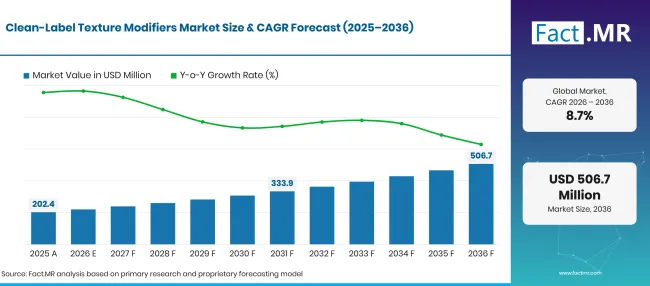
Clean Label Texture Modifiers Forecast Global | Source: Fact.MR
Category
| Category | Segments |
|---|---|
| Product Type | Fiber-based texture systems, Enzyme-derived texturizers, Protein-based texture systems, Hydrocolloid texture modifiers, Starch texture modifiers |
| Functionality | Gelling, Thickening, Texturizing, Stabilizing, Film forming |
| Application | Bakery fillings, Soups and sauces, Infant food, Ready meals, Dairy and desserts |
| End User | Ingredient blenders, Food manufacturers, Foodservice operators, Infant nutrition brands, Contract manufacturers |
| Country | Netherlands; United States; France; Germany; United Kingdom |
Source: Fact.MR analysis. Updated Nov 25, 2026
Segmental Analysis
Why do fiber-based texture systems lead product demand in the Clean-Label Texture Modifiers Market?
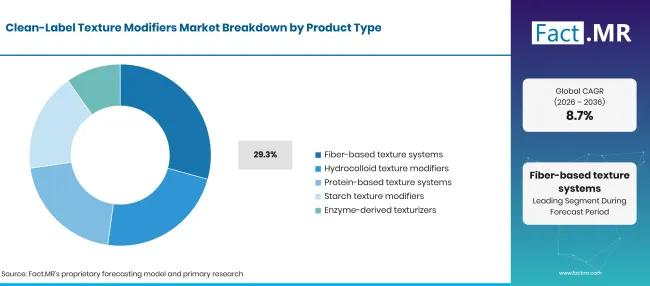
Clean Label Texture Modifiers Breakdown Product Type | Source: Fact.MR
Fiber-based texture systems account for 29.3% of revenue in 2026, approximately USD 64.5 million, as citrus and apple fibers provide water binding, emulsification and viscosity control. Their multifunctional properties help reduce reliance on conventional stabilizers. Manufacturers are selecting plant-derived ingredients that improve mouthfeel and moisture retention while supporting simpler ingredient declarations and fiber-forward formulations.
How is gelling leading functionality demand in the Clean-Label Texture Modifiers Market?
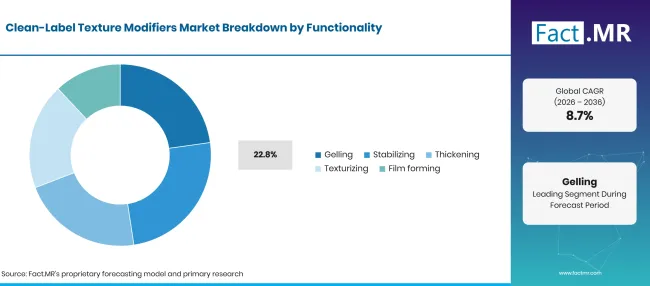
Clean Label Texture Modifiers Breakdown Functionality | Source: Fact.MR
Gelling represents 22.8% of revenue in 2026, valued at approximately USD 50.2 million, reflecting the need for controlled structure in bakery fillings, dairy and desserts, and ready meals. Pectin, agar and compatible starch systems provide different gel textures and setting characteristics. Formulators adjust ingredient combinations to achieve suitable firmness, elasticity and temperature stability while meeting product-specific labeling requirements.
Why do bakery fillings lead application demand in the Clean-Label Texture Modifiers Market?
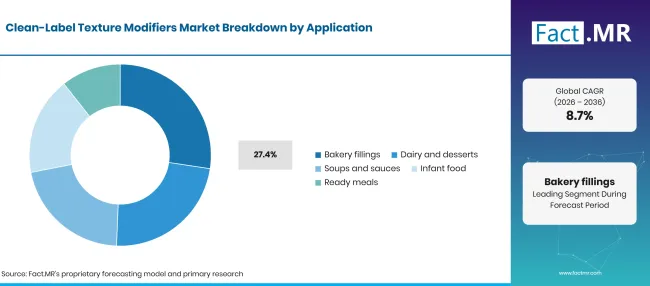
Clean Label Texture Modifiers Breakdown Application | Source: Fact.MR
Bakery fillings hold 27.4% of revenue in 2026, equivalent to approximately USD 60.3 million, because fruit and cream fillings require moisture control during baking, freezing and storage. Ingredient performance affects filling leakage, texture and finished product appearance. Food processors are evaluating clean-label fiber and starch combinations that maintain consistency under heat while providing dependable handling during industrial production.
How are ingredient blenders leading end-user demand in the Clean-Label Texture Modifiers Market?
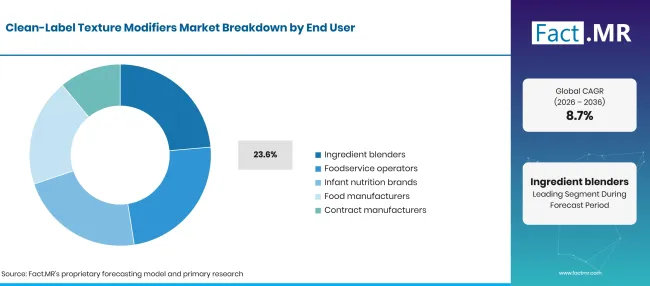
Clean Label Texture Modifiers Breakdown End User | Source: Fact.MR
Ingredient blenders represent 23.6% of revenue in 2026, approximately USD 51.9 million, as food producers increasingly purchase customized stabilizer systems rather than individual texturizing ingredients. Blenders combine fibers, starches and hydrocolloids to meet specific processing requirements. Their formulation expertise supports faster product development and consistent results, complementing activity in texture portfolio expansions.
Clean-Label Texture Modifiers Market-Drivers, Restraints & Trends
Drivers:
Food manufacturers are increasing their use of texture ingredients to maintain consistency in bakery fillings. In November 2026, Puratos opened a EUR 15 million manufacturing facility in Tunari, Romania, to expand fruit filling production capacity by approximately 50%.
Restraints:
Demand for clean-label texture modifiers is constrained by higher cost and narrower process tolerance than conventional texturizers. For example, Ingredion said in November 2026 that higher tapioca costs, manufacturing expense and price mix reduced texture segment operating income, and Tate & Lyle said it plans to recover cost inflation through price increases as 2027 customer contracts renew.
Trend:
Enzymes as Texture Tools Demand for enzymes that build viscosity, softness or gel structure during processing is rising because enzymes are processing aids and do not appear on labels. Suppliers are developing enzyme and fiber combinations. IFF described the role of enzymes in label-friendly baking in an article dated 4 June 2026.
Trend:
Regulatory Focus on Additives In August 2026, U.S. health agencies submitted a proposed definition of ultra-processed foods for review, and the FDA published a proposed rule on 11 August 2026 that would make GRAS notification mandatory. Demand for recognizable texturizing ingredients is rising as brands prepare for stricter oversight.
Clean-Label Texture Modifiers Market Analysis by Key Country
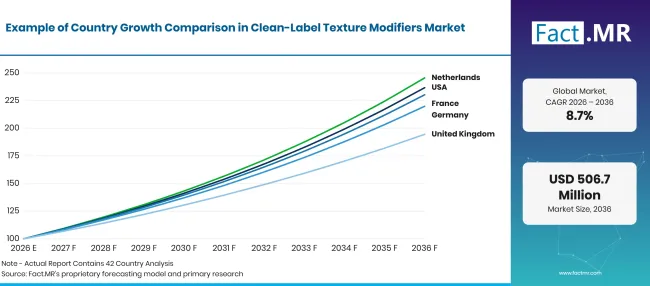
Clean Label Texture Modifiers Growth Index | Source: Fact.MR
| Country | CAGR (2026-2036) |
|---|---|
| Netherlands | 9.4% |
| United States | 9.0% |
| France | 8.7% |
| Germany | 8.2% |
| United Kingdom | 6.9% |
Source: Fact.MR analysis. Updated Nov 25, 2026
What is driving clean-label texture modifiers demand in the Netherlands?
Demand for clean-label texture modifiers in the Netherlands is forecast to rise at a 9.4% CAGR through 2036, the fastest among the five countries.
Dutch ingredient manufacturers are developing functional solutions for bakery, dairy and processed food exporters. Food processors are examining ingredient systems that preserve consistency, support simpler formulations and perform reliably during commercial production.
How is federal policy supporting clean-label texture modifiers sales in the United States?
Sales of clean-label texture modifiers in the United States are set to expand at a 9.0% CAGR through 2036 as regulatory scrutiny encourages closer examination of food ingredients.
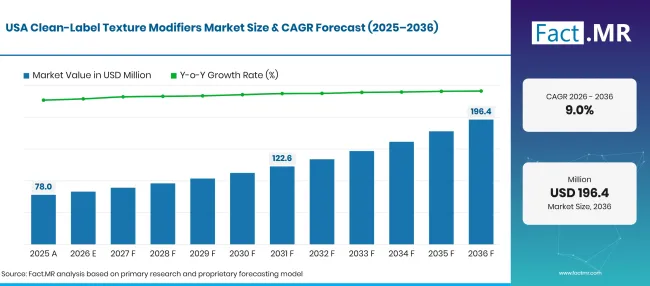
Clean Label Texture Modifiers Analysis Usa | Source: Fact.MR
In August 2026, the FDA proposed mandatory notification for GRAS determinations, while federal agencies submitted a proposed definition of ultra-processed foods for review. Ingredion subsequently reported its tenth consecutive quarter of volume growth in Texture & Healthful Solutions. American manufacturers are assessing citrus fibers, functional starches and alternative emulsifiers. Commercial interest will reflect labeling requirements, ingredient functionality and reformulation costs.
What is shaping clean-label texture modifiers demand in France?
Demand for clean-label texture modifiers in France is likely to advance at an 8.7% CAGR through 2036, with industrial bakeries seeking better control over filling stability and product texture.
Fruit preparations, pastry creams and chilled desserts require ingredients that maintain structure during heating and storage. French manufacturers are examining plant-derived fibers and functional starches for specialized applications. Suppliers offering reliable moisture management and consistent processing results can strengthen relationships with bakery producers.
How is a weak market shaping clean-label texture modifiers sales in Germany?
Sales of clean-label texture modifiers in Germany are forecast to increase at an 8.2% CAGR through 2036, despite challenging conditions across food manufacturing.
The BVE reported declining industry revenue during the first half of 2026, increasing pressure on producers to control formulation expenses. German bakeries, delicatessen manufacturers and ready-meal processors are examining ingredients that deliver texture with efficient dosage levels. Suppliers offering multifunctional fibers and starches may help reduce formulation complexity. Purchasing decisions will increasingly reflect processing efficiency, ingredient costs and consistent finished product quality.
Why is growth slower for clean-label texture modifiers in the United Kingdom?
Demand for clean-label texture modifiers in the United Kingdom is forecast to rise at a 6.9% CAGR through 2036, the slowest among the five countries. Established retailer specifications have already encouraged reformulation across many private-label food categories.
Manufacturers are concentrating on improving existing recipes rather than undertaking extensive ingredient replacement. British food processors are examining texture systems that maintain product quality while managing production costs, particularly in chilled desserts, sauces and prepared meals.
Competitive Landscape for Clean-Label Texture Modifiers Market
Replacing conventional stabilizers in bakery fillings, dairy desserts and prepared foods requires manufacturers to balance ingredient simplicity with dependable texture.
This creates different competitive opportunities for fiber specialists, hydrocolloid producers and enzyme developers. Ingredion addresses moisture retention and emulsification through citrus fibers, while IFF focuses on pectin-based gelling for fruit preparations and bakery fillings. Kerry approaches formulation challenges through enzyme technologies that improve dough handling and product freshness. Cargill, Roquette and Tate & Lyle provide complementary ingredient options for food manufacturers. Ingredion’s recommended all-cash acquisition of Tate & Lyle, announced on 8 June 2026 and expected to complete in the second half of 2027 subject to approvals, would bring two of these key players under one owner.
Bakery filling performance has become a distinct area of product innovation. At IBIE 2025, IFF introduced DANISCO GRINDSTED Pectin FB 420, a citrus-derived ingredient designed to provide bake-stable texture and improve mouthfeel in reduced-sugar bakery applications. In September 2026, Kerry highlighted enzyme technologies that can help bakeries reduce selected emulsifiers while maintaining freshness and processing efficiency. Ingredion has also demonstrated how citrus fibers can work alongside functional native starches to maintain creamy textures in lower-fat formulations. These developments illustrate competition through targeted ingredient replacement rather than broad portfolio expansion.
Recent Developments
- In June 2026, Ingredion announced a recommended all-cash acquisition of Tate & Lyle, with completion expected in the second half of 2027 subject to approvals.
- In November 2024, Tate & Lyle completed its acquisition of CP Kelco, expanding its specialty ingredients portfolio with pectin, gums, and hydrocolloids to strengthen texture, mouthfeel, and stabilization capabilities across food applications.
Key Players in Clean-Label Texture Modifiers Market
Key companies operating in the Clean-Label Texture Modifiers Market include Ingredion, Cargill, Tate & Lyle, Roquette, IFF, and Kerry Group.
- Ingredion
- Cargill
- Tate & Lyle
- Roquette
- IFF
- Kerry Group
Bibliography
- Food Ingredients First. (2026, September 16). Ingredion and Kerry back systems approach to clean label & high-protein bakery.
- Food Ingredients First. (2026, November). Tate & Lyle returns to sales growth as costs weigh on profits.
- Ingredion Incorporated. (2026, November 5). Ingredion Incorporated reports third quarter 2026 results.
- Ingredion Incorporated. (2026, July 6). Ingredion to spotlight next-generation solutions for texture, clean labels and positive nutrition at IFT FIRST 2026.
- Ingredion Incorporated. (2026, June 8). Ingredion announces recommended all-cash acquisition of Tate & Lyle.
- Ingredion Incorporated. (2026). Form 10-Q for the quarterly period ended September 30, 2026.
- IFF. (2026, June 23). IFF launches first-of-its-kind stabilizer system in Europe, the Middle East and Africa. iff.com
- IFF. (2025, September 2). IFF Tackles Top Challenges in Baking at IBIE 2025.
- IFF. (2026, June 4). Label-Friendly by Design: How Enzymes Are Changing the Future of Baking.
- Novonesis. (2026, November 5). 9M 2026: Novonesis delivered 7% organic sales growth, confirming full-year outlook.
- Milling MEA. (2026, November). Puratos expands regional production capacity with over US$16.5M investment in Romania.
- U.S. Department of Health and Human Services. (2026, August 10). Secretary Kennedy announces landmark food policy reforms to advance President Trump’s MAHA agenda.
- U.S. Food and Drug Administration. (2026, August 11). Substances Generally Recognized as Safe (Proposed Rule), Federal Register.
- Tate & Lyle. (2024, November 15). Completion of combination of Tate & Lyle and CP Kelco to create a leading global speciality food and beverage solutions business.
Segmentation
Scope of Report
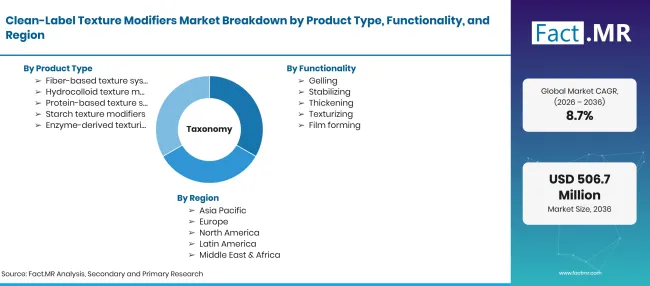
Clean Label Texture Modifiers Taxonomy | Source: Fact.MR
| Items | Values |
|---|---|
| Quantitative Units (2026) | USD 220.0 Million |
| Product Type | Fiber-based texture systems, Enzyme-derived texturizers, Protein-based texture systems, Hydrocolloid texture modifiers, Starch texture modifiers |
| Functionality | Gelling, Thickening, Texturizing, Stabilizing, Film forming |
| Application | Bakery fillings, Soups and sauces, Infant food, Ready meals, Dairy and desserts |
| End User | Ingredient blenders, Food manufacturers, Foodservice operators, Infant nutrition brands, Contract manufacturers |
| Regions Covered | North America, Latin America, Europe, East Asia, South Asia and Pacific, Middle East & Africa |
| Countries Covered | Netherlands, United States, France, Germany, United Kingdom, and other countries |
| Key Companies Profiled | Ingredion, Cargill, Tate & Lyle, Roquette, IFF, Kerry Group |
| Additional Attributes | Dollar revenue in the Clean-Label Texture Modifiers Market is segmented by product type (fiber-based, enzyme-derived, protein-based, hydrocolloid, starch texture modifiers), functionality, application, end user and region. |
Source: Fact.MR analysis. Updated Nov 25, 2026
Clean-Label Texture Modifiers Market by Segments
-
Product Type
- Fiber-based texture systems
- Enzyme-derived texturizers
- Protein-based texture systems
- Hydrocolloid texture modifiers
- Starch texture modifiers
-
Functionality
- Gelling
- Thickening
- Texturizing
- Stabilizing
- Film forming
-
Application
- Bakery fillings
- Soups and sauces
- Infant food
- Ready meals
- Dairy and desserts
-
End User
- Ingredient blenders
- Food manufacturers
- Foodservice operators
- Infant nutrition brands
- Contract manufacturers
-
Region:
- North America
- United States
- Canada
- Mexico
- Europe
- Germany
- United Kingdom
- France
- Netherlands
- Italy
- Spain
- Rest of Europe
- Asia Pacific
- China
- India
- Japan
- South Korea
- Australia
- Rest of Asia Pacific
- Latin America
- Brazil
- Argentina
- Rest of Latin America
- Middle East & Africa
- GCC Countries
- South Africa
- Rest of Middle East & Africa
- North America
Table of Contents
Key Takeaways
- Market Size and CAGR
- Top Growth Driver
- Fastest Growing Segment
- Leading Region
- Key Companies
- Emerging Opportunities

