
- Market Value (2025): USD 102.2 Mn
- Estimated Value (2026): USD 110.0 Mn
- Forecast Value (2036): USD 228.8 Mn
- CAGR (2026-2036): 7.6%
Functional Native Starches Market Forecast and Outlook 2026 to 2036
The functional native starches market is projected to grow from USD 110.0 million in 2026 to USD 228.8 million by 2036. Demand for functional native starches is likely to grow at a CAGR of 7.6% over the forecast period.
Demand for functional native starches is rising as food makers replace chemically modified starches with grades that are selected, bred or physically treated (for example, by thermal inhibition) to give better stability, and that appear on the label simply as starch. In this report, functional native starches cover such starches and exclude chemically modified starches. Suppliers of functional native starches are offering waxy potato, wheat, corn, tapioca and pea starches with improved freeze-thaw, shear and acid tolerance. For example, in November 2026, Royal Avebe launched PuraMYL 440, an instant potato starch that is physically modified through thermal inhibition and can be declared as potato starch, extending its clean-label PuraMYL range into cold-prepared applications.
Key Takeaways from the Functional Native Starches Market
- Sales of functional native starches stood at USD 102.2 million in 2025
- Functional Native Starches Market Value (2026): USD 110.0 million
- Functional Native Starches Market Forecast Value (2036): USD 228.8 million
- Functional Native Starches Market Forecast CAGR (2026-2036): 7.6%
- Leading Product Type: Native potato starch (29.7%)
- Key Market Participants: Avebe, Ingredion, Emsland Group, Roquette, AGRANA, KMC
- Key Growth Countries: France, Netherlands, United Kingdom, Japan, Germany
In October 2026, AGRANA reported that first-half 2026/27 EBIT in its starch segment rose to EUR 17.2 million from EUR 3.1 million a year earlier, while segment revenue stayed at EUR 508.1 million despite lower selling prices. The margin recovery at a European starch producer is a supportive signal for the supply base, although it was reported for the whole starch segment and not for specialty food grades.
Functional Native Starches Market
| Metric | Value |
|---|---|
| Estimated Value in (2026) | USD 110.0 million |
| Forecast Value in (2036) | USD 228.8 million |
| Forecast CAGR (2026 to 2036) | 7.6% |
Source: Fact.MR analysis.
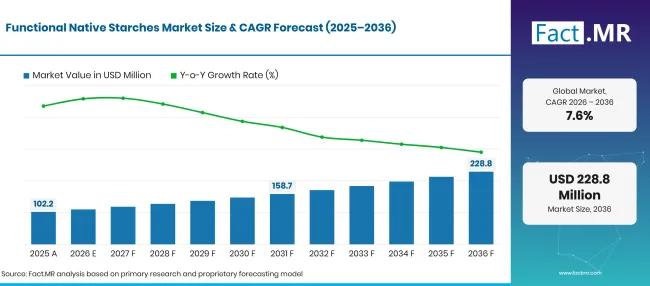
Functional Native Starches Forecast Global | Source: Fact.MR
Category
| Category | Segments |
|---|---|
| Product Type | Native potato starch, Native wheat starch, Other native specialty starch, Native corn starch, Native tapioca starch |
| Product Form | Granule and agglomerate, Encapsulated, Liquid concentrate, Custom premix, Dry powder |
| Application | Dairy and alternatives, Beverages, Bakery and confectionery, Savory and other, Nutrition and supplements |
| Buyer Type | Nutrition brand, Beverage producer, Ingredient blender, Contract formulator, Food manufacturer |
| Region | France; Netherlands; United Kingdom; Japan; Germany |
Source: Fact.MR analysis. Updated Nov 24, 2026
Segmental Analysis
Why does native potato starch lead product demand in the Functional Native Starches Market?
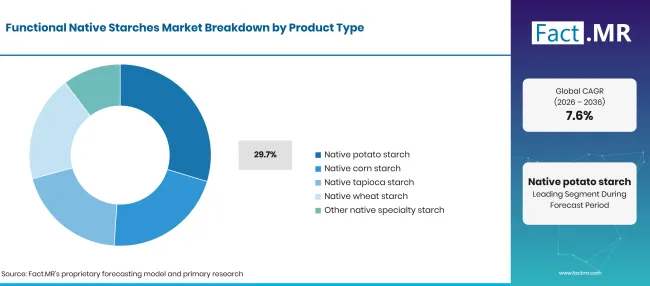
Functional Native Starches Breakdown Product Type | Source: Fact.MR
Native potato starch accounts for 29.7% of revenue in 2026, approximately USD 32.7 million, owing to its strong thickening capacity, neutral flavor and clear paste appearance. These characteristics make it suitable for sauces, fillings and processed foods. Waxy potato grades offer additional texture options. Manufacturers are developing functional varieties that deliver reliable viscosity without chemical modification, supporting the broader potato starch market.
How are granules and agglomerates leading form demand in the Functional Native Starches Market?
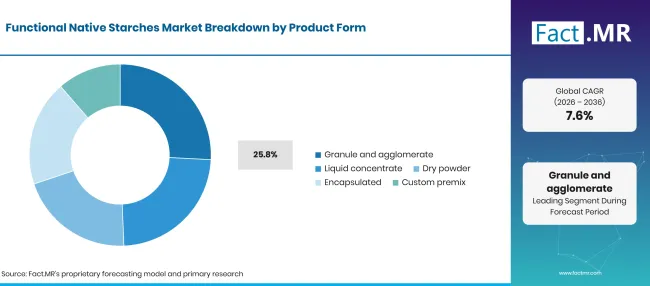
Functional Native Starches Breakdown Product Form | Source: Fact.MR
Granules and agglomerates represent 25.8% of revenue in 2026, valued at approximately USD 28.4 million, as food processors seek starch ingredients that disperse evenly during mixing. Agglomerated formats can reduce dust formation and improve powder handling in industrial equipment. Suppliers are developing easily dispersible grades for instant desserts, powdered mixes and beverages, where hydration speed and consistent texture influence formulation performance.
Why do dairy and alternatives lead application demand in the Functional Native Starches Market?
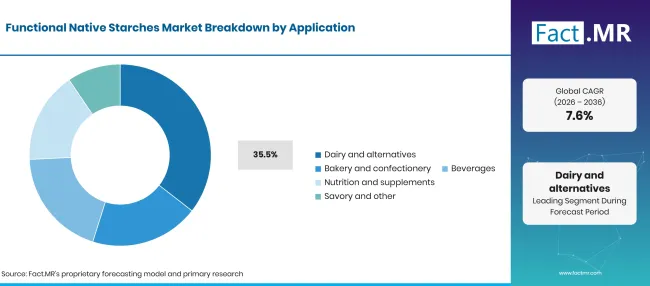
Functional Native Starches Breakdown Application | Source: Fact.MR
Dairy and alternatives hold 35.5% of revenue in 2026, equivalent to approximately USD 39.1 million, reflecting the importance of creaminess and texture in yogurts, puddings and plant-based desserts. Potato-derived starches can help manufacturers achieve smooth consistency while reducing reliance on other texturizers. Manufacturers are refining application-specific ingredients that maintain mouthfeel and stability across different dairy processing conditions.
How are nutrition brands leading buyer demand in the Functional Native Starches Market?
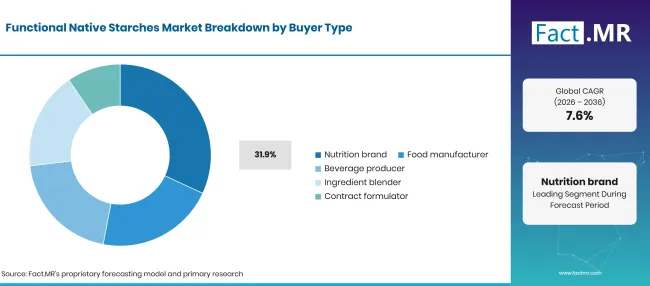
Functional Native Starches Breakdown Buyer Type | Source: Fact.MR
Nutrition brands account for 31.9% of revenue in 2026, approximately USD 35.1 million, as specialized food manufacturers seek starch ingredients with documented quality and consistent composition. Clinical, sports and pediatric nutrition products require careful ingredient selection. Suppliers are offering grades with controlled microbial specifications and reliable processing properties. Buyers also assess regulatory suitability alongside developments in the wider native starch market.
Functional Native Starches Market-Drivers, Restraints & Trends
Drivers
Demand for functional native starches is increasing as food manufacturers seek recognizable ingredients for processed-food formulations. Retailer specifications and clean-label preferences are encouraging manufacturers to examine physically treated starches that provide reliable texture and processing stability. Suppliers are developing potato, corn and tapioca starches that support simpler ingredient declarations across bakery, dairy and convenience food applications.
Restraints
Demand for functional native starches is constrained by crop variability and lower process tolerance than modified starch. For example, Roquette's July 2026 European starch industry outlook pointed to crop challenges, including a weaker French corn crop, as a key consideration for 2027. Harvest risk may also affect prices and availability of specialty potato and wheat starches.
Trend
Waxy and Specialty Crop Varieties Demand for starch from waxy potato, waxy corn and waxy tapioca is rising because these varieties resist retrogradation naturally. Suppliers are contracting growers of specialty varieties. Avebe said in November 2026 that a waxy potato grade, PuraMYL 700, was in development.
Trend
Co-Product Use in Starch Plants In June 2026, Emsland Group described its innovation work on starches, proteins, fibers, flakes and granules from potatoes and peas. Demand for full use of the crop is rising as producers seek better returns. Similar integration is projected to support sales of functional native starches.
Functional Native Starches Market by Analysis by Key Country
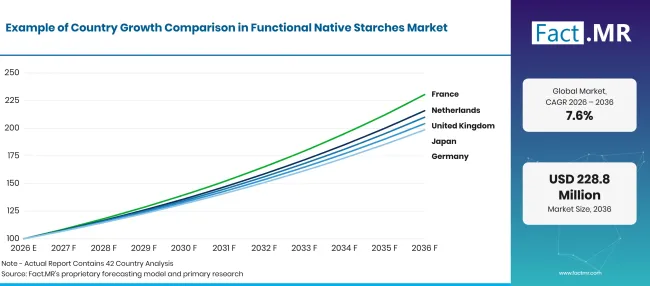
Functional Native Starches Growth Index | Source: Fact.MR
| Country | CAGR (2026-2036) |
|---|---|
| France | 8.7% |
| Netherlands | 8.0% |
| United Kingdom | 7.7% |
| Japan | 7.4% |
| Germany | 7.1% |
Source: Fact.MR analysis.
What is driving functional native starches demand in France?
Demand for functional native starches in France is forecast to increase at an 8.7% CAGR through 2036, the fastest among the five countries.
Dairy dessert manufacturers and bakeries are exploring potato and cereal starches that provide texture without chemical modification. In September 2026, Roquette reported a 9% increase in first-half group turnover, mainly from the IFF Pharma Solutions acquisition; like-for-like turnover fell 2%, so the figure does not indicate starch-specific sales. France's established ingredient processing industry supports formulation development for yogurts, fillings and desserts. Buyers will assess thickening performance, paste clarity, processing stability and consistent ingredient quality.
How is potato innovation supporting functional native starches sales in the Netherlands?
Sales of functional native starches in the Netherlands are set to rise at an 8.0% CAGR through 2036, supported by potato starch innovation and specialized food ingredient development.
In November 2026, Royal Avebe launched PuraMYL 440, a thermally inhibited instant potato starch for cold-prepared sauces and plant-based foods that can be declared as potato starch. Such processing improvements demonstrate the commercial value of potato-based functional ingredients. Dutch manufacturers are examining starch solutions for confectionery, dairy desserts and other processed foods. Product development will emphasize gelling performance, texture consistency, processing efficiency and ingredient functionality.
What is shaping functional native starches demand in the United Kingdom?
Demand for functional native starches in the United Kingdom is likely to advance at a 7.7% CAGR through 2036 as food manufacturers examine simpler ingredient formulations for chilled desserts, sauces and ready meals. Retailer specifications are encouraging the use of recognizable starch ingredients that provide reliable texture.
In November 2026, Tate & Lyle, which Ingredion has agreed to acquire with closing expected in the second half of 2027, reported 3% growth in volume and mix across its broader business, which does not isolate starch. British food processors are assessing starch functionality alongside formulation costs. Supplier selection will reflect viscosity control, ingredient declarations, processing compatibility and product consistency.
How are rising prices shaping functional native starches sales in Japan?
Sales of functional native starches in Japan are forecast to expand at a 7.4% CAGR through 2036 as food manufacturers reassess ingredient choices amid rising production costs.
Teikoku Databank reported that price increases have been taken or scheduled for 20,187 food and beverage items by 195 major makers in 2026, highlighting continued pressure on packaged food producers. Potato and tapioca starches offer different thickening and texture properties for noodles, desserts and dairy products. Japanese manufacturers are reviewing recipes to balance ingredient costs with product quality. Purchasing decisions will reflect viscosity, texture retention, processing efficiency and supply stability.
Why is growth slower for functional native starches in Germany?
Demand for functional native starches in Germany is expected to increase at a 7.1% CAGR through 2036, the slowest among the five countries.
Established starch applications and cautious spending among food manufacturers are influencing new ingredient purchases. In October 2026, the German Food and Drink Industries Federation reported a 2.3% decline in industry sales during the first half of the year. Domestic suppliers such as Emsland Group serve food and industrial applications. Manufacturers will focus on cost efficiency, consistent thickening performance and suitable starch grades for existing production lines.
Competitive Landscape for Functional Native Starches Market
Competition in the functional native starches market centers on crop-specific innovation and the ability to deliver modified starch-like performance through physically processed ingredients. Royal Avebe and KMC specialize in potato-based starches, with Avebe offering PuraMYL for texture and processing stability and KMC supplying native potato starches for food applications. Emsland Group competes through potato-derived ingredients designed for binding and texture development, while AGRANA and Roquette draw on diversified agricultural processing capabilities. Ingredion differentiates its NOVATION portfolio through functional native starches made from potato, waxy maize, tapioca and rice. Ingredion agreed in June 2026 to acquire Tate & Lyle, with completion expected in the second half of 2027.
Recent developments show manufacturers targeting specialized applications where starch functionality can improve production efficiency and product consistency. In November 2026, Avebe introduced PuraMYL 440 for cold-prepared food applications. Roquette also highlighted raw material and energy cost pressures affecting European starch production.
Recent Developments
- In November 2026, Avebe launched PuraMYL 440, an instant clean-label potato starch that develops texture during cold preparation, supporting improved viscosity, water binding, and simplified processing across sauces and plant-based foods.
- In January 2026, Emsland Group introduced Emjel LC 15, a functional starch developed for vegan confectionery, enabling atmospheric cooking, improved heat stability, and gelatin-like textures in plant-based jellies and gummies.
Key Players in Functional Native Starches Market
Key companies operating in the market include Avebe, Ingredion, Emsland Group, Roquette, AGRANA, and KMC.
- Avebe
- Ingredion
- Emsland Group
- Roquette
- AGRANA
- KMC
Bibliography
- AGRANA Beteiligungs-AG. (2026, October 8). AGRANA posts significantly improved first-half results. AGRANA.
- Bundesvereinigung der Deutschen Ernährungsindustrie. (2026, October 28). BVE-Halbjahresbilanz: Ernährungsindustrie muss Umsatzeinbußen verkraften.
- Emsland Group. (2026, January 21). Emjel® LC 15 sets a new standard for vegan & vegetarian jellies & gums. Emsland Group.
- ICN Bureau. (2026, September 25). Roquette posts 9% H1 growth as transformation plan delivers early gains. Indian Chemical News.
- Ingredion Incorporated. (2026, June 8). Ingredion announces recommended all-cash acquisition of Tate & Lyle. Ingredion.
- Ingredion Incorporated. (2026, July 28). Ingredion's 595 pence all-cash offer to acquire Tate & Lyle accepted by their shareholders. Ingredion.
- Roquette. (2026, July 15). July 2026 European starch industry outlook by Roquette market analysts. Roquette.
- Royal Avebe. (2026, November 12). Avebe launches instant clean label potato starch for cold applications. Royal Avebe.
- U.S. Department of Health and Human Services. (2026, August 10). HHS announces ultra-processed foods and GRAS reforms. HHS
- Vegconomist. (2026, November). Avebe launches PuraMYL 440 clean label potato starch for cold preparation. Vegconomist.
Segmentation
Scope of Report
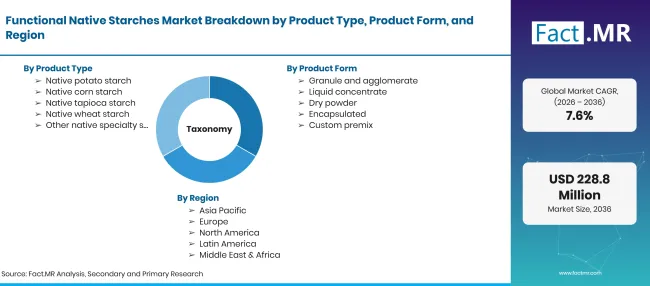
Functional Native Starches Taxonomy | Source: Fact.MR
| Items | Values |
|---|---|
| Quantitative Units (2026) | USD 110.0 Million |
| Product Type | Native potato starch, Native wheat starch, Other native specialty starch, Native corn starch, Native tapioca starch |
| Product Form | Granule and agglomerate, Encapsulated, Liquid concentrate, Custom premix, Dry powder |
| Application | Dairy and alternatives, Beverages, Bakery and confectionery, Savory and other, Nutrition and supplements |
| Buyer Type | Nutrition brand, Beverage producer, Ingredient blender, Contract formulator, Food manufacturer |
| Regions Covered | North America, Latin America, Europe, Asia Pacific, Middle East & Africa |
| Countries Covered | France, Netherlands, United Kingdom, Japan, Germany, and other countries |
| Key Companies Profiled | Avebe, Ingredion, Emsland Group, Roquette, AGRANA, KMC |
| Additional Attributes | Dollar revenue in the Functional Native Starches Market is segmented by product type (native potato, wheat, corn, tapioca, other specialty starch), product form, application, buyer type and region. |
Source: Fact.MR analysis. Updated Nov 24, 2026
Functional Native Starches Market by Segments
-
Product Type
- Native potato starch
- Native wheat starch
- Other native specialty starch
- Native corn starch
- Native tapioca starch
-
Product Form
- Granule and agglomerate
- Encapsulated
- Liquid concentrate
- Custom premix
- Dry powder
-
Application
- Dairy and alternatives
- Beverages
- Bakery and confectionery
- Savory and other
- Nutrition and supplements
-
Buyer Type
- Nutrition brand
- Beverage producer
- Ingredient blender
- Contract formulator
- Food manufacturer
-
Region:
- North America
- United States
- Canada
- Mexico
- Europe
- Germany
- United Kingdom
- France
- Italy
- Spain
- Rest of Europe
- Asia Pacific
- China
- India
- Japan
- South Korea
- Australia
- Rest of Asia Pacific
- Latin America
- Brazil
- Argentina
- Rest of Latin America
- Middle East & Africa
- GCC Countries
- South Africa
- Rest of Middle East & Africa
- North America
Table of Contents
Key Takeaways
- Market Size and CAGR
- Top Growth Driver
- Fastest Growing Segment
- Leading Region
- Key Companies
- Emerging Opportunities

