- Market Value (2025): USD 4.0 Bn
- Estimated Value (2026): USD 4.3 Bn
- Forecast Value (2036): USD 8.2 Bn
- CAGR (2026-2036): 6.7%
What is the Clean-Opening Lidding Films Market forecast to be worth by 2036?
USD 4.3 billion in 2026 to USD 8.2 billion by 2036 at a 6.7% CAGR.
- The Clean-Opening Lidding Films Market reached USD 4.0 billion in 2025.
- Demand is expected to increase from USD 4.3 billion in 2026 to USD 8.2 billion by 2036.
- The market is expected to grow at a 6.7% CAGR from 2026 to 2036 as dairy, ready-meal and protein packers place more weight on repeatable peel behavior and seal integrity.
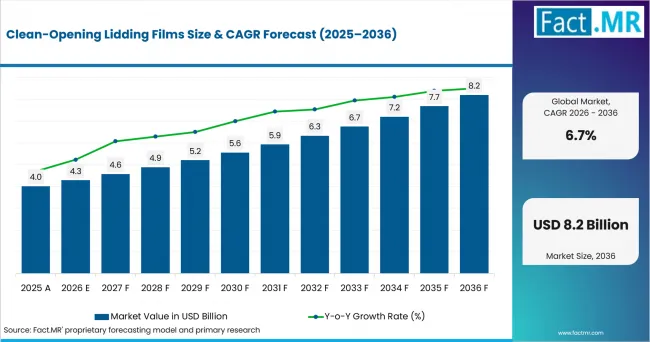
Clean Opening Lidding Films Value Analysis | Source: Fact.MR
What are the defining numbers behind Clean-Opening Lidding Films Market growth?
USD 3.9 billion absolute opportunity by 2036, led by clean peel, PET base film and peelable sealant structures.
- Demand Drivers in the Market
- Dairy processors need seals that open cleanly from cups and tubs. USDA Economic Research Service said in June 2026 that U.S. Food spending reached USD 2.51 trillion in 2025. This scale supports regular use of lidding across dairy and prepared foods.
- Ready-meal packers need repeatable tray seals that stay secure in distribution and open at a practical peel force.
- Meat and cheese processors need barrier lidding that keeps trays secure and opens in a controlled way. Similar seal and barrier needs appear across fresh meat packaging and processed meat packaging applications.
- Specialty food and medical packers need predictable opening after heat sealing and storage. Their specifications often depend on the seal layer, including waterborne heat-seal coatings used on selected film and paper structures.
- Key Segments Analyzed
- By Seal Mechanism: Peelable sealant is expected to hold 33.0% share in 2026 due to its direct role in balancing package integrity with controlled opening force.
- By Base Film: PET is projected to account for 34.0% share in 2026 owing to its clarity and stable converting performance. PP options connect this segment with CPP packaging film and other polypropylene structures used in food packs.
- By Opening Performance: Clean peel is expected to capture 37.0% share in 2026 because pack makers can specify opening behavior and target a clean seal interface with minimal stringing or shred.
- By Application: Dairy cups are expected to hold 29.0% share in 2026 as portioned yogurt, desserts and cultured products require dependable sealing with consumer-friendly opening.
- Analyst Opinion at Fact.MR
- Fact.MR Principal Consultant Shambhu Nath Jha states: “Clean opening is a testing issue as much as a convenience feature. The market is expected to reward films that hold a stable seal window while keeping peel force consistent after filling and cold-chain handling. Firms should combine substrate control with pack testing and clear seal-performance files.”
- Strategic Implications
- Film pack makers should document peel-force ranges against common cup and tray substrates.
- Food processors should test films on production lines because temperature and dwell time alter peel behavior.
- Packaging developers should simplify material structures where performance allows. The European Commission stated in August 2026 that the PPWR applies across the EU from 12 August 2026. The change raises the value of clear recycling pathways for lids and trays, including options linked with paper barrier coatings when fiber structures are used.
China is expected to record a 7.5% CAGR through 2036 as packaged-food channels expand. The USA and Japan are estimated at 7.0%. Germany is anticipated at 6.8%. France is expected to record 6.3%.
How does the Clean-Opening Lidding Films Market break down by segment?
Clean peel leads Opening Performance at 37.0%. PET leads Base Film at 34.0%.
Which Seal Mechanism dominates?
Peelable sealant is expected to hold 33.0% share in 2026.
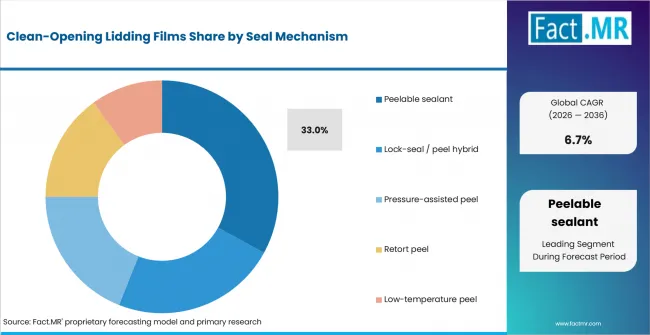
Clean Opening Lidding Films Analysis By Seal Mechanism | Source: Fact.MR
Peelable sealant is central to clean opening because it controls the bond between the lid and container. Lock-seal and peel hybrids suit packs that need a firmer first seal. Pressure-assisted peel options serve packs with a defined opening force. Retort and low-temperature peel grades extend the same principle across different process settings.
What leads the Base Film segment?
PET is expected to account for 34.0% share in 2026.
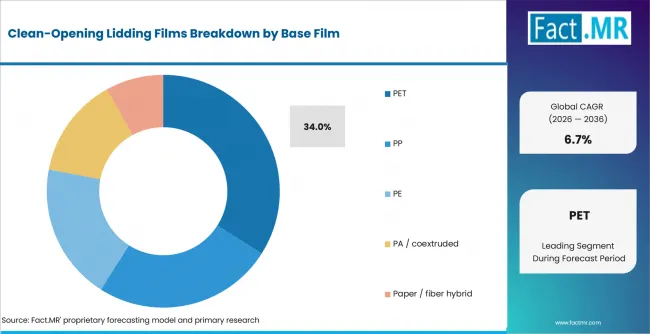
Clean Opening Lidding Films Analysis By Base Film | Source: Fact.MR
PET gives converters a stable base for printing, barrier layers and heat-seal coatings. PP supports heat-resistant and mono-material designs, including structures related to BOPP packaging film. PE works well in lower-temperature seal layers. PA and coextruded films add toughness. Paper and fiber hybrids depend more on coating and laminate design.
How does Opening Performance shape demand?
Clean peel is expected to lead with 37.0% share in 2026.
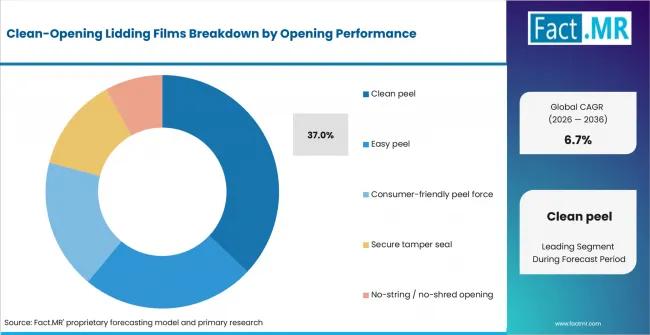
Clean Opening Lidding Films Analysis By Opening Performance | Source: Fact.MR
Clean peel addresses a visible lidding problem because residue and film tearing can weaken the opening experience. Easy-peel grades focus on lower force. Consumer-friendly peel force aims for repeatable handling. Secure tamper seals add visible opening evidence. No-string and no-shred formats focus on clean separation at the seal edge.
What supports Dairy Cups within Application?
Dairy cups are expected to hold 29.0% share in 2026.
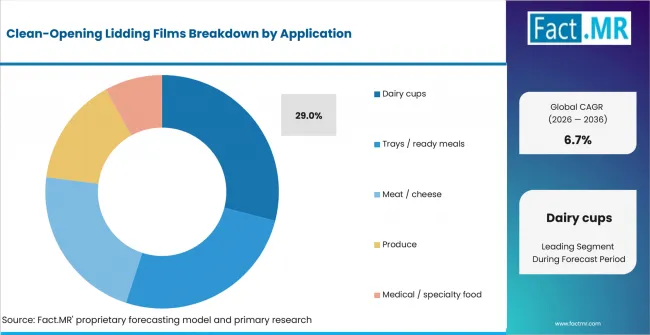
Clean Opening Lidding Films Analysis By Application | Source: Fact.MR
Dairy cups use lidding at high pack counts and need a seal that handles filling-line variation. Trays and ready meals need a wider seal window. Destatis said in January 2026 that the value of German ready-meal production reached EUR 4.5 billion in the first three quarters of 2025. Meat and cheese packs place more weight on barrier and leak control. These uses connect with broader fresh food packaging needs.
What is accelerating Clean-Opening Lidding Films Market adoption, and what is holding it back?
Seal stability and easy opening support adoption. Substrate testing and recycling fit shape switch decisions.
Drivers Impact Analysis
| DRIVER | (~) % IMPACT ON CAGR | GEOGRAPHIC RELEVANCE | IMPACT TIMELINE |
|---|---|---|---|
| Higher use of portioned dairy and prepared meals | +1.4% | Global | Short term (<= 2 years) |
| Need for repeatable peel force on automated lines | +1.2% | North America, Europe, East Asia | Medium term (2-4 years) |
| Barrier lidding for meat, cheese and chilled food | +0.9% | Global | Medium term (2-4 years) |
| Recyclability-led redesign of tray and lid structures | +0.7% | Europe, North America, Japan | Long term (>= 4 years) |
Opportunity Impact Analysis
| OPPORTUNITY | (~) % IMPACT ON CAGR | GEOGRAPHIC RELEVANCE | IMPACT TIMELINE |
|---|---|---|---|
| Recyclable PE and PP lidding combinations | +0.9% | Europe, North America | Medium term (2-4 years) |
| Lower-gauge lidding with stable peel behavior | +0.7% | Global | Short term (<= 2 years) |
| Clean-peel solutions for ready meals and dairy | +0.6% | Europe, East Asia, North America | Long term (>= 4 years) |
Restraints Impact Analysis
| RESTRAINT | (~) % IMPACT ON CAGR | GEOGRAPHIC RELEVANCE | IMPACT TIMELINE |
|---|---|---|---|
| Qualification across multiple tray and cup substrates | -0.6% | Global | Short term (<= 2 years) |
| Trade-off between peel force and seal security | -0.5% | Global | Medium term (2-4 years) |
| Recycling compatibility of mixed-material structures | -0.4% | Europe, Japan | Long term (>= 4 years) |
Which countries are scaling the Clean-Opening Lidding Films Market through 2036?
- The country comparison spans 1.2 percentage points across the forecast period.
- China remains 0.5 percentage point above the USA as packaged-food retail supports tray and cup demand.
- The USA and Japan share a 7.0% CAGR but follow different demand paths across dairy and prepared foods.
- Japan remains 0.2 percentage point above Germany as portioned food formats support clean-opening lids.
- Germany remains 0.5 percentage point above France as ready-meal output and recycling rules shape pack design.
- France closes the displayed range at 6.3% as dairy and chilled-food use supports lidding demand.
Similar CAGRs can create different entry settings because food formats, tray resins and recycling systems vary by country. Full coverage includes North America, Latin America, Western Europe, Eastern Europe, East Asia, South Asia & Pacific, Middle East & Africa.
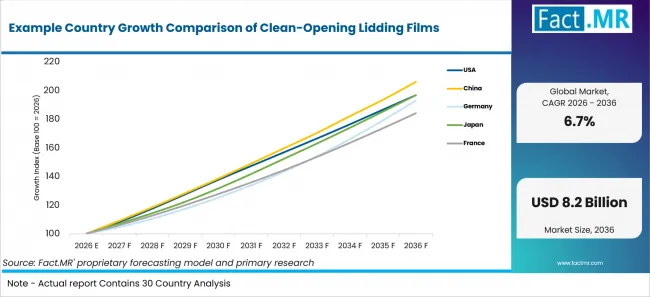
Example Country Growth Comparison Of Clean Opening Lidding Films | Source: Fact.MR
| Country | CAGR (2026-2036) |
|---|---|
| China | 7.5% |
| United States | 7.0% |
| Japan | 7.0% |
| Germany | 6.8% |
| France | 6.3% |
What is powering China’s lead?
7.5% CAGR, supported by packaged-food retail and catering activity.
China’s food retailers need lidding that works across dairy cups, prepared meals and protein trays. The National Bureau of Statistics said in February 2026 that retail sales of grain, oil and food by enterprises above the designated size rose 9.3% in 2025. That broad food channel supports steady use of sealed cups and trays. Film pack makers still need to tune peel force for local tray resins and filling lines. A stable seal across a practical temperature range can reduce line adjustments and improve opening stability.
How is the United States scaling lidding-film demand?
7.0% CAGR, led by high food spending and packaged retail activity.
U.S. Dairy and prepared-food plants place high value on line speed and stable seal strength. USDA National Agricultural Statistics Service said in April 2026 that U.S. Milk production reached 232 billion pounds in 2025. Large dairy volumes support frequent use of lidding on yogurt and cultured products. The film must match the cup resin and sealing window used on the line. Firms that document peel force after filling and chilled storage have a clearer path through technical approval.
What supports the Japan outlook?
7.0% CAGR, backed by household consumption and packaging-recovery needs.
Japan’s portioned food formats favor easy opening and compact pack design. The Statistics Bureau of Japan said in February 2026 that average monthly consumption spending for two-or-more-person households reached 314,001 yen in 2025. Chilled foods and dairy cups give clean peel a visible role at consumption. Pack makers need steady opening force after refrigeration and retail handling. Film choices that fit local recovery routes can strengthen the case for PET, PP and coated paper structures.
What underpins Germany’s growth?
6.8% CAGR, driven by ready-meal output and packaging-recycling rules.
Germany’s ready-meal and dairy packers pair opening performance with recycling checks. The German Environment Agency and Central Agency Packaging Register reported in January 2026 that around 5.5 million tonnes of packaging waste collected by Germany’s dual systems were recovered in 2024. That scale keeps recycling in the design discussion for trays and lids. Pack makers are expected to favor structures that give a stable seal and fit sorting systems. Production-line testing remains central because temperature and dwell time affect peel force.
How is France developing demand?
6.3% CAGR, shaped by packaged food use and recycling obligations.
France’s dairy, dessert and chilled-food uses give a steady base for cup and tray lidding. INSEE said on May 29, 2026 that French household spending on food and non-alcoholic beverages reached EUR 192.8 billion in 2025. This spending base supports recurring use of sealed food packs across retail channels. Film firms can compete through clear opening performance and efficient film use. Designs that align with local recycling routes are expected to receive closer attention during pack development.
Who leads the Clean-Opening Lidding Films Market?
Amcor and Klöckner Pentaplast provide broad lidding-film portfolios, while Constantia Flexibles and Coveris add food-packaging depth across dairy and ready-meal applications. Winpak extends coverage into protein packaging through lidding solutions for meat, poultry, seafood, and related applications. Supplier differentiation is expected to reflect seal performance, barrier control, packaging-line compatibility, and film efficiency.
Amcor completed its combination with Berry Global on April 30, 2025, bringing the former Berry film and packaging operations into the combined Amcor portfolio. In August 2025, Constantia Flexibles highlighted an expanded product portfolio that included EcoPeelCover, its thin die-cut aluminum lidding solution for dairy applications. EcoPeelCover reduces aluminum thickness by 25% and coating weight by 50% compared with conventional specifications while maintaining barrier and sealing performance. These developments broaden the range of lidding formats available to food processors.
Coveris and Winpak compete in flexible food packaging where seal integrity, barrier performance, and line compatibility are important application requirements. Klöckner Pentaplast provides barrier top-lidding films for rigid trays. These portfolios connect clean-opening lidding with adjacent polyfilm applications and with PCR in dairy bottle and lid applications, where recycled-content requirements increasingly influence packaging design.
Which companies are the key givers?
Key companies include Amcor, Klöckner Pentaplast, Constantia Flexibles, Coveris, Winpak, and Berry Global.
- Amcor (including the former Berry Global range)
- Klöckner Pentaplast
- Constantia Flexibles
- Coveris
- Winpak
Bibliography
- Zeballos, E., & Sinclair, W. (2026, June 11). Total U.S. food spending reached $2.51 trillion in 2025. U.S. Department of Agriculture, Economic Research Service.
- European Commission, Directorate-General for Environment. (2026, August 11). New EU packaging rules start to apply, including restrictions on PFAS in food-contact packaging.
- National Bureau of Statistics of China. (2026, February 28). Statistical communiqué of the People’s Republic of China on the 2025 national economic and social development.
- U.S. Department of Agriculture, National Agricultural Statistics Service. (2026, April). Milk production, disposition, and income 2025 summary.
- Statistics Bureau, Ministry of Internal Affairs and Communications. (2026, February 6). 2025 yearly average.
- Statistisches Bundesamt (Destatis). (2026, January 14). Produktion von Fertiggerichten binnen fünf Jahren mengenmäßig um 25,6 % gestiegen.
- German Environment Agency, & Central Agency Packaging Register. (2026, January 27). Facts against myths: Packaging waste recycling in Germany is working.
- Insee. (2026, May 29). Consommation effective des ménages par fonction : données annuelles 1965 et 2025.
- Constantia Flexibles. (2025, August 12). FACHPACK 2025: Constantia Flexibles invests over €100 million and expands product portfolio.
- Amcor plc. (2025, April 30). Amcor completes combination with Berry Global; positioned to significantly enhance value for customers and shareholders.
This Report Answers
- The report explains how seal mechanism and base film affect clean-opening performance across cups and trays.
- Segment analysis identifies the leading 2026 shares and the technical reasons behind film choice.
- Country analysis compares China, the United States, Japan, Germany and France across the stated growth rates.
- Competitive analysis reviews Amcor, Klöckner Pentaplast, Constantia Flexibles, Coveris and Winpak across range fit and market activity.
- Application analysis covers dairy cups, ready-meal trays, meat and cheese packs, produce and selected specialty uses.
What does the Clean-Opening Lidding Films Market cover?
Peelable, hybrid, pressure-assisted and retort-capable lidding films used on cups, trays and specialty sealed containers.
The market covers lidding webs and die-cut film structures that seal to rigid or semi-rigid containers and then open with controlled separation. The core boundary is seal security plus predictable opening. Adjacent technology includes bio barrier coatings where coated structures add functional protection to food packs.
The market differs from broad film packs because the lid works at a defined seal interface with a cup or tray. Wider film context includes BOPP packaging film and CPP packaging film when those films serve as lidding substrates or seal layers.
What is included in the scope?
Clean-opening lidding films used in food, dairy, protein, produce and selected medical or specialty uses. The boundary also touches PCR in dairy bottle and lid uses where lid design choices affect recovery goals.
Coverage includes peelable sealants and hybrid seal mechanisms on PET, PP, PE, PA or coextruded substrates and paper or fiber hybrids. Uses include dairy cups, ready-meal trays, meat and cheese packs, produce and selected specialty formats. Adjacent film choices such as paper barrier coatings are considered when they affect seal design or recycling fit.
What is excluded from the scope?
The scope centers on lidding layers that seal directly to cups and trays. Forming films and general flexible packages remain adjacent uses.
Scope is limited to flexible lidding layers and coatings integrated into those layers. Standalone thermoforming bottom webs and shrink films belong to adjacent packaging uses. Overwrap and general pouches are treated as separate formats. Rigid closures form a separate closure category. Forming films appear only when they explain tray compatibility. Heat-seal coating technologies appear when they form part of a finished clean-opening lidding film.
How Was the Analysis Built?
The analysis draws on 120+ sources, 35+ company portfolios, 25+ countries, and more than 20 industry interviews.
- Primary Research: Primary research includes discussions with manufacturers, service providers, technology developers, distributors, end users, and subject-matter experts. These conversations examine purchasing priorities, product adoption, operational challenges, approval requirements, competitive positioning, and the factors that influence wider market acceptance.
- Desk Research: Desk research covers government statistics, regulatory publications, company filings, trade data, technical studies, industry associations, standards, public policy, and other authoritative sources. Every source used in the analysis is documented in the bibliography.
- Market Sizing and Forecasting: Market estimates combine historical performance, demand indicators, pricing and volume trends, segment shares, company participation, country-level growth, adoption patterns, investment activity, and barriers to market expansion.
- Data Validation and Update Cycle: Findings are validated by comparing primary interviews with public data, company activity, regulatory changes, trade patterns, and industry developments. Regular updates review new product launches, capacity changes, partnerships, approvals, and shifts in commercial adoption.
What is the report’s scope and coverage?
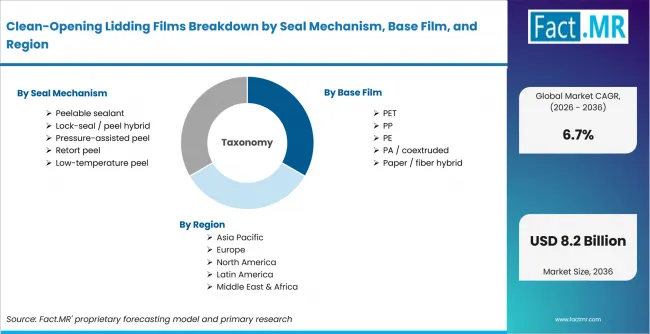
Clean Opening Lidding Films Breakdown By Seal Mechanism, Base Film, And Region | Source: Fact.MR
| Attribute | Details |
|---|---|
| Quantitative Units | USD billion |
| Market Definition | Flexible or semi-flexible lidding films engineered to create a secure heat seal and then separate from a cup, tray or container with a controlled, clean opening. |
| Seal Mechanism | Peelable sealant; Lock-seal / peel hybrid; Pressure-assisted peel; Retort peel; Low-temperature peel |
| Base Film | PET; PP; PE; PA / coextruded; Paper / fiber hybrid |
| Opening Performance | Clean peel; Easy peel; Consumer-friendly peel force; Secure tamper seal; No-string / no-shred opening |
| Application | Dairy cups; Trays / ready meals; Meat / cheese; Produce; Medical / specialty food |
| Regions Covered | North America; Latin America; Western Europe; Eastern Europe; East Asia; South Asia & Pacific; Middle East & Africa |
| Countries Profiled | China; United States; Japan; Germany; France |
| Key Companies Profiled | Amcor; Klöckner Pentaplast; Constantia Flexibles; Coveris; Winpak |
| Forecast Period | 2026 to 2036 |
| Approach | Demand mapping by application, film substrate, seal mechanism, opening performance, country indicators and provider portfolio review. |
How is the market segmented?
-
By Seal Mechanism:
- Peelable sealant
- Lock-seal / peel hybrid
- Pressure-assisted peel
- Retort peel
- Low-temperature peel
-
By Base Film:
- PET
- PP
- PE
- PA / coextruded
- Paper / fiber hybrid
-
By Opening Performance:
- Clean peel
- Easy peel
- Consumer-friendly peel force
- Secure tamper seal
- No-string / no-shred opening
-
By Application:
- Dairy cups
- Trays / ready meals
- Meat / cheese
- Produce
- Medical / specialty food
-
By Region:
- North America
- Latin America
- Western Europe
- Eastern Europe
- East Asia
- South Asia & Pacific
- Middle East & Africa