- Market Value (2025): USD 37.6 Mn
- Estimated Value (2026): USD 42.2 Mn
- Forecast Value (2036): USD 132.7 Mn
- CAGR (2026-2036): 12.1%
What is the Clinical Workflow FeNO Devices Market forecast to be worth by 2036?
USD 42.2 million in 2026 to USD 132.7 million by 2036 at a 12.1% CAGR.
- Fact.MR estimates that the Clinical Workflow FeNO Devices Market reached a value of USD 37.6 million in 2025.
- demand is projected to increase from USD 42.2 million in 2026 to USD 132.7 million by 2036.
- The forecast indicates a 12.1% CAGR from 2026 to 2036 as healthcare providers increasingly incorporate FeNO measurements into respiratory assessment and patient monitoring workflows.
| Year | Basis | Market Value (USD million) |
|---|---|---|
| 2025 | Actual | 37.6 |
| 2026 | Estimate | 42.2 |
| 2036 | Forecast | 132.7 |
| CAGR 2026 to 2036 | Forecast period | 12.1% |
Source: Fact.MR analysis. Updated Nov 11, 2026
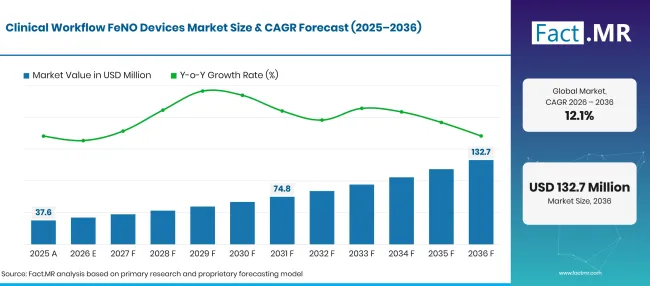
Clinical Workflow Feno Devices Forecast Global | Source: Fact.MR
What are the defining numbers behind Clinical Workflow FeNO Devices Market growth?
USD 90.5 million in additional market value between 2026 and 2036.
-
Demand Drivers in the Market
- Greater use of FeNO testing in asthma assessment supports demand for clinical testing systems. The BTS/NICE/SIGN asthma guideline recommends FeNO measurement as an objective test for adults with a history suggestive of asthma. It also recommends considering FeNO monitoring for adults with asthma at regular reviews and before and after changes to therapy.
- Need for more complete respiratory assessments encourages the use of FeNO alongside established diagnostic methods. The U.S. National Asthma Education and Prevention Program conditionally recommends FeNO measurement for patients aged five years and older with persistent allergic asthma when decisions about anti-inflammatory therapy remain uncertain after clinical assessment and spirometry.
- Growth in pediatric respiratory assessment creates demand for devices that support children and adults with suitable testing procedures. FeNO systems with guided breathing instructions and age-specific measurement modes can help clinicians conduct tests in younger patients. Device usability and patient cooperation remain important factors when selecting equipment for pediatric care.
- Digital patient management and remote monitoring create opportunities for connected FeNO platforms. Bosch Vivatmo combines clinical and home measurement options with an app for recording patient FeNO values and related asthma information. Such systems can help clinicians review measurements over time and support communication between consultations.
- Key Segments Analyzed
- By Clinical FeNO Integration: EHR Integration is projected to account for 34.0% of the market in 2026. Demand reflects the value of incorporating test results into patient records and clinical documentation.
- By Clinical Care Location: Pediatric Care is estimated to hold 30.5% share in 2026. This reflects the need for age-appropriate respiratory assessment and guided testing procedures.
- By Device Consumable Model: Reusable Sensor is forecast to lead with a 33.9% share in 2026. Its position reflects the role of sensor-based measurement systems in repeated clinical testing.
- By Patient / Use Profile: Adult Asthma is projected to capture 28.8% share in 2026. FeNO measurement supports the assessment of airway inflammation and treatment response in suitable adult patients.
- Analyst Opinion at Fact.MR
- Shambhu Nath Jha, Principal Consultant at Fact.MR, states, “Clinical workflow FeNO devices are gaining relevance as respiratory teams look for practical ways to include airway inflammation measurements in asthma assessment. Manufacturers that combine reliable testing with patient data management and straightforward clinical integration can address important workflow requirements.”
- Strategic Implications
- Device manufacturers can strengthen market positioning by improving connectivity with electronic health records and patient management systems. Compatibility with common data exchange standards can reduce manual documentation and help respiratory teams incorporate FeNO readings into existing clinical workflows.
- Healthcare providers need to interpret FeNO results alongside patient symptoms and lung-function measurements rather than relying on a single test for asthma diagnosis or treatment decisions. Consistent clinical protocols can help teams use biomarker results appropriately across pediatric and adult care.
- Technology developers can improve device adoption by simplifying patient instructions and measurement procedures. Clear visual guidance and reliable performance across repeated tests can support use in busy clinics where staff need to complete assessments without adding unnecessary steps.
- Suppliers can expand their role by offering connected monitoring platforms that allow clinicians to review patient results over time. Integration with clinical records and remote monitoring tools can support longitudinal assessment and improve communication between patients and respiratory care teams.
The United Kingdom is projected to record the highest growth among the listed countries at 14.5% CAGR through 2036. China follows at 14.3%, while the USA is estimated to advance at 14.2%. Germany is forecast to grow at 13.1%, followed by Japan at 10.8%.
How does the Clinical Workflow FeNO Devices Market break down by segment?
Fact.MR estimates that EHR Integration leads Clinical FeNO Integration at 34.0%; Pediatric Care leads Clinical Care Location at 30.5%; Reusable Sensor leads Device Consumable Model at 33.9%; and Adult Asthma leads Patient / Use Profile at 28.8% in 2026.
Which Clinical FeNO Integration category dominates?
EHR Integration is set to hold 34.0% share in 2026.
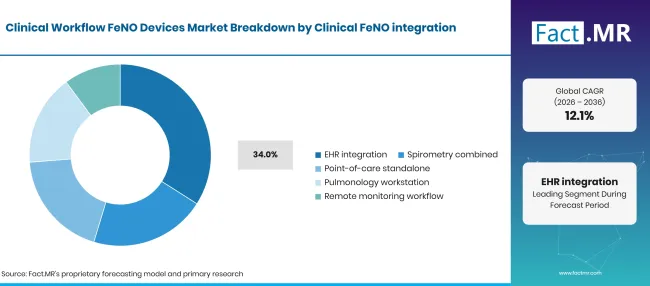
Clinical Workflow Feno Devices Breakdown Clinical Feno Integration | Source: Fact.MR
| Clinical FeNO Integration | Share (2026) |
|---|---|
| EHR Integration (Leading segment) | 34.0% |
| Other segments combined | 66.0%* |
| Total | 100.0% |
Source: Fact.MR analysis. Updated Nov 11, 2026
EHR integration leads because clinical teams need FeNO results to remain accessible alongside patient histories and other diagnostic findings. Connected systems can reduce separate data entry and make previous measurements easier to review. Spirometry-combined platforms and pulmonology workstations also support coordinated respiratory assessment, while standalone point-of-care devices remain relevant where broader IT integration is limited.
What leads the Clinical Care Location segment?
Pediatric Care is set to represent 30.5% share in 2026.
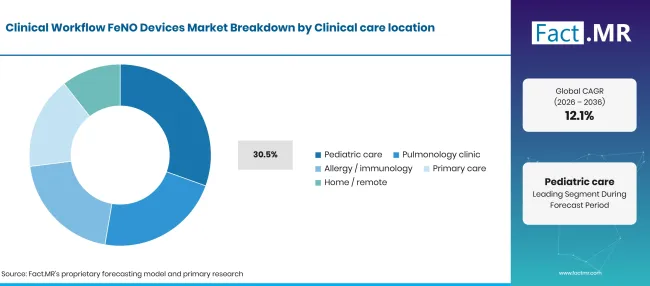
Clinical Workflow Feno Devices Breakdown Clinical Care Location | Source: Fact.MR
| Clinical Care Location | Share (2026) |
|---|---|
| Pediatric Care (Leading segment) | 30.5% |
| Other segments combined | 69.5%* |
| Total | 100.0% |
Source: Fact.MR analysis. Updated Nov 11, 2026
Pediatric care represents the largest share under the segmentation. FeNO testing can provide information about airway inflammation in children who are able to complete the required breathing maneuver. Device manufacturers need to provide age-appropriate instructions and measurement modes. Pulmonology clinics and allergy or immunology centers also use FeNO as part of respiratory assessment, while home and remote settings support follow-up monitoring.
How does the Device Consumable Model shape demand?
Reusable Sensor is likely to account for 33.9% share in 2026.
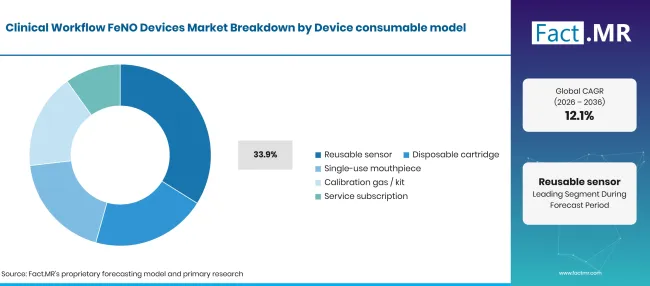
Clinical Workflow Feno Devices Breakdown Device Consumable Model | Source: Fact.MR
| Device Consumable Model | Share (2026) |
|---|---|
| Reusable Sensor (Leading segment) | 33.9% |
| Other segments combined | 66.1%* |
| Total | 100.0% |
Source: Fact.MR analysis. Updated Nov 11, 2026
Reusable sensor systems can support repeated measurements through a device platform designed for ongoing clinical use. Their commercial value depends on sensor life and maintenance requirements as well as measurement consistency. Disposable cartridges and single-use mouthpieces address different testing and hygiene requirements. Calibration kits and service subscriptions contribute to the broader ownership and operating model of FeNO equipment.
Which Patient / Use Profile accounts for the largest share?
Adult Asthma is projected to hold 28.8% share in 2026.
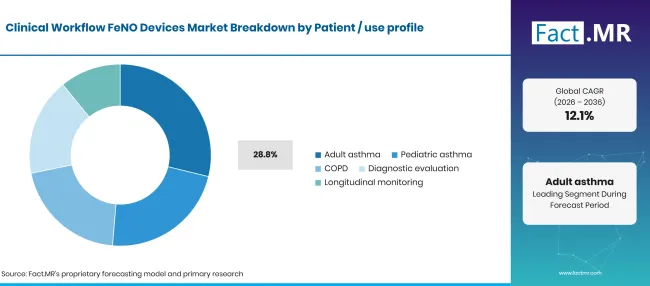
Clinical Workflow Feno Devices Breakdown Patient Use Profile | Source: Fact.MR
| Patient / Use Profile | Share (2026) |
|---|---|
| Adult Asthma (Leading segment) | 28.8% |
| Other segments combined | 71.2%* |
| Total | 100.0% |
Source: Fact.MR analysis. Updated Nov 11, 2026
Adult asthma leads the specified patient and use profile categories because FeNO measurement is used to assess eosinophilic airway inflammation and support decisions about treatment response in appropriate patients. Pediatric asthma remains an important application, while COPD assessment and diagnostic evaluation represent additional use cases. Longitudinal monitoring can support review of changes in FeNO levels over time.
What is accelerating Clinical Workflow FeNO Devices Market adoption, and what is holding it back?
Demand is supported by wider use of objective asthma assessment and interest in connected respiratory care. However, equipment costs and the need for trained interpretation can limit adoption across smaller healthcare facilities.
Drivers Impact Analysis
| DRIVER | (~) % IMPACT ON CAGR | GEOGRAPHIC RELEVANCE | IMPACT TIMELINE |
|---|---|---|---|
| Greater use of FeNO in asthma assessment | +1.0% | North America, Europe | Short term (≤ 2 years) |
| Integration with electronic health records | +0.9% | Global | Medium term (2–4 years) |
| Pediatric respiratory testing requirements | +0.7% | Global | Medium term (2–4 years) |
| Growth in connected patient monitoring | +0.6% | North America, Europe, Asia | Long term (≥ 4 years) |
| Wider access to point-of-care testing | +0.5% | Global | Medium term (2–4 years) |
Source: Fact.MR analysis. Updated Nov 11, 2026
Opportunity Impact Analysis
| OPPORTUNITY | (~) % IMPACT ON CAGR | GEOGRAPHIC RELEVANCE | IMPACT TIMELINE |
|---|---|---|---|
| EHR-compatible FeNO platforms | +0.8% | North America, Europe | Medium term (2–4 years) |
| Home and remote FeNO monitoring | +0.7% | Europe, North America | Long term (≥ 4 years) |
| Pediatric-friendly device interfaces | +0.5% | Global | Medium term (2–4 years) |
| Combined FeNO and spirometry workflows | +0.6% | Global | Medium term (2–4 years) |
| Patient data analytics and longitudinal reporting | +0.4% | Global | Long term (≥ 4 years) |
Source: Fact.MR analysis. Updated Nov 11, 2026
Restraints Impact Analysis
| RESTRAINT | (~) % IMPACT ON CAGR | GEOGRAPHIC RELEVANCE | IMPACT TIMELINE |
|---|---|---|---|
| Initial device and operating costs | -0.8% | Global | Short term (≤ 2 years) |
| Consumable replacement and maintenance requirements | -0.6% | Global | Short term (≤ 2 years) |
| Limited clinical IT integration | -0.5% | Emerging markets | Medium term (2–4 years) |
| Need for trained test interpretation | -0.4% | Global | Medium term (2–4 years) |
| Variation in reimbursement and procurement pathways | -0.3% | Global | Long term (≥ 4 years) |
Source: Fact.MR analysis. Updated Nov 11, 2026
Which countries are scaling the Clinical Workflow FeNO Devices Market through 2036?
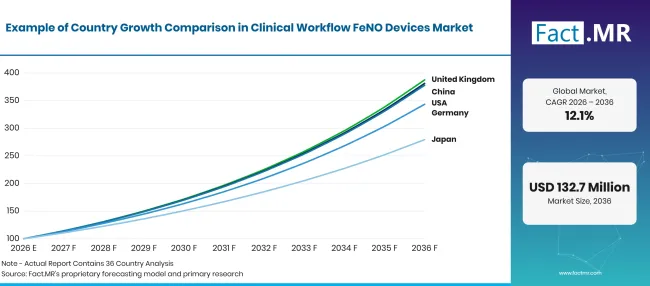
Clinical Workflow Feno Devices Growth Index | Source: Fact.MR
| Country | CAGR (2026–2036) |
|---|---|
| United Kingdom | 14.5% |
| China | 14.3% |
| USA | 14.2% |
| Germany | 13.1% |
| Japan | 10.8% |
Source: Fact.MR analysis. Updated Nov 11, 2026
What supports United Kingdom adoption?
14.5% CAGR, supported by guideline-backed FeNO testing and wider asthma monitoring across primary and specialist care.
The United Kingdom is projected to record the fastest growth among the listed countries. The BTS/NICE/SIGN asthma guideline recommends FeNO testing as part of objective asthma assessment and considers its use during regular reviews and before and after changes to therapy. This creates opportunities for devices used in primary care and specialist respiratory services. Suppliers can address demand through portable systems and patient management software that supports consistent documentation.
Which Factors Are Driving market growth in China?
14.3% CAGR, shaped by expanding respiratory diagnostic capacity and demand for accessible hospital-based testing.
China's projected growth reflects opportunities to expand access to respiratory diagnostic equipment across hospitals and specialist care settings. Device suppliers can focus on portable analyzers and systems that simplify testing procedures for clinical staff. Local distribution support and clear operating instructions can also help healthcare facilities evaluate equipment requirements for pediatric and adult respiratory assessment.
What supports United States adoption?
14.2% CAGR, driven by a substantial asthma patient population and growing emphasis on objective disease assessment.
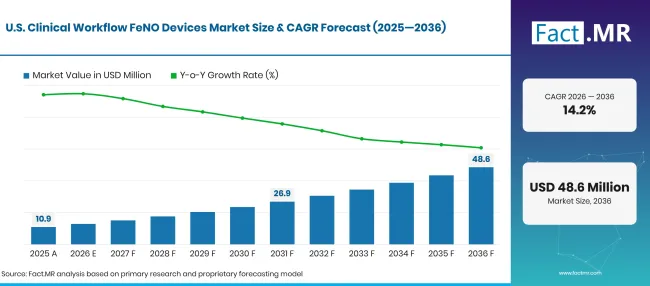
Clinical Workflow Feno Devices Forecast Usa | Source: Fact.MR
The United States market is supported by demand for objective asthma assessment and treatment monitoring. The CDC reported that 8.6% of adults and 6.5% of children in the country currently had asthma in 2024. FeNO devices can support assessment of airway inflammation when used alongside clinical history and lung-function testing. Manufacturers with established point-of-care systems and patient data management capabilities can address hospital and outpatient care requirements.
What are the Factors Supporting the Growth of the Germany Market?
13.1% CAGR, led by connected respiratory monitoring and the availability of professional and home-based FeNO systems.
Germany's projected growth is linked to opportunities for connected respiratory monitoring and point-of-care testing. Clinical and home-based FeNO measurement can provide additional information for physicians reviewing asthma patients over time. Bosch Healthcare Solutions offers the Vivatmo system with professional and home measurement options as well as an app for recording FeNO values and related patient information.
What supports Japan adoption?
10.8% CAGR, backed by demand for reliable asthma monitoring and streamlined respiratory testing in established healthcare settings.
Japan's market opportunity is shaped by demand for reliable respiratory assessment across hospitals and specialist clinics. Suppliers can focus on compact analyzers and straightforward patient testing procedures that fit established clinical workflows. Integration with electronic records and consistent access to replacement consumables can also influence purchasing decisions. Pediatric testing and longitudinal asthma monitoring provide additional application opportunities.
Who leads the Clinical Workflow FeNO Devices Market?
Fact.MR identifies NIOX Group plc, Bedfont Scientific Ltd., Bosch Healthcare Solutions GmbH, ECO MEDICS AG and Sunvou Medical Electronics Co., Ltd. as the companies profiled in this market.
NIOX Group offers FeNO measurement and monitoring systems for asthma diagnosis and management. Its product portfolio includes NIOX VERO and the next-generation NIOX PRO platform. The company also provides patient measurement software and consumables that support clinical use. Bedfont Scientific offers the NObreath FeNO device for measuring airway inflammation. Its FeNOchart software helps healthcare professionals record patient results, while its software development kit allows device functionality to be incorporated into compatible applications.
Bosch Healthcare Solutions provides the Vivatmo system for professional and home FeNO measurement. Its platform combines clinical testing equipment with an app and connectivity options that support patient data management and clinical workflow integration. ECO MEDICS offers pulmonary diagnostic products that include FeNO analysis. Its CLD 88 sp system supports single- and multiple-breath FeNO testing for asthma management and primary ciliary dyskinesia screening.
Sunvou Medical Electronics offers breath analysis systems that measure nitric oxide alongside other breath biomarkers. Its portfolio includes testing modes and quality-control features for respiratory and other clinical applications.
Competition depends on measurement performance and the ability to fit devices into existing respiratory care processes. Software compatibility and consumable availability also influence purchase decisions. Companies with clinical support and training programs can help healthcare providers introduce FeNO testing into routine assessment and monitoring workflows.
Which companies are the key providers?
Key Companies: NIOX Group plc, Bedfont Scientific Ltd., Bosch Healthcare Solutions GmbH, ECO MEDICS AG, and Sunvou Medical Electronics Co., Ltd.
- NIOX Group plc
- Bedfont Scientific Ltd.
- Bosch Healthcare Solutions GmbH
- ECO MEDICS AG
- Sunvou Medical Electronics Co., Ltd.
What is the report's scope and coverage?
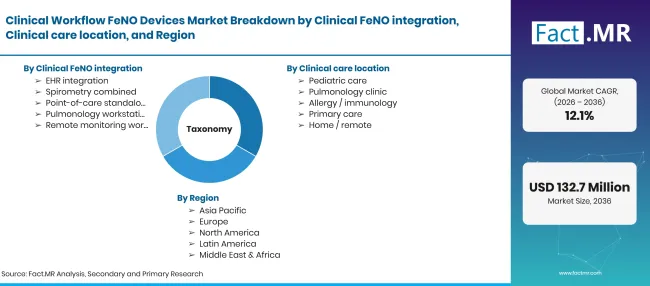
Clinical Workflow Feno Devices Taxonomy | Source: Fact.MR
| Attribute | Details |
|---|---|
| Quantitative Units | USD million |
| Market Definition | Clinical Workflow FeNO Devices are medical diagnostic systems and associated software solutions used to measure fractional exhaled nitric oxide (FeNO) in a patient's breath to assess airway inflammation and support asthma diagnosis and management. These solutions include standalone analyzers and connected platforms that facilitate clinical documentation and longitudinal respiratory monitoring across healthcare settings. |
| Clinical FeNO Integration | EHR Integration; Spirometry Combined; Point-of-Care Standalone; Pulmonology Workstation; Remote Monitoring Workflow |
| Clinical Care Location | Pediatric Care; Pulmonology Clinic; Allergy / Immunology; Primary Care; Home / Remote |
| Device Consumable Model | Reusable Sensor; Disposable Cartridge; Single-Use Mouthpiece; Calibration Gas / Kit; Service Subscription |
| Patient / Use Profile | Adult Asthma; Pediatric Asthma; COPD; Diagnostic Evaluation; Longitudinal Monitoring |
| Regions Covered | North America; Latin America; Western Europe; Eastern Europe; East Asia; South Asia & Pacific; Middle East & Africa |
| Countries Covered | USA; Germany; UK; China; Japan |
| Companies Profiled | NIOX Group plc; Bedfont Scientific Ltd.; Bosch Healthcare Solutions GmbH; ECO MEDICS AG; Sunvou Medical Electronics Co., Ltd. |
| Forecast Period | 2026 to 2036 |
| Approach | Market segmentation and scenario-based analysis supported by clinical guidelines and company portfolio research |
Source: Fact.MR analysis. Updated Nov 11, 2026
How is the market segmented?
-
By Clinical FeNO Integration
- EHR Integration
- Spirometry Combined
- Point-of-Care Standalone
- Pulmonology Workstation
- Remote Monitoring Workflow
-
By Clinical Care Location
- Pediatric Care
- Pulmonology Clinic
- Allergy / Immunology
- Primary Care
- Home / Remote
-
By Device Consumable Model
- Reusable Sensor
- Disposable Cartridge
- Single-Use Mouthpiece
- Calibration Gas / Kit
- Service Subscription
-
By Patient / Use Profile
- Adult Asthma
- Pediatric Asthma
- COPD
- Diagnostic Evaluation
- Longitudinal Monitoring
-
By Region
- North America
- Latin America
- Western Europe
- Eastern Europe
- East Asia
- South Asia & Pacific
- Middle East & Africa
Bibliography
- Bosch Healthcare Solutions GmbH. (n.d.). The Vivatmo System by Bosch.
- Centers for Disease Control and Prevention, National Center for Health Statistics. (n.d.). FastStats: Asthma.
- National Asthma Education and Prevention Program Coordinating Committee Expert Panel Working Group. (2020, December). 2020 focused updates to the asthma management guidelines. National Heart, Lung, and Blood Institute..
- National Institute for Health and Care Excellence. (2024, November 27). Asthma: diagnosis, monitoring and chronic asthma management (BTS, NICE, SIGN) – Recommendations (NG245).
- NIOX Group plc. (2026). Annual Report & Accounts: Year Ended 31 December 2025..
This Report Answers
- The report examines the use of clinical FeNO devices across the specified respiratory care settings.
- Segment analysis compares clinical integration approaches and their respective 2026 market shares.
- The assessment covers care locations including pediatric services and pulmonology clinics as well as primary care and home monitoring.
- The competitive overview profiles five named FeNO device and breath analysis providers.
- The analysis evaluates the role of sensors and consumables in device ownership and recurring operating requirements.
What does the Clinical Workflow FeNO Devices Market cover?
The market covers clinical devices and associated solutions used to measure fractional exhaled nitric oxide in human breath. These systems support the assessment of airway inflammation and can provide additional information during asthma diagnosis and monitoring. The market includes equipment used in hospitals and outpatient clinics as well as selected home monitoring applications.
What is included in the scope?
Included products comprise FeNO analyzers and related clinical measurement systems used for respiratory assessment.
The scope also considers associated patient management software and workflow features such as EHR connectivity and integration with spirometry. Device-related consumables and service models are included where they form part of the commercial offering.
What is excluded from the scope?
The analysis excludes general spirometry equipment that does not measure FeNO and breath analyzers that do not provide relevant nitric oxide measurements.
Laboratory research instruments without a clinical respiratory application are also excluded. General asthma medications and unrelated respiratory treatment equipment fall outside the defined device market.
How Was the Analysis Built?
The analysis draws on 120+ sources and 35+ company portfolios across 25+ countries and more than 20 industry interviews.
- Primary Research: Primary research includes discussions with medical device manufacturers and distributors as well as respiratory care professionals and healthcare consumption specialists. These conversations examine device selection and clinical integration requirements alongside consumable use and maintenance needs. Discussions also consider purchasing priorities and barriers to wider adoption.
- Desk Research: Desk research covers clinical guidelines and regulatory publications as well as company filings and product documentation. Government health statistics and industry publications provide additional context for respiratory disease burden and healthcare infrastructure. Sources used in the analysis are documented in the bibliography.
- Market Sizing and Forecasting: Market estimates combine historical performance and company participation with device pricing and consumable revenue trends. The forecast also considers clinical adoption patterns and care-setting requirements as well as country-level growth analysis and barriers to market expansion.
- Data Validation and Update Cycle: Findings are validated by comparing company disclosures with product documentation and clinical guidance. Regular updates review product launches and regulatory developments as well as distribution agreements and changes in clinical workflow requirements.
Frequently Asked Questions
How big is the Clinical Workflow FeNO Devices Market in 2026?
What is the CAGR from 2026 to 2036?
Which Clinical FeNO Integration category has the largest share?
Which Clinical Care Location leads?
Which Device Consumable Model leads?
Which Patient / Use Profile has the largest share?
Which country is projected to grow fastest?
Which companies are covered?
Who worked on this report


Preview the report firsthand - request a free sample
Free SampleGet the brochure for pricing and purchase details
Download PDF