- Market Value (2025): USD 29.1 Mn
- Estimated Value (2026): USD 34.1 Mn
- Forecast Value (2036): USD 164.8 Mn
- CAGR (2026-2036): 17.1%
What is the Cloud-Connected FeNO Systems Market forecast to be worth by 2036?
USD 34.1 million in 2026 to USD 164.8 million by 2036 at a 17.1% CAGR.
- Fact.MR estimates that the cloud-connected FeNO systems market reached a value of USD 29.1 million in 2025.
- Demand is projected to increase from USD 34.1 million in 2026 to USD 164.8 million by 2036.
- The market is projected to grow at a 17.1% CAGR from 2026 to 2036 as respiratory care providers adopt connected testing platforms and digital workflows.
| Year | Basis | Market Value (USD million) |
|---|---|---|
| 2025 | Derived estimate* | 29.1 |
| 2026 | Estimate | 34.1 |
| 2036 | Forecast | 164.8 |
| CAGR 2026 to 2036 | Forecast period | 17.1% |
Source: Fact.MR analysis. Updated Nov 11, 2026
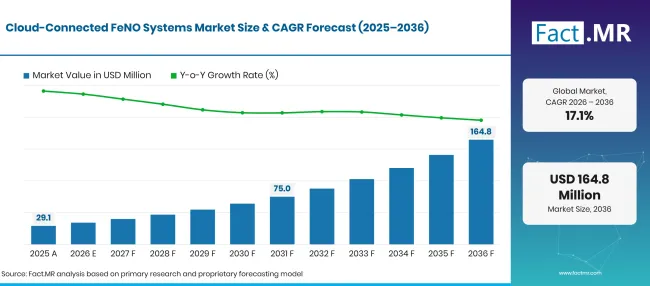
Cloud Connected Feno Systems Forecast Global | Source: Fact.MR
What are the defining numbers behind Cloud-Connected FeNO Systems Market growth?
USD 130.7 million in additional market value between 2026 and 2036.
-
Demand Drivers in the Market
- FeNO testing in asthma assessment supports demand for connected measurement systems. Fractional exhaled nitric oxide (FeNO) testing provides a non-invasive way to assess Type 2 airway inflammation. Its use as an adjunct to asthma diagnosis and patient assessment is encouraging demand for FeNO devices across primary care and specialist respiratory settings.
- Connected respiratory care is increasing demand for cloud-connected FeNO systems. Healthcare providers are adopting digital tools that make test results easier to transfer, access and review. Cloud connectivity can support information sharing across clinics and help healthcare professionals manage FeNO readings across multiple care locations.
- Asthma prevalence among children and adults supports demand for respiratory testing. The prevalence of asthma creates a need for accessible assessment and ongoing monitoring solutions. FeNO systems are gaining relevance in respiratory care pathways where clinicians use inflammation measurements alongside symptoms and other clinical findings.
- Primary care expansion and decentralized testing create opportunities for connected FeNO platforms. FeNO testing outside specialist hospitals can support earlier assessment and more convenient follow-up. Connected systems can help primary care providers share test information with respiratory specialists and maintain continuity across care settings.
- Key Segments Analyzed
- By Cloud FeNO Connectivity: Clinic network sync is forecast to account for 33.8% of the market in 2026, reflecting demand for centralized access to FeNO test information across connected clinical locations.
- By Clinical Care Location: Primary care is projected to hold 26.3% of the market in 2026 as FeNO testing becomes more accessible outside specialist respiratory centers.
- By Device Consumable Model: Disposable cartridge is expected to lead with a 29.6% share in 2026, supported by recurring consumable requirements in compatible FeNO testing platforms.
- By Patient / Use Profile: Pediatric asthma is set to represent 30.3% of the market in 2026, reflecting the relevance of FeNO testing in childhood asthma assessment and management.
- Analyst Opinion at Fact.MR
- Shambhu Nath Jha, Principal Consultant at Fact.MR, states, “Cloud-connected FeNO systems can help respiratory care providers make test information more accessible across clinical locations. Manufacturers will need to combine reliable measurements with secure data handling and practical connectivity features to support wider use in asthma assessment and ongoing patient management.”
- Strategic Implications
- FeNO device manufacturers should prioritize secure clinic network synchronization and reliable data transfer to support multi-location respiratory care. They should also clarify whether connectivity covers patient results or only device management.
- Healthcare providers need to evaluate compatibility with existing electronic health record systems before adopting connected FeNO platforms. Clear workflows for reviewing and storing test results can improve continuity of care.
- Suppliers must develop pediatric-friendly testing interfaces and provide clear guidance on patient preparation. Measurement consistency and ease of use are important when systems are deployed across primary care and specialist settings.
- Device developers can balance disposable cartridge performance with recurring operating costs. Transparent consumable requirements and predictable supply can help clinics plan testing volumes and maintain service continuity.
The USA is projected to record the fastest growth at a 19.8% CAGR through 2036. Germany is set to advance at 18.1%, followed by China at 18.8% and the UK at 18.9%. Japan is forecast to grow at 15.2%.
How does the Cloud-Connected FeNO Systems Market break down by segment?
Fact.MR finds that Clinic network sync leads Cloud FeNO Connectivity at 33.8%; Primary care leads Clinical Care Location at 26.3%; Disposable cartridge leads Device Consumable Model at 29.6%; and Pediatric asthma leads Patient / Use Profile at 30.3%.
Which Cloud FeNO Connectivity model dominates?
Clinic network sync is set to hold a 33.8% share in 2026.
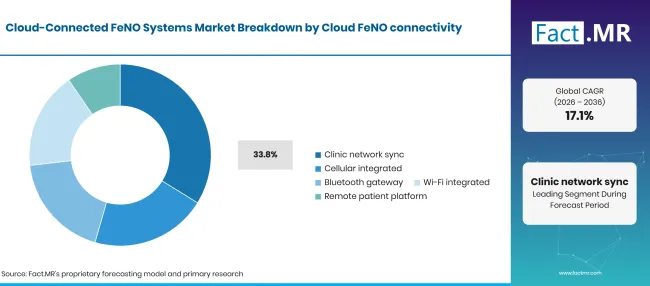
Cloud Connected Feno Systems Breakdown Cloud Feno Connectivity | Source: Fact.MR
| Cloud FeNO Connectivity | Share (2026) |
|---|---|
| Clinic network sync (Leading segment) | 33.8% |
| Other segments combined | 66.2%* |
| Total | 100.0% |
Source: Fact.MR analysis. Updated Nov 11, 2026
Clinic network synchronization enables FeNO test information to be accessed across connected clinical locations. This can support centralized review and consistent record management for healthcare groups operating multiple facilities. Connected systems can also reduce manual data transfer between devices and clinical software. However, manufacturers need to specify whether synchronization includes patient-level results or only device status and technical information.
Which Clinical Care Location leads?
Primary care is set to represent 26.3% of the market in 2026.
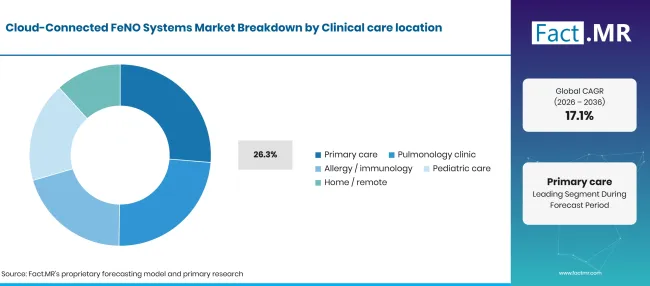
Cloud Connected Feno Systems Breakdown Clinical Care Location | Source: Fact.MR
| Clinical Care Location | Share (2026) |
|---|---|
| Primary care (Leading segment) | 26.3% |
| Other segments combined | 73.7%* |
| Total | 100.0% |
Source: Fact.MR analysis. Updated Nov 11, 2026
Primary care offers an accessible setting for FeNO testing because patients can undergo airway inflammation assessment during routine consultations. FeNO measurement can support asthma diagnosis when considered alongside symptoms and other objective tests. It can also help monitor airway inflammation in people with diagnosed asthma. This creates opportunities for connected devices that fit general practice workflows.
What leads the Device Consumable Model segment?
Disposable cartridge is set to account for 29.6% of the market in 2026.
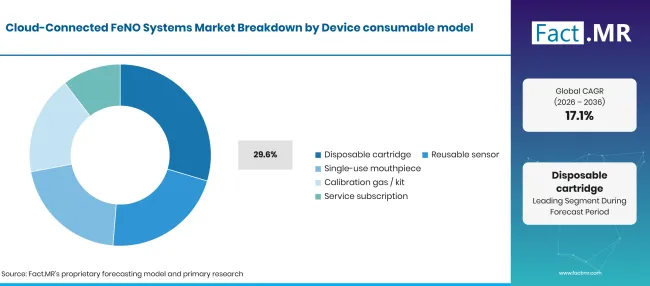
Cloud Connected Feno Systems Breakdown Device Consumable Model | Source: Fact.MR
| Device Consumable Model | Share (2026) |
|---|---|
| Disposable cartridge (Leading segment) | 29.6% |
| Other segments combined | 70.4%* |
| Total | 100.0% |
Source: Fact.MR analysis. Updated Nov 11, 2026
Disposable cartridges support testing platforms designed around replaceable measurement components. Their recurring use can create repeat purchasing requirements for clinics and diagnostic centers. Manufacturers need to maintain consistent supply and provide clear replacement instructions. Reusable sensors and single-use mouthpieces serve different device designs and should be evaluated according to measurement requirements and operating costs.
Which Patient / Use Profile accounts for the largest share?
Pediatric asthma is projected to represent 30.3% of the market in 2026.
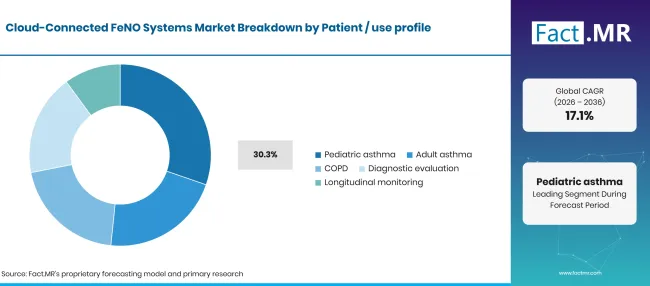
Cloud Connected Feno Systems Breakdown Patient Use Profile | Source: Fact.MR
| Patient / Use Profile | Share (2026) |
|---|---|
| Pediatric asthma (Leading segment) | 30.3% |
| Other segments combined | 69.7%* |
| Total | 100.0% |
Source: Fact.MR analysis. Updated Nov 11, 2026
Pediatric asthma represents a significant application area for FeNO testing because the measurement can help assess Type 2 airway inflammation in children with symptoms suggestive of asthma. The BTS/NICE/SIGN asthma guideline includes FeNO measurement among the objective tests used to assess suspected asthma in children aged five to sixteen, alongside clinical history and other diagnostic findings. Devices designed for children need suitable breathing guidance and age-appropriate test procedures.
What is accelerating Cloud-Connected FeNO Systems Market adoption, and what is holding it back?
Greater use of FeNO in asthma assessment and wider digital connectivity support market growth. Data integration costs and differences in device connectivity capabilities can slow adoption.
Drivers Impact Analysis
| DRIVER | (~) % IMPACT ON CAGR | GEOGRAPHIC RELEVANCE | IMPACT TIMELINE |
|---|---|---|---|
| Wider use of FeNO in asthma assessment | +1.2% | North America, Europe | Short term (≤ 2 years) |
| Connected clinic network workflows | +1.0% | Global | Medium term (2–4 years) |
| Growth in pediatric asthma assessment | +0.8% | Global | Medium term (2–4 years) |
| Integration with clinical information systems | +0.7% | North America, Europe | Long term (≥ 4 years) |
| Demand for remote device management | +0.5% | Global | Medium term (2–4 years) |
Source: Fact.MR analysis. Updated Nov 11, 2026
Opportunity Impact Analysis
| OPPORTUNITY | (~) % IMPACT ON CAGR | GEOGRAPHIC RELEVANCE | IMPACT TIMELINE |
|---|---|---|---|
| Interoperability with electronic health records | +0.9% | North America, Europe | Medium term (2–4 years) |
| Multi-site clinic synchronization | +0.8% | Global | Medium term (2–4 years) |
| Pediatric-friendly connected devices | +0.6% | Global | Long term (≥ 4 years) |
| Secure remote access to test records | +0.6% | Global | Long term (≥ 4 years) |
Source: Fact.MR analysis. Updated Nov 11, 2026
Restraints Impact Analysis
| RESTRAINT | (~) % IMPACT ON CAGR | GEOGRAPHIC RELEVANCE | IMPACT TIMELINE |
|---|---|---|---|
| High device and connectivity costs | -0.8% | Emerging markets | Short term (≤ 2 years) |
| Data privacy and cybersecurity requirements | -0.7% | Global | Medium term (2–4 years) |
| Limited interoperability across clinical systems | -0.6% | Global | Medium term (2–4 years) |
| Recurring consumable expenses | -0.5% | Global | Short term (≤ 2 years) |
Source: Fact.MR analysis. Updated Nov 11, 2026
Which countries are scaling the Cloud-Connected FeNO Systems Market through 2036?
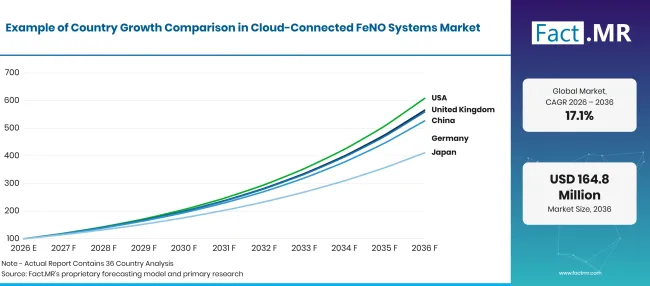
Cloud Connected Feno Systems Growth Index | Source: Fact.MR
| Country | CAGR (2026–2036) |
|---|---|
| USA | 19.8% |
| UK | 18.9% |
| China | 18.8% |
| Germany | 18.1% |
| Japan | 15.2% |
Source: Fact.MR analysis. Updated Nov 11, 2026
What supports United States market growth?
19.8% CAGR, supported by established asthma care services and demand for connected respiratory testing.
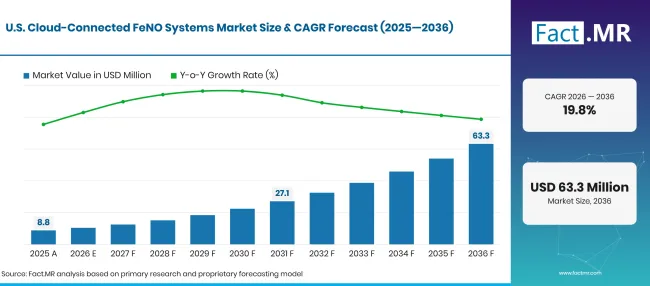
Cloud Connected Feno Systems Forecast Usa | Source: Fact.MR
The United States has a substantial population requiring asthma assessment and monitoring. The CDC reported that 8.5% of adults and 6.3% of children had current asthma in 2025. This creates opportunities for FeNO systems that support objective airway inflammation assessment. Manufacturers can strengthen adoption by offering secure data synchronization and compatibility with clinical workflows.
How is the United Kingdom building adoption?
18.9% CAGR, shaped by primary care asthma management and digital health integration.
England recorded approximately 3.94 million people aged six and older on asthma registers in 2024/25. The recorded prevalence reached 6.6% according to NHS England data compiled by the Office for Health Improvement and Disparities. This established patient base supports demand for routine asthma assessment. Connected FeNO systems can help primary care teams access test information and support follow-up reviews.
How is China developing the market?
18.8% CAGR, driven by expanding respiratory diagnostics and growing attention to asthma management.
Clinical asthma care in China creates opportunities for wider use of objective airway inflammation assessment, alongside symptoms and lung-function testing.der access to respiratory assessment and greater availability of connected diagnostic devices can support market development. Suppliers can focus on clinic network integration and cost-effective testing solutions.
What supports Germany’s market development?
18.1% CAGR, led by a large diagnosed asthma population and established respiratory care infrastructure.
Germany has an established asthma care system involving primary care and specialist respiratory services.is patient base creates demand for consistent assessment and ongoing disease management. Connected FeNO platforms can support clinics by simplifying access to test records and enabling device management across healthcare locations. Manufacturers should prioritize secure data handling and compatibility with clinical information systems.
What supports Japan’s market growth?
15.2% CAGR, backed by established asthma treatment pathways and demand for more personalized respiratory care.
Japan has established respiratory care services for asthma assessment and follow-up.ntinued emphasis on asthma phenotyping and treatment management can support demand for FeNO testing. Connected systems can help providers review measurements during follow-up consultations.
Who leads the Cloud-Connected FeNO Systems Market?
Fact.MR finds that NIOX Group plc, Bosch Healthcare Solutions GmbH, LOTHAR MEDTEC GmbH / Lothar Medical, ZEPHYRX and Biometry Inc. / myBiometry are profiled across the FeNO testing and connected respiratory diagnostics value chain.
NIOX Group plc has a direct cloud-connected FeNO offering through its NIOX PRO device and NIOX Cloud application. The platform allows healthcare professionals to synchronize FeNO results and access or manage data through a web application and supported devices. Bosch Healthcare Solutions GmbH offers the Vivatmo Pro FeNO system and Vivasuite cloud-based device management platform. Vivasuite supports remote software updates and device monitoring. Bosch specifies that Vivasuite receives technical device information rather than patient data. Vivatmo Pro also supports data exchange through interfaces such as HL7 and GDT.
Competition depends on the accuracy of FeNO measurements and the quality of supporting digital workflows. Providers need clear information about data storage and system interoperability. Manufacturers also need to distinguish cloud-based patient data management from remote device monitoring because these capabilities serve different clinical and operational purposes.
Which companies are the key providers?
Key companies include NIOX Group plc; Bosch Healthcare Solutions GmbH; LOTHAR MEDTEC GmbH / Lothar Medical; ZEPHYRX; and Biometry Inc. / myBiometry
- NIOX Group plc
- Bosch Healthcare Solutions GmbH
- LOTHAR MEDTEC GmbH / Lothar Medical
- ZEPHYRX
- Biometry Inc. / myBiometry
Bibliography
- Bosch Healthcare Solutions GmbH. (n.d.). Vivasuite.
- Centers for Disease Control and Prevention, National Center for Health Statistics. (2026, July 9). Asthma. NCHS Data Query System..
- Federal Ministry of Health, Germany. (n.d.). Asthma: Symptoms, outlook, and treatment..
- Ministry of Health, Labour and Welfare, Japan. (2025, September 11). Patient numbers by clinical area.
- National Health Commission of the People’s Republic of China. (2026, April 3). 2025 China Health Statistics Yearbook..
- National Institute for Health and Care Excellence. (2024, November 27). Asthma: Diagnosis, monitoring and chronic asthma management (BTS, NICE, SIGN) – Recommendations (NG245)..
- NIOX Group plc. (2025). NIOX Cloud® launched.
- Office for Health Improvement and Disparities. (2026, May 6). Respiratory disease profile. GOV.UK.
- Office for Health Improvement and Disparities. (2026, May 6). Respiratory disease profile: Statistical commentary, May 2026. GOV.UK..
This Report Answers
- The report evaluates demand for cloud-connected FeNO systems across the specified connectivity models.
- Segment analysis compares clinical care locations and device consumable models using their 2026 shares.
- Country analysis discusses the USA; Germany; UK; China; and Japan alongside available asthma statistics.
- The competitive overview profiles NIOX Group plc; Bosch Healthcare Solutions GmbH; LOTHAR MEDTEC GmbH / Lothar Medical; ZEPHYRX; and Biometry Inc. / myBiometry
- Application analysis distinguishes pediatric asthma and adult asthma testing from diagnostic evaluation and longitudinal monitoring.
What does the Cloud-Connected FeNO Systems Market cover?
The market covers FeNO testing platforms that measure nitric oxide in exhaled breath and support connected access to test information. It includes devices with clinic network synchronization and other connectivity features. The scope also covers compatible software and digital services used to manage measurements across clinical locations.
What is included in the scope?
Included products comprise FeNO analyzers with connected data transfer or management capabilities.
The scope covers clinic network synchronization and cellular or wireless connectivity. It also includes supporting software and compatible consumables such as disposable cartridges and single-use mouthpieces. Both primary care and specialist respiratory care applications are considered.
What is excluded from the scope?
The analysis excludes standalone FeNO analyzers without connected functionality.
General spirometry devices and respiratory monitoring equipment that do not measure fractional exhaled nitric oxide are outside the defined market. General electronic health record software and unrelated telehealth services are also excluded unless directly integrated with a covered FeNO platform.
How Was the Analysis Built?
The analysis draws on 120+ sources and 35+ company portfolios across 25+ countries with more than 20 industry interviews.
- Primary Research: Primary research includes discussions with medical device manufacturers and respiratory care providers. These conversations examine device purchasing priorities and connectivity requirements alongside clinical workflows and barriers to wider adoption.
- Desk Research: Desk research covers government health statistics and clinical guidelines as well as regulatory publications and company filings. Technical studies and product documentation are reviewed to understand FeNO measurement and connected device capabilities.
- Market Sizing and Forecasting: Market estimates combine historical performance and demand indicators with segment shares and company participation. Country-level growth and adoption patterns are assessed alongside device pricing and barriers to market expansion.
- Data Validation and Update Cycle: Findings are validated by comparing primary interviews with public data and company activity. Regular updates review product launches and software developments as well as connectivity upgrades and changes in clinical adoption.
Segmentation
What is the report’s scope and coverage?
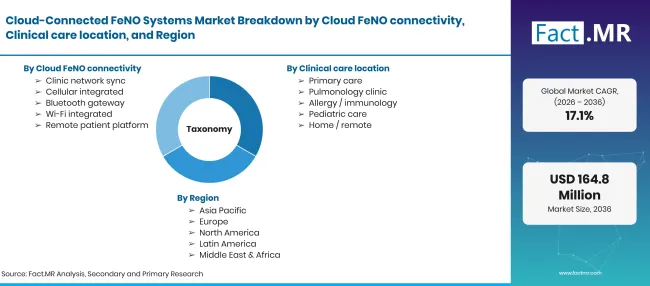
Cloud Connected Feno Systems Taxonomy | Source: Fact.MR
| Attribute | Details |
|---|---|
| Quantitative Units | USD million |
| Market Definition | Cloud-connected FeNO systems are respiratory diagnostic devices that measure fractional exhaled nitric oxide (FeNO) to assess airway inflammation and support asthma evaluation and monitoring. These systems incorporate digital connectivity features that enable the transfer, storage and management of test results across healthcare settings, supporting clinical review and continuity of respiratory care. |
| Cloud FeNO Connectivity | Clinic network sync; Cellular integrated; Bluetooth gateway; Wi-Fi integrated; Remote patient platform |
| Clinical Care Location | Primary care; Pulmonology clinic; Allergy / immunology; Pediatric care; Home / remote |
| Device Consumable Model | Disposable cartridge; Reusable sensor; Single-use mouthpiece; Calibration gas / kit; Service subscription |
| Patient / Use Profile | Pediatric asthma; Adult asthma; COPD; Diagnostic evaluation; Longitudinal monitoring |
| Regions Covered | North America; Latin America; Western Europe; Eastern Europe; East Asia; South Asia & Pacific; Middle East & Africa |
| Countries Covered | USA; Germany; UK; China; Japan |
| Companies Profiled | NIOX Group plc; Bosch Healthcare Solutions GmbH; LOTHAR MEDTEC GmbH / Lothar Medical; ZEPHYRX; Biometry Inc. / myBiometry |
| Forecast Period | 2026 to 2036 |
| Approach | Market segmentation and scenario-based analysis supported by clinical guidelines; respiratory disease statistics; and company portfolio reviews |
Source: Fact.MR analysis. Updated Nov 11, 2026
How is the market segmented?
-
By Cloud FeNO Connectivity
- Clinic network sync
- Cellular integrated
- Bluetooth gateway
- Wi-Fi integrated
- Remote patient platform
-
By Clinical Care Location
- Primary care
- Pulmonology clinic
- Allergy / immunology
- Pediatric care
- Home / remote
-
By Device Consumable Model
- Disposable cartridge
- Reusable sensor
- Single-use mouthpiece
- Calibration gas / kit
- Service subscription
-
By Patient / Use Profile
- Pediatric asthma
- Adult asthma
- COPD
- Diagnostic evaluation
- Longitudinal monitoring
-
By Region
- North America
- Latin America
- Western Europe
- Eastern Europe
- East Asia
- South Asia & Pacific
- Middle East & Africa
Frequently Asked Questions
How big is the Cloud-Connected FeNO Systems Market in 2026?
What is the CAGR from 2026 to 2036?
Which connectivity model has the largest share?
Which clinical care location leads?
Which device consumable model has the largest share?
Which patient / use profile leads?
Which companies are covered?
Who worked on this report


Preview the report firsthand - request a free sample
Free SampleGet the brochure for pricing and purchase details
Download PDF