- Market Value (2025): USD 275.3 Mn
- Estimated Value (2026): USD 325.0 Mn
- Forecast Value (2036): USD 1708.2 Mn
- CAGR (2026-2036): 18.1%
What is the Consumer Neurostimulation Wellness Devices Market forecast to be worth by 2036?
USD 325.0 million in 2026 to USD 1708.2 million by 2036 at an 18.1% CAGR.
- Spending on consumer neurostimulation wellness devices came to USD 275.3 million in 2025, a base built mostly on cranial electrotherapy units, auricular stimulators and the first prescription tDCS headsets.
- Revenue will grow from USD 325.0 million in 2026 to USD 1708.2 million by 2036, with the gain resting on authorized home therapies and app-linked wellness stimulators.
- An 18.1% CAGR reflects a young category gaining medical credibility, so each new authorization widens the pool of clinicians willing to recommend home stimulation.
| Year | Basis | Market Value (USD million) |
|---|---|---|
| 2025 | Actual | 275.3 |
| 2026 | Estimate | 325.0 |
| 2036 | Forecast | 1,708.2 |
| CAGR 2026 to 2036 | Forecast period | 18.1% |
Source: Fact.MR analysis. Updated Nov 12, 2026
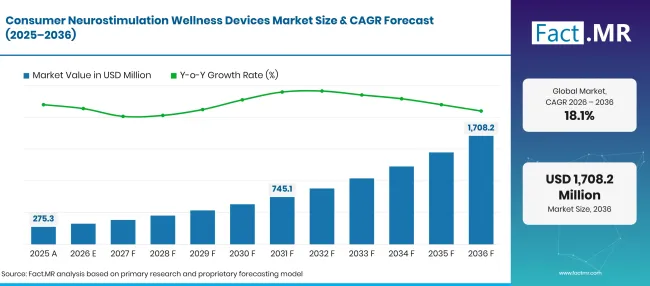
Consumer Neurostimulation Wellness Devices Forecast Global | Source: Fact.MR
What are the defining numbers behind Consumer Neurostimulation Wellness Devices Market growth?
The 2026 to 2036 period adds USD 1383.2 million in new value, with most of it coming from supervised home treatment and consumer vagus nerve products.
- Demand Drivers in the Market
- Mental health need is the first engine of demand. The World Health Organization reported in September 2025 that more than 1 billion people live with mental health conditions, with anxiety and depression the most common disorders for both men and women.
- Regulatory firsts are giving the category clinical standing. The FDA approved the Flow FL-100 tDCS headset on December 8, 2025, for adults with moderate to severe major depressive disorder. In May 2026 the agency granted De Novo authorization to Modius Spero, a head-worn stimulator for home treatment of PTSD symptoms under professional direction.
- Clearer rules on wellness claims help honest suppliers. The FDA reissued its General Wellness guidance on January 6, 2026, and it cites a neurostimulation product that claims to improve memory as an example that is not low risk. Brands therefore keep relaxation and sleep claims modest, which builds trust with retailers.
- Mass retail is opening for vagus nerve stimulators. electroCore placed its Truvaga Plus handheld wellness stimulator on Amazon in February 2025.
- Key Segments Analyzed
- By Consumer Stimulation Modality: tDCS will hold 25.9% share in 2026, helped by the first FDA-approved home headset for depression and a deep base of published brain stimulation research.
- By Device Form Factor: Home Tabletop / Fixture will account for 31.9% of 2026 value, since cranial electrotherapy units with wired ear clips and control boxes remain the installed base in many homes.
- By Data Processing: Clinician-Linked Dashboard will capture 30.7% in 2026 as prescribed devices require a professional to review adherence and session logs.
- By Sales Channel: Retail Electronics will take 33.2% in 2026, given that wellness stimulators now share shelf space and online listings with earbuds and smartwatches.
- Analyst Opinion at Fact.MR
- Shambhu Nath Jha, Principal Consultant at Fact.MR, states, “Home neurostimulation has crossed an important threshold, because regulators now treat the strongest products as real therapy. The winners will be companies that pair a comfortable headset or ear device with clinician software and honest claims. Wellness brands that overstate cognitive benefits will face retailer pushback and regulatory risk.”
- Strategic Implications
- Manufacturers should design intensity controls and electrode placement guides that a first-time user can follow without help.
- Software teams should give clinicians a clear view of session adherence while protecting user data with encryption and role-based access.
- Healthcare providers should separate general wellness stimulators from products authorized for depression, PTSD or insomnia, and they should supervise any use linked to a diagnosed condition.
- Retailers should state prescription requirements and regulatory status on every listing, which reduces mistaken purchases and protects them from claims that cross into disease treatment.
- Investors should favor companies with an FDA authorization or CE certification in hand, as these assets shorten the path to reimbursement and professional referral.
South Korea will lead the country set at a 21.1% CAGR, 1.6 points ahead of China at 19.5%, because an aging and highly connected population takes up app-linked home care quickly. China and the United States, at 19.3%, are separated by only 0.2 points, though their engines differ: online smart-product buying in China and authorized prescription therapies in the US. Japan follows at 18.9%, 0.4 points behind the US, with demand concentrated among older adults. Germany closes the list at 17.8%, a 1.1-point gap to Japan that reflects slower uptake of devices sold outside the medical channel.
How does the Consumer Neurostimulation Wellness Devices Market break down by segment?
tDCS will lead Consumer Stimulation Modality at 25.9%; Home Tabletop / Fixture will head Device Form Factor at 31.9%; Clinician-Linked Dashboard will hold Data Processing at 30.7%; Retail Electronics will lead Sales Channel at 33.2% in 2026.
Which Consumer Stimulation Modality leads?
tDCS takes 25.9% of 2026 sales.
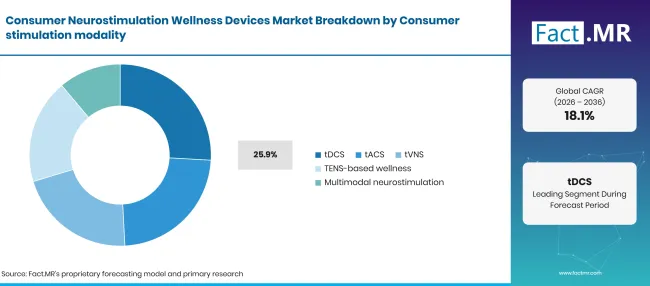
Consumer Neurostimulation Wellness Devices Breakdown Consumer Stimulation Modality | Source: Fact.MR
| Consumer Stimulation Modality | Share (2026) |
|---|---|
| tDCS (Leading segment) | 25.9% |
| Other segments combined | 74.1%* |
| Total | 100.0% |
Source: Fact.MR analysis. Updated Nov 12, 2026
Depression patients who want a drug-free option at home are the core users of transcranial direct current stimulation. The method sends a weak, steady current between two scalp electrodes, and the FDA approval of a home headset for major depressive disorder in December 2025 gave it a level of medical acceptance no other consumer modality holds in the US. tACS uses alternating current and remains mostly a research and premium wellness format. tVNS targets the auricular branch of the vagus nerve through ear electrodes. Meanwhile, handheld neck stimulators reach the same nerve through the skin. TENS-based wellness units stimulate peripheral nerves for relaxation and comfort, a technology shared with the wider neurostim pain devices market. Multimodal systems combine stimulation types or add feedback from sensors, borrowing ideas from the clinical electrical stimulation devices market.
What leads the Device Form Factor segment?
Home Tabletop / Fixture represents 31.9% of 2026 revenue.
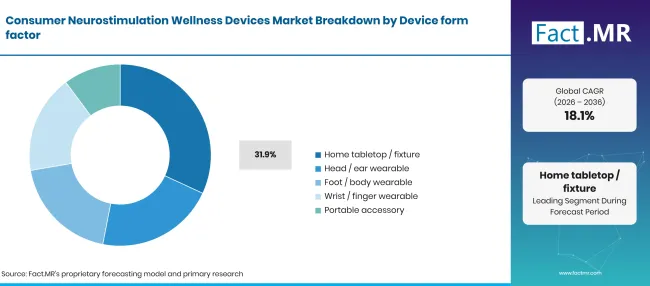
Consumer Neurostimulation Wellness Devices Breakdown Device Form Factor | Source: Fact.MR
| Device Form Factor | Share (2026) |
|---|---|
| Home Tabletop / Fixture (Leading segment) | 31.9% |
| Other segments combined | 68.1%* |
| Total | 100.0% |
Source: Fact.MR analysis. Updated Nov 12, 2026
Users who run a daily 20 to 60 minute session at a desk or bedside prefer a fixed unit with a separate controller and leads. Cranial electrotherapy devices have long used this format, and Alpha-Stim units remain FDA cleared for anxiety, insomnia and pain in the US with a prescription. Head and ear wearables are gaining ground as tDCS headsets and auricular devices shrink. Wrist and finger formats suit peripheral stimulation, while foot and body wearables serve users seeking relaxation away from the head. Many of these body units share electrode designs with products in the muscle stimulators market. Portable accessories such as handheld neck stimulators fit travel and short sessions. Clinical versions of these nerve-targeting tools are tracked in the peripheral nerve stimulator market.
How does Data Processing shape demand?
Clinician-Linked Dashboard accounts for 30.7% of 2026 value.
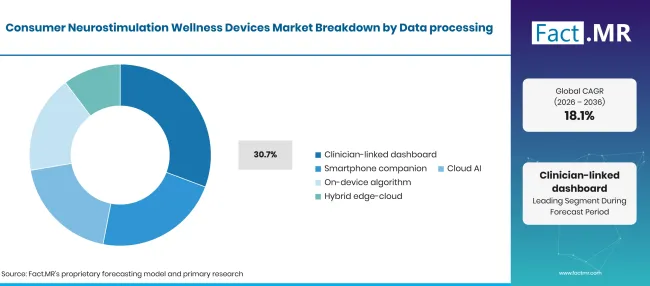
Consumer Neurostimulation Wellness Devices Breakdown Data Processing | Source: Fact.MR
| Data Processing | Share (2026) |
|---|---|
| Clinician-Linked Dashboard (Leading segment) | 30.7% |
| Other segments combined | 69.3%* |
| Total | 100.0% |
Source: Fact.MR analysis. Updated Nov 12, 2026
Prescription pathways create the need for professional oversight. The Modius Spero De Novo order specifies home use as part of a treatment plan directed by a healthcare professional, so clinicians need a way to check that sessions happen as planned. Flow and Neurovalens both connect their headsets to software that supports this review. Smartphone companion apps carry most wellness products, logging sessions and guiding intensity. electroCore linked Truvaga Plus to the Apple Health app in May 2025, letting users record mood after each session.
Which Sales Channel is gaining traction?
Retail Electronics captures 33.2% of 2026 sales.
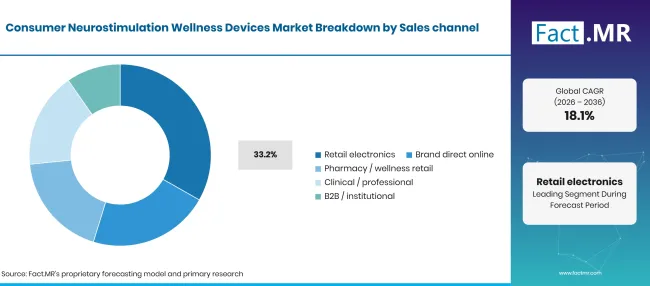
Consumer Neurostimulation Wellness Devices Breakdown Sales Channel | Source: Fact.MR
| Sales Channel | Share (2026) |
|---|---|
| Retail Electronics (Leading segment) | 33.2% |
| Other segments combined | 66.8%* |
| Total | 100.0% |
Source: Fact.MR analysis. Updated Nov 12, 2026
Shoppers increasingly meet stimulation devices in the same aisles and web pages as sleep earbuds and fitness trackers. This exposure helps wellness products that need no prescription, such as handheld vagus nerve stimulators and over-the-counter migraine devices from CEFALY. Forehead stimulators of this kind also feature in the digital migraine treatment device market. Brand direct online stores remain important for subscription models and rental plans. Pharmacy and wellness retail reach buyers who look for drug-free sleep or stress aids. Clinical and professional channels handle prescribed headsets, while B2B and institutional buyers include rehabilitation centers and veteran care programs.
What is accelerating Consumer Neurostimulation Wellness Devices Market adoption, and what is holding it back?
Regulatory authorizations for depression and PTSD, wide mental health need and growing retail access are pulling consumers toward home stimulation. Against this, prescription rules slow casual purchase in the US, and the FDA’s view of electrical stimulation as higher risk limits how far wellness brands can stretch their claims.
Drivers Impact Analysis
| DRIVER | (~) % IMPACT ON CAGR | GEOGRAPHIC RELEVANCE | IMPACT TIMELINE |
|---|---|---|---|
| Expansion of home-use neurostimulation systems | +1.1% | North America, Europe | Medium term (2-4 years) |
| Growing interest in non-invasive stimulation | +0.9% | Global | Short term (<=2 years) |
| Wider availability of tVNS devices | +0.8% | Europe, Asia | Medium term (2-4 years) |
| Clinician-linked home treatment pathways | +0.7% | North America, Europe | Medium term (2-4 years) |
| Development of connected stimulation platforms | +0.6% | Global | Long term (>=4 years) |
Source: Fact.MR analysis. Updated Nov 12, 2026
Opportunity Impact Analysis
| OPPORTUNITY | (~) % IMPACT ON CAGR | GEOGRAPHIC RELEVANCE | IMPACT TIMELINE |
|---|---|---|---|
| Remote supervision and treatment monitoring | +0.9% | North America, Europe | Medium term (2-4 years) |
| Improved wearable electrode comfort | +0.8% | Global | Medium term (2-4 years) |
| Consumer-focused tVNS product development | +0.7% | Europe, Asia | Long term (>=4 years) |
| Smartphone-based session management | +0.6% | Global | Short term (<=2 years) |
| Expansion of professional distribution networks | +0.5% | Global | Medium term (2-4 years) |
Source: Fact.MR analysis. Updated Nov 12, 2026
Restraints Impact Analysis
| RESTRAINT | (~) % IMPACT ON CAGR | GEOGRAPHIC RELEVANCE | IMPACT TIMELINE |
|---|---|---|---|
| Regulatory approval and prescription requirements | -0.9% | North America, Europe | Short term (<=2 years) |
| Limited evidence for some wellness claims | -0.8% | Global | Medium term (2-4 years) |
| Device affordability and treatment costs | -0.6% | Global | Short term (<=2 years) |
| Variation in stimulation protocols | -0.5% | Global | Medium term (2-4 years) |
| Consumer concerns about incorrect use | -0.4% | Global | Medium term (2-4 years) |
Source: Fact.MR analysis. Updated Nov 12, 2026
Which countries are scaling the Consumer Neurostimulation Wellness Devices Market through 2036?
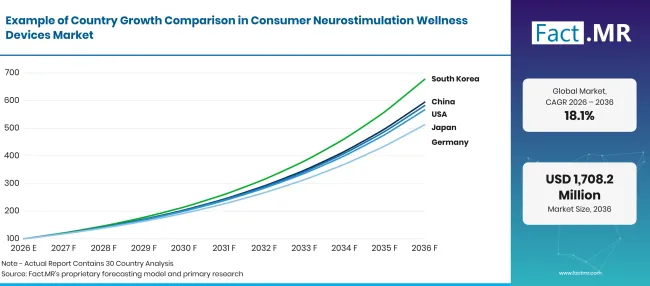
Consumer Neurostimulation Wellness Devices Growth Index | Source: Fact.MR
| Country | CAGR (2026 to 2036) |
|---|---|
| South Korea | 21.1% |
| China | 19.5% |
| United States | 19.3% |
| Japan | 18.9% |
| Germany | 17.8% |
Source: Fact.MR analysis. Updated Nov 12, 2026
What supports South Korea’s market growth?
21.1% CAGR, driven by a fast-aging population that is already at ease online.
Korea’s statistics ministry reported in September 2025 that people aged 65 and over formed 20.3% of the population, and that 76.9% of seniors used the internet in 2024. Older adults who use messaging apps every day are open to a stimulator controlled from a phone. Suppliers that offer large text, voice guidance and family sharing features will win this group first.
How is China developing the market?
19.5% CAGR, backed by heavy online buying of smart and wearable products.
China’s digital consumption reached 9.37 trillion yuan in the first half of 2025, equal to 46.5% of household consumer spending, and nearly four in ten internet users bought smart appliances, digital devices or wearables in that period. Wellness stimulators fit naturally into these online baskets. Brands will still need clear statements on medical device status, since claims that touch on disease fall under separate registration rules.
What is supporting United States adoption?
19.3% CAGR, helped by the first authorized home stimulation therapies for mood and trauma.
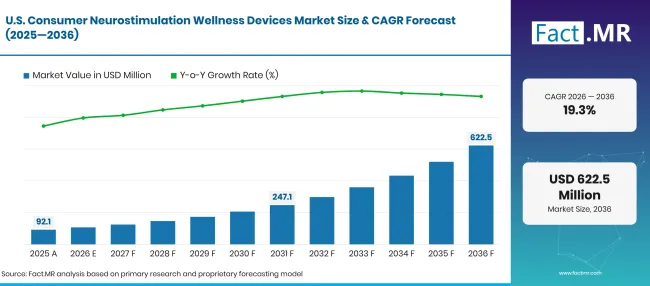
Consumer Neurostimulation Wellness Devices Forecast Usa | Source: Fact.MR
The National Center for Health Statistics reported in April 2025 that more than one in ten US adults took prescription medication for depression in 2023. Many of these patients now have a drug-free home option, as the FDA approved a tDCS headset for depression in 2025 and authorized a PTSD stimulator in 2026. Prescription rules will keep clinicians at the center of the US channel, while wellness vagus nerve devices grow through online retail.
How is Japan building demand?
18.9% CAGR, reflecting a large senior population looking for gentle home care.
The Statistics Bureau of Japan estimated in September 2026 that 36.24 million people, or 29.6% of the population, were aged 65 or older. Sleep and stress concerns are common in this group, and many older buyers prefer simple tabletop units with large controls. Products that require clinical supervision will need clear referral routes through local clinics.
What supports Germany’s market development?
17.8% CAGR, as online health purchasing slowly widens the channel beyond clinics.
The Federal Statistical Office reported in March 2025 that 21% of people aged 16 to 74 bought medicines or dietary supplements online in 2024, up from 16% in 2021. This habit opens a path for wellness stimulators sold through online pharmacies and health shops. German buyers still expect CE certification and medical evidence, which favors auricular devices and supervised systems from established European developers. The country’s strong clinical base is also visible across the broader neurology devices market.
Who leads the Consumer Neurostimulation Wellness Devices Market?
Competition divides into three groups that win on different strengths. Prescription therapy developers such as Flow Neuroscience and Neurovalens compete on regulatory authorizations and clinical trial data, which open doors to psychiatrists and veteran care programs.
Neurovalens reported in May 2026 that veterans will gain access to Modius Spero through the US Department of Veterans Affairs. Cranial electrotherapy specialists, namely Electromedical Products International and Fisher Wallace Laboratories, rely on long user histories and prescription sales of headband or ear clip devices. A third group, including electroCore, Parasym and CEFALY, sells vagus or trigeminal stimulators with wellness or over-the-counter positioning, and it competes on design, app features and retail reach. electroCore’s move onto Amazon in 2025 shows how this group pursues volume. The edge to 2036 will go to firms that hold a medical authorization and also run a consumer brand, since that pairing lets them serve both clinicians and self-directed buyers.
Which companies are the key providers?
Key companies in the Consumer Neurostimulation Wellness Devices Market include Flow Neuroscience, Neurovalens, Electromedical Products International, Fisher Wallace Laboratories, electroCore, Parasym and CEFALY.
- Flow Neuroscience
- Neurovalens
- Electromedical Products International
- Fisher Wallace Laboratories
- electroCore
- Parasym
- CEFALY
Bibliography
- electroCore, Inc. (2025, February 19). electroCore’s Truvaga Now Available on Amazon.
- electroCore, Inc. (2025, May 1). electroCore’s Truvaga Now Works with the Apple Health app.
- Federal Statistical Office of Germany. (2025, March 11). 21 % der 16- bis 74-Jährigen kaufen Arzneimittel oder Nahrungsergänzungsmittel online.
- Ministry of Data and Statistics, Republic of Korea. (2025, September 29). 2025 Statistics on the Aged.
- National Center for Health Statistics. (2025, April 16). New Reports Highlight Depression Prevalence and Medication Use in the U.S..
- Neurovalens. (2026, May 26). FDA Grants World’s First Neuromodulation Device to Treat Symptoms of PTSD.
- State Council of the People’s Republic of China. (2025, December 17). China’s digital consumption accounts for nearly half of household spending in H1: report.
- Statistics Bureau of Japan. (2026, September 20). Statistics Topics No. 149: The elderly in Japan from a statistical perspective.
- U.S. Food and Drug Administration. (2025, December 8). Premarket Approval (PMA): Flow FL-100, P230024.
- U.S. Food and Drug Administration. (2026, January 6). General Wellness: Policy for Low Risk Devices.
- U.S. Food and Drug Administration. (2026, May 8). De Novo classification order DEN250013: Modius Spero.
- World Health Organization. (2025, September 2). Over a billion people living with mental health conditions: services require urgent scale-up.
This Report Answers
- How large the consumer neurostimulation wellness devices market is today and how it will grow to 2036.
- Why tDCS holds the top modality position and where tVNS and TENS-based products gain ground.
- Which form factors, software models and sales channels shape what home users buy.
- What separates growth in South Korea, China, the United States, Japan and Germany.
- How regulatory authorizations and wellness claim rules change the commercial path for suppliers.
- Where prescription therapy developers, cranial electrotherapy specialists and wellness brands compete.
What does the Consumer Neurostimulation Wellness Devices Market cover?
This study tracks non-invasive devices that deliver controlled electrical stimulation to the brain, the vagus nerve or peripheral nerves for use at home. It spans wellness stimulators for stress, relaxation and sleep, along with home devices authorized for specific conditions and used under professional guidance.
Values are stated in USD million at the manufacturer level and include the hardware, electrodes and bundled companion software sold with each device.
What is included in the scope?
tDCS, tACS, auricular and cervical vagus nerve stimulators and TENS-based wellness devices built for home use.
Prescription home devices authorized for conditions such as depression, PTSD, anxiety or insomnia.
Over-the-counter trigeminal and other stimulation devices sold through retail or brand stores.
Replacement electrodes, headbands and companion apps sold with a stimulation device.
What is excluded from the scope?
Implanted neurostimulators, including surgically placed vagus nerve and spinal cord systems.
Hospital neuromodulation equipment such as transcranial magnetic stimulation chairs not meant for home use.
Fitness trackers and EEG headbands that measure signals but deliver no stimulation.
Standalone apps and software sold without stimulation hardware.
How Was the Analysis Built?
The analysis draws on 120+ sources, 35+ company portfolios, 25+ countries, and more than 20 industry interviews.
- Primary Research: Primary research includes discussions with manufacturers, service providers, technology developers, distributors, end users, and subject-matter experts. These conversations examine purchasing priorities, product adoption, operational challenges, approval requirements, competitive positioning, and the factors that influence wider market acceptance.
- Desk Research: Desk research covers government statistics, regulatory publications, company filings, trade data, technical studies, industry associations, standards, public policy, and other authoritative sources. Every source used in the analysis is documented in the bibliography.
- Market Sizing and Forecasting: Market estimates combine historical performance, demand indicators, pricing and volume trends, segment shares, company participation, country-level growth, adoption patterns, investment activity, and barriers to market expansion.
- Data Validation and Update Cycle: Findings are validated by comparing primary interviews with public data, company activity, regulatory changes, trade patterns, and industry developments. Regular updates review new product launches, capacity changes, partnerships, approvals, and shifts in commercial adoption.
Segmentation
What is the report’s scope and coverage?
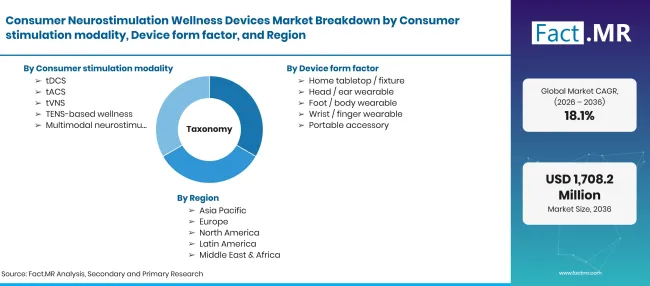
Consumer Neurostimulation Wellness Devices Taxonomy | Source: Fact.MR
| Attribute | Details |
|---|---|
| Quantitative Units | USD million |
| Market Definition | Non-invasive electrical stimulation devices for home use in personal wellness and supervised self-care, covering hardware and its companion software. |
| Consumer Stimulation Modality | tDCS; tACS; tVNS; TENS-Based Wellness; Multimodal Neurostimulation |
| Device Form Factor | Home Tabletop / Fixture; Head / Ear Wearable; Foot / Body Wearable; Wrist / Finger Wearable; Portable Accessory |
| Data Processing | Clinician-Linked Dashboard; Smartphone Companion; Cloud AI; On-Device Algorithm; Hybrid Edge-Cloud |
| Sales Channel | Retail Electronics; Brand Direct Online; Pharmacy / Wellness Retail; Clinical / Professional; B2B / Institutional |
| Regions Covered | North America; Latin America; Western Europe; Eastern Europe; East Asia; South Asia & Pacific; Middle East & Africa |
| Countries Covered | South Korea; China; United States; Japan; Germany |
| Companies Profiled | Flow Neuroscience; Neurovalens; Electromedical Products International; Fisher Wallace Laboratories; electroCore; Parasym; CEFALY |
| Forecast Period | 2026 to 2036 |
| Approach | Segment and country modeling drawing on regulatory records, company product information and national health and digital statistics. |
Source: Fact.MR analysis. Updated Nov 12, 2026
How is the market segmented?
-
By Consumer Stimulation Modality
- tDCS
- tACS
- tVNS
- TENS-Based Wellness
- Multimodal Neurostimulation
-
By Device Form Factor
- Home Tabletop / Fixture
- Head / Ear Wearable
- Foot / Body Wearable
- Wrist / Finger Wearable
- Portable Accessory
-
By Data Processing
- Clinician-Linked Dashboard
- Smartphone Companion
- Cloud AI
- On-Device Algorithm
- Hybrid Edge-Cloud
-
By Sales Channel
- Retail Electronics
- Brand Direct Online
- Pharmacy / Wellness Retail
- Clinical / Professional
- B2B / Institutional
-
By Region
- North America
- Latin America
- Western Europe
- Eastern Europe
- East Asia
- South Asia & Pacific
- Middle East & Africa
Frequently Asked Questions
How large is the consumer neurostimulation wellness devices market in 2026?
What growth rate will the consumer neurostimulation wellness devices market record?
Which consumer stimulation modality leads?
Which device form factor leads?
Which data processing model leads?
Which sales channel leads?
Which country will grow quickest?
Who are the main companies?
What holds the market back?
Who worked on this report


Preview the report firsthand - request a free sample
Free SampleGet the brochure for pricing and purchase details
Download PDF