- Market Value (2025): USD 356.4 Mn
- Estimated Value (2026): USD 383.7 Mn
- Forecast Value (2036): USD 802.7 Mn
- CAGR (2026-2036): 7.7%
What is the Cuffless Blood Pressure Wearables Market forecast to be worth by 2036?
USD 383.7 million in 2026 to USD 802.7 million by 2036 at a 7.7% CAGR.
- A 2025 base of USD 356.4 million anchors the cuffless blood pressure wearables market.
- Revenue will expand from USD 383.7 million in 2026 to USD 802.7 million by 2036, as cleared over-the-counter devices widen the buyer pool beyond early adopters.
- A 7.7% CAGR reflects steady replacement of occasional cuff checks with passive readings across the day and night.
| Year | Basis | Market Value (USD million) |
|---|---|---|
| 2025 | Actual | 356.4 |
| 2026 | Estimate | 383.7 |
| 2036 | Forecast | 802.7 |
| CAGR 2026 to 2036 | Forecast period | 7.7% |
Source: Fact.MR analysis. Updated Nov 12, 2026
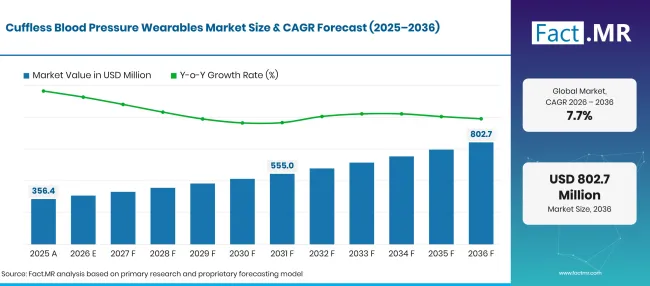
Cuffless Blood Pressure Wearables Forecast Global | Source: Fact.MR
What are the defining numbers behind Cuffless Blood Pressure Wearables Market growth?
The 2026 to 2036 period will add USD 419.0 million in new value, led by calibrated optical devices sold for home use.
- Demand Drivers in the Market
- Undiagnosed hypertension creates a large screening gap. WHO reports that about 1.4 billion adults aged 30 to 79 had hypertension in 2024 and that about 600 million of them were unaware of the condition.
- Regulators are writing clearer test rules. In January 2026 the U.S. Food and Drug Administration issued draft guidance on clinical performance testing and evaluation for cuffless non-invasive blood pressure devices, which gives developers a defined route for premarket submissions.
- Direct consumer access is opening. Hilo reported in July 2025 that the FDA had cleared its cuffless monitoring system for direct consumer access in the United States. Over-the-counter status lets pharmacies and online stores sell the device without a prescription step.
- Smartwatch platforms are adding blood pressure functions to products people already wear. Software updates reach large installed bases at little extra cost to the buyer, which lowers the barrier to a first trial.
- Key Segments Analyzed
- By Cuffless BP Measurement Approach: Pulse Transit Time will lead with 25.2% share in 2026, because timing a pulse between two sensing points gives a signal that tracks pressure changes well after calibration.
- By Device Form Factor: Head / Ear Wearable will account for 24.0% of 2026 value, since the ear offers a stable optical site with less motion than the wrist.
- By Data Processing: Smartphone Companion will capture 27.6% in 2026 as the phone app handles calibration prompts, trend charts and reports for doctors.
- By Sales Channel: Pharmacy / Wellness Retail will take 30.8% of 2026 sales, helped by pharmacist advice at the point of purchase.
- Analyst Opinion at Fact.MR
- Shambhu Nath Jha, Principal Consultant at Fact.MR, states, “Cuffless blood pressure wearables will win wider trust only when brands show that readings hold up during sleep, work and exercise, and not just in a seated test. Calibration is the main friction point, so the makers that cut it to a short monthly routine will convert curious buyers into long-term users. Clinician-ready reports will decide whether these devices stay a consumer gadget or become part of hypertension care.”
- Strategic Implications
- Manufacturers should publish validation results against recognized standards and state clearly when a cuff calibration is required.
- Software developers should flag low-quality signals, drop unreliable readings and present trends in plain language that patients can share with clinicians.
- Pharmacies and retailers should train staff to explain the difference between estimated trends and confirmed cuff readings at the point of sale.
- Investors should favor companies with cleared devices and a calibration routine that users will actually keep.
China will post a 10.1% CAGR, ahead of every other profiled country, as a vast older population meets a domestic wearable industry with strong retail reach. South Korea follows at 8.8%, where a heavy hypertension cost burden pushes the health system toward home measurement. The United States will grow at 7.7%, matching the global pace, since over-the-counter clearances arrive alongside a very high adult prevalence. Germany comes next at 7.4%, with a fast-aging population that favors home checks but buyers who expect proof of medical certification. Japan trails at 6.8%; it has the oldest population of the five, yet cuff monitors are already common in Japanese homes, which slows switching.
How does the Cuffless Blood Pressure Wearables Market break down by segment?
Pulse Transit Time will lead Cuffless BP Measurement Approach at 25.2%; Head / Ear Wearable will head Device Form Factor at 24.0%; Smartphone Companion will hold Data Processing at 27.6%; Pharmacy / Wellness Retail will top Sales Channel at 30.8% in 2026.
Which Cuffless BP Measurement Approach leads?
Pulse Transit Time holds 25.2% of 2026 sales.
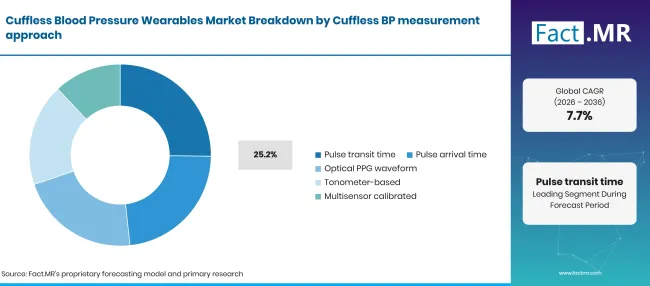
Cuffless Blood Pressure Wearables Breakdown Cuffless Bp Measurement Approach | Source: Fact.MR
| Cuffless BP Measurement Approach | Share (2026) |
|---|---|
| Pulse Transit Time (Leading segment) | 25.2% |
| Other segments combined | 74.8%* |
| Total | 100.0% |
Source: Fact.MR analysis. Updated Nov 12, 2026
Developers favor transit timing because the delay between two pulse points shortens as arteries stiffen under higher pressure, and that link can be tuned to each user with an occasional cuff reading. Synchronized sensors in a band or patch capture the two signals, and algorithms convert the delay into systolic and diastolic estimates. The FDA draft guidance of January 2026 sets out how such devices should be tested across ranges of pressure and over time since calibration. Pulse arrival time adds the electrical start of the heartbeat and suits devices with an ECG electrode. Optical PPG waveform analysis reads shape changes in a single light signal and powers many wrist products. Tonometer-based systems press gently on an artery, and multisensor calibrated designs combine optical, electrical and motion inputs to resist noise from movement. Component choices draw on the wider medical sensors range used across clinical devices.
What leads the Device Form Factor segment?
Head / Ear Wearable represents 24.0% of 2026 revenue.
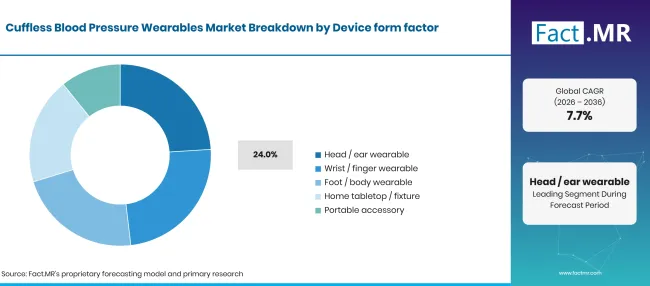
Cuffless Blood Pressure Wearables Breakdown Device Form Factor | Source: Fact.MR
| Device Form Factor | Share (2026) |
|---|---|
| Head / Ear Wearable (Leading segment) | 24.0% |
| Other segments combined | 76.0%* |
| Total | 100.0% |
Source: Fact.MR analysis. Updated Nov 12, 2026
Ear sites stay still during walking and typing, and the thin skin over ear vessels gives a clean optical trace, which explains why earbuds and headbands with sensors gain ground in this category. Wrist and finger wearables follow closely and benefit from the habit of wearing a watch or ring, with designs that overlap the broader wearable healthcare devices category. Foot and body wearables serve sleep studies and patches, home tabletop units support calibration, and portable accessories suit people who prefer spot checks to all-day wear.
How does Data Processing shape demand?
Smartphone Companion accounts for 27.6% of 2026 value.
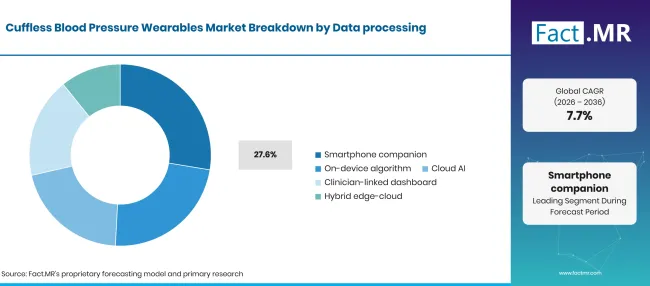
Cuffless Blood Pressure Wearables Breakdown Data Processing | Source: Fact.MR
| Data Processing | Share (2026) |
|---|---|
| Smartphone Companion (Leading segment) | 27.6% |
| Other segments combined | 72.4%* |
| Total | 100.0% |
Source: Fact.MR analysis. Updated Nov 12, 2026
Phone apps do the work most users see: they schedule calibrations, store months of readings and turn them into reports for a doctor visit. Apple introduced hypertension notifications in September 2025 that review optical heart sensor data over 30-day periods and suggest a week of cuff readings when a pattern appears. On-device algorithms process signals inside the wearable and help with privacy and battery life. Cloud AI supports deeper trend analysis, while clinician-linked dashboards push selected readings into care programs similar to a patient monitoring system.
What supports Pharmacy / Wellness Retail within Sales Channel?
Pharmacy / Wellness Retail takes 30.8% of 2026 sales.
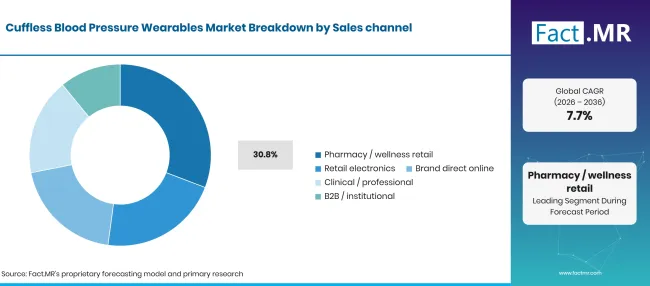
Cuffless Blood Pressure Wearables Breakdown Sales Channel | Source: Fact.MR
| Sales Channel | Share (2026) |
|---|---|
| Pharmacy / Wellness Retail (Leading segment) | 30.8% |
| Other segments combined | 69.2%* |
| Total | 100.0% |
Source: Fact.MR analysis. Updated Nov 12, 2026
Shoppers often buy their first home monitor where they collect prescriptions, and pharmacists can explain how calibration works before the sale. Calibration needs are real: Samsung’s blood pressure feature, launched to U.S. users in March 2026, asks for an upper-arm cuff reading to start and a recalibration every 28 days. Retail electronics stores sell smartwatch models with blood pressure features, and brand-direct online sites explain subscriptions and bundle cuffs with bands. Clinical and professional channels place devices through cardiology practices, and B2B or institutional sales serve employers and remote care programs. These channels overlap with the wider self-care medical devices shelf in pharmacies.
What is accelerating Cuffless Blood Pressure Wearables Market adoption, and what is holding it back?
Large numbers of undiagnosed adults, new FDA test guidance and over-the-counter clearances are pulling buyers toward passive blood pressure tracking. Accuracy during movement, the need for regular cuff calibration and confusion between estimated and confirmed readings still slow uptake, especially among clinicians who must decide whether to act on the data.
Drivers Impact Analysis
| DRIVER | (~) % IMPACT ON CAGR | GEOGRAPHIC RELEVANCE | IMPACT TIMELINE |
|---|---|---|---|
| Large pool of undiagnosed hypertension | +1.0% | Global | Medium term (2-4 years) |
| Better optical PPG sensors | +0.8% | North America, East Asia | Medium term (2-4 years) |
| Smartphone-linked health tracking | +0.7% | Global | Short term (<=2 years) |
| Wearable pulse-wave analysis gains | +0.6% | Western Europe, East Asia | Long term (>=4 years) |
| Clearer rules for cuffless device testing | +0.5% | North America, Western Europe | Medium term (2-4 years) |
Source: Fact.MR analysis. Updated Nov 12, 2026
Opportunity Impact Analysis
| OPPORTUNITY | (~) % IMPACT ON CAGR | GEOGRAPHIC RELEVANCE | IMPACT TIMELINE |
|---|---|---|---|
| Calibration-free measurement methods | +0.9% | Global | Long term (>=4 years) |
| Better accuracy during daily activity | +0.8% | Global | Medium term (2-4 years) |
| Links to remote patient monitoring programs | +0.7% | North America, Western Europe | Medium term (2-4 years) |
| Compact wrist and finger sensors | +0.6% | East Asia, North America | Medium term (2-4 years) |
Source: Fact.MR analysis. Updated Nov 12, 2026
Restraints Impact Analysis
| RESTRAINT | (~) % IMPACT ON CAGR | GEOGRAPHIC RELEVANCE | IMPACT TIMELINE |
|---|---|---|---|
| Accuracy variation in real-world use | -0.9% | Global | Short term (<=2 years) |
| Dependence on periodic cuff calibration | -0.7% | Global | Medium term (2-4 years) |
| Limited clinical validation across device types | -0.7% | Global | Medium term (2-4 years) |
| Consumer confusion about estimated readings | -0.5% | Global | Short term (<=2 years) |
Source: Fact.MR analysis. Updated Nov 12, 2026
Which countries are scaling the Cuffless Blood Pressure Wearables Market through 2036?
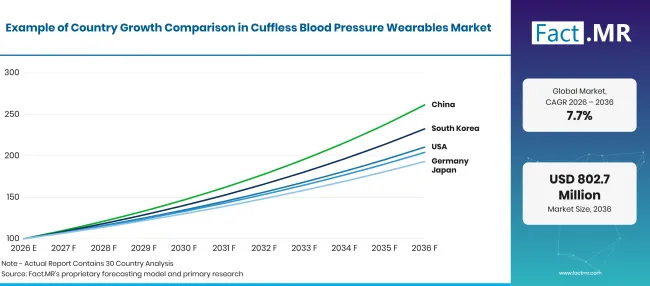
Cuffless Blood Pressure Wearables Growth Index | Source: Fact.MR
| Country | CAGR (2026 to 2036) |
|---|---|
| China | 10.1% |
| South Korea | 8.8% |
| United States | 7.7% |
| Germany | 7.4% |
| Japan | 6.8% |
Source: Fact.MR analysis. Updated Nov 12, 2026
What supports cuffless blood pressure wearable adoption in China?
10.1% CAGR, supported by a fast-growing older population and a deep domestic wearable supply base.
The National Bureau of Statistics counted 223.65 million people aged 65 and over at the end of 2025, or 15.9% of the population. Older adults with hypertension need frequent checks, and family members often buy connected devices for parents who live apart. Domestic watch and band makers already sell through large online platforms, which shortens the path from launch to mass retail.
How is South Korea developing demand?
8.8% CAGR, as rising treatment costs push care toward home measurement.
The Korea Disease Control and Prevention Agency reported in December 2025 that hypertension medical expenses reached KRW 4.5 trillion in 2024, the most of any single non-communicable disease, and that adult prevalence stood at 20.0% in 2023. High smartphone use and a strong local electronics industry make phone-linked wearables an easy fit for long-term tracking.
What is supporting United States adoption?
7.7% CAGR, backed by very high adult prevalence and new over-the-counter clearances.
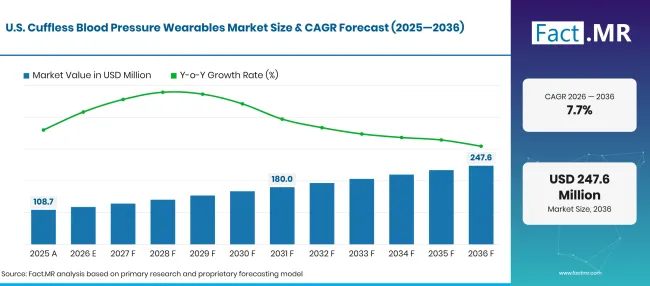
Cuffless Blood Pressure Wearables Forecast Usa | Source: Fact.MR
CDC data show that 48.1% of U.S. adults, or 119.9 million people, have high blood pressure, and only about one in four of them has it under control. Over-the-counter cuffless devices can now reach these buyers through pharmacies and online stores.
How is Germany building demand?
7.4% CAGR, reflecting rapid population aging and demand for certified medical devices.
The Federal Statistical Office reported in December 2025 that about one in five residents is aged 67 or over, and that the group will reach one in four by 2035. German buyers tend to ask for medical certification under EU rules before trusting a wearable reading.
What supports Japan’s adoption?
6.8% CAGR, owing to the oldest population among the five countries.
The Statistics Bureau of Japan counted about 36.19 million people aged 65 and over in September 2025, or 29.4% of the population, a record share. Many of these households already own cuff monitors, so cuffless devices must offer something new, such as night readings or automatic reports.
Who leads the Cuffless Blood Pressure Wearables Market?
Competition splits into three groups. Dedicated medical brands such as Hilo, Biobeat Technologies and Corsano Health build calibrated optical systems and compete on clinical validation and regulatory status; Hilo reported FDA clearance for direct consumer access in July 2025, and Biobeat presented FDA-cleared cuffless ambulatory monitoring at the American Heart Association sessions in November 2025.
Smartwatch platforms, led by Apple and Samsung Electronics, compete on installed base and software reach, adding blood pressure alerts or calibrated estimates to watches that people already own. Fitness wearables such as WHOOP position blood pressure as a wellness insight; its WHOOP MG, launched in May 2025, offers daily estimated systolic and diastolic values after cuff-based setup. Sensor specialist Valencell supplies optical know-how and is preparing its own fingertip device. Through 2036, the winners will be the companies that pair cleared accuracy with low-effort calibration and reports that clinicians accept.
Which companies are the key providers?
Key companies in the Cuffless Blood Pressure Wearables Market include Hilo, Apple Inc., Samsung Electronics Co., Ltd., Biobeat Technologies Ltd., WHOOP, Inc., Valencell, Inc. and Corsano Health B.V.
- Hilo
- Apple Inc.
- Samsung Electronics Co., Ltd.
- Biobeat Technologies Ltd.
- WHOOP, Inc.
- Valencell, Inc.
- Corsano Health B.V.
Bibliography
- Apple Inc. (2025, September 9). Apple debuts Apple Watch Series 11, featuring groundbreaking health insights.
- Biobeat Technologies Ltd. (2025, November). Join Biobeat at AHA Scientific Sessions 2025: FDA cleared cuffless BP monitoring.
- Centers for Disease Control and Prevention. (2026, June 2). High Blood Pressure Facts.
- Federal Statistical Office of Germany. (2025, December 11). By 2035, one quarter of Germany’s population will be aged 67 or over.
- Hilo. (2025, July 9). Hilo by Aktiia: First cuffless blood pressure monitor cleared by the FDA.
- Korea Disease Control and Prevention Agency. (2025, December 30). 2025 Chronic Disease Status and Issues.
- National Bureau of Statistics of China. (2026, January 19). National Economy Pushed Forward with Innovation-led and High-quality Development and Expected Targets Achieved Successfully in 2025.
- Samsung Electronics. (2026, March 31). Samsung’s Blood Pressure Monitoring Feature Now Available to U.S. Users in Samsung Health.
- Statistics Bureau of Japan. (2025, September 14). Statistical Topics No. 146: Japan’s Elderly from a Statistical Perspective.
- U.S. Food and Drug Administration. (2026, January 22). Cuffless Non-invasive Blood Pressure Measuring Devices: Clinical Performance Testing and Evaluation.
- WHOOP, Inc. (2025, May 8). WHOOP Unveils WHOOP 5.0 and WHOOP MG.
- World Health Organization. (2025, September 25). Hypertension.
This Report Answers
- How large will cuffless blood pressure wearable revenue be in 2026 and 2036, and what growth rate links the two?
- Which measurement approach, form factor, processing model and sales channel will lead in 2026, and for what reasons?
- What role do FDA test guidance and over-the-counter clearances play in opening retail sales?
- Why will China and South Korea outpace the United States, Germany and Japan?
- How do medical brands, smartwatch platforms and fitness wearables differ in what they offer buyers?
- Which restraints, such as calibration effort and accuracy during movement, will limit uptake?
What does the Cuffless Blood Pressure Wearables Market cover?
This study tracks wearable devices that estimate blood pressure without inflating a cuff at each reading, including bands, rings, earbuds, patches and smartwatches with blood pressure software. Systems that need a periodic cuff calibration are counted, provided routine readings are taken without inflation.
Values are measured at manufacturer selling prices in USD million and cover hardware plus bundled apps and subscriptions sold with the device.
What is included in the scope?
Wrist, finger, ear, head and body wearables that estimate blood pressure from optical, electrical or tonometric signals.
Calibration cuffs sold as part of a cuffless system, along with companion apps and clinician dashboards tied to the device.
Blood pressure software features on smartwatches when they produce estimated values or hypertension alerts, including sensor modules that overlap the consumer healthcare sensor supply chain.
Devices sold over the counter, by prescription or through remote care programs.
What is excluded from the scope?
Conventional upper-arm and wrist-cuff monitors, including wearables that inflate an airbag or cuff for each reading.
Smartwatches that track only heart rate or rhythm, which belong with wearable cardiac monitors instead.
Invasive arterial line systems used in hospitals and operating rooms.
Standalone apps that do not connect to a measuring wearable.
How Was the Analysis Built?
The analysis draws on 120+ sources, 35+ company portfolios, 25+ countries, and more than 20 industry interviews.
- Primary Research: Primary research includes discussions with manufacturers, service providers, technology developers, distributors, end users, and subject-matter experts. These conversations examine purchasing priorities, product adoption, operational challenges, approval requirements, competitive positioning, and the factors that influence wider market acceptance.
- Desk Research: Desk research covers government statistics, regulatory publications, company filings, trade data, technical studies, industry associations, standards, public policy, and other authoritative sources. Every source used in the analysis is documented in the bibliography.
- Market Sizing and Forecasting: Market estimates combine historical performance, demand indicators, pricing and volume trends, segment shares, company participation, country-level growth, adoption patterns, investment activity, and barriers to market expansion.
- Data Validation and Update Cycle: Findings are validated by comparing primary interviews with public data, company activity, regulatory changes, trade patterns, and industry developments. Regular updates review new product launches, capacity changes, partnerships, approvals, and shifts in commercial adoption.
Segmentation
What is the report’s scope and coverage?
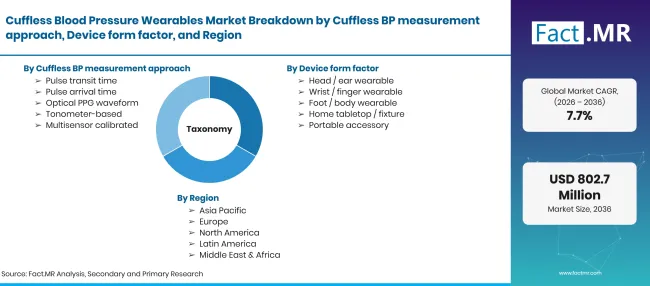
Cuffless Blood Pressure Wearables Taxonomy | Source: Fact.MR
| Attribute | Details |
|---|---|
| Quantitative Units | USD million |
| Market Definition | Wearable electronic devices and their companion software that estimate systolic and diastolic blood pressure from optical, electrical or pressure signals without inflating a cuff at each reading. |
| Cuffless BP Measurement Approach | Pulse Transit Time; Pulse Arrival Time; Optical PPG Waveform; Tonometer-Based; Multisensor Calibrated |
| Device Form Factor | Head / Ear Wearable; Wrist / Finger Wearable; Foot / Body Wearable; Home Tabletop / Fixture; Portable Accessory |
| Data Processing | Smartphone Companion; On-Device Algorithm; Cloud AI; Clinician-Linked Dashboard; Hybrid Edge-Cloud |
| Sales Channel | Pharmacy / Wellness Retail; Retail Electronics; Brand Direct Online; Clinical / Professional; B2B / Institutional |
| Regions Covered | North America; Latin America; Western Europe; Eastern Europe; East Asia; South Asia & Pacific; Middle East & Africa |
| Countries Covered | China; South Korea; United States; Germany; Japan |
| Companies Profiled | Hilo; Apple Inc.; Samsung Electronics Co., Ltd.; Biobeat Technologies Ltd.; WHOOP, Inc.; Valencell, Inc.; Corsano Health B.V. |
| Forecast Period | 2026 to 2036 |
| Approach | Device shipment and price tracking combined with regulatory clearance reviews and hypertension prevalence data by country. |
Source: Fact.MR analysis. Updated Nov 12, 2026
How is the market segmented?
-
By Cuffless BP Measurement Approach
- Pulse Transit Time
- Pulse Arrival Time
- Optical PPG Waveform
- Tonometer-Based
- Multisensor Calibrated
-
By Device Form Factor
- Head / Ear Wearable
- Wrist / Finger Wearable
- Foot / Body Wearable
- Home Tabletop / Fixture
- Portable Accessory
-
By Data Processing
- Smartphone Companion
- On-Device Algorithm
- Cloud AI
- Clinician-Linked Dashboard
- Hybrid Edge-Cloud
-
By Sales Channel
- Pharmacy / Wellness Retail
- Retail Electronics
- Brand Direct Online
- Clinical / Professional
- B2B / Institutional
-
By Region
- North America
- Latin America
- Western Europe
- Eastern Europe
- East Asia
- South Asia & Pacific
- Middle East & Africa
Frequently Asked Questions
How large is the cuffless blood pressure wearables market in 2026?
What growth rate will the cuffless blood pressure wearables market record?
Which measurement approach leads?
Which device form factor leads?
Which data processing model leads?
Which sales channel leads?
Which country will grow quickest?
Who are the main companies?
What holds the market back?
Who worked on this report


Preview the report firsthand - request a free sample
Free SampleGet the brochure for pricing and purchase details
Download PDF