Cloud-Connected Workshop Diagnostic Equipment Systems Market
The Cloud-Connected Workshop Diagnostic Equipment Systems Market is analyzed by solution type, including cloud-connected diagnostic software & remote platforms and diagnostic hardware, and region, forecast 2026 to 2036.
By Fact.MR Automotive DeskLead analyst:
Shubham PatidarPublished :
14 min read
Fact-checked under the Fact.MR editorial process
Cloud-Connected Workshop Diagnostic Equipment Systems Market Forecast By Fact.MR and Outlook
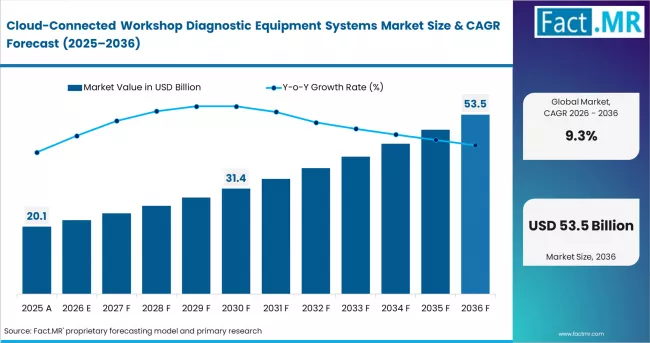
In 2025, the cloud-connected workshop diagnostic equipment systems market was valued at USD 18.9 billion.
Based on Fact.MR analysis, demand for cloud-connected workshop diagnostic equipment systems is estimated to grow to USD 20.1 billion in 2026 and USD 48.7 billion by 2036.
FACT.MR projects a CAGR of 9.3% during the forecast period.
Cloud Connected Workshop Diagnostic Equipment Systems Market Market Value Analysis | Source: Fact.MR
Metric
Value
Estimated Value in 2026
USD 20.1 billion
Forecast Value in 2036
USD 48.7 billion
Forecast CAGR (2026–2036)
9.3%
Source: Fact.MR analysis. Updated May 12, 2026
Summary of Cloud-Connected Workshop Diagnostic Equipment Systems Market
Market Definition
The market covers cloud-connected diagnostic systems combining hardware and software platforms that enable real-time vehicle diagnostics, predictive maintenance, and remote troubleshooting across global automotive workshop ecosystems.
Demand Drivers
Rising vehicle software complexity is increasing dependence on cloud-based diagnostics for fault identification and repair validation.
Growth in fleet operations and logistics is driving demand for predictive maintenance and remote diagnostics solutions.
OEM shift toward software-defined vehicles is requiring connected diagnostic ecosystems for service lifecycle management.
Key Segments Analyzed
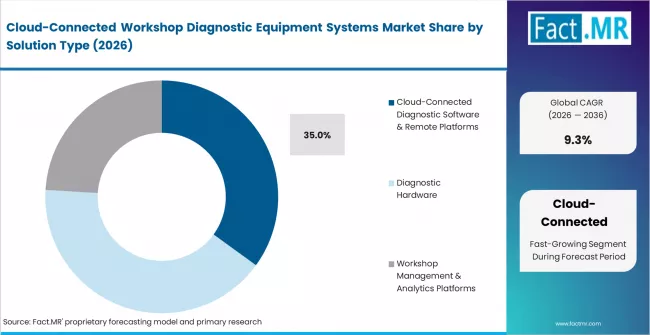
By Solution Type: Cloud-connected diagnostic software leads with 35% share in 2026 due to recurring subscription models.
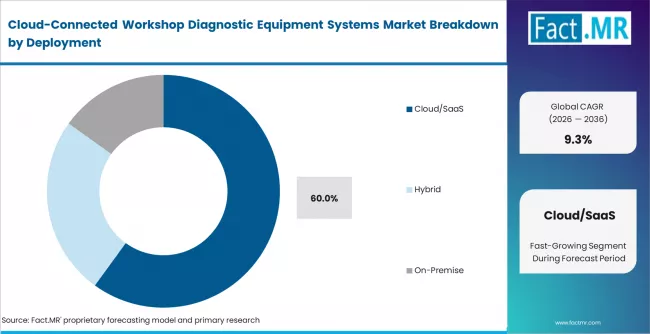
By Deployment: Cloud/SaaS holds ~60% share driven by scalability and real-time data access.
By Geography: China leads growth at 10.8% CAGR due to connected vehicle scale and workshop digitization.
Analyst Opinion at FACT.MR
Shambhu Nath Jha, Principal Consultant at Fact.MR, opines, 'CXOs will find that diagnostic revenue is shifting from one-time hardware sales to recurring software subscriptions, making platform ownership more critical than tool manufacturing capability.'
Strategic Implications
Invest in cloud-native diagnostic platforms to capture recurring service revenue.
Build OEM-integrated diagnostic ecosystems to secure long-term service contracts.
Develop cybersecurity-compliant diagnostic architectures to meet regulatory requirements.
Methodology
Market sizing based on connected vehicle penetration, workshop adoption rates, and SaaS pricing models.
Analysis incorporates OEM disclosures, connectivity data, and regulatory frameworks.
Forecasts consider vehicle software complexity trends and workshop digital transformation pace.
The market is projected to generate USD 28.6 billion in absolute opportunity between 2026 and 2036. Growth is steady rather than explosive, driven by gradual digitization of workshops and increasing vehicle software complexity. Constraints include high upfront integration cost for small workshops, data interoperability issues across OEM platforms, and cybersecurity compliance requirements.
Cloud diagnostics adoption is accelerating across OEM service ecosystems. Robert Bosch and Continental AG both expanded connected workshop platforms in 2024, integrating remote diagnostics and predictive maintenance features into their service networks. Bosch highlighted increased subscription-based diagnostic revenue in its 2024 mobility solutions update.
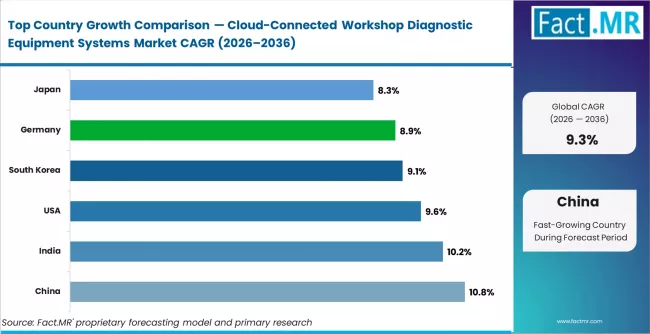
China leads with 10.8% CAGR through 2036, driven by large-scale connected vehicle deployment and digital workshop adoption. India follows at 10.2%, supported by rapid fleet expansion and government-led logistics digitization. The United States grows at 9.6%, driven by fleet telematics and insurance-linked diagnostics. Germany records 8.9%, anchored by OEM-integrated service networks. South Korea grows at 9.1% through connected vehicle ecosystems. Japan records 8.3%, reflecting mature workshop infrastructure and slower transition cycles.
Segmental Analysis
Cloud-Connected Workshop Diagnostic Equipment Systems Market Analysis by Solution Type
Cloud Connected Workshop Diagnostic Equipment Systems Market Analysis By Solution Type | Source: Fact.MR
Based on FACT.MR's cloud-connected workshop diagnostic equipment systems market report, Cloud-Connected Diagnostic Software & Remote Platforms hold approximately 35% share in 2026. This segment leads due to the shift toward subscription-based diagnostics. It enables real-time OEM database access. It also supports remote fault resolution, reducing workshop downtime without requiring technician presence at the vehicle.
Bosch Remote Diagnostics Platform: Robert Bosch GmbH expanded its Remote Diagnostics platform across 42 countries in Q3 2024. It allows authorised workshops to initiate OEM-level control unit diagnostics via cloud connection. No local server installation is required. The platform integrates with Bosch ESI[tronic] 2.0. It also supports ADAS activation and remote software coding. [1]
Snap-on CloudDeck Expansion: Snap-on Incorporated expanded its CloudDeck diagnostic platform in Q2 2024. It added real-time ADAS guided calibration workflows. Over 4,000 vehicle-specific procedures were included. These are sourced from OEM service bulletins. This helps independent workshops perform post-repair ADAS verification via cloud tools. [2]
Subscription Model Shift: Autel Intelligent Technology reported a 38% YoY increase in MaxiSYS Ultra cloud subscription renewals in 2024. This reflects growing preference for always-updated diagnostic data. Technicians are moving away from perpetual-license hardware. The trend is strong in multi-bay workshops handling multiple vehicle brands. [3]
Cloud-Connected Workshop Diagnostic Equipment Systems Market Analysis by Deployment
Cloud Connected Workshop Diagnostic Equipment Systems Market Analysis By Deployment | Source: Fact.MR
Based on FACT.MR's cloud-connected workshop diagnostic equipment systems market report, Cloud/SaaS deployment holds approximately 60% share in 2026. This model leads due to lower infrastructure requirements. It removes the need for local server maintenance. It enables automatic OEM database updates. It also supports multi-location access for workshop chains and fleet operators.
Continental Cloud Platform Investment: Continental AG expanded its ContiConnect platform in 2024. It added powertrain fault monitoring features. It also integrated ADAS sensor health tracking. The platform targets commercial vehicle fleets in Europe. It supports compliance with EU inspection frameworks. It generates workshop-ready diagnostic reports with regulatory data. [4]
ZF Friedrichshafen SaaS Integration: ZF Friedrichshafen launched ZF [pro]Tech SaaS platform in Q4 2024. It integrates transmission and chassis diagnostics. It also connects with service scheduling and parts procurement tools. The platform links diagnostic data with workshop CRM systems. This enables predictive maintenance scheduling. [5]
On-Premise Retention in OEM Networks: Toyota Motor Corporation continues using on-premise diagnostic systems in Japan. This is due to strict OEM data security and compliance requirements. The approach is also seen in South Korea. Toyota maintained on-premise infrastructure through 2025. Hybrid cloud connectivity for updates is gradually being introduced. [6]
Drivers, Restraints, and Opportunities
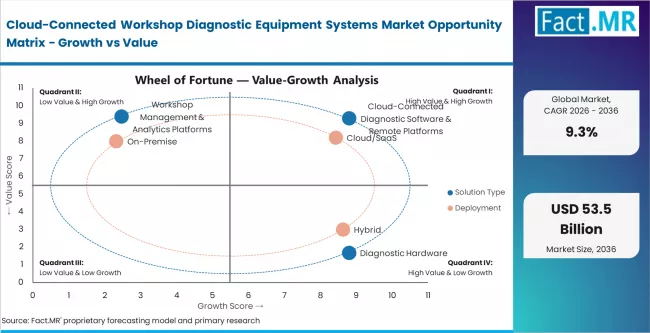
Cloud Connected Workshop Diagnostic Equipment Systems Market Opportunity Matrix Growth Vs Value | Source: Fact.MR
FACT.MR analysts observe that the cloud-connected workshop diagnostic equipment systems market is structurally linked to rising vehicle complexity and workshop digitalization. The market exists at its current scale because modern vehicles require software-driven diagnostics, especially for EVs, ADAS, and connected systems.
The market is shifting from standalone tools to integrated diagnostic platforms. Traditional hardware tools are losing relevance in high-end servicing. Cloud platforms are gaining share due to remote diagnostics and subscription models. More than 26% of workshops adopted subscription-based diagnostic platforms in 2024.
Vehicle Complexity Surge: EV and ADAS systems are increasing diagnostic requirements. Over 48% of workshops reported the need for advanced calibration and diagnostics in 2024. This is structurally increasing demand for cloud-connected platforms.
Subscription Model Shift: Cloud diagnostics platforms are replacing one-time tool purchases. Over 26% of workshops globally adopted subscription-based diagnostics in 2024. This creates recurring revenue streams and lowers upfront cost barriers.
Telematics Integration Growth: Remote vehicle diagnostics is expanding rapidly with connected vehicle adoption. The remote diagnostics market is growing at over 16% CAGR driven by telematics and real-time monitoring.
Regional Analysis
The cloud-connected workshop diagnostic equipment systems market is assessed across Asia Pacific, North America, Europe, Latin America, and Middle East and Africa, covering 40+ countries segmented by vehicle parc size, OEM diagnostic mandate compliance, EV penetration, and independent workshop digitalisation readiness. The full report provides market attractiveness analysis by region and country.
Top Country Growth Comparison Cloud Connected Workshop Diagnostic Equipment Systems Market Cagr (2026 2036) | Source: Fact.MR
Country
CAGR (2026 to 2036)
China
10.8%
India
10.2%
South Korea
9.1%
United States
9.6%
Germany
8.9%
Japan
8.3%
Source: Fact.MR analysis. Updated May 12, 2026
Source: Fact.MR (FACT.MR) analysis, based on proprietary forecasting model and primary research
Cloud Connected Workshop Diagnostic Equipment Systems Market Cagr Analysis By Country | Source: Fact.MR
Asia Pacific Cloud-Connected Workshop Diagnostic Equipment Systems Market Analysis
Asia Pacific shows the fastest growth globally, driven by China’s NEV ecosystem and India’s expanding vehicle base. Diagnostic complexity is rising with EV and ADAS adoption. Government-led smart workshop initiatives are accelerating digital integration.
China: China’s market is being reshaped by policy-led electrification and high-end diagnostics demand. Demand is projected to grow at 10.8% CAGR through 2036. The dual-credit policy has expanded ADAS-equipped NEV parc significantly. This drives the need for OEM-certified cloud diagnostics at service centres. Launch Tech Co. Ltd. launched X-431 PRO5 in Q2 2024. It enables real-time remote diagnostics for BYD, NIO, and SAIC EV models.
India: India’s growth is driven by scale and multi-brand service complexity. Demand is projected to grow at 10.2% CAGR through 2036. The vehicle parc crossed 330 million in 2024. Workshops are adopting cloud tools to manage diverse OEM diagnostics. Bosch Automotive Aftermarket India expanded ESI[tronic] subscriptions to 2,200 workshops in Q3 2024. Tiered packages support both two- and four-wheeler diagnostics.
Fact.MR's analysis of Asia Pacific covers China, India, Japan, ASEAN, and Australia and New Zealand. It includes NEV diagnostic adoption rates, OEM certification trends, and smart workshop programme impact.
North America Cloud-Connected Workshop Diagnostic Equipment Systems Market Analysis
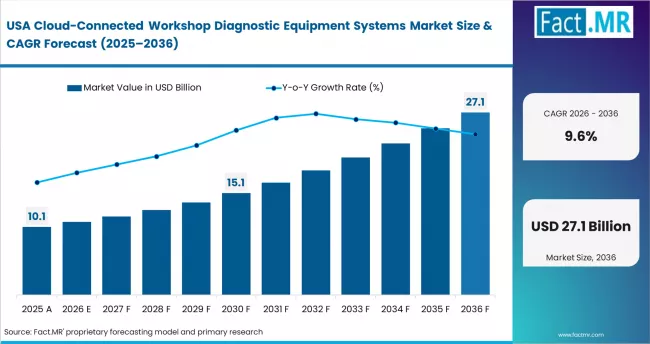
Cloud Connected Workshop Diagnostic Equipment Systems Market Country Value Analysis | Source: Fact.MR
North America reflects a mature yet evolving diagnostic ecosystem. Growth is supported by fleet digitalisation and ADAS recalibration requirements. Cloud platforms are expanding beyond OEM networks into independent repair shops. Key players include Snap-on Incorporated, Bosch Automotive Aftermarket, and Delphi Technologies. The market is shaped by certification standards and insurer-driven compliance workflows.
United States: The U.S. market is being driven by liability frameworks and insurance-linked diagnostics. Demand is projected to grow at 9.6% CAGR through 2036. ADAS recalibration rules are expanding across states. Collision repair shops must integrate cloud-based verification tools. Snap-on Incorporated reported a 22% rise in cloud tool placements in 2024. Growth is linked to insurer-mandated calibration documentation. Delphi Technologies partnered with Mitchell International in 2025. The integration embeds real-time diagnostic reports into estimating platforms used by over 30,000 workshops.
Fact.MR's analysis covers the United States, Canada, and Mexico. It includes ADAS compliance trends, fleet telematics integration, and insurer-driven diagnostic demand.
Europe Cloud-Connected Workshop Diagnostic Equipment Systems Market Analysis
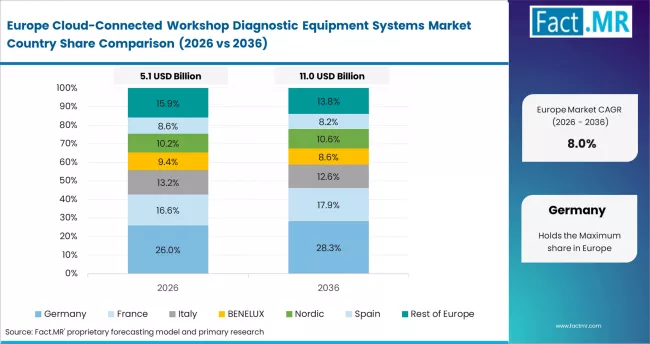
Cloud Connected Workshop Diagnostic Equipment Systems Market Europe Country Market Share Analysis, 2026 & 2036 | Source: Fact.MR
Europe is shaped by regulation-led diagnostic transformation. EU frameworks are enforcing structured access to vehicle data. Cloud diagnostics are becoming mandatory across OEM and independent workshops. Leading suppliers include Robert Bosch GmbH and Continental AG. Growth is steady across EV servicing and precision maintenance markets.
Germany: Germany’s market is defined by compliance-first adoption of diagnostic technologies. Demand is projected to grow at 8.9% CAGR through 2036. EU Regulation 2018/858 enables independent access to OEM diagnostic data. This has expanded cloud platform usage at scale. Robert Bosch GmbH increased ESI[tronic] 2.0 subscriptions by 18% in 2024. Growth is linked to updated Hauptuntersuchung inspection protocols. These require cloud-connected electronic system diagnostics.
Fact.MR's analysis covers Germany, France, the UK, Italy, Spain, and Rest of Europe. It includes EU compliance impact, OEM data-sharing mandates, and EV diagnostic platform trends.
Competitive Aligners for Market Players
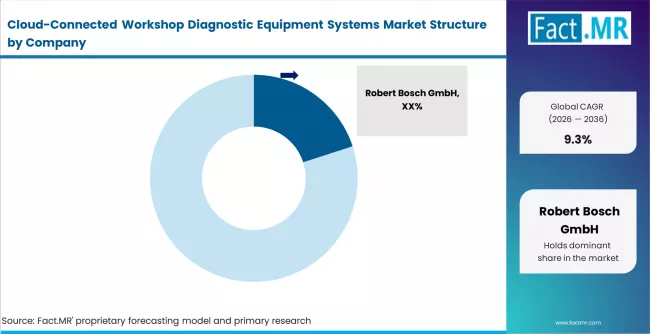
Cloud Connected Workshop Diagnostic Equipment Systems Market Analysis By Company | Source: Fact.MR
The cloud-connected workshop diagnostic equipment systems market is moderately concentrated. A few major players shape most of the competition. Companies like Robert Bosch GmbH, Snap-on Incorporated, Continental AG, Autel Intelligent Technology, and Delphi Technologies control a large share of global subscriptions and connected diagnostic tools. What really sets them apart is access to OEM data, how many vehicle brands they support, and how frequently their platforms update. Strong OEM partnerships make it difficult for new entrants to compete.
A clear structural advantage exists for companies that combine hardware reach with cloud ecosystems. Snap-on benefits from its vast technician network, making it easier to introduce and scale new platforms. Bosch, on the other hand, uses its deep OEM relationships to integrate diagnostics across both factory and aftermarket channels. Autel takes a different route, focusing on affordability and scale in Asia Pacific. This approach works well in price-sensitive markets where workshops care more about cost than brand alignment.
Buyer behavior varies across segments. Independent workshops are highly price-conscious and often switch platforms based on subscription value. They constantly compare costs with OEM diagnostic charges. Fleet operators tend to stay longer with one platform because of integration needs across multiple vehicles. OEM dealerships operate differently, as their diagnostic systems are usually mandated, ensuring stable demand.
Competition is gradually shifting beyond pricing. Companies are now building ecosystems that lock users in. Features like ADAS calibration libraries, integrated parts ordering, and technician training programs increase switching costs. Over time, this reduces price-driven competition and strengthens long-term customer retention.
Key Players
Robert Bosch GmbH
Continental AG
Snap-on Incorporated
Autel Intelligent Technology Co., Ltd.
Delphi Technologies PLC
ZF Friedrichshafen AG
Launch Tech Co., Ltd.
Hella GmbH & Co. KGaA
Softing Automotive Electronics GmbH
Texa S.p.A.
Bibliography
[1] Robert Bosch GmbH. (2024). Remote Diagnostics Platform global expansion and ESI[tronic] 2.0 integration update. Bosch Automotive Aftermarket official communication, Q3 2024.
[6] Toyota Motor Corporation. (2025). Dealership diagnostic infrastructure strategy and hybrid cloud transition overview. Toyota service network and compliance documentation, 2025.
This Report Addresses
Strategic intelligence on cloud diagnostic platform adoption across independent workshop, OEM dealership, and fleet operator segments globally.
Market forecast from USD 20.1 billion in 2026 to USD 48.7 billion by 2036 at a CAGR of 9.3%.
Growth opportunity mapping across China NEV diagnostic infrastructure, India vehicle parc expansion, U.S. ADAS recalibration mandates, and EU Regulation 2018/858 independent workshop data access compliance.
Segment analysis by solution type, deployment mode, and end user, with leading sub-segment share estimates for 2026.
Regional outlook covering Asia Pacific NEV-driven platform adoption, North America fleet telematics convergence, and Europe OEM data mandate compliance impacts.
Competitive analysis of Robert Bosch, Snap-on, Continental AG, Autel, and ZF Friedrichshafen. Focus on OEM data partnership depth, subscription renewal rates, and ADAS calibration library breadth.
Regulatory impact analysis covering EU Regulation 2018/858 diagnostic data access mandates, NHTSA ADAS recalibration frameworks, and China MIIT smart workshop digitalisation guidelines.
Report delivered in PDF, Excel datasets, and presentation formats, supported by primary interviews, OEM certification data, SAE vehicle complexity benchmarks, and regulatory filing documentation.
Cloud-Connected Workshop Diagnostic Equipment Systems Market Definition
The market covers digital diagnostic systems used in automotive workshops that connect vehicles, diagnostic tools, and cloud platforms to enable real-time fault detection, predictive maintenance, and remote troubleshooting.
Cloud-Connected Workshop Diagnostic Equipment Systems Market Inclusions
Covers global and regional forecasts from 2026 to 2036. Includes cloud-connected diagnostic software, hardware systems, workshop analytics platforms, and subscription services. Covers deployment models including SaaS, hybrid, and on-premise systems across OEM workshops, independent garages, and fleet service providers. Includes remote diagnostics, predictive maintenance platforms, and connected vehicle data integration.
Cloud-Connected Workshop Diagnostic Equipment Systems Market Exclusions
Excludes standalone offline diagnostic tools without cloud connectivity. Omits consumer-grade OBD scanners and DIY diagnostic devices. Excludes telematics hardware not integrated into workshop diagnostic workflows. Also excludes vehicle embedded diagnostics unless connected to external workshop systems.
Cloud-Connected Workshop Diagnostic Equipment Systems Market Research Methodology
Primary Research:Interviews with OEM service heads, workshop operators, fleet managers, and diagnostic equipment suppliers across the United States, Germany, China, India, and Japan.
Desk Research:Analysis of OEM annual reports, connected vehicle policy frameworks, GSMA automotive connectivity data, and company disclosures from Bosch, Continental, and Snap-on (2024–2025).
Market-Sizing and Forecasting:Hybrid model combining workshop penetration rates, connected vehicle parc data, diagnostic tool adoption rates, and SaaS subscription pricing.
Data Validation and Update Cycle:Validated using OEM disclosures, supplier earnings reports, and industry expert interviews. Updated annually.
Market Breakdown
Segmentation
Scope of Report
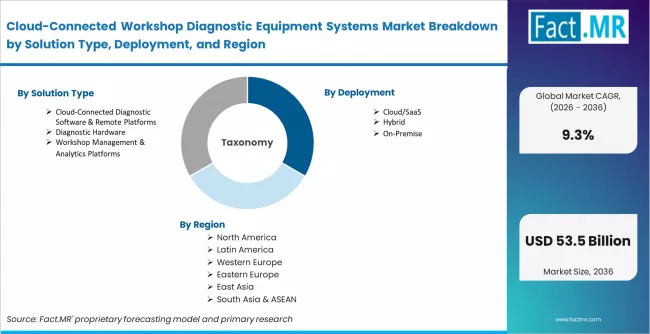
Cloud Connected Workshop Diagnostic Equipment Systems Market Breakdown By Solution Type, Deployment, And Region | Source: Fact.MR
Attribute
Details
Quantitative Units
USD 20.1 billion (2026) to USD 48.7 billion (2036), at a CAGR of 9.3%
Market Definition
Cloud-connected diagnostic software platforms, connected workshop hardware, and subscription analytics tools used for vehicle fault detection, ADAS calibration, remote servicing, and workshop management by independent shops, OEM dealerships, and fleet operators globally.
ADAS recalibration, EV powertrain diagnostics, OBD fault code resolution, remote vehicle health monitoring, fleet telematics integration, collision repair post-diagnostic verification, and OEM software update management.
Regions Covered
North America, Europe, Asia Pacific, Latin America, Middle East and Africa
Countries Covered
USA, Canada, Mexico, Germany, UK, France, Italy, Spain, Nordic, BENELUX, China, Japan, South Korea, India, ASEAN, Australia and New Zealand, Brazil, Argentina, Chile, Saudi Arabia, GCC, Turkey, South Africa, Rest of MEA
Hybrid top-down and bottom-up model using active vehicle parc by region, OEM diagnostic certification penetration rates, average platform subscription revenue per workshop tier, ADAS-equipped vehicle share, EV parc projections, and primary interviews with workshop procurement managers and fleet telematics directors.
Source: Fact.MR analysis. Updated May 12, 2026
Cloud-Connected Workshop Diagnostic Equipment Systems Market by Segments
How large is the global cloud-connected workshop diagnostic equipment systems market in 2025?
The global cloud-connected workshop diagnostic equipment systems market was valued at USD 18.9 billion in 2025.
What will the market size be in 2026?
Based on Fact.MR analysis, demand for cloud-connected workshop diagnostic equipment systems is estimated to grow to USD 20.1 billion in 2026.
What is the projected market size by 2036?
The market is projected to reach USD 48.7 billion by 2036, generating USD 28.6 billion in absolute dollar opportunity over the forecast period.
What is the expected CAGR from 2026 to 2036?
FACT.MR projects a CAGR of 9.3% for the global cloud-connected workshop diagnostic equipment systems market during the 2026 to 2036 forecast period.
Which solution type segment is poised to lead the market?
Cloud-Connected Diagnostic Software & Remote Platforms lead with approximately 35% share in 2026, driven by subscription-based diagnostic access demand from independent workshops managing diverse multi-OEM vehicle portfolios.
Which deployment mode holds the largest share?
Cloud/SaaS deployment leads with approximately 60% share in 2026, preferred for automatic OEM database updates, multi-location access, and lower total cost of ownership compared to on-premise configurations.
Which country shows the fastest growth?
China leads at 10.8% CAGR through 2036, driven by NEV mandate-linked diagnostic infrastructure investment and government smart workshop digitalisation programmes across 50,000-plus registered automotive service enterprises.
What is driving demand for cloud-connected diagnostic systems?
Demand is driven by ADAS and EV vehicle complexity requiring cloud-integrated calibration data, EU Regulation 2018/858 independent workshop data access mandates, and North American fleet operator telematics consolidation on unified diagnostic platforms.
What is the key challenge in this market?
Subscription cost sensitivity among independent workshop operators, OEM data access fragmentation across proprietary platforms, and cybersecurity compliance requirements for cloud-connected vehicle diagnostic data transmission constrain mass adoption rates in price-sensitive markets.
.webp "Top Country Growth Comparison Cloud Connected Workshop Diagnostic Equipment Systems Market Cagr (2026 2036)")