- Base Value(2026): 7.7 Bn
- Forecast Value (2036): 13.7 Bn
- CAGR (2036): 6.0%
Nitrogen Oxide Control Systems Market Forecast and Outlook By Fact.MR
The nitrogen oxide control systems market reached USD 7.5 billion in 2025. Fact MR estimates the market will expand to USD 7.7 billion in 2026 and attain USD 13.7 billion by 2036. The market is forecast to register a CAGR of 6.0% across the assessment period.
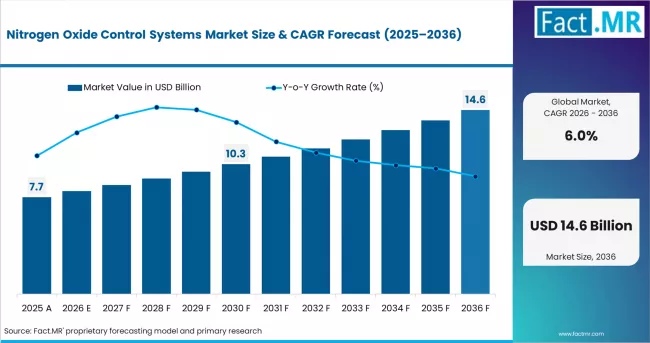
Nitrogen Oxide Control Systems Market Market Value Analysis | Source: Fact.MR
Nitrogen Oxide Control Systems Market
| Metric | Details |
|---|---|
| Industry Size (2026E) | USD 7.7 billion |
| Industry Value (2036F) | USD 13.7 billion |
| CAGR (2026 to 2036) | 6.0% |
Source: Fact.MR analysis. Updated Apr 21, 2026
Summary of the Nitrogen Oxide Control Systems Market
- Market Definition
- The market comprises industrial emission control technologies designed to reduce nitrogen oxide emissions generated during combustion processes using catalytic reduction, combustion modification, and exhaust gas treatment systems across power plants, industrial boilers, refineries, cement kilns, and chemical processing facilities.
- Demand Drivers
- Increasing regulatory enforcement of emission standards across power generation and industrial combustion facilities.
- Rising installation of catalytic reduction technologies supporting compliance with nitrogen oxide emission thresholds.
- Growing retrofit demand across aging thermal power plants requiring upgraded flue gas treatment infrastructure.
- Expansion of industrial production capacity requiring integration of emission control systems across combustion equipment.
- Increasing adoption of low emission combustion technologies supporting reduction of nitrogen oxide formation during fuel oxidation.
- Rising requirement for continuous monitoring and treatment of exhaust gases across regulated manufacturing environments.
- Key Segments Analyzed
- Technology: SCR systems lead with 46% share supported by high nitrogen oxide removal efficiency performance.
- End Use Industry: Energy and utilities account for 44% share driven by emission compliance requirements across thermal power generation.
- Application: Power plants represent primary installation base due to continuous combustion related emission generation.
- Technology Role: Catalytic and non catalytic reduction systems enable conversion of nitrogen oxides into nitrogen and water.
- Geography: Asia Pacific demonstrates strong adoption supported by expansion of industrial combustion infrastructure.
- Analyst Opinion at Fact MR
- Shambhu Nath Jha, Principal Consultant, Fact MR, opines, 'In this updated edition of the Nitrogen Oxide Control Systems Market report, industrial emission compliance requirements remain the primary factor sustaining demand for catalytic and combustion modification technologies through 2036.'
- Strategic Implications or Executive Takeaways
- Strengthen SCR and SNCR technology capability supporting compliance with tightening emission thresholds across industrial combustion systems.
- Invest in catalyst material development supporting stable performance across varied temperature operating environments.
- Expand retrofit solution capability supporting integration of emission control technologies within existing power and industrial infrastructure.
- Improve system efficiency supporting reduction of nitrogen oxide concentration across flue gas treatment workflows.
- Enhance digital monitoring capability supporting continuous measurement of emission levels across regulated facilities.
- Focus on engineering integration capability supporting compatibility with combustion equipment across utilities and heavy industry.
- Methodology
- Primary interviews conducted with environmental engineering firms, emission control technology providers, and industrial plant operators.
- Benchmarked against industrial combustion output indicators influencing demand for nitrogen oxide reduction systems.
- Evaluated regulatory compliance frameworks supporting adoption of catalytic reduction technologies across power generation infrastructure.
- Hybrid modeling applied combining top down emission control demand assessment with bottom up installation benchmarking across industrial facilities.
- Validation conducted using technology deployment indicators across utilities, refining, and manufacturing emission control environments.
- Peer review applied using Fact MR analytical frameworks linking industrial production activity with nitrogen oxide reduction technology adoption patterns.
A CAGR of 6.0% indicates moderate expansion with variability linked to regulatory enforcement cycles across power generation and industrial combustion sources. Growth is supported by emissions compliance requirements, while volatility persists due to retrofit capital costs, policy uncertainty, and substitution between selective catalytic reduction and alternative abatement technologies.
China leads with a projected CAGR of 6.9%, supported by installation of flue gas treatment systems across industrial combustion and power generation facilities. India follows with a CAGR of 6.6%, driven by increasing implementation of emission reduction equipment across thermal power and heavy industry operations. The United Kingdom records a CAGR of 6.4%, reflecting steady integration of catalytic and non-catalytic reduction technologies across industrial emission control systems. Germany shows a CAGR of 6.3%, supported by consistent use of nitrogen oxide abatement systems across regulated manufacturing environments. The United States records the slowest growth at 6.0%, reflecting a mature market tied to replacement demand within established industrial emission control infrastructure.
Segmental Analysis
Nitrogen Oxide Control Systems Market Analysis by Technology
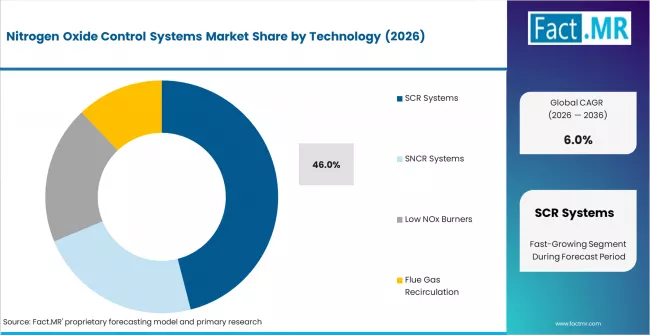
Nitrogen Oxide Control Systems Market Analysis By Technology | Source: Fact.MR
- Market Overview: Based on Fact MR assessment, selective catalytic reduction systems are projected to account for 46% share of the nitrogen oxide control systems market in 2026. SCR systems utilize catalytic reaction pathways enabling conversion of nitrogen oxides into nitrogen and water through interaction with ammonia or urea based reducing agents. Reactor configuration supports controlled gas flow across catalyst beds enabling reduction of NOx concentration within exhaust streams generated across combustion processes. Integration across industrial emission control infrastructure supports stable removal efficiency across high temperature flue gas treatment environments requiring consistent catalytic performance across varied operating conditions.
- Demand Drivers:
- Emission Reduction Requirements: SCR technology supports chemical conversion of nitrogen oxides enabling controlled reduction of regulated exhaust gas components.
- Catalytic Reaction Stability: Catalyst materials demonstrate stable performance across temperature ranges encountered in industrial combustion exhaust streams.
- Process Integration Needs: SCR systems support incorporation within flue gas treatment units requiring consistent pollutant removal performance across emission control workflows.
Nitrogen Oxide Control Systems Market Analysis by End Use Industry
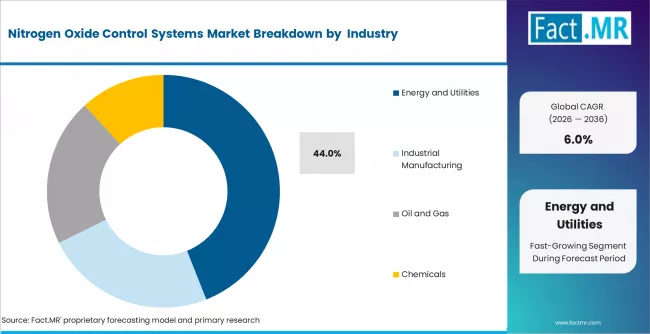
Nitrogen Oxide Control Systems Market Analysis By End Use Industry | Source: Fact.MR
- Market Overview: Energy and utilities sector is estimated to hold 44% share of the nitrogen oxide control systems market in 2026, supported by requirement for emission control across thermal power plants, gas turbines, and industrial boilers requiring reduction of nitrogen oxide output within regulated limits. Combustion based power generation processes produce NOx emissions requiring installation of control technologies supporting compliance with air emission standards governing industrial exhaust release. Integration of emission control equipment supports reduction of pollutant concentration across power generation facilities requiring consistent performance across continuous energy production environments.
- Demand Drivers:
- Regulatory Compliance Requirements: Energy producers deploy NOx control systems supporting adherence to emission limits defined for combustion based power generation infrastructure.
- Flue Gas Treatment Parameters: Emission control technologies support reduction of nitrogen oxide concentration across exhaust gas streams generated during fuel combustion processes.
- Operational Stability Needs: Continuous emission control performance supports maintenance of environmental compliance across high output power generation facilities.
Key Dynamics
Nitrogen Oxide Control Systems Market Drivers, Restraints, and Opportunities
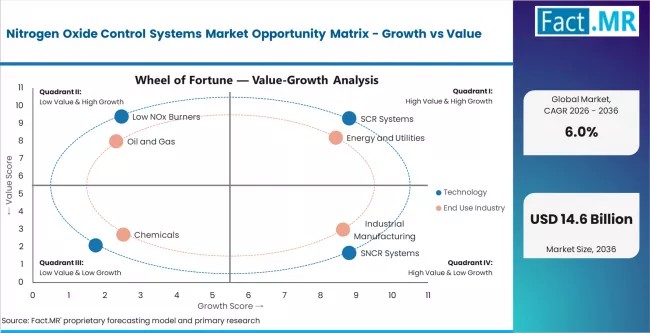
Nitrogen Oxide Control Systems Market Opportunity Matrix Growth Vs Value | Source: Fact.MR
Fact MR analysis indicates historical demand for nitrogen oxide control systems has been structurally tied to combustion-based industrial processes including coal power generation, gas turbines, cement kilns, and refining units where high-temperature fuel oxidation produces NOx as a regulated pollutant. The present market size reflects a mature environmental compliance segment sustained by continuous tightening of air quality standards governing industrial stack emissions and mobile combustion sources. Structural reality indicates stable growth because existing thermal power infrastructure and heavy industry capacity continue to require post-combustion treatment technologies to maintain operating permits under evolving emission thresholds. Technologies such as selective catalytic reduction and selective non-catalytic reduction remain embedded in plant design due to proven ability to achieve high NOx removal efficiency across large exhaust volumes.
The current structural shift reflects declining installation of basic low-NOx burners alone as integrated catalytic systems provide higher removal efficiency required under updated emission frameworks. Advanced catalyst materials and digital monitoring systems increase per-unit system cost, yet regulatory penalties and operational restrictions create strong economic justification for retrofits across legacy facilities. Value growth remains linked to compliance-driven upgrades rather than expansion of new fossil fuel capacity in mature markets.
- Emission Compliance Mandates: U.S. Clean Air Act NAAQS requirements and EU Industrial Emissions Directive enforce NOx reduction thresholds, sustaining baseline demand for SCR and SNCR installation across industrial combustion sources.
- Catalytic Technology Shift: SCR systems achieve high removal efficiency, supporting replacement of lower-performance burner modifications as emission limits tighten across utilities and heavy industry.
- Asia Industrial Expansion: China and India drive incremental demand due to expansion of thermal power generation, cement production, and refining capacity requiring compliant flue gas treatment systems.
Regional Analysis
The Nitrogen Oxide Control Systems Market is assessed across North America, Europe, and Asia Pacific, segmented by country-level demand in selective catalytic reduction systems, selective non-catalytic reduction technologies, flue gas treatment equipment, and industrial emission compliance solutions. Regional demand reflects tightening air quality regulations and installation of emission reduction technologies in power and process industries. The full report offers market attractiveness analysis.
.webp "Top Country Growth Comparison Nitrogen Oxide Control Systems Market Cagr (2026 2036)")
Top Country Growth Comparison Nitrogen Oxide Control Systems Market Cagr (2026 2036) | Source: Fact.MR
CAGR Table of Nitrogen Oxide Control Systems Market
| Country | CAGR (2026–2036) |
|---|---|
| China | 6.9% |
| India | 6.6% |
| United Kingdom | 6.4% |
| Germany | 6.3% |
| United States | 6.0% |
Source: Fact.MR analysis. Updated Apr 21, 2026
Source: Fact MR analysis, based on proprietary forecasting model and primary research
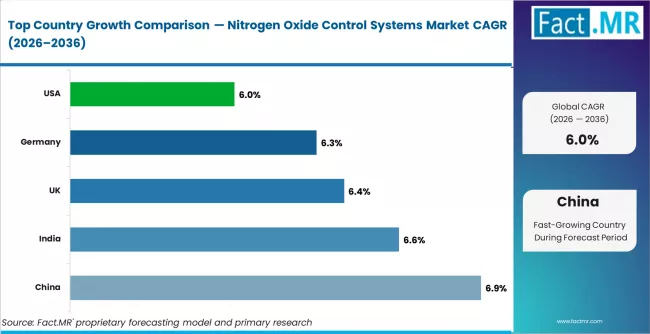
Nitrogen Oxide Control Systems Market Cagr Analysis By Country | Source: Fact.MR
Asia Pacific
Asia Pacific functions as the industrial emission control deployment hub, supported by expansion of power generation capacity and implementation of flue gas treatment technologies. Mitsubishi Heavy Industries Ltd. strengthens selective catalytic reduction engineering capability. Thermax Limited expands industrial emission treatment system integration. Babcock & Wilcox Enterprises Inc. supports combustion emission control solutions.
- China: China is projected to record 6.9% CAGR in nitrogen oxide control systems adoption through 2036. Ultra-low emission standards update for thermal power plants (Ministry of Ecology and Environment, March 2024) supports installation of flue gas denitrification technologies. Mitsubishi Heavy Industries Ltd. expanded SCR system engineering capability (June 2023).
- India: Installation of nitrogen oxide control systems in India is forecast to grow at 6.6% CAGR through 2036. National Clean Air Programme implementation update (Ministry of Environment, January 2024) supports deployment of industrial emission control equipment. Thermax Limited expanded flue gas treatment system manufacturing capability (May 2023).
Europe
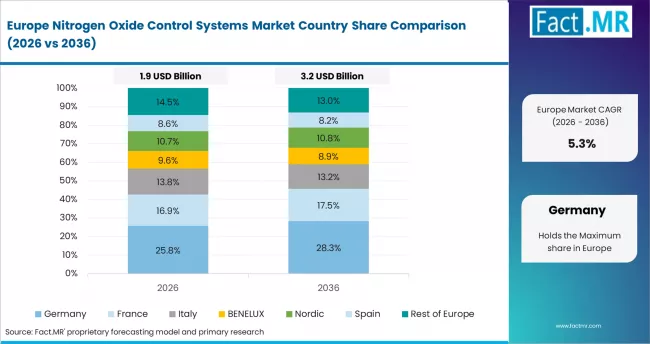
Nitrogen Oxide Control Systems Market Europe Country Market Share Analysis, 2026 & 2036 | Source: Fact.MR
Europe operates as the emission compliance technology benchmark, supported by strict air pollution directives and structured industrial environmental standards. Siemens Energy AG strengthens emission reduction engineering capability. ANDRITZ AG expands flue gas treatment portfolio. Hitachi Energy Ltd. supports industrial environmental control solutions.
- United Kingdom: Adoption of nitrogen oxide control systems in United Kingdom is expected to expand at 6.4% CAGR through 2036. Industrial Emissions Directive compliance update (Environment Agency, February 2024) supports selective catalytic reduction installation across process industries. ANDRITZ AG expanded emission control system engineering capability (July 2023).
- Germany: Germany is anticipated to observe 6.3% CAGR in nitrogen oxide control systems deployment through 2036. Federal Immission Control Act regulatory update (October 2023) supports industrial flue gas purification adoption. Siemens Energy AG expanded denitrification technology integration capability (April 2023).
North America
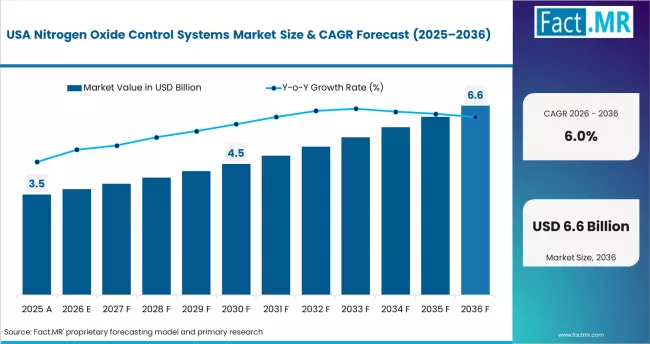
Nitrogen Oxide Control Systems Market Country Value Analysis | Source: Fact.MR
North America represents the industrial air pollution mitigation technology environment, supported by established emission standards and modernization of combustion-based industrial infrastructure. Babcock & Wilcox Enterprises Inc. strengthens flue gas treatment engineering capability. General Electric Company expands emission reduction system integration. Honeywell International Inc. supports industrial environmental monitoring technologies.
- United States: The United States is forecast to witness 6.0% CAGR in nitrogen oxide control systems demand through 2036. Clean Air Act emission compliance update (U.S. Environmental Protection Agency, April 2024) supports adoption of selective catalytic reduction systems. Babcock & Wilcox Enterprises Inc. expanded emission control engineering capability (August 2023).
Fact MR's analysis of nitrogen oxide control systems market in global regions consists of country-wise assessment that includes China, India, United Kingdom, Germany, and United States. Readers can find industrial emission regulation trends, flue gas treatment developments, environmental compliance signals, and competitive positioning across key markets.
Competitive Landscape
Competitive Structure and Buyer Dynamics in the Nitrogen Oxide Control Systems Market
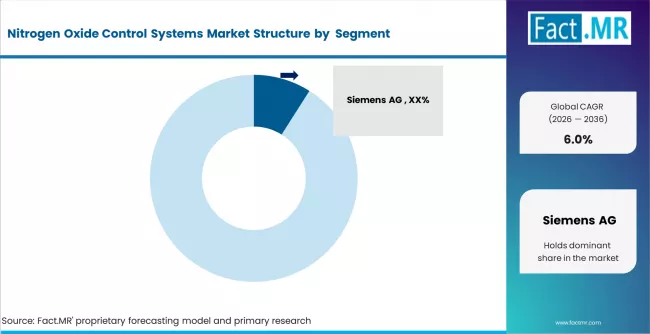
Nitrogen Oxide Control Systems Market Analysis By Company | Source: Fact.MR
The competitive structure of the Nitrogen Oxide Control Systems Market is moderately concentrated, with environmental engineering firms and industrial emission control technology providers controlling a significant share of installation projects. Companies such as Siemens AG, Mitsubishi Heavy Industries Ltd., Babcock and Wilcox Enterprises Inc., Honeywell International Inc., CECO Environmental Corp., FLSmidth and Co. AS, Hamon Group, John Wood Group plc, Thermax Ltd., and Ducon Technologies Inc. maintain strong positions through established flue gas treatment technologies and engineering integration capabilities. Competition is primarily influenced by removal efficiency performance, system reliability, compliance with emission standards, and ability to integrate with industrial combustion and power generation systems.
Several companies maintain structural advantages through proprietary catalyst technologies and long term relationships with power plants, cement producers, and heavy industrial operators requiring emission reduction systems. Firms such as Mitsubishi Heavy Industries Ltd. and Babcock and Wilcox Enterprises Inc. benefit from extensive engineering expertise in selective catalytic reduction and selective non catalytic reduction technologies. Siemens AG and Honeywell International Inc. maintain advantages through integrated industrial automation capabilities supporting emission monitoring systems. Industrial operators typically evaluate multiple engineering providers to reduce dependence on a single system supplier and ensure compliance flexibility. Procurement decisions assess suppliers based on performance reliability, regulatory alignment, and lifecycle maintenance capability, moderating supplier pricing leverage across emission control infrastructure deployments.
Key Players of the Nitrogen Oxide Control Systems Market
- Siemens AG
- Mitsubishi Heavy Industries Ltd.
- Babcock and Wilcox Enterprises Inc.
- Honeywell International Inc.
- Ducon Technologies Inc.
- CECO Environmental Corp.
- FLSmidth and Co. AS
- Hamon Group
- John Wood Group plc
- Thermax Ltd
Bibliographies
- [1] U.S. Environmental Protection Agency. (2024, April). Clean air act emission compliance update. U.S. Environmental Protection Agency.
- [2] Ministry of Ecology and Environment. (2024, March). Ultra low emission standards update for thermal power plants. Government of China.
- [3] Ministry of Environment Forest and Climate Change. (2024, January). National clean air programme implementation update. Government of India.
- [4] Environment Agency. (2024, February). Industrial emissions directive compliance update. UK Government.
- [5] Federal Ministry for Economic Affairs and Climate Action. (2023, October). Federal immission control act regulatory update. Government of Germany.
- [6] Mitsubishi Heavy Industries Ltd. (2023, June). SCR system engineering capability expansion. Mitsubishi Heavy Industries Ltd.
- [7] Thermax Limited. (2023, May). Flue gas treatment system manufacturing capability expansion. Thermax Limited.
This Report Addresses
- Market size forecasts for 2026 to 2036 based on installation of combustion emission control technologies across power generation and heavy industrial facilities.
- Opportunity mapping across selective catalytic reduction, selective non catalytic reduction, low NOx burners, and flue gas recirculation system configurations.
- Segment and regional forecasts covering power plants, industrial boilers, cement plants, chemical plants, and refinery emission control infrastructure applications.
- Competition benchmarking based on removal efficiency performance, catalyst durability characteristics, system integration capability, and compliance alignment with industrial emission standards.
- Regulatory assessment covering air quality compliance frameworks influencing installation of nitrogen oxide reduction technologies across combustion-based industrial operations.
- Report delivery in PDF, Excel, PPT, and dashboard formats supporting environmental engineering firms, industrial plant operators, and emission control technology providers.
- Technology risk evaluation covering retrofit cost structure, catalyst material lifecycle variability, process integration complexity, and regulatory enforcement dependency influencing adoption of NOx abatement systems.
Nitrogen Oxide Control Systems Market Definition
The Nitrogen Oxide Control Systems Market includes technologies designed to reduce nitrogen oxide emissions generated during combustion processes in power plants, industrial boilers, refineries, and manufacturing facilities, using methods such as selective catalytic reduction, selective non catalytic reduction, low NOx burners, and flue gas treatment to convert harmful gases into nitrogen and water.
Nitrogen Oxide Control Systems Market Inclusions
The report includes global and regional market size estimates, forecast analysis, and segmentation by control technology such as SCR, SNCR, low NOx burners, and flue gas recirculation, application area, end use industry, pricing structure, and emission compliance integration across industrial pollution control systems.
Nitrogen Oxide Control Systems Market Exclusions
The scope excludes carbon capture technologies, particulate filtration systems such as electrostatic precipitators, sulfur oxide removal technologies, combustion equipment without emission control functionality, and finished industrial plants where NOx control system components cannot be isolated.
Nitrogen Oxide Control Systems Market Research Methodology
- Primary Research: Interviews were conducted with emission control equipment manufacturers, power generation companies, industrial plant operators, environmental engineering firms, and regulatory specialists.
- Desk Research: Public sources included environmental regulatory frameworks, industrial emission standards documentation, company technical literature, patent filings, and research publications on NOx reduction technologies.
- Market-Sizing and Forecasting: A hybrid model combining top-down industrial emission control demand evaluation and bottom-up analysis of NOx control technology installation across combustion based facilities was applied.
- Data Validation and Update Cycle: Outputs were validated through cross comparison of technology deployment data, expert consultation, and periodic monitoring of environmental regulation changes and industrial emission reduction adoption trends.
Segmentation
Report Scope
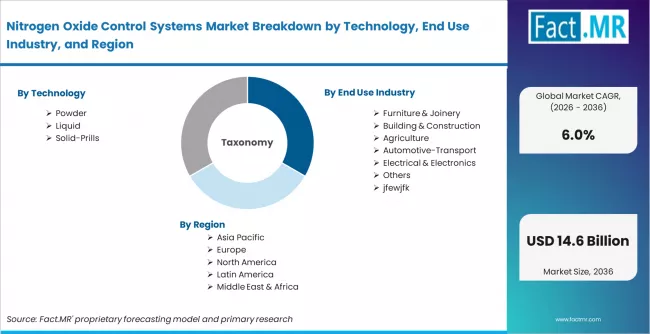
Nitrogen Oxide Control Systems Market Breakdown By Technology, End Use Industry, And Region | Source: Fact.MR
| Metric | Value |
|---|---|
| Quantitative Units | USD 7.7 billion (2026) to USD 13.7 billion (2036), at a CAGR of 6.0% |
| Market Definition | The nitrogen oxide control systems market includes emission reduction technologies designed to limit NOx formation and release from combustion processes through catalytic reduction, combustion optimization, and exhaust gas treatment across industrial and energy facilities. |
| Technology Segmentation | SCR systems, SNCR systems, Low NOx burners, Flue gas recirculation |
| Application Segmentation | Power plants, Industrial boilers, Cement plants, Chemical plants, Refineries |
| End Use Industry Segmentation | Energy and utilities, Industrial manufacturing, Oil and gas, Chemicals |
| Regions Covered | North America, Latin America, Europe, East Asia, South Asia, Oceania, Middle East and Africa |
| Countries Covered | United States, Canada, Germany, France, United Kingdom, Italy, Spain, Netherlands, China, Japan, South Korea, India, Saudi Arabia, United Arab Emirates, Brazil, Mexico, South Africa, Australia, and 40+ countries |
| Key Companies Profiled | Siemens AG, Mitsubishi Heavy Industries Ltd., Babcock and Wilcox Enterprises Inc., Honeywell International Inc., Ducon Technologies Inc., CECO Environmental Corp., FLSmidth and Co. AS, Hamon Group, John Wood Group plc, Thermax Ltd. |
| Forecast Period | 2026 to 2036 |
| Approach | Hybrid top-down and bottom-up market estimation based on industrial emission compliance requirements, flue gas treatment system adoption benchmarking, power generation emission control retrofit demand, environmental regulatory framework analysis, and validation through primary interviews with environmental technology providers, engineering firms, and industrial plant operators. |
Source: Fact.MR analysis. Updated Apr 21, 2026
Nitrogen Oxide Control Systems Market Key Segments
-
Technology:
- SCR Systems
- SNCR Systems
- Low NOx Burners
- Flue Gas Recirculation
-
Application:
- Power Plants
- Industrial Boilers
- Cement Plants
- Chemical Plants
- Refineries
-
End Use Industry:
- Energy and Utilities
- Industrial Manufacturing
- Oil and Gas
- Chemicals
-
Region:
- North America
- USA
- Canada
- Mexico
- Europe
- Germany
- UK
- France
- Italy
- Spain
- Nordic Countries
- BENELUX
- Rest of Europe
- Asia Pacific
- China
- Japan
- South Korea
- India
- Australia
- Rest of Asia Pacific
- Latin America
- Brazil
- Argentina
- Rest of Latin America
- Middle East and Africa
- Kingdom of Saudi Arabia
- United Arab Emirates
- South Africa
- Rest of Middle East and Africa
- Other Regions
- Oceania
- Central Asia
- Other Markets
- North America
Frequently Asked Questions
How large is the demand for Nitrogen Oxide Control Systems in the global market in 2026?
What will be the market size of Nitrogen Oxide Control Systems in the global market by 2036?
What is the expected demand growth for Nitrogen Oxide Control Systems in the global market between 2026 and 2036?
Which company is identified as a leading provider in the Nitrogen Oxide Control Systems market?
Which technology segment is projected to dominate nitrogen oxide control system adoption by 2026?
Why are SCR systems widely used in nitrogen oxide emission control applications?
What is driving demand for nitrogen oxide control systems in China?
What is the growth outlook for the Nitrogen Oxide Control Systems market in China?
Why is India an important market for nitrogen oxide emission control technologies?
What is the growth outlook for the Nitrogen Oxide Control Systems market in India?
How is demand for nitrogen oxide control systems evolving in the United Kingdom?
What is the growth outlook for the Nitrogen Oxide Control Systems market in the United Kingdom?
What is the growth outlook for the Nitrogen Oxide Control Systems market in Germany?
How is the United States positioned in the Nitrogen Oxide Control Systems market?
What is the growth outlook for the Nitrogen Oxide Control Systems market in the United States?
What are nitrogen oxide control systems and what are they mainly used for?
What does the Nitrogen Oxide Control Systems market include in this report?
What applications are included in the scope of the Nitrogen Oxide Control Systems market?
What is excluded from the scope of the Nitrogen Oxide Control Systems market report?
What does market forecast mean in the Nitrogen Oxide Control Systems market report?
How is the Nitrogen Oxide Control Systems market forecast developed in this report?
What does primary validation indicate in the Nitrogen Oxide Control Systems market analysis?
Who worked on this report


Preview the report firsthand - request a free sample
Free SampleGet the brochure for pricing and purchase details
Download PDF