- Base Value(2025): 312.6 Mn
- Estimated Value(2026): 348.2 Mn
- Forecast Value (2036): 1180 Mn
- CAGR (2026 - 2036): 13%
Cobots for Pharmaceutical Dispensing Market Forecast 2026 to 2036
In 2025, the cobots for pharmaceutical dispensing market was valued at USD 312.6 million. Based on Fact MR analysis, demand for collaborative robots used in pharmaceutical dispensing is estimated to grow to USD 348.2 million in 2026 and USD 1,180 million by 2036. FMR projects a CAGR of 13% during the forecast period.
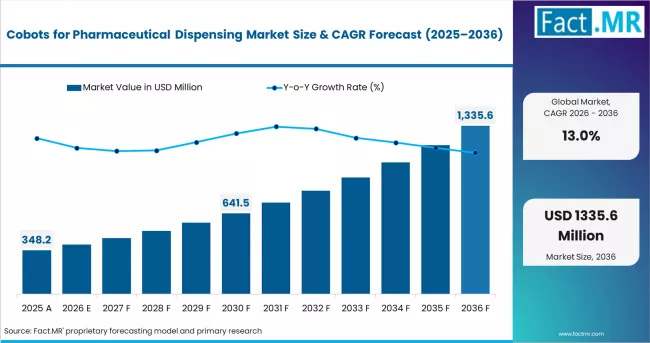
Cobots For Pharmaceutical Dispensing Market Market Value Analysis | Source: Fact.MR
Summary of Cobots for Pharmaceutical Dispensing Market
- Market Definition
- The market comprises collaborative robotic systems designed to automate pharmaceutical dispensing, counting, filling, labeling, and packaging processes while operating safely alongside human personnel. These cobots enable controlled dosing accuracy, contamination reduction, and workflow standardization across hospital pharmacies, retail pharmacies, pharmaceutical manufacturing facilities, compounding pharmacies, and research laboratories requiring precision handling of pharmaceutical products.
- Demand Drivers
- Increasing requirement for dosing precision supporting reduction of variability across pharmaceutical dispensing and formulation workflows.
- Rising adoption of automation systems supporting contamination control in sterile compounding and aseptic pharmaceutical handling environments.
- Growing need for workflow efficiency across high volume pharmaceutical packaging and dispensing operations.
- Expansion of pharmaceutical manufacturing capacity requiring programmable robotic systems supporting repeatable motion accuracy.
- Integration of collaborative robotics with digital pharmacy management systems enabling traceability and batch level process documentation.
- Rising emphasis on operational safety through deployment of robots designed to operate alongside personnel without protective enclosures.
- Key Segments Analyzed
- Application: Hospital pharmacies and pharmaceutical manufacturing represent major adoption environments due to demand for automated dispensing consistency.
- Payload Capacity: Up to 5 kg accounts for 41% share in 2026 supported by requirement for precision handling of lightweight pharmaceutical containers.
- Function: Dispensing function leads with 39% share driven by requirement for accurate dosing across pharmaceutical preparation workflows.
- Technology Role: Pick and place, packaging, and labeling functions support automated material handling across pharmaceutical production lines.
- Geography: Asia Pacific demonstrates strong adoption driven by pharmaceutical manufacturing expansion, while North America and Europe maintain significant value share linked to regulatory compliant automation integration.
- Analyst Opinion at Fact MR
- Shambhu Nath Jha, Principal Consultant, Fact MR, opines, 'In this updated edition of the Cobots for Pharmaceutical Dispensing Market report, adoption patterns reflect increasing reliance on collaborative robotic systems supporting dosing accuracy, contamination control, and workflow repeatability across pharmaceutical processing environments. Market participants observe strong demand progression aligned with regulatory compliance requirements and digital integration across automated dispensing operations. Manufacturers emphasizing precision engineering, software compatibility, and validation support capabilities are positioned to maintain sustained market expansion through 2036.'
- Strategic Implications/Executive Takeaways
- Strengthen development of collaborative robotic platforms aligned with pharmaceutical dispensing precision requirements.
- Focus on compact payload cobots supporting high accuracy handling of small volume pharmaceutical containers.
- Expand integration capabilities with pharmacy information systems supporting automated documentation and traceability workflows.
- Enhance compliance alignment with sterile manufacturing and quality assurance requirements across pharmaceutical environments.
- Develop modular robotic configurations supporting flexible deployment across hospital pharmacies and pharmaceutical production facilities.
- Monitor cost optimization strategies supporting wider adoption of collaborative automation across mid scale pharmaceutical operations.
- Methodology
- Built on primary interviews with collaborative robot manufacturers, pharmaceutical companies, hospital pharmacy managers, and automation integrators.
- Benchmarked against pharmaceutical production automation indicators influencing robotic deployment across dispensing workflows.
- Evaluated demand trends across sterile compounding environments, packaging automation systems, and laboratory dispensing operations.
- Applied hybrid modeling combining top down healthcare automation demand assessment with bottom up analysis of cobot deployment across pharmaceutical facilities.
- Validated through cross comparison of supplier shipment data, regulatory compliance requirements, and robotic integration trends.
- Peer reviewed using Fact MR analytical frameworks integrating supply side robotics manufacturing capacity with end use pharmaceutical automation demand mapping.
Cobots for Pharmaceutical Dispensing Market
| Metric | Details |
|---|---|
| Industry Size (2026E) | USD 348.2 million |
| Industry Value (2036F) | USD 1,180 million |
| CAGR (2026 to 2036) | 13% |
Source: Fact.MR analysis. Updated Apr 11, 2026
An increase of USD 831.8 million indicates transformational expansion driven by automation demand for dosing accuracy, contamination control, and workflow efficiency in pharmaceutical dispensing environments. Growth is supported by regulatory emphasis on traceability, while constraints persist from integration costs, validation timelines, and compatibility requirements with existing pharmacy information systems.
China leads with a projected CAGR of 14.2%, supported by expanding automation deployment across high-volume pharmaceutical packaging and dispensing facilities. India follows with a CAGR of 13.9%, driven by increasing integration of collaborative robotic systems across pharmaceutical manufacturing and hospital dispensing environments. The United Kingdom records a CAGR of 13.6%, reflecting stable adoption of precision dispensing cobots across regulated pharmaceutical production processes. Germany shows a CAGR of 13.3%, supported by steady incorporation of robotic automation systems across pharmaceutical quality control and packaging operations. The United States records the slowest growth at 13.0%, reflecting a relatively mature automation landscape where demand is largely tied to replacement cycles within existing pharmaceutical robotics infrastructure. Mature markets generate a significant share of replacement demand as automation upgrades remain aligned with accuracy requirements, operational efficiency, and regulatory compliance across pharmaceutical dispensing systems.
Segmental Analysis
Cobots for Pharmaceutical Dispensing Market Analysis by Payload Capacity
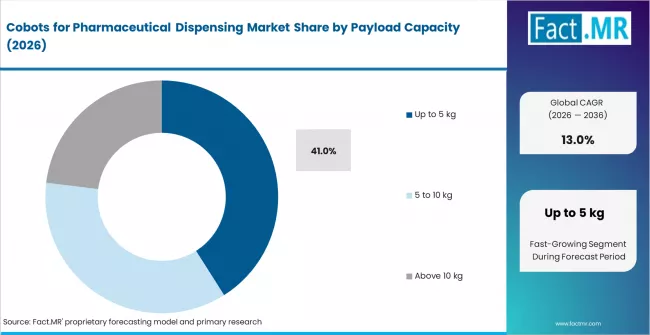
Cobots For Pharmaceutical Dispensing Market Analysis By Payload Capacity | Source: Fact.MR
- Market Overview: Based on Fact MR assessment, payload capacity up to 5 kg is projected to account for 41% share of the cobots for pharmaceutical dispensing market in 2026. Low payload collaborative robots are deployed across dispensing workflows requiring high positioning accuracy and controlled movement across compact workstations handling vials, blister packs, and small batch containers. Equipment configuration supports integration into laboratory scale and small volume pharmaceutical packaging environments requiring repeatable motion control and stable handling precision. Compact payload systems enable installation within cleanroom environments requiring reduced footprint and controlled operational parameters aligned with pharmaceutical handling protocols.
- Demand Drivers:
- Precision Handling Requirements: Cobots with lower payload capacity support accurate positioning across pharmaceutical dispensing processes requiring controlled movement of lightweight containers.
- Cleanroom Compatibility Parameters: Compact robotic units support installation within controlled environments requiring minimized particulate generation during automated handling operations.
- Operational Flexibility Needs: Low payload collaborative robots enable adaptable deployment across varied dispensing configurations requiring programmable movement paths.
Cobots for Pharmaceutical Dispensing Market Analysis by Function
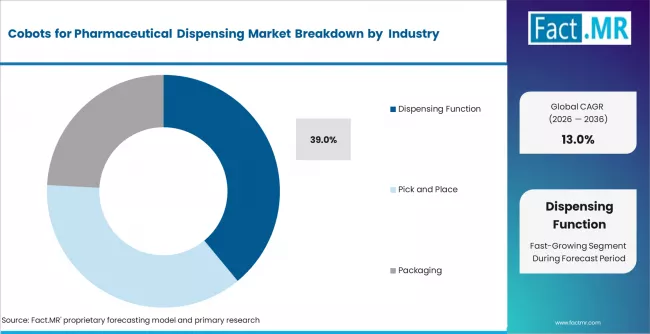
Cobots For Pharmaceutical Dispensing Market Analysis By Function | Source: Fact.MR
- Market Overview: Dispensing function is estimated to hold 39% share of the cobots for pharmaceutical dispensing market in 2026, supported by requirement for controlled dosage allocation across pharmaceutical packaging and formulation workflows. Collaborative robots are programmed to handle liquid and solid dosage transfer operations requiring consistent dispensing accuracy across repetitive production cycles. Integration with automated filling equipment supports maintenance of dosage precision across pharmaceutical manufacturing environments requiring controlled product handling conditions aligned with regulatory compliance frameworks.
- Demand Drivers:
- Dosage Accuracy Requirements: Cobot dispensing systems support controlled quantity transfer across pharmaceutical production workflows requiring repeatable precision performance.
- Process Consistency Parameters: Automated dispensing supports uniform product filling performance across batch controlled pharmaceutical packaging operations.
- System Integration Needs: Collaborative robots demonstrate compatibility with filling systems and conveyor units supporting continuous pharmaceutical production workflows.
Key Dynamics
Cobots for Pharmaceutical Dispensing Market Drivers, Restraints, and Opportunities
Fact MR analysis indicates that the cobots for pharmaceutical dispensing market developed from laboratory automation and sterile manufacturing systems designed to reduce variability in drug formulation and dispensing accuracy. Historically, pharmaceutical dispensing relied on manual measurement and preparation processes that required skilled personnel to maintain dose precision and contamination control. The current market valuation reflects increasing deployment of collaborative robots in sterile compounding, tablet dispensing, and precision dosing systems where consistency and traceability are critical. Demand persists because cobots enable controlled handling of active pharmaceutical ingredients while reducing variability associated with manual processes.
A structural shift is occurring as conventional manual dispensing workflows transition toward automated dispensing platforms designed to improve repeatability and compliance with sterile production protocols. Manual preparation methods remain widely used in small-scale laboratories where capital investment in robotics occurs gradually. Cobots integrate machine vision, force sensing, and programmable dosing functions that enable high-precision dispensing and real-time data recording aligned with regulated pharmaceutical manufacturing environments. These systems involve higher upfront equipment and integration costs compared with manual workflows. Even with gradual adoption across pharmaceutical manufacturing and hospital pharmacies, higher-value automation systems support steady market value expansion.
- Precision Dose Automation: Cobots dispense active ingredients with consistent measurement accuracy, improving batch reproducibility and reducing formulation variability in pharmaceutical production.
- Sterile Manufacturing Compliance: Standards such as EU GMP Annex 1 sterile manufacturing guidelines influence adoption of robotic systems that reduce contamination risk in aseptic environments.
- North America Pharma Automation: The United States maintains advanced pharmaceutical manufacturing infrastructure adopting collaborative robots to improve dispensing efficiency and traceability.
Regional Analysis
The cobots for pharmaceutical dispensing market is assessed across North America, Europe, Asia Pacific, Latin America, and Middle East & Africa, segmented by country-level demand for robotic dispensing automation, precision dosing systems, and pharmaceutical production digitization. Regional demand reflects adoption of collaborative robotics, regulatory compliance requirements, and automated drug dispensing workflows. The full report offers market attractiveness analysis.
.webp "Top Country Growth Comparison Cobots For Pharmaceutical Dispensing Market Cagr (2026 2036)")
Top Country Growth Comparison Cobots For Pharmaceutical Dispensing Market Cagr (2026 2036) | Source: Fact.MR
| Country | CAGR (2026-2036) |
|---|---|
| China | 14.2% |
| India | 13.9% |
| United Kingdom | 13.6% |
| Germany | 13.3% |
| United States | 13.0% |
Source: Fact.MR analysis. Updated Apr 11, 2026
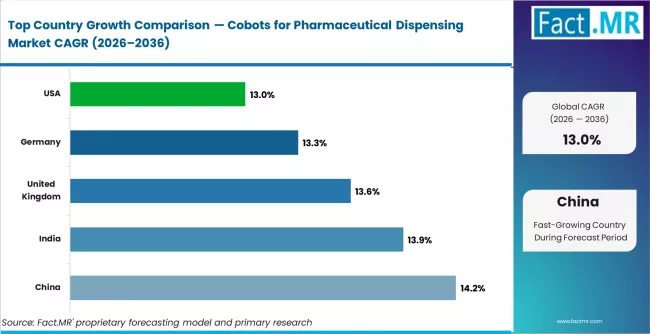
Cobots For Pharmaceutical Dispensing Market Cagr Analysis By Country | Source: Fact.MR
Source: Fact MR analysis, based on proprietary forecasting model and primary research
Asia Pacific
Asia Pacific functions as the pharmaceutical automation deployment and robotics integration hub, supported by expanding drug manufacturing capacity and precision dispensing technology adoption. ABB Ltd. strengthens collaborative robot deployment capabilities. FANUC Corporation expands precision robotic dispensing solutions. Yaskawa Electric Corporation supports robotic system integration for pharmaceutical workflows.
- China: Demand for cobots for pharmaceutical dispensing in China is projected to rise at 14.2% CAGR through 2036. The Made in China 2025 initiative update (State Council, ongoing) supports industrial robotics adoption. FANUC Corporation expanded collaborative robot deployment capabilities (April 2023), supporting automation growth.
- India: Demand for cobots for pharmaceutical dispensing in India is projected to rise at 13.9% CAGR through 2036. The Production Linked Incentive Scheme for pharmaceuticals (Department of Pharmaceuticals, 2021) supports manufacturing automation investment. ABB Ltd. expanded collaborative robot installation capabilities (March 2023), supporting adoption.
Europe
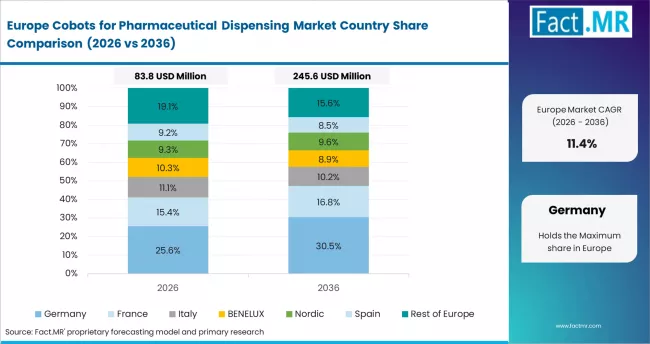
Cobots For Pharmaceutical Dispensing Market Europe Country Market Share Analysis, 2026 & 2036 | Source: Fact.MR
Europe functions as the pharmaceutical automation regulatory laboratory for precision robotic dispensing technologies, supported by structured manufacturing compliance frameworks and advanced robotics engineering ecosystems. KUKA AG strengthens pharmaceutical robotic integration capabilities. Universal Robots A/S expands collaborative robot deployment portfolio. Siemens AG supports digital manufacturing automation systems.
- United Kingdom: Demand for cobots for pharmaceutical dispensing in United Kingdom is projected to rise at 13.6% CAGR through 2036. The UK Life Sciences Vision update (Department of Health and Social Care, 2021) supports pharmaceutical manufacturing digitization. Universal Robots A/S expanded pharmaceutical collaborative robot deployment (February 2023), supporting market adoption.
- Germany: Demand for cobots for pharmaceutical dispensing in Germany is projected to rise at 13.3% CAGR through 2036. The Industry 4.0 Strategy update (Federal Ministry for Economic Affairs and Climate Action, ongoing) supports robotic automation integration. KUKA AG expanded pharmaceutical automation robotics portfolio (January 2023), supporting supply growth.
North America
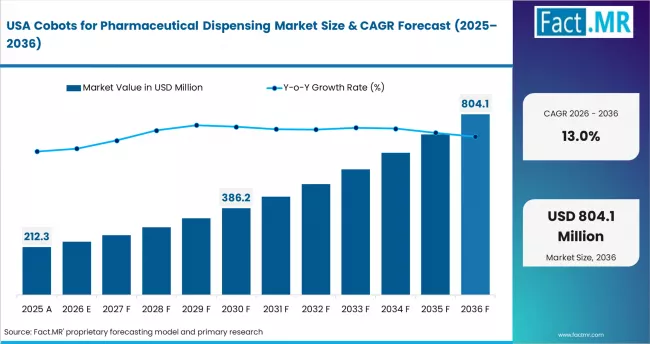
Cobots For Pharmaceutical Dispensing Market Country Value Analysis | Source: Fact.MR
North America serves as the pharmaceutical robotics commercialization and automated dispensing technology innovation hub, supported by structured regulatory compliance requirements and digital manufacturing adoption. Rockwell Automation, Inc. strengthens pharmaceutical automation system capabilities. Omron Corporation expands robotic dispensing integration solutions. Teradyne Inc. supports collaborative robotics innovation.
- United States: Demand for cobots for pharmaceutical dispensing in United States is projected to rise at 13.0% CAGR through 2036. The FDA Pharmaceutical Quality for the 21st Century initiative update (U.S. FDA, ongoing) supports automated production adoption. Rockwell Automation, Inc. expanded robotic dispensing automation capabilities (May 2023), supporting market demand.
Fact MR's analysis of cobots for pharmaceutical dispensing market in global regions consists of country-wise assessment that includes China, India, United Kingdom, Germany, and United States. Readers can find robotic dispensing adoption trends, pharmaceutical automation developments, regulatory frameworks, and competitive positioning across key markets.
Competitive Landscape
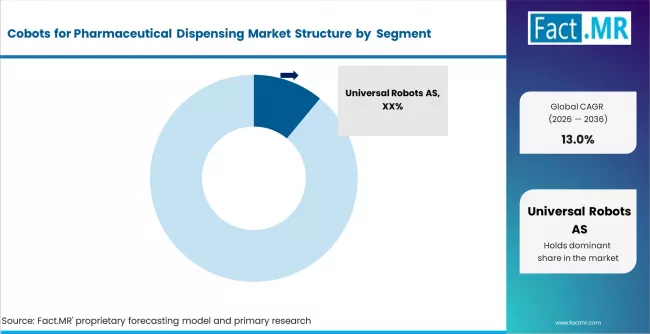
Cobots For Pharmaceutical Dispensing Market Analysis By Company | Source: Fact.MR
Competitive Structure and Buyer Dynamics in the Cobots for Pharmaceutical Dispensing Market
The competitive structure of the Cobots for Pharmaceutical Dispensing Market is moderately concentrated, with industrial robotics manufacturers controlling a significant share of collaborative automation deployments. Companies such as Universal Robots AS, ABB Ltd., FANUC Corporation, KUKA AG, Yaskawa Electric Corporation, Omron Corporation, Denso Corporation, Stäubli International AG, Techman Robot Inc., and Doosan Robotics Inc. maintain strong positions through established collaborative robot platforms and precision motion control technologies. These firms supply robotic systems used for accurate pharmaceutical dispensing, handling, and packaging operations within controlled environments. Competition is primarily influenced by positional accuracy, ease of programming, system safety certification, and compatibility with pharmaceutical manufacturing processes.
Several companies maintain structural advantages through advanced robotics engineering capabilities and established relationships with pharmaceutical manufacturers and automation integrators. Firms such as ABB Ltd., FANUC Corporation, and KUKA AG benefit from extensive industrial robotics portfolios and global technical support networks. Universal Robots AS and Techman Robot Inc. maintain advantages through user friendly programming interfaces designed for flexible automation deployment. Pharmaceutical manufacturers typically adopt multi vendor automation strategies to reduce dependence on a single robotics supplier and ensure operational flexibility. Procurement decisions evaluate suppliers based on system precision, validation support, and long term reliability, moderating supplier pricing leverage across pharmaceutical automation applications.
Key Players of the Cobots for Pharmaceutical Dispensing Market
- Universal Robots AS
- ABB Ltd.
- FANUC Corporation
- KUKA AG
- Yaskawa Electric Corporation
- Omron Corporation
- Techman Robot Inc.
- Denso Corporation
- Stäubli International AG
- Doosan Robotics Inc.
Bibliographies
- [1] U.S. Food and Drug Administration. (2024). Pharmaceutical Quality for the 21st Century - 2024 update: Automation, closed-isolation systems, and collaborative robotics in sterile manufacturing. FDA Center for Drug Evaluation and Research.
- [2] European Medicines Agency. (2023). Guideline on aseptic manufacturing and contamination control: Role of automation and robotic dispensing systems. EMA Human Medicines Division, Updated Annex 1 Commentary.
- [3] ABB Ltd. (2023). Collaborative robot solutions for pharmaceutical dispensing and sterile vial filling - Technical application note for hospital pharmacies and GMP manufacturing. ABB Life Sciences and Pharma Automation.
- [4] Universal Robots A/S. (2024). Pharmaceutical dispensing cobots - Case studies on precision dosing, label handling, and batch-counting automation in hospital and compounding pharmacies. Universal Robots Healthcare Portfolio.
- [5] FANUC Corporation. (2023). Robotic dispensing automation in pharmaceutical packaging and sterile filling lines - Automation integration guidelines for collaborative and SCARA robots. FANUC Pharma and Healthcare Solutions.
This Report Addresses
- Market size estimation and revenue forecasts from 2026 to 2036, supported by validated pharmaceutical automation adoption benchmarks and collaborative robot deployment indicators.
- Growth opportunity mapping across hospital pharmacies, retail pharmacies, pharma manufacturing, compounding pharmacies, and research labs utilizing precision robotic dispensing and handling systems.
- Segment and regional revenue forecasts covering dispensing, pick and place, packaging, and labeling functions across low payload and medium payload collaborative robotic configurations.
- Competition strategy assessment including robotics platform integration models and supplier benchmarking across positional accuracy, software compatibility, and validation support capabilities.
- Regulatory impact analysis covering EU GMP Annex 1 sterile manufacturing compliance frameworks and traceability requirements influencing pharmaceutical automation deployment.
- Market report delivery in PDF, Excel, PPT, and interactive dashboard formats structured for pharmaceutical engineers, automation specialists, and healthcare technology procurement teams.
- Supply chain vulnerability assessments identifying component dependency risks linked to servo motors, machine vision modules, precision sensors, and robotics control software infrastructure supporting pharmaceutical dispensing automation.
Cobots for Pharmaceutical Dispensing Market Definition
Cobots for Pharmaceutical Dispensing Market Definition Paragraph
The cobots for pharmaceutical dispensing market includes collaborative robotic systems designed to automate medication preparation, counting, filling, labeling, and dispensing processes while operating safely alongside human personnel in pharmacies, hospitals, and pharmaceutical production environments.
Cobots for Pharmaceutical Dispensing Market Inclusions
The report includes global and regional market size estimates, forecast analysis, and segmentation by robot type, dispensing function, level of automation, application setting, end use industry, pricing structure, and integration with pharmacy management systems.
Cobots for Pharmaceutical Dispensing Market Exclusions
The scope excludes conventional industrial robots requiring safety cages, manual dispensing equipment, pharmaceutical manufacturing machinery not related to medication dispensing, and healthcare robotics used for surgery, rehabilitation, or patient assistance.
Cobots for Pharmaceutical Dispensing Market Research Methodology
- Primary Research: Interviews were conducted with robotic system manufacturers, pharmaceutical companies, hospital pharmacy managers, automation integrators, and healthcare technology specialists.
- Desk Research: Public sources included robotics industry publications, healthcare automation guidelines, company technical documentation, regulatory frameworks, and research literature on collaborative robotics applications.
- Market-Sizing and Forecasting: A hybrid model combining top-down healthcare automation demand evaluation and bottom-up analysis of cobot deployment in pharmaceutical dispensing operations was applied.
- Data Validation and Update Cycle: Outputs were validated through cross comparison of supplier data, expert consultation, and periodic monitoring of robotic adoption trends in pharmacy and laboratory environments.
Segmentation
Report Scope
| Metric | Value |
|---|---|
| Quantitative Units | USD 348.2 million (2026) to USD 1,180 million (2036), at a CAGR of 13% |
| Market Definition | The cobots for pharmaceutical dispensing market includes collaborative robotic systems designed to automate dispensing, packaging, labeling, and material handling processes in pharmaceutical environments, supporting precision dosing, workflow efficiency, and controlled handling of pharmaceutical products. |
| Application Segmentation | Hospital pharmacies, Retail pharmacies, Pharma manufacturing, Compounding pharmacies, Research labs |
| Payload Capacity Segmentation | Up to 5 kg, 5 to 10 kg, Above 10 kg |
| Function Segmentation | Dispensing, Pick and place, Packaging, Labeling |
| Regions Covered | North America, Latin America, Europe, East Asia, South Asia, Oceania, Middle East and Africa |
| Countries Covered | United States, Canada, Mexico, Germany, France, United Kingdom, Italy, Spain, Netherlands, Switzerland, China, Japan, South Korea, India, Singapore, Australia, United Arab Emirates, Saudi Arabia, and 40+ countries |
| Key Companies Profiled | Universal Robots AS, ABB Ltd., FANUC Corporation, KUKA AG, Yaskawa Electric Corporation, Omron Corporation, Techman Robot Inc., Denso Corporation, Stäubli International AG, Doosan Robotics Inc. |
| Forecast Period | 2026 to 2036 |
| Approach | Hybrid top-down and bottom-up market estimation based on pharmaceutical automation adoption rates, robotic payload capability deployment analysis, dispensing workflow integration trends, healthcare facility automation benchmarking, and validation through primary interviews with robotics manufacturers, pharmaceutical companies, and automation system integrators. |
Source: Fact.MR analysis. Updated Apr 11, 2026
Cobots for Pharmaceutical Dispensing Market Key Segments
-
By Application :
- Hospital Pharmacies
- Retail Pharmacies
- Pharma Manufacturing
- Compounding Pharmacies
- Research Labs
-
By Payload Capacity :
- Up to 5 kg
- 5 to 10 kg
- Above 10 kg
-
By Function :
- Dispensing
- Pick and Place
- Packaging
- Labeling
-
By Region :
- North America
- USA
- Canada
- Europe
- Germany
- UK
- France
- Italy
- Spain
- Nordic Countries
- BENELUX
- Rest of Europe
- Asia Pacific
- China
- Japan
- South Korea
- India
- Australia
- Rest of Asia Pacific
- Latin America
- Brazil
- Argentina
- Mexico
- Rest of Latin America
- Middle East and Africa
- Kingdom of Saudi Arabia
- United Arab Emirates
- South Africa
- Rest of Middle East and Africa
- Other Regions
- Oceania
- Central Asia
- Other Markets
- North America
Frequently Asked Questions
How large is the demand for Cobots for Pharmaceutical Dispensing in the global market in 2026?
What will be the market size of Cobots for Pharmaceutical Dispensing in the global market by 2036?
What is the expected demand growth for Cobots for Pharmaceutical Dispensing in the global market between 2026 and 2036?
Which company is identified as a leading manufacturer in the Cobots for Pharmaceutical Dispensing market?
Which payload capacity segment is projected to dominate cobot adoption by 2026?
Why are low payload capacity cobots widely used in pharmaceutical dispensing applications?
What is driving demand for cobots for pharmaceutical dispensing in China?
What is the growth outlook for the Cobots for Pharmaceutical Dispensing market in China?
Why is India an important market for pharmaceutical dispensing cobots?
What is the growth outlook for the Cobots for Pharmaceutical Dispensing market in India?
How is demand for pharmaceutical dispensing cobots evolving in the United Kingdom?
What is the growth outlook for the Cobots for Pharmaceutical Dispensing market in the United Kingdom?
What is the growth outlook for the Cobots for Pharmaceutical Dispensing market in Germany?
How is the United States positioned in the Cobots for Pharmaceutical Dispensing market?
What is the growth outlook for the Cobots for Pharmaceutical Dispensing market in the United States?
What are cobots for pharmaceutical dispensing and what are they mainly used for?
What does the Cobots for Pharmaceutical Dispensing market include in this report?
What applications are included in the scope of the Cobots for Pharmaceutical Dispensing market?
What is excluded from the scope of the Cobots for Pharmaceutical Dispensing market report?
What does market forecast mean in the Cobots for Pharmaceutical Dispensing market report?
How is the Cobots for Pharmaceutical Dispensing market forecast developed in this report?
What does primary validation indicate in the Cobots for Pharmaceutical Dispensing market analysis?
Who worked on this report


Preview the report firsthand - request a free sample
Free SampleGet the brochure for pricing and purchase details
Download PDF