- Market Value (2025): USD 1059.3n Mn
- Estimated Value (2026): USD 1250.0 Mn
- Forecast Value (2036): USD 6542.0 Mn
- CAGR (2026-2036): 18.0%
What is the Cocoa-Free Alternatives Market forecast to be worth by 2036?
USD 1250.0 million in 2026 to USD 6542.0 million by 2036, at an 18.0% CAGR.
- The cocoa-free alternatives market was valued at USD 1059.3 million in 2025.
- Demand is projected to increase from USD 1250.0 million in 2026 to USD 6,542.0 million by 2036.
- The market is forecast to record an 18.0% CAGR from 2026 to 2036 as confectionery makers qualify alternatives for flavor, color and process stability.
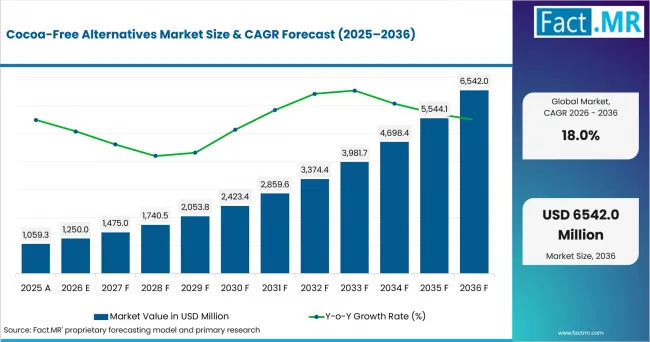
Cocoa Free Alternatives Market Value Analysis | Source: Fact.MR
What are the defining numbers behind Cocoa-Free Alternatives Market growth?
USD 5292.0 million absolute opportunity by 2036, led by cocoa alternatives, powder form and confectionery use.
- Demand Drivers in the Market
- Bakery product developers need powders and chips that work in fillings, coatings and mixes with minimal changes to plant equipment.
- Brand owners need color and bitterness control so cocoa-free products deliver a familiar sensory profile across bars, creams and beverages.
- Procurement teams need alternative ingredient routes because ICCO placed 2024/25 cocoa production at 4.723 million tonnes and grindings at 4.628 million tonnes in May 2026.
- Key Segments Analyzed
- By Product: Cocoa alternatives are expected to hold 37.0% share in 2026 because they form the base ingredient route for chocolate-type taste and bulk formulation.
- By Function: Flavor delivery is projected to account for 35.0% share in 2026 as brands qualify alternatives primarily against aroma, melt and aftertaste.
- By Application: Confectionery is anticipated to capture 39.0% share in 2026 owing to direct substitution needs in bars, coatings and seasonal products.
- By Form: Powder is estimated to represent 48.0% share in 2026 due to easier handling in bakery mixes, beverage bases and dry blends.
- Analyst Opinion at Fact.MR
- Shambhu Nath Jha, Principal Consultant at Fact.MR, states, “Cocoa-free alternatives are drawing attention because the purchase decision has moved beyond novelty. The market is expected to reward suppliers that prove flavor delivery at plant scale. Winning portfolios should combine powder, paste and chip formats with clear allergen, label and processing documentation.”
- Strategic Implications
- Ingredient suppliers should map each product format to the manufacturing step it replaces, since bakery and confectionery teams buy based on process fit.
- Food brands should build sensory panels around bitterness control and color stability before shifting cocoa-free products into wider retail launches.
- Investors should assess scale-up routes, since first commercial traction depends on production reliability and repeated B2B qualification.
The USA is projected to record 19.8% CAGR through 2036 supported by food manufacturing scale and North American distribution. Germany is expected to post 18.9% CAGR through confectionery price pressure and local cocoa-free technology. Japan is forecast to advance at 17.6% CAGR owing to premium confectionery testing. France is anticipated to hold 16.9% CAGR as chocolate price pass-through supports recipe work. Brazil is estimated to reach 16.2% CAGR linked to cocoa familiarity and blended-system trials.
How does the Cocoa-Free Alternatives Market break down by segment?
Cocoa alternatives lead Product at 37.0%; Powder leads Form at 48.0%.
Which Product dominates?
Cocoa alternatives hold 37.0% share in 2026.
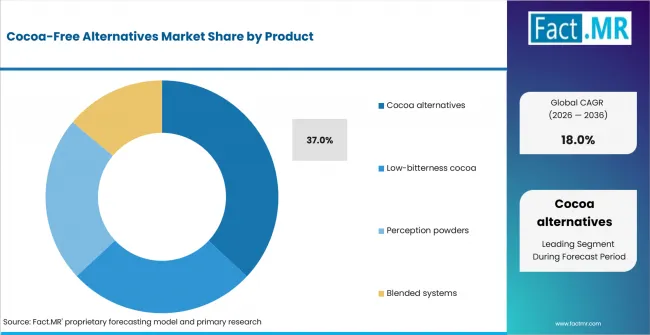
Cocoa Free Alternatives Market Analysis By Product | Source: Fact.MR
Cocoa alternatives are expected to lead Product because they provide the central base for chocolate-type taste, color and bulk. Low-bitterness cocoa systems serve brands that want a softer flavor profile. Perception powders support aroma and appearance in dry applications. Blended systems suit brands that want cost control while keeping some cocoa-style positioning.
What leads the Function segment?
Flavor delivery accounts for 35.0% share in 2026.
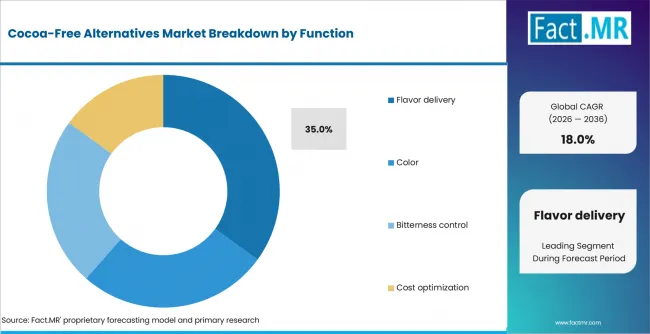
Cocoa Free Alternatives Market Analysis By Function | Source: Fact.MR
Flavor delivery is projected to lead Function since shoppers judge cocoa-free products first through aroma, sweetness balance and aftertaste. Color systems remain relevant where brands need a chocolate-like visual cue. Bitterness control supports repeat purchase in bars and beverages. Cost optimization shapes B2B trials when cocoa price movement affects seasonal and private-label planning.
How does Application shape demand?
Confectionery captures 39.0% share in 2026.
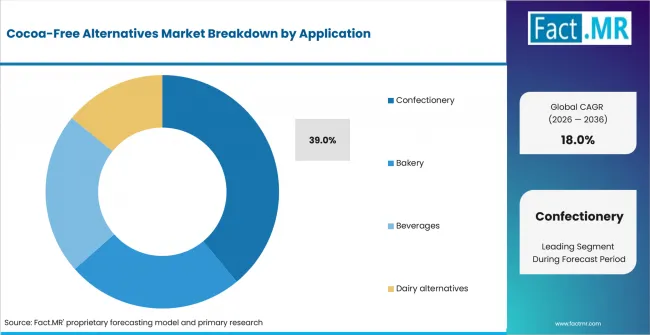
Cocoa Free Alternatives Market Analysis By Application | Source: Fact.MR
Confectionery is anticipated to lead Application due to its direct exposure to cocoa input costs and sensory expectations. Bakery follows through coatings, fillings and cookie inclusions. Beverages create a route for powders where solubility and color are easier to test. Dairy alternatives use cocoa-free systems to support plant-based desserts and flavored drinks.
What supports Powder within Form?
Powder represents 48.0% share in 2026.
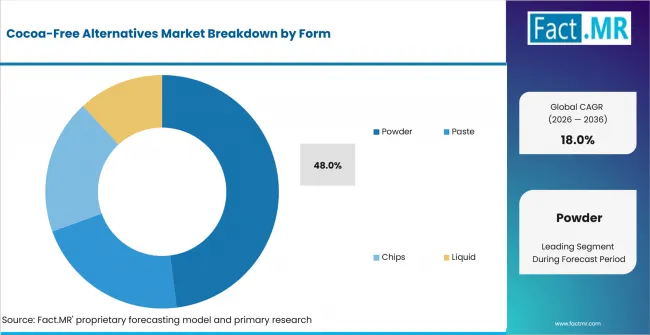
Cocoa Free Alternatives Market Analysis By Form | Source: Fact.MR
Powder is estimated to lead Form because it is easier to dose, store and blend in existing dry-mix systems. Paste supports spreads, fillings and creams where fat phase behavior guides performance. Chips serve bakery and confectionery applications that need visible inclusions. Liquid systems suit beverage and coating lines that require dispersion before final processing.
What is accelerating Cocoa-Free Alternatives Market adoption, and what is holding it back?
Cocoa volatility drives it; sensory qualification restrains it.
| DRIVER | (~) % IMPACT ON CAGR | GEOGRAPHIC RELEVANCE | IMPACT TIMELINE |
|---|---|---|---|
| Cocoa input volatility and procurement pressure | +2.0% | North America, Europe | Short term (<= 2 years) |
| Confectionery reformulation and bakery trials | +1.6% | Global | Medium term (2-4 years) |
| B2B launches by ingredient suppliers | +1.2% | USA, Europe | Short term (<= 2 years) |
| Powder-led adoption in beverages and dry mixes | +0.9% | Japan, France, USA | Medium term (2-4 years) |
| Allergen-aware and plant-based product positioning | +0.7% | North America, Western Europe | Long term (>= 4 years) |
- Confectionery reformulation and bakery trials: Confectionery teams are projected to test cocoa-free ingredients in coatings, inclusions, bakery products and seasonal formats as manufacturers explore alternative formulations.
- B2B launches by ingredient suppliers: Commercial ingredient launches are anticipated to shorten the path from concept to plant trial as suppliers expand cocoa-free solutions for chocolate, confectionery and bakery applications.
- Powder-led adoption in beverages and dry mixes: Powder formats are expected to gain use where brands need easy dosing, consistent color and straightforward incorporation into beverages, baking mixes and other dry formulations.
- Allergen-aware and plant-based product positioning: Ingredient teams are forecast to use cocoa-free systems where plant-based and allergen-aware positioning supports product briefs and broader formulation flexibility.
| OPPORTUNITY | (~) % IMPACT ON CAGR | GEOGRAPHIC RELEVANCE | IMPACT TIMELINE |
|---|---|---|---|
| Industrial partnerships for scale-up | +1.4% | Europe, North America | Short term (<= 2 years) |
| Premium bakery and dessert applications | +1.1% | France, Japan, USA | Medium term (2-4 years) |
| Local-crop ingredient sourcing | +0.8% | Germany, Brazil, Europe | Long term (>= 4 years) |
| Private-label reformulation programs | +0.6% | USA, Germany, France | Medium term (2-4 years) |
- Industrial partnerships for scale-up: Large ingredient partnerships are projected to give cocoa-free alternatives a route into established manufacturing accounts and support broader commercial adoption.
- Premium bakery and dessert applications: Bakery and dessert brands are expected to test cocoa-free alternatives where premium positioning, formulation flexibility and differentiated product concepts support the business case.
- Local-crop ingredient sourcing: Local-crop models are anticipated to appeal to brands seeking supply routes beyond tropical cocoa and greater flexibility in ingredient sourcing.
- Private-label reformulation programs: Private-label retailers are expected to evaluate cocoa-free alternatives in snacks, coatings and bakery products. Suppliers that document recipe-conversion steps can reach buyers managing multiple SKUs across the same season.
| RESTRAINT | (~) % IMPACT ON CAGR | GEOGRAPHIC RELEVANCE | IMPACT TIMELINE |
|---|---|---|---|
| Flavor and mouthfeel parity requirements | -0.8% | Global | Short term (<= 2 years) |
| Labeling and consumer understanding | -0.6% | USA, Europe, Japan | Medium term (2-4 years) |
| Scale-up capacity and unit cost | -0.5% | Europe, North America | Medium term (2-4 years) |
| Retail placement beside chocolate products | -0.4% | Global | Long term (>= 4 years) |
- Flavor and mouthfeel parity requirements: Flavor parity is expected to slow adoption where cocoa-free products compete directly with chocolate. Brands need to validate aroma release, melt behavior, texture and aftertaste before expanding into broader product formats.
- Labeling and consumer understanding: Labeling review is projected to affect launch timing because cocoa-free products need clear positioning across retail, foodservice and B2B ingredient channels.
- Scale-up capacity and unit cost: Scale-up is anticipated to remain a qualification barrier for smaller suppliers as they work to improve production efficiency, consistency and commercial pricing.
- Retail placement beside chocolate products: Retail placement is expected to remain cautious while category teams assess how shoppers compare cocoa-free products with conventional chocolate. Shelf language, price gaps and pack cues are likely to influence trial.
Which countries are scaling the Cocoa-Free Alternatives Market through 2036?
- The country comparison spans 3.6 percentage points and forms three practical growth bands across the forecast period.
- USA remains 0.9 percentage point above Germany through large food manufacturing scale and North American distribution access.
- Germany remains 1.3 percentage points above Japan through confectionery price pressure and local cocoa-free ingredient development.
- Japan remains 0.7 percentage point above France through premium confectionery testing and careful flavor qualification.
- France remains 0.7 percentage point above Brazil through chocolate price pass-through and artisan bakery demand.
- Brazil closes the displayed range through cocoa familiarity, local crop awareness and blended-system testing.
Comparable CAGRs create different entry conditions because each country evaluates cocoa-free alternatives through a different commercial lens. Full report coverage includes North America, Latin America, Western Europe, Eastern Europe, East Asia, South Asia & Pacific, Middle East & Africa.
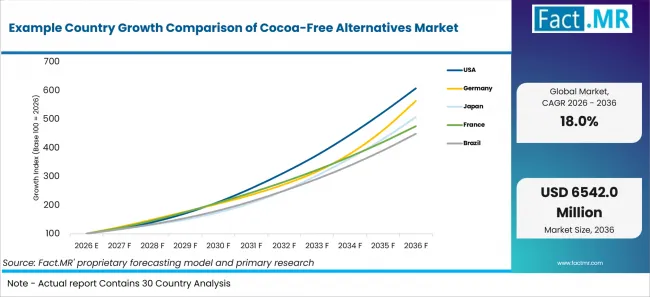
Example Country Growth Comparison Of Cocoa Free Alternatives Market | Source: Fact.MR
| Country | CAGR |
|---|---|
| USA | 19.8% |
| Germany | 18.9% |
| Japan | 17.6% |
| France | 16.9% |
| Brazil | 16.2% |
What supports USA adoption?
19.8% CAGR, supported by confectionery reformulation and bakery substitution.
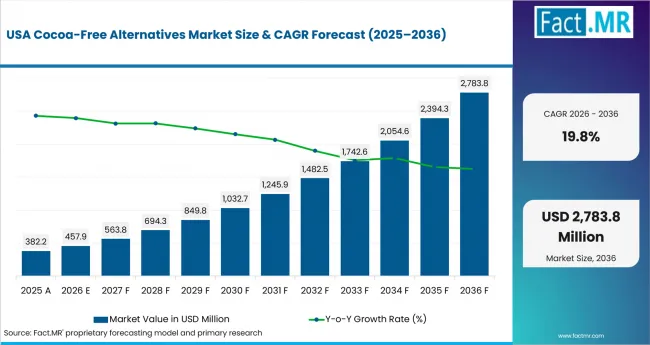
Cocoa Free Alternatives Market Country Value Analysis | Source: Fact.MR
The U.S. cocoa-free alternatives market to post 19.8% CAGR through 2036 and interprets price pass-through in everyday treats as supportive of reformulation activity. BLS reported in July 2026 that U.S. cakes, cupcakes and cookies prices were 3.5% higher year over year in June 2026. Cargill and Voyage Foods expanded cocoa-free confectionery options for U.S. manufacturers with the May 2026 North American launch of NextCoa™, starting in the United States.
How is Germany scaling demand?
18.9% CAGR, driven by confectionery cost pressure and local ingredient technology.
Germany's cocoa-free alternatives market to record 18.9% CAGR through 2036 and interprets chocolate price increases as supportive of recipe review. Destatis reported in November 2025 that German chocolate prices were 21.8% higher year over year in October 2025. Planet A Foods strengthens the German and European cocoa-free chocolate landscape through ChoViva, while its partnership with Barry Callebaut adds global production capabilities and broader access to food-industry customers.
What supports Japan’s outlook?
17.6% CAGR, led by premium confectionery and controlled flavor qualification.
Japan’s premium confectionery brands are anticipated to test cocoa-free ingredients carefully, and the market is estimated to advance at 17.6% CAGR through 2036. The Statistics Bureau of Japan reported in January 2026 that Japan’s food CPI rose 6.8% in 2025.
What underpins France’s growth?
16.9% CAGR, supported by chocolate price pass-through and artisan formulation.
France is projected to record 16.9% CAGR through 2036 as chocolatiers, bakeries and dessert makers compare cocoa-free powders against conventional cocoa inputs. Agreste reported in February 2026 that France’s 2025 agri-food surplus fell to EUR 181 million, its lowest level since the late 1970s. Agreste reported that the 2025 trade deterioration was driven in part by higher imports of processed products, including cocoa-related goods.
How does Brazil perform?
16.2% CAGR, shaped by cocoa familiarity and blended-system testing.
Brazil is expected to reach 16.2% CAGR through 2036 because manufacturers understand cocoa processing and can compare alternatives against familiar inputs. IBGE reported in July 2026 that its June estimate placed Brazilian cacao production at 321.0 thousand tonnes, up 8.9% year over year.
Who leads the Cocoa-Free Alternatives Market?
Voyage Foods and Planet A Foods as leading direct cocoa-free providers in the assessed company set, while Barry Callebaut and Cargill strengthen industrial access.
Voyage Foods is active through cocoa-free confectionery alternatives and its partnership with Cargill. Cargill expands B2B access through NextCoa™, which launched in North America in May 2026, starting in the United States. Planet A Foods supplies ChoViva, while Barry Callebaut adds global production capabilities and customer reach through their November 2025 commercial partnership focused on chocolate alternatives made from locally available crops.
Win-Win, previously referenced in company materials as Win-Win (WNWN Food Labs Ltd.), raised £3 million in a July 2025 Series A funding round led by Oetker Collection and FoodLabs. Foreverland develops Choruba across cocoa-free formats including powder and bake-stable drops.
Which companies are the key providers?
Key companies include Voyage Foods, Planet A Foods, Win-Win (WNWN Food Labs Ltd.), Foreverland, Döhler GmbH (Nukoko), and Barry Callebaut.
- Voyage Foods
- Planet A Foods
- Win-Win (WNWN Food Labs Ltd.)
- Foreverland
- Döhler GmbH (Nukoko)
- Barry Callebaut
Bibliography
- Zeballos, E., & Sinclair, W. (2026, June 11). Total U.S. food spending reached $2.51 trillion in 2025. U.S. Department of Agriculture, Economic Research Service.
- U.S. Bureau of Labor Statistics. (2026, July 14). Consumer Price Index—June 2026.
- International Cocoa Organization. (2026, May 29). May 2026 Quarterly Bulletin of Cocoa Statistics.
- Federal Statistical Office (Destatis). (2025, November 12). Inflation rate at +2.3% in October 2025.
- Statistics Bureau of Japan. (2026, January 23). Consumer Price Index Japan yearly average: Japan 2025.
- Champagnol, T. (2026, February 12). Commerce extérieur agroalimentaire. En 2025, l’excédent agroalimentaire français atteint son plus bas niveau depuis la fin des années soixante-dix. Agreste.
- Brazilian Institute of Geography and Statistics. (2026, July 14). In June, IBGE estimates crops of 347.4 million tonnes for 2026. IBGE News Agency.
- Cargill. (2026, May 12). Cargill and Voyage Foods to bring NextCoa™ cocoa-free confectionery alternatives to North America.
- Barry Callebaut. (2025, November 5). Barry Callebaut and Planet A Foods partner to pioneer sustainable chocolate alternatives without cocoa.
- CDP Venture Capital. (2026, March 24). Foreverland raises €6M to accelerate international expansion and scale Choruba® commercial growth.
- Döhler. (2026, June 18). Döhler acquires Nukoko and accelerates cocoa-free chocolate alternative innovation.
- Oetker Collection. (2025, July 23). WIN-WIN raises £3 million in Series A funding round – Oetker Collection continues to invest in cocoa-free chocolate alternative.
- Institut national de la statistique et des études économiques. (2025, June 24). The surge in tropical commodity prices in 2024 is being passed on to consumer prices for chocolate and coffee in 2025.
This Report Answers
- The report explains where cocoa-free alternatives are used across Product and Function. It also covers Application and Form.
- Segment analysis identifies cocoa alternatives and powder as the highest-share subsegments in the 2026 view.
- Country analysis examines USA, Germany, Japan, France and Brazil through manufacturing, price and ingredient-qualification mechanisms.
- Competitive analysis reviews Voyage Foods, Planet A Foods, Win-Win (WNWN Food Labs Ltd.), Foreverland, Döhler GmbH (Nukoko) and Barry Callebaut.
- Application analysis assesses how confectionery, bakery, beverages and dairy alternatives shape formulation decisions.
- The research links cocoa supply signals with buyer behavior, application tests and supplier scale-up activity.
What does the Cocoa-Free Alternatives Market cover?
Cocoa alternatives, low-bitterness systems, perception powders and blended systems used for chocolate-type formulation.
The Cocoa-Free Alternatives Market covers ingredient systems that help food brands reproduce chocolate-like taste, color, bitterness control and bulk. It includes products sold to manufacturers for use in confectionery, bakery, beverage and dairy-alternative applications.
The assessment differs from finished chocolate and snack categories because it focuses on inputs used in formulation. Finished branded bars, standard cocoa ingredients and retail confectionery are covered only when they explain the buyer need for cocoa-free alternatives.
What is included in the scope?
Cocoa-free alternative systems used in confectionery, bakery, beverage and dairy-alternative formulation.
The scope includes cocoa alternatives, low-bitterness systems, perception powders and blends sold in powder, paste, chip and liquid forms. It covers B2B ingredients used by food manufacturers, contract developers and brands.
Tracking of cocoa beans supports comparison with the input chain that cocoa-free systems are designed to reduce exposure to. The analysis links related cocoa alternatives to formulation decisions in coatings, fillings and chocolate-type applications.
What is excluded from the scope?
Conventional cocoa ingredients and finished retail chocolate products are outside the scope.
The scope excludes standard cocoa beans, cocoa liquor, cocoa butter and cocoa powder when sold as conventional cocoa ingredients. Finished retail chocolate, snack bars and desserts are assessed only where they show the application route for ingredient suppliers.
The scope also excludes general sweeteners, dairy bases and flavor houses when they are sold separately from a cocoa-free alternative system. Private-label retail products are treated as downstream demand, while ingredient revenues remain the market boundary.
How Was the Analysis Built?
The analysis draws on 120+ sources, 35+ company portfolios, 25+ countries, and more than 20 industry interviews.
- Primary Research: Primary research includes discussions with ingredient suppliers, food manufacturers, contract developers, distributors, bakery teams. These conversations examine product fit, scale-up barriers and purchasing criteria.
- Desk Research: Desk research covers government statistics, cocoa organization data, company announcements, technical portfolios, policy material, product pages and authoritative food-sector sources. Every source used in the analysis is documented in the bibliography.
- Market Sizing and Forecasting: Market estimates combine historical values, supplier activity, food manufacturing demand, segment shares, country-level CAGR and application fit. The model keeps supplied market values unchanged.
- Data Validation and Update Cycle: Findings are validated by comparing supplier claims with official data, company releases, application evidence and country-level indicators. Updates review new product launches, acquisitions, capacity changes, partnerships and commercial adoption.
What is the report’s scope and coverage?
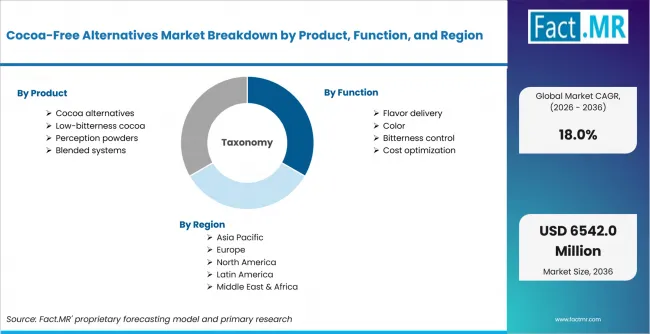
Cocoa Free Alternatives Market Breakdown By Product, Function, And Region | Source: Fact.MR
| Attribute | Details |
|---|---|
| Quantitative Units | USD million in 2026 to USD million by 2036 at an 18.0% CAGR |
| Market Definition | Ingredient systems and formulation inputs that deliver chocolate-like flavor, color, bitterness control or bulk without relying on cocoa as the central input. |
| Product | Cocoa alternatives; Low-bitterness cocoa; Perception powders; Blended systems |
| Function | Flavor delivery; Color; Bitterness control; Cost optimization |
| Application | Confectionery; Bakery; Beverages; Dairy alternatives |
| Form | Powder; Paste; Chips; Liquid |
| Regions Covered | North America; Latin America; Western Europe; Eastern Europe; East Asia; South Asia & Pacific; Middle East & Africa |
| Countries Covered | USA; Germany; Japan; France; Brazil |
| Key Companies Profiled | Voyage Foods; Planet A Foods; Win-Win (WNWN Food Labs Ltd.); Foreverland; Döhler GmbH (Nukoko); Barry Callebaut |
| Forecast Period | 2026 to 2036 |
| Approach | Hybrid top-down and bottom-up approach using food manufacturing indicators, cocoa supply signals, segment shares, country-level growth, supplier portfolios and application evidence. |
How is the market segmented?
-
By Product
- Cocoa alternatives
- Low-bitterness cocoa
- Perception powders
- Blended systems
-
By Function
- Flavor delivery
- Color
- Bitterness control
- Cost optimization
-
By Application
- Confectionery
- Bakery
- Beverages
- Dairy alternatives
-
By Form
- Powder
- Paste
- Chips
- Liquid
-
By Region
- North America
- Latin America
- Western Europe
- Eastern Europe
- East Asia
- South Asia & Pacific
- Middle East & Africa