- Market Value (2025): USD 184.6 Mn
- Estimated Value (2026): USD 240 Mn
- Forecast Value (2036): USD 3309 Mn
- CAGR (2026-2036): 30.0%
What is the Fermented Collagen Alternatives Market forecast to be worth by 2036?
USD 240 million in 2026 to USD 3309 million by 2036 at a 30.0% CAGR.
- The fermented collagen alternatives market reached USD 184.6 million in 2025.
- Demand is projected to increase from USD 240 million in 2026 to USD 3309 million by 2036.
- The market is forecast to record 30.0% CAGR from 2026 to 2036 as beauty formulators, food-nutrition brands and biomaterial developers qualify animal-free collagen alternatives.
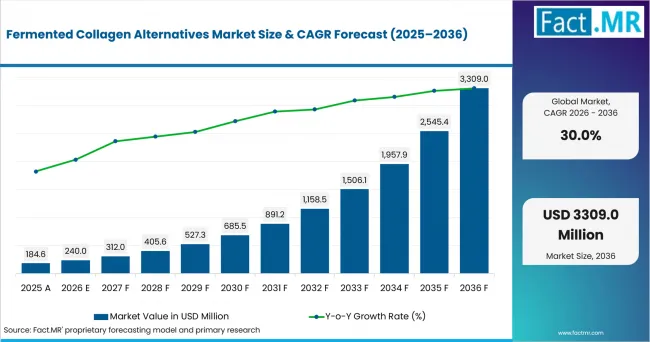
Fermented Collagen Alternatives Market Value Analysis | Source: Fact.MR
What are the defining numbers behind Fermented Collagen Alternatives Market growth?
An absolute opportunity of USD 3,069 million is expected between 2026 and 2036.
- Demand Drivers in the Market
- Beauty formulators need collagen-like actives that avoid bovine and marine sourcing limits while still supporting skin-care and ingestible wellness claims.
- Nutrition brands need animal-free protein identity for products positioned near collagen peptides, since vegan and religious certification can restrict animal collagen use.
- Food and supplement companies need stronger safety files as precision fermentation moves from technical sampling into commercial formulation work. The FDA proposed an August 2026 rule to enhance GRAS oversight for substances added to food.
- Medical-material developers need consistent recombinant collagen inputs after Evonik Industries AG launched clinical-grade VECOLLAN recombinant collagen in September 2025 for medical device development.
- Biomanufacturing programs support scale-up work. AIST launched its Biomanufacturing and Process Research Center in April 2025 with about 70 researchers working across microorganisms and plants.
- Key Segments Analyzed
- By Protein: Type I collagen is expected to hold 42.0% share in 2026 because it is the familiar reference point for beauty, aesthetic and biomaterial positioning.
- By Host: Yeast is projected to account for 32.0% share in 2026 as established fermentation know-how helps developers express collagen-like proteins with controlled impurity profiles.
- By Application: Beauty is anticipated to capture 43.0% share in 2026 owing to early brand testing in topical and ingestible collagen-alternative formats.
- By Grade: Food is estimated to represent 39.0% share in 2026 due to supplement shots, powders and functional-food concepts needing food-use documentation.
- Analyst Opinion at Fact.MR
- Shambhu Nath Jha, Principal Consultant at Fact.MR, states, “The practical question is no longer whether brands want animal-free collagen language. The next purchase test is whether a protein alternative has the identity, safety file and sensory fit to survive product development. Suppliers that combine fermentation control, application testing and clear regulatory documentation are expected to gain the first durable accounts.”
- Strategic Implications
- Fermentation developers should document protein sequence, host system and impurity controls before approaching beauty or nutrition brands.
- Cosmetic ingredient sellers should pair collagen-alternative claims with application data, especially after Geltor introduced HumaColl21 Select for topical beauty applications in March 2026.
- Food-nutrition brands should separate animal-free collagen signaling from conventional collagen peptide claims to avoid weak claim language.
- Biomaterial suppliers should keep medical-research and food-grade narratives separate because quality requirements differ sharply by application.
USA is projected to record 33.3% CAGR through 2036 because food, beauty and biomedical accounts can test animal-free collagen alternatives with a deep formulation base. Japan is anticipated to post 32.0% CAGR as public biomanufacturing programs add technical capacity. South Korea is estimated to advance at 31.1% CAGR due to beauty exports and food-nutrition development. The UK is forecast to reach 27.9% CAGR with precision fermentation authorization support improving early market entry. Germany is expected to record 23.3% CAGR supported by industrial bioeconomy funding and recombinant collagen activity.
How does the Fermented Collagen Alternatives Market break down by segment?
Type I collagen leads Protein at 42.0%; Beauty leads Application at 43.0%.
Which Protein dominates?
Type I collagen is expected to hold 42.0% share in 2026.
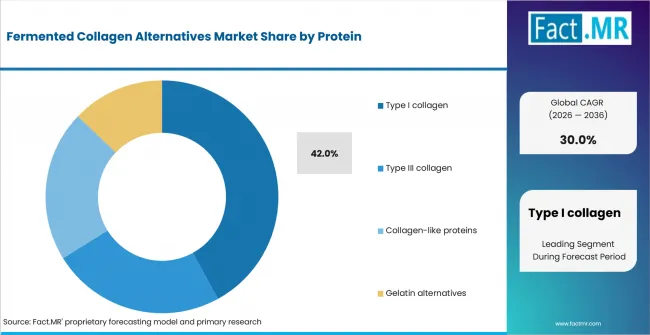
Fermented Collagen Alternatives Market Analysis By Protein | Source: Fact.MR
Type I collagen leads because beauty, medical aesthetics and tissue-scaffold research already use it as a familiar reference point. Fermented alternatives that mimic Type I functions give brands a clearer way to compare claims against conventional collagen materials.
Jellatech said it delivered its first human Type I collagen sample in December 2024 and a second sample in January 2025. Jellatech describes its production route as cellular agriculture, so this is adjacent biotechnology evidence rather than direct fermented-collagen evidence.
What leads the Host segment?
Yeast is projected to account for 32.0% share in 2026.
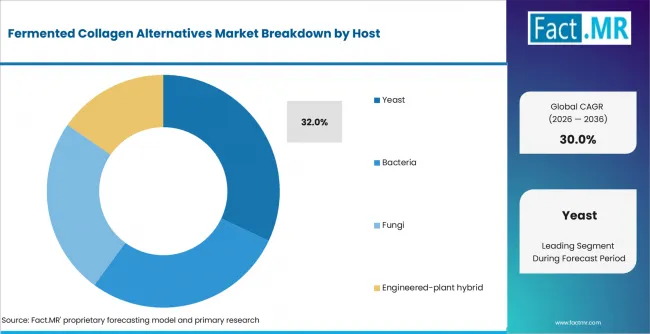
Fermented Collagen Alternatives Market Analysis By Host | Source: Fact.MR
Yeast leads the host segment because it is widely used in industrial fermentation and supports clear scale-up routes. For collagen-like proteins, expression control and downstream purification are central to cost. Yeast systems also fit supplier conversations around non-animal sourcing and controlled production.
How does Application shape demand?
Beauty is anticipated to capture 43.0% share in 2026.
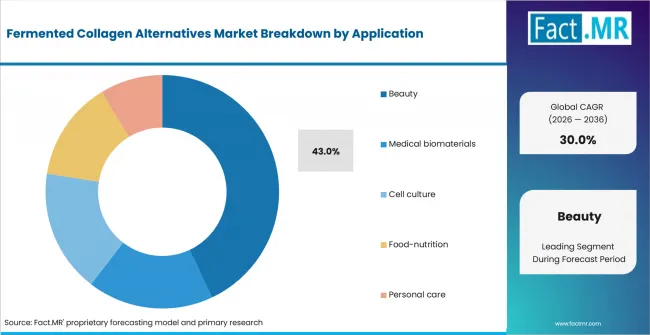
Fermented Collagen Alternatives Market Analysis By Application | Source: Fact.MR
Beauty leads application demand because product teams can test collagen alternatives in creams, serums and beauty-from-within concepts before larger food launches. Korea.net reported in January 2026 that South Korea’s cosmetics exports reached a record USD 11.4 billion in 2025.
Geltor launched HumaColl™21 Select in March 2026 as the first Type XXI collagen-based matrikine complex for topical beauty applications, positioning the ingredient as a way for beauty brands to differentiate in a crowded market.
What supports demand for Food within Grade?
Food is estimated to represent 39.0% share in 2026.
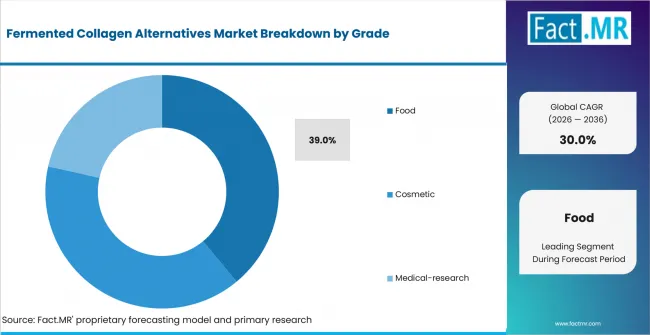
Fermented Collagen Alternatives Market Analysis By Grade | Source: Fact.MR
Food grade leads because ingestible collagen alternatives must meet safety, taste and label requirements before reaching supplement formats. USDA Economic Research Service reported in June 2026 that total U.S. food spending reached USD 2.51 trillion in 2025.
What is accelerating Fermented Collagen Alternatives Market adoption, and what is holding it back?
Demand is expected to rise through animal-free protein design, beauty formulation demand and food-grade validation.
Drivers Impact Analysis
| DRIVER | (~) % IMPACT ON CAGR | GEOGRAPHIC RELEVANCE | IMPACT TIMELINE |
|---|---|---|---|
| Animal-free collagen positioning in beauty and nutrition | +3.1% | Global | Short term (<=2 years) |
| Yeast fermentation scale-up and protein consistency | +2.2% | North America, East Asia | Medium term (2-4 years) |
| Beauty-from-within and topical testing routes | +1.8% | USA, South Korea, Japan | Medium term (2-4 years) |
| Medical biomaterial sampling and research-grade demand | +1.0% | USA, Japan, Germany | Long term (>=4 years) |
Source: Fact.MR analysis. Updated Aug 24, 2026
- Animal-free collagen positioning: Beauty and nutrition brands need alternatives that avoid animal origin while preserving collagen language.
- Yeast fermentation scale-up: Developers favor hosts with clearer manufacturing playbooks because protein expression and purification determine cost.
- Beauty testing routes: Topical and ingestible beauty products allow smaller launch sizes than mass food.
- Medical biomaterial sampling: Research groups and biomaterial suppliers need consistent recombinant inputs.
Opportunity Impact Analysis
| OPPORTUNITY | (~) % IMPACT ON CAGR | GEOGRAPHIC RELEVANCE | IMPACT TIMELINE |
|---|---|---|---|
| Food-grade signaling collagen supplements | +1.6% | USA, UK, South Korea | Medium term (2-4 years) |
| Clinical-grade recombinant collagen biomaterials | +1.2% | USA, Germany, Japan | Long term (>=4 years) |
| Fermentation-host optimization for lower cost | +1.0% | Global | Short term (<=2 years) |
Source: Fact.MR analysis. Updated Aug 24, 2026
- Food-grade signaling collagen supplements: Shot formats, powders and capsules can use animal-free collagen alternatives where suppliers have a credible safety file and clear ingredient identity.
- Clinical-grade recombinant collagen biomaterials: Evonik Industries AG launched a clinical-grade version of its non-animal-derived VECOLLAN® recombinant collagen platform in September 2025 for use in clinical trials and medical-device development.
- Fermentation-host optimization: Lower yield loss and cleaner purification are expected to make fermented collagen alternatives more practical for larger beauty and nutrition accounts.
Restraints Impact Analysis
| RESTRAINT | (~) % IMPACT ON CAGR | GEOGRAPHIC RELEVANCE | IMPACT TIMELINE |
|---|---|---|---|
| Novel-food and GRAS review timelines | -0.8% | USA, UK, EU | Short term (<=2 years) |
| High validation cost for bioidentical function | -0.6% | Global | Medium term (2-4 years) |
| Limited fermentation capacity for specialty proteins | -0.5% | North America, East Asia | Medium term (2-4 years) |
Source: Fact.MR analysis. Updated Aug 24, 2026
- Novel-food and GRAS review timelines: Food-use pathways still need careful documentation.
- High validation cost: Brands need evidence that the alternative matches the intended collagen function. Testing can slow launches when claims move beyond simple animal-free sourcing.
- Limited fermentation capacity: Specialty proteins compete for pilot and demonstration capacity. Small lots support sampling, but larger nutrition launches need predictable production availability.
Which countries are scaling the Fermented Collagen Alternatives Market through 2036?
- The country comparison spans 10.0 percentage points and forms three practical growth bands across the forecast period.
- USA remains 1.3 percentage points above Japan as food, beauty and biomedical channels widen animal-free collagen testing.
- Japan remains 0.9 percentage point above South Korea through public biomanufacturing capacity and medical-material research.
- South Korea remains 3.2 percentage points above the UK as K-beauty exporters localize differentiated raw materials.
- The UK remains 4.6 percentage points above Germany because precision fermentation applicants now have a clearer business-support route.
- Germany closes the displayed range through industrial bioeconomy funding and supplier-side recombinant collagen activity.
Comparable CAGRs can create different entry conditions due to food-authorization routes, cosmetic export depth, fermentation capacity and biomaterial qualification needs. Full report coverage includes North America, Latin America, Western Europe, Eastern Europe, East Asia, South Asia & Pacific, Middle East & Africa.
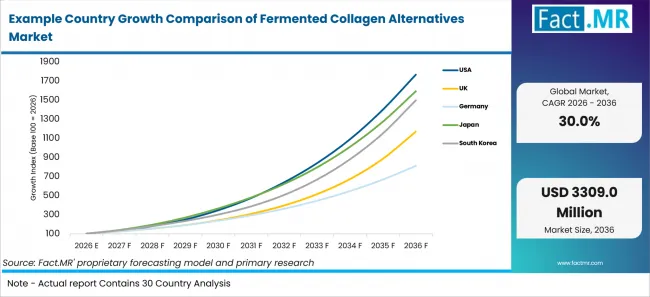
Example Country Growth Comparison Of Fermented Collagen Alternatives Market | Source: Fact.MR
| Country | CAGR |
|---|---|
| USA | 33.3% |
| Japan | 32.0% |
| South Korea | 31.1% |
| UK | 27.9% |
| Germany | 23.3% |
Source: Fact.MR analysis. Updated Aug 24, 2026
What supports USA adoption?
33.3% CAGR, supported by food-grade collagen alternatives and biomedical sampling demand.
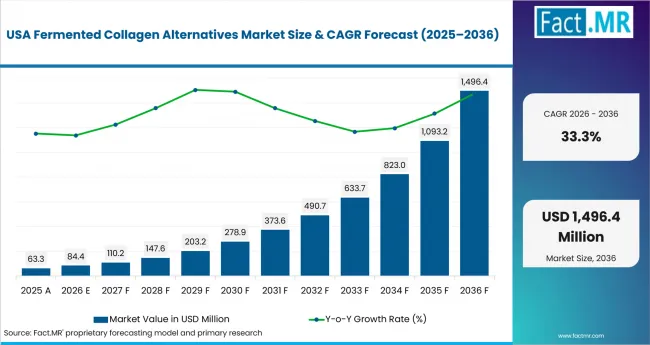
Fermented Collagen Alternatives Market Country Value Analysis | Source: Fact.MR
The USA’s growth is supported by large food and supplement channels and increasing attention to regulatory documentation. USDA ERS reported in June 2026 that inflation-adjusted U.S. food spending reached USD 2.51 trillion in 2025, expressed in 2025 dollars, while FDA proposed a rule in August 2026 to enhance oversight of substances added to human and animal food that are claimed to be GRAS. These conditions can support carefully documented food-grade collagen alternatives and biomedical sampling applications.
How is Japan scaling demand?
32.0% CAGR, led by biomanufacturing capacity and medical-material research.
Japan’s growth is supported by expanding biomanufacturing capability and premium food and medical-material development. AIST launched its Biomanufacturing and Process Research Center in April 2025, with approximately 70 researchers beginning activities at the center. In April 2026, METI launched a program to support 10,000 Japanese food exporters, linked to the government’s target of raising agricultural, forestry, fishery and food-product exports to JPY 5 trillion by 2030. Fermented collagen alternatives are expected to fit beauty, nutrition and medical-research applications where controlled ingredient identity and reproducible production matter.
What supports South Korea adoption?
31.1% CAGR, supported by K-beauty exports and food-nutrition development.
South Korea’s growth reflects the scale of its beauty-export industry and potential for collagen-alternative testing in premium formulations. Korea.net reported that cosmetics exports reached USD 11.4 billion in 2025, with skincare products accounting for USD 8.54 billion. Beauty brands are expected to provide an early route for animal-free collagen alternatives before broader ingestible applications develop. The export figures establish channel scale rather than direct evidence of collagen-alternative adoption.
What supports the UK’s growth?
27.9% CAGR, backed by precision fermentation authorization support and R&D funding.
The UK’s growth is supported by a clearer regulatory pathway for precision-fermented food ingredients and substantial public R&D funding. The Food Standards Agency and Food Standards Scotland launched the Precision Fermentation Business Support Service pilot in September 2025, while GOV.UK reported GBP 20.4 billion in government R&D funding for 2025/2026, including GBP 13.9 billion for DSIT. These conditions can strengthen safety preparation, authorization planning and development of collagen alternatives.
What is supporting Germany’s adoption?
23.3% CAGR, supported by industrial bioeconomy policy and recombinant collagen activity.
Germany’s growth is supported by bioeconomy policy and emerging recombinant collagen development. The European Commission published its Bioeconomy Strategy in November 2025 to promote sustainable biological resources and bio-based alternatives to fossil-based materials, while Evonik Industries AG launched a clinical-grade version of its VECOLLAN® recombinant collagen platform in September 2025 for use in clinical studies. Adoption is expected to begin in biomaterial, medical-research and cosmetic applications where purity, consistency and documentation carry greater importance than low unit cost.
Who leads the Fermented Collagen Alternatives Market?
Geltor commercializes biodesigned collagen-derived ingredients including PrimaColl® and HumaColl™21 Select. Geltor announced PrimaColl® in October 2025 following FDA’s October 22, 2024 closure of GRN 1171 with a “no questions” response for specified food uses; PrimaColl® is produced through precision fermentation. In March 2026, Geltor launched HumaColl™21 Select as a Type XXI collagen-based matrikine complex for topical beauty applications, building on HumaColl™21 through precision proteolysis.
Evonik Industries AG launched a clinical-grade version of its non-animal-derived VECOLLAN® recombinant collagen-like protein platform in September 2025 for clinical studies and medical-device development, with potential applications including orthopedics, medical aesthetics, and sports medicine.
Jellatech and CollPlant use collagen-production routes distinct from microbial precision fermentation: Jellatech describes its human Type I collagen platform as cellular agriculture, while CollPlant launched BioFlex on February 23, 2026 as a ready-to-print recombinant human collagen kit for DLP 3D bioprinting. CollPlant states that its rhCollagen is produced using proprietary plant-based genetic engineering technology.
Which companies are the key providers?
Key companies include Geltor; Jellatech; and Evonik Industries AG.
- Geltor
- Jellatech
- Evonik Industries AG
Bibliography
- CollPlant Biotechnologies Ltd. (2026, February 23). CollPlant elevates rhCollagen 3D bioprinting portfolio with launch of ready-to-print BioFlex.
- European Commission, Directorate-General for Communication. (2025, November 27). New plan to unlock the bioeconomy’s potential.
- Evonik Industries AG. (2025, September 16). Evonik launches recombinant collagen VECOLLAN® for use in clinical studies.
- Food Standards Agency. (2025, September 15). Precision Fermentation Business Support Service (BSS). GOV.UK.
- Geltor. (2025, October 13). Geltor’s PrimaColl® becomes first biodesigned collagen polypeptide cleared for food & beauty, redefining longevity inside and out.
- Geltor. (2026, March 25). Beyond peptides: Geltor introduces matrikine technology with HumaColl™21 Select.
- Department for Science, Innovation and Technology. (2025, April 4). DSIT research and development (R&D) allocations for 2025/2026. GOV.UK.
- Jellatech. (2025, January 22). Jellatech achieves milestone: Delivers first human Type I collagen samples.
- Ministry of Economy, Trade and Industry. (2026, April 10). Press conference by Minister Akazawa (excerpt).
- U.S. Food and Drug Administration. (2026, August 11). Substances generally recognized as safe (proposed rule).
This Report Answers
- The report explains where fermented collagen alternatives are used across protein type, host system, application and grade.
- Segment analysis identifies the leading subsegments and the commercial reasons brands prioritize them.
- Country analysis examines the listed markets and the regulatory, export or biomanufacturing factors shaping adoption.
- Competitive analysis reviews directly evidenced precision-fermentation and fermentation-based recombinant collagen providers, while cellular-agriculture, plant-recombinant and animal-free biomaterial companies are treated as adjacent comparators.
- Application analysis assesses how food-grade validation, beauty claims and biomaterial quality requirements influence purchase decisions.
What does the Fermented Collagen Alternatives Market cover?
The Fermented Collagen Alternatives Market covers animal-free collagen-like proteins and recombinant collagen inputs produced through fermentation. Other biotechnology routes, including cellular agriculture, plant-based recombinant collagen and biofabricated biomaterials, are treated as adjacent comparator technologies rather than part of the core fermented market. The market remains adjacent to the wider collagen market.
The assessment includes beauty, food-nutrition, personal care, medical-research and biomaterial uses. It also connects to gelatin substitutes where brands need non-animal gelling or structuring systems.
What is included in the scope?
The core scope includes fermentation-derived collagen polypeptides, recombinant collagen and collagen-like proteins where the production route is fermentation-based. Non-fermentation collagen technologies and gelatin substitutes may be cited as comparison benchmarks but are not counted in the core fermented-market value. Collagen and HA-based biomaterials applications may be discussed as adjacent use cases when non-animal collagen inputs are evaluated.
The report also includes formats where collagen alternatives support capsules, shots or functional foods. Adjacent reference areas include the gelatin market when customers compare animal and non-animal ingredient routes.
The scope also touches natural gelling agents where non-animal structure is material to food and supplement formats.
What is excluded from the scope?
The scope excludes animal-derived bovine, porcine, poultry and marine collagen when it is not replaced by a fermentation-derived alternative. Non-fermentation biotechnology routes, including cellular agriculture and plant-based recombinant collagen, are adjacent comparators and are excluded from the core market value. The scope also excludes base fermentation equipment, general bioreactor hardware and contract fermentation services sold without a collagen-alternative product.
General plant proteins, dairy proteins and microbial proteins are excluded unless they are fermentation-derived and positioned as a collagen alternative or collagen-like biomaterial. The core scope stays focused on fermentation-derived collagen-like proteins and fermentation-based recombinant biomaterial inputs; gelatin alternatives and non-fermentation collagen technologies are comparison benchmarks only.
How Was the Analysis Built?
The analysis draws on 120+ sources, 35+ company portfolios, 25+ countries, and more than 20 industry interviews.
- Primary Research: Primary research includes discussions with manufacturers, service providers, technology developers, distributors, end users, procurement teams, and subject-matter experts. These conversations examine purchasing priorities, product adoption, operational challenges, approval requirements, competitive positioning, and the factors that influence wider market acceptance.
- Desk Research: Desk research covers government statistics, regulatory publications, company filings, trade data, technical studies, industry associations, standards, public policy, and other authoritative sources. Every source used in the analysis is documented in the bibliography.
- Market Sizing and Forecasting: Market estimates combine historical performance, demand indicators, pricing and volume trends, segment shares, company participation, country-level growth, adoption patterns, investment activity, and barriers to market expansion.
- Data Validation and Update Cycle: Findings are validated by comparing primary interviews with public data, company activity, regulatory changes, trade patterns, and industry developments. Regular updates review new product launches, capacity changes, partnerships, approvals, procurement trends, and shifts in commercial adoption.
Segmentation
What is the report’s scope and coverage?
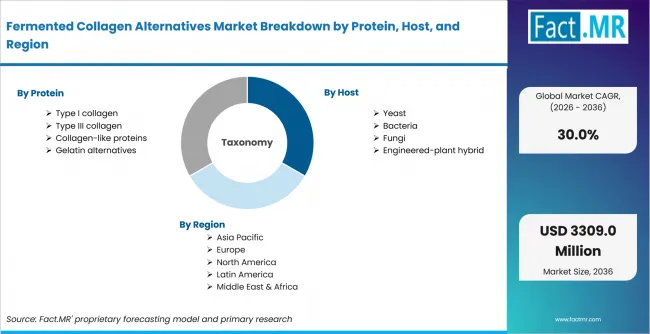
Fermented Collagen Alternatives Market Breakdown By Protein, Host, And Region | Source: Fact.MR
| Attribute | Details |
|---|---|
| Quantitative Units | USD million in 2026 to USD million by 2036 at a CAGR |
| Market Definition | Fermentation-derived collagen-like proteins and fermentation-based recombinant collagen inputs used to replace or mimic animal collagen in beauty, food-nutrition, personal care, medical biomaterials and research applications. |
| Protein | Type I collagen; Type III collagen; Collagen-like proteins; Gelatin alternatives |
| Host | Yeast; Bacteria; Fungi; Engineered-plant hybrid (adjacent comparator only) |
| Application | Beauty; Medical biomaterials; Medical-research; Food-nutrition; Personal care |
| Grade | Food; Cosmetic |
| Regions Covered | North America; Latin America; Western Europe; Eastern Europe; East Asia; South Asia & Pacific; Middle East & Africa |
| Countries Covered | USA; UK; Germany; Japan; South Korea |
| Companies Profiled | Geltor; Evonik Industries AG; Jellatech |
| Forecast Period | 2026 to 2036 |
| Approach | Hybrid top-down and bottom-up approach using application demand, fermentation route, protein type, country adoption, regulatory evidence and provider portfolio review. |
Source: Fact.MR analysis. Updated Aug 24, 2026
How is the market segmented?
-
By Protein:
- Type I collagen
- Type III collagen
- Collagen-like proteins
- Gelatin alternatives
-
By Host:
- Yeast
- Bacteria
- Fungi
- Engineered-plant hybrid (adjacent comparator only)
-
By Application:
- Beauty
- Medical biomaterials
- Medical-research
- Food-nutrition
- Personal care
-
By Grade:
- Food
- Cosmetic
-
By Region:
- North America
- Latin America
- Western Europe
- Eastern Europe
- East Asia
- South Asia & Pacific
- Middle East & Africa
Frequently Asked Questions
How big is the fermented collagen alternatives market in 2026?
What is the CAGR of the fermented collagen alternatives market from 2026 to 2036?
Which protein leads the fermented collagen alternatives market?
Which host leads the fermented collagen alternatives market?
Who are the leading companies in the fermented collagen alternatives market?
Who worked on this report


Preview the report firsthand - request a free sample
Free SampleGet the brochure for pricing and purchase details
Download PDF