
- Market Value (2025): USD 92.8 Mn
- Estimated Value (2026): USD100.0 Mn
- Forecast Value (2036): USD 210.0 Mn
- CAGR (2026-2036): 7.7%
Collaborative Palletizing Cells Market Forecast and Outlook 2026 to 2036
The collaborative palletizing cells market is projected to grow from USD 100.0 million in 2026 to USD 210.0 million by 2036. The forecast implies a compound annual growth rate of 7.7% over the forecast period.
Manufacturers use collaborative palletizing cells to automate repetitive end-of-line stacking where floor space and staffing are constrained. A complete cell combines a robot, end-of-arm tooling, pallet handling, control software and safety measures. Universal Robots and Robotiq demonstrated a UR20-based palletizing solution with Siemens at CES 2026. The required guarding and operating speed depend on the application-specific risk assessment.
Market figures and highlights: Collaborative Palletizing Cells Market
- Sales of collaborative palletizing cells stood at USD 92.8 million in 2025
- Collaborative Palletizing Cells Market Value (2026): USD 100.0 million
- Collaborative Palletizing Cells Market Forecast Value (2036): USD 210.0 million
- Collaborative Palletizing Cells Market Forecast CAGR (2026-2036): 7.7%
- Leading Product Type: Dual-arm collaborative cell (26.6%)
- Key Market Participants: ABB, FANUC, KUKA, Universal Robots
- Key Growth Regions: South Korea, United States, Germany, Japan, United Kingdom
The International Federation of Robotics reported that global industrial robot installations surpassed 600,000 units in 2025, an increase of 11%. This reflects industrial automation more broadly rather than confirmed demand for collaborative palletizing cells. Palletizing applications must be assessed for case weight, cycle time, floor space and safety requirements.
Collaborative Palletizing Cells Market
| Metric | Value |
|---|---|
| Estimated Value in (2026) | USD 100.0 million |
| Forecast Value in (2036) | USD 210.0 million |
| Forecast CAGR (2026 to 2036) | 7.7% |
Source: Fact.MR analysis. Updated Nov 25, 2026
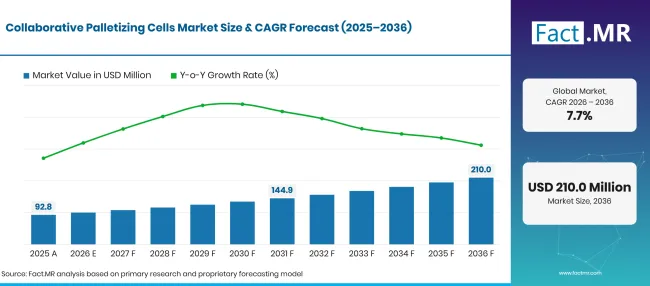
Collaborative Palletizing Cells Forecast Global | Source: Fact.MR
Source: Fact.MR analysis.
Category
| Category | Segments |
|---|---|
| Product Type | Dual-arm collaborative cell, Mobile cobot palletizer, Hybrid cobot and gantry, High-payload cobot cell, Cobot articulated palletizer |
| Operating Mode | Semi-continuous, Batch, Continuous, Turnkey integrated, Modular inline |
| Capacity Tier | High throughput, Pilot and laboratory, Medium throughput, Small commercial, Custom high-capacity |
| Customer Industry | Other industrial, Food and beverage, General manufacturing, Pharmaceutical, Chemicals |
| Region | South Korea; United States; Germany; Japan; United Kingdom |
Source: Fact.MR analysis. Updated Nov 25, 2026
Segmental Analysis
Why do dual-arm collaborative cells lead product demand in the Collaborative Palletizing Cells Market?
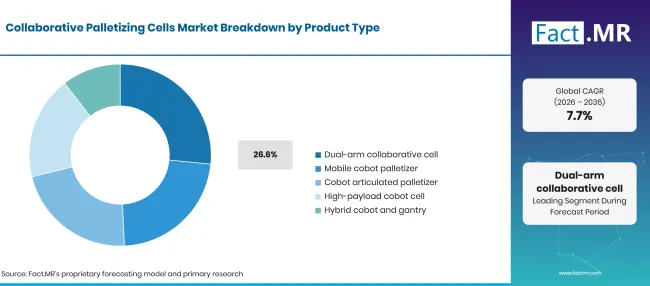
Collaborative Palletizing Cells Breakdown Product Type | Source: Fact.MR
Dual-arm collaborative cells account for 26.6% of revenue in 2026, approximately USD 26.6 million. Two coordinated arms may handle multiple pick-and-place tasks, but cell configuration depends on product flow, load weight and available space. Manufacturers must also verify simultaneous motion, pallet access and safety measures.
How is semi-continuous operation leading demand in the Collaborative Palletizing Cells Market?
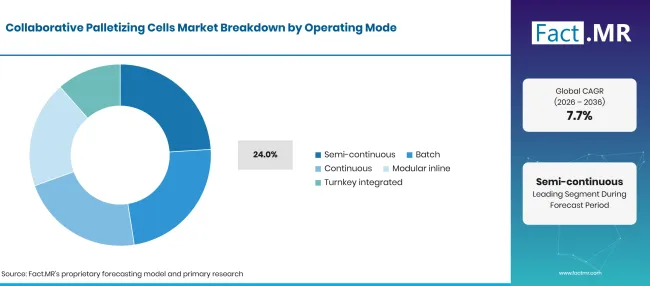
Collaborative Palletizing Cells Breakdown Operating Mode | Source: Fact.MR
Semi-continuous operation represents 24.0% of revenue in 2026, valued at approximately USD 24.0 million. Cells handling product changes or pallet replacement may stop between production runs. Robotiq’s palletizing software supports configurable pallet patterns, helping operators adjust stacking recipes. Cell throughput depends on gripper design, product dimensions and the time required for safe pallet changes.
Why does high throughput lead capacity demand in the Collaborative Palletizing Cells Market?
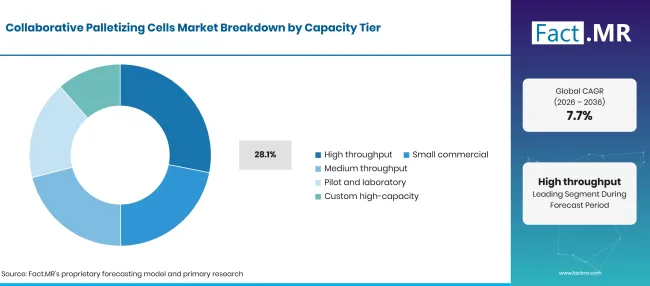
Collaborative Palletizing Cells Breakdown Capacity Tier | Source: Fact.MR
High-throughput cells hold 28.1% of revenue in 2026, equivalent to approximately USD 28.1 million. Higher-output applications require sufficient robot reach, payload and cycle rate, sometimes using multi-case gripping. Universal Robots’ UR20 and Robotiq palletizing solutions illustrate commercial cobot-based handling. Operators must verify the achievable rate and safety configuration for each production line.
How do other industrial users lead customer demand in the Collaborative Palletizing Cells Market?
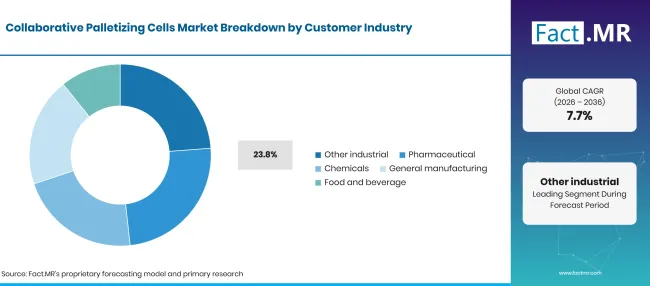
Collaborative Palletizing Cells Breakdown Customer Industry | Source: Fact.MR
Other industrial users contribute 23.8% of revenue in 2026, approximately USD 23.8 million. This category covers applications outside the separately listed food and beverage, general manufacturing, pharmaceutical and chemicals groups. Depending on the market definitions, it may include contract packaging and selected logistics uses. Configurable end effectors and stacking recipes help accommodate changing carton sizes.palletizing robot market
Collaborative Palletizing Cells Market: Drivers, Restraints and Trends
Drivers:
Manufacturers are adopting end-of-line automation where repeated lifting and stacking create handling bottlenecks. In January 2026, Universal Robots and Robotiq demonstrated a UR20-based palletizing cell integrated with Siemens automation and digital-twin technology. The launch provides an application-specific example of collaborative palletizing equipment.
Restraints:
Collaborative palletizing cells must meet site-specific risk-assessment requirements. Depending on the payload, speed and access conditions, a system may still require scanners, protective stops or physical guarding. High-speed fenced industrial robot cells can also offer more suitable performance for some high-volume packaging lines.
Trend:
Mobile and Redeployable Cells. Some smaller factories are considering palletizers that can be relocated between packaging lines. Redeployment still requires suitable floors, utilities, material flow and a renewed assessment of hazards at the new location. Integrators are developing compact cells and configurable grippers for changing production layouts.
Trend:
No-Code Pattern Software and Vision. Palletizing software can simplify pattern setup and changeovers without requiring operators to write robot code. Robotiq offers application software for palletizing with compatible Universal Robots arms. Machine vision and mixed-case stacking may require additional sensing and software, depending on the application.
Collaborative Palletizing Cells Market: Country Analysis
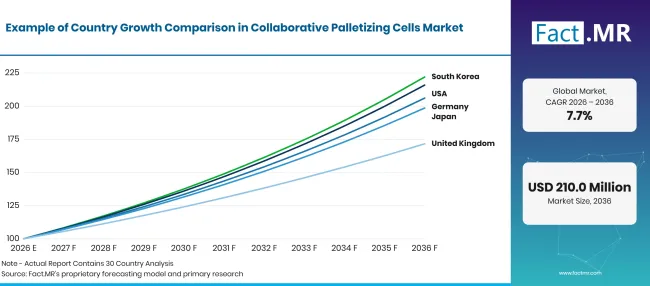
Collaborative Palletizing Cells Growth Index | Source: Fact.MR
| Country | CAGR (2026-2036) |
|---|---|
| South Korea | 8.3% |
| United States | 8.0% |
| Germany | 7.5% |
| Japan | 7.1% |
| United Kingdom | 5.6% |
Source: Fact.MR analysis.
What is driving collaborative palletizing cells demand in South Korea?
Demand for collaborative palletizing cells in South Korea is forecast to increase at an 8.3% CAGR through 2036, the fastest among the five countries.
In November 2026, the International Federation of Robotics reported a manufacturing robot density of 1,066 units per 10,000 employees, indicating extensive industrial automation. Food, cosmetics and battery manufacturers offer further opportunities for automating repetitive end-of-line handling. Labor availability and compact factory layouts make adaptable robotic cells attractive.
How is labor scarcity supporting collaborative palletizing cells sales in the United States?
Sales of collaborative palletizing cells in the United States are set to rise at an 8.0% CAGR through 2036, with smaller packaging operations seeking alternatives to repetitive manual stacking.
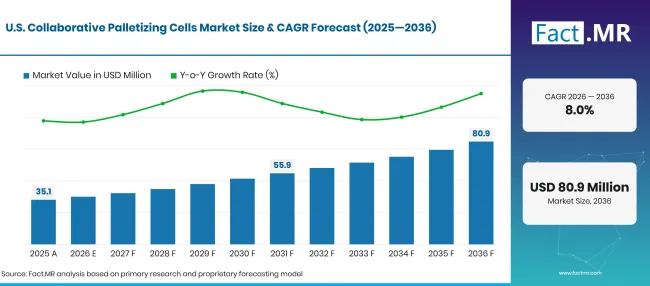
Collaborative Palletizing Cells Forecast Usa | Source: Fact.MR
The Brewers Association counted 9,344 operating breweries in June 2026, illustrating the scale of a fragmented production sector. Compact collaborative cells can suit facilities with limited installation space. Suppliers such as FANUC and Universal Robots work through integrators to offer palletizing solutions.
What is shaping collaborative palletizing cells demand in Germany?
Demand for collaborative palletizing cells in Germany carries a 7.5% CAGR through 2036 as medium-sized manufacturers examine automation for packaging and material handling.
The International Federation of Robotics ranked Germany third globally in manufacturing robot density in November 2026, reflecting its established automation base. KUKA provides palletizing robots and software that simplify stacking pattern programming. German food and chemical manufacturers may use these technologies to modernize existing packaging lines.
How is capital spending shaping collaborative palletizing cells sales in Japan?
Sales of collaborative palletizing cells in Japan are forecast to expand at a 7.1% CAGR through 2036.
Factory operators seeking to reduce physically demanding manual stacking may evaluate collaborative robots for end-of-line handling. Selection depends on the weight and dimensions of cases, line output, plant layout and required safety measures.
Why is growth slower for collaborative palletizing cells in the United Kingdom?
Demand for collaborative palletizing cells in the United Kingdom is likely to advance at a 5.6% CAGR through 2036, the slowest among the five countries.
Smaller manufacturing facilities and cautious capital spending can delay automation projects requiring equipment integration. In August 2026, SIBA reported that brewery closures had slowed during the first half of the year, although financial pressure remained across independent brewing. Compact palletizing systems may appeal to producers with limited space.
Competitive Landscape for Collaborative Palletizing Cells Market
Competition in the collaborative palletizing cells market increasingly depends on how quickly manufacturers can automate end-of-line operations without disrupting existing packaging lines. Universal Robots benefits from its ecosystem of palletizing specialists, including Robotiq, which combines collaborative arms with grippers and application software. FANUC competes through its CRX series and pre-engineered palletizing cells, while ABB offers GoFa robots supported by dedicated palletizing software. Yaskawa and Kawasaki Robotics provide alternative automation platforms, whereas KUKA serves palletizing applications through collaborative and conventional industrial robots. System integrators play an important role in converting these technologies into working cells.
Recent competition has moved beyond robot payload ratings toward ready-to-deploy palletizing systems with simpler programming and fewer integration steps. In January 2026, Universal Robots and Robotiq introduced a next-generation palletizing solution at CES in collaboration with Siemens, combining the UR20 robot with Robotiq's palletizing technology. FANUC subsequently showcased pre-engineered collaborative palletizing solutions at Automate 2026, including a Premier Tech system using its CRX-30iA robot. ABB introduced its PoWa collaborative robot family in April 2026, extending its offering for faster material handling and palletizing applications.
Recent Developments
- In January 2026, Universal Robots and Robotiq presented a UR20-based PAL Ready palletizing cell at CES in collaboration with Siemens. The demonstration combined palletizing equipment with Siemens automation hardware and Digital Twin Composer software.
Key Players in Collaborative Palletizing Cells Market
Key companies operating in the market include ABB, FANUC, KUKA, and Universal Robots.
- ABB
- FANUC
- KUKA
- Universal Robots
Bibliography
- Brewers Association. (2026, July 22). 2026 Midyear Report: Pressure Persists as Signs of Stability Emerge.
- International Federation of Robotics. (2026, September 24). Five Million Robots Now Operate in Factories Globally.
- International Federation of Robotics. (2026, June 18). US Robot Industry Returns to Double Digit Growth.
- International Federation of Robotics. (2026, September 24). Best-of World Robotics 2026: Top Facts Summary.
- International Federation of Robotics. (2026, November 12). Robot Density Highest in South Korea, Singapore and Germany.
- International Federation of Robotics. (2026). Executive Summary World Robotics 2026 Industrial Robots.
- Japan Machine Tool Builders’ Association. (2026, November 11). Machine Tool Orders: October 2026 Preliminary Results.
- Siemens AG. (2026, November 12). Outstanding fiscal 2026 performance – Industrial AI to drive future growth.
- Universal Robots. (2026, January 6). Universal Robots and Robotiq showcase next-gen palletizing solution at CES 2026 in collaboration with Siemens. https://www.universal-robots.com/news-and-media/news-center/universal-robots-robotiq-unveil-next-generation-palletizing-solution--ces-2026-collaboration-with-siemens/
- Universal Robots. (2026, January 6). Universal Robots and Robotiq showcase next-gen palletizing solution at CES 2026 in collaboration with Siemens.
- International Federation of Robotics. (2026, September 24). Five million robots now operate in factories globally.
- ABB Robotics. (2026, April 22). ABB Robotics launches high-speed PoWa cobot family.
Segmentation
Scope of Report
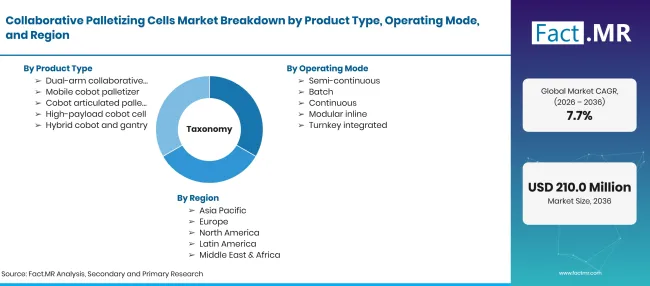
Collaborative Palletizing Cells Taxonomy | Source: Fact.MR
| Items | Values |
|---|---|
| Quantitative Units (2026) | USD million |
| Product Type | Dual-arm collaborative cell, Mobile cobot palletizer, Hybrid cobot and gantry, High-payload cobot cell, Cobot articulated palletizer |
| Operating Mode | Semi-continuous, Batch, Continuous, Turnkey integrated, Modular inline |
| Capacity Tier | High throughput, Pilot and laboratory, Medium throughput, Small commercial, Custom high-capacity |
| Customer Industry | Other industrial, Food and beverage, General manufacturing, Pharmaceutical, Chemicals |
| Regions Covered | North America, Latin America, Europe, East Asia, South Asia and Pacific, Middle East & Africa |
| Countries Covered | South Korea, United States, Germany, Japan, United Kingdom, and other countries |
| Key Companies Profiled | ABB, FANUC, KUKA, Universal Robots |
| Additional Attributes | Dollar revenue in the Collaborative Palletizing Cells Market is segmented by product type (dual-arm cell, mobile cobot palletizer, hybrid cobot and gantry, high-payload cell, articulated cobot palletizer), operating mode, capacity tier, customer industry and region. |
Source: Fact.MR analysis.
Collaborative Palletizing Cells Market by Segments
-
Product Type
- Dual-arm collaborative cell
- Mobile cobot palletizer
- Hybrid cobot and gantry
- High-payload cobot cell
- Cobot articulated palletizer
-
Operating Mode
- Semi-continuous
- Batch
- Continuous
- Turnkey integrated
- Modular inline
-
Capacity Tier
- High throughput
- Pilot and laboratory
- Medium throughput
- Small commercial
- Custom high-capacity
-
Customer Industry
- Other industrial
- Food and beverage
- General manufacturing
- Pharmaceutical
- Chemicals
-
Region:
- North America
- United States
- Canada
- Mexico
- Europe
- Germany
- United Kingdom
- France
- Italy
- Spain
- Rest of Europe
- Asia Pacific
- China
- India
- Japan
- South Korea
- Australia
- Rest of Asia Pacific
- Latin America
- Brazil
- Argentina
- Rest of Latin America
- Middle East & Africa
- GCC Countries
- South Africa
- Rest of Middle East & Africa
- North America
Table of Contents
Key Takeaways
- Market Size and CAGR
- Top Growth Driver
- Fastest Growing Segment
- Leading Region
- Key Companies
- Emerging Opportunities

