
- Market Value (2025): USD 163.8 Mn
- Estimated Value (2026): USD 173.0 Mn
- Forecast Value (2036): USD 298.3 Mn
- CAGR (2026-2036): 5.6%
Digital Malt Grinding Mills Market Forecast and Outlook 2026 to 2036
According to the Fact.MR analysis, the digital malt grinding mills market surpassed a value of USD 163.8 million in 2025 and is projected to grow from USD 173.0 million in 2026 to USD 298.3 million by 2036. Demand for digital malt grinding mills is likely to grow at a CAGR of 5.6% over the forecast period.
Demand for digital malt grinding mills is rising as brewers and distillers use sensors and motorized roll gaps to control grist quality, which drives extract yield and lautering speed. Digital mills store settings for each malt and adjust gaps automatically, replacing manual feeler gauges. For example, the US Brewers Association reported that craft brewery closures outnumbered openings in 2024, pushing surviving brewers to raise efficiency and yield. Similar margin pressure is projected to drive sales of digital malt grinding mills through 2036.
Key Takeaways from the Digital Malt Grinding Mills Market
- Digital Malt Grinding Mills Market Value (2025): USD 163.8 million
- Digital Malt Grinding Mills Market Value (2026): USD 173.0 million
- Digital Malt Grinding Mills Market Forecast Value (2036): USD 298.3 million
- Digital Malt Grinding Mills Market Forecast CAGR (2026-2036): 5.6%
- Leading Malt mill type: Two-roller (33.6%)
- Key Market Participants: Bühler, Künzel Maschinenbau, Ziemann Holvrieka, RMS Roller-Grinder, Malt Handling, Sasquatch Mills
- Key Growth Regions: Germany, China, United States, Belgium, United Kingdom
Large malting and brewing groups continue to consolidate, as seen when Boortmalt acquired Cargill's malt business in 2023. Demand for digital malt grinding mills is growing as brewers align milling with consistent malt specifications from fewer manufacturers. The manufacturing companies such as Künzel, Ziemann Holvrieka and Bühler are offering mills with recipe control and data logging. Similar standardization is projected to drive sales of digital malt grinding mills in Europe, North America and Asia.
Digital Malt Grinding Mills Market
| Metric | Value |
|---|---|
| Estimated Value in (2026) | USD 173.0 million |
| Forecast Value in (2036) | USD 298.3 million |
| Forecast CAGR (2026 to 2036) | 5.6% |
Source: Fact.MR analysis.
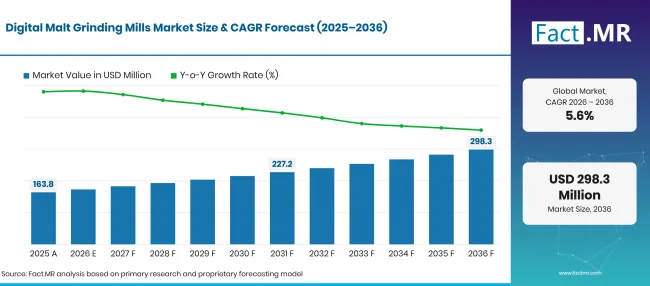
Digital Malt Grinding Mills Forecast Global | Source: Fact.MR
Category
| Category | Segments |
|---|---|
| Malt mill type | Two-roller, Four-roller, Six-roller, Hammer mill, Wet-conditioning mill |
| Processing scale | Pilot / lab, Small commercial, Mid-scale, High-throughput, Ultra-high-throughput |
| Operating configuration | Batch, Semi-continuous, Continuous, Modular skid, Integrated line |
| Food / process application | Bakery / wafers, Confectionery / cocoa, Snacks / seasoning, Brewing / grains, Other food / industrial |
| Region | Germany; China; United States; Belgium; United Kingdom |
Source: Fact.MR analysis.
Segmental Analysis
What is supporting demand for two-roller mills in the digital malt grinding mills market?
Digital Malt Grinding Mills Breakdown Malt Mill Type | Source: Fact.MR
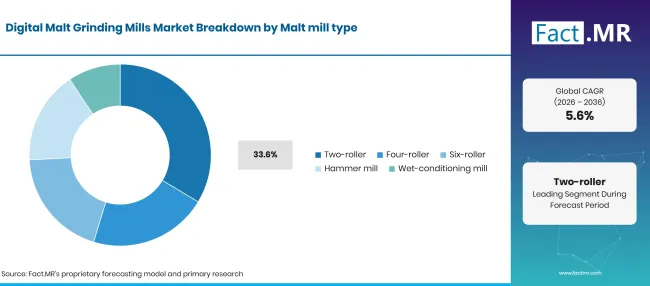
Demand for two-roller mills account for 33.6% of market revenue in 2026, about USD 58.1 million, as craft breweries, brewpubs and small distilleries seek compact milling equipment with straightforward gap adjustment and maintenance. The U.S. Alcohol and Tobacco Tax and Trade Bureau updated its beer production statistics in July 2026 and published a separate dataset tracking breweries by production size in June 2026. This official reporting demonstrates the continued importance of different brewery operating scales. Demand for two-roller mills is supported by smaller facilities seeking controlled malt preparation without investing in larger industrial milling configurations.
Which brewery investment patterns are supporting sales of small commercial digital malt grinding mills?
Digital Malt Grinding Mills Breakdown Processing Scale | Source: Fact.MR
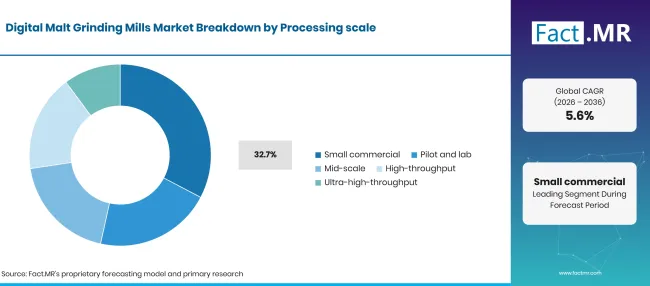
Sales of the small commercial segment represents 32.7% of market revenue in 2026, reaching USD 56.6 million, as independent breweries, brewpubs and specialist distilleries require milling capacities suited to smaller production batches. The TTB's 2026 brewery statistics include dedicated reporting by production-size category, with the dataset updated on June 3, 2026. This government classification provides a useful indicator of the range of operating scales within the U.S. brewing industry. Smaller production facilities create a potential customer base for compact digital mills offering repeatable grain sizing, adjustable roller gaps and automated material handling.
How are modular skid configurations creating opportunities in digital malt grinding mill sales?
Digital Malt Grinding Mills Breakdown Operating Configuration | Source: Fact.MR
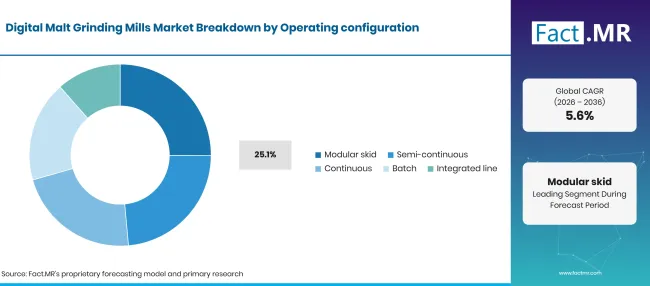
Demand for modular skid units account for 25.1% of market revenue in 2026, about USD 43.4 million, as breweries and specialist grain processors seek packaged milling equipment that combines roller mills, grain transfer and dust-control components. The USDA's November 2026 World Markets and Trade report forecasts global barley production at 161.05 million metric tonnes for 2026–27, compared with 154.40 million tonnes in 2025–26. This expanding raw-material supply supports opportunities across malt processing and grain-based manufacturing. Modular skids offer equipment buyers a practical way to integrate grinding operations into existing facilities with limited installation modifications.
What is expanding demand for digital malt grinding mills across other food and industrial applications?
Digital Malt Grinding Mills Breakdown Food And Process Application | Source: Fact.MR
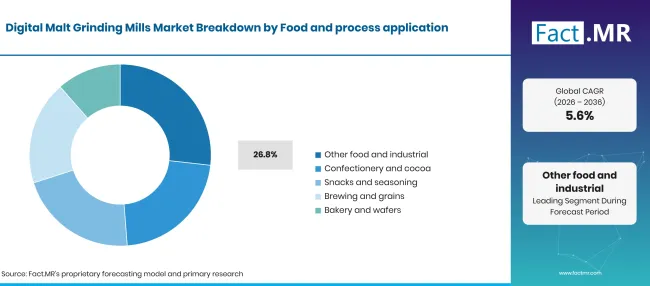
Other food and industrial applications capture 26.8% of market revenue in 2026, about USD 46.4 million, covering distilleries, specialty grain processing and malt-based ingredient manufacturing. The USDA's November 2026 grain outlook estimates global barley consumption at approximately 157.76 million tonnes during 2026–27, compared with 151.55 million tonnes in 2025–26. Barley is used across brewing, distilling, animal feed and food manufacturing, creating demand opportunities beyond conventional breweries. Digital grinding mills can support these processors through adjustable grinding gaps, repeatable particle sizing and controlled grain preparation.
Digital Malt Grinding Mills Market-Drivers, Restraints & Trends
Drivers: Demand for higher malt extraction and consistent grinding
Demand for digital malt grinding mills is increasing as breweries seek consistent grain particle sizes, improved lautering performance and better control over malt usage. The USDA's November 2026 World Agricultural Supply and Demand Estimates projects global barley production at 161.05 million metric tonnes in 2026–27, up from 154.40 million tonnes in 2025–26, representing approximately 4.3% growth. Greater barley availability supports malt processing and brewing supply chains. This creates opportunities for digitally controlled roller mills that adjust grinding gaps according to malt specifications and help breweries achieve repeatable milling results.
Restraints: Declining beer production and brewery investment
Sales of digital malt grinding mills face pressure in mature brewing markets where declining beer production can reduce demand for new milling installations. The U.S. Alcohol and Tobacco Tax and Trade Bureau (TTB) publishes monthly taxable beer-removal statistics and brewery counts by production size, with its latest 2026 datasets updated on July 31 and June 3, respectively. These official indicators allow manufacturers to monitor changes in brewery activity and production scale. Equipment manufacturers therefore need to pursue replacement demand and customers in distilling and specialty grain processing.
Opportunity: Recipe-controlled roll-gap adjustment
Demand for recipe-controlled digital malt grinding mills is creating opportunities for manufacturers developing automated roller-gap adjustment and programmable milling systems. The USDA's November 2026 estimates place global barley production at 161.05 million tonnes in 2026–27, compared with 154.40 million tonnes in 2025–26. The projected increase expands the raw-material base available to maltsters and grain processors. As breweries handle different barley varieties and malt specifications, programmable gap settings can help maintain consistent particle sizes across recipes. Suppliers incorporating servo-driven adjustments, digital controls and stored milling profiles can address this requirement.
Trend: Craft distilling and specialist spirits production
Demand for digital malt grinding mills is extending beyond breweries as craft distillers and specialist whisky producers require controlled grain preparation for spirit production. The UK Department for Environment, Food and Rural Affairs reported in September 2026 that England had more than 70 whisky distilleries, compared with 46 in 2023. The government also confirmed that English whisky had received protected geographical indication status, strengthening recognition of the category. This expanding distillery base creates opportunities for compact malt mills with adjustable roller gaps and repeatable grain preparation capabilities.
Digital Malt Grinding Mills Market by Analysis by Key Country
Digital Malt Grinding Mills Growth Index | Source: Fact.MR
| Country | CAGR (2026-2036) |
|---|---|
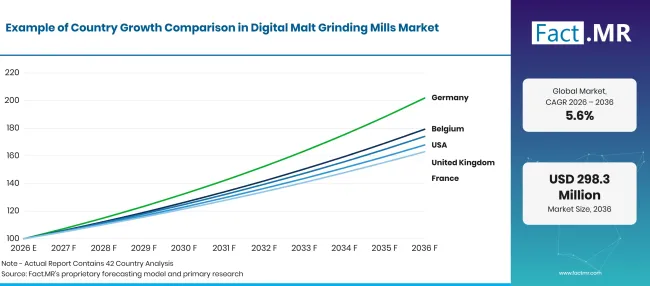
| Germany | 7.4% |
| China | 7.2% |
| United States | 5.7% |
| Belgium | 5.7% |
| United Kingdom | 5.2% |
Source: Fact.MR analysis.
Why is Germany the fastest-growing market for digital malt grinding mills?
Demand in Germany is projected to grow at a 7.4% CAGR, the fastest among the five key countries, as brewers modernize brewhouses to save energy and raw materials while volumes fall.
Künzel and Ziemann Holvrieka are German key players. Destatis reported in February 2026 that German beer sales fell 6.0% in 2025 to approximately 7.8 billion litres, marking the steepest decline since 1993. A further August 2026 release recorded 1,415 operating breweries in 2025, down 3.6% year over year. These conditions encourage brewers to improve raw-material utilization and optimize existing brewhouse capacity. Suppliers such as Künzel and Ziemann Holvrieka can benefit from modernization investments.
What is driving digital malt grinding mill demand in China?
Sales in China are anticipated to increase at a 7.2% CAGR as large brewers such as China Resources Beer and Tsingtao premiumize and craft brewing grows in cities.
Digital mills help groups keep quality consistent across many breweries. China's National Bureau of Statistics reported that beer production by above-designated-size enterprises reached 15.359 million kilolitres during January–May 2026, increasing 0.8% year over year. May production stood at 3.425 million kilolitres. This modest production expansion supports continued demand for reliable malt preparation equipment. Large brewers such as China Resources Beer and Tsingtao Brewery can use digitally controlled mills to standardize grist quality and improve extraction consistency across multiple production facilities.
What is shaping digital malt grinding mill sales in the United States?
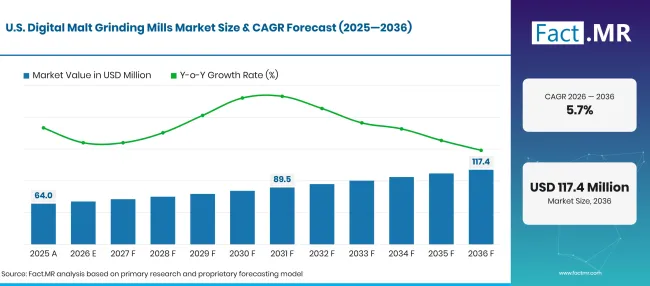
Sales in the United States are estimated to record a 5.7% CAGR as surviving craft brewers and distillers invest in efficiency despite closures.
Digital Malt Grinding Mills Forecast Usa | Source: Fact.MR
The number of US craft breweries fell in 2024 for the first time in about two decades, so remaining brewers focus on efficiency rather than new capacity. The U.S. Alcohol and Tobacco Tax and Trade Bureau updated its official beer statistics in July 2026, including national beer reports and brewer counts by production size. These datasets provide a government basis for monitoring brewery activity and production changes. Brewers facing competitive pressure can use automated grinding systems to improve milling consistency, monitor operating parameters and reduce raw-material losses. Consequently, equipment modernization offers an alternative to capacity expansion for established craft breweries and larger brewing groups.
What is shaping digital malt grinding mill demand in Belgium?
Demand in Belgium is projected to increase at a 5.7% CAGR as specialty and abbey brewers such as Duvel Moortgat and Chimay export widely and value consistent extract.
Belgium has hundreds of breweries, many of them small family firms. Eurostat reported in August 2026 that Belgium was the European Union's largest beer exporter in 2025, shipping approximately 1.5 billion litres through intra-EU and extra-EU trade. This export position creates opportunities for breweries to maintain consistent product specifications across international markets. Additionally, Statbel released consolidated 2025 industrial production data in August 2026, providing updated production-value and volume statistics. Digital grinding equipment can support Belgian brewers through automated grist preparation, process monitoring and improved extract consistency.
Why is digital malt grinding mill growth slower in the United Kingdom?
Demand in the United Kingdom is estimated to grow at a 5.2% CAGR, the slowest among the five key countries, as small breweries close under cost pressure despite small producer relief introduced in the August 2023 alcohol duty reform.
HMRC reported in August 2026 that UK beer-related Alcohol Duty receipts declined 5% year over year to £876 million during April–June 2026. However, the October 2026 Budget announced an additional £10 million annually in support for more than 2,000 small alcohol producers through changes to Small Producer Relief. These measures provide some financial support, although breweries still need to manage operating costs carefully. Digital mills offering lower energy consumption and reduced malt wastage can therefore attract selective modernization spending.
Competitive Landscape for Digital Malt Grinding Mills Market
Competition in the digital malt grinding mills market is shaped by established brewhouse engineering companies and specialist roller-mill manufacturers. Bühler, Künzel Maschinenbau and Ziemann Holvrieka are prominent industrial manufacturers, combining malt-milling equipment with automation and process integration. Bühler’s Maltomat IV, introduced in November 2026, features touchscreen monitoring, calibration assistance and live grinding-gap adjustment. Künzel offers PLC-controlled grist mills with stored milling-gap settings, while Ziemann Holvrieka’s T-Rex WET mill supports sensor integration into brewery process-control systems.
GEA Group competes through its MILLSTAR wet-milling system, which combines grain conditioning, crushing and mashing with adjustable roller speed and automated process controls. RMS Roller-Grinder supplies brewery-specific two- and four-roll mills, while Sasquatch Mills offers two-, four- and six-roll configurations with adjustable gaps. Sommer Maschinenbau, RAVOZ and Czech Brewery System extend competition into smaller brewery and specialist applications through their malt-mill portfolios.
Buyers evaluate manufacturers on grist consistency, husk preservation, throughput, energy consumption, automation, maintenance requirements and integration with existing brewhouse controls. Competitive differentiation increasingly depends on measurable process control rather than milling capacity alone.
Recent Developments
- In 2025, the Brewers Association reported more craft brewery closures than openings in 2024.
- In November 2026, Bühler introduced the Maltomat IV with a 15-inch touchscreen, automated calibration, live grinding-gap adjustment and continuous monitoring of roller speed, bearing temperature and product feed, improving process control and reducing changeover time.
- In February 2026, Ziemann Holvrieka presented its T-Rex Wet mill with stainless-steel grinding components, full CIP capability and sensors for process-control integration. Its 5–25 tonnes-per-hour capacity supports hygienic, digitally connected brewery milling operations.
Key Players in Digital Malt Grinding Mills Market
Key companies operating in the market include Bühler, Künzel Maschinenbau, Ziemann Holvrieka, RMS Roller-Grinder, GEA Group, Sasquatch Mills, Sommer Maschinenbau, RAVOZ, and Czech Brewery System (CBS).
- Bühler
- Künzel Maschinenbau
- Ziemann Holvrieka
- RMS Roller-Grinder
- GEA Group
- Sasquatch Mills
- Sommer Maschinenbau
- RAVOZ
- Czech Brewery System (CBS)
Bibliography
- Alcohol and Tobacco Tax and Trade Bureau. (2026). Beer reports. U.S. Department of the Treasury.
- Brewers Association. (2026). A year of correction for craft beer, with early signals of recovery.
- Department for Environment, Food & Rural Affairs. (2026, September 11). English whisky raises a glass to new protected status. GOV.UK.
- Eurostat. (2026, August 7). Extra-EU exports of beer down 11% in 2025. European Commission.
- Eurostat. (2026, August 31). EU produced 34.4 billion litres of beer in 2025. European Commission.
- HM Revenue & Customs. (2026, August 28). Alcohol bulletin commentary (May 2026 to July 2026). GOV.UK.
- HM Revenue & Customs. (2026, October 28). Alcohol Duty uprating and Small Producer Relief changes. GOV.UK.
- HM Treasury. (2026). Budget 2026. GOV.UK.
- Statbel. (2026, October 13). Production in industry: August 2026. Belgian Statistical Office.
- Statistisches Bundesamt (Destatis). (2026, February 2). 6.0% weniger Bier im Jahr 2025 abgesetzt [Beer sales declined by 6.0% in 2025].
- Statistisches Bundesamt (Destatis). (2026, August 4). Zahl der Brauereien auf 1 415 im Jahr 2025 gesunken – 137 weniger als im Rekordjahr 2019 [Number of breweries fell to 1,415 in 2025].
- U.S. Department of Agriculture, Foreign Agricultural Service. (2026, November 10). Grain: World markets and trade.
- U.S. Department of Agriculture, Foreign Agricultural Service. (2026, November 10). World barley production, consumption, and stocks.
- U.S. Department of Agriculture, World Agricultural Outlook Board. (2026, November 10). World agricultural supply and demand estimates.
- U.S. Department of Agriculture, Foreign Agricultural Service. (2026, November 10). World barley supply and demand outlook.
Segmentation
Scope of Report
Digital Malt Grinding Mills Taxonomy | Source: Fact.MR
| Items | Values |
|---|---|
| Quantitative Units (2026) | USD 173.0 Million |
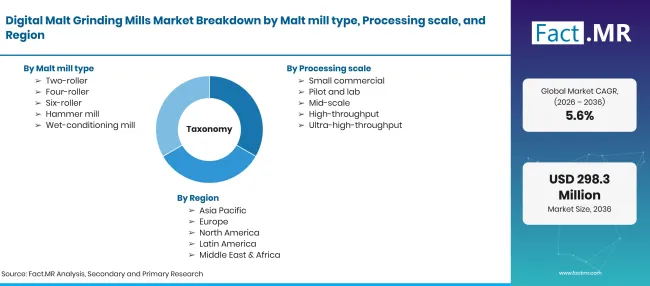
| Malt mill type | Two-roller, Four-roller, Six-roller, Hammer mill, Wet-conditioning mill |
| Processing scale | Pilot / lab, Small commercial, Mid-scale, High-throughput, Ultra-high-throughput |
| Operating configuration | Batch, Semi-continuous, Continuous, Modular skid, Integrated line |
| Food / process application | Bakery / wafers, Confectionery / cocoa, Snacks / seasoning, Brewing / grains, Other food / industrial |
| Regions Covered | North America, Latin America, Europe, East Asia, South Asia and Pacific, Middle East & Africa |
| Countries Covered | Germany, China, United States, Belgium, United Kingdom, and other countries |
| Key Companies Profiled | Bühler Künzel Maschinenbau Ziemann Holvrieka RMS Roller-Grinder GEA Group Sasquatch Mills Sommer Maschinenbau RAVOZ Czech Brewery System (CBS) |
| Additional Attributes | Dollar revenue in the Digital Malt Grinding Mills Market is segmented by malt mill type (two-roller, four-roller, six-roller, hammer mill, wet-conditioning mill); processing scale (pilot / lab, small commercial, mid-scale, high-throughput, ultra-high-throughput); operating configuration (batch, semi-continuous, continuous, modular skid, integrated line); food / process application (bakery / wafers, confectionery / cocoa, snacks / seasoning, brewing / grains, other food / industrial) and region. |
Source: Fact.MR analysis.
Digital Malt Grinding Mills Market by Segments
-
Malt mill type
- Two-roller
- Four-roller
- Six-roller
- Hammer mill
- Wet-conditioning mill
-
Processing scale
- Pilot / lab
- Small commercial
- Mid-scale
- High-throughput
- Ultra-high-throughput
-
Operating configuration
- Batch
- Semi-continuous
- Continuous
- Modular skid
- Integrated line
-
Food / process application
- Bakery / wafers
- Confectionery / cocoa
- Snacks / seasoning
- Brewing / grains
- Other food / industrial
-
Region:
- North America
- United States
- Canada
- Mexico
- Europe
- Germany
- United Kingdom
- France
- Italy
- Spain
- Rest of Europe
- Asia Pacific
- China
- India
- Japan
- South Korea
- Australia
- Rest of Asia Pacific
- Latin America
- Brazil
- Mexico
- Argentina
- Rest of Latin America
- Middle East & Africa
- GCC Countries
- South Africa
- Rest of Middle East & Africa
- North America
Table of Contents
Key Takeaways
- Market Size and CAGR
- Top Growth Driver
- Fastest Growing Segment
- Leading Region
- Key Companies
- Emerging Opportunities

