
- Market Value (2025): USD 42.2 Mn
- Estimated Value (2026): USD 45.0 Mn
- Forecast Value (2036): USD 85.3 Mn
- CAGR (2026-2036): 6.6%
Inductive Baking Systems Market Forecast and Outlook 2026 to 2036
The inductive baking systems market is projected to grow from USD 45.0 million in 2026 to USD 85.3 million by 2036. Demand for inductive baking systems is likely to grow at a CAGR of 6.6% over the forecast period.
Demand for inductive baking systems is rising as bakers look for electric heating that warms baking plates and molds directly, with fast response and no combustion. Induction heats the metal surface itself, so plates reach temperature quickly and can be controlled zone by zone. For example, Germany's national fuel emissions trading system has priced carbon on natural gas used for heat since 2021, adding to gas oven costs. Similar carbon pricing is projected to drive sales of inductive baking systems through 2036.
Key Takeaways from the Inductive Baking Systems Market
- Sales of inductive baking systems stood at USD 42.2 million in 2025
- Inductive Baking Systems Market Value (2026): USD 45.0 million
- Inductive Baking Systems Market Forecast Value (2036): USD 85.3 million
- Inductive Baking Systems Market Forecast CAGR (2026-2036): 6.6%
- Leading Inductive baking architecture: Zoned induction (27.4%)
- Key Market Participants: Bühler, WALTERWERK, Baker Perkins, Reading Bakery Systems, Haas-Meincke, Franz Haas
- Key Growth Regions: Germany, Japan, China, United States, Italy
Induction heating is widely used in Japanese kitchens and commercial cooking, and equipment makers are now applying it to waffle, wafer, pancake and confectionery shell baking. Demand for inductive baking systems is growing as bakers seek precise temperature control and electrification. Suppliers such as Bühler, WALTERWERK and Haas-Meincke are developing induction-based plate heating. Similar technology transfer is projected to drive sales of inductive baking systems in Europe and Asia.
Inductive Baking Systems Market
| Metric | Value |
|---|---|
| Estimated Value in (2026) | USD 45.0 million |
| Forecast Value in (2036) | USD 85.3 million |
| Forecast CAGR (2026 to 2036) | 6.6% |
Source: Fact.MR analysis. Updated 16 Nov 2026
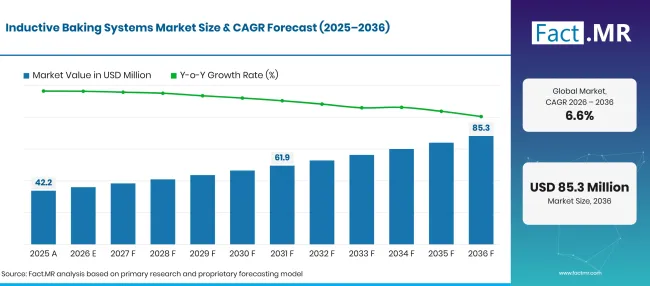
Inductive Baking Systems Forecast Global | Source: Fact.MR
Category
| Category | Segments |
|---|---|
| Inductive baking architecture | Induction plate, Induction tunnel, Hybrid induction / convection, Zoned induction, Induction mold |
| Processing scale | Pilot / lab, Small commercial, Mid-scale, High-throughput, Ultra-high-throughput |
| Operating configuration | Batch, Semi-continuous, Continuous, Modular skid, Integrated line |
| Food / process application | Bakery / wafers, Confectionery / cocoa, Snacks / seasoning, Brewing / grains, Other food / industrial |
| Region | Germany; Japan; China; United States; Italy |
Source: Fact.MR analysis. Updated Nov 25, 2026
Segmental Analysis
Why does Zoned induction lead architecture demand in the Inductive Baking Systems Market?
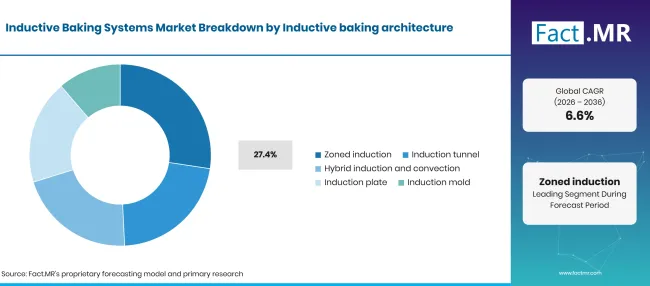
Inductive Baking Systems Breakdown Inductive Baking Architecture | Source: Fact.MR
Zoned induction accounts for 27.4% of revenue in 2026, about USD 12.3 million, as independently controlled heating zones let bakers shape temperature across a plate or tunnel for even color and texture. Hybrid induction-convection designs follow. Suppliers are offering multi-zone coils with software control.
Why does the Mid-scale segment lead scale demand in the Inductive Baking Systems Market?
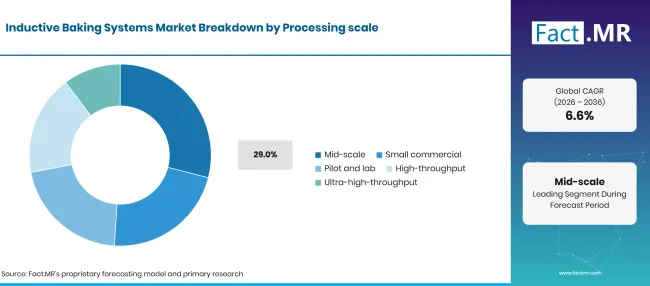
Inductive Baking Systems Breakdown Processing Scale | Source: Fact.MR
The Mid-scale segment accounts for 29.0% of revenue in 2026, about USD 13.0 million, as mid-size bakers are first to trial induction lines alongside existing gas ovens. Ultra-high-throughput plants follow. Suppliers are offering mid-capacity induction lines.
Why does Semi-continuous operation lead configuration demand in the Inductive Baking Systems Market?
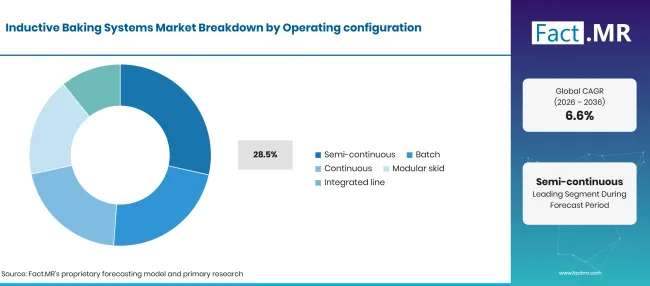
Inductive Baking Systems Breakdown Operating Configuration | Source: Fact.MR
Semi-continuous operation accounts for 28.5% of revenue in 2026, about USD 12.8 million, as induction's fast heat-up suits lines that start and stop between products. Modular skids follow. Suppliers are designing for short warm-up.
Why does Confectionery / cocoa lead application demand in the Inductive Baking Systems Market?
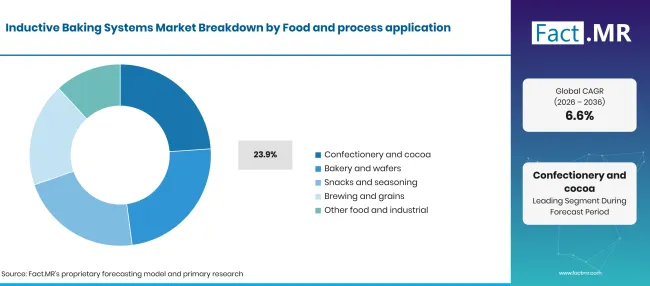
Inductive Baking Systems Breakdown Food And Process Application | Source: Fact.MR
Confectionery / cocoa accounts for 23.9% of revenue in 2026, about USD 10.8 million, as chocolate shells, filled wafers and molded confections need precise mold temperatures. Snacks and bakery follow. Suppliers are offering induction-heated molds.
Inductive Baking Systems Market-Drivers, Restraints & Trends
Drivers
Demand for inductive baking systems is rising as food companies commit to net-zero targets that require replacing gas-fired heat. Suppliers are offering induction lines powered by renewable electricity.
Restraints
Demand for inductive baking systems is limited by high electricity prices in some regions and by the cost of grid connections for large electric loads. Similar constraints are projected to slow adoption. Suppliers must show lower total energy use.
Trend
Electrified Bakery Lines Demand for all-electric bakery lines is rising. Suppliers are combining induction plates with electric tunnel ovens.
Trend
Digital Zone Control Demand for software-controlled heating zones is rising. Suppliers are adding sensors.
Inductive Baking Systems Market by Analysis by Key Country
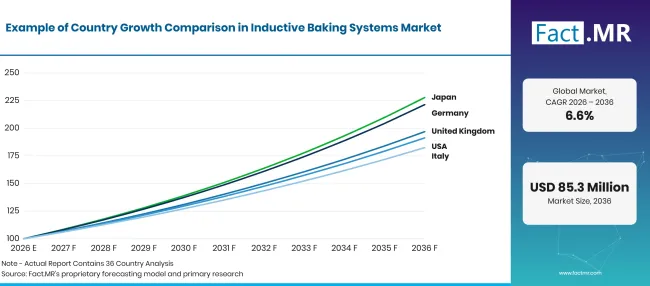
Inductive Baking Systems Growth Index | Source: Fact.MR
| Country | CAGR (2026-2036) |
|---|---|
| Germany | 9.8% |
| Japan | 9.3% |
| China | 8.2% |
| United States | 6.7% |
| Italy | 6.2% |
Source: Fact.MR analysis. Updated 16 Nov 2026
Why is Germany the fastest-growing market for inductive baking systems?
Demand in Germany is projected to grow at a 9.8% CAGR, the fastest among the five key countries, as carbon pricing on gas and industrial decarbonization funding favor electric heating.
German bakeries and equipment makers are trialing induction lines.
What is driving inductive baking system demand in Japan?
Demand in Japan is projected to grow at a 9.3% CAGR as induction heating is common in Japanese kitchens and rice cookers, and confectioners value precise control.
Panasonic and Mitsubishi Electric developed induction technology early.
What is driving inductive baking system demand in China?
Sales in China are projected to grow at a 8.2% CAGR as bakers electrify and appliance groups such as Midea produce induction heating at scale.
Domestic induction equipment makers in Guangdong expand into bakery uses.
What is shaping inductive baking system sales in the United States?
Sales in the United States are projected to grow at a 6.7% CAGR as low natural gas prices weaken the case for electrification.
Induction baking is used mainly by bakeries in states with clean-energy targets such as California.
Why is inductive baking system growth slower in Italy?
Demand in Italy is projected to grow at a 6.2% CAGR, the slowest among the five key countries, as confectionery plants have recently invested in gas lines and gas remains the main fuel for industrial baking.
Electrification is slowed by high industrial power prices.
Competitive Landscape for Inductive Baking Systems Market
Competition in the inductive baking systems market is concentrated among baking equipment specialists. Bühler, with Franz Haas and Haas-Meincke, and WALTERWERK compete on wafer and molded baking, while Baker Perkins and Reading Bakery Systems compete on bakery and snack ovens. Buyers select systems on energy use, control precision, capacity and cost.
From 2024 onward, competition shifted toward electrification. Suppliers with proven induction lines are best placed to grow.
Recent Developments
- Germany's national fuel emissions trading price continued to rise under its annual schedule.
- Baking equipment suppliers continued to develop induction heating.
- In May 2025, iba in Düsseldorf showcased electrified bakery equipment.
Key Players in Inductive Baking Systems Market
Bühler, WALTERWERK, Baker Perkins, Reading Bakery Systems, Haas-Meincke, and Franz Haas.
- Bühler
- WALTERWERK
- Baker Perkins
- Reading Bakery Systems
- Haas-Meincke
- Franz Haas
Bibliography
- Bundesministerium für Wirtschaft und Klimaschutz. 2024. Brennstoffemissionshandelsgesetz (BEHG). Berlin: BMWK.
- Bühler AG. 2025. Annual Report 2024. Uzwil: Bühler.
- Messe Düsseldorf. 2025. iba 2025. Düsseldorf: Messe Düsseldorf.
Segmentation
Scope of Report
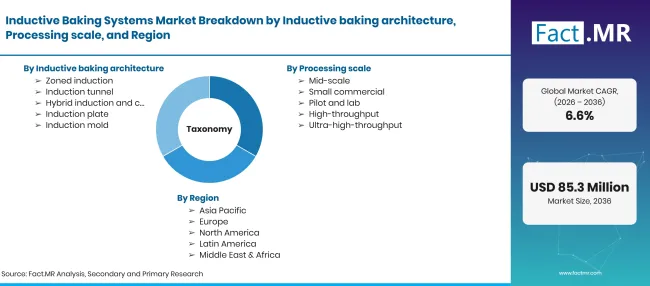
Inductive Baking Systems Taxonomy | Source: Fact.MR
| Items | Values |
|---|---|
| Quantitative Units (2026) | USD 45.0 Million |
| Inductive baking architecture | Induction plate, Induction tunnel, Hybrid induction / convection, Zoned induction, Induction mold |
| Processing scale | Pilot / lab, Small commercial, Mid-scale, High-throughput, Ultra-high-throughput |
| Operating configuration | Batch, Semi-continuous, Continuous, Modular skid, Integrated line |
| Food / process application | Bakery / wafers, Confectionery / cocoa, Snacks / seasoning, Brewing / grains, Other food / industrial |
| Regions Covered | North America, Latin America, Europe, East Asia, South Asia and Pacific, Middle East & Africa |
| Countries Covered | Germany, Japan, China, United States, Italy, and other countries |
| Key Companies Profiled | Bühler, WALTERWERK, Baker Perkins, Reading Bakery Systems, Haas-Meincke, Franz Haas |
| Additional Attributes | Dollar revenue in the Inductive Baking Systems Market is segmented by inductive baking architecture (induction plate, induction tunnel, hybrid induction / convection, zoned induction, induction mold); processing scale (pilot / lab, small commercial, mid-scale, high-throughput, ultra-high-throughput); operating configuration (batch, semi-continuous, continuous, modular skid, integrated line); food / process application (bakery / wafers, confectionery / cocoa, snacks / seasoning, brewing / grains, other food / industrial) and region. |
Source: Fact.MR analysis. Updated Nov 25, 2026
Inductive Baking Systems Market by Segments
-
Inductive baking architecture
- Induction plate
- Induction tunnel
- Hybrid induction / convection
- Zoned induction
- Induction mold
-
Processing scale
- Pilot / lab
- Small commercial
- Mid-scale
- High-throughput
- Ultra-high-throughput
-
Operating configuration
- Batch
- Semi-continuous
- Continuous
- Modular skid
- Integrated line
-
Food / process application
- Bakery / wafers
- Confectionery / cocoa
- Snacks / seasoning
- Brewing / grains
- Other food / industrial
-
Region:
- North America
- United States
- Canada
- Mexico
- Europe
- Germany
- United Kingdom
- France
- Italy
- Spain
- Rest of Europe
- Asia Pacific
- China
- India
- Japan
- South Korea
- Australia
- Rest of Asia Pacific
- Latin America
- Brazil
- Mexico
- Argentina
- Rest of Latin America
- Middle East & Africa
- GCC Countries
- South Africa
- Rest of Middle East & Africa
- North America
Table of Contents
Key Takeaways
- Market Size and CAGR
- Top Growth Driver
- Fastest Growing Segment
- Leading Region
- Key Companies
- Emerging Opportunities

