
- Market Value (2025): USD 242.0 Mn
- Estimated Value (2026): USD 256.0 Mn
- Forecast Value (2036): USD 449.9 Mn
- CAGR (2026-2036): 5.8%
Four-Roller Malt Systems Market Forecast and Outlook 2026 to 2036
As per the Fact.MR analysis, the four-roller malt systems market surpassed a value of USD 242.0 million in 2025 and is projected to grow from USD 256.0 million in 2026 to USD 449.9 million by 2036. Demand for four-roller malt systems is likely to grow at a CAGR of 5.8% over the forecast period.
Demand for four-roller malt systems is rising as mid-size breweries and distilleries want better grist than two-roller mills give without the cost of six-roller installations. A first roll pair cracks the kernel and a second pair grinds the endosperm while keeping husks largely intact, which helps lautering. For example, many regional breweries in Europe and North America run brewhouses of 20 to 100 hectoliters, the range where four-roller mills are common. Similar brewery profiles are projected to drive sales of four-roller malt systems through 2036.
Key Takeaways from the Four-Roller Malt Systems Market
- Four-Roller Malt Systems Market Value (2025): USD 242.0 million
- Four-Roller Malt Systems Market Value (2026): USD 256.0 million
- Four-Roller Malt Systems Market Forecast Value (2036): USD 449.9 million
- Four-Roller Malt Systems Market Forecast CAGR (2026-2036): 5.8%
- Leading Four-roller arrangement: Standard two-pair (32.2%)
- Key Market Participants: Bühler, Künzel Maschinenbau, Ziemann Holvrieka, RMS Roller-Grinder, Malt Handling, Sasquatch Mills
- Key Growth Regions: Germany, China, Belgium, United States, United Kingdom
Brewers are under pressure to raise extract yield as malt and energy costs remain above pre-2022 levels. Demand for four-roller malt systems is growing as better grist can add yield points and shorten lautering. Manufacturers such as Künzel, Bühler and Ziemann Holvrieka are offering adjustable-gap four-roller mills with automatic settings. Similar cost pressure is projected to drive sales of four-roller malt systems across mid-size breweries.
Four-Roller Malt Systems Market
| Metric | Value |
|---|---|
| Estimated Value in (2026) | USD 256.0 million |
| Forecast Value in (2036) | USD 449.9 million |
| Forecast CAGR (2026 to 2036) | 5.8% |
Source: Fact.MR analysis.
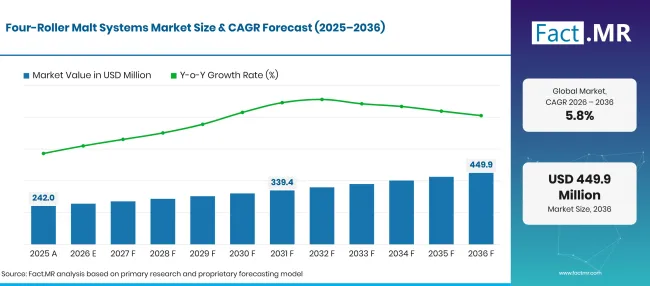
Four Roller Malt Systems Forecast Global | Source: Fact.MR
Category
| Category | Segments |
|---|---|
| Four-roller arrangement | Standard two-pair, Differential speed, Adjustable gap, Conditioned malt, Modular four-roller |
| Processing scale | Pilot / lab, Small commercial, Mid-scale, High-throughput, Ultra-high-throughput |
| Operating configuration | Batch, Semi-continuous, Continuous, Modular skid, Integrated line |
| Food / process application | Bakery / wafers, Confectionery / cocoa, Snacks / seasoning, Brewing / grains, Other food / industrial |
| Region | Germany; China; Belgium; United States; United Kingdom |
Source: Fact.MR analysis.
Segmental Analysis
What is sustaining demand for standard two-pair layouts in the Four-Roller Malt Systems Market?
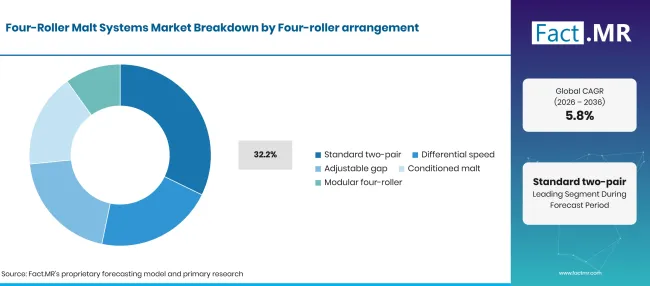
Four Roller Malt Systems Breakdown Four Roller Arrangement | Source: Fact.MR
Demand for standard two-pair layouts account for 32.2% of market revenue in 2026, about USD 82.4 million, as breweries seek dependable grist preparation without the complexity of more advanced milling configurations. Eurostat reported on August 31, 2026, that EU breweries produced 34.4 billion litres of beer in 2025, with Germany contributing 7.4 billion litres. This substantial brewing base supports continued requirements for reliable malt preparation equipment. Standard four-roller arrangements offer breweries two-stage grinding and separation, helping achieve consistent grist specifications. Equipment suppliers can strengthen sales through motorized gap adjustment and simplified maintenance options.
Which production-scale requirements are increasing sales of small commercial four-roller malt systems?
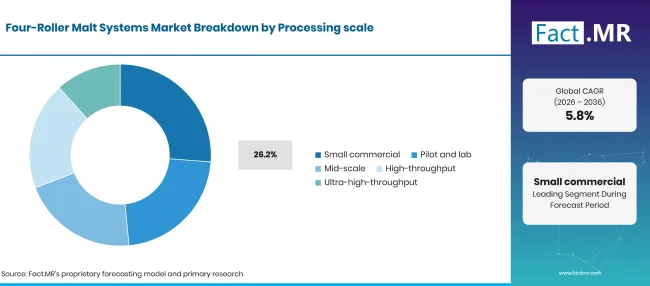
Four Roller Malt Systems Breakdown Processing Scale | Source: Fact.MR
Sales of small commercial systems represent 26.2% of market revenue in 2026, about USD 67.1 million, as regional breweries and specialist distilleries seek milling capacities suited to smaller production batches. The UK HMRC reported in August 2026 that approximately 1,900 beer producers submitted Alcohol Duty returns during 2025–26, with 97% receiving Small Producer Relief. This demonstrates the significant presence of smaller brewing businesses within the UK market. Their investment requirements favor compact four-roller mills that offer controlled grain preparation without the footprint and capital expenditure associated with industrial-scale installations.
How are preassembled configurations influencing modular skid unit demand?
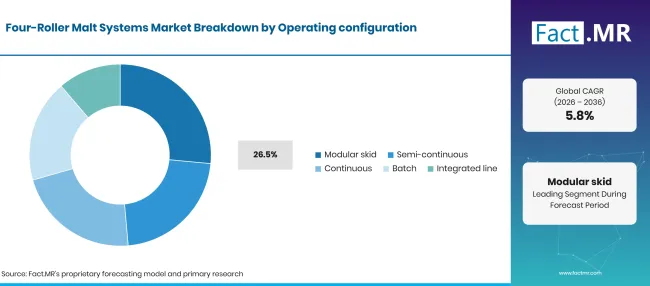
Four Roller Malt Systems Breakdown Operating Configuration | Source: Fact.MR
Demand for Modular skid units to capture 26.5% of market revenue in 2026, about USD 67.8 million, as breweries and grain processors seek packaged milling systems that reduce installation complexity. Eurostat's August 2026 production report recorded 34.4 billion litres of EU beer output in 2025, confirming the scale of the region's brewing infrastructure. Meanwhile, the USDA's November 10, 2026 World Agricultural Supply and Demand Estimates provide updated grain supply projections for 2026–27, supporting ongoing requirements for grain-processing equipment. Modular configurations combining four-roller mills, hoppers, conveyors and dust extraction can simplify equipment integration and commissioning.
What is strengthening confectionery and cocoa applications for four-roller systems?
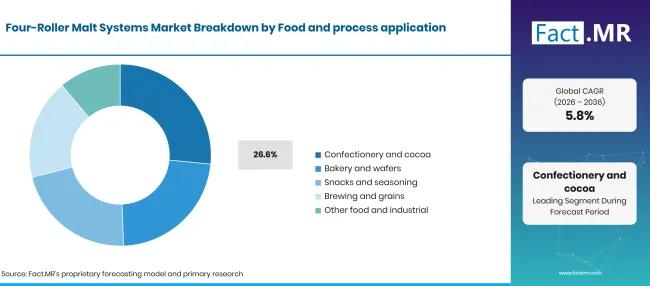
Four Roller Malt Systems Breakdown Food And Process Application | Source: Fact.MR
Confectionery and cocoa applications account for 26.6% of market revenue in 2026, about USD 68.1 million, as food processors use roller-based equipment for controlled size reduction of cocoa and other ingredients. The International Cocoa Organization's August 2026 quarterly bulletin estimated 2024–25 global cocoa grindings at 4.649 million tonnes, down 3.3% year over year. Although the bulletin withheld 2025–26 production and grindings estimates, the reported processing volume demonstrates the scale of global cocoa manufacturing. Four-roller configurations can support preliminary size reduction before refining, creating opportunities for machinery suppliers serving confectionery ingredient processors.
Four-Roller Malt Systems Market-Drivers, Restraints & Trends
Drivers: Demand for higher milling efficiency and improved malt yield
Demand for four-roller malt systems is increasing as breweries seek consistent grist distribution, improved extract recovery and better lautering performance. Eurostat reported on August 31, 2026, that the European Union produced 34.4 billion litres of beer in 2025, with Germany accounting for 7.4 billion litres and Poland contributing 3.5 billion litres. Germany represented 21.6% of EU beer production. This substantial brewing base supports replacement and modernization opportunities for malt milling equipment. Four-roller configurations offer breweries greater control over husk preservation and endosperm reduction, particularly when processing varied malt bills
Restraints: Lower beer production and brewery investment pressures
Sales of four-roller malt systems face constraints as beer production declines in several established markets, reducing incentives for breweries to expand milling capacity. Eurostat reported that EU beer production declined 0.7% in 2025, compared with 2024, reaching 34.4 billion litres. The U.S. Alcohol and Tobacco Tax and Trade Bureau updated its national beer production datasets and brewer counts by production size in July and June 2026, respectively, providing official indicators for monitoring brewery activity. These developments highlight the importance of replacement demand, distillery applications and food-processing customers in reducing dependence on new brewery installations.
Opportunity: Motorized gap adjustment
Demand for four-roller malt systems with motorized gap adjustment is creating opportunities for equipment suppliers as breweries seek faster recipe changes and repeatable grist specifications. The UK's Office for National Statistics reported that manufacturing output increased 0.9% in the third quarter of 2026 compared with the previous quarter. This indicates continued manufacturing activity and provides a supportive industrial investment backdrop for automated processing equipment. Motorized actuators, position sensors and programmable controls allow operators to adjust roller gaps without manual intervention. These features can improve operating consistency and reduce changeover requirements across breweries handling different malt varieties.
Trend: Grist analysis feedback and sensor-based milling
Grist analysis feedback is emerging as an important technology direction as breweries seek to connect particle-size measurements with automatic mill adjustments. India's RBI October 2026 Monetary Policy Report recorded 7.8% real GDP growth in Q1 FY 2026–27, supported by strong domestic demand and manufacturing activity. Separately, the Ministry of Agriculture's 2025–26 third advance estimates placed coarse cereal production at 744.7 lakh tonnes, representing 16.5% growth over the final 2024–25 estimate. These figures support the broader grain-processing opportunity. Manufacturer scan develop sensor-connected mills that use grist measurements to optimize roller gaps and maintain consistent milling quality.
Four-Roller Malt Systems Market by Analysis by Key Country
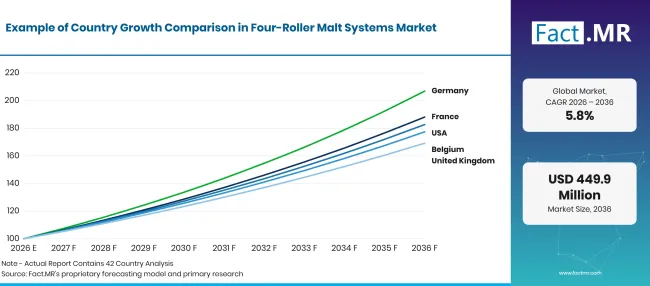
Four Roller Malt Systems Growth Index | Source: Fact.MR
| Country | CAGR (2026-2036) |
|---|---|
| Germany | 7.6% |
| China | 7.4% |
| Belgium | 5.9% |
| United States | 5.9% |
| United Kingdom | 5.4% |
Source: Fact.MR analysis.
Why is Germany the fastest-growing market for four-roller malt systems?
Demand in Germany is estimated to grow at a 7.6% CAGR, the fastest among the five key countries, as hundreds of regional breweries modernize brewhouses to save malt and energy.
Künzel and Ziemann Holvrieka are German manufacturers. Destatis reported in August 2026 that Germany had 1,415 operating breweries in 2025, a decline of 3.6% from the previous year. Beer sales also decreased 6.0% to approximately 7.8 billion litres. These pressures encourage established breweries to improve extraction efficiency and reduce raw-material losses rather than expand capacity. Künzel and Ziemann Holvrieka are relevant domestic equipment manufacturers offering opportunities for modernization-related sales.
What is driving four-roller malt system demand in China?
Sales in China are projected to increase at a 7.4% CAGR as craft and premium beer producers build mid-size brewhouses as taprooms spread in large cities.
Four-roller mills suit brewhouses that want higher yield without wet milling. The National Bureau of Statistics reported in June 2026 that value added in the manufacture of liquor, beverages and refined tea increased 1.5% year over year during January–May 2026. This mixed performance indicates that beverage manufacturers face pressure to improve productivity rather than rely entirely on volume expansion. Four-roller systems can help breweries achieve controlled grist preparation and consistent extraction across production batches, supporting equipment modernization among larger brewing groups.
What is shaping four-roller malt system demand in Belgium?
Demand in Belgium is anticipated to record a 5.9% CAGR as specialty breweries such as Duvel Moortgat and Westmalle invest in brewhouse upgrades.
Belgium established breweries invest in production consistency and brewhouse upgrades. Eurostat reported on August 7, 2026, that Belgium exported approximately 1.5 billion litres of beer in 2025, making it the EU's largest beer exporter. This strong export position creates opportunities for equipment upgrades that help breweries maintain consistent grist specifications and product quality across batches. Producers such as Duvel Moortgat and Westmalle represent potential customers for advanced milling equipment. Four-roller configurations can support controlled grain preparation in established brewing facilities.
What is shaping four-roller malt system sales in the United States?
Sales in the United States are projected to capture a 5.9% CAGR as regional craft brewers and distilleries upgrade mills even as the number of craft breweries declines.
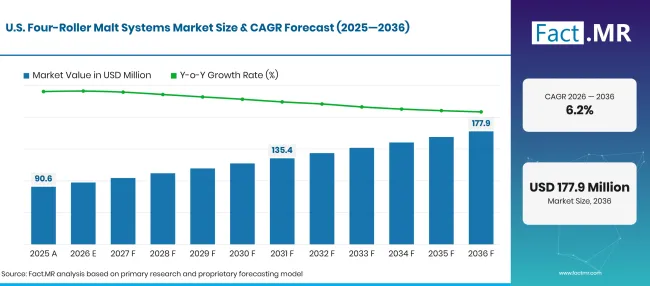
Four Roller Malt Systems Forecast Usa | Source: Fact.MR
Bourbon and rye distillers in Kentucky and Tennessee also use roller mills. The Alcohol and Tobacco Tax and Trade Bureau updated its national beer statistics on July 31, 2026, including annual beer data and monthly taxable-removal reports. Its brewery production-size dataset was also updated on June 3, 2026. These government reporting resources allow equipment suppliers to assess changes in brewery operating scales and production activity. Established maltsters and distillers can create replacement demand for four-roller mills offering consistent grain sizing and controlled processing.
Why is four-roller malt system growth slower in the United Kingdom?
The United Kingdom is projected to record the slowest growth in four-roller malt system demand, at a 5.4% CAGR through 2036, as brewery financial pressures constrain investment in new equipment.
HMRC reported in August 2026 that UK beer-related Alcohol Duty receipts declined 5% year over year to £876 million during April–June 2026. This reduction reflects weaker taxable beer activity and reinforces the cautious investment environment facing breweries. Smaller producers may prioritize essential maintenance and replacement purchases over complete brewhouse upgrades. Manufacturers offering compact four-roller mills with lower operating requirements and straightforward installation can therefore target selective modernization demand.
Competitive Landscape for Four-Roller Malt Systems Market
Competition in the four-roller malt systems market is divided between brewhouse engineering groups and craft mill specialists. Bühler, Künzel Maschinenbau and Ziemann Holvrieka compete on industrial mills, while RMS Roller-Grinder and Sasquatch Mills compete on craft-scale mills. Buyers select mills on grist quality, yield, automation and price.
From 2024 onward, competition shifted toward yield improvement and automation. Manufacturers with motorized gap control are best placed to grow.
Recent Developments
- In 2025, the Brewers Association reported more craft brewery closures than openings.
- On November 10, 2026, Bühler introduced the Maltomat IV at BrauBeviale in Nuremberg. The new grist mill is available in four-roller and six-roller configurations, with barley malt processing capacity of 4–16 tonnes per hour. Its upgrades include a 15-inch touchscreen, live grinding-gap adjustment, calibration guidance and continuous monitoring of roller speed, bearing temperature and product feed. Bühler also highlights dust-explosion protection and automated process control. This is the clearest 2026 product-launch development among the five companies for the four-roller malt systems market.
- In September 2025, Ziemann Holvrieka's official drinktec 2025 announcement identified Künzel Maschinenbau among the group companies presenting at the event. Künzel's focus was associated with raw-material handling, while the wider group showcased brewery and beverage process technologies.
Key Players in Four-Roller Malt Systems Market
Key companies operating in the market include Bühler, Künzel Maschinenbau, Ziemann Holvrieka, RMS Roller-Grinder, and Sasquatch Mills.
- Bühler
- Künzel Maschinenbau
- Ziemann Holvrieka
- RMS Roller-Grinder
- Sasquatch Mills
Bibliography
- Brewers Association. (2025, April 15). Brewers Association reports 2024 U.S. craft brewing industry figures
- Bühler. (2026, November 10). Bühler introduces the Maltomat IV at BrauBeviale in Nuremberg.
- HM Revenue & Customs. (2026, August 28). Alcohol bulletin: May 2026 to July 2026.
- HM Revenue & Customs, & HM Treasury. (2026, October 28). Alcohol duty reforms evaluation report.
- National Bureau of Statistics of China. (2026, June 17). Industrial production operation in May 2026.
- Office for National Statistics. (2026, November 12). Index of production, UK: September 2026.
- Reserve Bank of India. (2026, October 23). Monetary policy report – October 2026.
- Statistisches Bundesamt. (2026, August 4). Zahl der Brauereien auf 1 415 im Jahr 2025 gesunken – 137 weniger als im Rekordjahr 2019 [Number of breweries falls to 1,415 in 2025—137 fewer than in the record year 2019].
- U.S. Department of Agriculture, World Agricultural Outlook Board. (2026, November 10). World agricultural supply and demand estimates (WASDE-677).
- U.S. Department of the Treasury, Alcohol and Tobacco Tax and Trade Bureau. (2026, August 31). Beer reports.
- Ziemann Holvrieka. (2025). Turnkey plants and process technology for the beer and beverage market.
- Eurostat. (2026, August 7). Extra-EU exports of beer down 11% in 2025.
- Eurostat. (2026, August 31). EU produced 34.4 billion litres of beer in 2025.
Segmentation
Scope of Report
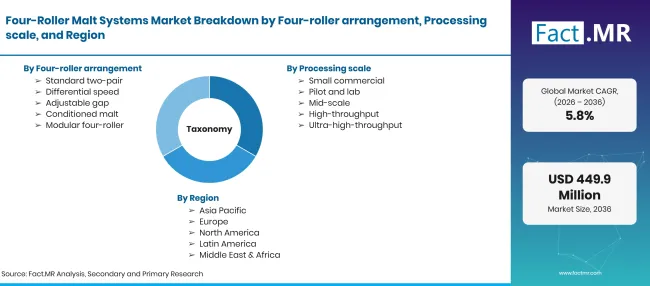
Four Roller Malt Systems Taxonomy | Source: Fact.MR
| Items | Values |
|---|---|
| Quantitative Units (2026) | USD 256.0 Million |
| Four-roller arrangement | Standard two-pair, Differential speed, Adjustable gap, Conditioned malt, Modular four-roller |
| Processing scale | Pilot / lab, Small commercial, Mid-scale, High-throughput, Ultra-high-throughput |
| Operating configuration | Batch, Semi-continuous, Continuous, Modular skid, Integrated line |
| Food / process application | Bakery / wafers, Confectionery / cocoa, Snacks / seasoning, Brewing / grains, Other food / industrial |
| Regions Covered | North America, Latin America, Europe, East Asia, South Asia and Pacific, Middle East & Africa |
| Countries Covered | Germany, China, Belgium, United States, United Kingdom, and other countries |
| Key Companies Profiled | Bühler, Künzel Maschinenbau, Ziemann Holvrieka, RMS Roller-Grinder, Malt Handling, Sasquatch Mills |
| Additional Attributes | Dollar revenue in the Four-Roller Malt Systems Market is segmented by four-roller arrangement (standard two-pair, differential speed, adjustable gap, conditioned malt, modular four-roller); processing scale (pilot / lab, small commercial, mid-scale, high-throughput, ultra-high-throughput); operating configuration (batch, semi-continuous, continuous, modular skid, integrated line); food / process application (bakery / wafers, confectionery / cocoa, snacks / seasoning, brewing / grains, other food / industrial) and region. |
Source: Fact.MR analysis.
Four-Roller Malt Systems Market by Segments
-
Four-roller arrangement
- Standard two-pair
- Differential speed
- Adjustable gap
- Conditioned malt
- Modular four-roller
-
Processing scale
- Pilot / lab
- Small commercial
- Mid-scale
- High-throughput
- Ultra-high-throughput
-
Operating configuration
- Batch
- Semi-continuous
- Continuous
- Modular skid
- Integrated line
-
Food / process application
- Bakery / wafers
- Confectionery / cocoa
- Snacks / seasoning
- Brewing / grains
- Other food / industrial
-
Region:
- North America
- United States
- Canada
- Mexico
- Europe
- Germany
- United Kingdom
- France
- Italy
- Spain
- Rest of Europe
- Asia Pacific
- China
- India
- Japan
- South Korea
- Australia
- Rest of Asia Pacific
- Latin America
- Brazil
- Mexico
- Argentina
- Rest of Latin America
- Middle East & Africa
- GCC Countries
- South Africa
- Rest of Middle East & Africa
- North America
Table of Contents
Key Takeaways
- Market Size and CAGR
- Top Growth Driver
- Fastest Growing Segment
- Leading Region
- Key Companies
- Emerging Opportunities

