- Forecast Value (2035): 3431.1 Mn
- CAGR (2035): 9.2%
Collagen Drinks Market Outlook 2025 to 2035
The global collagen drinks market is expected to reach USD 3,431.1 million by 2035, up from USD 1,545.8 million in 2025. During the forecast period (2025 – 2035), the industry is projected to expand at a CAGR of 8.3%.
The demands of collagen drinks have increased significantly all over the world, propelled by the awareness of benefits of wellness and nutrition. The category which previously was restricted to positioning as beauty-from-within is now considered as a mainstream functional beverage category.
Consumers are now becoming more and more linked with collagen supplementation to overall vitality, and this is what is driving its uptake in retail, eCommerce, and in healthcare-related distribution channels.
The effectiveness of collagen peptides in skin, joint, and bone health has been proven as the driving force of the industry. The increasing consciousness in developed economies and the faster adoption in Asia has laid a strong foundational base in the future growth.
Quick Stats for Collagen Drinks Market
- Industry Value (2025): USD 1,545.8 Million
- Projected Value (2035): USD 3,431.1 Million
- Forecast CAGR (2025 to 2035): 8.3%
- Leading Segment (2025): Marine/Fish (38.9% Market Share)
- Fastest Growing Country (2025-2035): United States (9.8% CAGR)
- Top Key Players: Shiseido Company Limited., Nestlé S.A., Kino Biotech Co. Ltd., Swisse, Vitabiotics, Heivy, By-Health, and Amway
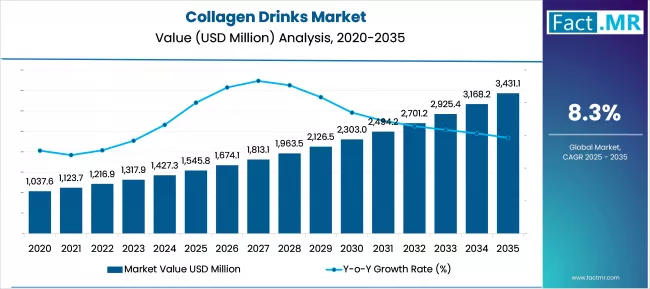
Collagen Drinks Market Market Value Analysis | Source: Fact.MR
The tendency toward clean-label beverages and natural bioactive by the consumer is also increasing the market momentum. there has also been the rise of premium-priced RTD drinks and shot formats with convenience and a specific benefit. World players are expanding portfolios to satisfy various populations, including millennials who are more interested in preventive care and retirees who prioritize mobility, meaning they will remain in demand.
The future prospects are stable growth due to introduction of products and strategic collaboration that will consolidate the markets. Even though pricing pressure and regulatory limitations on health-related claims are still a challenge, scientific confirmation and the growing access strengthens the strength of the sector. The collagen beverages are projected to continue being one of the most vibrant segments in the functional beverages category with a strong growth of double-digits until 2035.
What are the drivers of the collagen drinks market?
The market of the collagen drinks is being driven by the increased consumer interest in functional wellness with a particular focus in the United States, China, Japan, Germany, and the United Kingdom where the beauty-from-within positioning and preventive health solutions are acquiring high momentum. The strong nutraceutical R&D ecosystems and consumer sophisticated retail infrastructure in these markets enhance commercialization of new formulations and prompts quick adoption of the same in the mainstream and high-end consumer market segments.
Region such as North America, Europe and Asia Pacific emphasizing on the certified, and clean-label ingredients. This change has increased confidence of the consumers to the existing brands which portray compliance and have invested in ensuring sustainability-focused sourcing, particularly marine-based collagen associated with greater bioavailability and environmentally-friendly histories.
The continuous expansion of e-commerce platforms and young generations are embracing collagen drinks for preventive care, while older populations seek solutions for mobility and skin health, together creating a broad demand base for the product.
What are the regional trends of the collagen drinks market?
Asia pacific has continued to dominate the collagen drinks business due to high level of awareness among consumers to beauty-from-within product, governmental encouragement of functional food development and increasing disposable incomes.
China is heading to mass adoption through national health campaigns and high growth of local brands of nutraceuticals most of which incorporate marine collagen as a fortified nutrient beverage. It enjoys favourable regulatory and consumer confidence regarding clinical validation and this aspect allows Japan to easily commercialise new developmental forms of peptides. Innovation in South Korea with K-beauty trends and export-oriented nutraceutical positions, and the upward trends in India and the ASEAN market due to the growing middle-class market, e-commerce penetration, and focus on preventive health products are all positive.
In Europe, sustainable growth of collagen drinks is being observed in line with the EU requirements on clean-label claims, organic certification, and sustainable sourcing. Germany and France are the leaders of the market with high-end beauty-from-within products that are frequently associated with dermatology-supported certification. The new online subscription schemes and pharmacies are experiencing a high consumer adoption in the U.K., Italy, and Nordic nations. Consumer confidence in certified and transparent labeling is making the demand to marine collagen more focused, more so as to concentrate on the environmentally friendly storyline and increased absorption efficacy is positively enforced by regulations.
North America is growing fast and is embraced by both the United States and Canada with intense venture-backed nutraceutical startups, subscriptions, and the extensive e-commerce platforms. Canada is reinforcing its market where there is growing demand towards sustainable sourcing and clean-label certification, developing a sense of trust towards high-quality and clinical-grade products.
Latin America is improving continuously with Brazil and Mexico as the leading forces due to the increasing beauty and wellness consciousness and the emergence of retail pharmacy chains. Middle East & Africa are the less developed but increasingly gaining markets, as evidenced by the growing urbanization, access to online retailing, and the growing consumer preference to the high-end wellness drinks.
What are the challenges and restraining factors of the collagen drinks market?
The production technologies involved in the formulation of bioavailable and stable collagen drinks are also a major challenge to the manufacturing companies. High infrastructure, R&D skills, and high-cost production are needed to carry out hydrolysis, peptide stabilization as well as flavor masking. This has led to the inability to achieve economies of scale due to the large-scale production networks. The collagen drinks are sold at a very high price compared to the traditional functional drinks, which limits its usage in the cost-sensitive market and slows its penetration into other markets despite the rising demand across the globe.
The regulatory approval procedures also contribute to the complexities, with collagen drinks being subject to the resource-intensive health claims, ingredient safety, and efficacy substantiation validation procedures. The U.S., EU, Japan, and China have strict frameworks of nutraceutical beverages, which protect consumers but significantly increase commercialization processes and increase the cost of research and development.
The lack of trust in the effectiveness of collagen drinks among the consumers remains as a negative force. Although there is clinical evidence, most buyers have doubt about the apparent impact especially when the effects differ among age groups or living conditions. The availability of grey-market imports and unauthorized collagen products makes this perception issue even more pronounced, and it undermines trust and generates confusion in the retailing setting.
Other challenges are fluctuation on supply of raw materials especially marine collagen and increasing issues on sustainability and animal products. Firms that cannot meet the environmental demands or invest in collagen enhancers that are not plant-based will be considered irrelevant. All these forces combined highlight the challenge of balancing affordability, compliance, sustainability and consumer education which could slow wider adoption of the market in the short term.
Country-Wise Insights
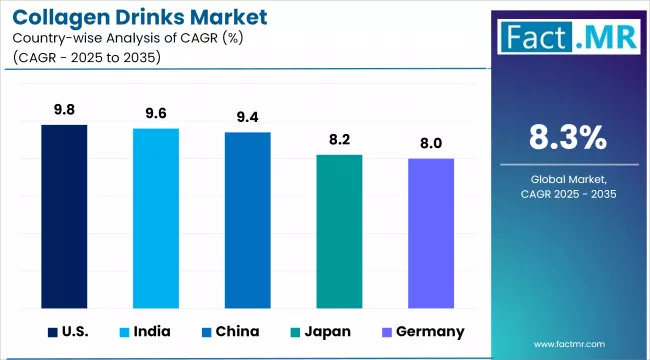
Collagen Drinks Market Cagr Analysis By Country | Source: Fact.MR
Rising beauty-from-within demand and clinical validation drive growth in China
The growing demand of using collagen drinks as a beauty-from-within product is driving the consumption of these products in China as young consumers who care more about their skin are looking to replace topical cosmetics with a different product. Protein beverages are also being promoted as product of daily lives due to urbanization and increased disposable income, which is attracting people to invest in holistic well-being.
Clinical validation has proved to be strong forces of consumer trust. The Chinese nutraceutical manufacturers and multinationals are concerned about the peptides with known absorption rates and blending collagen with co-actives, such as vitamin C, hyaluronic acid and antioxidants. Such a trend does not only enhance credibility but also compares with government insistence on more stringent labeling and substantiation of functional claims.
E-commerce is the most significant growth-driven channel, helped by the livestreaming, influencer marketing, and purchasing by subscription. Domestic brands have good digital infrastructure, and foreign entrants capture good spots with an image of sustainable sourcing and the story of marine collagen. With the continued growth of awareness, it is estimated that China will still be the biggest market of collagen drinks in Asia Pacific with the demand being aided by the innovation, compliance and the growing consumer demographics.
Strong wellness culture and premium functional beverages boost collagen drinks in the U.S.
The market of U.S. collagen drinks is growing at an accelerated pace as a subset of a broader wellness culture, in which consumers are actively introducing functional drinks into their daily diets. The increased preventive health attitude is favourable to the collagen drinks, and the use is in the beauty, joint health, sports recovery, and gut support segments. Health influencers and clinical endorsements support the adoption of Millennials and Gen Z.
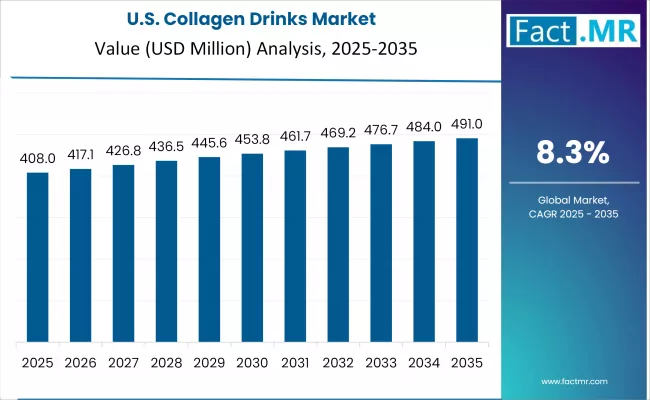
Collagen Drinks Market Country Value Analysis | Source: Fact.MR
Distribution is dominated by E-commerce and retail pharmacy channels where D2C platforms are increasing the speed of product access. Regular control of efficacy and claims generates consumer confidence whilst augmenting partnerships of nutraceutical companies with healthcare professionals enhances adoption. As the trend of sustainability and personalization continues to gather momentum, the U.S. collagen drinks market is set to maintain a strong growth trend, which will be founded on the principles of convenience, innovation, and wellness focused on consumers.
Category-Wise Analysis
Marine collagen dominates as consumers seek sustainable and bioavailable sources
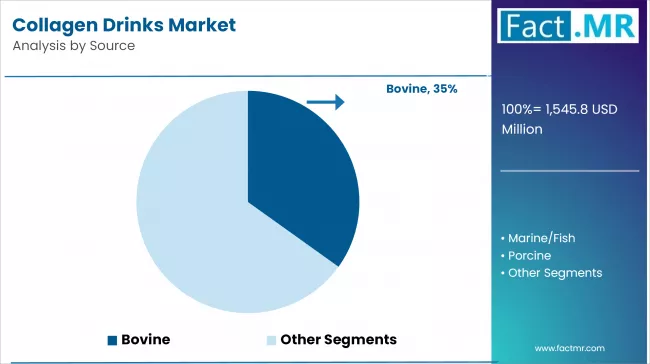
Collagen Drinks Market Analysis By Source | Source: Fact.MR
The marine/fish collagen segment is registering the most growth in the global collagen drinks sector since consumers are slowly associating it with increased absorption rates, sustainability, and upper-end segmentation. Increasing awareness of responsible sourcing tools, such as the use of fish skin and scales as by-products, are an added strength in such markets as China, Japan or Europe.
The scientific reports of the high bioavailability of marine peptide have boosted consumer confidence and manufacturers are actively considering using this source in the launch of functional beverages. Co-actives with marine collagen formulations include vitamin C and hyaluronic acid and are increasingly being used by many leading brands in their dominance as they have demonstrated visible effects in skin elasticity, skin hydration and joint mobility.
Type I collagen drives growth with proven efficacy in skin health
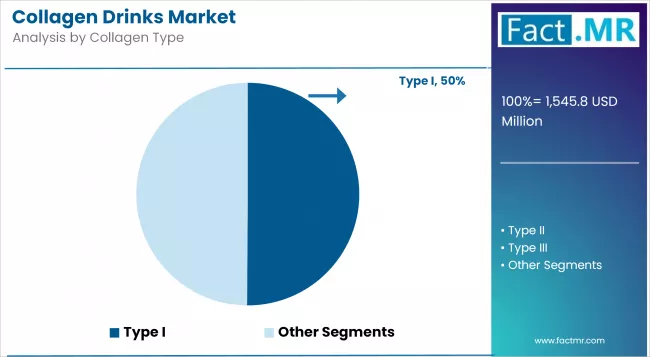
Collagen Drinks Market Analysis By Collagen Type | Source: Fact.MR
The most dominant portion is Type I collagen which has the biggest portion of collagen beverages given its ability to enhance firmness, elasticity, and hydration of the skin. It is common in beauty-from-within formulations, which provides it with a high level of appeal to the aging population and younger consumers who want to prevent aging.
The advances in the formulation have enabled manufacturers to add hydrolyzed Type I collagen peptides of higher absorption levels to ready-to-drink bottles and shots. The further incorporation of this segment with functional additives like antioxidants and probiotics in the segment also increases perceived efficacy, which propels higher adoption in North America, Europe, and Asia Pacific.
Type I collagen also has clinical support and regulatory acknowledgment as well as has the advantage of being greatly available in both marine and bovine sources. Type I collagen beverages will have a wide target market as more and more consumers gain confidence in the product. As the Type I collagen has high correlation to beauty, wellness, and preventive health trends, the company is projected to base the growth of the collagen drinks market up to 2035.
Competitive Analysis
Key players in the collagen drinks market are Shiseido Company Limited, Meiji Holdings Co. Ltd., Nestlé S.A., Kino Biotech Co. Ltd., Kirin Holdings Co. Ltd., AmorePacific Corporation, Bottles Science Ltd., Swisse, Vitabiotics, Neocell, Heivy, By-Health, Revive, Pola, and Amway.
The market of collagen drinks faces stiff competition between different companies, and the focus of rivalries is on formulation development, source of ingredients, functional blends and delivery form. Long-term differentiation and performance benefits are being sustained as a consequence of using superior hydrolysis, flavor masking, and stability systems that facilitate higher absorption rates.
The established competitors are gaining an advantage in retail pharmacy chains, e-commerce market places, and collaborations with healthcare providers, and alliances are increasingly opting toward companies with proprietary peptide technologies and synergistic collagen mixtures patents. The integration of collagen with functional co-actives like hyaluronic acid, vitamin C, probiotics, and adaptogens is a substantial point of differentiation that offers an ecosystem of value-added functionality that is not limited to beauty, but also to joint health, sports recovery and preventive health.
Strategic alliances between nutraceutical firms, clinical research institutions, and sustainable sources of raw materials are changing the definition of competitive positioning. This change highlights how the sector has evolved to be a very dynamic and innovative functional beverage market.
Recent Development
- In 2025, Shiseido further developed The Collagen brand with three ingestible products, a ready-to-drink Drink, Tablets, and a Powder that can be dissolved in drinks or food.
Fact.MR has provided detailed information about the price points of key manufacturers of Collagen Drinks Market positioned across regions, sales growth, production capacity, and speculative technological expansion, in the recently published report.
Methodology and Industry Tracking Approach
The 2025 collagen drinks market report by Fact.MR is based on insights collected from 1,200 stakeholders across 12 countries, with a minimum of 75 respondents per country. Among the participants, 65% were end users including biopolymer converters, specialty chemical formulators, and FMCG sustainability teams while the remaining 35% included sourcing managers, R&D directors, environmental compliance leads, and bioeconomy consultants.
Data collection was conducted between September 2024 and August 2025, focusing on parameters such as monomer purity, conversion yield, cost per ton, end-use compatibility, feedstock availability, and regulatory alignment. A regionally weighted calibration model ensured balanced representation across North America, Europe, and Asia-Pacific.
The study triangulated over 95 validated sources, including patent databases, sustainability disclosures, process modeling datasets, and annual reports from monomer and biopolymer producers.
Fact.MR applied rigorous analytical tools such as multi-variable regression and scenario modeling to ensure data robustness. With continuous monitoring of the glass adhesives space since 2018, this report offers a comprehensive roadmap for firms seeking competitive advantage, innovation, and sustainable growth within the sector.
Segmentation
Segmentation of Collagen Drinks Market
-
By Source :
- Bovine
- Marine/Fish
- Porcine
- Poultry
- Multi-source Blends
- Vegan-positioned Boosters
-
By Collagen Type :
- By Collagen Type
- Type I
- Type II
- Type III
-
By Beverage Format :
- Ready-to-Drink Bottles
- Concentrates/Syrups
- Functional Waters
- Dairy/Alt-Dairy Bases
- Coffee/Tea Beverages
- Juice/Nectar Blends
-
By Flavor :
- Citrus
- Berry
- Tropical
- Orchard
- Dessert/Indulgent
- Coffee/Tea Variants
- Botanical/Herbal
- Unflavored
-
By Packaging :
- PET Bottles
- Glass Bottles
- Aluminum Cans
- Tetra Cartons
- Shot Vials/Ampoules
-
By Consumer Demographics :
- Women
- Men
-
By Distribution Channel :
- Online
- E-commerce Platform
- Company Website
- Offline
- Supermarkets
- Pharmacies
- Specialty Stores
- Convenience
- Online
-
By Region :
- North America
- Latin America
- Western Europe
- Eastern Europe
- East Asia
- South Asia & Pacific
- Middle East & Africa
Frequently Asked Questions
What will be the Global Collagen Drinks Market Size Reported by Fact.MR for 2025?
Who are the Major Players Operating in the Collagen Drinks Market?
What is the Estimated Valuation of the Collagen Drinks Market in 2035?
What Value CAGR did the Collagen Drinks Market Exhibit Over the Last Five Years?
Who worked on this report


Preview the report firsthand - request a free sample
Free SampleGet the brochure for pricing and purchase details
Download PDF