- Base Value(2025): 1.9 Bn
- Estimated Value(2025): 1.9 Bn
- Forecast Value (2035): 3.0 Bn
- CAGR (2025 - 2035): 4.8%
Bovine Collagen Market Forecast and Outlook 2025 to 2035
The bovine collagen market stands at the threshold of a decade-long expansion trajectory that promises to reshape protein applications and nutritional solutions across food, nutraceutical, and cosmetic sectors. The market's journey from USD 1,850.0 million in 2025 to USD 2,950.0 million by 2035 represents robust growth, the market will rise at a CAGR of 4.8% which demonstrating the steady adoption of collagen technology and protein optimization across nutritional systems, health applications, and cosmetic formulations worldwide.
Quick Stats for Bovine Collagen Market
- Bovine Collagen Market Value (2025): USD 1,850.0 million
- Bovine Collagen Market Forecast Value (2035): USD 2,950.0 million
- Bovine Collagen Market Forecast CAGR: 4.8%
- Leading Type in Bovine Collagen Market: Gelatin Segment
- Key Growth Regions in Bovine Collagen Market: South Asia Pacific, East Asia, and North America
- Top Players in Bovine Collagen Market: Gelita, Nitta Gelatin, Rousselot, Weishardt, Collagen Matrix
- Where revenue comes from - now vs next (industry-level view)
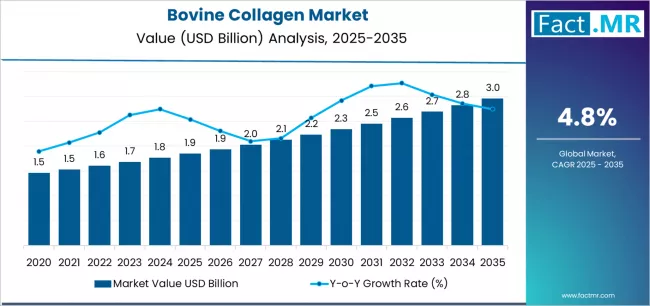
Bovine Collagen Market Market Value Analysis | Source: Fact.MR
The first half of the decade (2025-2030) will witness the market climbing from USD 1,850.0 million to approximately USD 2,332.0 million, adding USD 482.0 million in value, which constitutes 44% of the total forecast growth period. This phase will be characterized by the continued adoption of food and nutraceutical applications, driven by increasing health demands and the growing need for reliable protein solutions in nutritional and wellness applications globally. Enhanced processing capabilities and automated supply chain systems will become standard expectations rather than premium options.
The latter half (2030-2035) will witness continued growth from USD 2,332.0 million to USD 2,950.0 million, representing an addition of USD 618.0 million or 56% of the decade's expansion. This period will be defined by mass market penetration of cosmetic collagen applications, integration with comprehensive health management platforms, and seamless compatibility with existing food infrastructure. The market trajectory signals fundamental shifts in how health consumers approach protein selection and nutritional operations, with participants positioned to benefit from growing demand across multiple application segments and distribution channels.
| Period | Primary Revenue Buckets | Share | Notes |
|---|---|---|---|
| Today | Food applications | 45% | Volume-driven, protein focus |
| Nutraceutical products | 35% | Health and wellness | |
| Cosmetic formulations | 20% | Beauty and skincare | |
| Gelatin type | 55% | Primary product form | |
| Hydrolyzed type | 35% | Enhanced bioavailability | |
| Future (3-5 yrs) | Advanced food systems | 42-48% | Functional enhancement, nutrition gains |
| Expanded nutraceutical solutions | 33-38% | Health optimization, application expansion | |
| Enhanced cosmetic formulations | 18-23% | Beauty innovation, anti-aging growth | |
| Integrated gelatin processing | 50-57% | Production optimization, quality enhancement | |
| Advanced hydrolyzed systems | 33-40% | Bioavailability improvement, absorption enhancement | |
| Specialized native products | 8-12% | Premium applications, specific functionality |
Source: Fact.MR analysis. Updated Nov 4, 2025
Bovine Collagen Market Key Takeaways
At-a-Glance Metrics
| Metric | Value |
|---|---|
| Market Value (2025) → | USD 1,850.0 million |
| Market Forecast (2035) ↑ | USD 2,950.0 million |
| Growth Rate ★ | 4.8% CAGR |
| Leading Type → | Gelatin Segment |
| Primary Form → | Powder Channel |
Source: Fact.MR analysis. Updated Nov 4, 2025
The market demonstrates strong fundamentals with food and nutraceutical applications capturing a dominant share through reliable protein capabilities and nutritional optimization. Food and nutraceutical applications drive primary demand, supported by increasing health requirements and operational efficiency development. Geographic expansion remains concentrated in developed markets with established processing infrastructure, while emerging economies show accelerating adoption rates driven by health modernization initiatives and rising protein accessibility standards.
Imperatives for Stakeholders in Bovine Collagen Market
Design for application versatility, not just protein capacity
- Offer complete nutrition packages: collagen supply + processing systems + storage solutions + trained technicians + quality support.
- Preconfigured workflows: delivery schedules, product replacement procedures, safety protocols, and digital monitoring on protein operations.
Technology readiness for Health 4.0
- Real-time bioavailability monitoring analytics, predictive supply capabilities, and smart facility integration (IoT connectivity, usage tracking systems).
Quality-by-design approach
- Automated purity detection systems, real-time quality monitoring, certified processing solutions, and paperless documentation systems.
Value-based service models
- Clear base protein price + transparent service tiers (delivery support, equipment availability, supply guarantees); subscriptions for digital services and analytics.
Segmental Analysis
Primary Classification: The market segments by type into gelatin, hydrolyzed, and native, representing the evolution from basic protein extraction to specialized collagen solutions for comprehensive nutritional and cosmetic optimization.
Secondary Classification: Application segmentation divides the market into food (45%), nutraceuticals (35%), and cosmetics (20%) systems, reflecting distinct requirements for nutritional efficiency, health reliability, and beauty processing infrastructure standards.
Tertiary Classification: Form segmentation covers powder (65%) and liquid (35%) channels, demonstrating varied processing requirements and operational efficiency standards.
The segmentation structure reveals technology progression from standard protein extraction toward specialized collagen applications with enhanced processing consistency and nutritional capabilities, while application diversity spans from food enhancement to cosmetic formulations requiring precise protein solutions.
By Type, the Gelatin Segment Accounts for Dominant Market Share
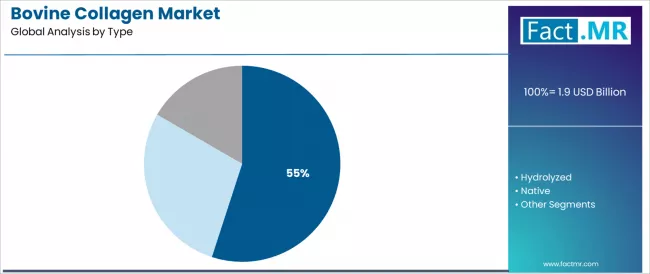
Bovine Collagen Market Analysis By Type | Source: Fact.MR
Market Position: Gelatin applications command the leading position in the market with 55% market share through advanced processing features, including superior extraction characteristics, operational efficiency, and protein optimization that enable manufacturers to achieve optimal functionality across diverse food and industrial applications.
Value Drivers: The segment benefits from manufacturer preference for reliable protein systems that provide consistent performance characteristics, reduced processing complexity, and operational efficiency optimization without requiring significant infrastructure modifications. Advanced design features enable automated extraction control systems, purity monitoring, and integration with existing processing equipment, where operational performance and quality compliance represent critical manufacturing requirements.
Competitive Advantages: Gelatin applications differentiate through proven operational reliability, consistent protein characteristics, and integration with automated processing management systems that enhance extraction effectiveness while maintaining optimal quality standards for diverse food and industrial applications.
Key market characteristics:
- Advanced extraction designs with optimized processing configuration and operational efficiency capabilities
- Enhanced protein effectiveness, enabling 90-95% extraction efficiency consistency with reliable processing performance
- Industrial facility compatibility, including automated monitoring systems, temperature integration, and process optimization for quality control
Hydrolyzed Applications Show Enhanced Market Growth
Hydrolyzed applications maintain a 35% market position in the market due to their enhanced bioavailability properties and specialized application characteristics. These systems appeal to manufacturers requiring premium performance with advanced positioning for nutraceutical and health applications. Market growth is driven by wellness segment expansion, emphasizing enhanced absorption solutions and operational efficiency through optimized processing designs.
Native Applications Demonstrate Specialized Solutions
Native applications capture 10% market share through specialized protein requirements in premium operations, cosmetic applications, and high-value formulations. These operations demand certified collagen systems capable of operating with minimal processing while providing effective protein integration and performance capabilities.
By Application, Food Shows Market Leadership
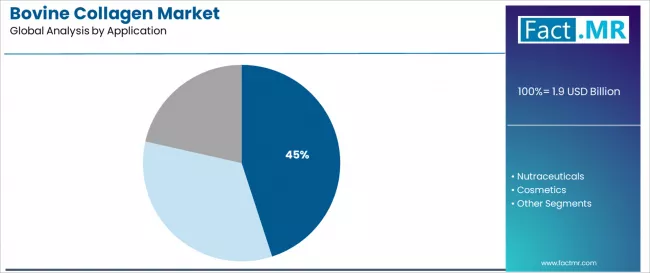
Bovine Collagen Market Analysis By Application | Source: Fact.MR
Market Context: Food applications demonstrate market leadership in the market with 45% share due to widespread adoption of integrated nutrition systems and increasing focus on operational protein efficiency, facility processing optimization, and food applications that maximize functionality while maintaining quality standards.
Appeal Factors: Food manufacturers prioritize processing consistency, operational efficiency, and integration with existing food infrastructure that enables coordinated protein operations across multiple production facilities. The segment benefits from substantial processing investment and modernization programs that emphasize the acquisition of collagen-based systems for nutrition optimization and food efficiency applications.
Growth Drivers: Food facility expansion programs incorporate collagen extraction as standard equipment for protein operations, while nutrition growth increases demand for consistent processing capabilities that comply with quality standards and minimize operational complexity.
Nutraceutical Applications Maintain Health Demand
Nutraceutical applications capture 35% market share through comprehensive health requirements in wellness facilities, supplement operations, and health applications requiring reliable collagen systems capable of handling specialized formulations while providing effective health integration and performance capabilities.
Cosmetic Applications Show Beauty Growth
Cosmetic applications account for 20% market share, including skincare formulations, anti-aging operations, and beauty applications requiring specialized collagen solutions for operational optimization and beauty accessibility.
By Form, Powder Channel Shows Market Leadership
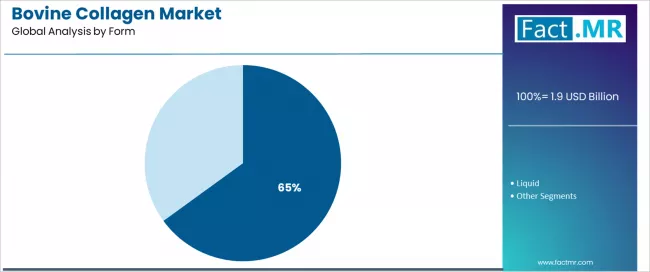
Bovine Collagen Market Analysis By Form | Source: Fact.MR
Market Context: Powder form demonstrates market leadership in the market with 65% share due to widespread adoption of stable protein systems and increasing focus on processing convenience, storage optimization, and manufacturing applications that maximize handling efficiency while maintaining quality standards.
Appeal Factors: Manufacturers and processors prioritize processing convenience, operational flexibility, and integration with existing production infrastructure that enables coordinated protein operations across multiple manufacturing applications. The segment benefits from substantial processing investment and modernization programs that emphasize the acquisition of powder-based systems for handling optimization and protein accessibility applications.
Growth Drivers: Manufacturing facility expansion programs incorporate powder processing as standard handling for protein operations, while production growth increases demand for consistent processing capabilities that comply with quality standards and minimize handling complexity.
Application dynamics include:
- Strong growth in food facilities and nutrition operations requiring reliable protein capabilities
- Increasing adoption in health optimization and operational efficiency applications for manufacturers
- Rising integration with automated processing systems for operational optimization and quality assurance
Liquid Form Maintains Processing Demand
Liquid form captures 35% market share through comprehensive processing requirements in specialized facilities, cosmetic operations, and direct-application formulations. These operations demand reliable liquid systems capable of handling immediate use while providing effective protein management and operational performance capabilities.
What are the Drivers, Restraints, and Key Trends of the Bovine Collagen Market?
| Category | Factor | Impact | Why It Matters |
|---|---|---|---|
| Driver | Health awareness demand & protein efficiency (wellness requirements, nutritional standards) | ★★★★★ | Large-scale health markets require efficient, reliable protein solutions with consistent performance and safety compliance across nutritional applications. |
| Driver | Food processing growth & facility development | ★★★★★ | Drives demand for specialized protein solutions and high-capacity processing capabilities; suppliers providing food-grade equipment gain competitive advantage. |
| Driver | Cosmetic formulation diversification & beauty conversion (anti-aging compliance, product efficiency) | ★★★★☆ | Beauty industries need premium protein solutions; demand for collagen formats expanding addressable market segments. |
| Restraint | Processing investment complexity & production requirements | ★★★★☆ | Small processors face capital pressure; increases cost sensitivity and affects supply consistency in budget-sensitive markets. |
| Restraint | Alternative protein competition & synthetic alternatives | ★★★☆☆ | Efficiency-focused applications face challenges with protein selection and nutritional requirements, limiting adoption in cost-sensitive segments. |
| Trend | Digital processing & smart monitoring (connected quality management) | ★★★★★ | Growing demand for connected protein equipment; digital integration becomes core value proposition in smart nutrition segments. |
| Trend | Asian market expansion & regional health growth | ★★★★☆ | Regional facility development drives demand for local protein solutions; regional processing capabilities drive competition toward localization. |
Source: Fact.MR analysis. Updated Nov 4, 2025
Analysis of the Bovine Collagen Market by Key Country
The market demonstrates varied regional dynamics with growth leaders including India (5.4% growth rate) and China (5.0% growth rate) driving expansion through health initiatives and processing capacity development. Steady Performers encompass USA (4.4% growth rate), Germany (4.2% growth rate), and South Korea (4.0% growth rate), benefiting from established nutrition industries and advanced processing adoption. Mature Markets feature France (3.9% growth rate) and Japan (3.8% growth rate), where protein technology advancement and quality standardization requirements support consistent growth patterns.
Regional synthesis reveals South Asian and East Asian markets leading adoption through health expansion and processing development, while Western countries maintain steady expansion supported by technology advancement and regulatory standardization requirements. Emerging markets show strong growth driven by nutrition applications and facility modernization trends.
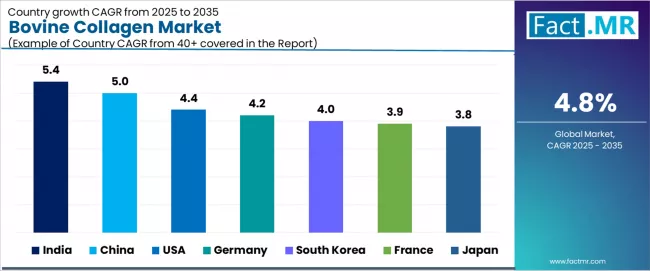
Bovine Collagen Market Cagr Analysis By Country | Source: Fact.MR
| Region/Country | 2025-2035 Growth | How to win | What to watch out |
|---|---|---|---|
| India | 5.4% | Focus on cost-effective health solutions | Infrastructure challenges; processing availability |
| China | 5.0% | Lead with high-volume processing systems | Environmental regulations; facility complexity |
| USA | 4.4% | Offer safety-compliant applications | FDA regulations; facility requirements |
| Germany | 4.2% | Premium quality positioning | Over-specification; regulatory compliance |
| South Korea | 4.0% | Push nutrition integration solutions | Technology saturation; facility costs |
| France | 3.9% | Premium efficiency positioning | Facility precision; market maturity |
| Japan | 3.8% | Premium processing positioning | Facility precision; market maturity |
Source: Fact.MR analysis. Updated Nov 4, 2025
India Drives Fastest Market Growth
India establishes fastest market growth through aggressive health programs and comprehensive processing capacity development, integrating advanced collagen processing as standard components in food enhancement and nutraceutical facility installations. The country's 5.4% growth rate reflects government initiatives promoting health modernization and processing development capabilities that mandate the use of alternative protein systems in nutrition facilities. Growth concentrates in major urban centers, including Delhi, Mumbai, and Chennai, where health technology development showcases integrated protein systems that appeal to consumers seeking advanced nutritional optimization capabilities and operational health applications.
Indian processors are developing cost-effective protein solutions that combine domestic processing advantages with advanced operational features, including automated delivery systems and enhanced reliability capabilities. Distribution channels through health suppliers and commercial service distributors expand market access, while government support for nutrition development supports adoption across diverse consumer segments.
Strategic Market Indicators:
- Food facilities leading adoption with 62% deployment rate in nutrition systems and health sectors
- Government health programs providing substantial funding for domestic protein technology development
- Local nutrition providers capturing 38% market share through competitive sourcing and localized processing support
- Export market development for cost-effective protein solutions targeting emerging health markets
China Emerges as High-Volume Market
In Guangdong, Jiangsu, and Zhejiang provinces, processing facilities and commercial operations are implementing advanced collagen processing as standard equipment for facility optimization and operational nutrition enhancement, driven by increasing government industrial investment and health modernization programs that emphasize the importance of protein capabilities. The market holds a 5.0% growth rate, supported by government nutrition initiatives and processing infrastructure development programs that promote advanced protein systems for production facilities. Chinese operators are adopting protein systems that provide consistent operational performance and safety compliance features, particularly appealing in processing regions where facility efficiency and protein standards represent critical operational requirements.
Market expansion benefits from growing food processing capabilities and nutrition integration agreements that enable domestic production of advanced protein systems for manufacturing applications. Technology adoption follows patterns established in nutrition equipment, where efficiency and performance drive procurement decisions and operational deployment.
USA Shows Safety-Compliant Market Development
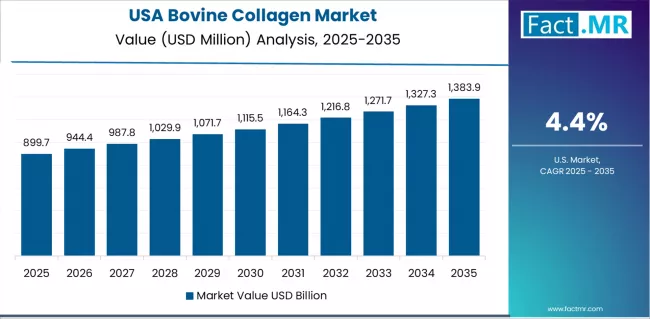
Bovine Collagen Market Country Value Analysis | Source: Fact.MR
The USA establishes safety-compliant market development through comprehensive health programs and established safety infrastructure, integrating collagen across food facilities and nutraceutical applications. The country's 4.4% growth rate reflects mature nutrition industry relationships and established protein adoption that supports widespread use of protein systems in health facilities and safety-compliant operations. Growth concentrates in major health centers, including California, Texas, and New York, where nutrition technology showcases mature protein deployment that appeals to consumers seeking proven safety capabilities and operational efficiency applications.
American processors leverage established distribution networks and comprehensive safety capabilities, including compliance programs and technical support that create customer relationships and operational advantages. The market benefits from mature safety standards and FDA requirements that support protein system use while supporting technology advancement and operational optimization.
Germany Shows Premium Quality Development
Germany establishes premium quality development through comprehensive nutrition programs and established quality infrastructure, integrating collagen across food facilities and specialized applications. The country's 4.2% growth rate reflects mature nutrition industry relationships and established protein adoption that supports widespread use of quality systems in food facilities and premium operations. Growth concentrates in major nutrition centers, including North Rhine-Westphalia, Bavaria, and Baden-Württemberg, where nutrition technology showcases mature protein deployment that appeals to consumers seeking proven quality capabilities and operational efficiency applications.
German processors leverage established distribution networks and comprehensive quality capabilities, including precision programs and technical support that create customer relationships and operational advantages. The market benefits from mature quality standards and regulatory requirements that support protein system use while supporting technology advancement and operational optimization.
South Korea Shows Nutrition Application Development
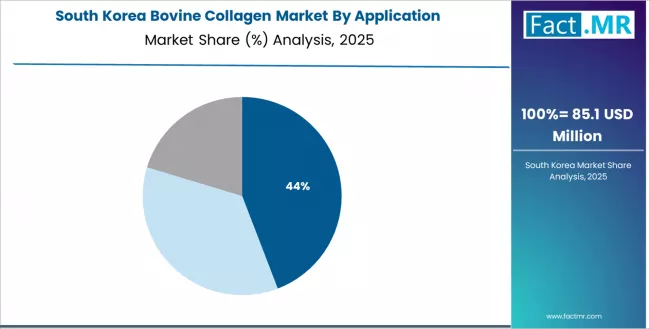
Bovine Collagen Market South Korea Market Share Analysis By Application | Source: Fact.MR
South Korea establishes nutrition application development through comprehensive facility modernization and technology integration, integrating collagen systems across food facilities and specialized health applications. The country's 4.0% growth rate reflects growing health investment and increasing adoption of protein technology that supports expanding use of collagen systems in Korean food facilities. Growth concentrates in major health areas, including Seoul metropolitan area, Busan, and Daegu, where nutrition technology development showcases integrated protein systems that appeal to Korean manufacturers seeking advanced health solutions with facility efficiency compatibility.
Korean processors focus on maintaining quality standards while adopting health protein efficiency, creating demand for systems that balance performance with operational advantages. The market benefits from strong health infrastructure and growing export opportunities that support protein technology adoption while maintaining quality standards important to Korean health applications.
France Demonstrates Premium Efficiency Focus
France's advanced nutrition technology market demonstrates sophisticated collagen integration with documented operational effectiveness in premium food applications and modern facility installations through integration with existing efficiency systems and nutrition infrastructure. The country maintains a 3.9% growth rate, leveraging traditional efficiency expertise and precision systems integration in protein technology. Nutrition centers, including Île-de-France, Auvergne-Rhône-Alpes, and Provence-Alpes-Côte d'Azur, showcase premium installations where protein systems integrate with traditional efficiency platforms and modern facility management systems to optimize nutrition operations and maintain health efficiency profiles.
French processors prioritize protein precision and efficiency consistency in collagen development, creating demand for premium systems with advanced features, including efficiency monitoring and automated protein systems. The market benefits from established efficiency infrastructure and commitment to nutrition standards that provide long-term operational benefits and compliance with traditional quality preparation methods.
Japan Demonstrates Premium Processing Focus
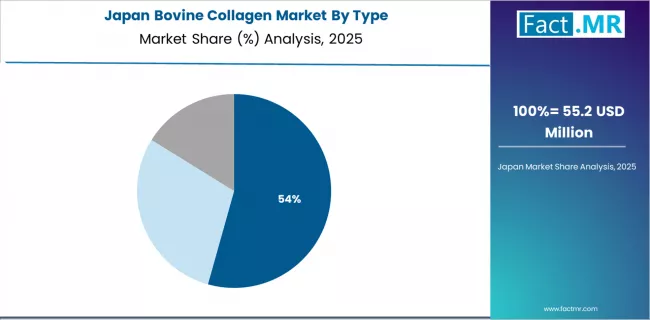
Bovine Collagen Market Japan Market Share Analysis By Type | Source: Fact.MR
Japan's advanced nutrition technology market demonstrates sophisticated collagen integration with documented operational effectiveness in premium food applications and modern facility installations through integration with existing processing systems and nutrition infrastructure. The country maintains a 3.8% growth rate, leveraging traditional processing expertise and precision systems integration in protein technology. Nutrition centers, including Tokyo, Osaka, and Nagoya, showcase premium installations where protein systems integrate with traditional processing platforms and modern facility management systems to optimize nutrition operations and maintain health processing profiles.
Japanese processors prioritize protein precision and processing consistency in collagen development, creating demand for premium systems with advanced features, including processing monitoring and automated protein systems. The market benefits from established processing infrastructure and commitment to nutrition standards that provide long-term operational benefits and compliance with traditional quality preparation methods.
Europe Market Split by Country
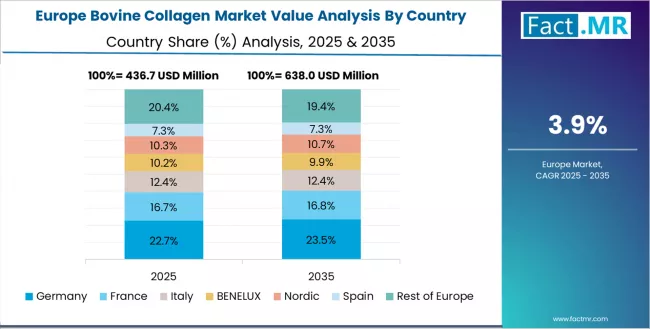
Bovine Collagen Market Europe Country Market Share Analysis, 2025 & 2035 | Source: Fact.MR
The European bovine collagen market is projected to represent a significant portion of global consumption, with strong regional distribution across major economies. Germany is expected to maintain its leadership position with USD 400.0 million in 2025, accounting for substantial European market share, supported by its advanced nutrition infrastructure and major processing centers.
United Kingdom follows with USD 300.0 million, representing significant European market share in 2025, driven by comprehensive health programs and nutrition technology development initiatives. France holds USD 260.0 million through specialized food applications and nutrition compliance requirements. Italy commands USD 200.0 million, while Spain accounts for USD 180.0 million in 2025. The rest of Europe region maintains USD 510.0 million, attributed to increasing protein system adoption in Nordic countries and emerging nutrition facilities implementing health modernization programs.
Competitive Landscape of the Bovine Collagen Market
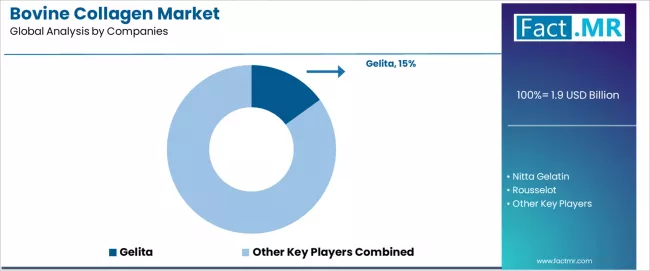
Bovine Collagen Market Analysis By Company | Source: Fact.MR
- Structure: ~12-18 active players; top 3-4 hold ~40-45% by revenue, with Gelita leading at 15.0% market share.
- Leadership is maintained through: global processing networks, specialized supply systems, and regional service capabilities (multi-application versatility + delivery support + quality compliance).
- What's commoditizing: standard powder delivery and basic processing systems.
- Margin Opportunities: specialized food applications, IoT-enabled monitoring, and comprehensive service contracts (predictive delivery, equipment management, compliance documentation).
| Stakeholder | What they actually control | Typical strengths | Typical blind spots |
|---|---|---|---|
| Global platforms | Processing networks, broad supply portfolios, production facilities | Proven reliability, multi-region support, comprehensive service | Technology refresh cycles; customer lock-in dependency |
| Technology innovators | R&D capabilities; advanced protein systems; digital interfaces | Latest technology first; attractive ROI on specialized applications | Service density outside core regions; customization complexity |
| Regional specialists | Local sourcing, fast delivery, nearby technical support | "Close to site" support; pragmatic pricing; local regulations | Technology gaps; talent retention in engineering |
| Application-focused ecosystems | Industry expertise, technical support, specialized solutions | Lowest application variation; comprehensive industry support | Scaling costs if overpromised; technology obsolescence |
| Service specialists | Delivery programs, equipment supply, technical training | Win service-intensive applications; flexible support | Scalability limitations; narrow market focus |
Source: Fact.MR analysis. Updated Nov 4, 2025
Key Players in the Bovine Collagen Market
- Gelita
- Nitta Gelatin
- Rousselot
- Weishardt
- Collagen Matrix
- PB Leiner
- Vital Proteins
- Amicogen
- Lapi Gelatine
- Vinh Hoan
- Seagarden
- Ewald-Gelatine
- Darling Ingredients
- Gelnex
- Holista
Segmentation
Scope of the Report
| Items | Values |
|---|---|
| Quantitative Units (2025) | USD 1,850.0 million |
| Type | Gelatin, Hydrolyzed, Native |
| Application | Food, Nutraceuticals, Cosmetics |
| Form | Powder, Liquid |
| Regions Covered | East Asia, Western Europe, South Asia Pacific, North America, Latin America, Middle East & Africa |
| Countries Covered | China, Germany, United States, Japan, India, South Korea, France, United Kingdom, and 25+ additional countries |
| Key Companies Profiled | Gelita, Nitta Gelatin, Rousselot, Weishardt, Collagen Matrix, PB Leiner, Vital Proteins, Amicogen, Lapi Gelatine, Vinh Hoan |
| Additional Attributes | Dollar sales by type and application categories, regional adoption trends across East Asia, Western Europe, and South Asia Pacific, competitive landscape with protein suppliers and service providers, consumer preferences for nutritional consistency and operational reliability, integration with health platforms and facility monitoring systems, innovations in protein technology and processing enhancement, and development of advanced collagen solutions with enhanced performance and facility optimization capabilities. |
Source: Fact.MR analysis. Updated Nov 4, 2025
Bovine Collagen Market by Segments
-
Type :
- Gelatin
- Hydrolyzed
- Native
-
Application :
- Food
- Nutraceuticals
- Cosmetics
-
Form :
- Powder
- Liquid
-
Region :
- East Asia
- China
- Japan
- South Korea
- South Asia Pacific
- India
- ASEAN
- Australia & New Zealand
- Rest of South Asia Pacific
- Western Europe
- Germany
- France
- United Kingdom
- Italy
- Spain
- Rest of Western Europe
- North America
- United States
- Canada
- Mexico
- Latin America
- Brazil
- Rest of Latin America
- Middle East & Africa
- GCC Countries
- South Africa
- Rest of Middle East & Africa
- East Asia
Frequently Asked Questions
How big is the bovine collagen market in 2025?
What will be the size of bovine collagen market in 2035?
How much will be the bovine collagen market growth between 2025 and 2035?
What are the key product types in the bovine collagen market?
Which application segment to contribute significant share in the bovine collagen market in 2025?
Who worked on this report


Preview the report firsthand - request a free sample
Free SampleGet the brochure for pricing and purchase details
Download PDF