- Market Value (2025): USD 850.1 Mn
- Estimated Value (2026): USD 899.2 Mn
- Forecast Value (2036): USD 1577.2 Mn
- CAGR (2026-2036): 5.8%
What is the Colposcopy Test Market forecast to be worth by 2036?
USD 899.2 million in 2026 to USD 1577.2 million by 2036 at a 5.8% CAGR.
- As per Fact.MR analysis, the colposcopy test market was valued at USD 850.1 million in 2025.
- Demand will grow from USD 899.2 million in 2026 to USD 1577.2 million by 2036.
- The market is projected to expand at a 5.8% CAGR between 2026 and 2036 as cervical screening programmes and diagnostic follow-up services support equipment demand.
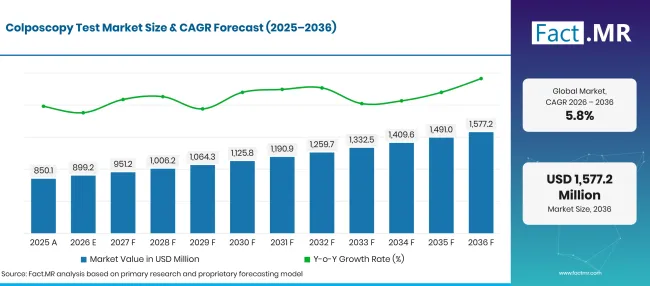
Colposcopy Test Market Forecast Global | Source: Fact.MR
| Year | Basis | Market Value (USD million) |
|---|---|---|
| 2025 | Actual | 850.1 |
| 2026 | Estimate | 899.2 |
| 2036 | Forecast | 1577.2 |
| CAGR 2026 to 2036 | Forecast period | 5.8% |
Source: Fact.MR analysis. Updated Nov 4, 2026
What are the defining numbers behind Colposcopy Test Market growth?
USD 678.0 million absolute opportunity between 2026 and 2036
Demand Drivers in the Market
- Expansion of cervical cancer screening programmes supports follow-up examinations. Governments are increasing access to cervical screening and early diagnosis, creating a larger pathway of patients who may require colposcopy after abnormal results. India's Ministry of Health and Family Welfare reported on March 23, 2026, that 8.73 crore women had been screened for cervical cancer under the National Programme for Prevention and Control of Non-Communicable Diseases as of February 2026. The programme also reported 93,062 diagnosed cases as of February 2026, highlighting the need for accessible diagnostic and referral services [1].
- Persistent cervical cancer burden sustains demand for diagnostic assessment. Colposcopy helps clinicians examine abnormal cervical tissue after a positive screening result and determine whether biopsy or treatment is required. The World Health Organization reported approximately 604,000 new cervical cancer cases and 280,000 deaths worldwide in 2024 in its July 2026 fact sheet. Continued efforts to detect precancerous changes and improve referral pathways can support demand for colposcopy equipment in hospitals and specialist clinics [2].
- Digital imaging and documentation are improving examination workflows. Digital colposcopes can capture and store images, support comparison of findings and improve documentation for clinical review. Systems with image-management software and connectivity can also help facilities organize examination records and support communication between clinicians. Leisegang, for example, offers photo/video colposcope configurations and software options that support image and report documentation [3].
- Referral standards and quality requirements encourage reliable colposcopy capacity. Healthcare providers need suitable equipment and trained personnel to assess patients referred after abnormal screening results. In England, national guidance states that at least 93% of people referred with specified high-grade or suspected invasive findings must be offered colposcopy within two weeks. Such service expectations encourage providers to maintain timely access to examination facilities and appropriate equipment [4].
- Expansion of HPV testing is strengthening the diagnostic pathway. Primary HPV testing can identify high-risk infections before cervical lesions develop, while colposcopy remains important for evaluating patients who meet referral criteria after screening. Brazil's Ministry of Health reported in October 2026 that DNA-HPV testing had become available in 26 federative units and that 153,000 samples had been collected during 2025 and 2026. As screening pathways expand, providers need adequate diagnostic capacity for patients requiring further assessment [5].
Key Segments Analyzed
- By Product Type: Digital Colposcopes are projected to account for 58.3% of the market in 2026, driven by demand for image capture, electronic documentation and integration with clinical workflows.
- By Application: Cervical Cancer Screening segment hold 75.5% share in 2026, reflecting the role of colposcopy in the follow-up assessment of abnormal screening results.
- By End User: Hospitals segment leads with 47.2% share in 2026, supported by their diagnostic infrastructure and ability to manage referrals, biopsies and follow-up care.
Analyst Opinion at Fact.MR
Shambhu Nath Jha, Principal Consultant at Fact.MR, states, “Colposcopy demand will depend on the strength of cervical screening and referral pathways as well as the availability of trained clinicians. Digital systems can improve image documentation and examination workflow, but purchasing decisions will continue to reflect clinical requirements, equipment affordability, service support and compatibility with existing hospital systems.”
Strategic Implications
- Manufacturers should demonstrate image quality, optical performance, documentation features and ease of use across different clinical settings.
- Hospitals need to evaluate digital systems based on image storage, reporting functions, service availability and compatibility with existing diagnostic workflows.
- Diagnostic centres can assess equipment investment against referral volumes, clinician availability and the range of gynaecological examinations performed.
- Specialty clinics must consider compact and cost-effective colposcopy systems that meet clinical requirements without adding unnecessary software or maintenance costs.
Germany is projected to record a 6.9% CAGR through 2036. Japan is expected to advance at 6.1%, followed by the UK at 5.7%. The USA is forecast to expand at 5.2%, while Brazil is projected to record a 4.9% CAGR.
How does the Colposcopy Test Market break down by segment?
Fact.MR finds that Digital Colposcopes lead Product Type with 58.3% share; Cervical Cancer Screening Leads Application with 75.5%; and Hospitals Lead End User with 47.2% in 2026.
Which Product Type dominates?
Digital Colposcopes are set to hold 58.3% share in 2026.
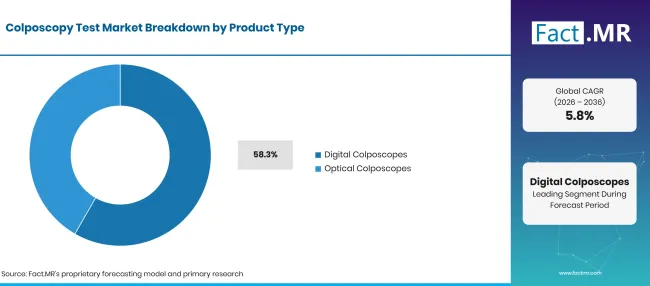
Colposcopy Test Market Breakdown Product Type | Source: Fact.MR
| Product Type | Share (2026) |
|---|---|
| Digital Colposcopes (Leading segment) | 58.3% |
| Other segments combined | 41.7%* |
| Total | 100.0% |
Source: Fact.MR analysis. Updated Nov 4, 2026
Digital colposcopes support image capture, electronic documentation and review of examination findings. These capabilities can help clinicians maintain patient records and compare observations during follow-up visits. Optical colposcopes remain relevant where providers prioritize conventional magnification, dependable illumination and lower equipment costs. Purchasing decisions depend on clinical requirements, available budgets and the need for digital record management.
What leads the Application segment?
Cervical Cancer Screening is set to represent 75.5% share in 2026.
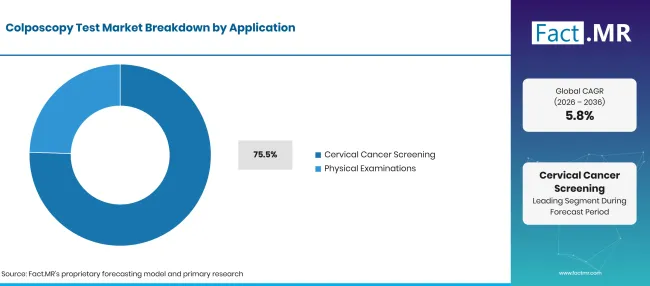
Colposcopy Test Market Breakdown Application | Source: Fact.MR
| Application | Share (2026) |
|---|---|
| Cervical Cancer Screening (Leading segment) | 75.5% |
| Other segments combined | 24.5%* |
| Total | 100.0% |
Source: Fact.MR analysis. Updated Nov 4, 2026
Colposcopy is used to investigate abnormal cervical screening results and examine suspicious areas of tissue under magnification. It can help clinicians determine whether a biopsy or further evaluation is needed. Physical examinations represent another application in which clinicians use colposcopes to assess cervical, vaginal and vulvar tissue. Demand across these applications depends on screening referrals, clinical protocols and access to trained practitioners.
Which End User accounts for the largest share?
Hospitals are projected to account for 47.2% share in 2026.
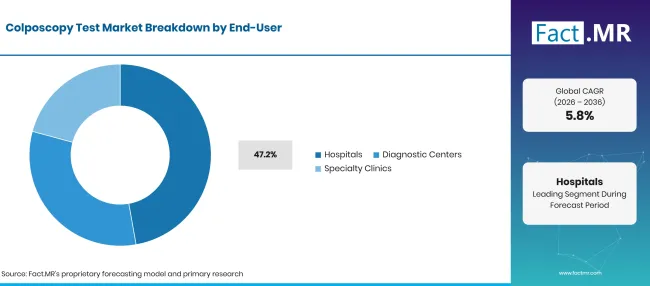
Colposcopy Test Market Breakdown End User | Source: Fact.MR
| End User | Share (2026) |
|---|---|
| Hospitals (Leading segment) | 47.2% |
| Other segments combined | 52.8%* |
| Total | 100.0% |
Source: Fact.MR analysis. Updated Nov 4, 2026
Hospitals handle a broad range of gynaecological examinations and can provide referral, biopsy and treatment services within the same healthcare setting. Their diagnostic departments may also have access to trained specialists and supporting pathology services. Diagnostic centres and specialty clinics serve patients who need focused examinations and follow-up appointments. Their equipment choices depend on referral volumes, clinician availability, service costs and the need for image documentation.
What is accelerating Colposcopy Test Market adoption, and what is holding it back?
Wider screening access, improved diagnostic documentation and cervical cancer prevention initiatives support demand. Equipment costs, uneven access to specialists and differences in screening infrastructure can constrain adoption.
Drivers Impact Analysis
| DRIVER | (~) % IMPACT ON CAGR | GEOGRAPHIC RELEVANCE | IMPACT TIMELINE |
|---|---|---|---|
| Expansion of cervical cancer screening programmes | +1.0% | Asia, Europe, Americas | Medium term (2–4 years) |
| Referral of abnormal screening results for diagnostic assessment | +0.9% | Global | Short term (≤2 years) |
| Adoption of digital imaging and documentation | +0.7% | North America, Europe, Asia | Medium term (2–4 years) |
| Investment in women's healthcare services | +0.5% | Global | Long term (≥4 years) |
| Clinical demand for improved examination records | +0.4% | Global | Short term (≤2 years) |
Source: Fact.MR analysis. Updated Nov 4, 2026
Opportunity Impact Analysis
| OPPORTUNITY | (~) % IMPACT ON CAGR | GEOGRAPHIC RELEVANCE | IMPACT TIMELINE |
|---|---|---|---|
| Digital image capture and reporting systems | +0.8% | North America, Europe, Asia | Medium term (2–4 years) |
| Expansion of screening and referral services | +0.6% | Asia, Latin America | Long term (≥4 years) |
| Equipment upgrades in hospitals and diagnostic centres | +0.5% | Global | Medium term (2–4 years) |
| Distribution partnerships in underserved markets | +0.4% | Latin America, Asia, Africa | Medium term (2–4 years) |
| Training and technical support for clinicians | +0.3% | Global | Short term (≤2 years) |
Source: Fact.MR analysis. Updated Nov 4, 2026
Restraints Impact Analysis
| RESTRAINT | (~) % IMPACT ON CAGR | GEOGRAPHIC RELEVANCE | IMPACT TIMELINE |
|---|---|---|---|
| High acquisition and maintenance costs | -0.8% | Emerging markets | Short term (≤2 years) |
| Shortage of trained colposcopy practitioners | -0.6% | Asia, Latin America, Africa | Medium term (2–4 years) |
| Uneven access to cervical screening services | -0.5% | Emerging markets | Long term (≥4 years) |
| Limited budgets at smaller diagnostic facilities | -0.4% | Global | Short term (≤2 years) |
| Competition from alternative screening and triage pathways | -0.3% | Global | Medium term (2–4 years) |
Source: Fact.MR analysis. Updated Nov 4, 2026
Which countries are scaling the Colposcopy Test Market through 2036?
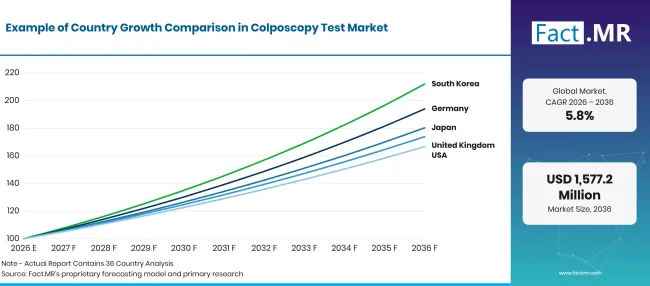
Colposcopy Test Market Growth Index | Source: Fact.MR
| Country | CAGR (2026–2036) |
|---|---|
| Germany | 6.9% |
| Brazil | 4.9% |
| USA | 5.2% |
| UK | 5.7% |
| Japan | 6.1% |
Source: Fact.MR analysis. Updated Nov 4, 2026
How is Germany strengthening colposcopy adoption through organized cervical screening?
6.9% CAGR, supported by a structured cervical cancer early-detection programme and established diagnostic follow-up pathways.
Germany's structured cervical cancer early-detection programme supports demand for diagnostic follow-up. The Federal Ministry of Health explains that abnormal screening findings can require further assessment through HPV testing, repeat cytology or colposcopy. This pathway creates a continuing clinical role for colposcopy systems in gynaecology practices and hospitals. Equipment upgrades may also be supported by demand for improved imaging and documentation capabilities [6].
How is Brazil expanding colposcopy demand through wider cervical screening coverage?
4.9% CAGR, driven by the expansion of cervical cancer screening and diagnostic follow-up services.
Brazil's cervical cancer control initiatives create demand for screening and diagnostic follow-up services. As the screening programme expands, healthcare providers need referral pathways for women with results requiring further assessment. Colposcopy equipment can support this diagnostic stage in public hospitals and specialist facilities.
How does the United States sustain colposcopy demand through established screening pathways?
5.2% CAGR, shaped by established cervical screening infrastructure and demand for diagnostic assessment of abnormal findings.
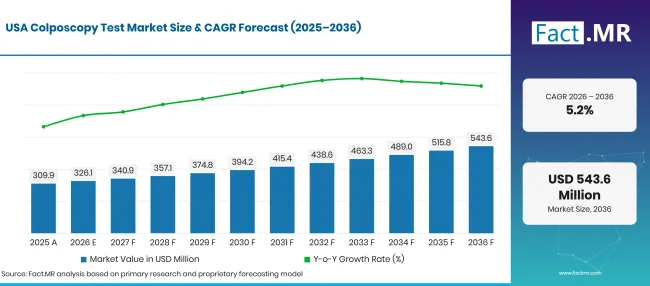
Colposcopy Test Market Forecast Usa | Source: Fact.MR
The United States has an established cervical screening infrastructure and demand for diagnostic equipment across hospitals and specialist practices. The CDC's 2026 cervical cancer information page reports 12,960 new cases in 2022 and 4,162 deaths in 2023. Separately, CDC/NCHS data show that 75.4% of women aged 21–65 were up to date with cervical cancer screening in 2023. Screening programmes and the need to investigate abnormal findings support continued demand for colposcopy services [7] [8].
How is the United Kingdom supporting colposcopy demand through defined referral timelines?
5.7% CAGR, led by organized cervical screening and defined timelines for colposcopy referrals.
England's NHS cervical screening programme and defined colposcopy referral pathways support demand for diagnostic equipment. England's NHS cervical screening programme invites eligible women and people with a cervix aged 25–64 for routine screening every five years. National colposcopy guidance also specifies that at least 93% of people referred with certain high-grade or suspected invasive findings must be offered an appointment within two weeks [9]. [9]
How is Japan increasing colposcopy adoption through higher cervical screening participation?
6.1% CAGR, backed by continued investment in cervical cancer screening participation and early-detection services.
Japan's cervical cancer screening infrastructure and focus on early detection support demand for colposcopy equipment. The Tokyo Metropolitan Government's 2026 release reported a cervical cancer screening rate of 55.3% in its FY2025 survey, compared with 48.0% in the FY2020 survey [10].
Who leads the Colposcopy Test Market?
Fact.MR identifies CooperSurgical, Leisegang Feinmechanik-Optik, ATMOS MedizinTechnik, MedGyn Products and the DYSIS technology business now held by Apgar Danmark as relevant companies in the colposcopy equipment landscape. Their portfolios differ across optical colposcopes, digital imaging, documentation and computer-aided cervical mapping.
Leisegang offers standard and photo/video colposcopes, with options for image documentation and integration into clinical IT systems. ATMOS markets its i View COLPO system for cervical examination and early detection workflows. MedGyn lists AL-101 and AL-102 colposcopes, with video and camera compatibility available on the AL-102. These product portfolios provide direct evidence of colposcopy equipment participation [11] [12].
CooperSurgical has an FDA record for its Digital Colposcopy System, although the record dates to 1998 and does not by itself establish current commercial availability. DYSIS Medical's ownership also requires an updated description: Apgar Danmark A/S acquired DYSIS Medical Limited's global production, sales and distribution rights effective February 4, 2025. DYSIS Medical separately announced the cessation of its U.S. operations. Accordingly, Apgar Danmark should be identified as the current rights holder for DYSIS technology rather than presenting DYSIS Medical Ltd. as an independent active company without qualification [13] [14].
Which companies are the key providers?
The following companies form the competitive set, with the DYSIS ownership qualification applied.
- CooperSurgical Inc.
- Leisegang Feinmechanik-Optik GmbH
- ATMOS MedizinTechnik GmbH & Co. KG
- MedGyn Products Inc.
- Apgar Danmark A/S (DYSIS technology rights holder)
Bibliography
- [1] Press Information Bureau, Ministry of Health and Family Welfare, Government of India. (2026, March 23). Update on NP-NCD: 8.73 crore women screened for cervical cancer; 93,062 cases diagnosed under NP-NCD.
- [2] World Health Organization. (2026, July 3). Cervical cancer.
- [3] Leisegang Feinmechanik-Optik GmbH. (n.d.). Colposcopes.
- [4] Department of Health and Social Care. (2025, July 9). 3. Providing a quality colposcopy clinic. GOV.UK.
- [5] Ministério da Saúde, Brasil. (2026, October 28). Teste para detecção precoce do câncer do colo do útero já está disponível em 26 estados do país.
- [6] Bundesministerium für Gesundheit. (n.d.). Verbesserte Früherkennung von Gebärmutterhalskrebs.
- [7] Centers for Disease Control and Prevention. (2026, May 26). Health and economic benefits of cervical cancer interventions.
- [8] Sabatino, S. A., Thompson, T. D., Croswell, J. M., Villarroel, M. A., Rodriguez, J. L., Adam, E. E., & Richardson, L. C. (2025, August 14). Use of cancer screening tests, United States, 2023. Preventing Chronic Disease, 22, 250139.
- [9] Department of Health and Social Care. (2026, August 25). Cervical screening supporting information. GOV.UK.
- [10] Tokyo Metropolitan Government. (2026, June 30). 令和7年度 健康増進法に基づくがん検診の対象人口率等調査の結果をまとめました [Results of the FY2025 survey on cancer screening participation and eligible population under the Health Promotion Act].
- [11] ATMOS MedizinTechnik GmbH & Co. KG. (n.d.). ATMOS i View COLPO colposcope.
- [12] MedGyn Products, Inc. (2024). MedGyn product catalog.
- [13] U.S. Food and Drug Administration. (1998, February 2). 510(k) premarket notification: CooperSurgical Digital Colposcopy System (K972630).
- [14] DYSIS Medical. (2025, April 24). Apgar Danmark A/S acquires DYSIS Medical Limited.
This Report Answers
- The report examines the colposcopy equipment market across digital and optical product categories.
- Segment analysis compares cervical cancer screening and physical examination applications.
- End-user analysis covers hospitals, diagnostic centres and specialty clinics.
- Country analysis discusses Germany, Brazil, USA, UK and Japan alongside available official healthcare indicators.
- The competitive overview profiles the named colposcopy suppliers and clarifies the ownership of DYSIS technology.
What does the Colposcopy Test Market cover?
The market covers optical and digital colposcopy systems used by healthcare professionals to examine the cervix, vagina and vulva under magnification. It includes equipment used in cervical screening follow-up, diagnostic assessment and physical examinations. Digital systems with image capture and documentation capabilities are included, alongside conventional optical colposcopes. Market demand is influenced by cervical screening coverage, referral volumes, clinical requirements and equipment replacement cycles.
What is included in the scope?
Included products comprise optical colposcopes, digital colposcopes and associated imaging or documentation features supplied as part of colposcopy systems.
The application scope covers cervical cancer screening follow-up and physical examinations. End users include hospitals, diagnostic centres and specialty clinics that use colposcopy equipment for clinical assessment.
What is excluded from the scope?
The analysis excludes standalone HPV test kits, Pap smear laboratory testing, HPV vaccines and cervical cancer treatments.
General-purpose microscopes and imaging equipment not specifically designed or marketed for colposcopy are excluded. Biopsy instruments, pathology services and unrelated gynaecological equipment are not counted as colposcopy system revenue unless sold as part of an integrated colposcopy product offering.
How Was the Analysis Built?
The analysis draws on 120+ sources, 35+ company portfolios, 25+ countries and more than 20 industry interviews.
- Primary Research: Primary research includes discussions with manufacturers, distributors, healthcare providers, gynaecologists, diagnostic centres and subject-matter experts. These discussions examine equipment purchasing priorities, digital adoption, clinical workflow requirements, maintenance needs and factors influencing market acceptance.
- Desk Research: Desk research covers government healthcare statistics, cervical screening programme publications, medical device information, company product catalogues, regulatory records, industry publications and other authoritative sources. Sources used in the analysis are documented in the bibliography.
- Market Sizing and Forecasting: Market estimates combine historical performance, equipment demand, pricing and replacement trends, segment shares, company participation, country-level growth and adoption patterns. The forecast also considers screening coverage, diagnostic referral pathways and healthcare infrastructure.
- Data Validation and Update Cycle: Findings are validated by comparing primary interviews with public data, company product information, regulatory records and healthcare developments. Regular updates review new product launches, portfolio changes, distribution agreements, regulatory developments and shifts in clinical adoption.
Segmentation
What is the report's scope and coverage?
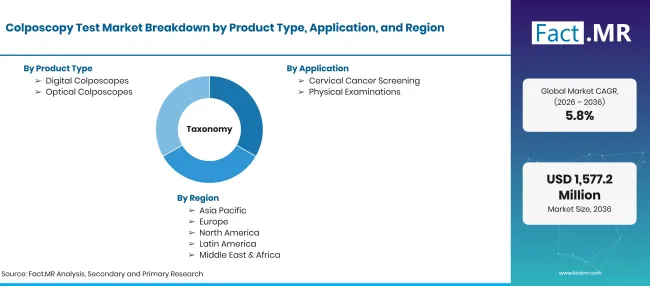
Colposcopy Test Market Taxonomy | Source: Fact.MR
| Attribute | Details |
|---|---|
| Quantitative Units | USD million in 2026 to USD million by 2036, at CAGR |
| Market Definition | The colposcopy test market comprises optical and digital colposcopy equipment, including video colposcopes and associated imaging, image-capture and documentation systems used to examine the cervix, vagina and vulva under magnification. |
| Product Type | Digital Colposcopes; Optical Colposcopes |
| Application | Cervical Cancer Screening; Physical Examinations |
| End User | Hospitals; Diagnostic Centers; Specialty Clinics |
| Regions Covered | North America; Latin America; Western Europe; Eastern Europe; East Asia; South Asia & Pacific; Middle East & Africa |
| Countries Covered | Germany; Brazil; USA; UK; Japan |
| Companies Profiled | CooperSurgical; Leisegang; ATMOS; MedGyn; Apgar Danmark (DYSIS technology) |
| Forecast Period | 2026 to 2036 |
| Approach | Market segmentation and scenario-based analysis supported by official healthcare statistics and company product information |
Source: Fact.MR analysis. Updated Nov 4, 2026
How is the market segmented?
-
By Product Type
- Digital Colposcopes
- Optical Colposcopes
-
By Application
- Cervical Cancer Screening
- Physical Examinations
-
By End User
- Hospitals
- Diagnostic Centers
- Specialty Clinics
-
By Region
- North America
- Latin America
- Western Europe
- Eastern Europe
- East Asia
- South Asia & Pacific
- Middle East & Africa
Frequently Asked Questions
How big is the Colposcopy Test Market in 2026?
What is the CAGR from 2026 to 2036?
Which product type has the largest share?
Which application leads the market?
Which end user accounts for the largest share?
Which companies are covered?
Who worked on this report


Preview the report firsthand - request a free sample
Free SampleGet the brochure for pricing and purchase details
Download PDF