- Market Value (2025): USD 684.2 Mn
- Estimated Value (2026): USD 737.6 Mn
- Forecast Value (2036): USD 1563.2 Mn
- CAGR (2026-2036): 7.8%
What is the Sulbactam Pivoxil Market forecast to be worth by 2036?
USD 737.6 million in 2026 to USD 1,563.2 million by 2036 at a 7.8% CAGR.
- In 2025, the sulbactam pivoxil market was worth USD 684.2 million, with most revenue coming from film-coated amoxicillin combination tablets.
- Revenue will grow from USD 737.6 million in 2026 to USD 1,563.2 million by 2036 as hospitals push earlier switches from intravenous to oral therapy.
- A 7.8% CAGR reflects resistance pressure on plain amoxicillin, which keeps inhibitor-protected oral regimens on formularies.
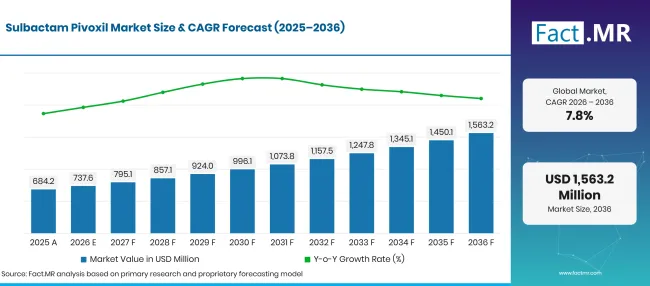
Sulbactam Pivoxil Market Forecast Global | Source: Fact.MR
| Year | Basis | Market Value (USD million) |
|---|---|---|
| 2025 | Actual | 684.2 |
| 2026 | Estimate | 737.6 |
| 2036 | Forecast | 1,563.2 |
| CAGR 2026 to 2036 | Forecast period | 7.8% |
Source: Fact.MR analysis. Updated Nov 4, 2026
What are the defining numbers behind Sulbactam Pivoxil Market growth?
The 2026 to 2036 window will add USD 825.6 million in new revenue, led by tablet formats dispensed through hospital pharmacies.
- Demand Drivers in the Market
- Resistance to first-line antibiotics keeps widening. WHO reported in October 2025 that about one in six laboratory-confirmed bacterial infections worldwide in 2023 resisted antibiotic treatment, with data from 104 countries [1]. Each rise in beta-lactamase activity pushes prescribers toward inhibitor-protected penicillins.
- Global prescribing guidance shapes which combinations reach formularies. The 24th WHO Essential Medicines List of September 2025 covers 523 medicines for adults. Its expert committee also reviewed updates to the AWaRe antibiotic classification [2]. Classification under these lists influences national tenders for amoxicillin combinations.
- Stewardship targets in Europe favour narrow, well-understood penicillin regimens. ECDC recorded EU/EEA consumption of 20.3 defined daily doses per 1,000 inhabitants per day in 2024, with Access antibiotics at 60.3% against a 2030 target above 65% [3]. Oral amoxicillin combinations help hospitals shift use toward that Access group.
- Shorter hospital stays raise the value of an oral step-down option. A patient who starts on injectable ampicillin or amoxicillin with sulbactam can continue the same inhibitor class at home. Earlier discharge frees beds and lowers the risk of catheter-related infections. Hospital managers under bed pressure in Europe and Latin America now track switch rates as a quality measure.
- Key Segments Analyzed
- By Product Type: Tablets will hold 61.7% share in 2026, since film-coated tablets give stable dosing and long shelf life for the pivoxil ester.
- By Application: Hospital Pharmacies will account for 50.0% of 2026 value, as they stock oral step-down therapy alongside injectable sulbactam combinations.
- By End-User: Hospitals will capture 60.0% of 2026 demand owing to their handling of pneumonia, complicated skin infections and post-surgical cases.
- Analyst Opinion at Fact.MR
- Shambhu Nath Jha, Principal Consultant at Fact.MR, states, “Sulbactam pivoxil earns its place where hospitals want to send a patient home on the same inhibitor class used on the ward. Manufacturers that secure registration in Latin American and Asian markets with active amoxicillin and sulbactam use will capture most of the new volume. Over time, stewardship rules will favour suppliers who can document stability, impurity control and clear dosing for each strength.”
- Strategic Implications
- Manufacturers should invest in moisture-protected tablet packaging and impurity profiling, because the pivoxil ester degrades faster than the parent compound.
- Distributors should align hospital pack sizes with discharge protocols so that ward stock and outpatient supply use the same product.
- Hospital buyers should check each oral combination against local AWaRe guidance before adding it to a formulary.
- Investors should weigh registration timelines in each country, since approval for a combination product rarely transfers across borders.
Germany leads the five-country comparison at 8.5%, as a dense hospital surveillance network keeps inhibitor-protected penicillins under steady review. Brazil follows at 7.8% with a national infection control programme that runs to 2030. The United States trails Brazil by 0.8 points at 7.0%, held back by a narrow range of registered oral sulbactam products. The United Kingdom posts 6.3% under tight prescribing control, and Japan closes the group at 5.6%, where stewardship guidance favours narrow use of oral antibiotics.
How does the Sulbactam Pivoxil Market break down by segment?
Tablets will lead Product Type at 61.7%; Hospital Pharmacies will head Application at 50.0%; Hospitals will hold End-User at 60.0% in 2026.
Which Product Type leads?
Tablets take 48.6% of 2026 sales.
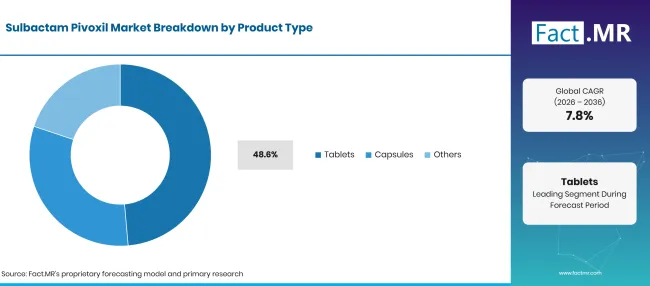
Sulbactam Pivoxil Market Breakdown Product Type | Source: Fact.MR
| Product Type | Share (2026) |
|---|---|
| Tablets (Leading segment) | 61.7% |
| Other segments combined | 38.3%* |
| Total | 100.0% |
Source: Fact.MR analysis. Updated Nov 4, 2026
Adult dosing of amoxicillin and sulbactam relies on fixed-ratio tablets that patients take two or three times a day. Laboratorios Bagó registers Trifamox IBL film-coated tablets in 500 and 1,000 strengths. Its packs of 500 and 1,000 tablets are reserved for hospital use [4]. Coated tablets also shield the ester from humidity during storage. Oral suspensions serve children and adults who cannot swallow tablets, and they need reconstitution at the pharmacy or at home. Capsules and other formats remain a smaller group, used where a manufacturer already runs capsule lines for extended oral antibiotics. Shelf life after reconstitution limits suspension volumes in hospital stock. Taste-masked suspensions with clear dosing syringes give paediatric clinics a reason to stock the combination.
What supports Hospital Pharmacies within Application?
Hospital Pharmacies represent 50.0% of 2026 revenue.
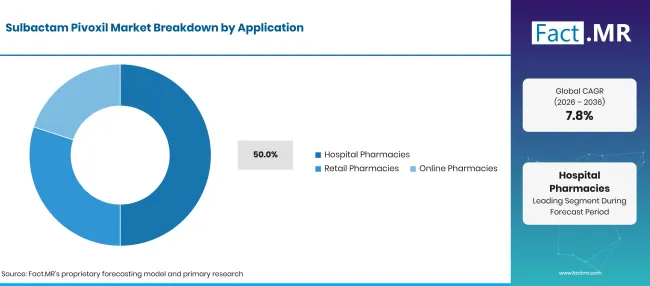
Sulbactam Pivoxil Market Breakdown Application | Source: Fact.MR
| Application | Share (2026) |
|---|---|
| Hospital Pharmacies (Leading segment) | 50.0% |
| Other segments combined | 50.0%* |
| Total | 100.0% |
Source: Fact.MR analysis. Updated Nov 4, 2026
Ward pharmacists control the switch from injectable to oral therapy, and they dispense the first oral doses before discharge. The Trifamox IBL Duo leaflet sets one 875 mg and 125 mg tablet every 12 hours for adults, a schedule that suits supply at the point of discharge [5]. Formulary committees in these pharmacies also track spending on reserve agents such as carbapenem-based antibiotics. Retail and online pharmacies fill repeat and community prescriptions for sinusitis, otitis media and bronchitis. Their share of revenue depends on whether national rules allow pharmacist supply of combination antibiotics without a fresh prescription. Pharmacies that also prepare injectable doses link to the work of sterile compounding pharmacies.
How does End-User shape demand?
Hospitals account for 60.0% of 2026 value.
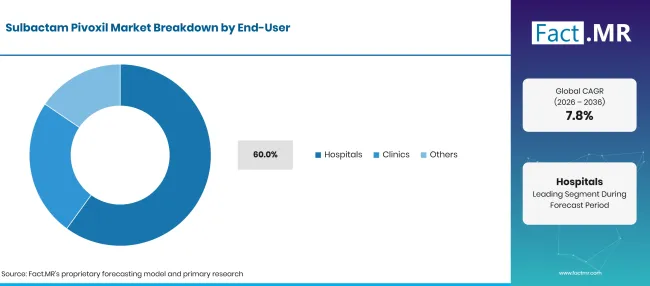
Sulbactam Pivoxil Market Breakdown End User | Source: Fact.MR
| End-User | Share (2026) |
|---|---|
| Hospitals (Leading segment) | 60.0% |
| Other segments combined | 40.0%* |
| Total | 100.0% |
Source: Fact.MR analysis. Updated Nov 4, 2026
Inpatient wards treat community-acquired pneumonia, diabetic foot infections and post-operative wounds, all conditions where beta-lactamase producers are common. In England, inpatient antibiotic use in 2024 stood 2.7% above the 2019 level, even as overall NHS use fell [6]. That gap shows how hospital demand holds up while community prescribing tightens. Clinics treat ear, sinus and urinary infections on an outpatient basis and often prescribe oral combinations as first choice after a failed course of amoxicillin. Physicians managing recurrent cases also compare options with those covered in urinary tract infection treatment guidance. Other end-users include nursing homes and day-surgery centres. Long-term care residents with repeated chest infections form a steady base of oral orders, and day-surgery units use short prophylactic courses after minor procedures.
What is accelerating Sulbactam Pivoxil Market adoption, and what is holding it back?
Rising beta-lactamase resistance and the push for early oral step-down after hospital care lift demand for amoxicillin with sulbactam pivoxil. Growth is limited by the small number of countries that register the product, by competition from amoxicillin with clavulanate, and by stewardship rules that cap total antibiotic use.
Drivers Impact Analysis
| DRIVER | (~) % IMPACT ON CAGR | GEOGRAPHIC RELEVANCE | IMPACT TIMELINE |
|---|---|---|---|
| Spread of beta-lactamase-producing respiratory and urinary pathogens | +1.8% | Global | Short term (<=2 years) |
| Hospital programmes for early intravenous to oral switch | +1.5% | Latin America, Western Europe, North America | Medium term (2-4 years) |
| Stewardship targets favouring Access penicillin combinations | +1.2% | Western Europe, East Asia, Latin America | Medium term (2-4 years) |
| New tablet and suspension strengths for adult and paediatric dosing | +1.0% | Latin America, South Asia & Pacific | Long term (>=4 years) |
Source: Fact.MR analysis. Updated Nov 4, 2026
Opportunity Impact Analysis
| OPPORTUNITY | (~) % IMPACT ON CAGR | GEOGRAPHIC RELEVANCE | IMPACT TIMELINE |
|---|---|---|---|
| Registration of amoxicillin and sulbactam pivoxil tablets in new markets | +0.8% | South Asia & Pacific, Middle East & Africa | Long term (>=4 years) |
| Hospital pack sizes linked to discharge supply | +0.6% | Latin America, Western Europe | Medium term (2-4 years) |
| Moisture-resistant packaging that extends shelf life | +0.5% | Global | Medium term (2-4 years) |
| Contract API supply for regional generic producers | +0.4% | East Asia, South Asia & Pacific | Long term (>=4 years) |
Source: Fact.MR analysis. Updated Nov 4, 2026
Restraints Impact Analysis
| RESTRAINT | (~) % IMPACT ON CAGR | GEOGRAPHIC RELEVANCE | IMPACT TIMELINE |
|---|---|---|---|
| Limited regulatory approvals outside Latin America and parts of Asia | -0.6% | North America, Western Europe | Short term (<=2 years) |
| Competition from amoxicillin with clavulanate | -0.4% | Global | Short term (<=2 years) |
| Caps on total antibiotic use under national action plans | -0.3% | Western Europe, East Asia | Medium term (2-4 years) |
| Ester stability and impurity control in hot, humid climates | -0.2% | South Asia & Pacific, Latin America | Long term (>=4 years) |
Source: Fact.MR analysis. Updated Nov 4, 2026
Which countries are scaling the Sulbactam Pivoxil Market through 2036?
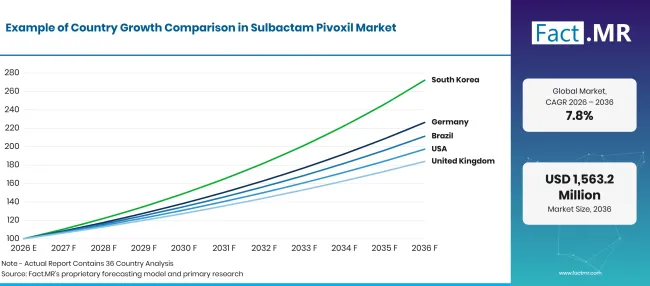
Sulbactam Pivoxil Market Growth Index | Source: Fact.MR
| Country | CAGR (2026 to 2036) |
|---|---|
| Germany | 8.5% |
| Brazil | 7.8% |
| United States | 7.0% |
| United Kingdom | 6.3% |
| Japan | 5.6% |
Source: Fact.MR analysis. Updated Nov 4, 2026
What supports sulbactam pivoxil adoption in Germany?
8.5% CAGR, supported by hospital resistance surveillance that steers penicillin combination choices.
The Robert Koch Institute published its 2025 surveillance results in September 2026, drawing on 126 laboratories for resistance data and 593 hospitals for consumption data [7]. Hospital antibiotic consumption in 2025 stayed largely unchanged from 2024, and the national goal is a 9% cut in total use by 2030 against 2019. German wards favour targeted penicillin combinations as they work toward that goal.
How is Brazil developing demand?
7.8% CAGR, backed by a national infection control programme running from 2026 to 2030.
Anvisa approved the National Programme for Prevention and Control of Healthcare-Related Infections on 6 February 2026, covering 2026 to 2030 [8]. The plan expands surveillance of healthcare infections and antimicrobial resistance across all levels of care. Laboratórios Bagó do Brasil already registers Trifamox IBL tablets and suspensions locally, giving hospitals a familiar oral product.
What is supporting United States adoption?
7.0% CAGR, helped by near-universal hospital stewardship programmes.
CDC data show that 97.5% of US hospitals met all seven Core Elements of antibiotic stewardship in 2024, up from 40.9% in 2014 [9]. Programmes at that scale review every broad-spectrum order, which creates room for oral step-down agents. Growth relies on future registration, since sulbactam pivoxil combinations are not yet widely marketed in the country, and demand overlaps with the wider antibiotics category.
How is the United Kingdom scaling demand?
6.3% CAGR, reflecting close monitoring of national antibiotic use.
The UKHSA dashboard recorded total antibiotic consumption of 17.7 defined daily doses per 1,000 inhabitants per day for the month ending 31 December 2025 [10]. Resistant bloodstream infections in England rose 9.3% to 20,484 cases in 2024 [11]. Those two trends push hospital prescribers toward protected penicillins under strict review.
How does Japan perform?
5.6% CAGR, as stewardship guidance limits routine oral antibiotic use.
The Ministry of Health, Labour and Welfare issued the fourth edition of its Manual for Antimicrobial Stewardship on 16 January 2026, adding a dental section [12]. Guidance of this kind narrows outpatient antibiotic use, so demand in Japan centres on hospital cases with confirmed beta-lactamase producers. Interest in alternatives to macrolide antibiotics for respiratory infections also supports penicillin combinations.
Who leads the Sulbactam Pivoxil Market?
Competition splits into two groups. Finished-dose producers in Latin America hold most of the branded revenue, and Laboratorios Bagó stands out with Trifamox IBL tablets, suspensions and the Trifamox IBL Duo line. Bagó updated its Trifamox IBL tablet leaflet in January 2026 with hospital packs of 500 and 1,000 tablets [4], and its Duo leaflet sets a twice-daily 875 mg and 125 mg dose [5]. These brands win on prescriber familiarity, wide strength ranges and hospital supply contracts.
The second group supplies the ester itself as API, reference standard and research material. Clearsynth and Chemicea list sulbactam pivoxil with certificates of analysis for quality control work, while Selleck Chemicals, TargetMol and MedChemExpress supply it for laboratory research. These firms compete on purity data, impurity profiles and delivery speed. Over the forecast period, success will hinge on registration in new countries and on proof of ester stability in tropical climates.
Which companies are the key providers?
Key companies in the Sulbactam Pivoxil Market include Laboratorios Bagó, Clearsynth, Chemicea, Selleck Chemicals, TargetMol and MedChemExpress.
- Laboratorios Bagó
- Clearsynth
- Chemicea
- Selleck Chemicals
- TargetMol
- MedChemExpress
Bibliography
- [1] World Health Organization. (2025, October 13). WHO warns of widespread resistance to common antibiotics worldwide.
- [2] World Health Organization. (2025, September 5). WHO updates list of essential medicines to include key cancer, diabetes treatments.
- [3] European Centre for Disease Prevention and Control. (2025, November 18). Antimicrobial consumption in the EU/EEA (ESAC-Net): Annual Epidemiological Report 2024.
- [4] Laboratorios Bagó. (2026, January 15). Trifamox IBL 500 and 1.000 comprimidos recubiertos: prospecto.
- [5] Laboratorios Bagó. (2025). Trifamox IBL Dúo comprimidos recubiertos: prospecto.
- [6] UK Health Security Agency. (2026, May 13). ESPAUR report 2024 to 2025: extended summary.
- [7] Robert Koch Institute. (2026, September 9). Neue RKI-Daten zu Antibiotikaresistenzen und -verbrauch.
- [8] Agência Nacional de Vigilância Sanitária. (2026, February 6). Anvisa aprova programa nacional de prevenção e controle de infecções em serviços de saúde.
- [9] Centers for Disease Control and Prevention. (2026, March 26). CDC Antibiotic Stewardship Updates.
- [10] UK Health Security Agency. (2026, May 29). Total antibiotic use.
- [11] UK Health Security Agency. (2025, November 13). Nearly 400 antibiotic-resistant infections each week in 2024.
- [12] Ministry of Health, Labour and Welfare. (2026, January 16). Manual for Antimicrobial Stewardship, Fourth Edition.
This Report Answers
- How is sulbactam pivoxil revenue split across tablets, capsules and other dosage forms?
- Why do hospital pharmacies carry half of 2026 value, and where do retail and online channels gain?
- Which hospital and clinic settings generate demand for oral sulbactam combinations?
- How do growth rates differ across Germany, Brazil, the United States, the United Kingdom and Japan?
- Which finished-dose and API suppliers shape competition?
- How do stewardship rules, product registration and competing inhibitor combinations affect demand through 2036?
What does the Sulbactam Pivoxil Market cover?
This study values sales of sulbactam pivoxil in oral finished-dose form, mainly fixed combinations with amoxicillin, along with the active ingredient sold to formulators. Tablets, capsules and suspensions are tracked across hospital, retail and online pharmacy channels.
Revenue is measured at manufacturer selling prices in USD million. For fixed combinations, only the value tied to the sulbactam pivoxil component counts toward the total.
What is included in the scope?
Amoxicillin and sulbactam pivoxil tablets and film-coated tablets for adult dosing.
Oral suspensions and dry powders for paediatric and adult use.
Sulbactam pivoxil active ingredient sold to finished-dose manufacturers and contract formulators.
Reference standards and analytical grades sold for quality control of registered products.
What is excluded from the scope?
Injectable sulbactam sodium products, including amoxicillin or ampicillin with sulbactam vials.
Sultamicillin tosilate, a separate mutual prodrug of ampicillin and sulbactam.
Sulbactam with durlobactam and other intravenous inhibitor combinations.
Amoxicillin with clavulanate and other beta-lactamase inhibitor combinations without sulbactam.
How Was the Analysis Built?
The analysis draws on 120+ sources, 35+ company portfolios, 25+ countries, and more than 20 industry interviews.
- Primary Research: Primary research includes discussions with manufacturers, service providers, technology developers, distributors, end users, and subject-matter experts. These conversations examine purchasing priorities, product adoption, operational challenges, approval requirements, competitive positioning, and the factors that influence wider market acceptance.
- Desk Research: Desk research covers government statistics, regulatory publications, company filings, trade data, technical studies, industry associations, standards, public policy, and other authoritative sources. Every source used in the analysis is documented in the bibliography.
- Market Sizing and Forecasting: Market estimates combine historical performance, demand indicators, pricing and volume trends, segment shares, company participation, country-level growth, adoption patterns, investment activity, and barriers to market expansion.
- Data Validation and Update Cycle: Findings are validated by comparing primary interviews with public data, company activity, regulatory changes, trade patterns, and industry developments. Regular updates review new product launches, capacity changes, partnerships, approvals, and shifts in commercial adoption.
Segmentation
What is the report’s scope and coverage?
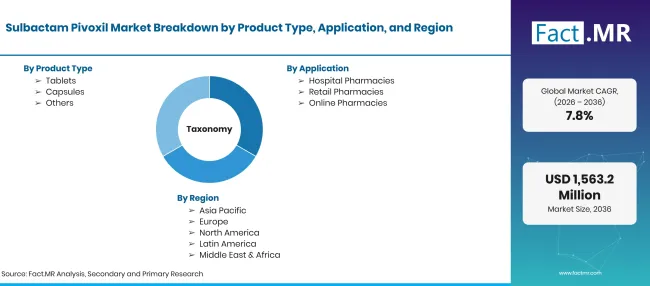
Sulbactam Pivoxil Market Taxonomy | Source: Fact.MR
| Attribute | Details |
|---|---|
| Quantitative Units | USD million |
| Market Definition | Oral finished-dose products and active ingredient containing sulbactam pivoxil, the ester prodrug of the beta-lactamase inhibitor sulbactam. |
| Product Type | Tablets; Capsules; Others |
| Application | Hospital Pharmacies; Retail and Online Pharmacies |
| End-User | Hospitals; Clinics; Others |
| Regions Covered | North America; Latin America; Western Europe; Eastern Europe; East Asia; South Asia & Pacific; Middle East & Africa |
| Countries Covered | Germany; Brazil; United States; United Kingdom; Japan |
| Companies Profiled | Laboratorios Bagó; Clearsynth; Chemicea; Selleck Chemicals; TargetMol; MedChemExpress |
| Forecast Period | 2026 to 2036 |
| Approach | Product registrations, hospital dispensing patterns and stewardship data were combined with manufacturer interviews to build demand by dosage form and channel. |
Source: Fact.MR analysis. Updated Nov 4, 2026
How is the market segmented?
-
By Product Type
- Tablets
- Capsules
- Others
-
By Application
- Hospital Pharmacies
- Retail and Online Pharmacies
-
By End-User
- Hospitals
- Clinics
- Others
-
By Region
- North America
- Latin America
- Western Europe
- Eastern Europe
- East Asia
- South Asia & Pacific
- Middle East & Africa
Frequently Asked Questions
How large is the sulbactam pivoxil market in 2026?
What growth rate will the sulbactam pivoxil market record?
Which product type leads?
Which application leads?
Which end-user leads?
Which country will grow quickest?
Who are the main companies?
What holds the market back?
Who worked on this report


Preview the report firsthand - request a free sample
Free SampleGet the brochure for pricing and purchase details
Download PDF