- Market Value (2025): USD 41.4 Bn
- Estimated Value (2026): USD 44.0 Bn
- Forecast Value (2036): USD 81.5 Bn
- CAGR (2026-2036): 6.4%
What is the Commercial Aero Turbofan Engine Market forecast to be worth by 2036?
USD 44.0 billion in 2026 to USD 81.5 billion by 2036, at a 6.4% CAGR.
- According to Fact.MR analysis, the market was valued at USD 41.4 billion in 2025.
- Sales are projected to rise from USD 44.0 billion in 2026 to USD 81.5 billion by 2036.
- A 6.4% CAGR is projected from 2026 to 2036, supported by new engine programs and ongoing maintenance.
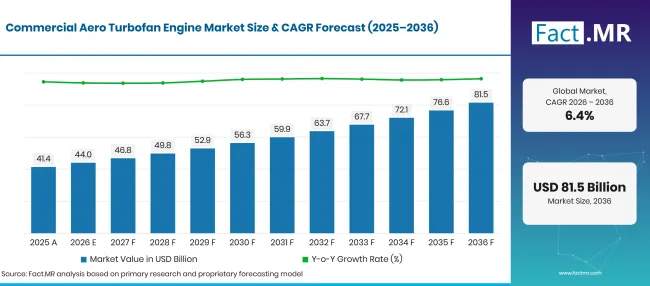
Commercial Aero Turbofan Engine Market Forecast Global | Source: Fact.MR
| Year | Basis | Market Value (USD billion) |
|---|---|---|
| 2025 | Actual | 41.4 |
| 2026 | Estimate | 44.0 |
| 2036 | Forecast | 81.5 |
| CAGR 2026 to 2036 | Forecast period | 6.4% |
Source: Fact.MR analysis. Updated Nov 10, 2026
What are the defining numbers behind Commercial Aero Turbofan Engine Market growth?
The projected increase is USD 37.5 billion between 2026 and 2036.
- Demand Drivers in the Market
- New aircraft production generates orders for original-equipment engines. Airbus delivered 793 commercial aircraft in 2025 and ended the year with an order backlog of 8,754 aircraft [1].
- Engine spending continues after the aircraft is delivered. GE Aerospace reported that its commercial engine service activity benefited from increased shop visits during 2025 [3].
- Airlines buying narrow-body aircraft evaluate fuel use alongside engine reliability. Fleet planners compare installed engines with alternative aircraft families and consider maintenance access across their route networks.
- Key Segments Analyzed
- By Engine Type: High Bypass accounts for 72.8% of 2026 market value since its fuel-saving design suits subsonic passenger routes.
- By Application: Commercial Aviation leads with 68.5% of 2026 market value since airline fleets account for the core revenue boundary.
- By Aircraft Type: Narrow-body captures 58.4% of 2026 market value since single-aisle aircraft operate frequent services.
- By Thrust Class: Medium Thrust represents 54.2% of 2026 market value since narrow-body fleets require this performance band.
- By End-User: Aftermarket holds 72.0% of 2026 market value since airlines purchase maintenance and replacement support across long engine lives.
- Analyst Opinion at Fact.MR
- Shambhu Nath Jha, Principal Consultant at Fact.MR, states, “Commercial turbofan demand is shaped by both new aircraft deliveries and the maintenance needs of engines already in service. Airlines compare fuel efficiency, durability, shop turnaround time and spare-engine availability when selecting an engine family.”
- Strategic Implications
- Engine original equipment manufacturers can align output plans with individual airframe production schedules and committed engine options.
- Airlines need to compare the complete service package when choosing an engine family, including turnaround commitments and access to spare engines.
- Maintenance providers benefit from concentrating on approved repair capability and dependable component access for engine families already in their service base.
- Aircraft lessors can assess maintenance reserve terms alongside engine condition when evaluating the financial performance of leased fleets.
Brazil is projected to record a 7.9% CAGR through 2036, followed by the United States at 7.3%.
How does the Commercial Aero Turbofan Engine Market break down by segment?
High Bypass leads at 72.8%; Commercial Aviation holds 68.5%; Narrow-body accounts for 58.4%.
Which Engine Type dominates?
High Bypass accounts for 72.8% of 2026 market value.
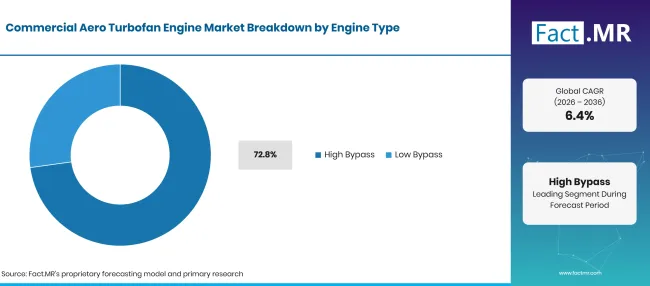
Commercial Aero Turbofan Engine Market Breakdown Engine Type | Source: Fact.MR
| Segment | Share (2026) |
|---|---|
| High Bypass (Leading segment) | 72.8% |
| Other segments combined | 27.2% |
| Total | 100.0% |
Source: Fact.MR analysis. Updated Nov 10, 2026
High-bypass turbofan engines direct much of the incoming air around the engine core. This design supports efficient propulsion for subsonic passenger aircraft, making it an important option across modern commercial fleets. Operators still compare the engine with the aircraft model, operating requirements and available maintenance arrangements.
What leads the Application segment?
Commercial Aviation leads with 68.5% of 2026 market value.
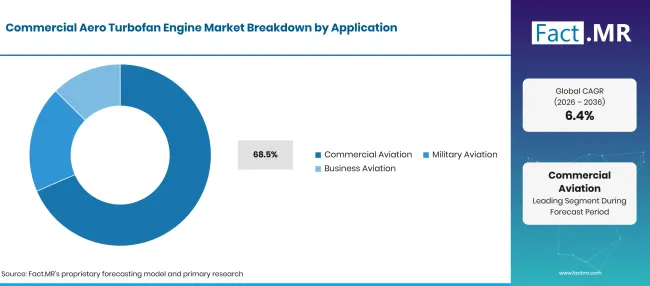
Commercial Aero Turbofan Engine Market Breakdown Application | Source: Fact.MR
| Segment | Share (2026) |
|---|---|
| Commercial Aviation (Leading segment) | 68.5% |
| Other segments combined | 31.5% |
| Total | 100.0% |
Source: Fact.MR analysis. Updated Nov 10, 2026
Airlines account for the largest application share because new aircraft require approved engines and active fleets need continuing technical support. Engine suppliers serve both aircraft production programs and the fleets that continue flying for many years.
How does Aircraft Type shape demand?
Narrow-body represents 58.4% of 2026 market value.
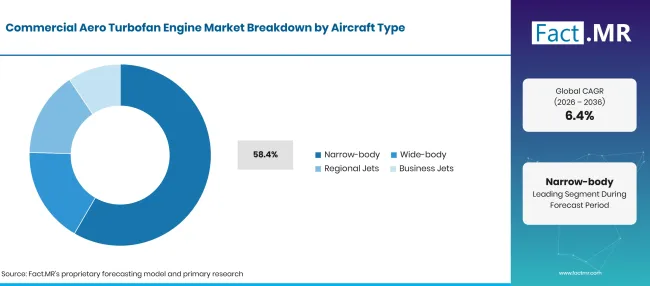
Commercial Aero Turbofan Engine Market Breakdown Aircraft Type | Source: Fact.MR
| Segment | Share (2026) |
|---|---|
| Narrow-body (Leading segment) | 58.4% |
| Other segments combined | 41.6% |
| Total | 100.0% |
Source: Fact.MR analysis. Updated Nov 10, 2026
Narrow-body aircraft operate short and medium-distance services and often make several flights in a day. Their engines experience frequent takeoffs as well as regular maintenance checks. Engines already in service generate recurring maintenance work. Wide-body aircraft use different thrust requirements and often accumulate long flight sectors. Regional jets and business jets are smaller categories with their own approved engine families. Boeing reported 447 deliveries of the 737 family during 2025 in its January 2026 annual results [2].
What is the principal Thrust Class?
Medium Thrust holds 54.2% of 2026 market value.
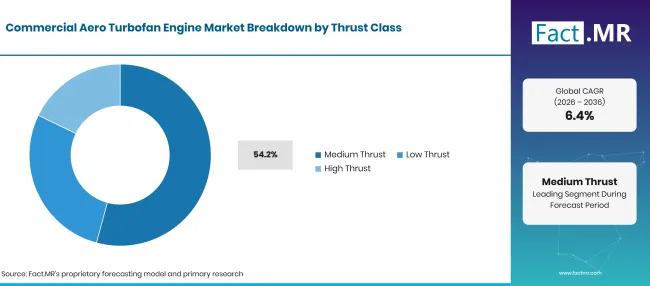
Commercial Aero Turbofan Engine Market Breakdown Thrust Class | Source: Fact.MR
| Segment | Share (2026) |
|---|---|
| Medium Thrust (Leading segment) | 54.2% |
| Other segments combined | 45.8% |
| Total | 100.0% |
Source: Fact.MR analysis. Updated Nov 10, 2026
Medium-thrust engines serve a substantial portion of the narrow-body aircraft fleet. The aircraft manufacturer establishes the thrust requirement during design, taking account of operating weight and the performance needed on intended routes. Engine selection must meet those aircraft-specific requirements rather than a general category label.
Which End-User accounts for more spending?
Aftermarket captures 72.0% of 2026 market value.
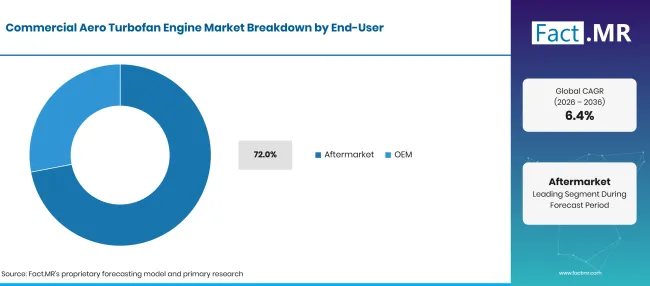
Commercial Aero Turbofan Engine Market Breakdown End User | Source: Fact.MR
| Segment | Share (2026) |
|---|---|
| Aftermarket (Leading segment) | 72.0% |
| Other segments combined | 28.0% |
| Total | 100.0% |
Source: Fact.MR analysis. Updated Nov 10, 2026
Aftermarket revenue includes support required after engine delivery. Airlines need replacement components and approved shop work to return engines to service safely. Engine manufacturers also sign long-term service agreements that connect revenue to operating activity. Rolls-Royce reported 20.0 million Civil Aerospace long-term service agreement engine flying hours in 2025, split between 17.0 million large-engine hours and 3.0 million business aviation and regional-engine hours [4].
What is accelerating Commercial Aero Turbofan Engine Market adoption, and what is holding it back?
Airline fleet renewal supports new-engine orders, while certified-part availability and maintenance-shop capacity influence how quickly aircraft can enter or return to service.
Drivers Impact Analysis
| Driver | (~) % Impact on CAGR | Geographic Relevance | Impact Timeline |
|---|---|---|---|
| Airline fleet renewal and aircraft deliveries | +1.3% | Global | Short term (≤ 2 years) |
| Long-life engine service agreements | +1.0% | North America; Europe | Long term (≥ 4 years) |
| Narrow-body route activity | +0.8% | Global | Medium term (2–4 years) |
| Engine durability upgrades | +0.6% | Global | Medium term (2–4 years) |
| Spare-engine and replacement demand | +0.5% | Global | Short term (≤ 2 years) |
Source: Fact.MR analysis. Updated Nov 10, 2026
Opportunity Impact Analysis
| Opportunity | (~) % Impact on CAGR | Geographic Relevance | Impact Timeline |
|---|---|---|---|
| Expansion of approved engine overhaul capacity | +0.8% | Americas; Asia Pacific | Medium term (2–4 years) |
| Higher on-wing engine durability | +0.6% | Global | Long term (≥ 4 years) |
| Parts repair and component availability | +0.4% | North America; Europe | Medium term (2–4 years) |
| Regional service coverage for airlines | +0.3% | Latin America; Asia Pacific | Long term (≥ 4 years) |
Source: Fact.MR analysis. Updated Nov 10, 2026
Restraints Impact Analysis
| Restraint | (~) % Impact on CAGR | Geographic Relevance | Impact Timeline |
|---|---|---|---|
| Certified parts supply bottlenecks | -0.7% | Global | Short term (≤ 2 years) |
| Long engine shop turnaround times | -0.5% | Global | Medium term (2–4 years) |
| Engine durability and inspection pressures | -0.4% | Global | Medium term (2–4 years) |
| Airline capital and fleet planning limits | -0.3% | Global | Long term (≥ 4 years) |
Source: Fact.MR analysis. Updated Nov 10, 2026
Which countries are scaling the Commercial Aero Turbofan Engine Market through 2036?
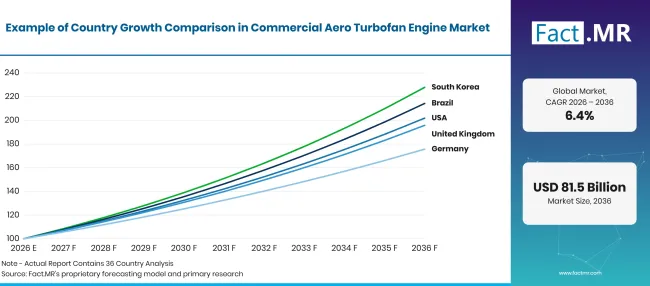
Commercial Aero Turbofan Engine Market Growth Index | Source: Fact.MR
| Country | CAGR (2026 to 2036) |
|---|---|
| Brazil | 7.9% |
| United States | 7.3% |
| United Kingdom | 7.0% |
| Germany | 5.8% |
| Japan | 5.3% |
Source: Fact.MR analysis. Updated Nov 10, 2026
What supports Brazil’s commercial turbofan demand?
7.9% CAGR, supported by high passenger volumes, extensive domestic routes and demand for spare-engine and maintenance support.
Brazil’s commercial turbofan market is shaped by busy domestic flight networks and the ability of airlines to maintain aircraft between scheduled services. The Ministry of Ports and Airports reported in January 2026 that Brazilian aviation carried 129.6 million domestic and international passengers in 2025 [7]. Airlines also consider the availability of spare engines when planning routes across a large national network.
How is the United States shaping turbofan sales?
7.3% CAGR, driven by large airline fleets, recurring engine maintenance and certified component demand.
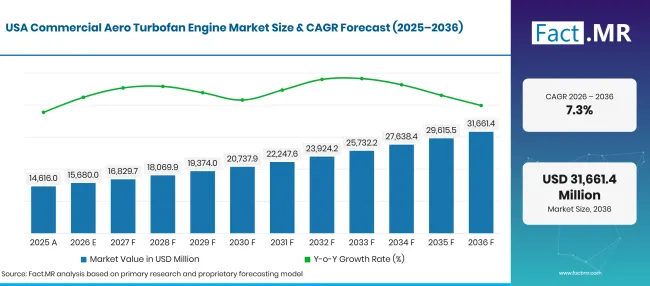
Commercial Aero Turbofan Engine Market Forecast Usa | Source: Fact.MR
Airline fleets in the United States create substantial business for engine manufacturers and approved maintenance organizations. The Bureau of Transportation Statistics reported in September 2026 that U.S. airlines carried 87.5 million passengers in June 2026 [9]. Maintenance workshops must also plan for qualified technicians and the delivery of certified replacement components, particularly when several operators use the same engine family.
What supports the United Kingdom’s engine service market?
7.0% CAGR, supported by international airline activity and strong commercial engine service capability.
The United Kingdom combines commercial engine engineering capability with airline activity that extends across international routes. The UK Civil Aviation Authority reported in February 2026 that 302 million passenger journeys passed through UK airports during 2025 [5]. Rolls-Royce’s service network also links UK-based engineering work to airlines operating in other countries, so local business extends beyond aircraft registered in Britain.
How does Germany contribute to turbofan demand?
5.8% CAGR, linked to aerospace manufacturing, airport traffic and maintenance activity.
Germany’s commercial turbofan activity combines specialized aerospace manufacturing with maintenance services connected to international airline fleets. The Federal Statistical Office reported in January 2026 that German main airports handled approximately 207.2 million passengers in 2025 [8]. Production timing depends on certified components and the delivery plans of aircraft manufacturers.
What is shaping Japan’s commercial engine market?
5.3% CAGR, supported by frequent domestic flying and participation in international engine supply programs.
Japanese airlines operate frequent domestic services while the country’s aerospace manufacturers contribute to international engine programs. The Ministry of Land, Infrastructure, Transport and Tourism reported in June 2026 that Japan carried 112.50 million scheduled domestic air passengers in fiscal 2025 [6]. Japanese manufacturers also work within approved engine supply chains where technical standards govern parts and production methods.
Who leads the Commercial Aero Turbofan Engine Market?
The Commercial Aero Turbofan Engine Market is led by a relatively small group of engine manufacturers and program partners with established aircraft approvals, large installed fleets and long-term service networks. GE Aerospace, Rolls-Royce, Pratt & Whitney and CFM International hold prominent positions through major commercial engine families used across narrow-body and wide-body aircraft.
Competition extends beyond the original engine sale. Aftermarket maintenance, shop visits, replacement components and long-term service agreements are important because engines remain in operation for many years. This gives manufacturers with strong maintenance capacity and broad airline support networks an advantage over suppliers focused only on new deliveries.
Safran Aircraft Engines also plays a central role through its participation in CFM International and wider commercial engine activities. MTU Aero Engines contributes to international engine programs while maintaining a significant commercial maintenance presence. International Aero Engines remains relevant through the V2500 family and its installed base.
Which companies are the key providers?
Key companies include GE Aerospace, Rolls-Royce Holdings plc, Pratt & Whitney, CFM International, Honeywell Aerospace Technologies, Safran Aircraft Engines, MTU Aero Engines AG, and International Aero Engines AG.
- GE Aerospace
- Rolls-Royce Holdings plc
- Pratt & Whitney
- CFM International
- Honeywell Aerospace Technologies
- Safran Aircraft Engines
- MTU Aero Engines AG
- International Aero Engines AG
Bibliography
- [1] Airbus. (2026, January 12). Airbus reports 793 commercial aircraft deliveries in 2025.
- [2] The Boeing Company. (2026, January 27). Boeing reports fourth quarter results.
- [3] GE Aerospace. (2026, January 22). GE Aerospace announces fourth quarter 2025 results.
- [4] Rolls-Royce Holdings plc. (2026, February 26). Rolls-Royce Holdings plc 2025 full year results.
- [5] UK Civil Aviation Authority. (2026, February 24). UK aviation officially breaks records with over 300m passenger journeys in 2025.
- [6] Ministry of Land, Infrastructure, Transport and Tourism. (2026, June 30). 航空輸送統計年報(令和7年度(2025年度)分)概要 [Summary of Air Transport Statistics Annual Report, FY2025].
- [7] Ministry of Ports and Airports, Brazil. (2026, January 19). Aviação civil registra recordes históricos em 2025 e consolida bases para novo ciclo de crescimento em 2026.
- [8] Statistisches Bundesamt (Destatis). (2026, January 29). 3,9 % mehr Fluggäste im Jahr 2025 als im Vorjahr.
- [9] Bureau of Transportation Statistics. (2026, September 14). June 2026 U.S. airline traffic data down 1.4% from the same month last year.
This Report Answers
- How original-engine demand differs from later maintenance work and why the two spending streams follow different schedules.
- Which commercial aircraft and thrust classes account for the stated segment mix, with an explanation of how engine choice relates to aircraft design.
- How the five country growth rates compare and where their airlines and aerospace operations create different service requirements.
- Which engine manufacturers, program partners and maintenance businesses operate within the competitive landscape.
- What supply availability, durability work and repair capacity mean for airline fleet planning.
What does the Commercial Aero Turbofan Engine Market cover?
The analysis covers the original sale of commercial turbofan engines and their related life-cycle support. Readers researching the wider aircraft engines category should distinguish passenger aircraft from military and other propulsion types.
Turbofan sales also depend on the wider commercial aircraft manufacturing activity because an engine is approved for a specific aircraft program. The engine choice becomes part of the operating and service relationship for that fleet.
What is included in the scope?
The report includes airline turbofans installed on narrow-body and wide-body aircraft.
It also includes compatible business-jet turbofans where relevant and engine aftermarket services such as approved shop visits and replacement components. Specialized workshop equipment affects maintenance capacity but falls outside the engine revenue boundary.
What is excluded from the scope?
The commercial revenue boundary excludes military-only powerplants and standalone turboprop engines.
Airframe sales and airport infrastructure spending are also outside the measured engine market. Fuel purchase costs form an airline operating expense and are treated separately from engines.
How Was the Analysis Built?
The analysis draws on 120+ sources, 35+ company portfolios, 25+ countries, and more than 20 industry interviews.
- Primary Research: Primary research includes discussions with manufacturers, service providers, technology developers, distributors, end users, and subject-matter experts. These conversations examine purchasing priorities, product adoption, operational challenges, approval requirements, competitive positioning, and the factors that influence wider market acceptance.
- Desk Research: Desk research covers government statistics, regulatory publications, company filings, trade data, technical studies, industry associations, standards, public policy, and other authoritative sources. Every source used in the analysis is documented in the bibliography.
- Market Sizing and Forecasting: Market estimates combine historical performance, demand indicators, pricing and volume trends, segment shares, company participation, country-level growth, adoption patterns, investment activity, and barriers to market expansion.
- Data Validation and Update Cycle: Findings are validated by comparing primary interviews with public data, company activity, regulatory changes, trade patterns, and industry developments. Regular updates review new product launches, capacity changes, partnerships, approvals, and shifts in commercial adoption.
Segmentation
What is the report’s scope and coverage?
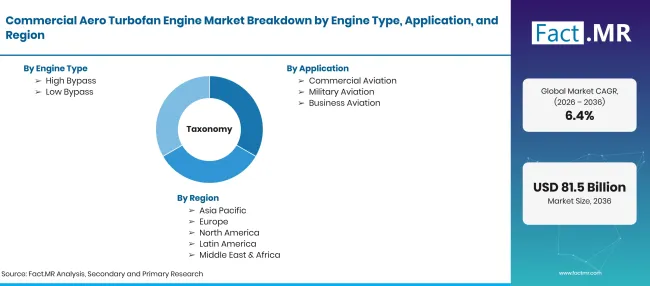
Commercial Aero Turbofan Engine Market Taxonomy | Source: Fact.MR
| Attribute | Details |
|---|---|
| Quantitative Units | USD billion |
| Market Definition | Commercial aviation turbofan engines and associated life-cycle engine support; business jet turbofans included where applicable. |
| Engine Type | High Bypass; Low Bypass |
| Application | Commercial Aviation; Military Aviation; Business Aviation (military shown for taxonomy comparison, outside commercial revenue scope) |
| Aircraft Type | Narrow-body; Wide-body; Regional Jets; Business Jets |
| Thrust Class | Medium Thrust; Low Thrust; High Thrust |
| End-User | Aftermarket; OEM |
| Regions Covered | North America; Latin America; Western Europe; Eastern Europe; East Asia; South Asia & Pacific; Middle East & Africa |
| Countries Covered | Brazil; United States; United Kingdom; Germany; Japan |
| Companies Profiled | GE Aerospace, Rolls-Royce Holdings plc, Pratt & Whitney, CFM International, Honeywell Aerospace Technologies, Safran Aircraft Engines, MTU Aero Engines AG, and International Aero Engines AG |
| Forecast Period | 2026 to 2036 |
| Approach | Aircraft delivery and installed-fleet demand analysis, supported by engine output and service activity indicators |
Source: Fact.MR analysis. Updated Nov 10, 2026
How is the market segmented?
-
By Engine Type
- High Bypass
- Low Bypass
-
By Application
- Commercial Aviation
- Military Aviation
- Business Aviation
-
By Aircraft Type
- Narrow-body
- Wide-body
- Regional Jets
- Business Jets
-
By Thrust Class
- Medium Thrust
- Low Thrust
- High Thrust
-
By End-User
- Aftermarket
- OEM
-
By Region
- North America
- Latin America
- Western Europe
- Eastern Europe
- East Asia
- South Asia & Pacific
- Middle East & Africa
Frequently Asked Questions
How big is the Commercial Aero Turbofan Engine Market in 2026?
What is the CAGR of the Commercial Aero Turbofan Engine Market from 2026 to 2036?
Which engine type leads the Commercial Aero Turbofan Engine Market?
Which application leads the Commercial Aero Turbofan Engine Market?
Companies listed in the report include GE Aerospace, Rolls-Royce Holdings plc, Pratt & Whitney, CFM International, Honeywell Aerospace Technologies, Safran Aircraft Engines, MTU Aero Engines AG, and International Aero Engines AG.
Who worked on this report


Preview the report firsthand - request a free sample
Free SampleGet the brochure for pricing and purchase details
Download PDF