- Base Value(2026): 6.3 Bn
- Estimated Value(2026): 6.3 Bn
- Forecast Value (2036): 9.8 Bn
- CAGR (2026 - 2036): 4.5%
Commercial Laundry Detergent Market Forecast and Outlook 2026 to 2036
The commercial laundry detergent market is projected to grow at a CAGR of 4.5% from 2026 to 2036, expanding from USD 6.3 billion to USD 9.8 billion.
Summary of Commercial Laundry Detergent Market - Key Takeaways
- The market includes powder detergents, liquid concentrates, single-dose packs, and other formulation types designed for commercial washing operations.
- The defined scope covers revenue generated by detergent type, end-use laundry sector, wash system integration, and performance positioning across global markets.
- The commercial laundry detergent market is projected to grow at a CAGR of 4.5% from 2026 to 2036, expanding from USD 6.3 billion to USD 9.8 billion based on Fact.MR forecasting.
- Liquid detergents lead the formulation segment with a 46% share in 2026, supported by compatibility with automated dosing systems and superior dissolution characteristics.
- Auto-dosed systems account for 48% of total demand, as operators seek labor efficiency and consistent performance across high-volume commercial operations.
- China records the fastest growth at 5.5% CAGR, supported by Healthy China 2030 roadmap driving healthcare and hospitality laundry infrastructure expansion.
- Competition is led by major players such as Ecolab, Diversey, Henkel, Procter & Gamble Professional, Unilever Professional, Kao Corporation, Reckitt, Zep, Spartan Chemical, and Betco.
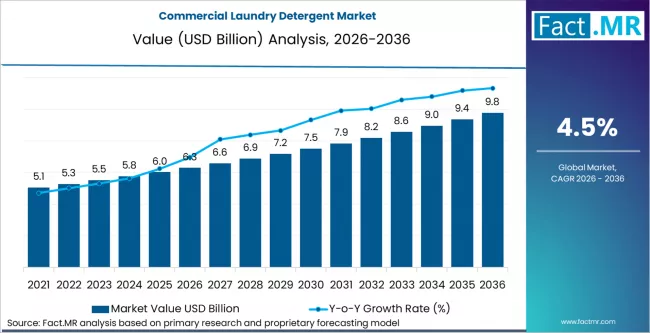
Commercial Laundry Detergent Market Market Value Analysis | Source: Fact.MR
Commercial laundry detergents have quietly become the backbone of cleanliness across hotels, hospitals, and industrial sites. In hospitality, thousands of pounds of sheets and towels move through washers every day, and guests expect them to feel soft, bright, and fresh every single time. In healthcare settings, the stakes are even higher, linens must meet strict disinfection standards that regular store-bought detergents simply can’t achieve. Meanwhile, industrial facilities depend on heavy-duty formulas that remove grease and grime without weakening flame-retardant or technical fabrics.
Beyond cleaning power, efficiency is driving change. Many facilities now use auto-dosed liquid systems that measure detergent automatically, reducing human error and cutting waste. These systems sync with washing machines, adjusting formulas based on soil levels and water temperature. High-efficiency detergents also perform well in cold water, helping facilities reduce energy use by up to 40%.
Regulations are reshaping the industry, too. European microplastic bans and U.S. water scarcity concerns push manufacturers toward biodegradable, low-water solutions. As Christophe Beck explains, operators increasingly seek integrated solutions combining chemistry, equipment, and data to improve sustainability, productivity, and long-term cost savings.
Commercial Laundry Detergent Market
| Metric | Value |
|---|---|
| Estimated Value in (2026) | USD 6.3 billion |
| Forecast Value in (2036) | USD 9.8 billion |
| Forecast CAGR (2026 to 2036) | 4.5% |
Source: Fact.MR analysis. Updated Feb 12, 2026
Category
| Category | Segments |
|---|---|
| Detergent Type | Powder Detergents, Liquid Detergents, Single-Dose Packs, Other Types |
| End-Use Laundry Sector | Hospitality & Linen Services, Healthcare Laundry, Industrial Workwear Laundry, Institutional Laundry |
| Wash System | Auto-Dosed Systems, Manual Dosing, Cartridge/Closed-Loop, Other Systems |
| Performance Positioning | High-Efficiency / Low-Temp, Bleach-Compatible Systems, Enzyme-Enhanced Systems, Standard Commercial |
| Region | North America; Europe; Asia Pacific; Latin America; Middle East & Africa |
Source: Fact.MR analysis. Updated Feb 12, 2026
Segmental Analysis
Why Do Liquid Detergents Hold a 46% Market Share?
Liquid detergents dominate the commercial laundry market for one simple reason: they make operations easier and more reliable. They dissolve completely even in cold water so there’s no residue left on fabrics or buildup inside washing machines. That’s especially important in hard water conditions, where powders can sometimes clump or leave deposits over time. They also work perfectly with automated dosing systems. Instead of relying on staff to measure chemicals manually, liquid detergents are fed directly into machines in precise amounts based on water hardness, soil level, and fabric type. This removes guesswork and ensures consistent cleaning results across every shift. There are practical advantages, too. Concentrated liquid formulas reduce shipping weight and storage space. They’re cleaner to handle than powders, which can create dust and pose respiratory concerns during pouring. For facility managers focused on efficiency, safety, and consistency, liquid simply makes sense.
Why Do Auto-Dosed Systems Lead with 48% Market Share?
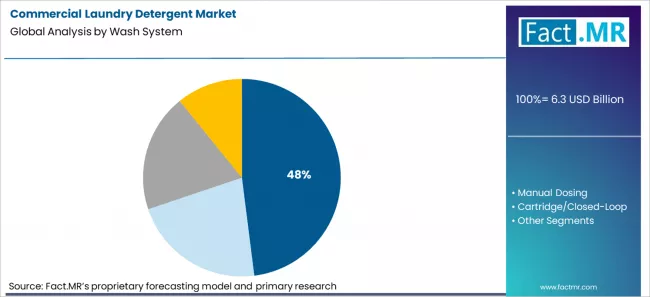
Commercial Laundry Detergent Market Analysis By Wash System | Source: Fact.MR
Auto-dosing systems have become standard in high-volume laundry operations because they eliminate human error. These systems connect directly to detergent containers and automatically inject the right amount of chemistry for each wash cycle. In facilities processing thousands of pounds of linen daily, even small dosing errors can add up to major costs. Automated systems prevent overuse of chemicals, reduce waste, and improve sustainability metrics. They also free up staff from repetitive measuring tasks, allowing them to focus on higher-value responsibilities. Because these systems integrate with wash programs, temperature sensors, and even soil detection technology, they deliver a level of precision that manual dosing simply can’t match. The result is consistent cleaning performance and better control over operating costs.
Market Drivers
- Drivers: Several forces are shaping the commercial laundry market today. Water scarcity particularly in the Southwest United States and parts of the Middle East is pushing innovation in zero-rinse chemistry that saves thousands of gallons daily. Rising labor costs, up roughly 15% over the past three years, are accelerating adoption of automation. Healthcare facilities face strict infection control standards, requiring laundry systems that eliminate tough pathogens like Clostridioides difficile and MRSA. Meanwhile, as the hospitality industry rebounds, hotels are reinvesting in linen quality to meet guest expectations. Sustainability is also front and center. Buyers increasingly prefer concentrated, biodegradable formulas that reduce packaging waste and lower carbon footprints.
- Restraints: Despite the benefits, challenges remain. Automated dosing systems require upfront investment, which can be difficult for small independent operators. Some cold-water or biodegradable formulations may require process adjustments to match the performance of traditional hot-water systems. Modern technical textiles add complexity as well. Flame-retardant, moisture-wicking, and antimicrobial fabrics require specialized detergents to avoid damaging functional properties. On top of that, supply chain disruptions and raw material price swings create budgeting uncertainty. Competition from consumer-grade products marketed to small businesses also puts pressure on pricing.
- Trend 1: Digital Integration and IoT Monitoring The industry is becoming smarter. Internet-connected dispensing systems now allow remote monitoring of chemical usage, wash performance, and machine health. For example, Ecolab introduced its Smart Water Pro-Cycle Systems in January 2026, combining sensors and dashboard analytics accessible via mobile apps. Facility managers can receive alerts about unusual chemical consumption or equipment issues before they become costly problems. Data insights help optimize cycle programming, fine-tune chemical concentrations, and benchmark performance across multiple properties especially valuable for hotel chains and healthcare networks.
- Trend 2: Fiber-Specific Formulation Development As textiles become more advanced, detergents must evolve too. New fibers such as poly trimethylene terephthalate designed to combine durability with softness require carefully balanced, pH-neutral chemistries. In April 2025, LG Chem launched its K-Clean line targeting athletic wear and medical fabrics that demand gentle yet effective cleaning. Industrial workwear with flame-retardant finishes must maintain protective properties through repeated washes. Healthcare linens need antimicrobial performance without causing skin irritation. This shift toward specialized, fiber-specific solutions is creating opportunities for premium products that go beyond standard cotton and polyester care reflecting a broader move toward performance-driven, value-based purchasing in commercial laundry.
Commercial Laundry Detergent Market Analysis by Country
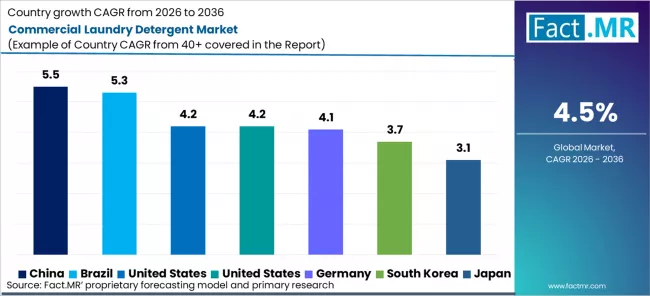
Commercial Laundry Detergent Market Cagr Analysis By Country | Source: Fact.MR
| Country | CAGR (2026 to 2036) |
|---|---|
| China | 5.5% |
| Brazil | 5.3% |
| United States | 4.2% |
| United Kingdom | 4.2% |
| Germany | 4.1% |
| South Korea | 3.7% |
| Japan | 3.1% |
Source: Fact.MR analysis. Updated Feb 12, 2026
Why is China emerging as a global growth leader in commercial laundry?
China leads with a 5.5% CAGR, fueled by healthcare and hospitality expansion under the Healthy China 2030 roadmap. Rapid urbanization has led to centralized laundry hubs serving major hotel chains and hospitals. Domestic players like Liby Group are accelerating the shift from powders to high-efficiency liquid pods compatible with automated systems. Government healthcare investment, a growing middle class, expanding hotel development in secondary cities, and strong e-commerce distribution channels all contribute to growth. Environmental regulations also promote biodegradable formulations and water-saving technologies.
Why is Brazil positioned as a high-growth opportunity?
Brazil is expanding at 5.3% CAGR, driven by tourism infrastructure and healthcare development. Hotel construction in major cities like Rio de Janeiro and São Paulo is increasing linen processing demand. Domestic producers are tailoring detergents to local water hardness and pricing realities, while international companies such as Procter & Gamble Professional are strengthening their local presence. Humid climate conditions also create demand for antimicrobial formulations. A growing middle class further boosts institutional laundry needs in education and corporate sectors.
What is fueling growth in the United States commercial laundry market?
The U.S. market is growing at a steady 4.2% CAGR, largely driven by the need to reduce labor costs and conserve water. Solutions like the Smart Water Pro-Cycle Systems introduced by Ecolab in January 2026 reflect this shift, helping operators automate dosing and monitor water usage more precisely. In drought-prone Southwest states, zero-rinse chemistries are especially valuable, saving thousands of gallons of water daily in hotel laundries. Hyper-concentrated liquid detergents also support sustainability goals by cutting water-heating energy use by up to 40%. At the same time, hospitality recovery is increasing linen volumes, while healthcare facilities continue to require validated disinfection processes. Ongoing labor shortages further encourage automation, and state-level water regulations continue shaping product innovation toward resource-efficient solutions.
What factors are influencing the United Kingdom market?
The UK is expanding at 4.2% CAGR, shaped by regulatory updates following Brexit. The Health and Safety Executive now requires updated GHS labeling for industrial biocidal detergents starting August 2026. Unilever Professional has responded by promoting non-pictogram bio-detergents that simplify COSHH compliance. Strong hygiene requirements in National Health Service facilities and renewed hospitality investment support growth. Market consolidation among professional laundries is also creating larger buyers focused on sustainability and comprehensive supplier partnerships.
What gives Germany a strategic edge in this market?
Germany is growing at 4.1% CAGR, supported by strong leadership in sustainable chemistry innovation. Companies such as Henkel AG have eliminated micro plastics and improved biodegradability across professional product lines. Corporate sustainability commitments particularly within automotive and advanced manufacturing sectors support demand for eco-certified detergents. The Blue Angel eco-label enhances premium positioning. Germany’s structured professional cleaning sector and focus on technical textiles also drive demand for specialized, fabric-safe formulations.
What is accelerating growth in South Korea?
South Korea is progressing at 3.7% CAGR, supported by rising demand for technical textile cleaning projected to reach USD 5.5 billion by 2030. In April 2025, LG Chem launched PTT-fiber-specific cleaning kits under its K-Clean line to protect high-performance athletic and medical fabrics. The country’s electronics manufacturing base sustains demand for cleanroom garment processing. Government procurement policies favor environmentally responsible products, while strong sports and textile industries encourage specialized fabric-care expertise.
How is Japan adapting to demographic and labor challenges?
Japan’s market grows at 3.1% CAGR, shaped by an aging population and labor shortages. Companies like Kao Corporation and Lion Corp have introduced ultra-compact, zero-rinse formats that reduce manual handling and machine wear. Cultural emphasis on cleanliness supports premium product adoption, even at higher price points. While infrastructure is mature, modernization through equipment replacement cycles continues. Japan’s leadership in specialty chemicals enables innovation suited to compact urban laundry facilities.
Competitive Landscape for Commercial Laundry Detergent Market
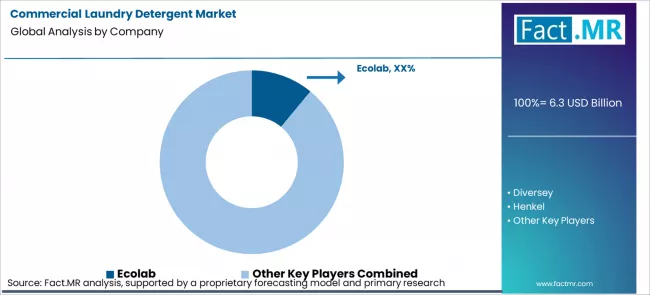
Commercial Laundry Detergent Market Analysis By Company | Source: Fact.MR
The commercial laundry detergent market is relatively consolidated, with a small group of multinational chemical companies competing alongside specialized professional suppliers that focus on targeted segments. Competition is less about basic cleaning performance and more about delivering measurable operational value to institutional customers.
Ecolab and Diversey differentiate themselves through fully integrated solution models. They combine detergents with automated dispensing systems, connected monitoring platforms, water management programs, and on-site technical service. This comprehensive approach appeals to large hotel chains, healthcare networks, and industrial laundries operating across multiple sites that require standardized processes and performance consistency. Their strategy focuses on optimizing total cost of ownership by reducing water consumption, energy use, chemical waste, and labor dependency through data-driven insights.
Henkel AG and Procter & Gamble Professional rely strongly on formulation expertise and global brand credibility. Their competitive advantage lies in advanced enzyme systems, surfactant innovation, and sustainability-driven reformulations. While they offer professional-grade products, integration with equipment and service platforms often depends on distributor partnerships rather than fully bundled systems. Regional players such as Unilever Professional and Kao Corporation emphasize regulatory compliance and sustainable chemistry innovation tailored to local market expectations. Companies including Zep Inc., Spartan Chemical, and Betco focus on janitorial distribution networks, serving small and mid-sized operators that prioritize flexible purchasing and local support.
Across the industry, competitive differentiation increasingly centers on sustainability credentials, cold-water performance, fiber-specific formulations, automated dosing compatibility, and digital analytics. The market is shifting from selling detergent as a standalone product toward delivering integrated performance solutions that improve efficiency, compliance, and environmental outcomes.
Recent Development
- In January 2026, Henkel AG marked its Persil Professional anniversary with a Net-Zero rollout, reformulating its German professional portfolio to meet sustainability goals. Ecolabel certifications now heavily influence procurement decisions.
Key Market Players in Commercial Laundry Detergent Market
- Ecolab
- Diversey
- Henkel
- Procter & Gamble Professional
- Unilever Professional
- Kao Corporation
- Reckitt
- Zep
- Spartan Chemical
- Betco
Bibliography
- Ecolab Inc. 2026. Smart Water Pro-Cycle System Overview. St. Paul, MN: Ecolab Inc.
- European Commission. 2023. Commission Regulation (EU) 2023/2055 Restricting Synthetic Polymer Microparticles. Brussels, Belgium: European Union.
- Henkel AG & Co. KGaA. 2026. Persil Professional Net-Zero Portfolio Announcement. Düsseldorf, Germany: Henkel AG.
- U.S. Environmental Protection Agency (EPA). 2024. Safer Choice Standard for Institutional and Industrial Cleaners. Washington, DC: U.S. EPA.
- U.S. Bureau of Labor Statistics (BLS). 2025. Employment Cost Index Summary. Washington, DC: U.S. Department of Labor.
- World Health Organization (WHO). 2023. Guidelines on Infection Prevention and Control in Health Care. Geneva, Switzerland: WHO Press.
- Procter & Gamble Professional. 2025. Commercial Laundry Solutions Product Guide. Cincinnati, OH: Procter & Gamble.
Segmentation
Scope of Report
| Items | Values |
|---|---|
| Quantitative Units (2026) | USD 6.3 Billion |
| Detergent Type | Powder Detergents, Liquid Detergents, Single-Dose Packs, Other Types |
| End-Use Laundry Sector | Hospitality & Linen Services, Healthcare Laundry, Industrial Workwear Laundry, Institutional Laundry |
| Wash System | Auto-Dosed Systems, Manual Dosing, Cartridge/Closed-Loop, Other Systems |
| Performance Positioning | High-Efficiency / Low-Temp, Bleach-Compatible Systems, Enzyme-Enhanced Systems, Standard Commercial |
| Regions Covered | North America, Europe, Asia Pacific, Latin America, Middle East & Africa |
| Countries Covered | U.S., Canada, Germany, Italy, UK, France, Japan, China, Brazil, South Korea, Australia, and other countries |
| Key Companies Profiled | Ecolab, Diversey, Henkel, Procter & Gamble Professional, Unilever, Professional, Kao Corporation, Reckitt, Zep, Spartan Chemical, Betco |
| Additional Attributes | Dollar revenue in the commercial laundry detergent market is segmented by concentrate format (ultra-concentrated liquids, pods/capsules, tablets/sachets, other specialty formats), product type (main wash detergents, disinfectants & sanitizers, fabric softeners, stain removers & boosters, specialty textile-care), use setting (hospitality, healthcare & institutions, industrial/workwear, commercial laundries, residential professional), and region (North America, Europe, Asia-Pacific, Latin America, Middle East & Africa). |
Source: Fact.MR analysis. Updated Feb 12, 2026
Super-Concentrate Cleaning Chemical Market by Segments
-
Detergent type :
- Powder Detergents
- Liquid Detergents
- Single-Dose Packs
- Other Types
-
End use :
- Hospitality & Linen Services
- Healthcare Laundry
- Industrial Work Wear Laundry
- Institutional Laundry
-
Wash System :
- Auto-Dosed Systems
- Manual Dosing
- Cartridge/Closed-Loop
- Other Systems
-
Performance Positioning :
- High-Efficiency / Low-Temp
- Bleach-Compatible Systems
- Enzyme-Enhanced Systems
- Standard Commercial
-
Region :
- Asia Pacific
- China
- Japan
- South Korea
- Rest of Asia Pacific
- North America
- United States
- Canada
- Mexico
- Europe
- Germany
- France
- UK
- Spain
- Rest of Europe
- Latin America
- Brazil
- Mexico
- Rest of Latin America
- Asia Pacific
Frequently Asked Questions
How big is the commercial laundry detergent market in 2026?
What will be the size of commercial laundry detergent market in 2036?
How much will be the commercial laundry detergent market growth between 2026 and 2036?
What are the key product types in the commercial laundry detergent market?
Which wash system segment to contribute significant share in the commercial laundry detergent market in 2026?
Who worked on this report


Preview the report firsthand - request a free sample
Free SampleGet the brochure for pricing and purchase details
Download PDF