- Market Value (2025): USD 481.7 Mn
- Estimated Value (2026): USD 445.0 Mn
- Forecast Value (2036): USD 1115.2 Mn
- CAGR (2026-2036): 7.9%
What is the Composite Piezoelectric Sensor Market forecast to be worth by 2036?
USD 519.9 million in 2026 to USD 1,115.2 million by 2036 at a 7.9% CAGR.
- As per Fact.MR analysis, the composite piezoelectric sensor market was valued at USD 481.7 million in 2025.
- Demand will grow from USD 519.9 million in 2026 to USD 1,115.2 million by 2036.
- The forecast records a 7.9% CAGR from 2026 to 2036 as demand develops across medical sensing and automotive monitoring alongside aerospace systems and industrial equipment.
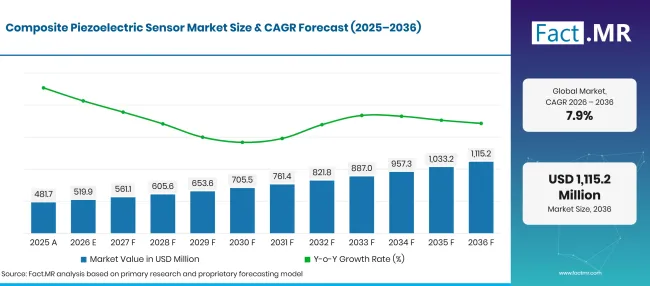
Composite Piezoelectric Sensor Market Forecast Global | Source: Fact.MR
| Year | Basis | Market Value (USD million) |
|---|---|---|
| 2025 | Actual | 481.8 |
| 2026 | Estimate | 519.9 |
| 2036 | Forecast | 1,115.2 |
| CAGR 2026 to 2036 | Forecast period | 7.9% |
Source: Fact.MR analysis. Updated Oct 26, 2026
What Are the Defining Numbers Behind Composite Piezoelectric Sensor Market Growth?
USD 595.3 million absolute opportunity between 2026 and 2036.
- Demand Drivers in the Market
- Healthcare sensing requirements: Medical devices use sensors to detect pressure and mechanical movement and to support monitoring functions. The U.S. Food and Drug Administration's medical device regulatory framework emphasizes safety and effectiveness requirements for devices entering the market [1].
- Automotive electronics and monitoring: Automotive manufacturers integrate sensors into vehicle systems to measure mechanical activity and support monitoring functions. Germany produced approximately 4.15 million passenger cars in 2025, according to figures released by the German Association of the Automotive Industry in January 2026 [2].
- Aerospace and industrial equipment requirements: Sensors used in aerospace and industrial environments may need to withstand vibration and repeated mechanical loading while maintaining reliable signal output. The U.S. Census Bureau's manufacturing indicators provide a current official measure of manufacturing orders and activity in 2026 [3].
- Key Segments Analyzed
- By Material Type: Ceramic-polymer composites are projected to account for 42.5% in 2026, reflecting their relevance where piezoelectric response must be balanced with flexibility and mechanical design requirements.
- By Application: Healthcare leads with 31.7% share in 2026, supported by the need for sensing functions in selected medical devices and monitoring systems.
- By End-User: Automotive manufacturers are projected to represent 27.9% of the market in 2026, driven by sensor integration requirements across vehicle development and production.
- Analyst Opinion at Fact.MR
- Shambhu Nath Jha, Principal Consultant at Fact.MR, states, “Composite piezoelectric sensors have opportunities in applications that require a combination of mechanical responsiveness and adaptable material design. Suppliers will need to demonstrate repeatable sensor performance under actual operating conditions while addressing integration requirements and the qualification standards of each target industry.”
- Strategic Implications
- Material developers must document piezoelectric response and mechanical properties under application-specific operating conditions.
- Medical device suppliers need to validate sensor accuracy and reliability within the intended device and operating environment.
- Automotive component manufacturers can assess composite sensors for monitoring applications where compact size and mechanical response are important.
- Aerospace and industrial equipment suppliers should evaluate sensor performance under varying vibration and temperature conditions before approving designs.
- Sensor manufacturers must strengthen technical documentation and application engineering to support integration into customer systems.
Germany is set to record a 9.8% CAGR through 2036. Brazil is projected to post 8.9%, followed by the USA at 8.1%. The UK is estimated to advance at 7.2%, while Japan is forecast to register a 6.4% CAGR.
How does the Composite Piezoelectric Sensor Market break down by segment?
Fact.MR finds that ceramic-polymer composites lead Material Type at 42.5%; Healthcare leads Application at 31.7%; and Automotive Manufacturers Lead End-User at 27.9%.
Which Material Type dominates?
Ceramic-Polymer Composites are set to hold 42.5% share in 2026.
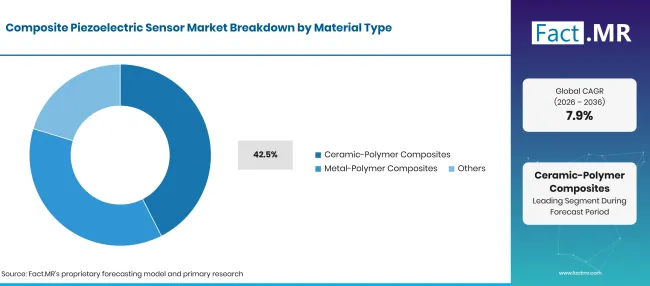
Composite Piezoelectric Sensor Market Breakdown Material Type | Source: Fact.MR
| Material Type | Share (2026) |
|---|---|
| Ceramic-Polymer Composites (Leading segment) | 42.5% |
| Other segments combined | 57.5%* |
| Total | 100.0% |
Source: Fact.MR analysis. Updated Oct 26, 2026
Ceramic-polymer composites combine the piezoelectric response of ceramic materials with selected properties of polymer matrices. This combination can support sensor designs that require mechanical compliance and a useful electrical response. Metal-polymer composites offer an alternative material approach for applications with different mechanical and electrical requirements. Material selection depends on sensitivity and operating frequency as well as temperature tolerance and fabrication requirements.
What leads the Application segment?
Healthcare is projected to represent 31.7% share in 2026.
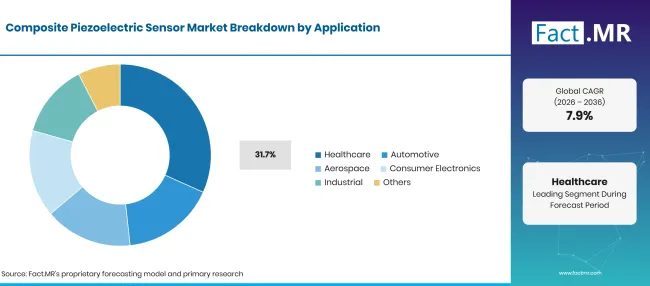
Composite Piezoelectric Sensor Market Breakdown Application | Source: Fact.MR
| Application | Share (2026) |
|---|---|
| Healthcare (Leading segment) | 31.7% |
| Other segments combined | 68.3%* |
| Total | 100.0% |
Source: Fact.MR analysis. Updated Oct 26, 2026
Healthcare applications can include pressure measurement and mechanical sensing within selected medical devices and monitoring systems. Composite piezoelectric sensors may be useful where a compact sensing element must respond to mechanical changes. Medical use requires appropriate validation of accuracy and reliability and, where applicable, compliance with device regulations. Automotive and aerospace applications have different qualification requirements, while consumer electronics and industrial applications prioritize performance suited to their operating environments.
Which End-User segment leads?
Automotive Manufacturers are projected to account for 27.9% share in 2026.
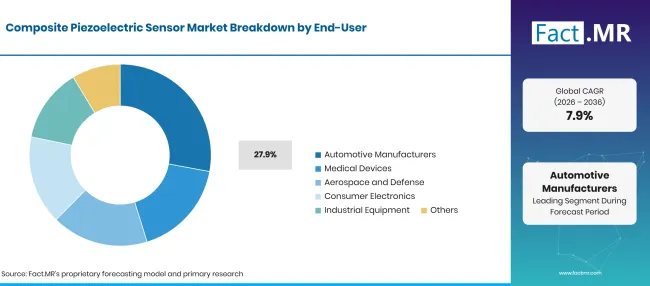
Composite Piezoelectric Sensor Market Breakdown End User | Source: Fact.MR
| End-User | Share (2026) |
|---|---|
| Automotive Manufacturers (Leading segment) | 27.9% |
| Other segments combined | 72.1%* |
| Total | 100.0% |
Source: Fact.MR analysis. Updated Oct 26, 2026
Automotive manufacturers use sensors across vehicle monitoring and control systems where reliable measurement of mechanical activity can be important. Composite piezoelectric sensors may serve selected vibration and pressure sensing applications depending on the system design. Aerospace and defense customers generally require extensive performance qualification, while industrial equipment manufacturers assess sensor response under repeated mechanical loads. Consumer electronics represents another potential use area where compact construction and integration requirements influence product selection.
What is accelerating Composite Piezoelectric Sensor Market adoption, and what is holding it back?
Demand for compact sensing solutions and application-specific material performance supports adoption, while qualification costs and integration complexity can slow deployment.
Drivers Impact Analysis
| DRIVER | (~) % IMPACT ON CAGR | GEOGRAPHIC RELEVANCE | IMPACT TIMELINE |
|---|---|---|---|
| Demand for compact mechanical sensing | +1.0% | Global | Medium term (2–4 years) |
| Healthcare monitoring and medical device integration | +0.9% | North America, Europe, Asia | Medium term (2–4 years) |
| Automotive sensing and system monitoring | +0.8% | Europe, Asia, North America | Medium term (2–4 years) |
| Industrial vibration and condition monitoring | +0.6% | Global | Short term (≤ 2 years) |
| Material customization for application-specific requirements | +0.5% | Global | Long term (≥ 4 years) |
Source: Fact.MR analysis. Updated Oct 26, 2026
Opportunity Impact Analysis
| OPPORTUNITY | (~) % IMPACT ON CAGR | GEOGRAPHIC RELEVANCE | IMPACT TIMELINE |
|---|---|---|---|
| Medical sensing applications requiring compact components | +0.8% | North America, Europe | Medium term (2–4 years) |
| Automotive sensor integration programs | +0.7% | Europe, Asia | Medium term (2–4 years) |
| High-performance aerospace sensing | +0.6% | North America, Europe | Long term (≥ 4 years) |
| Flexible composite material development | +0.5% | Global | Long term (≥ 4 years) |
| Industrial monitoring and predictive maintenance | +0.5% | Global | Medium term (2–4 years) |
Source: Fact.MR analysis. Updated Oct 26, 2026
Restraints Impact Analysis
| RESTRAINT | (~) % IMPACT ON CAGR | GEOGRAPHIC RELEVANCE | IMPACT TIMELINE |
|---|---|---|---|
| High material development and qualification costs | -0.8% | Global | Medium term (2–4 years) |
| Variation in sensor performance between production batches | -0.7% | Global | Short term (≤ 2 years) |
| Integration with existing electronics and signal-processing systems | -0.5% | Global | Medium term (2–4 years) |
| Application-specific testing and approval requirements | -0.5% | Healthcare, aerospace | Long term (≥ 4 years) |
| Competition from established sensor technologies | -0.4% | Global | Medium term (2–4 years) |
Source: Fact.MR analysis. Updated Oct 26, 2026
Which countries are scaling the Composite Piezoelectric Sensor Market through 2036?
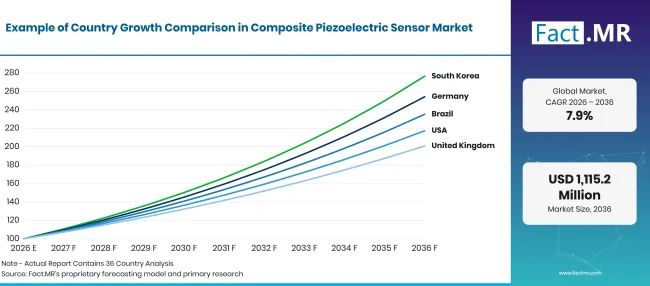
Composite Piezoelectric Sensor Market Growth Index | Source: Fact.MR
| Country | CAGR (2026–2036) |
|---|---|
| Germany | 9.8% |
| Brazil | 8.9% |
| USA | 8.1% |
| UK | 7.2% |
| Japan | 6.4% |
Source: Fact.MR analysis. Updated Oct 26, 2026
What supports Germany adoption?
9.8% CAGR, supported by automotive engineering and industrial sensing requirements.
Germany’s automotive engineering base creates opportunities for piezoelectric composite sensor suppliers in vibration monitoring, force measurement and structural health monitoring. These sensors can convert mechanical stress and vibration into electrical signals, supporting component testing, equipment diagnostics and real-time condition monitoring. Adoption depends on sensitivity, fatigue resistance, temperature stability, signal consistency and compatibility with vehicle electronics. Germany’s wider industrial engineering sector also provides potential applications in machinery monitoring and predictive maintenance, subject to application-specific validation.
How is Brazil developing composite piezoelectric sensor adoption?
8.9% CAGR, driven by industrial activity and potential demand from automotive and equipment manufacturers.
Brazil's national industrial production index recorded a 0.2% monthly increase in July 2026, according to the Brazilian Institute of Geography and Statistics [4]. Industrial production provides context for potential sensor demand across machinery and equipment applications, although individual sectors follow different cycles. Suppliers can target suitable applications through local technical support and partnerships with equipment manufacturers.
What supports United States adoption?
8.1% CAGR, shaped by medical device development and demand for advanced sensing components.
The United States has an established medical device and industrial technology sector supporting the development of advanced sensing solutions. Adoption of composite piezoelectric sensors will depend on sensitivity, durability, signal stability and compliance with application-specific technical and regulatory requirements.
How is the United Kingdom building adoption?
7.2% CAGR, driven by electronics manufacturing and aerospace engineering requirements.
The UK Office for National Statistics reported that manufacturing output increased by 1.2% in August 2026. Over the three months to August, computer, electronic and optical products manufacturing increased by 3.5% [5]. This activity provides a broader industrial context for advanced sensor components. Composite piezoelectric sensor adoption will depend on application-specific engineering needs and the performance evidence available to manufacturers.
What supports Japan adoption?
6.4% CAGR, led by manufacturing expertise in automotive systems and electronic components.
Japan's Ministry of Economy, Trade and Industry published its 2026 Manufacturing White Paper in May 2026, reviewing manufacturing competitiveness and the adoption of advanced digital technologies [6]. These priorities provide context for sensor development in industrial and automotive systems. Wider use of composite piezoelectric sensors will depend on component reliability and manufacturability as well as integration with existing sensing systems.
Who leads the Composite Piezoelectric Sensor Market?
Fact.MR identifies APC International, Ltd., Smart Material GmbH, CeramTec GmbH, CTS Corporation and PI Ceramic GmbH.
APC International, Ltd., CTS Corporation and PI Ceramic GmbH offer relevant piezoelectric materials, composites or components for application-specific sensor and transducer designs.
Competition depends on sensitivity, measurement accuracy, repeatability, mechanical durability and performance under application-specific operating conditions. Material and component suppliers focus on consistent electromechanical properties, while sensor providers emphasize signal reliability, product integration and technical support. End users evaluate operating requirements, system compatibility and lifecycle costs when selecting solutions.
Which companies are the key providers?
Key companies include APC International, Ltd., Smart Material GmbH, CeramTec GmbH, CTS Corporation and PI Ceramic GmbH.
- APC International, Ltd.
- Smart Material GmbH
- CeramTec GmbH
- CTS Corporation
- PI Ceramic GmbH
Bibliography
- [1] U.S. Food and Drug Administration. (2026, February 2). Overview of device regulation. FDA source
- [2] Verband der Automobilindustrie. (2026, January 5). Passenger car production in 2025 slightly above previous year's level. VDA source
- [3] U.S. Census Bureau. (n.d.). Economic indicators: Manufacturing. U.S. Census Bureau source
- [4] Instituto Brasileiro de Geografia e Estatística. (2026, September 2). Industrial output changes 0.2% in July. IBGE source
- [5] Office for National Statistics. (2026, October 15). GDP monthly estimate, UK: August 2026. ONS source
- [6] Ministry of Economy, Trade and Industry. (2026, May 29). FY2025 measures to promote manufacturing technology (White Paper on Manufacturing Industries 2026) released. Government of Japan. METI source
- [7] Ministry of Electronics and Information Technology. (2026, August 17). ECMS accelerates electronics manufacturing: 38 plants operational, 16 in advanced construction stages. Press Information Bureau, Government of India. PIB source
- [8] Press Information Bureau, Government of India. (2026, September 24). 12 years of Make in India: India’s journey towards a manufacturing nation. PIB source
This Report Answers
- The report describes the role of composite piezoelectric sensors across healthcare and automotive applications as well as aerospace and industrial systems.
- Material analysis compares ceramic-polymer composites with metal-polymer composites and other materials.
- Application analysis examines healthcare and automotive uses alongside aerospace and consumer electronics.
- End-user analysis covers automotive manufacturers and aerospace and defense organizations as well as consumer electronics and industrial equipment manufacturers.
- Country analysis discusses Germany, Brazil, the USA, the UK and Japan alongside official industrial indicators.
- The competitive overview profiles companies across the broader sensor and piezoelectric component industries.
What does the Composite Piezoelectric Sensor Market cover?
The market covers sensor products using composite piezoelectric materials to detect mechanical changes and convert them into electrical signals. It examines applications across healthcare and automotive systems alongside aerospace and defense equipment, consumer electronics and industrial machinery. Product selection depends on sensing performance and operating conditions as well as integration requirements and application-specific qualification.
What is included in the scope?
Included products are composite piezoelectric sensors and sensor assemblies that fall within the material and application categories.
The analysis covers the specified material types and end-user industries across the listed geographic regions. Commercial considerations include sensor performance and reliability as well as integration and manufacturing requirements.
What is excluded from the scope?
The analysis excludes conventional sensors that do not use composite piezoelectric materials unless they are explicitly included in a separately defined comparison.
Standalone piezoelectric materials sold solely as raw materials are excluded from sensor revenue unless incorporated into covered sensor products. General electronics and signal-processing equipment sold independently of the covered sensors are also excluded.
How Was the Analysis Built?
The analysis considers market forecasts, industry developments, company activities, technical requirements and relevant government statistics to assess market conditions and growth opportunities.
- Primary Research: Primary research includes discussions with manufacturers, service providers, technology developers, distributors, end users, and subject-matter experts. These conversations examine purchasing priorities, product adoption, operational challenges, approval requirements, competitive positioning, and the factors that influence wider market acceptance.
- Desk Research: Desk research covers government statistics, regulatory publications, company filings, trade data, technical studies, industry associations, standards, public policy, and other authoritative sources. Every source used in the analysis is documented in the bibliography.
- Market Sizing and Forecasting: Market estimates combine historical performance, demand indicators, pricing and volume trends, segment shares, company participation, country-level growth, adoption patterns, investment activity, and barriers to market expansion.
- Data Validation and Update Cycle: Findings are validated by comparing primary interviews with public data, company activity, regulatory changes, trade patterns, and industry developments. Regular updates review new product launches, capacity changes, partnerships, approvals, and shifts in commercial adoption.
Segmentation
What is the report's scope and coverage?
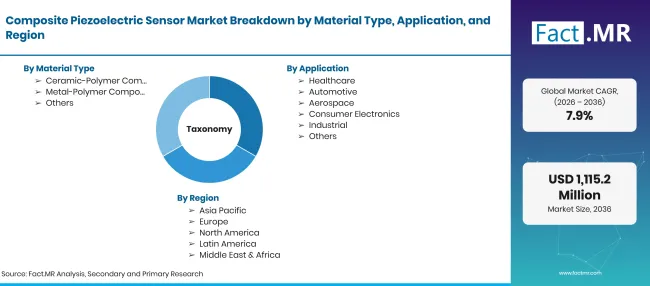
Composite Piezoelectric Sensor Market Taxonomy | Source: Fact.MR
| Attribute | Details |
|---|---|
| Quantitative Units | USD million |
| Market Definition | Composite piezoelectric sensors that convert mechanical stress or deformation into electrical signals using composite piezoelectric materials |
| Material Type | Ceramic-Polymer Composites; Metal-Polymer Composites; Others |
| Application | Healthcare; Automotive; Aerospace; Consumer Electronics; Industrial; Others |
| End-User | Automotive Manufacturers; Aerospace and Defense; Consumer Electronics; Industrial Equipment; Others |
| Regions Covered | North America; Latin America; Western Europe; Eastern Europe; East Asia; South Asia & Pacific; Middle East & Africa |
| Countries Covered | Germany; Brazil; USA; UK; Japan |
| Companies Profiled | APC International, Ltd., Smart Material GmbH, CeramTec GmbH, CTS Corporation and PI Ceramic GmbH. |
| Forecast Period | 2026 to 2036 |
| Approach | Market segmentation and scenario-based forecasting supported by official industrial statistics and company portfolio analysis |
Source: Fact.MR analysis. Updated Oct 26, 2026
How is the market segmented?
-
By Material Type
- Ceramic-Polymer Composites
- Metal-Polymer Composites
- Others
-
By Application
- Healthcare
- Automotive
- Aerospace
- Consumer Electronics
- Industrial
- Others
-
By End-User
- Automotive Manufacturers
- Aerospace and Defense
- Consumer Electronics
- Industrial Equipment
- Others
-
By Region
- North America
- Latin America
- Western Europe
- Eastern Europe
- East Asia
- South Asia & Pacific
- Middle East & Africa
Frequently Asked Questions
How big is the Composite Piezoelectric Sensor Market in 2026?
What is the CAGR from 2026 to 2036?
Which material type has the largest share?
Which application leads the market?
Which end-user segment has the largest share?
Which country has the highest projected CAGR?
Which companies are covered?
Who worked on this report


Preview the report firsthand - request a free sample
Free SampleGet the brochure for pricing and purchase details
Download PDF