- Market Value (2025): USD 691.9 Mn
- Estimated Value (2026): USD 745.0 Mn
- Forecast Value (2036): USD 1560.0 Mn
- CAGR (2026-2036): 7.7%
What is the Containment Isolators Market forecast to be worth by 2036?
USD 745.0 million in 2026 to USD 1,560.0 million by 2036 at 7.7% CAGR.
- The Containment Isolators Market crossed a valuation of USD 691.9 million in 2025, driven by sterile fill-finish investment and potent-compound containment needs.
- Demand is projected to increase from USD 745.0 million in 2026 to USD 1,560.0 million by 2036.
- The market is forecast to record 7.7% CAGR from 2026 to 2036 as barrier technology becomes a central control for aseptic and high-potency work.
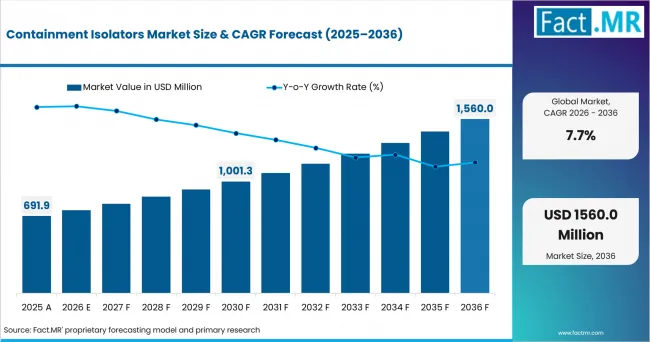
Containment Isolators Market Value Analysis | Source: Fact.MR
What are the defining numbers behind Containment Isolators Market growth?
USD 815.0 million absolute opportunity is expected by 2036. Growth is led by aseptic isolators and negative pressure systems. Sterile manufacturing, OEB 3-4 containment and pharma manufacturers shape the largest share positions.
- Demand Drivers in the Market
- Barrier systems keep operators away from the cleanest production area. This is especially important for injectable products that are not sterilized again after filling.
- Negative-pressure isolators help protect workers when strong powders are weighed or moved. This is especially useful in cancer-drug production, ADC payload work and handling of powerful active ingredients.
- Modular isolators help contract manufacturers move from one production run to another more easily. Faster changeovers, clear transfer steps and cleaning methods that inspectors can review all add practical value.
- Key Segments Analyzed
- By Isolator Type: Aseptic isolators are expected to hold 31.0% share in 2026 supported by repeat demand from sterile injectable production.
- By Pressure Regime: Negative pressure is projected to account for 36.0% share in 2026 owing to the use of inward airflow for potent-powder containment and operator protection.
- By Application: Sterile manufacturing is anticipated to capture 30.0% share in 2026 due to strict contamination controls in aseptic filling and open sterile handling.
- By Containment Level: OEB 3-4 is estimated to represent 30.0% share in 2026 attributable to its suitability for many high-potency compounds that do not require OEB 5 containment.
- By End User: Pharma manufacturers are forecast to hold 32.0% share in 2026 supported by their large installed base of regulated sterile and potent-compound operations.
- Analyst Opinion at Fact.MR
- Shambhu Nath Jha, Senior Analyst at Fact.MR, states, “Containment isolators are most useful when they support safe and reliable daily production. Pharma manufacturers are expected to look closely at glove access, transfer ports, pressure control and cleaning cycles that give the same result each time. Systems that protect workers from strong compounds while keeping the product sterile are likely to see wider use.”
- Strategic Implications
- Pharma manufacturers need to check whether transfer ports, bag-in and bag-out steps and daily working methods allow materials to move safely through the isolator.
- Facilities benefit from comparing the H2O2 cleaning time with residue removal, air clearing and repeat results before choosing a decontamination system.
- Equipment companies strengthen approval by providing clear records for design, installation and operating checks. These documents help sites prepare the line for GMP production.
- Local service companies need ready access to gloves, filters, seals, sensors and other spare parts. Trained field engineers are also important because slow service can keep the equipment out of use for longer.
In May 2024, SKAN Group AG increased its stake in Aseptic Technologies from 85% to 90% after acquiring a further 5% from Wallonie Entreprendre. The official announcement linked the move to aseptic filling and closed-vial technology. Isolator companies are moving closer to the fill-finish process and the transfer systems around it, which shifts competition beyond the steel enclosure toward validated process modules and lifecycle control.
The UAE is estimated to post an 8.4% CAGR as new drug manufacturing projects adopt modern barrier systems. The USA is anticipated to advance at a 7.7% CAGR through biologics production, sterile injectable upgrades and replacement demand. Japan is forecast to record a 7.6% CAGR, supported by strict quality requirements and specialist sterile manufacturing. The United Kingdom is projected to post a 7.4% CAGR, while Germany is estimated to record a 7.1% CAGR through replacement projects, engineering strength and high-specification pharmaceutical operations.
How does the Containment Isolators Market break down by segment?
Aseptic isolators are expected to lead Isolator Type at 31.0% share in 2026. Negative pressure is projected to lead Pressure Regime at 36.0% share in 2026.
Why do Aseptic isolators lead Isolator Type?
Aseptic isolators are projected to account for 31.0% share in 2026.
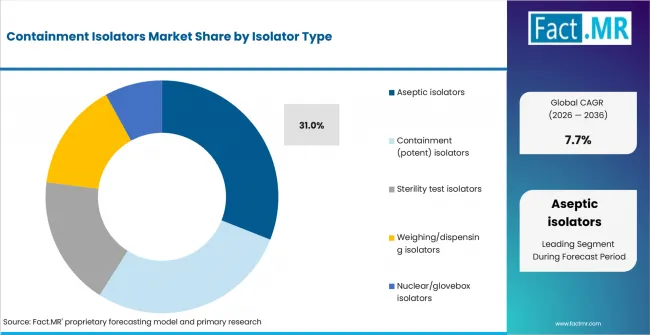
Containment Isolators Market Analysis By Isolator Type | Source: Fact.MR
These systems are widely used in injectable drugs, biologics and filling operations. They create a sealed space around sterile products and reduce the risk of contamination from direct worker contact. Closed transfer points and repeatable cleaning cycles also make them suitable for regular use in tightly controlled production.
Why does Negative pressure lead Pressure Regime?
Negative pressure is estimated to represent 36.0% share in 2026.
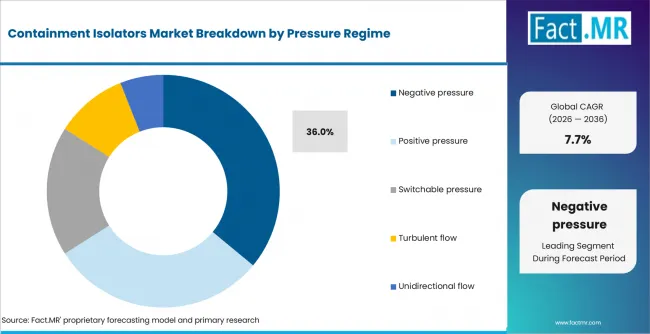
Containment Isolators Market Analysis By Pressure Regime | Source: Fact.MR
This setup is mainly used to protect workers when strong compounds are handled. Air moves into the enclosure, which helps keep harmful powders inside during weighing, sampling and transfer. It is widely used in cancer-drug production, potent ingredient handling and other work where worker exposure must remain very low.
Why does Sterile manufacturing lead Application?
Sterile manufacturing is anticipated to capture 30.0% share in 2026.
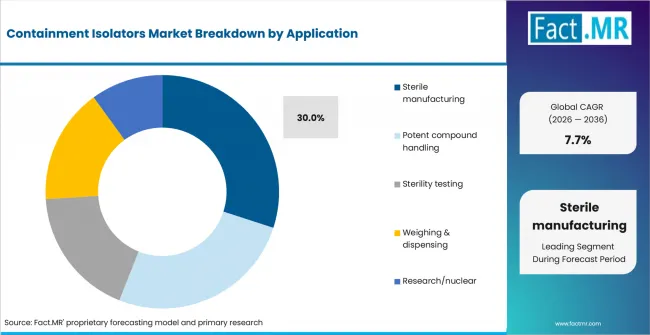
Containment Isolators Market Analysis By Application | Source: Fact.MR
A small contamination problem during filling or material transfer may affect a full batch. Isolators reduce open handling inside cleanrooms and give companies better control over the production area. They are also used for sterility testing, vial filling and other steps where sterile materials remain exposed.
Why does OEB 3-4 lead Containment Level?
OEB 3-4 is forecast to make up 30.0% share in 2026.
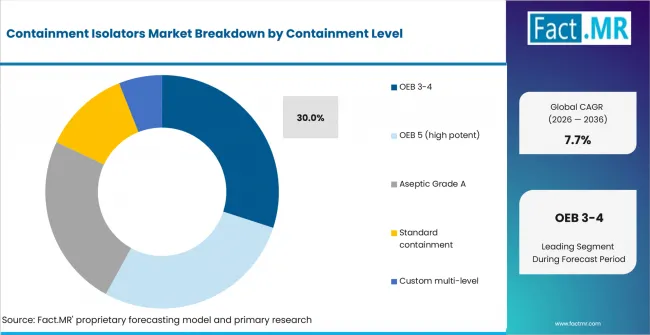
Containment Isolators Market Analysis By Containment Level | Source: Fact.MR
This level covers many strong compounds that require more protection than standard systems. However, they do not always require the highest OEB 5 level. OEB 3-4 gives manufacturers a practical balance between worker safety, powder control and equipment cost. Many cancer-drug ingredients and other potent compounds fall within this range.
Why do Pharma manufacturers lead End User?
Pharma manufacturers are projected to represent 32.0% share in 2026.
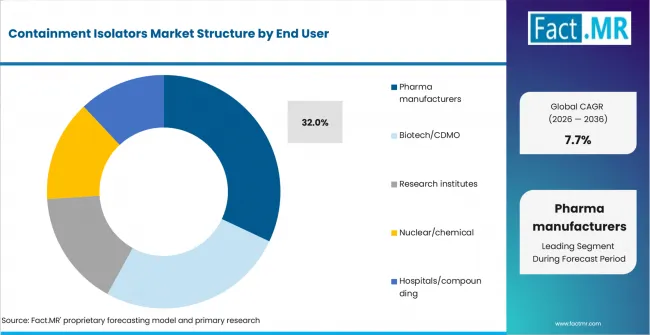
Containment Isolators Market Analysis By End User | Source: Fact.MR
These companies use isolators in sterile production, potent-compound handling, weighing and quality checks. They are also responsible for proving that cleaning works, approving each batch and preparing for inspections. Their equipment choices therefore affect daily production, worker safety and compliance across several parts of the business.
What is accelerating Containment Isolators Market adoption, and what is holding it back?
Aseptic contamination control is anticipated to expand Containment Isolators Market demand. High validation burden is expected to restrain projects where staffing, documentation and facility integration are stretched.
Drivers Impact Analysis
| DRIVER | (~) % IMPACT ON CAGR | GEOGRAPHIC RELEVANCE | IMPACT TIMELINE |
|---|---|---|---|
| Annex 1 contamination-control strategy reviews | +2.1% | Europe; UK; global exporters | Short term (<= 2 years) |
| Aseptic fill-finish capacity modernization | +1.8% | USA; China; Japan | Medium term (2-4 years) |
| High-potency API handling controls | +1.4% | USA; Germany; China | Short term (<= 2 years) |
| CDMO campaign flexibility needs | +0.9% | China; UAE; USA | Medium term (2-4 years) |
| Validated transfer-port adoption | +0.7% | Europe; Japan; USA | Long term (>= 4 years) |
Source: Fact.MR analysis. Updated Jul 22, 2026
- Annex 1 contamination-control strategy reviews: European sterile-medicine guidance has been fully applicable since 25 August 2024. This raises the value of barrier systems that reduce operator intervention and support written contamination-control strategies.
- Aseptic fill-finish capacity modernization: FDA guidance recognizes isolators and closed vial filling as modern designs that isolate aseptic processing from contamination risks. That wording supports upgrades where legacy cleanroom handling carries higher deviation risk.
- High-potency API handling controls: The NIOSH 2024 hazardous-drug list keeps occupational exposure visible for healthcare and handling settings. Pharma plants applying similar containment logic are expected to keep negative-pressure isolators in procurement plans.
- CDMO campaign flexibility needs: Contract manufacturers run small batches and frequent product changes. Modular isolators are expected to help them change formats without rebuilding the entire controlled area.
- Validated transfer-port adoption: Transfer ports decide how materials enter and leave the enclosure. Systems with repeatable docking and clear leak testing are expected to reduce operator workarounds.
Opportunity Impact Analysis
| OPPORTUNITY | (~) % IMPACT ON CAGR | GEOGRAPHIC RELEVANCE | IMPACT TIMELINE |
|---|---|---|---|
| Gloveless and robotic aseptic filling concepts | +1.3% | Germany; USA; Japan | Long term (>= 4 years) |
| Faster H2O2 bio-decontamination cycles | +1.1% | China; UAE; USA | Medium term (2-4 years) |
| Single-use flexible containment | +0.9% | USA; China; UK | Medium term (2-4 years) |
| Service contracts for gloves, filters and seals | +0.7% | Global installed base | Short term (<= 2 years) |
Source: Fact.MR analysis. Updated Jul 22, 2026
- Gloveless and robotic aseptic filling concepts: In May 2025, Syntegon announced SynTiso as a liquid filling line concept built around a gloveless isolator and remote robots. The opportunity is strongest where facilities want fewer glove interventions near the open sterile path.
- Faster H2O2 bio-decontamination cycles: Shorter validated cycles are expected to return more hours to production. The gain is practical only when residue limits, aeration and biological indicator results stay within the validation package.
- Single-use flexible containment: ILC Dover positions flexible isolators for pharmaceutical and biopharmaceutical processes, including API synthesis. This creates a path for projects that need containment without a fully rigid custom build.
- Service contracts for gloves, filters and seals: Installed systems require periodic replacement parts and integrity checks. A supplier with dependable lifecycle support is expected to protect uptime better than a supplier focused only on equipment sale.
Restraints Impact Analysis
| RESTRAINT | (~) % IMPACT ON CAGR | GEOGRAPHIC RELEVANCE | IMPACT TIMELINE |
|---|---|---|---|
| Validation package workload | -1.6% | Global GMP facilities | Short term (<= 2 years) |
| Facility HVAC and layout integration | -1.2% | USA; Germany; Japan | Medium term (2-4 years) |
| Operator ergonomics inside glove ports | -0.9% | Global installed base | Short term (<= 2 years) |
| Specialist service and spares gaps | -0.7% | UAE; China; emerging exporters | Medium term (2-4 years) |
Source: Fact.MR analysis. Updated Jul 22, 2026
- Validation package workload: Leak testing, decontamination validation and transfer qualification create a heavy documentation load. Smaller sites are expected to delay purchases when quality teams are already near capacity.
- Facility HVAC and layout integration: An isolator has to fit the room and pressure cascade. Material flow and adjacent equipment also have to line up. Retrofitting a mature facility is often harder than buying the enclosure.
- Operator ergonomics inside glove ports: Reach limits, visibility and repetitive handling affect how people use the system every day. Poor ergonomics are expected to increase interventions and deviation risk.
- Specialist service and spares gaps: A broken glove, seal or sensor stops work quickly in sterile operations. Regions with thinner field-service coverage are expected to see longer qualification and restart timelines.
Which countries are scaling Containment Isolators Market fastest?
The country comparison shows several clear gaps and closely spaced groups. UAE form a compact upper group with only a moderate separation. A more pronounced step appears between the UAE and the USA. The USA and Japan are closely aligned while the United Kingdom and Germany form another measured pair. These positions reflect differences in new pharmaceutical capacity and replacement demand rather than current market size alone.
- China holds a notable position as new sterile-product and high-potency facilities are expected to include modern barrier systems during initial plant design. Export-focused production also raises the value of equipment that meets EU and FDA expectations.
- The UAE remains relatively close to China but follows a different development route through new pharmaceutical projects and regional sterile-drug production. Its smaller installed base gives companies more scope to specify isolators before facility layouts are fixed.
- USA sits outside the upper pair as demand comes mainly from biologics production and upgrades to established sterile injectable lines. Replacement of cleanroom-heavy processes creates different installation and validation requirements.
- Japan stays closely aligned with the USA in CAGR terms but places greater weight on equipment reliability and careful qualification. Service quality and repeatable decontamination are expected to shape adoption in specialist sterile operations.
- The United Kingdom occupies a measured position through biologics and contract manufacturing activity. Smaller flexible lines for clinical production and advanced therapies support demand for systems that withstand client audits.
- Germany is separated slightly from the United Kingdom as mature pharmaceutical operations create greater dependence on replacement projects. Airflow performance and automation fit are expected to receive close technical review.
Comparable CAGRs therefore create different entry conditions across these markets. Deployment timing depends on whether a project involves a new facility or an established production line with strict qualification and service requirements. The full report provides country-level CAGR analysis across North America, Latin America, Europe, East Asia, South Asia, Oceania and the Middle East and Africa.
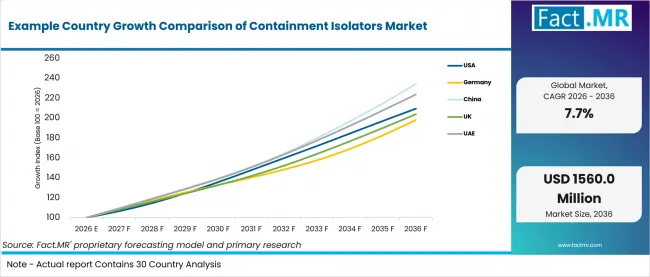
Example Country Growth Comparison Of Containment Isolators Market | Source: Fact.MR
| COUNTRY | 2026 to 2036 CAGR |
|---|---|
| UAE | 8.4% |
| USA | 7.7% |
| Japan | 7.6% |
| UK | 7.4% |
| Germany | 7.1% |
Source: Fact.MR analysis. Updated Jul 22, 2026
How is the UAE scaling demand?
8.4% CAGR, driven by pharmaceutical plants planned around safe movement of materials and workers.
The UAE’s 8.4% CAGR is closely linked to new pharmaceutical plant construction. Companies must submit detailed drawings that show how materials and workers move through the site before construction is approved. This allows isolators to be included early between preparation, transfer and filling areas. Systems that fit the approved layout and allow easy movement inside the plant are likely to see stronger demand.
What supports USA adoption?
7.7% CAGR, led by close checks on isolator operation and glove safety.
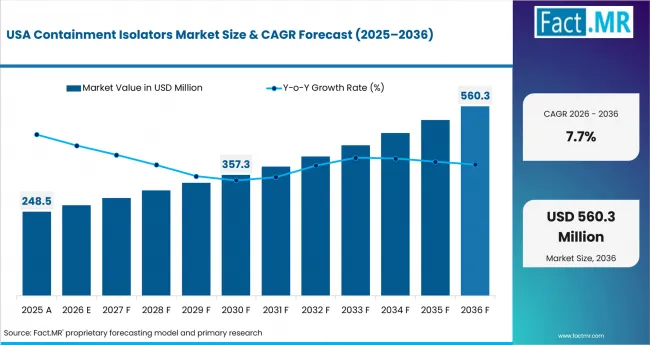
Containment Isolators Market Country Value Analysis | Source: Fact.MR
In the USA, companies must show that an isolator stays under control during regular production. FDA guidance covers cleaning, monitoring, maintenance and the steps followed if a glove fails. Equipment companies are therefore judged on how well pressure control, glove systems and cleaning cycles work over time. This also supports upgrades that improve safety without replacing the full filling line.
How does Japan perform?
7.6% CAGR, shaped by formal GMP inspections and close review of sterile production.
Japan’s 7.6% CAGR is supported by strict inspection and approval steps. PMDA guidance covers sterile manufacturing along with the wider GMP inspection process. Pharmaceutical companies review how the isolator works during filling, material transfer and cleaning, not only what the equipment documents claim. This gives an advantage to companies that provide clear test results and practical help during approval.
What shapes United Kingdom growth?
7.4% CAGR, backed by licensed production of sterile medicines and biotechnology products.
The United Kingdom’s 7.4% CAGR is tied to sites that make both sterile medicines and biotechnology products. These facilities often handle different batch sizes and product types within the same network. Isolators help them move between products while keeping the process separate from the surrounding room. Demand is therefore expected to favor flexible systems that maintain safe conditions across different production tasks.
How does Germany perform?
7.1% CAGR, driven by automation that reduces routine glove use during sterile filling.
Germany’s 7.1% CAGR reflects growing use of highly automated filling systems. New equipment includes gloveless isolators with remote robots and container movement without direct contact. These designs reduce human activity near exposed sterile products and link the isolator with the wider production line. Demand is expected to depend on how well the system balances filling speed, contamination control and product changeovers.
Who leads the Containment Isolators Market?
Getinge and SKAN have a strong position in sterile transfer and pharmaceutical isolators. Syntegon adds further strength by linking isolators with automated filling lines.
Getinge supports sterile transfer through its DPTE system, which connects isolators with filling equipment and cleanroom areas. SKAN provides isolators for sterile and high-potency production and has expanded its closed-vial filling range through Aseptic Technologies. Syntegon combines isolators with pharmaceutical filling machines and has also developed gloveless systems that use remote robots and contact-free container movement. Extract Technology offers filling-line isolators for filling, stoppering and capping. Comecer focuses on custom systems for sterile processing, weighing and hazardous-material handling. ILC Dover provides flexible isolators and glove-bag systems for API and biopharmaceutical work where a rigid enclosure may not be practical.
From 2026 to 2036, companies are expected to compete on how well the isolator works with material transfer, filling equipment and repeatable cleaning cycles. Pharma manufacturers are also likely to compare glove safety, pressure control, approval records and access to nearby service. Companies that reduce hands-on work while allowing faster product changes and steady daily production are likely to gain more business.
Which companies are the key providers?
Getinge AB; SKAN Group AG; Extract Technology Ltd.; Syntegon Technology GmbH; Comecer S.p.A.; and ILC Dover.
- Getinge AB
- SKAN Group AG
- Extract Technology Ltd.
- Syntegon Technology GmbH
- Comecer S.p.A.
- ILC Dover
Bibliography
- U.S. Food and Drug Administration. (2024). Questions and answers on current good manufacturing practice regulations: Production and process controls. U.S. Food and Drug Administration.
- National Medical Products Administration. (2026, April 14). Announcement of the National Medical Products Administration on strengthening supervision and administration of contract manufacturing of drugs. National Medical Products Administration.
- National Institute for Occupational Safety and Health. (2025). NIOSH list of hazardous drugs in healthcare settings, 2024. Centers for Disease Control and Prevention.
- Medicines and Healthcare products Regulatory Agency. (2025). Human medicines modular manufacture and point of care regulations 2025: Overview. GOV.UK.
This Report Addresses
- The report provides strategic intelligence on Containment Isolators Market across Isolator Type and Pressure Regime choices that shape equipment selection.
- Segment analysis covers Aseptic isolators as the share leader within the 2026 market structure.
- Regional outlook evaluates UAE alongside USA and Japan, with UK and Germany completing the growth comparison.
- Competitive analysis profiles Getinge and SKAN alongside Extract Technology. Syntegon, Comecer and ILC Dover complete the active company set.
- Use-case assessment covers sterile manufacturing and potent-compound handling. Sterility testing and controlled dispensing are reviewed across the forecast period.
What does the Containment Isolators Market cover?
Containment isolators are sealed systems used to separate sterile products or hazardous materials from operators and the surrounding room.
The Containment Isolators Market covers equipment used in aseptic production and potent-compound handling. It includes systems for sterility testing, controlled weighing and material dispensing. Coverage extends to aseptic isolators and high-potency containment isolators. Sterility-test and weighing or dispensing isolators are also included. Nuclear or specialist glovebox isolators fall within the scope when they provide controlled separation through pressure management, filtration and enclosed handling.
The market differs from general cleanroom equipment because commercial value comes from maintaining a sealed barrier around the process. Standard cleanrooms and open airflow cabinets remain outside the boundary. Complete pharmaceutical filling lines are excluded unless the isolator and directly connected containment modules are assessed separately. Routine room ventilation and unrelated laboratory enclosures are also outside the market.
What is included in the scope?
Containment isolators are used by pharmaceutical manufacturers and contract production companies. Research institutes, hospitals and specialist chemical or nuclear facilities are also included.
The scope covers Isolator Type and Pressure Regime alongside Application, Containment Level and End User. Isolator Type includes aseptic, potent-compound, sterility-test and weighing or dispensing systems. Pressure Regime covers negative, positive and switchable-pressure designs. Turbulent and unidirectional airflow systems are included where they operate within a sealed isolator. Applications include sterile manufacturing, potent-compound handling, sterility testing, weighing and research work. Coverage also spans OEB 3-4, OEB 5, Aseptic Grade A and custom containment levels.
What is excluded from the scope?
Cleanrooms and equipment that do not operate as sealed isolator systems remain outside the scope of this market.
The scope excludes standard laminar-flow cabinets and biosafety cabinets. General laboratory gloveboxes without relevant aseptic or hazardous-material functions are excluded. Complete fill-finish line spending also remains outside the boundary when an isolator is not separately identified. Facility HVAC systems, room construction and unrelated process equipment are not included. Public regulatory evidence is used to explain adoption conditions and does not replace Fact.MR market estimates.
How Was the Analysis Built?
The analysis draws on 120+ sources, 35+ company portfolios, 25+ countries, and more than 20 industry interviews.
- Primary Research: Primary research includes discussions with manufacturers, service providers, technology developers, distributors, end users, procurement teams, and subject-matter experts. These conversations examine purchasing priorities, product adoption, operational challenges, approval requirements, competitive positioning, and the factors that influence wider market acceptance.
- Desk Research: Desk research covers government statistics, regulatory publications, company filings, trade data, technical studies, industry associations, standards, public policy, and other authoritative sources. Every source used in the analysis is documented in the bibliography.
- Market Sizing and Forecasting: Market estimates combine historical performance, demand indicators, pricing and volume trends, segment shares, company participation, country-level growth, adoption patterns, investment activity, and barriers to market expansion.
- Data Validation and Update Cycle: Findings are validated by comparing primary interviews with public data, company activity, regulatory changes, trade patterns, and industry developments. Regular updates review new product launches, capacity changes, partnerships, approvals, procurement trends, and shifts in commercial adoption.
Segmentation
What is the report's scope and coverage?
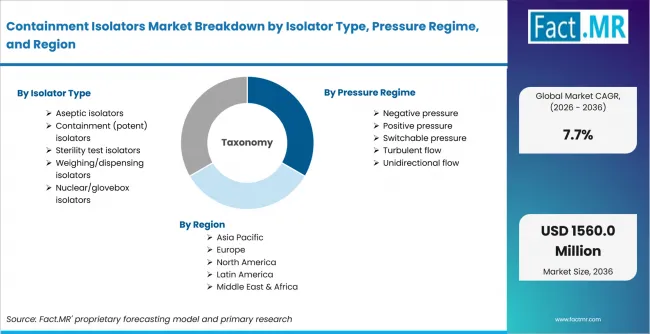
Containment Isolators Market Breakdown By Isolator Type, Pressure Regime, And Region | Source: Fact.MR
| Attribute | Details |
|---|---|
| Quantitative Units | USD million |
| Market Definition | A sealed barrier system that separates product or hazardous process from operators and room air through glove ports, transfer ports, filtration, pressure control and decontamination. |
| Isolator Type | Aseptic isolators; Containment (potent) isolators; Sterility test isolators; Weighing/dispensing isolators; Nuclear/glovebox isolators |
| Pressure Regime | Negative pressure; Positive pressure; Switchable pressure; Turbulent flow; Unidirectional flow |
| Application | Sterile manufacturing; Potent compound handling; Sterility testing; Weighing & dispensing; Research/nuclear |
| Containment Level | OEB 3-4; OEB 5 (high potent); Aseptic Grade A; Standard containment; Custom multi-level |
| End User | Pharma manufacturers; Biotech/CDMO; Research institutes; Nuclear/chemical; Hospitals/compounding |
| Regions Covered | North America; Latin America; Europe; East Asia; South Asia & Oceania; Middle East & Africa |
| Countries Covered | USA; Canada; Brazil; Mexico; Germany; U.K.; France; Italy; Spain; South Korea; Japan;Australia & New Zealand; GCC Countries; South Africa; UAE |
| Key Companies Profiled | Getinge; SKAN; Extract Technology; Syntegon; Comecer; ILC Dover |
| Forecast Period | 2026 to 2036 |
| Approach | Hybrid top-down and bottom-up approach using demand indicators across Isolator Type, Pressure Regime, Application, Containment Level and End User. |
Source: Fact.MR analysis. Updated Jul 22, 2026
How is the market segmented?
-
By Isolator Type:
- Aseptic isolators
- Containment (potent) isolators
- Sterility test isolators
- Weighing/dispensing isolators
- Nuclear/glovebox isolators
-
By Pressure Regime:
- Negative pressure
- Positive pressure
- Switchable pressure
- Turbulent flow
- Unidirectional flow
-
By Application:
- Sterile manufacturing
- Potent compound handling
- Sterility testing
- Weighing & dispensing
- Research/nuclear
-
By Containment Level:
- OEB 3-4
- OEB 5 (high potent)
- Aseptic Grade A
- Standard containment
- Custom multi-level
-
By End User:
- Pharma manufacturers
- Biotech/CDMO
- Research institutes
- Nuclear/chemical
- Hospitals/compounding
-
By Region:
- North America
- USA
- Canada
- Latin America
- Brazil
- Mexico
- Rest of Latin America
- Europe
- Germany
- U.K.
- France
- Italy
- Spain
- Rest of Europe
- East Asia
- South Korea
- Japan
- South Asia & Oceania
- Australia & New Zealand
- Rest of South Asia & Oceania
- Middle East & Africa
- GCC Countries
- South Africa
- UAE
- Rest of Middle East & Africa
- North America
Frequently Asked Questions
Which Isolator Type leads the Containment Isolators Market?
Which Pressure Regime leads the Containment Isolators Market?
Which Application leads the Containment Isolators Market?
Which Containment Level leads the Containment Isolators Market?
Which End User leads the Containment Isolators Market?
How does UAE perform in the Containment Isolators Market?
How does USA perform in the Containment Isolators Market?
What is the primary driver in the Containment Isolators Market?
What is the main restraint in the Containment Isolators Market?
Who worked on this report


Preview the report firsthand - request a free sample
Free SampleGet the brochure for pricing and purchase details
Download PDF