
- Market Value (2025): USD 192.3 Mn
- Estimated Value (2026): USD 204.0 Mn
- Forecast Value (2036): USD 368.8 Mn
- CAGR (2026-2036): 6.1%
Continuous Seasoning Application Systems Market Forecast and Outlook 2026 to 2036
The continuous seasoning application systems market reached a derived estimate of USD 192.3 million in 2025. The market is expected to increase from USD 204.0 million in 2026 to USD 368.8 million by 2036, expanding at a CAGR of 6.1% during the forecast period.
Snack manufacturers are expanding production while maintaining consistent flavor across every batch, creating opportunities for continuous seasoning application systems. These machines help distribute oil and dry seasonings evenly while reducing product waste. The scale of this expansion is evident at PepsiCo India, whose Pune facility reached an annual production capacity of 62,100 tonnes in August 2026, manufacturing brands such as Lay’s, Kurkure and Cheetos. As snack production grows, processors are placing greater importance on accurate seasoning and uninterrupted operations.
Key Takeaways from the Continuous Seasoning Application Systems Market
- Sales of continuous seasoning application systems stood at USD 192.3 million in 2025
- Continuous Seasoning Application Systems Market Value (2026): USD 204.0 million
- Continuous Seasoning Application Systems Market Forecast Value (2036): USD 368.8 million
- Continuous Seasoning Application Systems Market Forecast CAGR (2026-2036): 6.1%
- Leading Seasoning deposition: Tumble drum (40.3%)
- Key Market Participants: Heat and Control, tna solutions, GEA, Bühler, Kiremko, Nothum
- Key Growth Regions: India, United States, China, Thailand, Germany
India's food processing sector is gaining pace as manufacturers expand ready-to-eat meals and snack production. The Government's ₹10,900 crore PLI scheme, running through FY 2026-27, is adding momentum to this expansion. By December 2025, approved applicants had invested ₹9,207 crore and created 35 lakh tonnes of annual processing capacity. The momentum continued in 2026, with PLI-supported product sales reaching ₹1,08,854 crore in FY 2025-26, up from ₹58,758 crore in FY 2019-20. This expansion is creating opportunities for automated seasoning equipment.
Continuous Seasoning Application Systems Market
| Metric | Value |
|---|---|
| Estimated Value (2025) | USD 192.3 million |
| Estimated Value (2026) | USD 204.0 million |
| Forecast Value (2036) | USD 368.8 million |
| Forecast CAGR (2026 to 2036) | 6.1% |
Source: Fact.MR analysis. Updated Nov 25, 2026
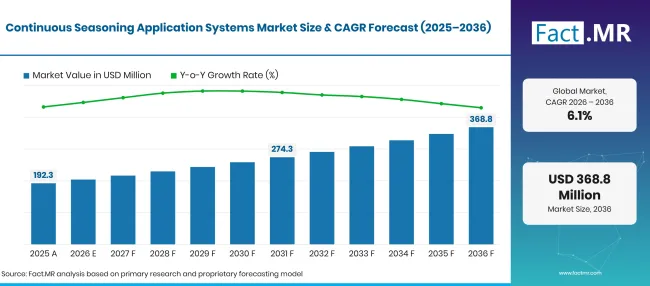
Continuous Seasoning Application Systems Forecast Global | Source: Fact.MR
Category
| Category | Segments |
|---|---|
| Seasoning deposition | Tumble drum, Vibratory bed, Continuous belt, Electrostatic applicator, Multi-stage hybrid |
| Processing scale | Pilot / lab, Small commercial, Mid-scale, High-throughput, Ultra-high-throughput |
| Operating configuration | Batch, Semi-continuous, Continuous, Modular skid, Integrated line |
| Food / process application | Bakery / wafers, Confectionery / cocoa, Snacks / seasoning, Brewing / grains, Other food / industrial |
| Region | India; United States; China; Thailand; Germany |
Source: Fact.MR analysis. Updated Nov 25, 2026
Segmental Analysis
Why do Tumble drum systems lead seasoning-deposition demand in the Continuous Seasoning Application Systems Market?
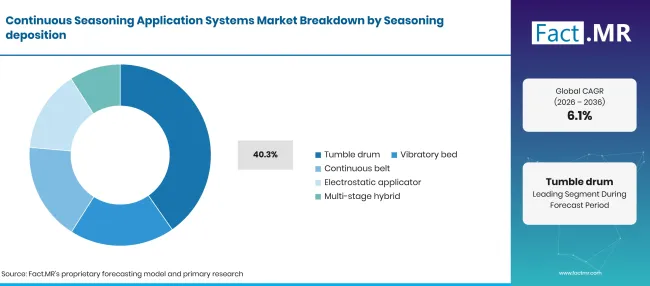
Continuous Seasoning Application Systems Breakdown Seasoning Deposition | Source: Fact.MR
Tumble drum systems lead with a 40.3% share in 2026, equivalent to USD 82.2 million. Their rotating action keeps chips and extruded snacks moving through a controlled seasoning flow, helping manufacturers achieve consistent coverage at high speeds. Electrostatic units are gaining attention for fine-powder application, while multi-stage systems suit products requiring several coating layers. Heat and Control's seasoning equipment portfolio includes drum-based solutions for snacks, reflecting the importance of controlled coating in large-scale food production.
Why does the Mid-scale segment lead scale demand in the Continuous Seasoning Application Systems Market?
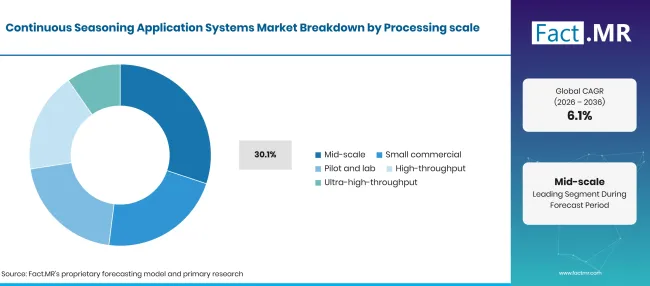
Continuous Seasoning Application Systems Breakdown Processing Scale | Source: Fact.MR
Mid-scale processing lines contribute 30.1% of the 2026 market, worth USD 61.4 million. Regional snack manufacturers often operate several product lines and need equipment that balances throughput with manageable installation costs. Smaller units are gaining traction among local producers, while large-scale systems attract multinational brands with continuous production requirements. India's Ministry of Food Processing Industries reported in April 2026 that its PLI scheme had generated 34 lakh tonnes of additional annual processing and preservation capacity, highlighting the expansion of facilities across the sector.
Why does Batch operation lead configuration demand in the Continuous Seasoning Application Systems Market?
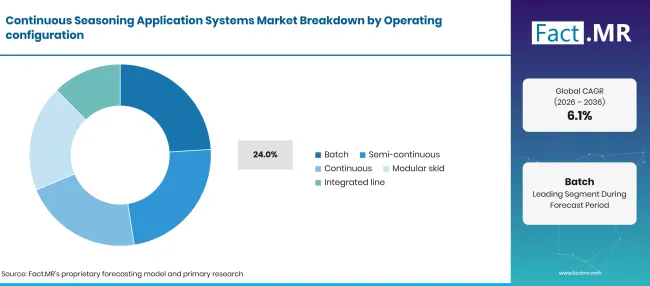
Continuous Seasoning Application Systems Breakdown Operating Configuration | Source: Fact.MR
Batch operation captures 24.0% of the market in 2026, equivalent to USD 49.0 million. Its appeal comes from the flexibility to handle short production runs, regional recipes and frequent flavour changes without keeping an entire line dedicated to one product. Continuous configurations are gaining ground among high-volume snack producers seeking uninterrupted output, while hybrid arrangements suit plants with varied production schedules. India's 2025 food-processing policy activity also included fresh applications for capacity expansion under the PMKSY scheme, reflecting continued investment in flexible processing infrastructure.
Why does Brewing / grains lead application demand in the Continuous Seasoning Application Systems Market?
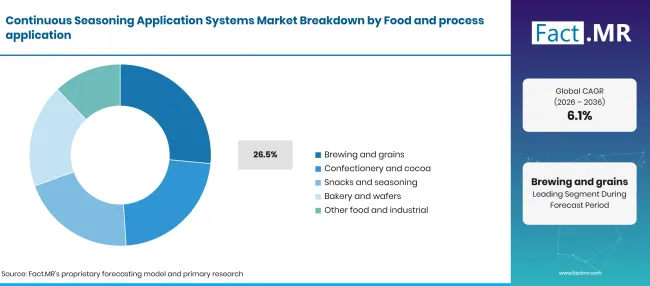
Continuous Seasoning Application Systems Breakdown Food And Process Application | Source: Fact.MR
Brewing / grains captures 26.5% of the 2026 market, equivalent to USD 54.1 million. Grain-based snacks, cereal clusters and granola require careful coating because uneven seasoning or sticky ingredients can affect texture and product consistency. Confectionery applications are gaining traction through demand for coated products, while savoury snacks continue to use automated systems for oil and spice distribution. India's 2025-26 agricultural estimates placed coarse cereal production at 63.93 million tonnes, reinforcing the importance of grain availability for food-processing applications.
Continuous Seasoning Application Systems Market-Drivers, Restraints & Trends
Driver
Expansion of Flavour Variants and Snack Product Launches: Frequent flavour launches and limited-edition snack ranges are pushing manufacturers to improve seasoning accuracy without slowing production. Each recipe change calls for precise powder and oil distribution, making automated dosing and recipe-based controls increasingly useful. India's food processing sector offers a strong indication of this expansion: by February 2026, the PLI scheme had supported 34 lakh tonnes of additional annual processing capacity across the industry. More production lines create room for automated seasoning installations.
Restraint
Allergen Cross-Contact Risks and Cleaning-Related Downtime: Frequent flavour changes create a costly cleaning challenge, particularly when recipes contain milk, soy or other allergens. Residue trapped inside drums, conveyors and dosing pipes can cause cross-contact between batches. Thorough washdowns also increase water consumption, labour expenses and production downtime. These costs can discourage smaller snack factories from replacing manual seasoning practices with automated equipment.
Trend
Electrostatic Seasoning: Electrostatic seasoning is gaining attention because charged powder particles can adhere more effectively to snack surfaces, helping reduce airborne dust and unused ingredients. This approach offers room for improvement in coating consistency and material efficiency. Future opportunities lie in adapting electrostatic application for different snack shapes, powder textures and production speeds, particularly as manufacturers look for cleaner seasoning processes with lower ingredient losses.
Trend
Reduced-Salt Formulations: Lower-sodium snack recipes are creating fresh opportunities for more precise seasoning control. Manufacturers need to preserve flavour even when salt levels change, making accurate powder blending and application increasingly important. In October 2026, the US FDA issued a final rule allowing salt substitutes across 139 standardized food categories that previously restricted their use. This regulatory change opens further scope for seasoning systems capable of handling alternative blends and finely adjusted ingredient ratios.
Continuous Seasoning Application Systems Market by Analysis by Key Country
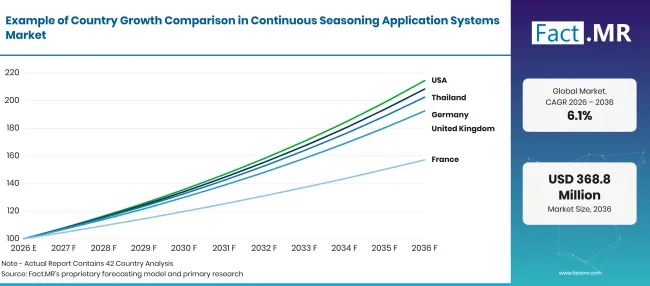
Continuous Seasoning Application Systems Growth Index | Source: Fact.MR
| Country | CAGR (2026-2036) |
|---|---|
| India | 8.4% |
| United States | 8.1% |
| China | 7.7% |
| Thailand | 7.5% |
| Germany | 7.4% |
Source: Fact.MR analysis. Updated Nov 25, 2026
Why is India the fastest-growing market for continuous seasoning application systems?
India's expanding packaged-snack industry is creating fresh opportunities for automated seasoning equipment.
Regional manufacturers are increasing production of savoury snacks and ready-to-eat foods, where consistent flavour and faster changeovers matter. The Ministry of Food Processing Industries reported in April 2026 that the PLI scheme had generated 34 lakh tonnes per annum of additional food processing capacity, alongside ₹9,207 crore in beneficiary investments. Expansion of domestic processing facilities is encouraging greater use of automated coating and seasoning lines.
What is shaping continuous seasoning system sales in the United States?
Large-scale snack production and frequent product launches are keeping equipment modernization on the agenda in the United States.
Manufacturers need reliable seasoning application across chips, crackers and extruded products without interrupting high-volume lines. In July 2026, US Census Bureau data showed food-product shipments reaching USD 623.3 billion during the first seven months of 2026, up 0.9% year over year. This broad manufacturing activity supports investment in accurate dosing, automated coating and production-line upgrades.
What is driving continuous seasoning system demand in China?
China's large food-manufacturing base is creating a favourable setting for continuous seasoning equipment.
Snack producers are catering to varied regional tastes, encouraging greater attention to coating consistency and production efficiency. China's National Bureau of Statistics reported that value added in food processing from agricultural and sideline products increased 5.6% in 2025. Continued factory modernization and rising output of processed foods are creating opportunities for automated seasoning systems across domestic manufacturing facilities.
What is shaping continuous seasoning system demand in Thailand?
Thailand's position as a regional food-processing and export hub is encouraging manufacturers to upgrade production facilities.
Seasoned snacks and packaged foods require dependable coating operations to maintain product consistency across export batches. The Thailand Board of Investment reported 184 applications in agriculture and food processing during the first half of 2025, involving THB 30.79 billion in investment, a 25% increase in project numbers year over year. These industrial investments are creating scope for modern seasoning and coating installations.
Why is continuous seasoning system growth slower in Germany?
Germany's established packaged-food industry is creating opportunities for more precise seasoning and coating operations.
Manufacturers are focusing on consistent product quality while expanding convenient food ranges. In January 2026, Destatis reported that Germany's prepared-meal production continued to increase during the first three quarters of 2025. The agency also recorded 1.7 million tonnes of prepared meals produced in 2024. Greater production of convenience foods is encouraging processors to modernize automated ingredient application and seasoning operations.
Competitive Landscape for Continuous Seasoning Application Systems Market
Competition in the continuous seasoning application systems market is increasingly shaped by coating accuracy, ingredient savings and easier product changeovers. Heat and Control offers Spray Dynamics coating drums, dry ingredient feeders and FastBack on-machine seasoning systems, while TNA Solutions markets its intelli-flav OMS 5.1 with gravimetric control for dry, wet and slurry applications.
In October 2025, TNA showcased this system at Gulfood Manufacturing, highlighting recipe adjustments and faster changeovers for snack producers. GEA is also extending its digital food-processing portfolio, with its 2026 Changeover Assist launch addressing waste and downtime during recipe changes. These developments point to growing competition around automation, hygiene and production flexibility.
Recent Developments
- On April 8, 2025, Heat and Control acquired UK-based Tek-Dry Systems Ltd. and Hunt Heat Exchangers to expand its thermal processing and heat transfer equipment portfolio.
- On October 9, 2025, TNA Solutions announced its participation in Gulfood Manufacturing 2025, where it showcased integrated snack processing, seasoning, distribution and packaging systems for food manufacturers.
- On August 24, 2026, GEA introduced Changeover Assist, a digital application that guides operators through product and recipe changes to reduce errors, material waste and production downtime.
- On May 6, 2026, Bühler launched its Nutrex 7 Series extrusion systems with improvements in food safety, cleaning, operating efficiency and user-friendliness.
- On August 27, 2025, Investindustrial agreed to acquire Kiremko Group, Idaho Steel Products and Reyco Systems to expand its presence in industrial potato-processing equipment and solutions
Key Players in Continuous Seasoning Application Systems Market
Key companies operating in the market include Heat and Control, tna solutions, GEA, Bühler, Kiremko, and Nothum.
- Heat and Control
- tna solutions
- GEA
- Bühler
- Kiremko
- Nothum
Bibliography
- Bureau of Investment, Thailand. (2025). Thailand first-half investment applications hit USD 32.5 billion. Office of the Board of Investment.
- Destatis. (2026). Statistics on food production and food manufacturing in Germany. Federal Statistical Office of Germany.
- Ministry of Food Processing Industries. (2021). Cabinet approves Production Linked Incentive Scheme for Food Processing Industry.
- Ministry of Food Processing Industries. (2026). Annual report 2025–26. Government of India.
- National Bureau of Statistics of China. (2026). Statistical communiqué of the People's Republic of China on the 2025 national economic and social development.
- PepsiCo India. (2026, August 23). PepsiCo India's Pune plant completes 25 years, marking a milestone in the company's India growth journey.
- U.S. Food and Drug Administration. (2026, October 9). FDA issues final rule on salt substitutes in standardized foods.
Segmentation
Scope of Report
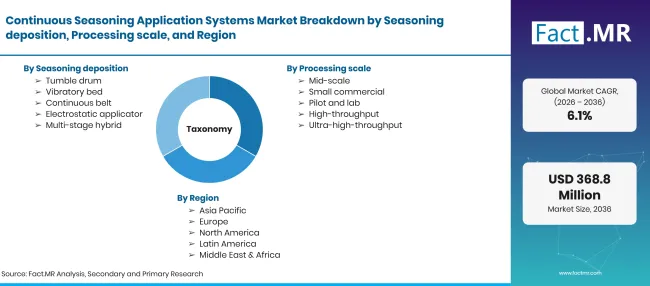
Continuous Seasoning Application Systems Taxonomy | Source: Fact.MR
| Items | Values |
|---|---|
| Quantitative Units (2026) | USD 204.0 Million |
| Seasoning deposition | Tumble drum, Vibratory bed, Continuous belt, Electrostatic applicator, Multi-stage hybrid |
| Processing scale | Pilot / lab, Small commercial, Mid-scale, High-throughput, Ultra-high-throughput |
| Operating configuration | Batch, Semi-continuous, Continuous, Modular skid, Integrated line |
| Food / process application | Bakery / wafers, Confectionery / cocoa, Snacks / seasoning, Brewing / grains, Other food / industrial |
| Regions Covered | North America, Latin America, Europe, East Asia, South Asia and Pacific, Middle East & Africa |
| Countries Covered | India, United States, China, Thailand, Germany, and other countries |
| Key Companies Profiled | Heat and Control, tna solutions, GEA, Bühler, Kiremko, Nothum |
| Additional Attributes | Dollar revenue in the Continuous Seasoning Application Systems Market is segmented by seasoning deposition (tumble drum, vibratory bed, continuous belt, electrostatic applicator, multi-stage hybrid); processing scale (pilot / lab, small commercial, mid-scale, high-throughput, ultra-high-throughput); operating configuration (batch, semi-continuous, continuous, modular skid, integrated line); food / process application (bakery / wafers, confectionery / cocoa, snacks / seasoning, brewing / grains, other food / industrial) and region. |
Source: Fact.MR analysis. Updated Nov 25, 2026
Continuous Seasoning Application Systems Market by Segments
-
Seasoning deposition
- Tumble drum
- Vibratory bed
- Continuous belt
- Electrostatic applicator
- Multi-stage hybrid
-
Processing scale
- Pilot / lab
- Small commercial
- Mid-scale
- High-throughput
- Ultra-high-throughput
-
Operating configuration
- Batch
- Semi-continuous
- Continuous
- Modular skid
- Integrated line
-
Food / process application
- Bakery / wafers
- Confectionery / cocoa
- Snacks / seasoning
- Brewing / grains
- Other food / industrial
-
Region:
- North America
- United States
- Canada
- Mexico
- Europe
- Germany
- United Kingdom
- France
- Italy
- Spain
- Rest of Europe
- Asia Pacific
- China
- India
- Japan
- South Korea
- Australia
- Rest of Asia Pacific
- Latin America
- Brazil
- Mexico
- Argentina
- Rest of Latin America
- Middle East & Africa
- GCC Countries
- South Africa
- Rest of Middle East & Africa
- North America
Table of Contents
Key Takeaways
- Market Size and CAGR
- Top Growth Driver
- Fastest Growing Segment
- Leading Region
- Key Companies
- Emerging Opportunities

