
- Market Value (2025): USD 266.7 Mn
- Estimated Value (2026): USD 280.0 Mn
- Forecast Value (2036): USD 456.1 Mn
- CAGR (2026-2036): 5.0%
Six-Roller Malt Systems Market Forecast and Outlook 2026 to 2036
The six-roller malt systems market reached a derived estimate of USD 266.7 million in 2025. The market is anticipated to increase from USD 280.0 million in 2026 to USD 456.1 million by 2036, expanding at a CAGR of 5.0% during the forecast period.
Large breweries are refining milling operations to extract more from every batch while keeping husks intact for efficient filtration. Six-roller systems help achieve this by separating husks, grits and flour before further grinding. The commercial value of such efficiency is evident at HEINEKEN, which reported over €500 million in gross savings in 2025 through productivity improvements and supply chain optimization. As large brewers place greater emphasis on production efficiency and raw material utilisation, investment in advanced malt milling equipment is likely to gain traction through 2036.
Key Takeaways from the Six-Roller Malt Systems Market
- Sales of six-roller malt systems stood at USD 266.7 million in 2025
- Six-Roller Malt Systems Market Value (2026): USD 280.0 million
- Six-Roller Malt Systems Market Forecast Value (2036): USD 456.1 million
- Six-Roller Malt Systems Market Forecast CAGR (2026-2036): 5.0%
- Leading Six-roller arrangement: Differential speed (33.3%)
- Key Market Participants: Bühler, Künzel Maschinenbau, Ziemann Holvrieka, RMS Roller-Grinder, Malt Handling, Sasquatch Mills
- Key Growth Regions: Germany, China, Belgium, United States, United Kingdom
Large-scale brewing investments are creating opportunities for advanced malt milling equipment, particularly where consistent grist quality matters across high-volume production. Carlsberg's 2025 annual report recorded growth in its Chinese business, while premium beer accounted for 30% of its Asian beer volume. In November 2026, Bühler introduced its Maltomat IV in four- and six-roller versions, featuring automated process control and live grinding-gap adjustment. Such equipment upgrades are likely to strengthen adoption across major brewing markets in Asia and Europe.
Six-Roller Malt Systems Market
| Metric | Value |
|---|---|
| Estimated Value (2025) | USD 266.7 million (Derived estimate) |
| Estimated Value (2026) | USD 280.0 million |
| Forecast Value (2036) | USD 456.1 million |
| Forecast CAGR (2026–2036) | 5.0% |
Source: Fact.MR analysis. Updated Nov 25, 2026
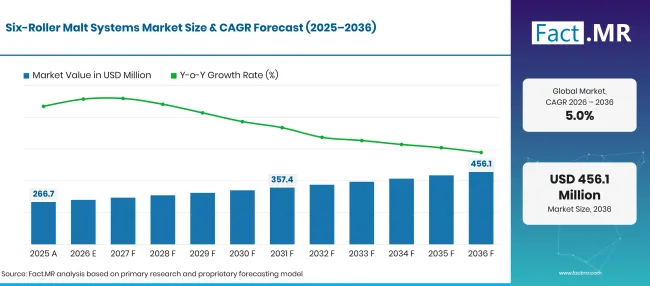
Six Roller Malt Systems Forecast Global | Source: Fact.MR
Category
| Category | Segments |
|---|---|
| Six-roller arrangement | Three-pair standard, Differential speed, Adjustable gap, Wet-conditioned, Automated six-roller |
| Processing scale | Pilot / lab, Small commercial, Mid-scale, High-throughput, Ultra-high-throughput |
| Operating configuration | Batch, Semi-continuous, Continuous, Modular skid, Integrated line |
| Food / process application | Bakery / wafers, Confectionery / cocoa, Snacks / seasoning, Brewing / grains, Other food / industrial |
| Region | Germany; China; Belgium; United States; United Kingdom |
Source: Fact.MR analysis. Updated Nov 25, 2026
Segmental Analysis
Why do Differential speed designs lead arrangement demand in the Six-Roller Malt Systems Market?
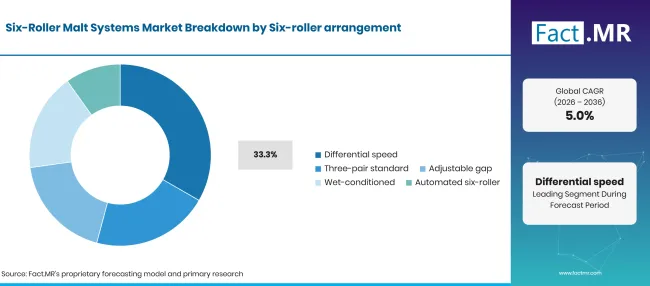
Six Roller Malt Systems Breakdown Six Roller Arrangement | Source: Fact.MR
Differential speed designs hold a 33.3% share in 2026, equivalent to USD 93.2 million. Their appeal lies in the ability to separate the starchy endosperm without crushing husks excessively, helping breweries maintain smoother lautering. A 2025 review published in Comprehensive Reviews in Food Science and Food Safety highlights how excessive malt comminution creates lautering difficulties and affects brewing quality. Automated designs are gaining interest through better process control, while standard three-pair arrangements remain relevant for conventional milling operations.
Why does the High-throughput segment lead scale demand in the Six-Roller Malt Systems Market?
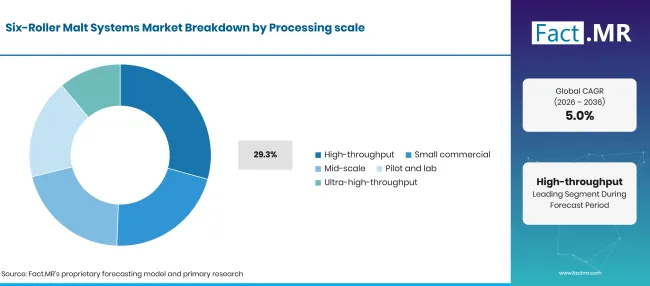
Six Roller Malt Systems Breakdown Processing Scale | Source: Fact.MR
The High-throughput segment captures 29.3% of the market in 2026, worth USD 82.0 million. Large breweries favour these systems because they process substantial malt volumes without slowing brewhouse schedules. China's Zhujiang Brewery commissioned a CNY 932 million capacity expansion in December 2025, adding 300,000 tonnes of annual brewing capacity and a 72,000-can-per-hour production line. Such investments strengthen the case for higher-capacity milling equipment. Ultra-high-throughput installations are gaining attention among larger plants, while standard-capacity mills remain suitable for smaller breweries.
Why do Modular skid units lead configuration demand in the Six-Roller Malt Systems Market?
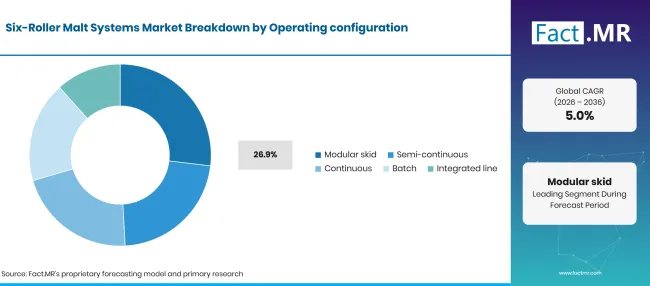
Six Roller Malt Systems Breakdown Operating Configuration | Source: Fact.MR
Modular skid units capture 26.9% of the market in 2026, translating to USD 75.3 million. Their preassembled format simplifies installation by bringing milling equipment, conveyors and supporting components together in one arrangement. This is particularly useful when breweries expand existing facilities without undertaking extensive structural changes. Zhujiang Brewery's 2025 expansion in China, which added new production capacity and modernized existing facilities, illustrates the wider move towards integrated brewery infrastructure. Semi-continuous configurations are also gaining traction where operators prefer gradual capacity additions.
Why does Snacks / seasoning lead application demand in the Six-Roller Malt Systems Market?
Six Roller Malt Systems Breakdown Food And Process Application | Source: Fact.MR
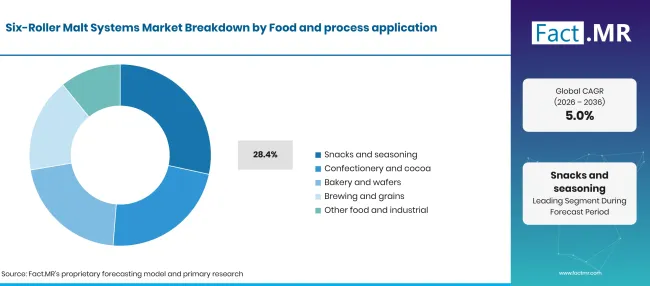
Snacks and seasoning capture 28.4% of the market in 2026, equivalent to USD 79.5 million. Cereal-based snack production uses graded grain fractions to achieve consistent texture and particle size across recipes. A 2025 Ministry of Food Processing Industries study found that tertiary millet processing, including extruded snacks and ready-to-eat products, reached a 10% share of millet processing. This wider shift towards value-added cereal ingredients creates opportunities for precision milling. Bakery applications are also gaining ground as manufacturers seek consistent flour and grain fractions
Six-Roller Malt Systems Market-Drivers, Restraints & Trends
Drivers: Brewery Efficiency and Malt Utilisation: Raw Material Savings Encourage Investment:
Large breweries are paying closer attention to malt losses, energy consumption and extraction efficiency as these factors affect production costs. Six-roller systems offer better control over particle separation and husk preservation, helping brewers improve grist quality without compromising filtration. HEINEKEN reported more than €500 million in gross savings during 2025 through productivity improvements and supply-chain optimisation. This focus on operational savings is creating a stronger business case for advanced malt milling equipment.
Restraints: High Installation Costs and Space Requirements: Capital Outlay Limits Brewery Upgrades:
Six-roller installations require substantial upfront investment, additional floor space and supporting equipment. Smaller breweries may find it difficult to justify these expenses when conventional roller mills or hammer mills paired with mash filters already meet their production requirements. Installation downtime and maintenance costs add further pressure. These financial and operational hurdles may delay replacement cycles, particularly among regional brewers operating with limited capital budgets.
Trends: Wet-Conditioned Milling and Better Husk Protection: Future Opportunity:
Breweries are showing greater interest in malt conditioning before grinding to improve husk flexibility and maintain consistent particle separation. A September 2025 review by researchers at the Technical University of Munich examined recent advances in milling and mashing, highlighting the relationship between milling intensity, starch exposure and lautering performance. This growing research focus creates opportunities for malt conditioning, moisture management and improved milling practices across commercial breweries.
Trends: Automated Roll Monitoring and Process Control: Future Opportunity:
Digital monitoring is becoming more relevant as breweries seek tighter control over roll gaps, wear and milling consistency. Automated adjustments can reduce manual intervention and help maintain uniform grist quality across repeated brewing cycles. Carlsberg's 2025 annual report highlighted equipment efficiency improvements and better measurement of energy consumption as priorities across its production facilities. Similar attention to measurable process performance creates scope for smarter milling operations and automation-led brewery upgrades.
Six-Roller Malt Systems Market by Analysis by Key Country
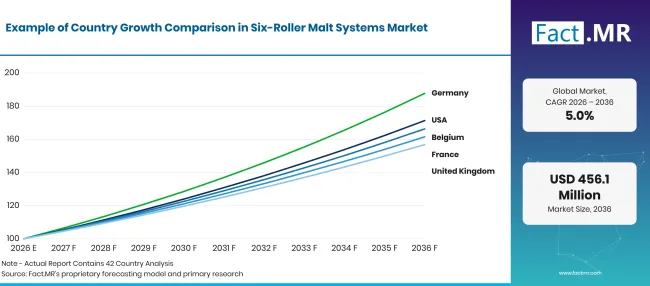
Six Roller Malt Systems Growth Index | Source: Fact.MR
| Country | CAGR (2026-2036) |
|---|---|
| Germany | 6.8% |
| China | 6.6% |
| Belgium | 5.1% |
| United States | 5.1% |
| United Kingdom | 4.6% |
Source: Fact.MR analysis. Updated Nov 25, 2026
Which factors are driving the Six-Roller Malt Systems Market in Germany?
Germany is emerging as a strong market for six-roller malt systems because of its extensive brewing infrastructure and growing focus on production efficiency.
According to the German Brewers Association's April 2026 statistics, the country recorded 79.238 million hectolitres of beer production in 2025, with 1,415 operating breweries. Non-alcoholic beer production also climbed to 7.465 million hectolitres from 6.938 million hectolitres in 2024. Product diversification and the need for consistent malt processing are encouraging breweries to modernise milling equipment.
Why is China becoming an important growth market for Six-Roller Malt Systems?
China's expanding brewery infrastructure is creating fresh opportunities for high-capacity malt milling installations.
A notable example came on December 18, 2025, when Zhujiang Brewery commissioned its CNY 932 million Zhongshan expansion. The project added 300,000 tonnes of annual brewing capacity and a production line capable of filling 72,000 cans per hour. Such large-scale investments increase the importance of reliable grain preparation, consistent grist quality and automated milling operations. Further brewery modernisation and rising interest in premium beer production are likely to strengthen equipment sales across China.
How are brewery investments supporting Six-Roller Malt Systems Market growth in Belgium?
Belgium's established brewing industry continues to invest in production facilities despite weaker domestic consumption.
Belgian Brewers reported in its June 2026 release that the industry invested EUR 213 million during 2025, marking a 20% increase over 2024. Around 70% of Belgian beer production goes to export markets, making consistent product quality particularly important. Modernisation of existing breweries, production flexibility and better raw material utilisation are creating opportunities for advanced milling equipment. Export-oriented manufacturers are likely to remain an important customer group for six-roller systems.
What is encouraging investment in Six-Roller Malt Systems across the United States?
Large-scale brewery upgrades are keeping the United States an attractive market for advanced malt processing equipment.
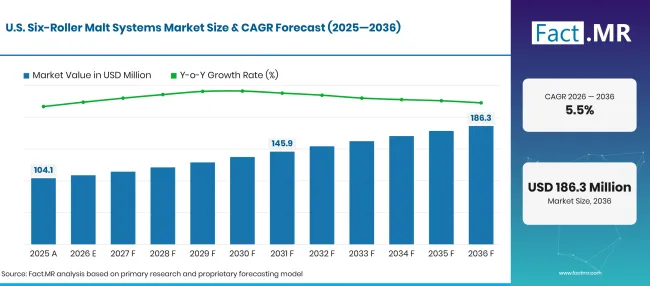
Six Roller Malt Systems Forecast Usa | Source: Fact.MR
Anheuser-Busch announced in April 2026 that its manufacturing investment across 2025 and 2026 would reach USD 600 million. The programme covers brewery improvements, technical training and manufacturing capabilities. Its January 2026 announcement also outlined a separate USD 30 million upgrade at its Jacksonville brewery and can plant. These investments highlight the industry's focus on production efficiency and equipment modernisation, creating opportunities for advanced milling installations at large brewing facilities.
Why is the United Kingdom witnessing steady growth in the Six-Roller Malt Systems Market?
Brewery capacity expansion and energy-saving initiatives are shaping equipment investment across the United Kingdom.
Damm inaugurated its Bedford brewery on October 9, 2025, following an investment exceeding GBP 70 million. The modernised facility nearly doubled production capacity to 1.8 million hectolitres annually. Separately, Molson Coors announced an investment exceeding GBP 18 million in March 2026 to install a heat pump system at its Burton brewery, targeting annual heating-energy savings of up to 40,000 MWh. Such facility upgrades are encouraging breweries to reconsider milling efficiency, production capacity and supporting equipment requirements.
Competitive Landscape for Six-Roller Malt Systems Market
Competition in the six-roller malt systems market centres on milling precision, husk separation, energy consumption and plant integration. Bühler offers the Maltomat III with automatic roller-gap adjustment, while its November 2026 launch of the Maltomat IV adds servo-driven adjustment, live process monitoring and four- and six-roller configurations with capacities of 4 to 16 tonnes per hour.
Künzel Maschinenbau differentiates itself through intermediate screening and customised grist mills, with capacities reaching 10 tonnes per hour in selected models. Ziemann Holvrieka strengthens its position through integrated brewery engineering and malt-handling capabilities. Service support, retrofit options and consistent extraction remain important competitive factors.
Recent Developments
- On November 10, 2026, Bühler introduced its new Maltomat IV grist mill at BrauBeviale 2026. The mill features automated process control, live grinding-gap adjustment and four- and six-roller configurations with capacities ranging from 4 to 16 tonnes per hour.
- On September 15, 2025, Künzel Maschinenbau presented its brewery raw material handling solutions at drinktec 2025 in Munich alongside Ziemann Holvrieka and other CLPT Group companies. Its offerings included malt handling and milling equipment.
- On September 15, 2025, Ziemann Holvrieka showcased its new T-Rex WET milling unit at drinktec 2025. The system features automatic gap adjustment, modular construction and clean-in-place (CIP) capability for wet malt milling.
- On January 14, 2026, RMS Roller-Grinder published new guidance on in-house milling versus purchasing pre-milled brewing grains, highlighting equipment control, grist consistency and operational considerations for breweries.
- On December 17, 2025, Ziemann Holvrieka announced Ziemann AnalytiX, a digital brewery analytics solution developed in cooperation with Indeex. The platform combines AI-driven analytics with brewing process expertise to help breweries improve operational efficiency.
Key Players in Six-Roller Malt Systems Market
Key companies operating in the market include Bühler, Künzel Maschinenbau, Ziemann Holvrieka, RMS Roller-Grinder, Malt Handling, and Sasquatch Mills.
- Bühler
- Künzel Maschinenbau
- Ziemann Holvrieka
- RMS Roller-Grinder
- Malt Handling
- Sasquatch Mills
Bibliography
- Anheuser-Busch. (2026, January 6). Anheuser-Busch investing $30M in Jacksonville facilities to drive local economic growth and fuel production of Michelob ULTRA.
- Anheuser-Busch. (2026, April 22). Anheuser-Busch increases investment in U.S. manufacturing to $600 million.
- Carlsberg Group. (2026). Carlsberg Group annual report 2025.
- Deutscher Brauer-Bund e.V. (2026). Deutsche Brauwirtschaft in Zahlen 2025.
- HEINEKEN N.V. (2026). FY 2025 results.
- Laus, A., Zarnkow, M., Gastl, M., & Jacob, F. (2025). Review on recent advances and novel approaches in milling and mashing. Comprehensive Reviews in Food Science and Food Safety, 24(5), e70239.
- Ministry of Food Processing Industries, Government of India. (2026). Study on assessment of level of food processing in India.
- Molson Coors Beverage Company. (2026, March 17). Molson Coors installs a new heat pump system at Burton Brewery following multi-million pound investment.
- Zhongshan Municipal People's Government. (2025, December 23). Zhujiang Brewery's Zhongshan project begins operation.
Segmentation
Scope of Report
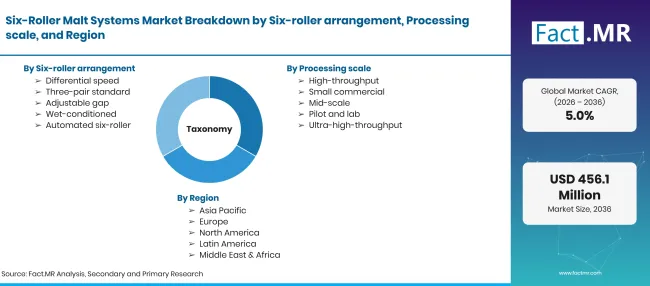
Six Roller Malt Systems Taxonomy | Source: Fact.MR
| Items | Values |
|---|---|
| Quantitative Units (2026) | USD 280.0 Million |
| Six-roller arrangement | Three-pair standard, Differential speed, Adjustable gap, Wet-conditioned, Automated six-roller |
| Processing scale | Pilot / lab, Small commercial, Mid-scale, High-throughput, Ultra-high-throughput |
| Operating configuration | Batch, Semi-continuous, Continuous, Modular skid, Integrated line |
| Food / process application | Bakery / wafers, Confectionery / cocoa, Snacks / seasoning, Brewing / grains, Other food / industrial |
| Regions Covered | North America, Latin America, Europe, East Asia, South Asia and Pacific, Middle East & Africa |
| Countries Covered | Germany, China, Belgium, United States, United Kingdom, and other countries |
| Key Companies Profiled | Bühler, Künzel Maschinenbau, Ziemann Holvrieka, RMS Roller-Grinder, Malt Handling, Sasquatch Mills |
| Additional Attributes | Dollar revenue in the Six-Roller Malt Systems Market is segmented by six-roller arrangement (three-pair standard, differential speed, adjustable gap, wet-conditioned, automated six-roller); processing scale (pilot / lab, small commercial, mid-scale, high-throughput, ultra-high-throughput); operating configuration (batch, semi-continuous, continuous, modular skid, integrated line); food / process application (bakery / wafers, confectionery / cocoa, snacks / seasoning, brewing / grains, other food / industrial) and region. |
Source: Fact.MR analysis. Updated Nov 25, 2026
Six-Roller Malt Systems Market by Segments
-
Six-roller arrangement
- Three-pair standard
- Differential speed
- Adjustable gap
- Wet-conditioned
- Automated six-roller
-
Processing scale
- Pilot / lab
- Small commercial
- Mid-scale
- High-throughput
- Ultra-high-throughput
-
Operating configuration
- Batch
- Semi-continuous
- Continuous
- Modular skid
- Integrated line
-
Food / process application
- Bakery / wafers
- Confectionery / cocoa
- Snacks / seasoning
- Brewing / grains
- Other food / industrial
-
Region:
- North America
- United States
- Canada
- Mexico
- Europe
- Germany
- United Kingdom
- France
- Italy
- Spain
- Rest of Europe
- Asia Pacific
- China
- India
- Japan
- South Korea
- Australia
- Rest of Asia Pacific
- Latin America
- Brazil
- Mexico
- Argentina
- Rest of Latin America
- Middle East & Africa
- GCC Countries
- South Africa
- Rest of Middle East & Africa
- North America
Table of Contents
Key Takeaways
- Market Size and CAGR
- Top Growth Driver
- Fastest Growing Segment
- Leading Region
- Key Companies
- Emerging Opportunities

