
- Market Value (2025): USD 41.9 Mn
- Estimated Value (2026): USD 45.0 Mn
- Forecast Value (2036): USD 91.0 Mn
- CAGR (2026-2036): 7.3%
Smart Air-Knife Modules Market Forecast and Outlook 2026 to 2036
The smart air-knife modules market reached a derived estimate of USD 41.9 million in 2025 and is expected to increase from USD 45.0 million in 2026 to USD 91.0 million by 2036. The market is anticipated to expand at a CAGR of 7.3% during the forecast period.
Food processors are paying closer attention to compressed-air consumption as energy costs and production efficiency come under greater scrutiny. Smart air-knife modules help remove excess water, coating and seasoning while adjusting airflow to limit waste. A 2026 study of 10 industrial facilities in Turkey found that compressed-air leakage accounted for energy losses ranging from 26.3 to 271.8 MWh annually. This finding reinforces the value of better airflow control and is likely to encourage investment in sensor-based air-knife systems.
Key Takeaways from the Smart Air-Knife Modules Market
- Sales of smart air-knife modules stood at USD 41.9 million in 2025
- Smart Air-Knife Modules Market Value (2026): USD 45.0 million
- Smart Air-Knife Modules Market Forecast Value (2036): USD 91.0 million
- Smart Air-Knife Modules Market Forecast CAGR (2026-2036): 7.3%
- Leading Air-knife control: Vision-assisted air knife (27.9%)
- Key Market Participants: GEA, JBT Marel, Heat and Control, Bühler, Baker Perkins, tna solutions
- Key Growth Regions: Germany, China, Japan, South Korea, United States
Food manufacturers are taking a closer look at compressed-air losses as rising operating costs make inefficient blow-off stations harder to justify. Smart air-knife modules offer a practical upgrade by adjusting airflow to match production requirements rather than running continuously at full pressure. A 2026 California Energy Commission project at Sun-Maid’s food-processing facility demonstrated annual electricity savings of 4.4 million kWh through compressed-air system optimisation and intelligent controls. Such results strengthen the case for smarter airflow management across food plants.
Smart Air-Knife Modules Market
| Metric | Value |
|---|---|
| Estimated Value in (2025) | USD 41.9 million |
| Estimated Value in (2026) | USD 45.0 million |
| Forecast Value in (2036) | USD 91.0 million |
| Forecast CAGR (2026 to 2036) | 7.3% |
Source: Fact.MR analysis. Updated Nov 25, 2026
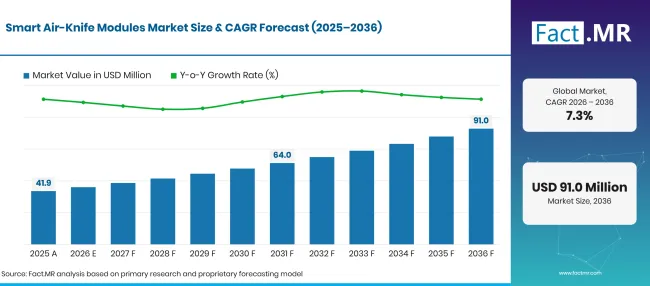
Smart Air Knife Modules Forecast Global | Source: Fact.MR
Category
| Category | Segments |
|---|---|
| Air-knife control | Fixed-pressure air knife, Servo-gap air knife, Flow-sensor feedback, Vision-assisted air knife, Multi-zone adaptive |
| Processing scale | Pilot / lab, Small commercial, Mid-scale, High-throughput, Ultra-high-throughput |
| Operating configuration | Batch, Semi-continuous, Continuous, Modular skid, Integrated line |
| Food / process application | Bakery / wafers, Confectionery / cocoa, Snacks / seasoning, Brewing / grains, Other food / industrial |
| Region | Germany; China; Japan; South Korea; United States |
Source: Fact.MR analysis. Updated Nov 25, 2026
Segmental Analysis
Why does Vision-assisted air knife lead air-knife control demand in the Smart Air-Knife Modules Market?
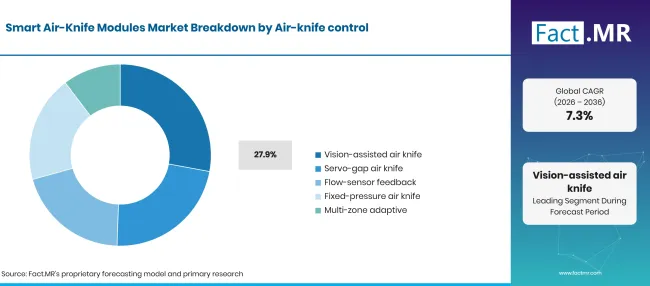
Smart Air Knife Modules Breakdown Air Knife Control | Source: Fact.MR
Vision-assisted air knives capture 27.9% of market revenue in 2026, equivalent to USD 12.6 million. Food processors favour this approach because cameras identify uneven coating, residual moisture and product-surface variations, allowing airflow to respond to actual line conditions. Fixed-pressure knives remain relevant for simpler operations, while servo-gap systems attract processors seeking precise mechanical adjustment. A European Digital Innovation Hubs case published in April 2026 documents how Czech manufacturer 24 Vision advanced from rule-based inspection towards AI-based defect classification using camera and sensor technologies.
Why does the Mid-scale segment lead scale demand in the Smart Air-Knife Modules Market?
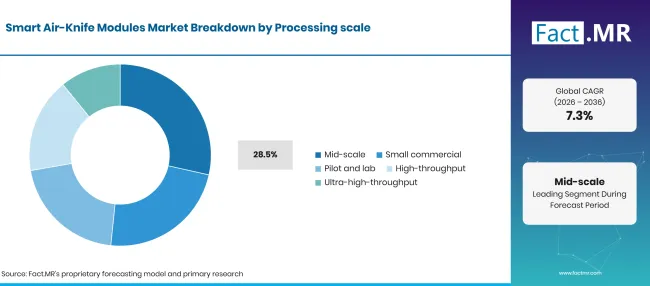
Smart Air Knife Modules Breakdown Processing Scale | Source: Fact.MR
Mid-scale installations capture 28.5% of revenue in 2026, worth USD 12.8 million. Food processors in this category often operate several production lines but prefer manageable equipment upgrades over extensive plant reconstruction. This makes sensor-controlled air knives attractive for improving airflow consistency without major changes to existing machinery. Pilot-scale installations are gaining traction among smaller processors testing automation, while large-scale facilities favour customised high-capacity systems. A July 2025 Enterprise Europe Network listing highlights modular vegetable-processing lines designed by a Polish SME, illustrating the growing availability of adaptable equipment for food manufacturers.
Why do Modular skid units lead configuration demand in the Smart Air-Knife Modules Market?
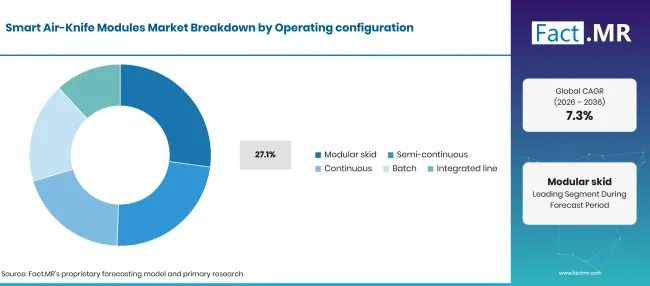
Smart Air Knife Modules Breakdown Operating Configuration | Source: Fact.MR
Modular skid units capture 27.1% of revenue in 2026, reaching USD 12.2 million. Their appeal comes from combining blowers, airflow controls and supporting components in a self-contained arrangement that simplifies installation and relocation. Integrated systems remain attractive for newly constructed plants, while standalone units suit processors upgrading individual stations. The European Enterprise Network's November 2026 listing of an Italian food machinery manufacturer highlights modular equipment with connectivity and energy-monitoring features alongside complete processing lines. This development reinforces interest in flexible machinery configurations across food production facilities.
Why does Brewing / grains lead application demand in the Smart Air-Knife Modules Market?
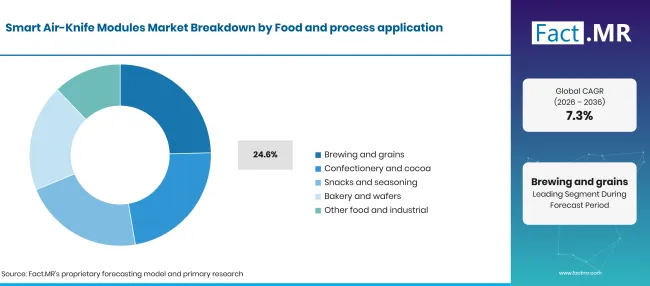
Smart Air Knife Modules Breakdown Food And Process Application | Source: Fact.MR
Brewing / grains captures 24.6% of revenue in 2026, equivalent to USD 11.1 million. Beverage plants use air knives to remove moisture from bottles and cans before filling or labelling, while grain processors apply controlled airflow during cleaning and handling. Bakery and snack manufacturers also adopt blow-off equipment for surface cleaning and moisture removal. Eurostat's 2026 publication on industrial energy consumption identifies food and beverage manufacturing as distinct energy-intensive production activities, reinforcing the importance of efficient equipment across these operations.
Smart Air-Knife Modules Market-Drivers, Restraints & Trends
Drivers: Rising focus on compressed-air efficiency:
Food processors are becoming less willing to run air knives at full pressure throughout a shift when airflow requirements change between products. Smart controls help match air output with actual production conditions, reducing electricity waste without compromising cleaning or drying quality. India's Bureau of Energy Efficiency reported 25.78 million tonnes of oil equivalent in savings under the industrial PAT programme in 2025. The figure shows the scale of industrial energy-efficiency improvements. This focus creates room for sensor-controlled air-knife installations.
Restraints: High retrofit costs and limited energy monitoring:
Smaller food plants often find smart air-knife upgrades difficult to justify against inexpensive conventional knives. Retrofitting also involves controls, sensors, installation work and production interruptions. Where compressed-air consumption is not measured separately, operators struggle to establish whether the investment will pay back. These financial and measurement barriers could delay adoption among smaller processors.
Trend: Blower-fed systems replacing central compressed air:
Food manufacturers are showing greater interest in dedicated blower-fed air knives because they avoid drawing from plant-wide compressed-air networks. This shift opens opportunities for equipment upgrades focused on lower operating costs and better airflow management. Australia's official food and beverage energy guidance identifies blow-off as a common compressed-air application. It also identifies excessive pressure, leakage and inefficient system layouts as sources of energy waste These concerns strengthen the case for alternative air-generation arrangements.
Trend: Vision-linked blow-off and adaptive airflow:
Camera-guided blow-off is gaining attention as processors look beyond fixed airflow settings to improve product consistency. Linking inspection results with air-knife controls creates opportunities for more selective moisture removal and coating correction, particularly on high-speed food lines. In June 2026, the UK Food Standards Agency published a Science Council report on AI applications in food safety. The report discusses real-time detection and automated assurance. This wider move towards intelligent food inspection creates fresh opportunities for vision-connected air-knife systems
Smart Air-Knife Modules Market by Analysis by Key Country
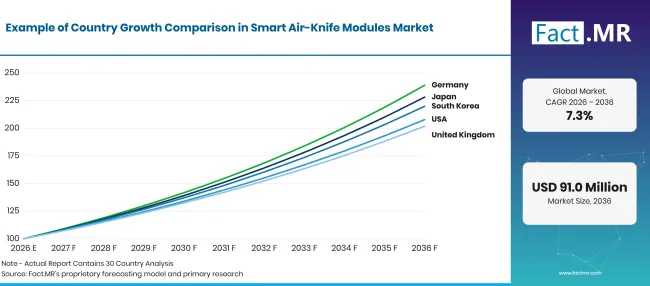
Smart Air Knife Modules Growth Index | Source: Fact.MR
| Country | CAGR (2026-2036) |
|---|---|
| Germany | 9.1% |
| China | 8.9% |
| Japan | 8.6% |
| South Korea | 8.2% |
| United States | 7.4% |
Source: Fact.MR analysis. Updated Nov 25, 2026
Why is Germany the fastest-growing market for smart air-knife modules?
Germany's strong food-processing machinery base creates favourable conditions for smart air-knife adoption.
According to VDMA's May 2026 industry review, German food-processing and packaging machinery production increased 4.9% in 2025, reaching nearly EUR 17 billion. Rising equipment output and pressure to control factory energy consumption are encouraging processors to consider airflow monitoring, automated pressure adjustment and compressed-air savings. Modernisation of existing production lines is likely to create further opportunities for smart air-knife modules.
What is driving smart air-knife module demand in China?
China's food-processing industry is gaining from wider factory automation and investment in intelligent manufacturing.
The National Bureau of Statistics reported that food processing from agricultural and sideline products grew 5.6% in 2025. Separately, the State Taxation Administration recorded an 11.3% annual increase in manufacturers' purchases of automated equipment. These developments create favourable conditions for sensor-based blow-off systems as processors modernise production lines and improve operating efficiency.
What is shaping smart air-knife module demand in Japan?
Labour shortages across Japan's food factories are encouraging investment in equipment that reduces manual intervention.
The Ministry of Agriculture, Forestry and Fisheries highlighted food manufacturing productivity and the adoption of AI, robotics and advanced technologies in its 2025 White Paper. Its June 2025 productivity initiative also supports automation across food-processing operations. These developments favour smart air-knife modules for drying, cleaning and surface treatment, particularly where consistent output is important despite limited staffing.
What is shaping smart air-knife module demand in South Korea?
South Korea is creating fresh opportunities through its national food-tech expansion programme.
In July 2026, the Ministry of Agriculture, Food and Rural Affairs announced plans to increase participating smart food-manufacturing facilities from 30 in 2024 to 187 by 2026. This expansion is encouraging food manufacturers to introduce connected machinery, automated inspection and more precise production controls. Smart air-knife modules fit this transition through sensor-led airflow regulation and reduced manual adjustment on beverage and packaged-food lines.
Why is smart air-knife module growth slower in the United States?
In the United States, industrial energy efficiency is an important factor behind investment in smarter air-handling equipment.
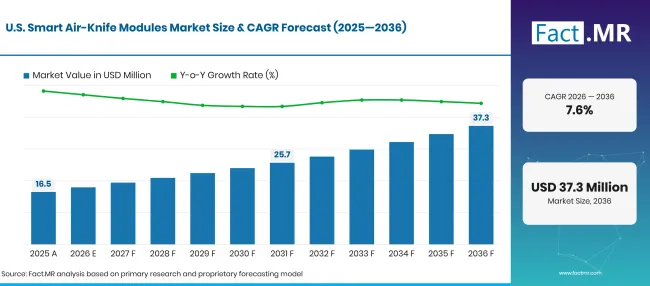
Smart Air Knife Modules Forecast Usa | Source: Fact.MR
The Department of Energy's compressor efficiency standards apply to compressors manufactured from January 10, 2025, strengthening the focus on energy performance across industrial facilities. Food and beverage manufacturers have additional reasons to modernise because drying, cleaning and packaging operations frequently use compressed air. Better airflow measurement and pressure control are creating opportunities for smart air-knife installations across established processing plants.
Competitive Landscape for Smart Air-Knife Modules Market
Competition in the smart air-knife modules market is shaped by equipment manufacturers serving complete food-processing lines and specialists focused on individual production stages. GEA offers bakery, snack and food-processing machinery, while JBT Marel combines processing equipment with production software, automation and lifecycle services. Heat and Control focuses on snack processing, coating and seasoning systems, whereas Bühler serves grain, bakery and food manufacturing operations. Baker Perkins and tna solutions strengthen the specialist field through bakery and snack-line technologies.
Recent portfolio developments show greater attention to connected machinery and resource efficiency. JBT Marel's 2025 portfolio highlights real-time production data and equipment connectivity, while GEA continues expanding its digital process-control and engineering services. Buyers increasingly compare airflow precision, compressed-air consumption, hygienic design and retrofit compatibility before selecting equipment.
Recent Development:
- On March 11, 2026, EXAIR introduced a new brand identity as part of its business repositioning. The revised branding shows its focus on compressed-air solutions, engineering innovation and customer service.
- On September 15, 2025, EXAIR partnered with John Brooks Company to expand the distribution of its compressed air products across Canada. The partnership covers air knives, air amplifiers, cabinet coolers and industrial vacuum products.
- On March 2025, ITW Air Management appointed Dan Black as its new Business Unit Manager. He took responsibility for overseeing operations and strategic initiatives across ITW Air Management and Pillar Technologies.
- On August 26, 2026, Paxton Products introduced a refreshed brand identity and logo. The new design shows its focus on industrial air-delivery solutions for drying, blow-off, rinsing and cooling applications.
- In August 2026, Vortec introduced a new brand identity featuring a redesigned vortex symbol. The branding reflects its focus on industrial air solutions for equipment cooling, protection and manufacturing efficiency.
Key Players in Smart Air-Knife Modules Market
Key companies operating in the market include Sonic Air Systems, EXAIR, ITW Air Management, Paxton Products, and Vortec.
- Sonic Air Systems
- EXAIR
- ITW Air Management
- Paxton Products
- Vortec
Bibliography
- Australian Government, Department of Climate Change, Energy, the Environment and Water. (n.d.). Food and beverage manufacturing.
- Bureau of Energy Efficiency. (n.d.). Perform, achieve and trade (PAT). Ministry of Power, Government of India.
- California Energy Commission. (2026). Demonstrating an optimized compressed air energy system at the Sun-Maid Kingsburg facility.
- Department of Energy. (n.d.). Commercial and industrial air compressors. U.S. Government.
- Destatis. (2026, November 16). Energieverbrauch der Industrie 2025 um 2,9 % gesunken [Industrial energy consumption declined by 2.9% in 2025]. Federal Statistical Office of Germany.
- Enterprise Europe Network. (2025, July 9). Polish provider of modular vegetable processing lines (from receiving to packing & palletising) seeks foreign partners. European Commission.
- Enterprise Europe Network. (2026, November 13). Italian manufacturer of food processing, dosing and packaging machinery seeks international distributors, commercial agents and customers under commercial agreement. European Commission.
- European Commission. (2026, April 27). 24 Vision: How EDIH-DIGIMAT helped to improve visual quality inspection method. European Digital Innovation Hubs Network.
- Eurostat. (2026, May 29). Growing energy consumption in the food industry. European Commission.
- Food Standards Agency. (2025). Artificial intelligence applications in food safety and authenticity: Science Council report.
- Ministry of Agriculture, Forestry and Fisheries. (n.d.). Improving productivity in the food manufacturing industry. Government of Japan.
- Ministry of Agriculture, Food and Rural Affairs. (2026). Food-tech development and expansion of smart food manufacturing. Government of the Republic of Korea.
- National Bureau of Statistics of China. (2026, February 28). Statistical communiqué of the People's Republic of China on the 2025 national economic and social development.
- State Taxation Administration. (2026, January 28). Tax data shows China's faster transformation in manufacturing. Government of the People's Republic of China.
Segmentation
Scope of Report
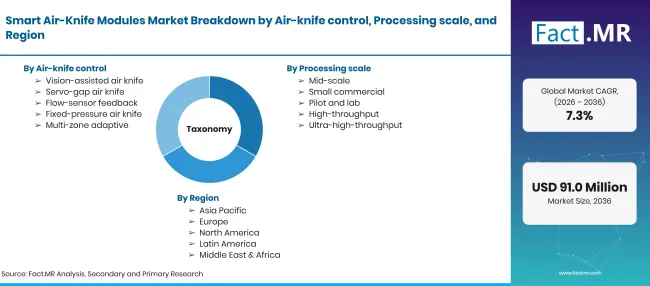
Smart Air Knife Modules Taxonomy | Source: Fact.MR
| Items | Values |
|---|---|
| Quantitative Units (2026) | USD 45.0 Million |
| Air-knife control | Fixed-pressure air knife, Servo-gap air knife, Flow-sensor feedback, Vision-assisted air knife, Multi-zone adaptive |
| Processing scale | Pilot / lab, Small commercial, Mid-scale, High-throughput, Ultra-high-throughput |
| Operating configuration | Batch, Semi-continuous, Continuous, Modular skid, Integrated line |
| Food and process application | Bakery / wafers, Confectionery / cocoa, Snacks / seasoning, Brewing / grains, Other food / industrial |
| Regions Covered | North America, Latin America, Europe, East Asia, South Asia and Pacific, Middle East & Africa |
| Countries Covered | Germany, China, Japan, South Korea, United States, and other countries |
| Key Companies Profiled | GEA, JBT Marel, Heat and Control, Bühler, Baker Perkins, tna solutions |
| Additional Attributes | Dollar revenue in the Smart Air-Knife Modules Market is segmented by air-knife control (fixed-pressure air knife, servo-gap air knife, flow-sensor feedback, vision-assisted air knife, multi-zone adaptive); processing scale (pilot / lab, small commercial, mid-scale, high-throughput, ultra-high-throughput); operating configuration (batch, semi-continuous, continuous, modular skid, integrated line); food / process application (bakery / wafers, confectionery / cocoa, snacks / seasoning, brewing / grains, other food / industrial) and region. |
Source: Fact.MR analysis. Updated Nov 25, 2026
Smart Air-Knife Modules Market by Segments
-
Air-knife control
- Fixed-pressure air knife
- Servo-gap air knife
- Flow-sensor feedback
- Vision-assisted air knife
- Multi-zone adaptive
-
Processing scale
- Pilot / lab
- Small commercial
- Mid-scale
- High-throughput
- Ultra-high-throughput
-
Operating configuration
- Batch
- Semi-continuous
- Continuous
- Modular skid
- Integrated line
-
Food / process application
- Bakery / wafers
- Confectionery / cocoa
- Snacks / seasoning
- Brewing / grains
- Other food / industrial
-
Region:
- North America
- United States
- Canada
- Mexico
- Europe
- Germany
- United Kingdom
- France
- Italy
- Spain
- Rest of Europe
- Asia Pacific
- China
- India
- Japan
- South Korea
- Australia
- Rest of Asia Pacific
- Latin America
- Brazil
- Mexico
- Argentina
- Rest of Latin America
- Middle East & Africa
- GCC Countries
- South Africa
- Rest of Middle East & Africa
- North America
Table of Contents
Key Takeaways
- Market Size and CAGR
- Top Growth Driver
- Fastest Growing Segment
- Leading Region
- Key Companies
- Emerging Opportunities

