
- Market Value (2025): USD 42.2 Mn
- Estimated Value (2026): USD 45.0 Mn
- Forecast Value (2036): USD 86.1 Mn
- CAGR (2026-2036): 6.7%
Continuous vs Batch Mixers Market Forecast and Outlook 2026 to 2036
The continuous and batch mixers market is projected to grow from USD 45.0 million in 2026 to USD 86.1 million by 2036. Demand for continuous and batch mixers is likely to grow at a CAGR of 6.7% over the forecast period.
Food processors select batch or continuous mixers according to recipe flexibility, line capacity, cleaning, and lot-management needs. The U.S. FDA Food Traceability Rule establishes additional records for foods on the Food Traceability List, while FDA enforcement is deferred until July 20, 2028.
Key Takeaways from the Continuous vs Batch Mixers Market
- Sales of continuous and batch mixers stood at USD 42.2 million in 2025
- Continuous vs Batch Mixers Market Value (2026): USD 45.0 million
- Continuous vs Batch Mixers Market Forecast Value (2036): USD 86.1 million
- Continuous vs Batch Mixers Market Forecast CAGR (2026-2036): 6.7%
- Leading Mixer operating mode: Batch ribbon (27.8%)
- Key Market Participants: GEA, JBT Marel, Heat and Control, Bühler, Baker Perkins, tna solutions
- Key Growth Countries: United States, China, Italy, Germany, Japan
Equipment suppliers such as GEA, JBT Marel and Bühler offer both batch and continuous mixing, helping customers compare energy use, yield and changeover times for each product. Processors are reviewing mixer configurations as product ranges change and cleaning requirements differ by recipe. Equipment makers offer pilot testing to choose the right mode.
Continuous vs Batch Mixers Market
| Metric | Value |
|---|---|
| Estimated Value in (2026) | USD 45.0 million |
| Forecast Value in (2036) | USD 86.1 million |
| Forecast CAGR (2026 to 2036) | 6.7% |
Source: Fact.MR analysis.
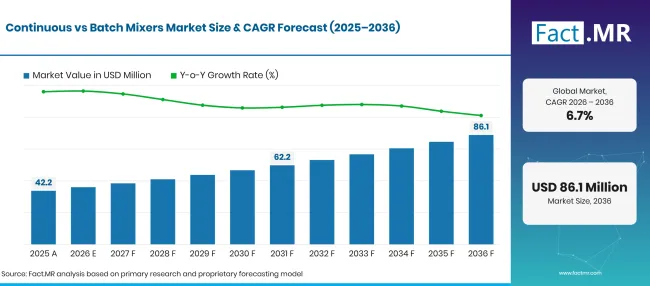
Continuous Vs Batch Mixers Forecast Global 1 | Source: Fact.MR
Category
| Category | Segments |
|---|---|
| Mixer operating mode | Batch ribbon, Batch high-shear, Continuous ribbon, Continuous twin-shaft, Hybrid switchable |
| Processing scale | Pilot / lab, Small commercial, Mid-scale, High-throughput, Ultra-high-throughput |
| Operating configuration | Batch, Semi-continuous, Continuous, Modular skid, Integrated line |
| Food / process application | Bakery / wafers, Confectionery / cocoa, Snacks / seasoning, Brewing / grains, Other food / industrial |
| Key Countries | United States; China; Italy; Germany; Japan |
Source: Fact.MR analysis.
Segmental Analysis
Why does batch ribbon lead operating-mode demand in the Continuous vs Batch Mixers Market?
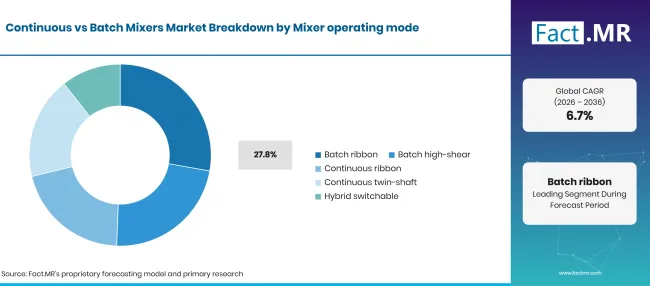
Continuous Vs Batch Mixers Breakdown Mixer Operating Mode 2 | Source: Fact.MR
Batch ribbon mixers account for 27.8% of revenue in 2026, approximately USD 12.5 million, as their helical agitators distribute powders and small liquid additions throughout the mixing vessel. Food and chemical processors use these machines for recipes requiring controlled blending. Equipment manufacturers are improving discharge mechanisms, cleaning access and liquid spray arrangements to reduce material residue between batches.
Why does the pilot / lab segment lead scale demand in the Continuous vs Batch Mixers Market?
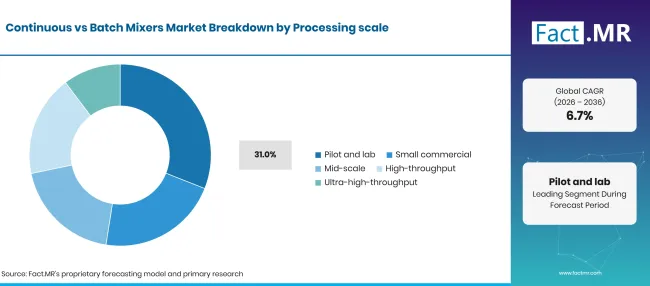
Continuous Vs Batch Mixers Breakdown Processing Scale 1 | Source: Fact.MR
Pilot and laboratory mixers represent 31.0% of revenue in 2026, valued at approximately USD 13.9 million, reflecting the importance of formulation trials before commercial equipment investment. Research teams examine mixing time, ingredient behavior and product uniformity under controlled conditions. GEA offers high-shear test mixers for process development. Pilot testing helps manufacturers establish suitable operating parameters and assess scale-up requirements.
Why does batch operation lead configuration demand in the Continuous vs Batch Mixers Market?
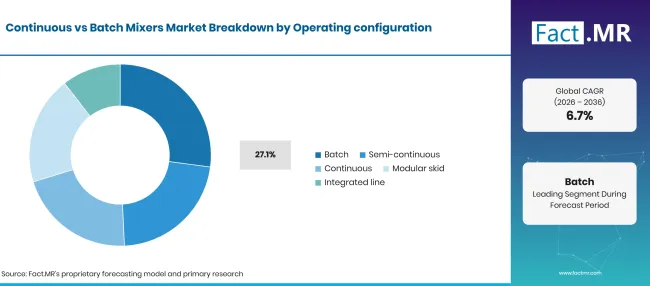
Continuous Vs Batch Mixers Breakdown Operating Configuration 1 | Source: Fact.MR
Batch operation holds 27.1% of revenue in 2026, equivalent to approximately USD 12.2 million, as manufacturers producing multiple recipes require separate, traceable production cycles. Individual batches allow controlled ingredient dosing and quality checks before discharge. Equipment suppliers are incorporating programmable controls and automated ingredient addition. Food processors benefit from adjustable production schedules, documented recipes and consistent lot management.
Why does confectionery / cocoa lead application demand in the Continuous vs Batch Mixers Market?
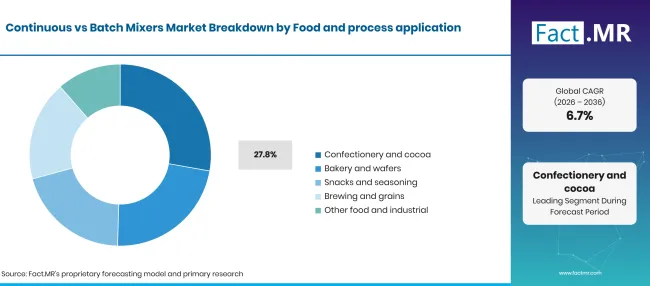
Continuous Vs Batch Mixers Breakdown Food And Process Application 1 | Source: Fact.MR
Confectionery and cocoa applications contribute 27.8% of revenue in 2026, approximately USD 12.5 million, owing to the careful blending required for chocolate masses, creams and fillings. Bühler introduced CompactMix in November 2025 for manufacturing confectionery masses with consistent quality. Chocolate producers assess mixing intensity, temperature control and ingredient distribution to achieve the desired texture and processing behavior.
Continuous vs Batch Mixers Market: Drivers, Restraints and Trends
Drivers
Food processors are evaluating batch and continuous mixing technologies to improve production efficiency and accommodate changing output requirements. Equipment manufacturers provide pilot testing and process assessments to help customers compare mixing uniformity, energy consumption, cleaning requirements and operating costs.
Restraints
Long equipment lifetimes and high conversion costs can delay investments in alternative mixing configurations. Switching between batch and continuous processing may require changes to feeding, discharge and cleaning systems. Manufacturers are offering retrofit solutions to reduce installation complexity and production interruptions.
Trend
Switchable Hybrid Mixers: Interest in hybrid mixing equipment is increasing among manufacturers handling different production volumes and recipes. Systems capable of batch and continuous operation offer greater processing flexibility. Equipment developers are refining control arrangements and mixing chambers to support reliable operation across different modes.
Trend: Traceable Batch Records
Food manufacturers are introducing automated data recording to improve batch documentation and production traceability. Modern mixing systems can capture ingredient quantities, processing parameters and recipe changes. Suppliers are integrating digital controls and production management software to simplify quality reviews and recordkeeping.
Continuous vs Batch Mixers Market by key country
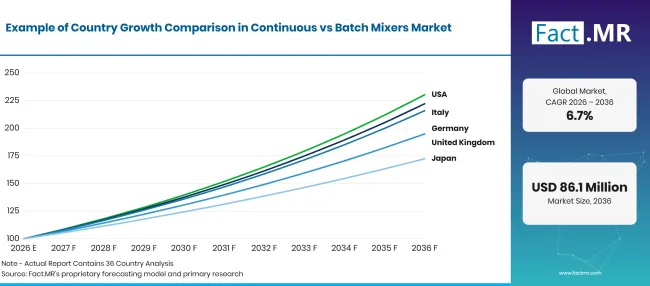
Continuous Vs Batch Mixers Growth Index 1 | Source: Fact.MR
| Country | CAGR (2026-2036) |
|---|---|
| United States | 8.7% |
| China | 8.3% |
| Italy | 8.2% |
| Germany | 8.0% |
| Japan | 5.6% |
Source: Fact.MR analysis.
Why is the United States the fastest-growing market for continuous and batch mixers?
Demand for continuous and batch mixers in the United States carries an 8.7% CAGR through 2036, the fastest among the five countries.
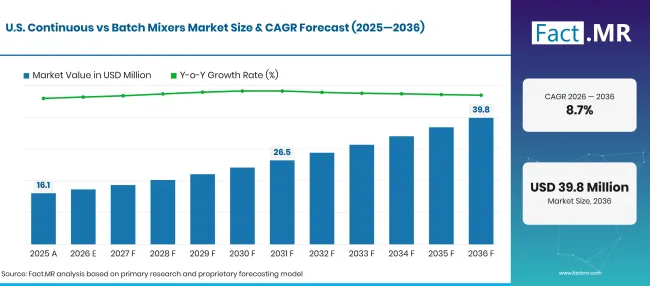
Continuous Vs Batch Mixers Forecast Usa | Source: Fact.MR
Food manufacturers are examining flexible mixing arrangements that accommodate changing recipes and production volumes. Under the Continuing Appropriations, Agriculture, Legislative Branch, Military Construction and Veterans Affairs, and Extensions Act of 2026, the FDA may not enforce the Food Traceability Rule before July 20, 2028, giving affected businesses additional preparation time. Equipment buyers may use this period to improve digital batch documentation and ingredient tracking.
What is driving continuous and batch mixer demand in China?
Sales of continuous and batch mixers in China are forecast to increase at an 8.3% CAGR through 2036 as food processors examine automated production and higher-capacity manufacturing equipment.
Domestic machinery suppliers compete through accessible pricing and customized equipment configurations. Dairy and infant nutrition manufacturers require precise ingredient incorporation and reliable cleaning arrangements. Larger producers may favor continuous systems for standardized recipes, while smaller facilities retain batch processing flexibility.
What is shaping continuous and batch mixer demand in Italy?
Demand for continuous and batch mixers in Italy is set to advance at an 8.2% CAGR through 2036, supported by equipment modernization across food and specialty manufacturing.
Italy's 2026 budget law replaced the Transizione 5.0 tax credit with a hyper-depreciation scheme, the New Transizione 5.0 Plan, for qualifying investments in advanced production technologies made from 1 January 2026 to 30 September 2028. Food manufacturers can examine mixing systems with automated dosing and improved process monitoring. Smaller processors may retain batch equipment for recipe flexibility, while larger facilities evaluate continuous production.
What is shaping continuous and batch mixer demand in Germany?
Demand for continuous and batch mixers in Germany is likely to expand at an 8.0% CAGR through 2036 as food manufacturers improve processing efficiency and manage energy expenses.
Osnabrück-based DIOSNA, a Coperion brand, supplies industrial mixing and kneading equipment for bakery and pharmaceutical applications. Its automated systems support controlled processing and production documentation. German manufacturers are examining mixer upgrades that reduce unnecessary operating time while maintaining consistent product quality.
Why is continuous and batch mixer growth slower in Japan?
Demand for continuous and batch mixers in Japan is forecast to increase at a 5.6% CAGR through 2036, the slowest among the five countries.
Established food manufacturing infrastructure and demographic changes influence equipment replacement planning. However, demand for ready-to-eat meals and changing consumer preferences continues to support investment in modern food processing machinery. Japanese manufacturers are examining automated batch controls and compact mixing systems suited to existing factory layouts.
Competitive Landscape for Continuous vs Batch Mixers Market
The continuous vs batch mixers market reflects different manufacturing priorities, with equipment suppliers addressing recipe flexibility, production consistency and line integration. GEA competes through its BATCH FORMULA and DIBATCH systems, alongside continuous liquid mixing technologies. JBT Marel offers industrial mixers and automated processing lines for prepared foods, while Bühler supplies Speedmix batch mixers for feed and dry ingredient applications. Baker Perkins, now part of Coperion alongside DIOSNA, specializes in high-speed bakery mixing. Heat and Control and tna solutions compete in broader snack processing equipment.
Equipment selection increasingly depends on how mixing technology fits existing production operations. GEA's Batch2Flow moves mixed meat, poultry and plant-based product from the batch mixer to the former in-line, while JBT Marel offers configurable mixing lines with automated material handling. These approaches give processors options for balancing recipe changes with production efficiency. Suppliers offering documented processing performance, practical integration support and reliable service can strengthen their competitive position.
Recent Developments
- In November 2025, GEA announced construction of a large-scale liquid flavor mixing plant for Symrise at Holzminden, Germany, with automated ingredient handling, cleaning systems and heat recovery. Symrise expects liquid flavor capacity to rise by up to 50 percent once the plant is commissioned, planned for spring 2026.
- In November 2025, Bühler launched CompactMix, integrating ShearMix mixing technology with Aurora ball milling, offering processing capacities from 400 to 3,000 kilograms per hour and up to 30 percent lower energy consumption.
- In June 2025, Heat and Control announced its acquisition of Fabcon Food Systems, a UK maker of processing, product handling, sorting, precision flavoring, weighing and packing systems for the snack, French fry and protein industries.
Key Players in Continuous vs Batch Mixers Market
Key companies operating in the Continuous vs Batch Mixers Market include GEA, JBT Marel, Heat and Control, Bühler, Baker Perkins, and tna solutions.GEA
- JBT Marel
- Heat and Control
- Bühler
- Baker Perkins
- tna solutions
Bibliography
- Baker Perkins. (n.d.). The Baker Perkins story.
- Bühler Group. (2025, November 4). Bühler introduces CompactMix – precision, flexibility, and energy efficiency for delicious results.
- Bühler Group. (n.d.). Speedmix batch mixer.
- GEA. (2025, November 18). GEA builds new large-scale mixing plant for flavor production at Symrise.
- GEA. (n.d.). Batch2Flow: the missing link between mixing and forming.
- GEA. (n.d.). DIBATCH batch mixer.
- Heat and Control. (2025, June 2). Heat and Control announces acquisition of Fabcon Food Systems Ltd.
- Ministero delle Imprese e del Made in Italy. (2026). Nuovo Piano Transizione 5.0 – Iperammortamento.
- U.S. Food and Drug Administration. (2025, August 7). Requirements for additional traceability records for certain foods: Compliance date extension (proposed rule). h
- U.S. Food and Drug Administration. (2026). FSMA final rule on requirements for additional traceability records for certain foods.
Segmentation
Scope of Report
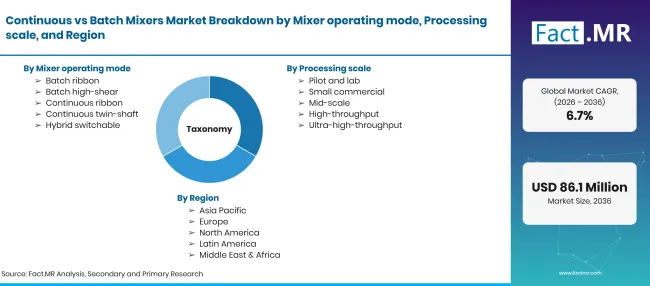
Continuous Vs Batch Mixers Taxonomy | Source: Fact.MR
| Items | Values |
|---|---|
| Quantitative Units (2026) | USD 45.0 Million |
| Mixer operating mode | Batch ribbon, Batch high-shear, Continuous ribbon, Continuous twin-shaft, Hybrid switchable |
| Processing scale | Pilot / lab, Small commercial, Mid-scale, High-throughput, Ultra-high-throughput |
| Operating configuration | Batch, Semi-continuous, Continuous, Modular skid, Integrated line |
| Food / process application | Bakery / wafers, Confectionery / cocoa, Snacks / seasoning, Brewing / grains, Other food / industrial |
| Regions Covered | North America, Latin America, Europe, Asia Pacific, Middle East & Africa |
| Countries Covered | United States, China, Italy, Germany, Japan, and other countries |
| Key Companies Profiled | GEA, JBT Marel, Heat and Control, Bühler, Baker Perkins, tna solutions |
| Additional Attributes | Dollar revenue in the Continuous vs Batch Mixers Market is segmented by mixer operating mode (batch ribbon, batch high-shear, continuous ribbon, continuous twin-shaft, hybrid switchable); processing scale (pilot / lab, small commercial, mid-scale, high-throughput, ultra-high-throughput); operating configuration (batch, semi-continuous, continuous, modular skid, integrated line); food / process application (bakery / wafers, confectionery / cocoa, snacks / seasoning, brewing / grains, other food / industrial) and region. |
Source: Fact.MR analysis.
Continuous vs Batch Mixers Market by Segments
-
Mixer operating mode
- Batch ribbon
- Batch high-shear
- Continuous ribbon
- Continuous twin-shaft
- Hybrid switchable
-
Processing scale
- Pilot / lab
- Small commercial
- Mid-scale
- High-throughput
- Ultra-high-throughput
-
Operating configuration
- Batch
- Semi-continuous
- Continuous
- Modular skid
- Integrated line
-
Food / process application
- Bakery / wafers
- Confectionery / cocoa
- Snacks / seasoning
- Brewing / grains
- Other food / industrial
-
Region
- North America
- United States
- Canada
- Mexico
- Europe
- Germany
- United Kingdom
- France
- Italy
- Spain
- Rest of Europe
- Asia Pacific
- China
- India
- Japan
- South Korea
- Australia
- Rest of Asia Pacific
- Latin America
- Brazil
- Argentina
- Rest of Latin America
- Middle East & Africa
- GCC Countries
- South Africa
- Rest of Middle East & Africa
- North America
Table of Contents
Key Takeaways
- Market Size and CAGR
- Top Growth Driver
- Fastest Growing Segment
- Leading Region
- Key Companies
- Emerging Opportunities

