
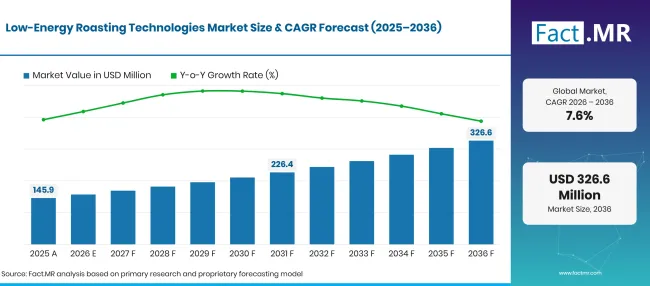
- Market Value (2025): USD 145.9 Mn
- Estimated Value (2026): USD 157.0 Mn
- Forecast Value (2036): USD 326.6 Mn
- CAGR (2026-2036): 7.6%
Low-Energy Roasting Technologies Market Forecast and Outlook 2026 to 2036
The low-energy roasting technologies market reached a derived estimate of USD 145.9 million in 2025. The market is projected to grow from USD 157.0 million in 2026 to USD 326.6 million by 2036. Demand for low-energy roasting technologies is likely to grow at a CAGR of 7.6% over the forecast period.
Demand for low-energy roasting technologies is rising as roasters of nuts, seeds, coffee, cocoa and grains cut gas use and emissions in one of the most energy-intensive steps of food processing. Low-energy designs include electric roasters with low heat losses, infrared heating, fluidized beds and heat recovery from exhaust air. For example, arabica coffee prices reached record highs in early 2025, with the Colombian Milds and Other Milds group prices averaging above USD 4 per pound in February 2025 (International Coffee Organization, 2025), increasing pressure on roasters to control all other costs. Similar cost pressure is projected to drive sales of low-energy roasting technologies through 2036.
Key Takeaways from the Low-Energy Roasting Technologies Market
- Sales of low-energy roasting technologies stood at USD 145.9 million in 2025
- Low-Energy Roasting Technologies Market Value (2026): USD 157.0 million
- Low-Energy Roasting Technologies Market Forecast Value (2036): USD 326.6 million
- Low-Energy Roasting Technologies Market Forecast CAGR (2026-2036): 7.6%
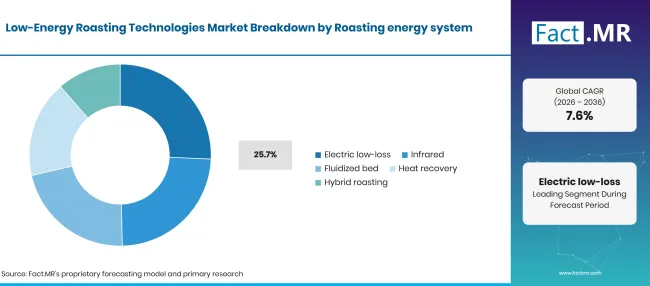
- Leading Roasting energy system: Electric low-loss (25.7%)
- Key Market Participants: Bühler, Royal Duyvis Wiener, NETZSCH, Caotech, Probat, JAF Inox
- Key Growth Countries: China, United States, Italy, Germany, Japan
Coffee chains in China, led by Luckin Coffee with more than 20,000 stores by 2024 (Luckin Coffee Inc., 2025), have driven fast growth in domestic roasting. Demand for low-energy roasting technologies is growing as new roasteries choose efficient, electric equipment. Suppliers such as Probat, Bühler and NETZSCH are offering roasters with heat recovery and emission control. Similar capacity growth is projected to drive sales of low-energy roasting technologies in Asia and other emerging markets.
Low-Energy Roasting Technologies Market
| Metric | Value |
|---|---|
| Estimated Value (2025) | USD 145.9 million |
| Market Value (2026) | USD 157.0 million |
| Forecast Value (2036) | USD 326.6 million |
| Forecast CAGR (2026 to 2036) | 7.6% |
Source: Fact.MR analysis. Updated Nov 26, 2026
Low Energy Roasting Technologies Forecast Global | Source: Fact.MR
Category
| Category | Category Segments |
|---|---|
| Roasting energy system | Heat recovery, Infrared, Fluidized bed, Electric low-loss, Hybrid roasting |
| Processing scale | Pilot / lab, Small commercial, Mid-scale, High-throughput, Ultra-high-throughput |
| Operating configuration | Batch, Semi-continuous, Continuous, Modular skid, Integrated line |
| Food / process application | Bakery / wafers, Confectionery / cocoa, Snacks / seasoning, Brewing / grains, Other food / industrial |
| Region | China; United States; Italy; Germany; Japan |
Source: Fact.MR analysis. Updated Nov 26, 2026
Segmental Analysis
Why does Electric low-loss roasting lead energy-system demand in the Low-Energy Roasting Technologies Market?
Low Energy Roasting Technologies Breakdown Roasting Energy System | Source: Fact.MR
Electric low-loss roasting accounts for 25.7% of revenue in 2026, about USD 40.3 million. The corresponding derived 2025 value is USD 37.5 million. Electric roasters avoid combustion emissions and can run on renewable power, with insulation and controls cutting losses. Infrared and fluidized-bed systems follow closely. Suppliers are offering electric drum and hot-air roasters.
Why does the Mid-scale segment lead scale demand in the Low-Energy Roasting Technologies Market?
Low Energy Roasting Technologies Breakdown Processing Scale 1 | Source: Fact.MR
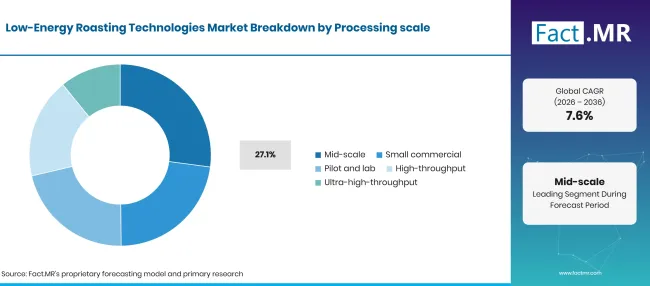
The Mid-scale segment accounts for 27.1% of revenue in 2026, about USD 42.5 million. The corresponding derived 2025 value is USD 39.5 million. Regional nut, seed and coffee roasters replace older gas roasters. Ultra-high-throughput plants follow. Suppliers are offering mid-size efficient roasters.
Why does Continuous operation lead configuration demand in the Low-Energy Roasting Technologies Market?
Low Energy Roasting Technologies Breakdown Operating Configuration | Source: Fact.MR
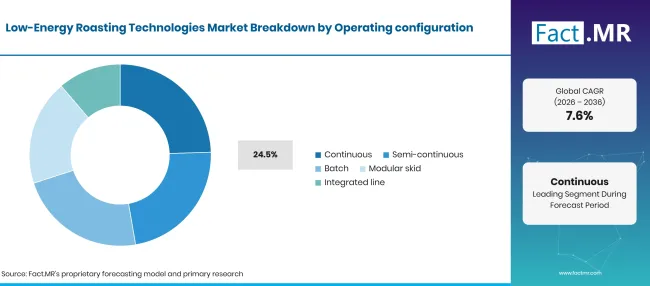
Continuous operation accounts for 24.5% of revenue in 2026, about USD 38.5 million. The corresponding derived 2025 value is USD 35.8 million. Continuous roasters reuse heat steadily and avoid warm-up losses between batches. Integrated and modular setups follow. Suppliers are offering continuous roasters with heat recovery.
Why does Snacks / seasoning lead application demand in the Low-Energy Roasting Technologies Market?
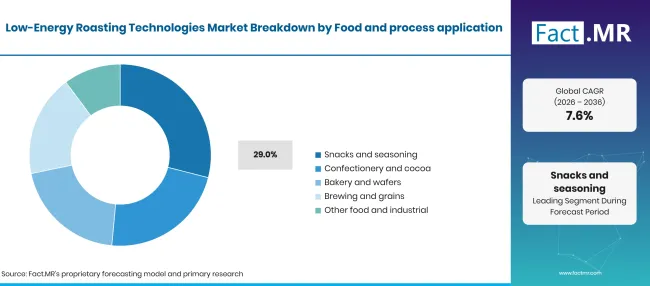
Low Energy Roasting Technologies Breakdown Food And Process Application | Source: Fact.MR
Snacks / seasoning accounts for 29.0% of revenue in 2026, about USD 45.5 million. The corresponding derived 2025 value is USD 42.3 million. Roasted nuts, seeds and seasoned snacks need large roasting capacity. Bakery and cocoa follow. Suppliers serve nut and snack processors.
Low-Energy Roasting Technologies Market: Drivers, Restraints & Trends
Drivers
Demand for low-energy roasting technologies is rising as food companies set net-zero targets and roasting is a major source of their direct emissions. Suppliers are offering electric and heat-recovery roasters.
Restraints
Demand for low-energy roasting technologies is limited by electricity costs and grid capacity in some regions and by concerns that electric roasting changes flavor. Similar concerns are projected to slow adoption. Suppliers must show equal flavor results.
Trend
Electrified Roasting. Demand for electric roasters is rising as roasters move off gas. Suppliers are launching electric models.
Trend
Afterburner Replacement. Demand for catalytic and low-energy emission control replacing thermal afterburners is rising. Suppliers are offering efficient smoke control.
Why does Snacks / seasoning lead application demand in the Low-Energy Roasting Technologies Market?
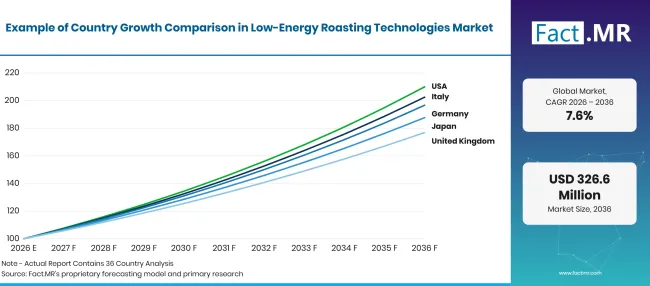
Low Energy Roasting Technologies Growth Index | Source: Fact.MR
| Country | CAGR (2026-2036) |
|---|---|
| China | 9.2% |
| United States | 7.7% |
| Italy | 7.2% |
| Germany | 7.0% |
| Japan | 6.5% |
Source: Fact.MR analysis. Updated Nov 26, 2026
Why is China the fastest-growing market for low-energy roasting technologies?
Demand in China is projected to grow at a 9.2% CAGR, the fastest among the five key countries, as coffee chains and nut snack brands expand domestic roasting. Luckin Coffee ended 2024 with 22,340 stores (Luckin Coffee Inc., 2025), and roasters are building plants to serve such chains.
What is shaping low-energy roasting sales in the United States?
Sales in the United States are projected to grow at a 7.7% CAGR as nut and coffee roasters pursue efficiency and emission goals. Starbucks and The J.M. Smucker Company run large roasteries, and state rules on air emissions push afterburner upgrades.
What is shaping low-energy roasting demand in Italy?
Demand in Italy is projected to grow at a 7.2% CAGR as coffee roasters such as Lavazza and illy and nut processors invest in efficiency. Lavazza, based in Turin, and illy, based in Trieste, run large roasteries and aim to cut emissions.
What is shaping low-energy roasting demand in Germany?
Demand in Germany is projected to grow at a 7.0% CAGR as the national CO2 price on heating fuels, EUR 55 per tonne in 2025 (German Emissions Trading Authority, n.d.), pushes roasters to cut gas use. Probat, based in Emmerich am Rhein, offers low-emission roasting technology.
Why is low-energy roasting growth slower in Japan?
Demand in Japan is projected to grow at a 6.5% CAGR, the slowest among the five key countries, as roasting capacity is mature and coffee consumption is stable. UCC and Key Coffee upgrade roasters mainly to reduce emissions at existing plants.
Competitive Landscape for Low-Energy Roasting Technologies Market
Competition in the low-energy roasting technologies market is divided between full-line processing suppliers and roasting specialists. Bühler and Royal Duyvis Wiener compete on complete lines, while Probat, NETZSCH, Caotech and JAF Inox compete on roasting and related equipment. Buyers select roasters on energy use, flavor, capacity and emissions.
From 2024 onward, competition shifted toward electrification. Suppliers with proven electric roasters are best placed to grow.
Recent Developments
- In early 2025, arabica coffee futures reached record highs.
- Roaster makers continued to launch electric and heat-recovery models.
- Coffee chains continued to expand roasting capacity in China.
Key Players in Low-Energy Roasting Technologies Market
Key companies operating in the market include Bühler, Royal Duyvis Wiener, NETZSCH, Caotech, Probat, and JAF Inox.
- Bühler
- Royal Duyvis Wiener
- NETZSCH
- Caotech
- Probat
- JAF Inox
Bibliography
- German Emissions Trading Authority. (n.d.). Fixed-price phase (2021 until 2025).
- International Coffee Organization. (2025). Coffee market report: February 2025.
- Luckin Coffee Inc. (2025). Form 20-F: Annual report for the fiscal year ended December 31, 2024. U.S. Securities and Exchange Commission.
Scope of Report
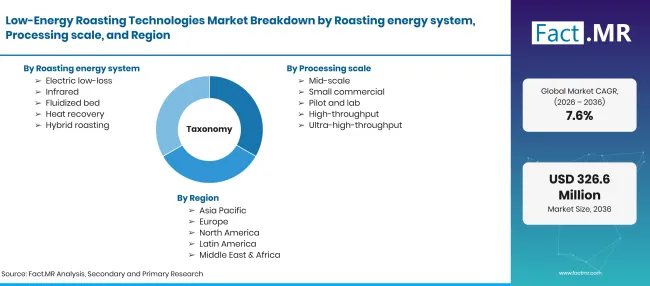
Low Energy Roasting Technologies Taxonomy | Source: Fact.MR
| Items | Values |
|---|---|
| Quantitative Units (2026) | USD 157.0 Million |
| Roasting energy system | Heat recovery, Infrared, Fluidized bed, Electric low-loss, Hybrid roasting |
| Processing scale | Pilot / lab, Small commercial, Mid-scale, High-throughput, Ultra-high-throughput |
| Operating configuration | Batch, Semi-continuous, Continuous, Modular skid, Integrated line |
| Food / process application | Bakery / wafers, Confectionery / cocoa, Snacks / seasoning, Brewing / grains, Other food / industrial |
| Regions Covered | North America, Latin America, Europe, Asia Pacific, Middle East & Africa |
| Countries Covered | China, United States, Italy, Germany, Japan, and other countries |
| Key Companies Profiled | Bühler, Royal Duyvis Wiener, NETZSCH, Caotech, Probat, JAF Inox |
Source: Fact.MR analysis. Updated Nov 26, 2026
Segmentation
Low-Energy Roasting Technologies Market by Segments
-
Roasting energy system
- Heat recovery
- Infrared
- Fluidized bed
- Electric low-loss
- Hybrid roasting
-
Processing scale
- Pilot / lab
- Small commercial
- Mid-scale
- High-throughput
- Ultra-high-throughput
-
Operating configuration
- Batch
- Semi-continuous
- Continuous
- Modular skid
- Integrated line
-
Food / process application
- Bakery / wafers
- Confectionery / cocoa
- Snacks / seasoning
- Brewing / grains
- Other food / industrial
Table of Contents
Key Takeaways
- Market Size and CAGR
- Top Growth Driver
- Fastest Growing Segment
- Leading Region
- Key Companies
- Emerging Opportunities

