
- Market Value (2025): USD 150.8 Mn
- Estimated Value (2026): USD 160.0 Mn
- Forecast Value (2036): USD 289.3 Mn
- CAGR (2026-2036): 6.1%
Foam-Reduction Coating Machines Market Forecast and Outlook 2026 to 2036
The global foam-reduction coating machines market was USD 150.8 million in 2025 and reached USD 160.0 million in 2026. The market is expected to reach USD 289.3 million by 2036, expanding at a CAGR of 6.1% during the 2026 to 2036 assessment period.
Food processors are paying closer attention to foam control as trapped air affects coating uniformity, product appearance and batter usage. GEA’s ProCoater, introduced in October 2026, features a guided return flow system that reduces foam formation by up to 80%, helping limit coating defects and improve consistency. Its launch highlights how equipment innovation is addressing quality challenges in coated food production.
Key Takeaways from the Foam-Reduction Coating Machines Market
- Sales of foam-reduction coating machines stood at USD 150.8 million in 2025
- Foam-Reduction Coating Machines Market Value (2026): USD 160.0 million
- Foam-Reduction Coating Machines Market Forecast Value (2036): USD 289.3 million
- Foam-Reduction Coating Machines Market Forecast CAGR (2026-2036): 6.1%
- Leading Defoaming approach: Vacuum deaeration (29.5%)
- Key Market Participants: GEA, JBT Marel, Heat and Control, Bühler, Baker Perkins, tna solutions
- Key Growth Regions: United States, China, Italy, Germany, Japan
Rising cocoa prices are putting pressure on confectionery manufacturers to make better use of chocolate coatings and limit production losses. The International Cocoa Organization reported that New York cocoa futures closed December 2024 at USD 11,545 per tonne. Bühler’s ChocoMaster production line uses vertical shaking to remove unwanted air from chocolate mass, helping improve product appearance and mouthfeel. Such process improvements are encouraging confectioners to pay greater attention to air control and coating efficiency.
Foam-Reduction Coating Machines Market
| Metric | Value |
|---|---|
| Estimated Value in (2025) | USD 138.9 million |
| Estimated Value in (2026) | USD 149.0 million |
| Forecast Value in (2036) | USD 289.3 million |
| Forecast CAGR (2026 to 2036) | 6.1% |
Source: Fact.MR analysis. Updated Nov 26, 2026
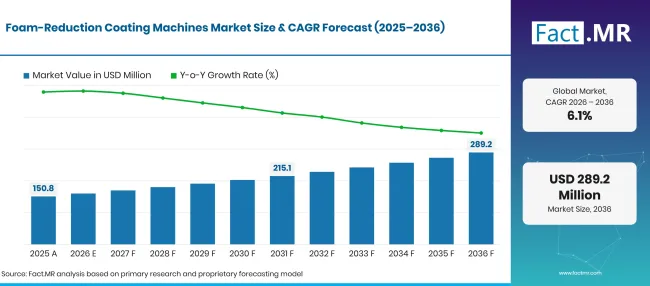
Foam Reduction Coating Machines Forecast Global | Source: Fact.MR
Category
| Category | Segments |
| Defoaming approach | Vacuum deaeration, Mechanical bubble breaking, Antifoam dosing, Ultrasonic defoaming, Hybrid low-foam coating |
| Processing scale | Pilot / lab, Small commercial, Mid-scale, High-throughput, Ultra-high-throughput |
| Operating configuration | Batch, Semi-continuous, Continuous, Modular skid, Integrated line |
| Food / process application | Bakery / wafers, Confectionery / cocoa, Snacks / seasoning, Brewing / grains, Other food / industrial |
| Region | United States; China; Italy; Germany; Japan |
Source: Fact.MR analysis. Updated Nov 26, 2026
Segmental Analysis
Why does Vacuum deaeration lead the defoaming approach segment in the Foam-Reduction Coating Machines Market?
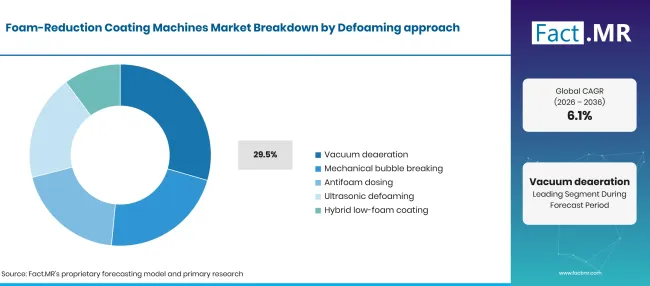
Foam Reduction Coating Machines Breakdown Defoaming Approach | Source: Fact.MR
Vacuum deaeration captures 29.5% of market revenue in 2026, reaching USD 47.2 million. Its appeal lies in removing entrapped air through pressure reduction rather than relying entirely on chemical antifoam agents. This is particularly relevant for chocolate coatings and specialty glazes where surface consistency and ingredient specifications influence production decisions. Hybrid low-foam systems are also gaining traction as processors combine mechanical air removal with controlled additive dosing. Suppliers are developing vacuum chambers that fit between tempering and enrobing stages, reducing disruption to existing production workflows.
Why does the Pilot / lab segment lead the scale category in the Foam-Reduction Coating Machines Market?
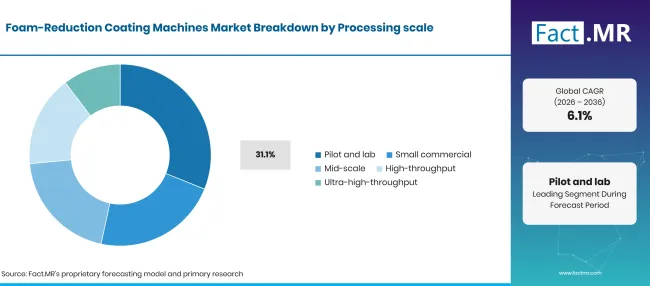
Foam Reduction Coating Machines Breakdown Processing Scale | Source: Fact.MR
Product development laboratories are creating a strong market for smaller foam-control equipment, with the Pilot / lab segment capturing 31.1% of revenue, or USD 49.8 million, in 2026. Food developers use pilot trials to assess coating thickness, viscosity and air retention before committing to commercial production.
India's CSIR-CFTRI inaugurated a BioNEST incubation centre in April 2026 to strengthen food innovation, research and scale-up validation, highlighting the expanding institutional focus on product development. Large ultra-high-throughput installations are also gaining relevance as established manufacturers expand production capacity.
Why do Integrated line systems lead the configuration segment in the Foam-Reduction Coating Machines Market?
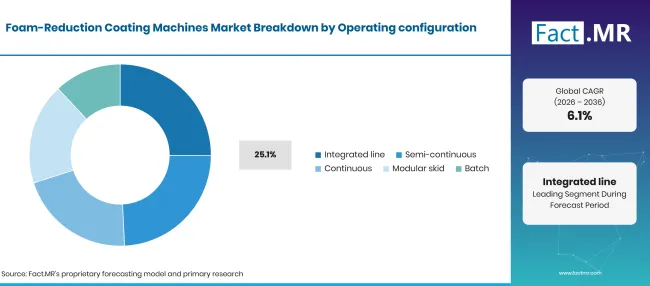
Foam Reduction Coating Machines Breakdown Operating Configuration | Source: Fact.MR
Integrated line systems generate 25.1% of market revenue in 2026, equivalent to USD 40.2 million. Their appeal comes from coordinating deaeration with tempering, pumping and coating circulation, allowing manufacturers to maintain consistent product flow without introducing separate processing bottlenecks. India's Ministry of Food Processing Industries highlighted modern processing infrastructure and efficient supply-chain integration in its February 2026 update on high-tech food manufacturing. Modular skids are also attracting interest because they offer existing factories a practical route to upgrade individual coating stages without replacing complete production lines.
Why do Snacks / seasoning applications lead the application segment in the Foam-Reduction Coating Machines Market?
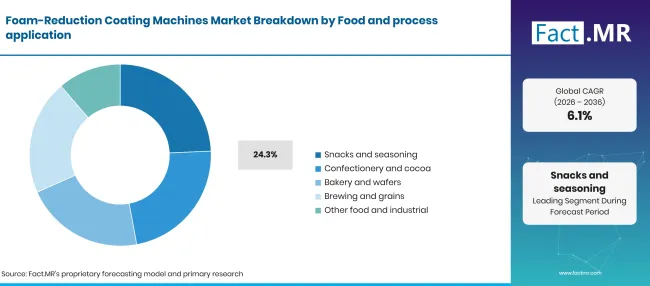
Foam Reduction Coating Machines Breakdown Food And Process Application | Source: Fact.MR
Snack and seasoning applications generate 24.3% of market revenue in 2026, reaching USD 38.9 million. High-speed mixing and pumping introduce air into oil-based and water-based seasoning slurries, making foam control important for uniform coating and reduced product wastage.
India's APEDA reported FY2025-26 exports of USD 1,006.95 million for cereal preparations and USD 317.93 million for cocoa products, illustrating the commercial scale of processed food categories relevant to coating applications. Bakery and confectionery applications are also gaining traction as manufacturers refine glaze consistency and chocolate coverage across automated production lines.
Foam-Reduction Coating Machines Market-Drivers, Restraints & Trends
Drivers
Rising Production Speeds: Faster coating operations are making foam harder to control, particularly when viscous mixtures pass repeatedly through pumps and mixing systems. Entrapped air creates uneven surfaces, inconsistent coating thickness and avoidable product losses. This is encouraging manufacturers to consider inline deaeration rather than slowing production to correct coating defects. A 2025 Ministry of Food Processing Industries study found that around 40% of surveyed food-processing companies had automation levels above 70%, highlighting the growing importance of equipment that performs reliably within automated production environments.
Restraints
High Installation and Operating Costs: Smaller food processors often prefer recipe adjustments or conventional antifoam additives over dedicated foam-control equipment. Vacuum installations involve additional capital expenditure, cleaning requirements and maintenance, making the investment harder to justify when production volumes are modest. Some plants also lack the technical staff to manage more sophisticated coating systems, extending the payback period and delaying equipment upgrades.
Trend
Clean-Label Defoaming: Food brands are paying closer attention to additive declarations, creating fresh interest in mechanical foam removal. Processors seeking simpler ingredient lists are exploring vacuum deaeration as an alternative to routine antifoam dosing. This also opens an opportunity for equipment manufacturers to develop adaptable systems that handle different coating formulations without chemical intervention. The opportunity lies in helping manufacturers balance formulation preferences with production efficiency, rather than treating chemical additives as universally undesirable.
Trend
Coating Cost Control: Expensive ingredients are encouraging confectionery and bakery manufacturers to scrutinize coating losses more closely. Excess foam can disrupt application uniformity and increase material wastage, making accurate coating control increasingly important. The International Cocoa Organization's August 2026 bulletin reported that global cocoa grindings declined 3.3% to 4.649 million tonnes in 2024/25, while cocoa futures remained sensitive to weather and supply risks. This creates room for integrated deaeration and coating-weight monitoring across larger processing lines.
Foam-Reduction Coating Machines Market by Analysis by Key Country
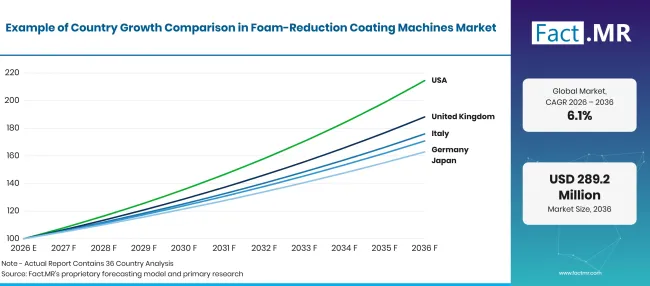
Foam Reduction Coating Machines Growth Index | Source: Fact.MR
| Country | CAGR (2026-2036) |
|---|---|
| United States | 8.0% |
| China | 7.7% |
| Italy | 5.7% |
| Germany | 5.5% |
| Japan | 5.0% |
Source: Fact.MR analysis. Updated Nov 26, 2026
Why is the United States the fastest-growing market for foam-reduction coating machines?
The United States is likely to see strong equipment uptake as large-scale food manufacturers invest in automated processing and tighter production controls. The USDA reported that spending on domestically produced food reached USD 2.08 trillion in 2025, up 3.1% from 2024.
Expanding foodservice activity and processed-food production are creating opportunities for foam-control installations, particularly where coating consistency and reduced material wastage influence operating costs. Manufacturers are also exploring integrated deaeration systems to maintain coating uniformity across high-speed production lines.
What is driving foam-reduction coating machine demand in China?
China's expanding food-processing base offers considerable room for advanced coating equipment. According to the National Bureau of Statistics, value added in food processing from agricultural and sideline products increased 5.6% in 2025.
Rising factory output and wider industrial automation are encouraging processors to improve mixing, pumping and coating efficiency. These developments are likely to strengthen interest in integrated foam-removal systems across packaged foods, confectionery and snack manufacturing. Growing investments in automated food factories are further opening opportunities for equipment that reduces production interruptions and coating inconsistencies.
What is shaping foam-reduction coating machine demand in Italy?
Italy's established bakery and confectionery industry provides a strong foundation for specialised coating equipment. CREA reported that Italian exports of traditional food products reached EUR 52.2 billion in 2025, increasing 3.7% year over year.
Cocoa-based confectionery exports grew 21.4% in value, while bakery product exports advanced 6.5%. Greater export activity and pressure to maintain consistent product finishes are encouraging manufacturers to improve coating operations and limit processing losses. Specialty chocolate and bakery producers are also creating opportunities for compact foam-control installations suited to varied product batches.
What is shaping foam-reduction coating machine demand in Germany?
Germany's food-processing machinery ecosystem is creating favourable conditions for foam-reduction equipment adoption. Destatis reported that domestic ready-meal production reached 1.7 million tonnes in 2024, with output volumes rising 25.6% over five years. Production growth continued through the first three quarters of 2025.
Higher processed-food volumes are increasing the importance of reliable coating operations, while established machinery capabilities make integration of automated deaeration systems more practical for industrial manufacturers. The country's emphasis on precision engineering also favours equipment upgrades that improve process stability without requiring complete production-line replacement.
Why is foam-reduction coating machine growth slower in Japan?
Labour constraints and the need for consistent food quality are encouraging Japanese processors to modernise production facilities. Japan's Ministry of Agriculture, Forestry and Fisheries reported that agricultural and food exports reached JPY 1.7005 trillion in 2025, marking 12.8% annual growth and a thirteenth consecutive record.
Export-oriented food manufacturers are strengthening production quality and processing efficiency, creating opportunities for coating equipment that reduces air entrapment and maintains uniform finishes across automated operations. Demand for compact, labour-efficient processing installations is likely to create additional opportunities among confectionery, bakery and prepared-food manufacturers.
Competitive Landscape for Foam-Reduction Coating Machines Market
Competition in the foam-reduction coating machines market is taking a more technology-focused direction as food processors seek better control over batter usage and product consistency. GEA has strengthened its position with the ProCoater, introduced in October 2026. Its guided return-flow system reduces foam formation by up to 80%, while adjustable scrapers and smart air knives improve coating accuracy.
JBT Marel and Heat and Control compete through battering systems and integrated food-processing equipment. GEA also offers installation, operator training, maintenance and product-testing support. Competitive strength increasingly rests on measurable reductions in batter waste, reliable coating performance and the ability to handle different food products without compromising production efficiency.
Recent Developments
- On October 19, 2026, GEA launched its ProCoater wet coating system, featuring guided batter return flow to reduce foam formation by up to 80% and improve coating consistency.
- On September 23, 2025, JBT Marel inaugurated a Global Production Center in Pune, India, to expand manufacturing capabilities and strengthen its service across India and the Asia-Pacific region.
- On June 2, 2025, Heat and Control acquired Fabcon Food Systems Ltd., expanding its food-processing and handling equipment portfolio for snack foods, French fries and protein products.
- On June 9, 2025, Nothum Food Processing Systems announced a leadership transition, appointing Philip Hurwitz as president and CEO, succeeding Robert Nothum.
- On April 25, 2025, Rosenqvists Food Technologies received the 2025 Innovation Award from the regional business council in Kristianstad, Sweden, for its resource-efficient food-processing technologies.
Key Players in Foam-Reduction Coating Machines Market
Key companies operating in the market include GEA, JBT Marel, Heat and Control, Gpi Process Equipment, FMT Food Processing Equipment, Nothum Food Processing Systems, and Rosenqvists Food Technologies.
- GEA
- JBT Marel
- Heat and Control
- Gpi Process Equipment
- FMT Food Processing Equipment
- Nothum Food Processing Systems
- Rosenqvists Food Technologies
Bibliography
- Agricultural and Processed Food Products Export Development Authority. (2026). Processed foods. Government of India
- Council for Agricultural Research and Economics. (2026). Export agroalimentare da record, oltre i 72 miliardi. CREA.
- Press Information Bureau. (2026, April 4). Dr. Jitendra Singh inaugurates BioNEST at Central Food Technology & Research Institute (CFTRI), Mysuru, focus on food startups. Ministry of Science and Technology, Government of India.
- Federal Statistical Office of Germany. (2026, January 14). Produktion von Fertiggerichten binnen fünf Jahren mengenmäßig um 25,6 % gestiegen [Production of ready meals increased by 25.6% by volume over five years].
- International Cocoa Organization. (2026). August 2026 quarterly bulletin of cocoa statistics.
- Ministry of Agriculture, Forestry and Fisheries. (2026, February 3). 2025[Export performance of agricultural, forestry and fishery products and food in 2025]. Government of Japan.
- Ministry of Food Processing Industries. (2026). Annual report 2025-26. Government of India.
- National Bureau of Statistics of China. (2026, February 28). Statistical communiqué of the People's Republic of China on the 2025 national economic and social development.
- U.S. Department of Agriculture, Economic Research Service. (2026). Food dollar: Summary findings.
Segmentation
Scope of Report
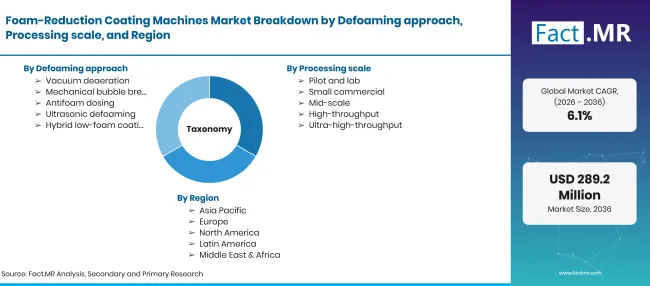
Foam Reduction Coating Machines Taxonomy | Source: Fact.MR
| Items | Values |
|---|---|
| Quantitative Units (2026) | USD 160.0 Million |
| Defoaming approach | Vacuum deaeration, Mechanical bubble breaking, Antifoam dosing, Ultrasonic defoaming, Hybrid low-foam coating |
| Processing scale | Pilot / lab, Small commercial, Mid-scale, High-throughput, Ultra-high-throughput |
| Operating configuration | Batch, Semi-continuous, Continuous, Modular skid, Integrated line |
| Food / process application | Bakery / wafers, Confectionery / cocoa, Snacks / seasoning, Brewing / grains, Other food / industrial |
| Regions Covered | North America, Latin America, Europe, East Asia, South Asia and Pacific, Middle East & Africa |
| Countries Covered | United States, China, Italy, Germany, Japan, and other countries |
| Key Companies Profiled | GEA, JBT Marel, Heat and Control, Bühler, Baker Perkins, tna solutions |
| Additional Attributes | Dollar revenue in the Foam-Reduction Coating Machines Market is segmented by defoaming approach (vacuum deaeration, mechanical bubble breaking, antifoam dosing, ultrasonic defoaming, hybrid low-foam coating); processing scale (pilot / lab, small commercial, mid-scale, high-throughput, ultra-high-throughput); operating configuration (batch, semi-continuous, continuous, modular skid, integrated line); food / process application (bakery / wafers, confectionery / cocoa, snacks / seasoning, brewing / grains, other food / industrial) and region. |
Source: Fact.MR analysis. Updated Nov 26, 2026
Foam-Reduction Coating Machines Market by Segments
-
Defoaming approach
- Vacuum deaeration
- Mechanical bubble breaking
- Antifoam dosing
- Ultrasonic defoaming
- Hybrid low-foam coating
-
Processing scale
- Pilot / lab
- Small commercial
- Mid-scale
- High-throughput
- Ultra-high-throughput
-
Operating configuration
- Batch
- Semi-continuous
- Continuous
- Modular skid
- Integrated line
-
Food / process application
- Bakery / wafers
- Confectionery / cocoa
- Snacks / seasoning
- Brewing / grains
- Other food / industrial
-
Region:
- North America
- United States
- Canada
- Mexico
- Europe
- Germany
- United Kingdom
- France
- Italy
- Spain
- Rest of Europe
- Asia Pacific
- China
- India
- Japan
- South Korea
- Australia
- Rest of Asia Pacific
- Latin America
- Brazil
- Mexico
- Argentina
- Rest of Latin America
- Middle East & Africa
- GCC Countries
- South Africa
- Rest of Middle East & Africa
- North America
Table of Contents
Key Takeaways
- Market Size and CAGR
- Top Growth Driver
- Fastest Growing Segment
- Leading Region
- Key Companies
- Emerging Opportunities

