
- Market Value (2025): USD 1.25 Bn
- Estimated Value (2026): USD 1.31 Bn
- Forecast Value (2036): USD 2.24 Bn
- CAGR (2026-2036): 5.5%
Non-metallic Expansion Joints Market Forecast and Outlook 2026 to 2036
According to the Fact.MR analysis, the non-metallic expansion joint market surpassed a value of USD 1.25 billion in 2025 and is projected to grow from USD 1.31 billion in 2026 to USD 2.24 billion by 2036. Demand for non-metallic expansion joints is likely to grow at a CAGR of 5.5% over the forecast period.
Demand for non-metallic expansion joints is rising as power, water, chemical and building-service operators need flexible connectors that absorb thermal movement, vibration and misalignment in pipes and ducts. Suppliers are offering rubber, coated-fabric, PTFE and composite joints in a range of sizes and connection types.
Key Takeaways from the Non-metallic Expansion Joints Market
- Non-metallic Expansion Joints Market Value (2025): USD 1.25 billion
- Non-metallic Expansion Joints Market Value (2026): USD 1.31 billion
- Non-metallic Expansion Joints Market Forecast Value (2036): USD 2.24 billion
- Non-metallic Expansion Joints Market Forecast CAGR (2026-2036): 5.5%
- Leading Material: Rubber (EPDM, NBR, neoprene) (40.4%)
- Key Market Participants: Trelleborg, Senior plc, Witzenmann, Garlock, Proco Products
- Key Growth Countries: India, China, South Korea, United States, United Kingdom
Investment in power generation, emission-control infrastructure, water networks and building services is expected to support demand for elastomeric joints and sealing products, while ageing installations create recurring replacement requirements. India's Ministry of Statistics and Programme Implementation reported in October 2026 that 1,853 central infrastructure projects were under monitoring, representing a revised investment of ₹37.56 lakh crore, with cumulative expenditure of ₹17.73 lakh crore. The portfolio included 225 energy projects worth ₹11.04 lakh crore and 50 water and sanitation projects worth ₹1.99 lakh crore. Additionally, the Ministry of Power reported that India added 52,536.49 MW of installed generation capacity during FY 2025–26 up to January 2026. These investments support demand for durable elastomeric joints in pipelines, power equipment, industrial installations and building-service networks.
Non-metallic Expansion Joints Market
| Metric | Value |
|---|---|
| Estimated Value in (2026) | USD 1.31 billion |
| Forecast Value in (2036) | USD 2.24 billion |
| Forecast CAGR (2026 to 2036) | 5.5% |
Source: Fact.MR analysis.
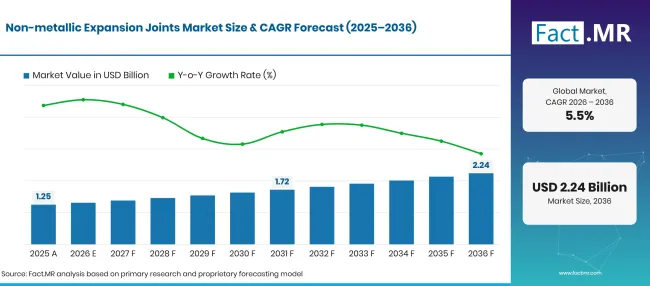
Non Metallic Expansion Joints Market Forecast Global | Source: Fact.MR
Category
| Category | Segments |
|---|---|
| Material | Rubber (EPDM, NBR, neoprene), Coated fabric (PTFE, fluoroelastomer, silicone), PTFE and PTFE-lined bellows, Fibre-reinforced polymer composite |
| Type | Rubber arch and spool, Fabric belt for ducts, Spherical and sleeve, PTFE bellows, Rectangular frame |
| Application | Power generation, Water and wastewater, Chemicals and petrochemicals, HVAC and building services, Cement, steel and pulp and paper |
| Connection | Flanged, Clamped and bolted frame, Threaded, Weld-on |
| Region | India; China; South Korea; United States; United Kingdom |
Source: Fact.MR analysis.
Segmental Analysis
What is driving rubber materials to lead the Non-metallic Expansion Joints Market?
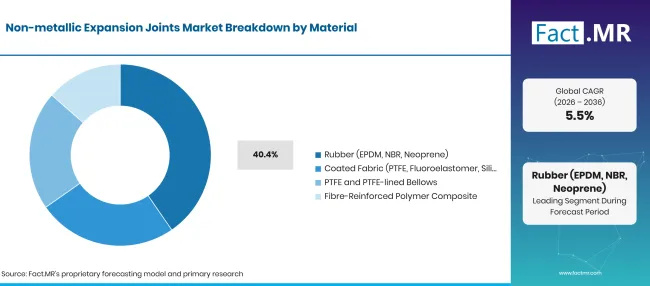
Non Metallic Expansion Joints Market Breakdown Material | Source: Fact.MR
Demand for rubber expansion joints made from EPDM, NBR and neoprene is supported by their flexibility, vibration absorption, corrosion resistance and relatively low installation costs. The segment accounts for 40.4% of market revenue in 2026, about USD 529.2 million. India's Ministry of Jal Shakti reported in July 2026 that 15.89 crore rural households, representing 82.09% of the total, had tap-water connections under the Jal Jeevan Mission. The expansion of piped-water infrastructure creates opportunities for flexible rubber connectors in pumping stations, treatment facilities and distribution networks. Ageing pipeline installations also support replacement demand.
Which industrial requirements are supporting rubber arch and spool expansion joints sales?
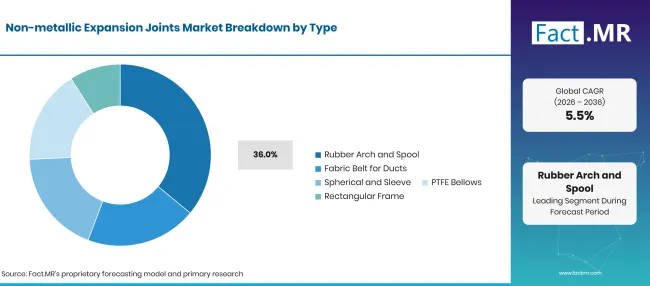
Non Metallic Expansion Joints Market Breakdown Type 1 | Source: Fact.MR
Sales of rubber arch and spool expansion joints benefit from their use in pump connections, cooling systems and water pipelines, where they accommodate movement and reduce mechanical vibration. This segment represents 36.0% of market revenue in 2026, about USD 471.6 million. According to India's Ministry of Jal Shakti, the Jal Jeevan Mission had connected 15.82 crore rural households to tap-water supplies by March 3, 2026, compared with 3.23 crore at the programme's launch. The continuing development and maintenance of water-supply networks support opportunities for flexible piping connections, pump-related accessories and replacement joints across municipal and industrial installations.
How is power-sector investment influencing demand for non-metallic expansion joints?
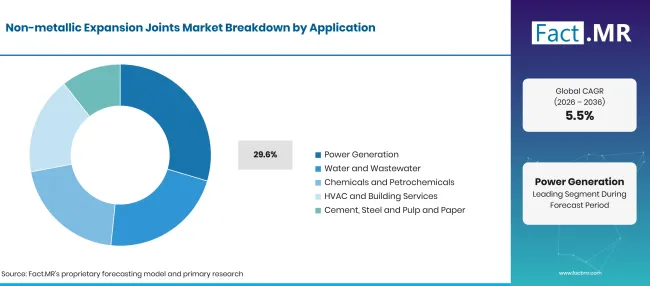
Non Metallic Expansion Joints Market Breakdown Application | Source: Fact.MR
Adoption of fabric and rubber expansion joints in power generation is supported by their ability to accommodate thermal movement, vibration and pressure fluctuations in air, flue-gas and cooling-water systems. Power generation accounts for 29.6% of market revenue in 2026, about USD 387.8 million. India's Ministry of Power reported that 52,536.49 MW of additional generation capacity was installed during FY 2025–26 up to January 2026. The total installed generation capacity reached 520,511 MW as of January 31, 2026. New power-generation installations and upgrades to existing plants create opportunities for expansion joints used in ducting, exhaust and auxiliary piping systems.
WHAT is sustaining flanged connections as the leading connection segment?
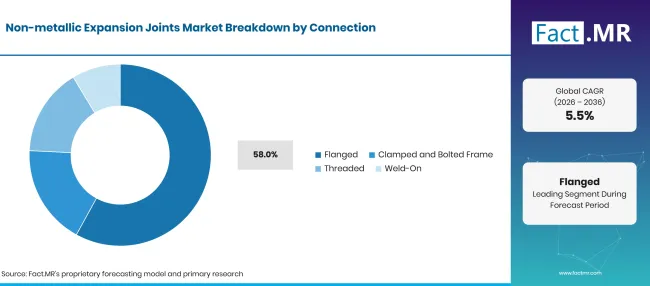
Non Metallic Expansion Joints Market Breakdown Connection | Source: Fact.MR
Demand for flanged expansion joints remains strong because bolted connections simplify installation, inspection and replacement across industrial pipelines and building-service systems. The flanged segment holds 58.0% of market revenue in 2026, about USD 759.8 million. India's Ministry of Statistics and Programme Implementation reported that 1,731 central infrastructure projects worth ₹33.60 lakh crore were being monitored as of August 2026, with cumulative expenditure reaching ₹16.33 lakh crore. These projects span major infrastructure sectors and reinforce the requirement for reliable piping connections in industrial and public infrastructure. Flanged configurations remain attractive where maintenance access and component replacement are important purchasing considerations.
Non-metallic Expansion Joints Market-Drivers, Restraints & Trends
Drivers: Industrial Infrastructure Expansion and Equipment Replacement
Demand for non-metallic expansion joints is expected to benefit from investments in industrial infrastructure, power generation and process facilities that require reliable piping and duct connections. India's Union Budget 2026-27 allocated ₹12.2 lakh crore towards public capital expenditure, strengthening investment in infrastructure and industrial capacity. Additionally, the Government's Petroleum Planning and Analysis Cell reported that India's installed refining capacity reached 267.116 million tonnes per annum as of April 1, 2026. Expanding refinery, power and manufacturing infrastructure creates opportunities for expansion joints that accommodate thermal movement, absorb vibration and prevent leakage in industrial systems.
Restraints: Competition from Metallic Alternatives and Material Limitations
Non-metallic expansion joints face competition from metallic bellows in applications involving high pressure, elevated temperatures and demanding operating conditions. Rubber and fabric-based joints also require periodic inspection because ageing, chemical exposure and thermal stress can affect their service life. India's Ministry of Power reported in July 2026 that the national transmission network stood at 5.09 lakh circuit kilometres, with planned expansion to 6.48 lakh circuit kilometres by 2032. Although infrastructure expansion creates opportunities for industrial components, equipment suppliers must meet increasingly demanding reliability and operating requirements. These factors can influence material selection and replacement costs.
Opportunity: Fluoropolymer and Coated Fabric Technologies
The growing complexity of chemical processing, petroleum refining and industrial exhaust applications creates opportunities for PTFE-lined and fluoropolymer-coated fabric expansion joints. These materials offer chemical resistance and suitability for demanding corrosive environments, depending on their construction and operating limits. India's installed refining capacity reached 267.116 million tonnes per annum in April 2026, according to the Petroleum Planning and Analysis Cell. Furthermore, the Government's December 2025 refining-sector outlook projected capacity expansion to 309.5 million tonnes per annum by 2030. Refinery expansion and modernization create potential procurement opportunities for specialized expansion joints used in ducts, exhaust systems and process connections.
Trend: Engineered Replacement Programs
Industrial operators are placing greater emphasis on asset reliability, scheduled maintenance and infrastructure inspection to minimize unplanned shutdowns. This supports demand for engineered replacement programs involving expansion joints in power stations, refineries and chemical processing facilities. India's National Electricity Plan, discussed by the Ministry of Power in July 2026, anticipates transmission infrastructure expansion from 5.09 lakh circuit kilometres in June 2026 to 6.48 lakh circuit kilometres by 2032. The plan also projects transformation capacity growth from 1,478 GVA to 2,345 GVA. Such infrastructure development reinforces the importance of dependable industrial equipment and maintenance planning across connected facilities.
Non-metallic Expansion Joints Market Analysis by Key Country
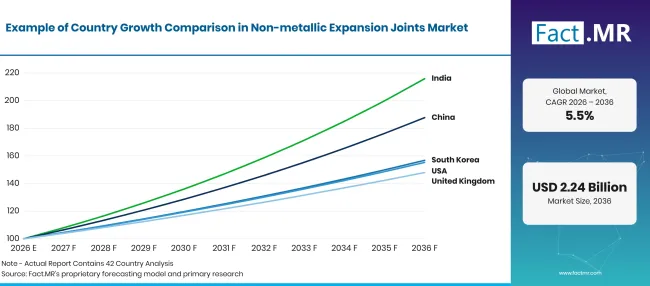
Non Metallic Expansion Joints Market Growth Index | Source: Fact.MR
| Country | CAGR (2026-2036) |
|---|---|
| India | 8.0% |
| China | 6.5% |
| South Korea | 4.6% |
| United States | 4.5% |
| United Kingdom | 4.0% |
Source: Fact.MR analysis.
What is accelerating disinfectors sales and demand in China?
China's disinfectors market is projected to expand at a 9.3% CAGR from 2026 to 2036, supported by hospital modernization, rising healthcare utilization and stricter hygiene requirements.
According to China's National Bureau of Statistics, the country had approximately 38,000 hospitals and 10.09 million medical beds at the end of 2025, with these figures reported in its February 2026 statistical communiqué. Healthcare institutions also recorded 10.58 billion medical visits during 2025. This substantial treatment volume creates recurring requirements for instrument cleaning, equipment disinfection and infection prevention. Expanding hospital infrastructure and growing demand for standardized reprocessing are expected to strengthen equipment procurement and replacement sales.
Which healthcare developments are supporting disinfectors demand in South Korea?
South Korea's disinfectors market is anticipated to register a 6.8% CAGR between 2026 and 2036.
Hospital equipment procurement is supported by an extensive healthcare network, increasing requirements for reusable medical instrument reprocessing and established infection-control practices. According to the National Health Insurance Service, South Korea recorded 105,271 healthcare institutions in the second quarter of 2026, including 47 tertiary general hospitals, 337 general hospitals and 1,429 hospitals. The expanding institutional base provides opportunities for washer-disinfectors, automated endoscope reprocessors and specialized disinfection systems. Continued equipment modernization and demand for reliable sterilization workflows are likely to support recurring purchases across hospitals and outpatient facilities.
How are hospital procurement and replacement sales shaping the United States disinfectors market?
The United States disinfectors market is forecast to grow at a 6.3% CAGR from 2026 to 2036.
Forecast
Hospital procurement, outpatient treatment expansion and infection-prevention requirements continue to influence equipment replacement decisions. According to the Centers for Disease Control and Prevention's first-quarter 2026 National Healthcare Safety Network newsletter, 4,125 general hospitals, 6,915 ambulatory surgery centers and 18,727 long-term care facilities were enrolled as of March 11, 2026. Separately, CMS reported 5,978 hospitals and 6,410 ambulatory surgical centers in its April 2026 Fast Facts publication, using 2024 provider data. These extensive care networks sustain demand for automated cleaning, validated disinfection and equipment upgrades.
What is influencing disinfectors purchasing patterns across the United Kingdom?
The United Kingdom disinfectors market is estimated to advance at a 5.8% CAGR during 2026 to 2036.
Healthcare procurement increasingly emphasizes reliable decontamination, reusable instrument safety and compliance with national infection-prevention guidance. NHS England recorded 18.5 million finished admission episodes during the 2025-26 financial year in its official statistics published in September 2026. Its National Infection Prevention and Control Manual, updated in July 2026, also establishes mandatory guidance for NHS settings and addresses the decontamination of reusable invasive equipment, including surgical instruments and flexible endoscopes. These requirements support continued purchasing of washer-disinfectors and endoscope reprocessors, while replacement cycles and hospital budget constraints influence annual sales growth.
Which factors explain the comparatively moderate growth of disinfectors sales in France?
France's disinfectors market is projected to register a 5.4% CAGR from 2026 to 2036, reflecting an established hospital infrastructure and comparatively mature equipment procurement environment.
However, modernization and increasing demand for efficient instrument reprocessing continue to generate replacement opportunities. The French Directorate for Research, Studies, Evaluation and Statistics (DREES), in its Health Establishments in 2024 – 2026 Edition, published in May 2026, reported 2,962 hospitals and clinics with 367,100 full-hospitalization beds and 91,000 partial-hospitalization places. It also recorded 13.6 million patients receiving hospital stays or treatment sessions during 2024. These substantial service volumes sustain demand for validated disinfection equipment, although established purchasing patterns moderate incremental sales growth.
Competitive Landscape for Non-metallic Expansion Joints Market
The non-metallic expansion joint market is relatively concentrated, with Trelleborg, Senior plc, Witzenmann, Garlock and Proco Products together hold about 66% of 2026 revenue, based on Fact.MR estimates. Competition centers on materials expertise, custom engineering for ducts, availability and delivery time. Specialist engineered-rubber and fabric-joint makers compete with industrial groups, and regional producers serve standard rubber joints.
Recent Developments
- On February 27, 2026, Witzenmann announced the construction of a new production facility in India to strengthen its manufacturing infrastructure and support future growth. The facility will support industrial products, including expansion joints, metal hoses and metal bellows. This investment strengthens its production capabilities and regional presence.
- On May 30, 2025, Opening of a new manufacturing facility in India. Senior plc announced the opening of a new Indian facility, supporting its manufacturing operations and long-term growth strategy. Its Flexonics business manufactures engineered expansion joints for chemical processing, refineries and power generation applications, making this development relevant to its broader expansion-joint business.
- On January 7, 2026, Trelleborg completed the acquisition of the Austrian company Nexus Elastomer Molds GmbH, which specialises in customised tooling solutions and automated manufacturing cells.
Key Players in Non-metallic Expansion Joints Market
Key companies operating in the market include Trelleborg, Senior plc, Witzenmann, Garlock, and Proco Products.
- Trelleborg
- Senior plc
- Witzenmann
- Garlock
- Proco Products
Bibliography
- Ministry of Jal Shakti. (2026, March 9). Functional household tap connections under Jal Jeevan Mission. Press Information Bureau, Government of India.
- Ministry of Jal Shakti. (2026, July 27). Extension of the Jal Jeevan Mission and transfer of rural water supply schemes. Press Information Bureau, Government of India.
- Ministry of Power. (2026, March 12). Power generation capacity from various sources. Press Information Bureau, Government of India.
- Ministry of Statistics and Programme Implementation. (2026, September 25). Flash report on central sector infrastructure projects worth ₹150 crore and above. Press Information Bureau, Government of India.
- Ministry of Statistics and Programme Implementation. (2026, October 26). Monthly flash report on central sector infrastructure projects tracks 1,853 infrastructure projects worth ₹37.56 lakh crore as of September 2026. Press Information Bureau, Government of India.
- Ministry of Statistics and Programme Implementation. (2026, October 26). Monthly flash report on central sector infrastructure projects, September 2026 [PDF]. Government of India.
Segmentation
Scope of Report
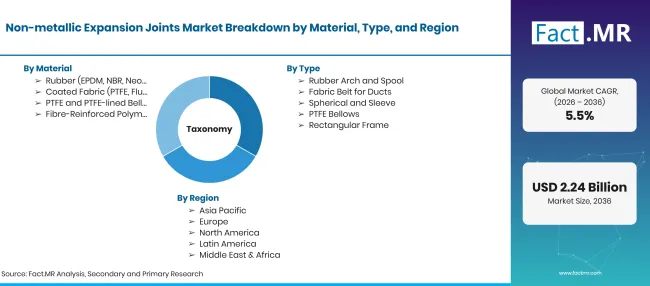
Non Metallic Expansion Joints Market Taxonomy | Source: Fact.MR
| Items | Values |
|---|---|
| Quantitative Units (2026) | USD 1.31 Billion |
| Material | Rubber (EPDM, NBR, neoprene), Coated fabric (PTFE, fluoroelastomer, silicone), PTFE and PTFE-lined bellows, Fibre-reinforced polymer composite |
| Type | Rubber arch and spool, Fabric belt for ducts, Spherical and sleeve, PTFE bellows, Rectangular frame |
| Application | Power generation, Water and wastewater, Chemicals and petrochemicals, HVAC and building services, Cement, steel and pulp and paper |
| Connection | Flanged, Clamped and bolted frame, Threaded, Weld-on |
| Regions Covered | North America, Latin America, Europe, Asia Pacific, Middle East & Africa |
| Countries Covered | India, China, South Korea, United States, United Kingdom, and other countries |
| Key Companies Profiled | Trelleborg, Senior plc, Witzenmann, Garlock, Proco Products |
| Additional Attributes | Dollar revenue in the Non-metallic Expansion Joints Market is segmented by material, type, application and connection and region. |
Source: Fact.MR analysis.
Non-metallic Expansion Joints Market by Segments
-
Material
- Rubber (EPDM, NBR, neoprene)
- Coated fabric (PTFE, fluoroelastomer, silicone)
- PTFE and PTFE-lined bellows
- Fibre-reinforced polymer composite
-
Type
- Rubber arch and spool
- Fabric belt for ducts
- Spherical and sleeve
- PTFE bellows
- Rectangular frame
-
Application
- Power generation
- Water and wastewater
- Chemicals and petrochemicals
- HVAC and building services
- Cement, steel and pulp and paper
-
Connection
- Flanged
- Clamped and bolted frame
- Threaded
- Weld-on
-
Region:
- North America
- United States
- Canada
- Mexico
- Europe
- Germany
- United Kingdom
- France
- Italy
- Spain
- Rest of Europe
- Asia Pacific
- China
- India
- Japan
- South Korea
- Australia and New Zealand
- Rest of Asia Pacific
- Latin America
- Brazil
- Argentina
- Rest of Latin America
- Middle East & Africa
- GCC Countries
- South Africa
- Rest of Middle East & Africa
- North America
Table of Contents
Key Takeaways
- Market Size and CAGR
- Top Growth Driver
- Fastest Growing Segment
- Leading Region
- Key Companies
- Emerging Opportunities

