- Market Value (2025): USD 808.1 Mn
- Estimated Value (2026): USD 880.0 Mn
- Forecast Value (2036): USD 2064.2 Mn
- CAGR (2026-2036): 8.9%
What is the Cooking-Oil Plastic Housings Market forecast to be worth by 2036?
USD 880.0 million in 2026 to USD 2064.2 million by 2036 at an 8.9% CAGR.
- The Cooking-Oil Plastic Housings Market crossed a valuation of USD 808.1 million in 2025.
- Demand is projected to increase from USD 880.0 million in 2026 to USD 2064.2 million by 2036.
- The market is forecast to record 8.9% CAGR from 2026 to 2036 as oil bottle closure converters and foodservice dispenser makers qualify recycled-content polymers for oil-contact use.
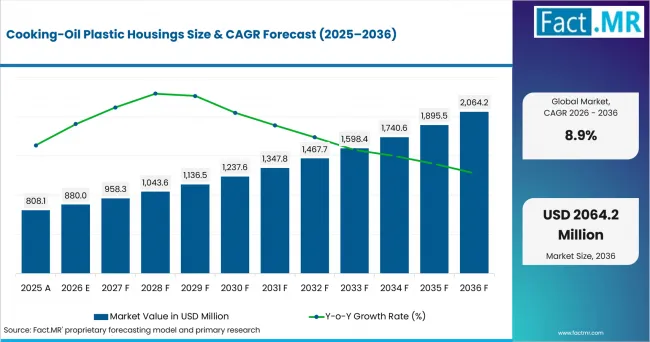
Cooking Oil Plastic Housings Value Analysis | Source: Fact.MR
What are the defining numbers behind Cooking-Oil Plastic Housings Market growth?
An absolute opportunity of USD 1,184.2 million is expected between 2026 and 2036.
- Demand Drivers in the Market
- Edible-oil packers need PP closures that resist cap stress cracking during filling, transport and repeat opening. Stable torque and hinge behavior are expected to receive more attention as resin choices shift toward recycled-content blends.
- Food-contact validation is becoming central to recycled plastic use. The U.S. Food and Drug Administration database lists a September 11, 2025 No Objection Letter for a polypropylene recycling process covering caps and closures in contact with all food types under Conditions of Use C through H, provided the feedstock comes from food-contact articles and complies with all applicable authorizations.
- Foodservice distributors need dispenser housings that reduce leakage in bulk cooking-oil packs. The commercial value comes from controlled pouring and lower mess during repeated kitchen use.
- Appliance OEMs need heat-stable oil-contact housings for removable trays and pump modules. Material approval is expected to focus on grease exposure, cleaning cycles and drop resistance.
- Key Segments Analyzed
- By Polymer: Recycled PP is expected to hold 31.0% share in 2026 due to its fit with cap molding, hinge performance and food-contact recycled-content claims.
- By Product: Oil bottle caps / closures are projected to account for 29.0% share in 2026 since closures are replaced with every packaged oil unit.
- By Oil Application: Edible oil packaging is anticipated to capture 46.0% share in 2026 owing to high unit turnover in retail cooking-oil formats.
- By Requirement: Food-contact compliance is estimated to represent 34.0% share in 2026, shaped by documentation needs for recycled PP and PET streams.
- Analyst Opinion at Fact.MR
- Shambhu Nath Jha, Principal Consultant at Fact.MR, states, "Cooking-oil plastic housings extend beyond a resin substitution story. Converters win when they prove a cap, pourer or dispenser housing handles oily contact and line-speed stress. Demand is projected to favor suppliers that combine food-contact records, recycled-content control and repeatable molding quality."
- Strategic Implications
- Converters should document migration testing and torque performance before using recycled-content PP in closures.
- Resin producers should keep food-contact PCR streams separate from general recycled feedstock.
- Appliance OEMs should test oil-contact housings against heat, grease and drop impact early.
- Brand owners should align cap design with recycled-content rules before filling-line trials.
The UK is projected to post 11.1% CAGR through 2036, led by recycled-content tax pressure and closure redesign. Brazil is expected to advance at 10.4% CAGR with soybean output providing upstream context for vegetable-oil processing and packaging. Germany is anticipated to record 9.5% CAGR owing to packaging recycling discipline and converter capability. The USA is forecast to hold 9.2% CAGR as soybean-oil production and FDA recycled-plastic review shape specification choices. France is estimated to reach 8.9% CAGR with domestic olive-oil production supporting packaging activity alongside appliance-related oil-contact parts.
How does the Cooking-Oil Plastic Housings Market break down by segment?
Recycled PP leads Polymer at 31.0%; edible oil packaging leads Oil Application at 46.0%.
Which Polymer dominates?
Recycled PP is expected to hold 31.0% share in 2026.
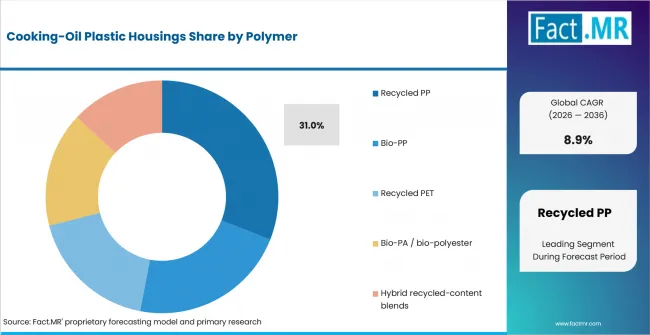
Cooking Oil Plastic Housings Analysis By Polymer | Source: Fact.MR
Recycled PP leads where oil-contact housings need hinge strength, closure torque and resistance to oily residues. It also supports recycled-content claims where qualified streams are accepted. Borealis, now part of Borouge International, announced in October 2025 that Integra Plastics AD was converting its facility to recycled polypropylene production using Borcycle™ M technology, with the upgrade expected to increase output beyond its then-current capacity of 20,000 metric tons.
What leads the Product segment?
Oil bottle caps / closures are projected to account for 29.0% share in 2026.
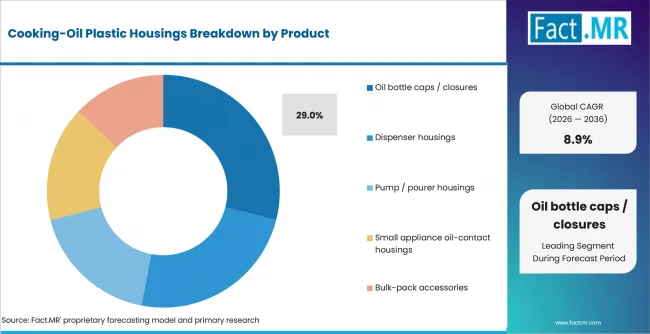
Cooking Oil Plastic Housings Analysis By Product | Source: Fact.MR
Caps and closures lead since each bottle requires a housing that seals, opens cleanly and supports controlled pouring. Resin changes therefore receive line-level review. The segment has a natural link with adjacent demand for secure closure systems across food packaging applications.
How does Oil Application shape demand?
Edible oil packaging is anticipated to capture 46.0% share in 2026.
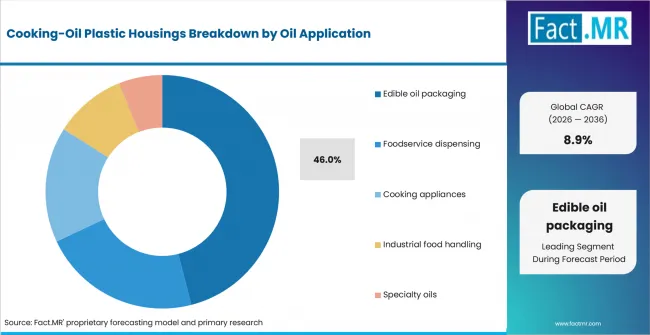
Cooking Oil Plastic Housings Analysis By Oil Application | Source: Fact.MR
Edible oil packaging leads where retail bottles and refill packs need housings that tolerate grease contact through storage and repeated use. The application also carries steady replacement volume as closures and pourer housings move with every packaged oil unit.
What supports Food-contact compliance within Requirement?
Food-contact compliance is estimated to represent 34.0% share in 2026.
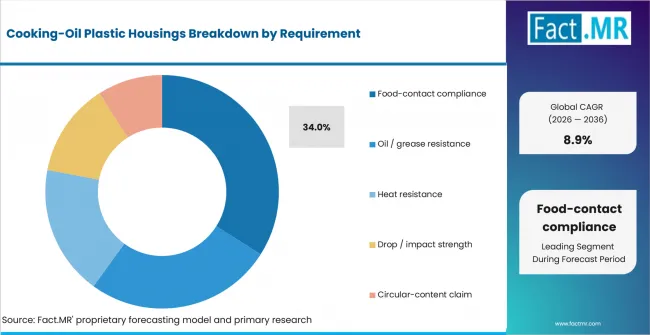
Cooking Oil Plastic Housings Analysis By Requirement | Source: Fact.MR
Food-contact compliance leads since recycled and bio-based polymers require documented suitability before caps, pumps or pourers reach commercial oil packs. The requirement affects material selection, supplier approval and plant trials where edible oils remain in direct contact with molded parts.
What is accelerating Cooking-Oil Plastic Housings Market adoption, and what is holding it back?
Demand is expected to rise through recycled PP qualification and edible-oil packaging turnover. Growth is limited by approval work and recycled-feedstock consistency.
Drivers Impact Analysis
| DRIVER | (~) % IMPACT ON CAGR | GEOGRAPHIC RELEVANCE | IMPACT TIMELINE |
|---|---|---|---|
| Recycled PP use in caps and closures | +1.4% | North America, Europe | Short term (<= 2 years) |
| Food-contact validation for PCR streams | +1.2% | USA, Europe | Medium term (2-4 years) |
| Foodservice dispensing and bulk-pack oil formats | +1.0% | USA, UK, Brazil | Medium term (2-4 years) |
| EU packaging recyclability and recycled-content rules | +0.8% | Western Europe | Long term (>= 4 years) |
- Recycled PP use in caps and closures: Closure makers are expected to qualify recycled PP where stiffness, hinge behavior and line-speed molding remain stable.
- Food-contact validation for PCR streams: Resin processors with favorable regulatory documentation are expected to reduce approval friction for oil-contact caps and pourer housings.
- Foodservice dispensing and bulk-pack formats: Larger oil packs are projected to need durable dispenser housings that reduce leakage and support controlled flow in commercial kitchens.
- EU packaging recyclability and recycled-content rules: European brand owners are anticipated to link molded housing design with recyclability records and material traceability.
Opportunity Impact Analysis
| OPPORTUNITY | (~) % IMPACT ON CAGR | GEOGRAPHIC RELEVANCE | IMPACT TIMELINE |
|---|---|---|---|
| Bio-PP and bio-polymer substitution | +1.0% | Europe, Brazil | Medium term (2-4 years) |
| rPET-compatible additive packages | +0.8% | Global | Short term (<= 2 years) |
| Oil-contact modules in small appliances | +0.7% | France, Germany, USA | Long term (>= 4 years) |
- Bio-PP and bio-polymer substitution: Bio-based polymers are expected to create specification options where oil brands want circular-content claims with stable molded-part performance.
- rPET-compatible additive packages: Additive suppliers are projected to support recycled PET bottle systems where clarity and shelf behavior remain buyer priorities.
- Oil-contact modules in small appliances: Appliances with removable oil trays and pump housings are anticipated to raise demand for compact parts that resist heat and grease.
Restraints Impact Analysis
| RESTRAINT | (~) % IMPACT ON CAGR | GEOGRAPHIC RELEVANCE | IMPACT TIMELINE |
|---|---|---|---|
| Food-contact approval complexity | -0.7% | Global | Short term (<= 2 years) |
| Recycled resin color and odor variability | -0.5% | North America, Europe | Medium term (2-4 years) |
| Tax and reporting exposure on plastic packaging | -0.4% | UK, EU, Brazil | Medium term (2-4 years) |
- Food-contact approval complexity: Recycled polymer streams require careful evidence before use in caps or housings that touch edible oil.
- Recycled resin color and odor variability: PCR feedstock variation is expected to slow replacement of virgin PP in visible closures and pump housings.
- Tax and reporting exposure: Plastic packaging rules are anticipated to raise the value of supplier traceability and recycled-content records.
Which countries are scaling the Cooking-Oil Plastic Housings Market through 2036?
- The country comparison spans 2.2 percentage points and forms three practical growth bands across the forecast period.
- The UK remains 0.7 percentage point above Brazil through recycled-content tax pressure and closure redesign.
- Brazil remains 0.9 percentage point above Germany through soybean oil output that supports local edible-oil packaging and dispensing demand.
- Germany remains 0.3 percentage point above the USA through packaging recycling discipline and recycled-content qualification.
- The USA remains 0.3 percentage point above France as domestic soybean-oil production and FDA recycled-plastic review shape specification choices.
- France closes the displayed range through domestic olive-oil production and appliance-related oil-contact parts.
Comparable CAGRs create different entry conditions where each country combines oil consumption, packaging rules and resin qualification differently. Full report coverage includes North America, Latin America, Western Europe, Eastern Europe, East Asia, South Asia & Pacific, Middle East & Africa.
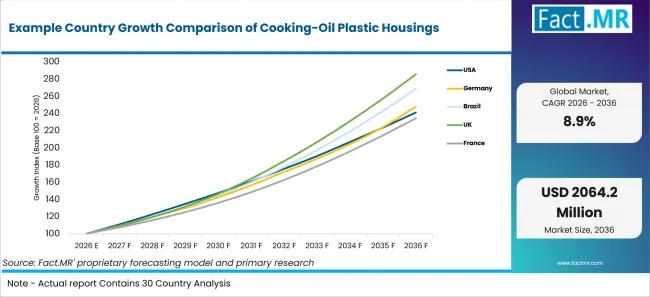
Example Country Growth Comparison Of Cooking Oil Plastic Housings | Source: Fact.MR
| Country | CAGR (2026-2036) |
|---|---|
| UK | 11.1% |
| Brazil | 10.4% |
| Germany | 9.5% |
| USA | 9.2% |
| France | 8.9% |
What supports UK adoption?
11.1% CAGR, supported by recycled-content tax pressure and food packaging scale.
The UK market is expected to benefit from recycled-content reporting and closure redesign across edible-oil packs. HM Revenue & Customs reported in August 2026 that 1,506 thousand tonnes of plastic packaging declared for FY 2025/26 contained 30% or more recycled content. The Plastic Packaging Tax applies to plastic packaging components containing less than 30% recycled plastic, creating a direct policy incentive for greater recycled-content use.
How is Brazil scaling demand?
10.4% CAGR, driven by soybean oil output and local packaging conversion.
Brazil is expected to gain from a large oilseed base that supports vegetable-oil processing and packaging activity. Conab reported on August 13, 2026 that soybean production in the 2025/26 crop was estimated at 180.5 million tonnes. This production scale provides upstream context for edible-oil bottling and related packaging conversion.
What is supporting Germany's adoption?
9.5% CAGR, supported by packaging recycling discipline and converter capability.
Germany is anticipated to scale through recyclable packaging discipline and a mature converter base. The German Environment Agency and the Central Agency Packaging Register reported on January 27, 2026 that around 5.5 million tonnes of packaging waste collected through Germany’s dual systems were recovered in 2024. The result provides official context for Germany's established packaging-recycling environment as converters evaluate recycled-content materials.
What supports USA adoption?
9.2% CAGR, backed by soybean-oil production and recycled-plastic review pathways.
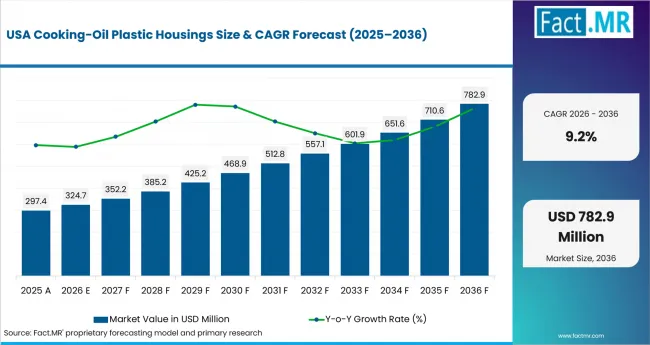
Cooking Oil Plastic Housings Country Value Analysis | Source: Fact.MR
The USA is forecast to advance through a large domestic edible-oil processing base and recycled-plastic review pathways. The U.S. Department of Agriculture's National Agricultural Statistics Service reported on June 1, 2026 that U.S. soybean once-refined oil production reached 1.94 billion pounds in April 2026, up 11% from April 2025. The production level provides direct upstream context for edible-oil filling and packaging activity.
How does France perform?
8.9% CAGR, led by olive-oil packaging activity and appliance-related parts.
France is estimated to grow through edible-oil formats and small appliance parts that touch cooking oil. The French Ministry of Agriculture reported on May 26, 2026 that France produced 5,700 tonnes of olive oil during the 2024/25 campaign. This output provides direct context for domestic olive-oil packaging activity.
Who leads the Cooking Oil Plastic Housings Market?
Competitive coverage is best framed around suppliers with directly relevant material portfolios rather than an unsupported market-share ranking. LyondellBasell participates through Pro-fax EP649U, a polypropylene impact copolymer launched in March 2025 for thin-walled rigid food-packaging applications.
SABIC lists dedicated materials for oil caps, including CC2056 and M500026. Braskem offers post-consumer-recycled polypropylene grades for caps and closures, including a 25% PCR grade that meets requirements for certain U.S. FDA food-contact applications.
Borouge International, formed in March 2026 through the combination of Borouge, Borealis and NOVA Chemicals, is included as the current corporate group in place of Borealis. Competitive differentiation in this narrowly defined market can therefore be assessed through material suitability, food-contact documentation, recycled-content capability and molding performance rather than an unverified supplier ranking.
Which companies are the key providers?
Key companies include LyondellBasell; Borouge International; SABIC; and Braskem.
- LyondellBasell
- Borouge International
- SABIC
- Braskem
Bibliography
- U.S. Department of Agriculture, National Agricultural Statistics Service. (2026, June 1). Fats and oils: Oilseed crushings, production, consumption and stocks.
- European Commission, Directorate-General for Environment. (2026, August 11). New EU rules on packaging enter into application.
- HM Revenue & Customs. (2026, August 27). Plastic Packaging Tax (PPT) statistics commentary.
- Companhia Nacional de Abastecimento. (2026, August 13). Estimativa aponta para uma produção de 360,8 milhões de toneladas na safra 2025/26.
- German Environment Agency, & Central Agency Packaging Register. (2026, January 27). Facts against myths: Packaging waste recycling in Germany is working.
- Ministère de l’Agriculture, de l’Agro-alimentaire et de la Souveraineté alimentaire. (2026, May 26). La filière oléicole française.
- LyondellBasell. (2025, March 6). LYB launches Pro-fax EP649U: A new solution for rigid packaging with recycled and renewable-based options.
- Borealis. (2025, October 2). Integra upgraded for recycled polypropylene with Borcycle™ M advanced mechanical recycling technology.
- Borouge International. (2026, April 1). XRG and OMV complete transactions to create Borouge International.
This Report Answers
- The report explains housing use across polymer, product, oil application, requirement and sales channel. It connects closure demand with adjacent plastic caps and closures applications.
- Segment analysis identifies recycled PP, oil bottle caps / closures and edible oil packaging. The polymer discussion aligns with recycled polyolefin and synthetic and bio-based polypropylene categories.
- Country analysis examines the USA, Germany, Brazil, the UK and France. It links cooking-oil housings with vegetable oils processing and packaging rules.
- Competitive analysis reviews providers across polypropylene, bio-based polymers, additives and engineered materials. It connects supplier positioning with recycled plastic inputs.
- Application analysis assesses cap sealing, dispensing control and oil-contact durability. It places cooking-oil housings near edible oil cans and plastic caps systems.
What does the Cooking-Oil Plastic Housings Market cover?
The Cooking-Oil Plastic Housings Market covers molded plastic parts that enclose, dispense, seal or guide edible oils. The assessment sits close to sustainable plastic packaging where recycled-content and food-contact requirements influence material choice.
Coverage includes recycled PP, bio-PP, recycled PET, bio-PA / bio-polyester and hybrid recycled-content blends. It also covers requirements linked with design-for-recycling packaging when housing geometry affects recyclability.
What is included in the scope?
The scope includes molded housings used in closures, foodservice dispensers, pump units, appliance modules and bulk-pack accessories. It covers components that contact cooking oil or control oil flow inside packaging and appliance systems.
It includes recycled and bio-based polymers formed into oil-contact housings. Adjacent material choices are tracked under circular polyolefins where recycled, bio-circular and mechanically recycled PP materials influence specification work.
What is excluded from the scope?
The scope excludes full bottles, metal cans, labels, edible oils, filling machinery and packaging formats lacking a distinct oil-contact plastic housing. The boundary focuses on molded parts that control oil contact, dispensing or sealing.
Design services, recycling equipment and raw resin trading are outside the scope unless tied directly to housing production. Broader packaging formats remain adjacent to rigid plastic packaging when the format lacks a separate closure or dispenser housing.
Biopolymer markets are adjacent where resin selection changes housing material. The analysis uses bioplastics only as linked material context for bio-PP and bio-polyester choices.
How Was the Analysis Built?
The analysis draws on 120+ sources, 35+ company portfolios, 25+ countries, and more than 20 industry interviews.
- Primary Research: Primary research includes discussions with manufacturers, service providers, technology developers, distributors, end users, and subject-matter experts. These conversations examine purchasing priorities, product adoption, operational challenges, approval requirements, competitive positioning, and the factors that influence wider market acceptance.
- Desk Research: Desk research covers government statistics, regulatory publications, company filings, trade data, technical studies, industry associations, standards, public policy, and other authoritative sources. Every source used in the analysis is documented in the bibliography.
- Market Sizing and Forecasting: Market estimates combine historical performance, demand indicators, pricing and volume trends, segment shares, company participation, country-level growth, adoption patterns, investment activity, and barriers to market expansion.
- Data Validation and Update Cycle: Findings are validated by comparing primary interviews with public data, company activity, regulatory changes, trade patterns, and industry developments. Regular updates review new product launches, capacity changes, partnerships, approvals, and shifts in commercial adoption.
What is the report's scope and coverage?
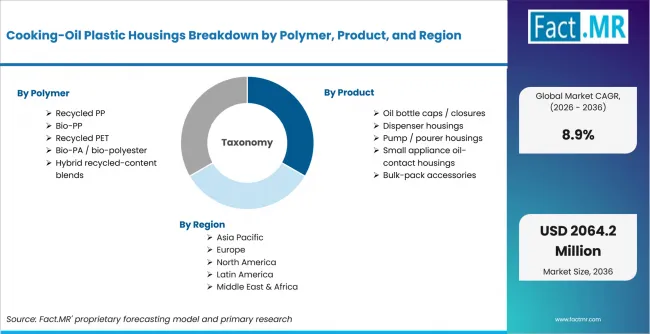
Cooking Oil Plastic Housings Breakdown By Polymer, Product, And Region | Source: Fact.MR
| Attribute | Details |
|---|---|
| Quantitative Units | USD million |
| Market Definition | Molded plastic housings, closures, dispenser bodies, pourers and small appliance oil-contact parts used with cooking-oil handling or packaging. |
| Polymer | Recycled PP; Bio-PP; Recycled PET; Bio-PA / bio-polyester; Hybrid recycled-content blends |
| Product | Oil bottle caps / closures; Dispenser housings; Pump / pourer housings; Small appliance oil-contact housings; Bulk-pack accessories |
| Oil Application | Edible oil packaging; Foodservice dispensing; Cooking appliances; Industrial food handling; Specialty oils |
| Requirement | Food-contact compliance; Oil / grease resistance; Heat resistance; Drop / impact strength; Circular-content claim |
| Sales Channel | Packaging converters; Resin distributors; Appliance OEMs; Foodservice suppliers; Direct processor sales |
| Regions Covered | North America; Latin America; Western Europe; Eastern Europe; East Asia; South Asia & Pacific; Middle East & Africa |
| Countries Covered | USA; Germany; Brazil; UK; France |
| Key Companies Profiled | LyondellBasell; Borouge International; SABIC; Braskem |
| Forecast Period | 2026 to 2036 |
| Approach | Hybrid top-down and bottom-up approach using packaging demand, polymer substitution, food-contact rules and company portfolio review. |
How is the market segmented?
-
By Polymer
- Recycled PP
- Bio-PP
- Recycled PET
- Bio-PA / bio-polyester
- Hybrid recycled-content blends
-
By Product
- Oil bottle caps / closures
- Dispenser housings
- Pump / pourer housings
- Small appliance oil-contact housings
- Bulk-pack accessories
-
By Oil Application
- Edible oil packaging
- Foodservice dispensing
- Cooking appliances
- Industrial food handling
- Specialty oils
-
By Requirement
- Food-contact compliance
- Oil / grease resistance
- Heat resistance
- Drop / impact strength
- Circular-content claim
-
By Region
- North America
- Latin America
- Western Europe
- Eastern Europe
- East Asia
- South Asia & Pacific
- Middle East & Africa