- Estimated Value(2026): 48.3 Bn
- Forecast Value (2036): 68.1 Bn
- CAGR (2026 - 2036): 3.5%
Plastic Caps and Closures Market Forecast and Outlook by Fact.MR
In 2025, the plastic caps and closures market surpassed a valuation of USD 46.6 billion. Based on Fact.MR analysis, demand is estimated to grow to USD 48.3 billion in 2026 and USD 68.1 billion by 2036. FACT.MR projects a CAGR of 3.5% during the forecast period.
The market is expected to generate USD 19.8 billion in incremental revenue during the forecast period. Growth remains steady but moderated by volatility in polypropylene and HDPE resin prices. Rising compliance costs linked to EU tethered cap mandates also affect profitability. Competition from alternative closure formats in premium packaging segments adds substitution pressure. Demand is supported by beverage consumption growth in Asia Pacific and expanding pharmaceutical packaging production worldwide.
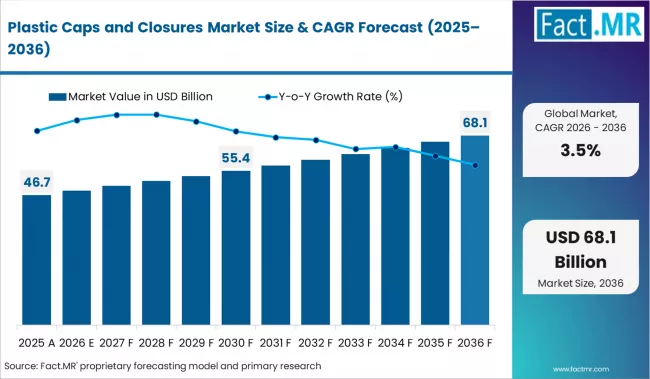
Plastic Caps And Closures Market Market Value Analysis | Source: Fact.MR
| Metric | Value |
|---|---|
| Estimated Value in 2026 | USD 48.3 billion |
| Forecast Value in 2036 | USD 68.1 billion |
| Forecast CAGR (2026 to 2036) | 3.5% |
Source: Fact.MR analysis. Updated Mar 25, 2026
Country growth varies based on regulatory progress, beverage industry expansion, and manufacturing investment. China leads with 6.0% CAGR due to large-scale beverage production and rising pharmaceutical packaging output. Brazil follows at 5.7% supported by strong packaged food and beverage manufacturing and domestic resin supply. Germany grows at 5.0% as a mature market driven by compliance redesign under EU Single-Use Plastics Directive tethered cap rules. The United States records 4.8% growth supported by beverage and pharmaceutical packaging demand and lightweighting investments. Canada posts 4.0% growth as a stable secondary market linked to the US packaging supply chain and growing private-label packaging production.
Summary of Plastic Caps and Closures Market
- Market Definition
- The market includes polymer-based closures such as screw, snap, push-pull, and specialty caps used across beverage, food, pharmaceutical, household, and cosmetics packaging.
- Demand Drivers
- Growth in bottled beverages across Asia Pacific is increasing demand for high-volume screw closures.
- Pharmaceutical packaging expansion is raising demand for child-resistant and tamper-evident closures.
- EU tethered cap rules are driving closure redesign investment across European manufacturers.
- Key Segments Analyzed
- By Cap Type: Screw closures lead with about 70% share in 2026 due to widespread beverage and household packaging use.
- By End Use: Beverage applications account for about 48% of total closure demand in 2026.
- By Material Type: Thermoplastics such as polypropylene and HDPE dominate closure production due to cost efficiency and recyclability.
- Analyst Opinion at Fact.MR
- Shambhu Nath Jha, Principal Consultant at Fact.MR, notes that the report highlights compliance redesign, lightweighting strategies, and Asia Pacific expansion opportunities for closure manufacturers.
- Strategic Implications
- Manufacturers should expand tethered cap production to meet EU compliance requirements.
- Producers should invest in mono-material polypropylene closures to improve recyclability.
- Companies targeting Asia Pacific should build capacity near beverage production hubs.
- Methodology
- Market sizing uses closure shipment volumes, cap type distribution, and revenue disclosures from Berry Global, Amcor, Silgan, and Aptar.
- Regulatory data, resin price indices, and plastics industry statistics support regional analysis.
- Forecasts incorporate beverage production growth, pharmaceutical packaging demand, tethered cap regulations, and expert interviews.
Segmental Analysis
Plastic Caps and Closures Market Analysis by Cap Type
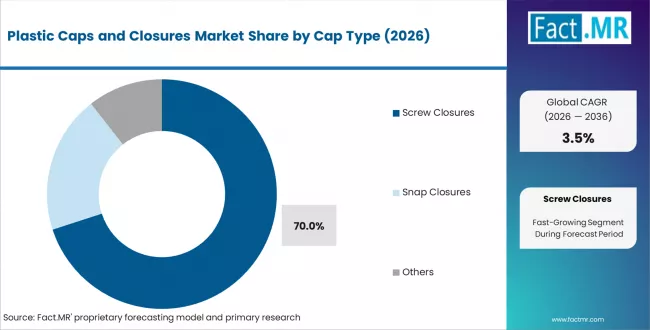
Plastic Caps And Closures Market Analysis By Cap Type | Source: Fact.MR
FACT.MR estimates screw closures will account for about 70% share in 2026. Their dominance comes from compatibility with PET, HDPE, and glass bottles across beverage, pharmaceutical, and household packaging.
- Silgan Holdings Tethered Cap Launch: In March 2024, Silgan Plastics launched a new tethered screw closure for European beverage customers. The design meets EU regulations while maintaining standard filling line speeds and polypropylene recyclability. [4]
- Berry Global Lightweight Screw Closure: Berry Global reported in Q2 2024 that its lightweight closure programme reduced closure weight by about 12% since 2022. The programme helps beverage brands cut material usage and improve sustainability targets. [5]
- Push-Pull Closure Growth in Sports Nutrition: Innova Market Insights reported a 22% rise in beverage launches using push-pull closures in 2024. Growth was driven by protein drinks, electrolyte beverages, and sports hydration products in North America and Europe. [6]
Plastic Caps and Closures Market Analysis by End Use
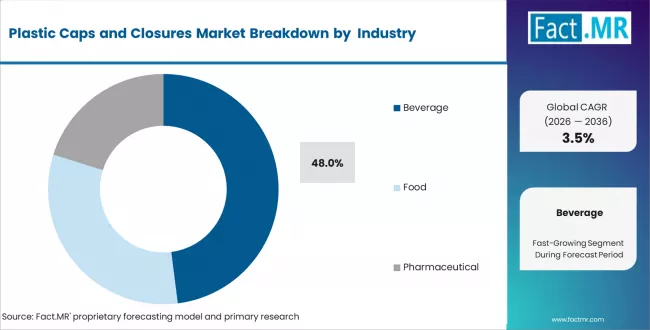
Plastic Caps And Closures Market Analysis By End Use | Source: Fact.MR
FACT.MR estimates beverage applications will represent about 48% of closure demand in 2026. High global PET bottle production continues to drive screw closure consumption across water, soft drinks, juices, and functional beverages.
- Amcor Beverage Closure Sustainability Programme: Amcor reported in its FY2024 sustainability report that all beverage closures in its European portfolio are fully recyclable by design. The company expanded closure production capacity in Poland in 2024 to support regional PET bottle manufacturers. [7]
- Pharmaceutical Closure Compliance Investment: Aptar expanded its pharmaceutical closure facility in Congers, New York in November 2024. The investment increased production of child-resistant and senior-friendly closures for oral liquid medicines. [3]
- Cosmetics Closure Premiumisation: Bericap introduced a new premium cosmetics closure range at Interpack 2024. The designs include airless dispensing and metallic-effect polypropylene closures aimed at premium skincare and haircare brands. [8]
Drivers, Restraints, and Opportunities
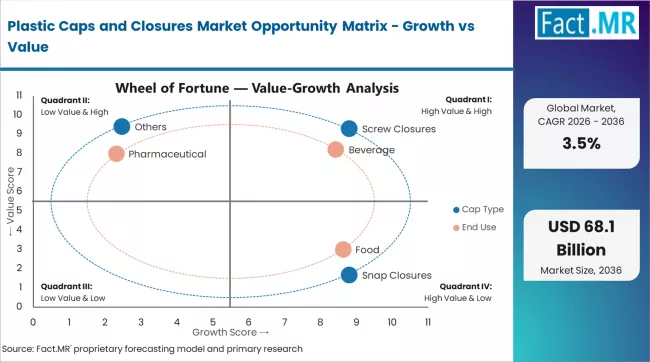
Plastic Caps And Closures Market Opportunity Matrix Growth Vs Value | Source: Fact.MR
FACT.MR analysts note that the plastic caps and closures market is supported by strong demand from beverage, pharmaceutical, and food packaging sectors. Global beverage production continues to expand in emerging markets, sustaining closure volume demand. However, mature regions such as Western Europe and North America show slower growth in carbonated beverage consumption.
The market is shifting from commodity closure production toward compliance-driven design innovation. EU tethered cap rules introduced in 2024 require closures to remain attached to containers after opening. This is increasing redesign costs but also raising per-unit closure value. At the same time, beverage companies continue to push for lightweight closures to reduce plastic usage and improve sustainability.
- EU Tethered Cap Mandate: The EU Single-Use Plastics Directive requires tethered caps for beverage containers up to three litres from July 2024. Major suppliers including Silgan, Berry Global, and Aptar launched compliant closure designs in 2024, confirming industry-wide redesign investment. [1]
- Asia Pacific Beverage Expansion: China’s bottled water and functional beverage market grew around 9% in 2024. India’s packaged beverage sector expanded about 11% in FY2024–25. Rising PET bottle production in both countries continues to drive high-volume demand for polypropylene screw closures. [2]
- Pharmaceutical Closure Demand: India’s pharmaceutical packaging sector expanded in 2024 due to rising generic medicine exports. Updated US Pharmacopeia Chapter 〈671〉 container standards increased closure testing requirements, boosting demand for compliant child-resistant and tamper-evident closures. [3]
Regional Analysis
The plastic caps and closures market is analysed across Asia Pacific, Europe, North America, Latin America, and Middle East and Africa, covering 40+ key beverage, food, and pharmaceutical packaging manufacturing countries. The full report offers market attractiveness analysis based on beverage production volumes, regulatory compliance requirements, and end-use industry growth trajectories.
.webp "Top Country Growth Comparison Plastic Caps And Closures Market Cagr (2026 2036)")
Top Country Growth Comparison Plastic Caps And Closures Market Cagr (2026 2036) | Source: Fact.MR
| Country | CAGR (2026 to 2036) |
|---|---|
| China | 6.0% |
| Brazil | 5.7% |
| Germany | 5.0% |
| USA | 4.8% |
| Canada | 4.0% |
Source: Fact.MR analysis. Updated Mar 25, 2026
Source: Fact.MR (FACT.MR) analysis, based on proprietary forecasting model and primary research
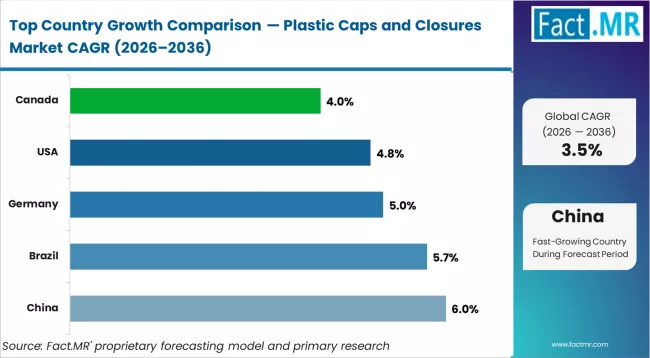
Plastic Caps And Closures Market Cagr Analysis By Country | Source: Fact.MR
Asia Pacific Plastic Caps and Closures Market Analysis
Asia Pacific remains the largest manufacturing hub for plastic caps and closures due to strong beverage and pharmaceutical production. China and India drive regional demand, supported by expanding FMCG consumption and packaging investments. International suppliers such as United Caps and Closure Systems International are strengthening their presence, while local companies like Zijiang Enterprise and Jiangsu Dalishi dominate domestic supply.
- China: As the region’s largest beverage producer, China generates substantial demand for plastic closures. The market is projected to grow at 6.0% CAGR through 2036. Bottled water and functional beverages recorded about 9% volume growth in 2024. Increased PET bottle manufacturing continues to raise screw closure consumption. Updated recyclability rules issued in 2024 require polypropylene mono-material closures for major beverage packaging by 2026.
- India: Rapid FMCG and beverage consumption is strengthening closure demand in India. The packaged beverage sector expanded about 11% in FY2024–25. Rising PET bottle output is increasing procurement of polypropylene screw closures. Government incentives under the Production Linked Incentive scheme are also encouraging local packaging component production.
FACT.MR’s Asia Pacific analysis includes China, India, Japan, South Korea, ASEAN, and Australia and New Zealand. The report provides beverage production benchmarks, pharmaceutical packaging requirements, and country-level forecasts.
Europe Plastic Caps and Closures Market
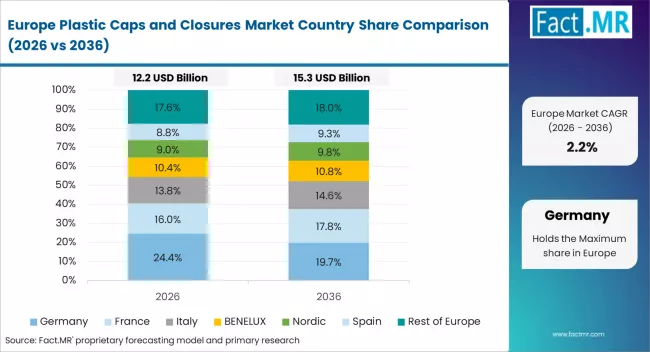
Plastic Caps And Closures Market Europe Country Market Share Analysis, 2026 & 2036 | Source: Fact.MR
Analysis Europe functions as a regulatory driver for sustainable closure design. The EU Single-Use Plastics Directive introduced tethered cap requirements that are reshaping packaging formats across the region. Major producers such as Silgan, Berry Global, and Guala Closures hold strong market positions.
- Germany: Regulatory compliance is a major factor shaping Germany’s closure market. Demand is expected to grow at 5.0% CAGR through 2036. The EU tethered cap rule implemented in July 2024 requires closures to remain attached to beverage containers. The German Packaging Act also encourages recyclability and recycled material use. Guala Closures invested in new tethered cap production tooling in 2024 to serve beverage manufacturers.
FACT.MR’s Europe coverage includes Germany, France, the United Kingdom, Italy, Spain, and the rest of Europe. The report outlines EPR legislation impacts, tethered cap adoption trends, and country-level projections.
North America Plastic Caps and Closures Market
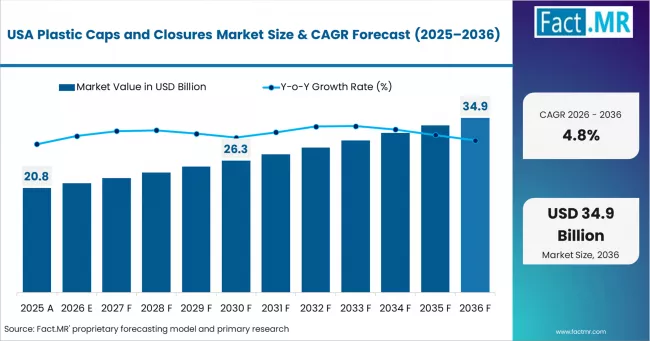
Plastic Caps And Closures Market Country Value Analysis | Source: Fact.MR
Analysis North America represents a high-value market for advanced closure solutions. Pharmaceutical packaging growth and functional beverage demand support steady revenue expansion. Major suppliers including Berry Global, Silgan, and Aptar dominate the regional supply chain.
- USA: The United States closure market benefits from strong pharmaceutical and beverage packaging demand. The market is projected to grow at 4.8% CAGR through 2036. Increasing domestic generic drug manufacturing is expanding demand for pharmaceutical closures. Berry Global reported faster growth in pharmaceutical closures compared with standard beverage closures in 2024.
- Canada: Environmental regulation and beverage packaging demand are shaping Canada’s closure market. Growth is projected at 4.0% CAGR through 2036. Updated Canadian Environmental Protection Act rules introduced stricter recyclability criteria for packaging in 2024. Closure Systems International expanded production capacity in Ontario to supply mono-material closures for beverage and dairy producers.
FACT.MR’s North America analysis covers the United States, Canada, and Mexico. The report includes pharmaceutical packaging demand trends, beverage lightweighting initiatives, and regional regulatory developments.
Latin America Plastic Caps and Closures Market
Analysis Latin America is emerging as a growth market due to expanding beverage and food manufacturing capacity. Brazil leads regional demand, supported by strong domestic packaging supply chains and local resin production.
- Brazil: Strong food and beverage manufacturing is supporting Brazil’s closure market expansion. Demand is expected to grow at 5.7% CAGR through 2036. Packaged food and beverage production increased about 8% in 2024. Domestic polypropylene supply from Braskem supports stable closure manufacturing. Resin price guidance programmes introduced in 2025 help producers manage long-term supply agreements with beverage brands.
FACT.MR’s Latin America coverage includes Brazil, Mexico, Argentina, Chile, and the rest of the region. The report highlights beverage production trends, resin availability, and closure demand forecasts across major countries.
Competitive Aligners for Market Players
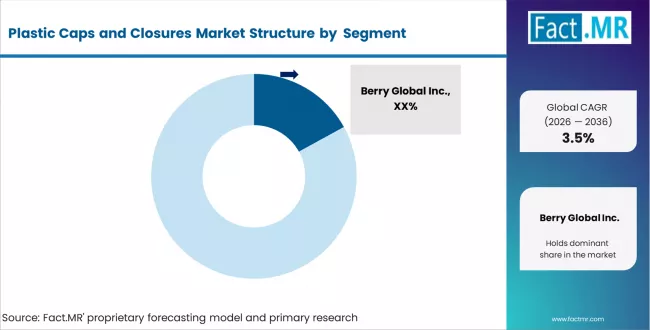
Plastic Caps And Closures Market Analysis By Company | Source: Fact.MR
The global plastic caps and closures market is moderately concentrated at the high-value engineered closure level but remains fragmented for standard screw closures. Major packaging companies such as Berry Global, Amcor, Silgan Holdings, and AptarGroup together generate high global closure revenue. Competition is not driven purely by price; instead, reliability, regulatory compliance, and technical service play a major role because closures directly affect filling line efficiency and product safety in food and pharmaceutical packaging.
Berry Global and Silgan benefit from large-scale resin purchasing and advanced mould tooling, which allow them to produce lightweight closures at lower cost and high volumes. Aptar differentiates itself with specialised dispensing and dosing closures used in pharmaceutical and personal care packaging, where regulatory approvals make supplier switching difficult. Meanwhile, European companies like Bericap and Guala Closures maintain strong positions through long-standing relationships with beverage and spirits producers.
Large beverage and pharmaceutical companies typically approve multiple closure suppliers for each packaging format. This strategy reduces supply risk and prevents any single supplier from dominating pricing negotiations.
Key Players of Plastic Caps and Closures Market
- Berry Global Inc.
- Amcor Plc
- Silgan Plastics
- Aptar Inc.
- Bericap GmbH & Co KG
- United Caps
- Closure Systems International Inc.
- Guala Closures S.p.A.
Bibliography
- [1] Silgan Holdings Inc. (2024). Annual Report 2024 and Q2 2024 Earnings Presentation: Tethered Cap Product Launch for European PET Beverage Customers, EU Single-Use Plastics Directive Compliance Programme and Tooling Investment. silganholdings.com/investors
- [2] China Beverage Industry Association; FICCI Food Processing Division. (2024–2025). China Bottled Beverage Market Volume Growth Data 2024; India Packaged Beverage Sector Annual Report FY2024–25: PET Bottle Closure Demand and Natural Ingredient Sourcing Trends. cbic.org.cn; ficci.in
- [3] Aptar Inc. (2024). Press Release: Pharmaceutical Closure Manufacturing Facility Expansion at Congers, New York Child-Resistant and Senior-Friendly Closure Capacity for US Generics Pharmaceutical Packaging Market. November 2024. aptar.com/news
- [4] Silgan Plastics. (2024). Product Launch Announcement: Tethered Screw Closure System for European PET Beverage Applications, EU SUPD Compliance, Polypropylene Mono-Material Recyclability Qualification. March 2024. silganplastics.com
- [5] Berry Global Inc. (2024). Q2 2024 Earnings Communication and Q1 2024 Investor Update: Lightweight Closure Programme Results, North American Beverage Closure Weight Reduction, Tethered Cap Range Launch for European Customers. berryglobal.com/investors
- [6] Innova Market Insights. (2025). Global Packaging and Beverage Trends Report 2025: Push-Pull Dispensing Closure Growth in Sports and Functional Beverages, North America and Europe New Product Launch Data. January 2025. innovamarketinsights.com
- [7] Amcor Plc. (2024). FY2024 Sustainability Report and Q3 2024 Investor Update: Beverage Closure Recyclability Programme, European Mono-Material Portfolio Qualification, Poland Capacity Expansion for Central and Eastern European PET Bottle Market. amcor.com/investors
- [8] Bericap GmbH & Co KG. (2024). Interpack 2024 Press Release: Premium Cosmetics and Personal Care Closure Range Launch, Airless Dispensing and Metallic-Effect Polypropylene Closures for European and North American Skincare and Haircare Brands. May 2024. bericap.com/news
This Report Addresses
- Strategic intelligence on EU tethered cap mandates, German Verpackungsgesetz EPR rules, US FDA closure standards, India FSSAI packaging guidelines, and China recyclability regulations influencing closure demand through 2036.
- Market forecast from USD 48.3 billion in 2026 to USD 68.1 billion by 2036 at 3.5% CAGR, segmented by cap type, material, end use, and region.
- Growth opportunities across China’s beverage expansion, India’s pharmaceutical and FMCG packaging growth, Brazil’s resin-integrated market, Germany’s compliance redesign demand, and US pharmaceutical closure growth.
- Country CAGR outlook including China (6.0%), Brazil (5.7%), Germany (5.0%), USA (4.8%), and Canada (4.0%), supported by beverage production and regulatory timelines.
- Competitive analysis of Berry Global, Amcor, Silgan, Aptar, Bericap, United Caps, Closure Systems International, and Guala Closures focusing on product portfolios and sustainability strategies.
- Technology tracking covering tethered cap designs, polypropylene lightweight closures, child-resistant pharmaceutical caps, dispensing closures, and recycled resin integration.
- Regulatory coverage including EU SUPD tethered cap rules, German EPR packaging law, US USP container standards, Canada CEPA recyclability criteria, and India PLI packaging incentives.
- Report delivery includes PDF report, Excel datasets, PowerPoint summary, and dashboards supported by company disclosures, regulatory reports, industry data, and expert interviews.
Plastic Caps and Closures Market Definition
The plastic caps and closures market includes polymer-based sealing components used for bottles, jars, tubes, and containers. These closures ensure sealing, tamper evidence, and dispensing functionality across beverage, food, pharmaceutical, household, cosmetics, and chemical packaging.
Plastic Caps and Closures Market Inclusions
Covers global and regional market forecasts from 2026 to 2036 by cap type, material, and end use. Includes screw, snap, push-pull, dispensing, and child-resistant closures made from polypropylene, HDPE, LDPE, and thermoset polymers. Also includes tethered caps and lightweight closure designs.
Plastic Caps and Closures Market Exclusions
Excludes metal caps, cork closures, and glass stoppers unless used in hybrid polymer assemblies. Finished packaged products such as beverages or pharmaceuticals are excluded. Closure manufacturing equipment and mould tooling are also outside the scope.
Plastic Caps and Closures Research Methodology
- Primary Research: Interviews with closure plant managers, packaging procurement leaders at beverage and pharma companies, sustainability officers at FMCG firms, and resin buyers across Europe, North America, and Asia Pacific.
- Desk Research: Sources include EU Single-Use Plastics Directive reports, FDA packaging guidance, annual reports from Berry Global, Amcor, Silgan, and Aptar, ICIS resin price indices, and publications from EPCA and Plastics Europe.
- Market Sizing and Forecasting: Hybrid model using closure shipment volumes, average selling prices by cap type, beverage and pharmaceutical production data, and resin cost trends.
- Data Validation and Update Cycle: Data validated through company revenue disclosures, resin pricing indices, EU regulatory reports, and expert interviews with packaging professionals.
Segmentation
Scope of Report
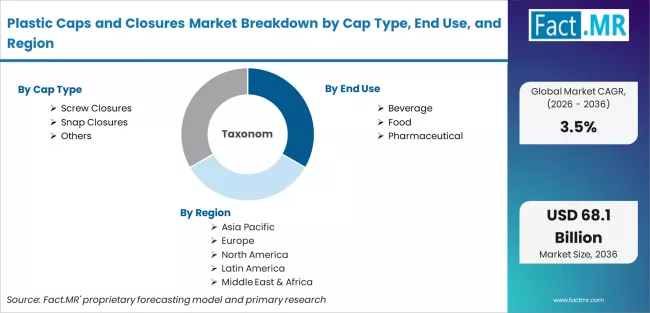
Plastic Caps And Closures Market Breakdown By Cap Type, End Use, And Region | Source: Fact.MR
| Attribute | Details |
|---|---|
| Quantitative Units | USD 48.3 billion (2026) to USD 68.1 billion (2036), at a CAGR of 3.5% |
| Market Definition | Polymer-based sealing components across screw, snap, push-pull, and specialty formats used in beverage, food, pharmaceutical, household, cosmetics, and chemical packaging globally. |
| Cap Type Segmentation | Screw Closures, Snap Closures, Push-Pull Closures, Others |
| Material Type Segmentation | Thermoplastics, Thermosets |
| End Use Segmentation | Beverage, Food, Pharmaceutical, Household, Cosmetics & Personal Care, Chemicals & Fertilizers |
| Regions Covered | Asia Pacific, Europe, North America, Latin America, Middle East and Africa |
| Countries Covered | China, India, Japan, South Korea, ASEAN, Australia and New Zealand, Germany, UK, France, Italy, Spain, USA, Canada, Mexico, Brazil, Argentina, Chile, Saudi Arabia, GCC, South Africa |
| Key Companies Profiled | Berry Global Inc., Amcor Plc, Silgan Plastics, Aptar Inc., Bericap GmbH & Co KG, United Caps, Closure Systems International Inc., Guala Closures S.p.A. |
| Forecast Period | 2026 to 2036 |
| Approach | Hybrid top-down and bottom-up model using closure volume shipments by end use, average selling prices by cap type and material, beverage and pharmaceutical production output data, and primary research. |
Source: Fact.MR analysis. Updated Mar 25, 2026
Plastic Caps and Closures Market by Segments
-
By Cap Type:
- Screw Closures
- Snap Closures
- Push-Pull Closures
- Others
-
By Material Type:
- Thermoplastics
- Thermosets
-
By End Use:
- Beverage
- Food
- Pharmaceutical
- Household
- Cosmetics & Personal Care
- Chemicals & Fertilizers
-
By Region:
- North America
- United States
- Canada
- Mexico
- Latin America
- Brazil
- Mexico
- Argentina
- Chile
- Rest of Latin America
- Western Europe
- Germany
- United Kingdom
- France
- Italy
- Spain
- Nordic Countries
- BENELUX
- Rest of Western Europe
- East Asia
- China
- Japan
- South Korea
- South Asia and Pacific
- India
- ASEAN
- Australia and New Zealand
- Rest of South Asia and Pacific
- Middle East and Africa
- Kingdom of Saudi Arabia
- Other GCC Countries
- Turkey
- South Africa
- Rest of Middle East and Africa
- North America
Frequently Asked Questions
How large is the plastic caps and closures market in 2025?
What will the market size be in 2026?
What is the projected market size by 2036?
What is the expected CAGR?
Which cap type segment leads the market?
Which end-use segment dominates?
Which country shows the fastest growth?
Which industries use plastic caps and closures the most?
Which cap type dominates the market?
Why are tethered caps becoming important in the market?
How is sustainability affecting the caps and closures industry?
Which materials are most commonly used for plastic closures?
Which region produces the most plastic caps and closures?
Who worked on this report


Preview the report firsthand - request a free sample
Free SampleGet the brochure for pricing and purchase details
Download PDF