The Design-for-Recycling Packaging Market is analyzed across its key product, application and end-use segments, with the study covering market dynamics, regional trends and demand outlook, forecast 2026 to 2036.
By Fact.MR Consumer Goods DeskLead analyst:
Ayush RajPublished :
Updated :
11 min read
Fact-checked under the Fact.MR editorial process
Design-for-Recycling Packaging Market Forecast and Outlook 2026 to 2036
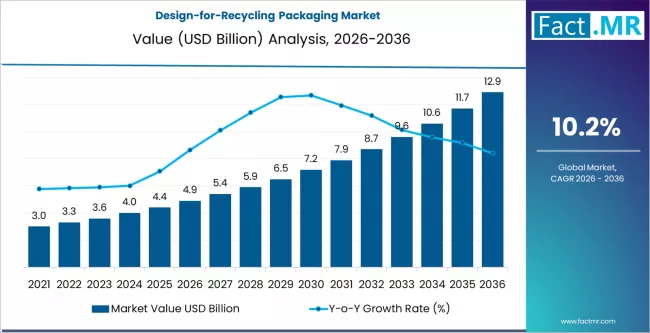
The design-for-recycling packaging market is projected to reach USD 4.9 billion in 2026, growing to USD 12.9 billion by 2036, with a CAGR of 10.2%.
Design For Recycling Packaging Market Market Value Analysis | Source: Fact.MR
Summary of Design-for-Recycling Packaging Market
Market Snapshot
Global design-for-recycling packaging market revenue stood atUSD 4.9 billion in 2026and is forecast to reachUSD 12.9 billion by 2036.
At a10.2%CAGRfrom 2026 to 2036, this market is set to expand~2.6x in value, addingUSD 8.0 billion in absolute opportunity.
Growth is being driven by increasing regulatory pressure and rising consumer demand for sustainable and recyclable packaging solutions acrossFMCG, food, retail, and e-commerce industries.
Design-for-recycling packaging is evolving into a critical sustainability strategy, enabling companies to improve recyclability, reduce material complexity, and strengthen environmental compliance performance.
Demand and Growth Drivers
Increasing focus on reducing packaging waste and improving circular economy performance is accelerating adoption of recyclable packaging formats globally.
Companies are increasingly prioritizing packaging solutions that support sustainability targets, operational efficiency, and long-term regulatory compliance.
Growing demand for mono-material packaging structures and recyclable flexible packaging is supporting sustained market expansion.
Packaging redesign initiatives aimed at improving recyclability,lightweighting, and material simplification are becoming key procurement priorities across consumer goods industries.
Advancements in recyclable laminates, barrier redesign technologies,downgaugingsolutions, and high-speed packaging conversion systems are further supporting market growth.
Product and Segment View
PE, PP simplification holds 54% of material strategy share in 2026,emergingas the leading segment due to its strong recyclability compatibility and simplified material recovery characteristics.
Mono-material packs and recyclable flexible packaging formats arewitnessingincreasing adoption as companies shift toward circular packaging systems and material reduction strategies.
Demandremainsparticularly strong acrossFMCGpackaging, food packaging, retail packaging, consumer packaging, and e-commerce applications requiring recyclable and lightweight packaging solutions.
Barrier replacement technologies, sealant redesign,downgaugingsolutions, and polyolefin mono-structures are increasingly being integrated into next-generation recyclable packaging systems.
Geography and Competitive Outlook
Asia Pacificrepresentsthe key growth region, supported by expanding packaging manufacturing capacity, increasing sustainability investments, and tightening environmental regulations.
Market expansion is closely tied to circular economy initiatives, recyclable packaging mandates, sustainable material innovation, and corporateESGcommitments.
Competitive dynamics are shaped by recyclable material engineering capabilities, packaging redesignexpertise,lightweightingtechnologies, and large-scale flexible packaging production capacity.
Key companies active in this market includeMondi,Berry Global,Amcor China,UFlex,Huhtamaki,Sealed Air, andGreatview.
Design-for-Recycling Packaging Market — At a Glance
Attribute
Details
Market Value 2026
USD 4.9 billion
Market Value 2036
USD 12.9 billion
Absolute Dollar Opportunity 2026–2036
USD 8.0 billion
Total Growth 2026–2036
163.3%
CAGR2026–2036
10.2%
Growth Multiple
~2.6x
Key Demand Theme
Increasing adoption of recyclable and circular packaging systems across consumer goods industries
North America, Latin America, Western Europe, Eastern Europe, East Asia, South Asia & Pacific, Middle East & Africa
Source: Fact.MR analysis. Updated May 12, 2026
This market holds significant economic relevance as regulatory pressures and consumer demand for sustainable practices intensify. Buyers are increasingly focused on solutions that reduce waste and meet evolving environmental standards, positioning design-for-recycling packaging as a critical consideration in procurement decisions. Companies are making strategic decisions based on both cost-efficiency and compliance, with packaging solutions serving as key levers to enhance brand image and market differentiation. As businesses strive to meet sustainability targets, packaging design will directly impact bottom lines, influencing operational costs, supply chain efficiency, and product lifecycle management. The growing expectation for companies to adopt environmentally responsible practices ensures that this market will continue to gain momentum, making it a focal point for industry leaders seeking long-term growth and market leadership.
Category
Category
Segments
End-use
FMCG and food packaging; Consumer packaging; Retail and e-commerce; FMCG and sachets; Food packaging
Barrier replacement and material reduction; Sealant and barrier redesign; High-speed conversion; Downgauging and redesign; Others
Region
North America; Europe; Asia Pacific; Latin America; Middle East & Africa
Source: Fact.MR analysis. Updated May 12, 2026
Segmental Analysis
What Is the Impact of Packaging Format on the Design-for-Recycling Packaging Market?
Design For Recycling Packaging Market Analysis By Packaging Format | Source: Fact.MR
In the design-for-recycling packaging market, packaging format plays a significant role in ensuring ease of recycling and reducing environmental impact. Mono-material packs lead the market with a 48% share, as they simplify the recycling process by using a single material that can be easily sorted and processed. This format minimizes contamination and increases the efficiency of recycling operations. As sustainability continues to drive packaging innovation, mono-material packs are expected to remain a key trend, offering solutions that contribute to the circular economy by making recycling more efficient and less complex.
How Does Material Strategy Influence the Design-for-Recycling Packaging Market?
Design For Recycling Packaging Market Analysis By Material Strategy | Source: Fact.MR
Material strategy is a critical factor in enhancing the recyclability of packaging solutions, with PE and PP simplification leading the market at a 54% share. By focusing on polyolefin mono-structures, this strategy simplifies the material composition of packaging, making it easier to recycle and reducing waste. The shift toward recyclable laminates and PE-based mono films further supports this trend, allowing for more sustainable packaging solutions. As demand for eco-friendly packaging solutions rises, material strategies that prioritize recyclability will continue to play a crucial role in shaping the future of the packaging industry.
What are the Principal Drivers, Constraints, and Evolving Dynamics of the Design for Recycling Packaging Market?
Growth in the design for recycling packaging market has been shaped by requirements to simplify end of life recovery and improve material value retained through sorting systems. Brand owners and converters specify designs that minimize mixed materials and complex attachments that hinder recycling processes. Regulatory frameworks that set recycled content targets and extended producer responsibility responsibilities have influenced design criteria that favor recyclability.
Variability in material performance requirements across product types affects the pace of adoption where trade offs occur between function and recyclability specifications. Some packaging formats require engineering changes to meet both barrier performance and recycling goals. Work on defining material guidelines and standardizing recyclable design features is under way. Collaboration between packaging designers, recyclers, and material suppliers aims to broaden validated design practices.
Analysis of the Design-for-Recycling Packaging Market by Key Country
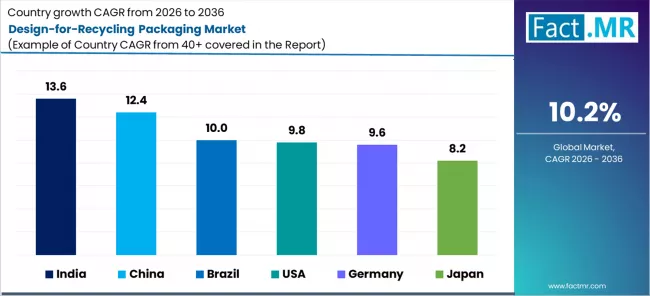
Design For Recycling Packaging Market Cagr Analysis By Country | Source: Fact.MR
Country
CAGR 2026 to 2036
Germany
9.6%
USA
9.8%
China
12.4%
India
13.6%
Brazil
10%
Japan
8.2%
Source: Fact.MR analysis. Updated May 12, 2026
The report covers an in-depth analysis of 40+ countries; top-performing countries are highlighted below.
What is the Growth Outlook for Design-for-Recycling Packaging in Germany?
Germany’s design-for-recycling packaging market is projected to grow at a CAGR of 9.6% from 2026 to 2036. As Germany continues to prioritize sustainability and recycling efficiency, the demand for packaging designed with recyclability in mind is increasing. Stricter regulations on waste management and growing consumer demand for eco-friendly products are driving the market. With Germany’s well-established recycling infrastructure and strong regulatory framework, the market for design-for-recycling packaging is expected to experience steady growth in the coming years.
How is the Design-for-Recycling Packaging Market Performing in the USA?
The USA’s design-for-recycling packaging market is expected to grow at a CAGR of 9.8% from 2026 to 2036. Increasing regulatory pressures and consumer demand for sustainable packaging are driving the adoption of packaging solutions that are easier to recycle. Design-for-recycling principles are gaining traction as companies seek to reduce plastic waste and improve recycling rates. With the USA's focus on improving waste management and supporting circular economy practices, the market for these packaging solutions is set to expand, supported by both government initiatives and industry innovation.
What is the Market Outlook for Design-for-Recycling Packaging in China?
China is projected to experience significant growth in the design-for-recycling packaging market, with a projected CAGR of 12.4% from 2026 to 2036. As China focuses on improving its recycling infrastructure and tackling plastic waste, design-for-recycling packaging solutions are becoming a priority. The country's government is implementing stricter regulations on plastic waste and promoting sustainability in packaging. With a large-scale manufacturing sector and growing consumer awareness of environmental issues, China is set to lead the market in adopting packaging solutions that align with recycling goals.
What is the Growth Potential for Design-for-Recycling Packaging in India?
India’s design-for-recycling packaging market is forecast to grow at a robust CAGR of 13.6% from 2026 to 2036. As India’s packaging industry expands, there is an increasing focus on sustainability and reducing the environmental impact of packaging waste. Design-for-recycling packaging solutions are crucial in helping the country meet both regulatory standards and consumer demand for eco-friendly products. With growing government support for recycling infrastructure and sustainability initiatives, India’s market for design-for-recycling packaging will continue to grow at a rapid pace.
What is the Demand for Design-for-Recycling Packaging in Brazil?
Brazil’s design-for-recycling packaging market is set to grow at a CAGR of 10% from 2026 to 2036. With increasing focus on sustainability and waste reduction, Brazil is adopting design-for-recycling principles to reduce packaging waste and improve recycling rates. Government initiatives aimed at improving recycling infrastructure and reducing environmental impact are driving this demand. As Brazil continues to strengthen its sustainability practices, the market for design-for-recycling packaging is expected to expand steadily, supported by both regulatory frameworks and consumer preferences for eco-friendly products.
What is the Market Expansion Outlook for Design-for-Recycling Packaging in Japan?
Japan’s design-for-recycling packaging market is projected to grow at a CAGR of 8.2% from 2026 to 2036. Japan has long been a leader in waste management and recycling, and the adoption of design-for-recycling packaging solutions is becoming increasingly important. The country’s focus on reducing waste and improving recycling efficiency supports the demand for packaging solutions that are easier to recycle. Although Japan’s growth rate may be more modest compared to other regions, the country’s ongoing sustainability efforts will continue to drive demand for these packaging solutions.
How is Competition Structured in the DesignforRecycling Packaging Market?
Competition in the design for recycling packaging market is defined by how well packaging simplifies material recovery and meets recycling infrastructure capabilities. Mondi and Berry Global offer solutions that prioritize mono material structures and easy separation of components to improve recyclability. Sealed Air and Greatview focus on high performance designs that balance barrier properties with recycling friendliness for food and consumer goods segments. Huhtamaki positions its offerings with fibre based and hybrid structures that align with existing collection and sorting systems.
Amcor China and UFlex emphasize regional manufacturing scale and flexible design rules that support recycling targets set by brand owners and regulators. Competitive differentiation arises from documented recyclability data, compatibility with mechanical recycling processes, and technical support for packaging conversion. Buyers assess suppliers based on recyclability scores, ease of processing on current lines, and alignment with circular economy standards.
Key Players in the DesignforRecycling Packaging Market
Mondi
Berry Global
Amcor China
UFlex
Huhtamaki
Sealed Air
Greatview
Bibliographies
Amcor. (2026). Amcor: Packaging solutions for a circular economy and sustainability. Amcor.
WRAP. (2024).Recyclability guidance for plastic packaging: Design rules, material compatibility, and system impacts. Waste & Resources Action Programme.
United Nations Environment Programme. (2023).Design for circularity: Packaging design principles to improve recyclability and material recovery. UNEP.
European Commission, Joint Research Centre. (2024).Design-for-recycling criteria for plastic packaging: Technical guidance and performance thresholds. JRC Technical Reports.
Market Breakdown
Segmentation
Scope of the Report
Items
Values
Quantitative Units (2026)
USD Billion
End-use
FMCG and food packaging, Consumer packaging, Retail and e-commerce, FMCG and sachets, Food packaging
Dollar revenue by end-use, packaging format, material strategy, and technology; regional demand trends, competitive landscape, technological advancements in design-for-recycling packaging, and innovations in material reduction and recyclability
How big is the design-for-recycling packaging market in 2026?
The global design-for-recycling packaging market is estimated to be valued at USD 4.9 billion in 2026.
What will be the size of design-for-recycling packaging market in 2036?
The market size for the design-for-recycling packaging market is projected to reach USD 12.9 billion by 2036.
How much will be the design-for-recycling packaging market growth between 2026 and 2036?
The design-for-recycling packaging market is expected to grow at a 10.2% CAGR between 2026 and 2036.
What are the key product types in the design-for-recycling packaging market?
The key product types in design-for-recycling packaging market are fmcg and food packaging, consumer packaging, retail and e-commerce, fmcg and sachets and food packaging.
Which packaging format segment to contribute significant share in the design-for-recycling packaging market in 2026?
In terms of packaging format, mono-material packs segment to command 48.0% share in the design-for-recycling packaging market in 2026.