- Market Value (2025): USD 167.6 Mn
- Estimated Value (2026): USD 173.0 Mn
- Forecast Value (2036): USD 238.0 Mn
- CAGR (2026-2036): 3.2%
What is the Cosmetics HPP Pigments Market forecast to be worth by 2036?
USD 173 million in 2026 to USD 238 million by 2036, at 3.2% CAGR.
- The market reached approximately USD 167.6 million in 2025, reflecting pigment demand across lip, eye, nail, face, and skin-care tint products.
- Value is forecast to increase from USD 173 million in 2026 to USD 238 million by 2036 as brands broaden color ranges and seek purer, better-dispersed, surface-treated, and internationally usable grades.
- A 3.2% CAGR is supported by continued color-cosmetics formulation, contract and private-label activity, and the need to match pigment chemistry with intended use, regional rules, heavy-metal controls, and product format.
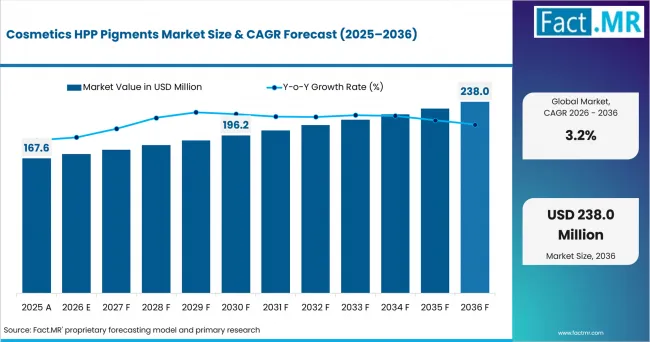
Cosmetics Hpp Pigments Market Value Analysis | Source: Fact.MR
What are the defining numbers behind Cosmetics HPP Pigments Market growth?
USD 65 million absolute opportunity by 2036, led by Lip products and EU-compliant grades within their respective segments.
- Demand Drivers in the Market
- Lip and eye products require strong color payoff from pigments specifically allowed for the intended area of use.
- Surface-treated powders help formulators adjust wetting, feel, adhesion, hydrophobicity, and compatibility with oils or silicones.
- Contract manufacturers need repeatable pigment and dispersion systems that can move from laboratory batch to pressed, poured, or filled product.
- Brands selling across regions value grades supported by clear identity, purity, heavy-metal, certification, and regulatory documentation.
- Key Segments Analyzed
- By Cosmetic Application: Lip products lead at 27.0% of demand. FDA's color additive framework can treat lip use separately from general external application for a number of listed colorants, since incidental ingestion at the lip site can trigger its own listing and use-level requirements, and D&C aluminum lakes get chosen there in part for their water insolubility and resistance to bleeding. That added compliance step, combined with the wide shade counts brands carry per lip line, concentrates a large share of certified pigment purchasing in this one application.
- By Regulatory Position: EU-compliant grades lead at 27.0% of demand. The EU's Annex IV works as a positive list, with each colorant approved by Color Index number for defined product types and concentration limits, and the Scientific Committee on Consumer Safety (SCCS), an expert panel, reviews the underlying safety data before a colorant is added. The ASEAN Cosmetic Directive adopted that same Annex IV colorant listing directly rather than building its own, so a pigment manufactured to Annex IV specification can ship into both the EU and ASEAN markets without a separate compliance grade, which is why EU-compliant grades hold the largest share of the regulatory-position segment.
- By Pigment Chemistry: D&C organic lakes lead at 30.0% of demand. Lakes are made by precipitating a water-soluble certified dye onto an insoluble substrate, typically alumina hydrate, which converts the dye into a form that disperses in oil, wax, and anhydrous bases as well as water systems, a dual compatibility that straight dyes and inorganic oxides do not offer on their own. Organic lake chemistry also covers a more diverse, vibrant color range than inorganic oxide pigments, whose spectrum stays comparatively limited, so formulators specify D&C lakes across lip, eye, face, and nail products instead of confining them to one formulation type.
- By Form: Powder pigments lead at 35.0% of demand. Powder pigments stay chemically stable and do not dry out or separate the way pre-dispersed liquid and paste pigment preparations can over time, and because a powder is not committed to any single carrier, formulators disperse the same lot into oil-phase, water-phase, or anhydrous bases depending on whether they are building a pressed powder, a loose powder, an eyeshadow, or a foundation. That combination of shelf stability and cross-formulation flexibility is what keeps powder the default form buyers purchase.
- By Buyer Type: Color cosmetics brands lead at 28.0% of demand. In color cosmetics, pigment is not a minor additive; it is the ingredient that sets shade payoff, opacity, and coverage, which pushes brands to carry wide shade ranges and refresh them on seasonal cycles. Personal care categories such as skincare and haircare use pigment mainly for cosmetic tinting rather than as the defining functional ingredient, so their purchase volumes stay smaller by comparison, leaving color cosmetics brands as the largest buyer segment.
- Analyst Opinion at Fact.MR
- Shambhu Nath Jha, Senior Analyst at Fact.MR, states, "The cosmetic buyer is purchasing permission, performance, and sensorial fit in the same ingredient. Color strength opens the conversation, but intended-use status, purity, surface behavior, and supply continuity determine whether the pigment reaches a launch."
- Strategic Implications
- Pigment suppliers should map every grade to lip, eye, nail, face, or skin-care tint use by jurisdiction rather than label it broadly for cosmetics.
- Brands need to verify the underlying evidence for vegan or cruelty-free claims instead of treating a sales descriptor as complete substantiation.
- Contract manufacturers can reduce reformulation by approving backup shades with comparable regulatory and surface-treatment profiles before a disruption occurs.
- Distributors should preserve batch certificates and change notifications because a minor composition or treatment change can trigger a new product assessment.
FDA guidance requires each cosmetic color additive to be permitted for its specific intended use and notes that many colors allowed generally are not permitted in the eye area. The European Union likewise maintains allowed colorants and conditions through Annex IV of its Cosmetics Regulation, making regional use mapping a core commercial capability for pigment suppliers.
The United States is projected to expand at a 5.8% CAGR from 2026 to 2036, driven by an active color market and strict intended-use rules for cosmetic additives. France follows at 5.7% as luxury brands and color houses keep premium pigments in development, Germany is forecast at 5.6% on EU compliance and quality control, and Italy adds 5.5% growth through its contract-manufacturing base. Japan is anticipated to advance at a 5.4% CAGR, supported by precise formulation, refined texture, and controlled color expectations.
How does the Cosmetics HPP Pigments Market break down by segment?
The leading shares are Lip products at 27.0% by Cosmetic Application and EU-compliant grades at 27.0% by Regulatory Position.
Why do lip products lead cosmetic HPP demand?
At 27.0% share in 2026, the leading position goes to Lip products because they combine visible color payoff with demanding bleed, taste, wear, purity, and intended-use requirements.
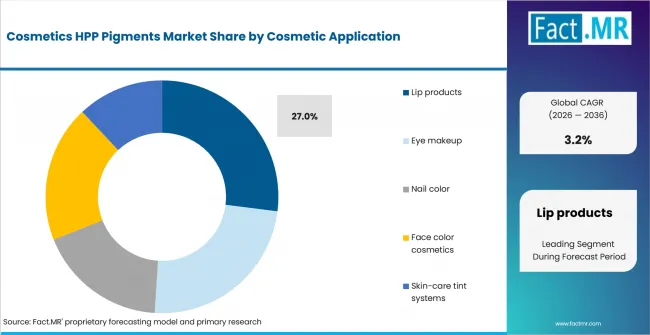
Cosmetics Hpp Pigments Market Analysis By Cosmetic Application | Source: Fact.MR
Lip products hold 27% of cosmetic-application demand and make pigment selection central to both shade and product behavior. Eye makeup follows at 24%, but its usable color list must be checked specifically for the eye area. Face color cosmetics account for 19% and nail color 18%, each placing different emphasis on feel, coverage, dispersion, film, and solvent compatibility.
Why are EU-compliant grades the largest regulatory position?
The 2026 leader is EU-compliant grades at 27.0% share because Annex IV use conditions and a broad regional market make documented compliance commercially valuable.
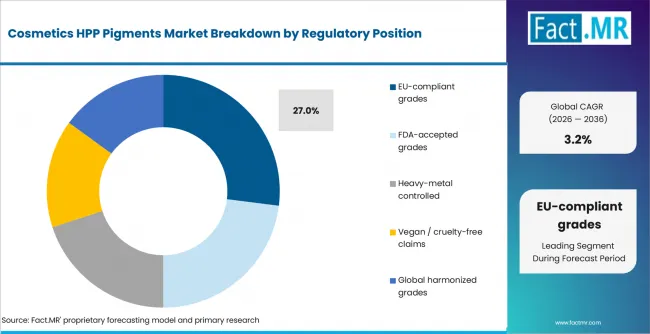
Cosmetics Hpp Pigments Market Analysis By Regulatory Position | Source: Fact.MR
EU-compliant grades represent 27% of the regulatory-position mix, while FDA-accepted grades hold 23%. Heavy-metal controlled products account for 20%, showing that impurity evidence remains a substantial procurement criterion alongside legal listing status. Vegan / cruelty-free claims and global harmonized grades each hold 15%, but neither category removes the need for product- and jurisdiction-specific review.
Why do D&C organic lakes lead the chemistry mix?
A 30.0% share puts D&C organic lakes first in 2026 because insoluble lake color can deliver strong, controlled payoff in many oil-rich and low-water cosmetic formats.
D&C organic lakes account for 30% of pigment chemistry demand and are important in lip, pressed-powder, liner, and nail formats when the specific color and use are permitted. Iron oxide blends follow at 22%, supporting earth tones, coverage, and broad face-color utility. HPP red/orange pigments hold 21%, while phthalocyanine pigments at 13% and specialty effect-compatible pigments at 14% serve narrower color and formulation needs.
Why do powder pigments remain the largest form?
For Form, the top 2026 position is Powder pigments at 35.0% share because they give experienced formulators full control over treatment, carrier, loading, milling, and final texture.
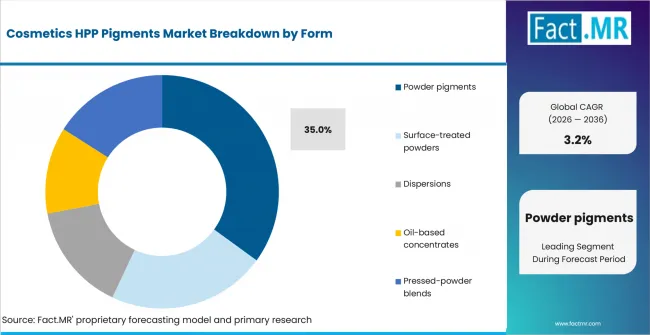
Cosmetics Hpp Pigments Market Analysis By Form | Source: Fact.MR
Powder pigments lead with 35% of form demand and remain the basic route for many color houses and manufacturers. Surface-treated powders account for 22%, adding tailored wetting and sensorial behavior without moving fully into a supplied dispersion. Pressed-powder blends at 16%, dispersions at 15%, and oil-based concentrates at 12% reduce selected processing steps but narrow the customer's freedom over vehicle and composition.
Why are color cosmetics brands the leading buyer type?
The leading 2026 share is 28.0% for Color cosmetics brands because they own shade architecture, claims, market access, and the consumer-visible result.
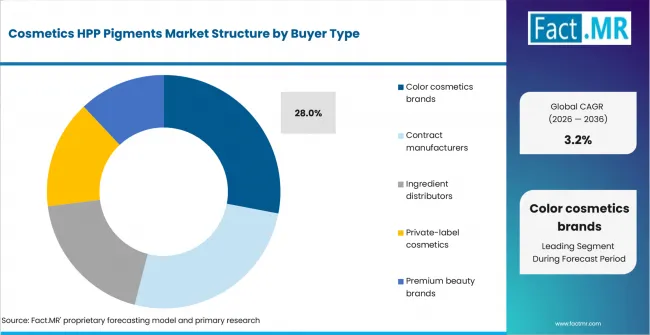
Cosmetics Hpp Pigments Market Analysis By Buyer Type | Source: Fact.MR
Color cosmetics brands hold 28% of buyer demand and influence which shades, certifications, and performance stories reach the shelf. Contract manufacturers are close at 26%, reflecting their role in translating briefs into scalable formulas. Ingredient distributors account for 19% and private-label cosmetics 15%, giving suppliers routes to customers that may not maintain their own global color-regulatory teams.
What is accelerating Cosmetics HPP Pigments Market adoption, and what is holding it back?
Frequent shade development and demand for pigments with strong payoff, good feel, and credible global documentation drive the category. Growth is constrained by fragmented intended-use rules, impurity scrutiny, long reformulation cycles, and the difficulty of carrying one exact color across lips, eyes, nails, and face products.
Drivers Impact Analysis
| DRIVER | (~) % IMPACT ON CAGR | GEOGRAPHIC RELEVANCE | IMPACT TIMELINE |
|---|---|---|---|
| Lip color development | +0.5% | Global beauty markets | Short term (<= 2 years) |
| Eye-area compliance | +0.4% | United States and European Union | Long term (>= 4 years) |
| Surface-treatment demand | +0.4% | Japan, South Korea, and United States | Medium term (2-4 years) |
| Contract manufacturing | +0.3% | Europe and North America | Medium term (2-4 years) |
| Purity documentation | +0.2% | Global | Long term (>= 4 years) |
Source: Fact.MR analysis. Updated Jul 16, 2026
- Lip color development: Lip products are the largest application at 27%. They reward pigments and lakes that combine permitted use, intense payoff, controlled bleed, and compatibility with oil and wax systems.
- Eye-area compliance: Eye makeup holds 24%, yet not every cosmetic color is allowed around the eye. Suppliers with precise use maps reduce the risk of an invalid shade brief.
- Surface-treatment demand: Surface treatments can change powder wetting, adhesion, water response, and skin feel. This lets brands tune performance without abandoning the underlying pigment shade.
Opportunity Impact Analysis
| OPPORTUNITY | (~) % IMPACT ON CAGR | GEOGRAPHIC RELEVANCE | IMPACT TIMELINE |
|---|---|---|---|
| Cross-region use maps | +0.3% | United States, European Union, and Japan | Short term (<= 2 years) |
| High-payoff treated powders | +0.2% | Japan, United States, and Germany | Medium term (2-4 years) |
| Ready-to-use lip dispersions | +0.2% | Emerging beauty-manufacturing hubs | Medium term (2-4 years) |
| Controlled global shades | +0.2% | Global premium brands | Long term (>= 4 years) |
Source: Fact.MR analysis. Updated Jul 16, 2026
- Cross-region use maps: A concise matrix linking pigment identity to lip, eye, nail, face, and other permitted uses can prevent wasted formulation work. The service becomes more valuable when updates and supporting documents are controlled.
- High-payoff treated powders: Surface-treated powders already hold 22% of form demand. Treatments that improve oil wetting, wear, pressability, or skin feel can earn a premium when the base pigment's regulatory position remains clear.
- Ready-to-use lip dispersions: Pigment dispersions and oil-based concentrates can help growing brands reduce milling and shade variability. Suppliers must declare carrier composition and pigment content so formulators can calculate the complete formula correctly.
Restraints Impact Analysis
| RESTRAINT | (~) % IMPACT ON CAGR | GEOGRAPHIC RELEVANCE | IMPACT TIMELINE |
|---|---|---|---|
| Intended-use restrictions | -0.2% | Global regulated markets | Short term (<= 2 years) |
| Impurity variation | -0.2% | Global supply chains | Long term (>= 4 years) |
| Treatment-formula interaction | -0.1% | Advanced cosmetic formulation hubs | Medium term (2-4 years) |
| Shade discontinuity | -0.1% | Color cosmetics brands | Short term (<= 2 years) |
Source: Fact.MR analysis. Updated Jul 16, 2026
- Intended-use restrictions: A pigment or lake allowed in one cosmetic category may not be permitted on lips or around the eye. Late discovery can invalidate a complete shade range.
- Impurity variation: Trace heavy metals and other impurities can vary by raw material and process control. Brands may reject a nominally correct color when supporting limits or batch records are insufficient.
- Treatment-formula interaction: A hydrophobic or sensorial surface treatment can improve one base and destabilize another. The treated grade must be retested for dispersion, payoff, wear, and preservation.
Where is cosmetics HPP pigment demand strongest by country?
United States 5.8% CAGR. France 5.7%. Germany 5.6%. Italy 5.5%. Japan 5.4%.
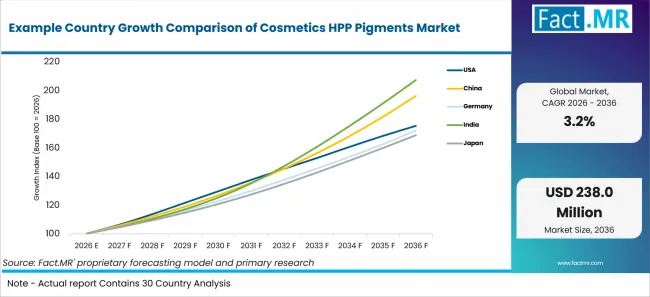
Example Country Growth Comparison Of Cosmetics Hpp Pigments Market | Source: Fact.MR
Regional analysis spans North America, Europe, and Asia Pacific, with country detail on the United States, France, Germany, Italy, and Japan. The complete report pushes this coverage past 30 countries.
| COUNTRY | CAGR |
|---|---|
| United States | 5.8% |
| France | 5.7% |
| Germany | 5.6% |
| Italy | 5.5% |
| Japan | 5.4% |
Source: Fact.MR analysis. Updated Jul 16, 2026
How Is MoCRA Reshaping Color Additive Sourcing for US Brands?
The Modernization of Cosmetics Regulation Act, signed in 2022, gave FDA new facility registration and recall powers.
It kept the agency's older rule requiring certified color additives to pass batch certification before sale, a step the EU's colorant list skips. Pigment suppliers must clear that certification lane before a new lip or eye shade reaches a formulator's bench, which lengthens qualification timelines against Europe.
Mass-market color cosmetics add pull. e.l.f. Beauty closed fiscal 2025 with 28% net sales growth and its 25th straight quarter of both sales growth and market share gains, now the top US mass cosmetics brand by unit share. That pace rewards pigment partners who can turn new shades around fast, feeding the 5.8% CAGR forecast for the US market from 2026 to 2036.
Why Does Cosmetic Valley Keep Pigment Formulation Rooted in France?
Cosmetic Valley, the cluster centered on Chartres, spans seven French departments and represents roughly 3,200 companies by its own count, including L'Oreal's Maybelline and Yves Saint Laurent units, LVMH's Dior and Guerlain, and Shiseido's Jean Paul Gaultier line.
Guerlain's own plant in Chartres, La Ruche, opened in 2015 with roughly 350 employees and has since grown to around 400, giving pigment suppliers a concentrated cluster of makeup manufacturers to sell into.
Corporate makeup R&D sits close by. Chanel runs a dedicated facility in Pantin, and L'Oreal, Dior, and Guerlain keep headquarters in or near Paris, putting formulation decisions near pigment suppliers rather than offshore. That proximity between brand houses and cluster manufacturing supports pigment demand at a 5.7% CAGR from 2026 to 2036.
How Do Drugstore Chains and Natural Cosmetics Standards Shape German Pigment Demand?
Germany's color cosmetics retail runs through drugstore chains rather than department stores. dm and Rossmann anchor a channel holding an estimated 45% of color cosmetics retail value in 2025, much of it private label, which pushes pigment sourcing decisions toward chains and their contract formulators rather than individual prestige brands.
Douglas, with more than 400 stores, remains the main channel for premium color launches.
On standards, IKW, the trade association representing more than 470 beauty and home care companies, formed a formal alliance with NaTrue to push a single natural cosmetics definition, one pigment suppliers now certify mineral and inorganic pigments against. Germany also keeps a specialized effect-pigment plant in Gernsheim, the former Merck Timiron line, supporting pigment demand at a 5.6% CAGR from 2026 to 2036.
Why Is Lombardy's Contract Manufacturing Base Central to Italy's Pigment Demand?
Italy's color cosmetics production concentrates in Lombardy, where Intercos, founded in 1972 and now running plants across 12 countries, formulates for Dior, Lancome, and Giorgio Armani from its headquarters in Agrate Brianza.
That contract manufacturing model lets a single Lombardy formulator place pigment orders for several luxury brands at once, giving pigment suppliers fewer, larger accounts to serve than markets built around individual in-house brand labs.
National trade data backs the export orientation. Cosmetica Italia reported cosmetics exports above EUR 7.92 billion in 2024, up 12.0%, making Italy the world's fifth largest cosmetics exporter with a 5.6% global export share. Pigment demand tied to that export volume is forecast to grow at a 5.5% CAGR from 2026 to 2036.
How Does Japan's Quasi-Drug Classification Affect Color Additive Approval?
Japan's Pharmaceutical and Medical Device Act splits products into cosmetics and quasi-drugs, and only quasi-drugs carry government-reviewed active ingredients and efficacy claims.
Color additives fall under a separate ordinance on coal tar colors permitted for pharmaceutical and quasi-drug use, and the Japanese Standards of Quasi-drug Ingredients, updated in 2021, lists the additives allowed. A pigment destined for a whitening or UV-linked quasi-drug needs a different approval path than the same pigment sold in an ordinary lipstick.
Brand aesthetics narrow pigment choice further. Kanebo's black-and-white prestige line topped Best Cosme rankings for base makeup in 2025 and 2026, and Shiseido builds makeup around one statement feature rather than full-face coverage, favoring pigments with precise, low-volume performance. That regulatory split and single-feature aesthetic sit behind Japan's 5.4% CAGR forecast for 2026 to 2036.
Who leads the Cosmetics HPP Pigments Market?
Sensient Cosmetic Technologies, Sun Chemical, Sudarshan Chemical, Neelikon, and Solar Organics compete through cosmetic color breadth, regulatory support, surface treatments, and formulation service.
Sensient Cosmetic Technologies leads the source data at 10%, followed by Sun Chemical at 8% and Sudarshan Chemical at 7%. Sensient Beauty's official color portfolio spans dyes, pigments, pearls, purified lakes, organic pigments, surface treatments, and dispersions, illustrating how cosmetic competition extends beyond dry pigment chemistry.
Neelikon holds 6% and Solar Organics 3% in the source structure. Both can compete through regional shade service and colorant know-how, but cosmetic programs require a disciplined link between product identity, intended use, purity, treatment, and batch continuity.
Which companies are the key providers?
The company set includes Sensient Cosmetic Technologies, Sun Chemical, Sudarshan Chemical, Neelikon, and Solar Organics.
- Sensient Cosmetic Technologies
- Sun Chemical
- Sudarshan Chemical
- Neelikon
- Solar Organics
Beyond these five names, the complete report profiles more than 30 companies across pigment manufacture, surface treatment, and cosmetic ingredient distribution.
This Report Addresses
- It explains the 2025 market position and the value path from 2026 to 2036.
- Regional discussion centers on the United States, France, Germany, Italy, and Japan, within analysis of 30+ countries.
- It profiles Sensient Cosmetic Technologies, Sun Chemical, Sudarshan Chemical, Neelikon, and Solar Organics within the source shares.
- It compares lakes, organic HPPs, phthalocyanines, iron oxide blends, effect-compatible pigments, and five supply forms.
- It traces demand across lip, eye, nail, face color, and skin-care tint applications.
- It examines intended-use regulation, purity, heavy metals, claims, treatment, dispersion, payoff, wear, sensorial fit, and supply continuity.
What does the Cosmetics HPP Pigments Market cover?
The report captures pigment value sold for regulated cosmetic coloration and related high-performance formulation needs.
Application, regulatory position, chemistry, form, buyer, country, and competition define the quantitative scope.
The analysis also considers listing status, body-area use, purity, heavy metals, surface treatment, carrier, dispersion, texture, wear, and claims.
What is included in the scope?
A product is included when it is sold as a cosmetic pigment or pigment preparation for one of the source applications.
Dry and prepared forms are counted at pigment-related ingredient value, with carrier adjustment where data allow.
Both mass and premium cosmetic grades remain included when their intended use and market value can be identified.
What is excluded from the scope?
Finished beauty products and non-cosmetic color markets are outside the pigment boundary.
Cosmetic bases, waxes, oils, binders, preservatives, packaging, applicators, contract filling, retail margins, and finished-product value are removed.
Hair, tattoo, food, drug, and industrial colorants without a qualifying cosmetic pigment sale are not counted.
How was the analysis built?
Ingredient portfolios, regulatory records, formulator interviews, and forecast cross-checks covering more than 30 countries.
- Primary Research: Primary research includes discussions with manufacturers, service providers, technology developers, distributors, end users, procurement teams, and subject-matter experts. These conversations examine purchasing priorities, product adoption, operational challenges, approval requirements, competitive positioning, and the factors that influence wider market acceptance.
- Desk Research: Desk research covers government statistics, regulatory publications, company filings, trade data, technical studies, industry associations, standards, public policy, and other authoritative sources. Every source used in the analysis is documented in the bibliography.
- Market Sizing and Forecasting: Market estimates combine historical performance, demand indicators, pricing and volume trends, segment shares, company participation, country-level growth, adoption patterns, investment activity, and barriers to market expansion.
- Data Validation and Update Cycle: Findings are validated by comparing primary interviews with public data, company activity, regulatory changes, trade patterns, and industry developments. Regular updates review new product launches, capacity changes, partnerships, approvals, procurement trends, and shifts in commercial adoption.
Segmentation
What is the report's scope and coverage?
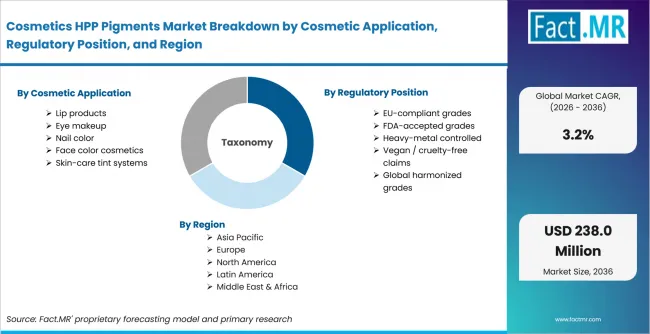
Cosmetics Hpp Pigments Market Breakdown By Cosmetic Application, Regulatory Position, And Region | Source: Fact.MR
| ATTRIBUTE | DETAILS |
|---|---|
| Quantitative Units | USD 173 million in 2026 to USD 238 million by 2036 at 3.2% CAGR |
| Market Definition | Cosmetics HPP pigments are high-purity pigments, lakes, blends, treated powders, and dispersions sold to deliver durable color and controlled performance in cosmetic formulations under defined intended-use rules. |
| Cosmetic Application | Lip products; Eye makeup; Nail color; Face color cosmetics; Skin-care tint systems |
| Regulatory Position | EU-compliant grades; FDA-accepted grades; Heavy-metal controlled; Vegan / cruelty-free claims; Global harmonized grades |
| Pigment Chemistry | D&C organic lakes; HPP red/orange pigments; Phthalocyanine pigments; Iron oxide blends; Specialty effect-compatible pigments |
| Form | Powder pigments; Surface-treated powders; Dispersions; Oil-based concentrates; Pressed-powder blends |
| Buyer Type | Color cosmetics brands; Contract manufacturers; Ingredient distributors; Private-label cosmetics; Premium beauty brands |
| Regions Covered | North America; Europe; Asia Pacific |
| Countries Covered | United States; France; Germany; Italy; Japan (analysis on 30+ countries in the complete report) |
| Key Companies Profiled | Sensient Cosmetic Technologies; Sun Chemical; Sudarshan Chemical; Neelikon; Solar Organics |
| Forecast Period | 2026 to 2036 |
| Approach | Sizing should combine color-cosmetic output by application with pigment loading, HPP penetration, chemistry and form mix, prepared-product solids, and realized ingredient price. |
Source: Fact.MR analysis. Updated Jul 16, 2026
How is the market segmented?
-
By Cosmetic Application
- Lip products
- Eye makeup
- Nail color
- Face color cosmetics
- Skin-care tint systems
-
By Regulatory Position
- EU-compliant grades
- FDA-accepted grades
- Heavy-metal controlled
- Vegan / cruelty-free claims
- Global harmonized grades
-
By Pigment Chemistry
- D&C organic lakes
- HPP red/orange pigments
- Phthalocyanine pigments
- Iron oxide blends
- Specialty effect-compatible pigments
-
By Form
- Powder pigments
- Surface-treated powders
- Dispersions
- Oil-based concentrates
- Pressed-powder blends
-
By Buyer Type
- Color cosmetics brands
- Contract manufacturers
- Ingredient distributors
- Private-label cosmetics
- Premium beauty brands
-
By Region
- North America
- United States
- Europe
- France
- Germany
- Italy
- Asia Pacific
- Japan
Frequently Asked Questions
What is the Cosmetics HPP pigments forecast?
Which cosmetic application leads demand?
What regulatory position has the largest share?
Which pigment chemistry is largest?
What pigment form leads?
Which buyer type has the highest share?
How do Western markets compare on growth?
Which competitors are named in the source?
Who worked on this report


Preview the report firsthand - request a free sample
Free SampleGet the brochure for pricing and purchase details
Download PDF