- Market Value (2025): USD 160.5 Mn
- Estimated Value (2026): USD 169.0 Mn
- Forecast Value (2036): USD 284.0 Mn
- CAGR (2026-2036): 5.3%
What is the Low-Solubility HPPs Market forecast to be worth by 2036?
USD 169.0 million in 2026 to USD 284.0 million by 2036, at 5.3% CAGR.
- The low-solubility HPPs market surpassed a valuation of USD 160.5 million in 2025, supported by steady use of durable red and orange pigments in coatings and plastics. Yellow, violet, and specialty shades added demand across inks and cosmetic products.
- Demand is projected to increase from USD 169.0 million in 2026 to USD 284.0 million by 2036 as formulators seek pigments with lower migration and stronger resistance to heat, weather, and chemical exposure.
- The market is forecast to record a 5.3% CAGR from 2026 to 2036 as DPP and quinacridone pigments gain wider use in demanding applications. Perylene, perinone, benzimidazolone, and isoindolinone grades are also expected to support specialized shade and durability needs.
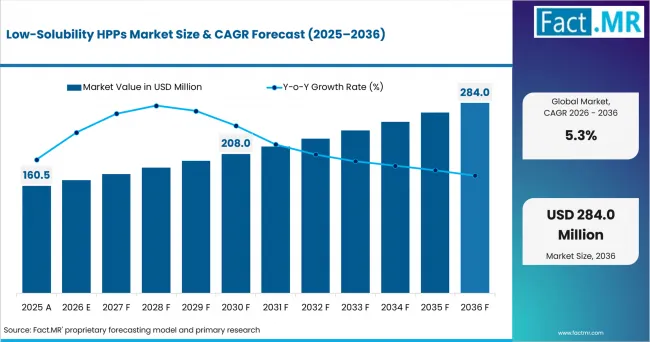
Low Solubility Hpps Market Value Analysis | Source: Fact.MR
What are the defining numbers behind Low-Solubility HPPs Market growth?
USD 115 million absolute opportunity is projected by 2036. DPP pigments and Automotive coatings are expected to lead within their respective segments.
- Demand Drivers in the Market
- Automotive coatings use pigments that keep the same shade and do not react with strong solvents. They must also work well in clear and special-effect finishes.
- High-performance plastics require pigments that stay in place and keep their color during heating, shaping, and long-term use.
- Packaging inks use low-solubility pigments to reduce bleeding and unwanted color transfer. The pigments also have to meet printing and packaging rules.
- Customers may accept a higher pigment cost when it helps the final product keep its color after long exposure to weather or chemicals.
- Key Segments Analyzed
- By HPP Chemistry: DPP pigments are expected to account for 28.0% of 2026 demand because they combine strong red and orange color with durability required in coatings and plastics.
- By Application: Automotive coatings are projected to hold 31.0% share in 2026. Vehicle finishes combine long weather exposure with chemical contact. They also require color styling and strict appearance control.
- By Performance Attribute: Low solubility is anticipated to capture 31.0% share in 2026 because resistance to dissolution underpins bleed and migration control in hostile media.
- By Color Family: Red / orange is estimated to represent 34.0% share in 2026. DPP and quinacridone pigments support durable red and orange shades. Perylene chemistry extends the same color space into selected high-performance uses.
- By Buyer Type: Coating manufacturers are forecast to account for 32.0% share in 2026. They formulate for automotive and industrial exposure while managing color and surface appearance.
- Analyst Opinion at Fact.MR
- Senior Analyst Shambhu Nath Jha at Fact.MR states, " Low solubility helps the pigment stay in place and keep the intended color. It still has to mix evenly so the full shade can develop. The most useful grades combine long-lasting color with easier mixing and milling. A smooth finish and steady performance in the final product also support approval."
- Strategic Implications
- HPP companies can show how each pigment reacts with different solvents and binders. Test records also cover the type of plastic, temperature, and contact conditions.
- Automotive coating companies often review transparency, outdoor color life, chemical resistance, and interaction with effect pigments during the same approval process.
- Plastic companies get a clearer result by checking heat exposure and color movement after molding. The color of an unmolded mix does not show how the pigment will behave in the finished part.
- Ink and cosmetic companies must treat legal approval and technical performance as separate checks. Low solubility alone does not confirm that a pigment is approved for the intended use.
The United States is projected to expand at a 5.3% CAGR from 2026 to 2036 through automotive coatings and engineering plastics. Switzerland is expected to follow at 5.2% through specialty-chemical depth. Germany is anticipated to reach 5.1% through engineering-led demand and chemical stewardship. The United Kingdom is forecast to post 4.9% across coatings and packaging inks. Japan is projected to advance at 5.0% through precision color control in coating and polymer uses.
How does the Low-Solubility HPPs Market break down by segment?
The leading shares are DPP pigments at 28.0% by HPP Chemistry and Automotive coatings at 31.0% by Application.
Which Pigment Chemistry dominates?
DPP Pigments hold 28.0% share in 2026.
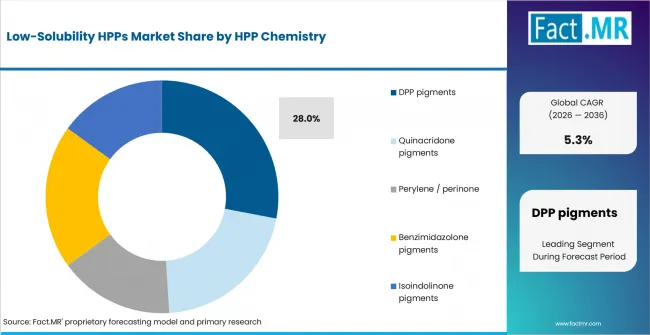
Low Solubility Hpps Market Analysis By Hpp Chemistry | Source: Fact.MR
DPP Pigments lead because they deliver strong red and orange shades while maintaining color under heat, sunlight, and chemical exposure. This combination suits automotive coatings, industrial finishes, and high-performance plastics where ordinary pigments may fade or shift. Their balance of brightness, durability, and processing stability gives manufacturers a dependable option for applications that require both visual strength and long service life.
What leads the Application segment?
Automotive Coatings account for 31.0% share in 2026.
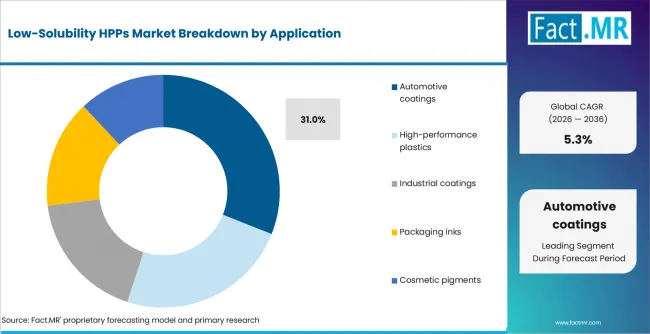
Low Solubility Hpps Market Analysis By Application | Source: Fact.MR
Automotive Coatings create the largest demand because vehicle finishes face sunlight, rain, road salts, fuel contact, and repeated washing. Pigments must preserve shade, gloss, and appearance across these conditions without reacting with the coating system. Long qualification cycles also favor grades with proven consistency. These demanding performance checks make automotive finishes one of the strongest commercial outlets for high-performance pigments.
Which Performance Attribute ranks first?
Low Solubility captures 31.0% share in 2026.
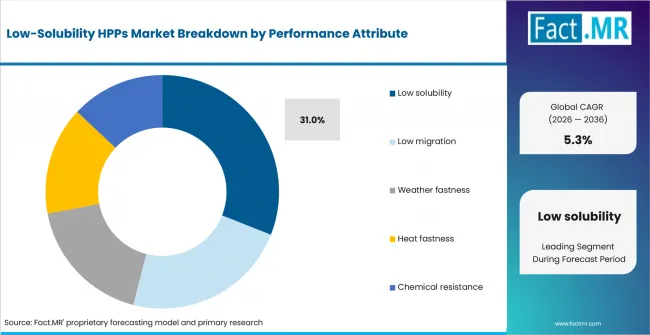
Low Solubility Hpps Market Analysis By Performance Attribute | Source: Fact.MR
Low Solubility ranks first because unwanted dissolution can cause bleeding, staining, migration, or shade loss inside plastics and coatings. A stable pigment remains fixed in the material even when it faces solvents, heat, or chemical contact. This property supports cleaner processing and more reliable long-term color. It also helps manufacturers meet strict appearance standards in products exposed to demanding service conditions.
What leads the Color Family segment?
Red / Orange represents 34.0% share in 2026.
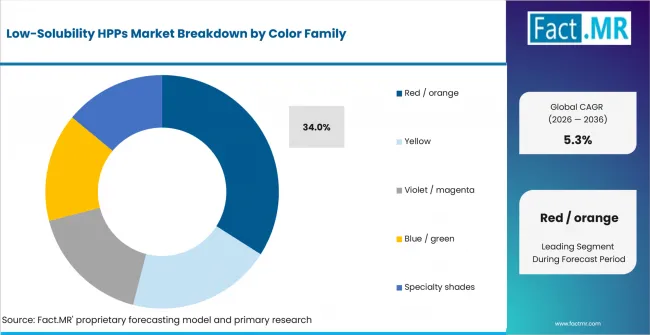
Low Solubility Hpps Market Analysis By Color Family | Source: Fact.MR
Red and orange shades hold the largest share because several durable chemistries serve this color range, including DPP, quinacridone, and perylene pigments. These grades support bright, deep, and transparent effects across vehicle coatings, plastics, industrial finishes, and specialty inks. Their strong visual impact combines with heat and weather resistance, giving formulators wider room to meet both styling and performance targets.
Which Buyer Type holds the top position?
Coating Manufacturers account for 32.0% share in 2026.
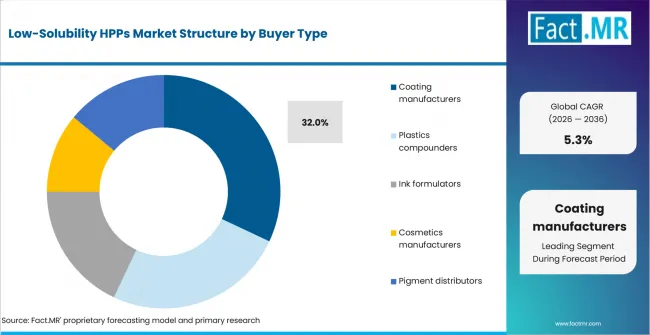
Low Solubility Hpps Market Analysis By Buyer Type | Source: Fact.MR
Coating Manufacturers lead because they directly select and test pigments for automotive and industrial finishes. Their approval work covers color strength, gloss, dispersion, weather resistance, solvent exposure, and batch consistency before a grade enters production. Since pigment choice affects both appearance and coating life, these manufacturers purchase high-performance grades regularly and maintain close technical contact with pigment companies during formulation and scale-up.
What is accelerating Low-Solubility HPPs Market adoption, and what is holding it back?
Color resistance against migration and weather is expected to remain the main adoption driver for low-solubility HPPs. Heat and chemical resistance reinforce that demand in harsher applications. Higher pigment cost and demanding dispersion work are expected to restrain adoption where a classical grade meets the actual exposure window.
Drivers Impact Analysis
| DRIVER | (~) % IMPACT ON CAGR | GEOGRAPHIC RELEVANCE | IMPACT TIMELINE |
|---|---|---|---|
| Automotive color durability | +0.8% | United States and Germany with Japan | Long term (>= 4 years) |
| Engineering-plastic heat | +0.7% | Asia Pacific and Europe | Medium term (2-4 years) |
| Low-migration packaging | +0.6% | North America and European Union | Long term (>= 4 years) |
| Outdoor industrial assets | +0.5% | Global | Medium term (2-4 years) |
| High-chroma styling | +0.4% | Japan and Germany with United States | Short term (<= 2 years) |
Source: Fact.MR analysis. Updated Jul 17, 2026
- Automotive color durability: Vehicle coatings must preserve style through weather and chemical exposure. Low-solubility HPPs support durable red and orange shades. Violet shades and effect-combination finishes also depend on controlled migration behavior.
- Engineering-plastic heat: High-performance polymers expose pigments to elevated processing temperatures. Chemistries that retain shade and resist migration have a stronger case in critical components.
- Low-migration packaging: Packaging ink and plastic applications require careful control of transferable substances. Low-solubility pigments help technically, but finished-article compliance still depends on the full formulation and use.
Opportunity Impact Analysis
| OPPORTUNITY | (~) % IMPACT ON CAGR | GEOGRAPHIC RELEVANCE | IMPACT TIMELINE |
|---|---|---|---|
| Dispersion-optimized DPPs | +0.4% | Global coatings and plastics hubs | Medium term (2-4 years) |
| Transparent automotive reds | +0.4% | Germany and Japan with United States | Short term (<= 2 years) |
| High-temperature plastic grades | +0.3% | Asia Pacific | Long term (>= 4 years) |
| Compliance data packages | +0.3% | European Union and North America | Medium term (2-4 years) |
Source: Fact.MR analysis. Updated Jul 17, 2026
- Dispersion-optimized DPPs: DPP pigments are projected to lead chemistry demand at 28%. Grades that preserve low solubility while improving wetting are expected to reduce the main processing tradeoff.
- Transparent automotive reds: Perylene and quinacridone pigments are expected to support color depth and effect-pigment visibility in vehicle finishes. Formulation packages that balance transparency and gloss with weathering are expected to win styling programs.
- High-temperature plastic grades: Engineering polymer applications are expected to reward pigments that retain color under heat and resist transfer after processing. Polymer-specific selection tools are expected to help compounders avoid broad trial lists.
Restraints Impact Analysis
| RESTRAINT | (~) % IMPACT ON CAGR | GEOGRAPHIC RELEVANCE | IMPACT TIMELINE |
|---|---|---|---|
| Difficult dispersion | -0.4% | Global | Short term (<= 2 years) |
| Premium chemistry cost | -0.3% | Price-sensitive applications | Medium term (2-4 years) |
| Media-dependent solubility | -0.2% | Coatings and plastics with inks and cosmetics | Long term (>= 4 years) |
| Color-space limitations | -0.2% | Global design teams | Short term (<= 2 years) |
Source: Fact.MR analysis. Updated Jul 17, 2026
- Difficult dispersion: A stable pigment crystal is expected to require substantial wetting and milling to reach full color. Inadequate dispersion reduces strength and gloss across coatings and plastics. It also reduces consistency and can obscure the chemistry's durability benefit.
- Premium chemistry cost: DPP and quinacridone pigments often cost more than classical alternatives. Perylene and related HPPs carry the same price pressure. Formulators are expected to reject performance that exceeds the actual exposure requirement.
- Media-dependent solubility: Low solubility is not identical across every solvent or plasticizer. Polymer and oil choice also change the result during application testing. Binder chemistry can shift the outcome again under different temperature and exposure conditions. Test outcomes must be tied to a defined medium and temperature.
How is country demand for low-solubility HPPs distributed?
United States 5.3%, Switzerland 5.2%, Germany 5.1%, United Kingdom 4.9%, Japan 5.0%
The report covers North America, Europe, and Asia Pacific. Country-level discussion includes the United States, Switzerland, Germany, the United Kingdom, and Japan. Japan is included to show demand from industries that require careful color control. The full report reviews more than 30+ countries.
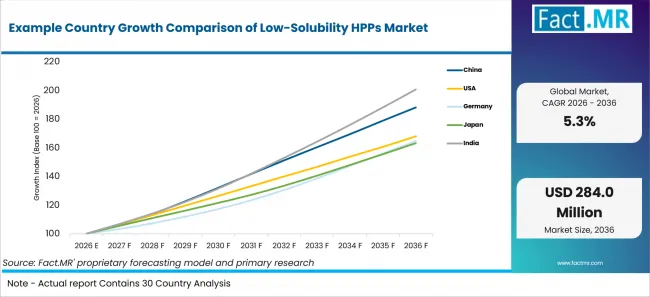
Example Country Growth Comparison Of Low Solubility Hpps Market | Source: Fact.MR
| COUNTRY | CAGR |
|---|---|
| United States | 5.3% |
| Switzerland | 5.2% |
| Germany | 5.1% |
| United Kingdom | 4.9% |
| Japan | 5.0% |
Source: Fact.MR analysis. Updated Jul 17, 2026
Where does the United States opportunity concentrate?
5.3% CAGR, supported by automotive coatings and high-performance plastic applications.
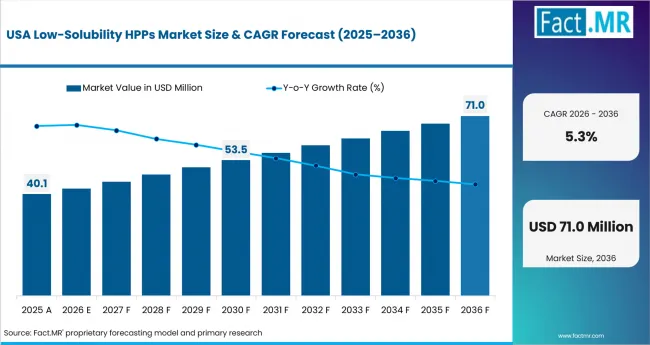
Low Solubility Hpps Market Country Value Analysis | Source: Fact.MR
The United States market is shaped by uses where pigment choice affects both appearance and safety review. Automotive finishes and plastic parts require stable color under weather, heat, and chemical contact. EPA’s recent review of Pigment Violet 29 also keeps worker protection and product handling in focus. Demand is forecast to grow at a 5.3% CAGR from 2026 to 2036 as companies seek clearer migration, exposure, and performance data.
Why does Switzerland influence High-Performance Pigment demand?
5.2% CAGR, driven by specialty-chemical knowledge and export-focused production.
Switzerland has a strong chemical industry that serves customers across Europe and other major markets. This gives pigment producers access to skilled formulation work and strict customer review. The market is projected to expand at a 5.2% CAGR through 2036 as buyers favor grades supported by full weathering, migration, and chemical-resistance records.
How does Germany influence provider standards?
5.1% CAGR, linked to automotive engineering and detailed material approval.
German vehicle and machinery companies often test pigments inside named coating or polymer systems before accepting them for regular use. Color alone is not enough. Heat resistance, solvent exposure, migration, and repeatable batch quality also shape approval. Germany is anticipated to record a 5.1% CAGR from 2026 to 2036 as companies place more weight on documented performance during material changes.
What drives United Kingdom purchases of durable pigments?
4.9% CAGR, supported by industrial coatings and packaging-ink requirements.
The United Kingdom presents a different demand pattern because packaging rules now place closer attention on recyclability and ink composition. From 2025, covered producers must assess and report packaging recyclability, while official guidance also refers to UK REACH and printing-ink controls. The market is expected to post a 4.9% CAGR through 2036 as formulators seek pigments that combine durability with clear compliance records.
What sustains Japan’s demand for durable pigments?
5.0% CAGR, backed by precision manufacturing and tight control over product changes.
Japanese customers often keep industrial products in service for long periods, making shade continuity and controlled substitutions important. Pigment companies therefore need to maintain stable chemistry, dispersion, and batch quality across repeat orders. The market is projected to grow at a 5.0% CAGR by 2036 as coatings, polymers, and specialty inks require dependable color across carefully managed production systems.
Who leads the Low-Solubility HPPs Market?
Sudarshan Chemical, including the acquired Heubach business, competes with the DIC Group through broad high-performance pigment portfolios. artience Co., Ltd. supports DIC’s position across coatings, plastics, inks, and specialty color applications.
Sudarshan Chemical strengthened its global pigment business after completing the acquisition of Heubach Group in March 2025. The combined portfolio includes DPP, quinacridone, benzimidazolone, and other durable organic pigments used where heat, weather, chemical resistance, and low migration are important.
DIC and its wholly owned subsidiary Sun Chemical add established pigment production, application support, and regional customer access.
Which companies are the key providers?
The company set includes Pidilite Industries Limited and DIC as major named pigment suppliers. Sudarshan Chemical and artience Co., Ltd. add further pigment coverage. Trust Chem Co., Ltd. completes the named group for this competitive review.
- Pidilite Industries Limited
- DIC
- Sudarshan Chemical
- artience Co., Ltd.
- Trust Chem Co., Ltd.
Bibliography
- Sudarshan Chemical Industries Limited. (2025, March 3). Sudarshan Chemical completes acquisition of Heubach Group.
- DIC Corporation. (2026, March 2). Sun Chemical to invest in quinacridone production in Newport, Delaware.
- Department for Environment, Food & Rural Affairs, Scottish Government, & Welsh Government. (2025, July 31). UK REACH: Rationale for priorities 2025 to 2026.
- U.S. Environmental Protection Agency. (2026, March). Enforcement and compliance assurance annual results for fiscal year 2025.
This Report Addresses
- It quantifies the market from the 2025 through the 2026 to 2036.
- Country coverage centers on the United States and Switzerland within analysis of more than 30 countries. Germany and the United Kingdom complete the European set. Japan adds the Asia Pacific reference point for precision color control.
- It assesses Pidilite Industries Limited and DIC within the source shares. Sudarshan Chemical and artience Co., Ltd. add large pigment portfolios. Trust Chem Co., Ltd. completes the named company set through custom pigment supply.
- It differentiates DPP and quinacridone pigments from perylene or perinone chemistry. Benzimidazolone and isoindolinone chemistries complete the HPP set.
- It follows HPP demand into automotive and industrial coatings. Plastics and packaging inks add two technical application bases. Cosmetics complete the application set through regulated color use.
- It validates forecast reasoning against solubility and migration. Weather and heat performance add two durability checks. Chemical behavior and dispersion complete the technical review. Color family and buyer qualification complete the evidence set.
What does the Low-Solubility HPPs Market cover?
The report covers high-performance organic pigment value where low solubility or its related durability outcomes shape purchasing.
Chemistry and application choices are analyzed with performance attribute and color family. Buyer type and country coverage connect the segmentation to competitive decisions. The technical layer considers crystal permanence and wetting. Dispersion and migration are reviewed with processing heat and weather. Chemical behavior and gloss complete one performance layer. Transparency completes the appearance review for high-chroma grades.
What is included in the scope?
Included pigments must belong to the source HPP chemistry set. Each product must carry a low-solubility or low-migration use case. Associated durability claims remain in scope when they are tied to pigment performance.
Revenue is counted for pigment powders and preparations after removing carrier value where practical Automotive coating and plastic uses remain in scope when the HPP component can be isolated. Industrial coating and packaging ink uses follow the same rule. Cosmetic uses remain in scope when the pigment contribution is separable.
What is excluded from the scope?
The study excludes host materials and finished products. Colorants outside the defined HPP boundary are also excluded.
Coating binders and plastic resins are not counted. Ink vehicles and cosmetic bases are also excluded. Dispersants and equipment remain outside the revenue boundary. Finished articles are also excluded from pigment revenue accounting. Soluble dyes and classical pigments without the required performance are outside scope. Inorganic pigments and effect flakes sold separately are also outside scope.
How Was the Analysis Built?
The analysis draws on 120+ sources, 35+ company portfolios, 25+ countries, and more than 20 industry interviews.
- Primary Research: Primary research includes discussions with manufacturers, service providers, technology developers, distributors, end users, procurement teams, and subject-matter experts. These conversations examine purchasing priorities, product adoption, operational challenges, approval requirements, competitive positioning, and the factors that influence wider market acceptance.
- Desk Research: Desk research covers government statistics, regulatory publications, company filings, trade data, technical studies, industry associations, standards, public policy, and other authoritative sources. Every source used in the analysis is documented in the bibliography.
- Market Sizing and Forecasting: Market estimates combine historical performance, demand indicators, pricing and volume trends, segment shares, company participation, country-level growth, adoption patterns, investment activity, and barriers to market expansion.
- Data Validation and Update Cycle: Findings are validated by comparing primary interviews with public data, company activity, regulatory changes, trade patterns, and industry developments. Regular updates review new product launches, capacity changes, partnerships, approvals, procurement trends, and shifts in commercial adoption.
Segmentation
What is the report's scope and coverage?
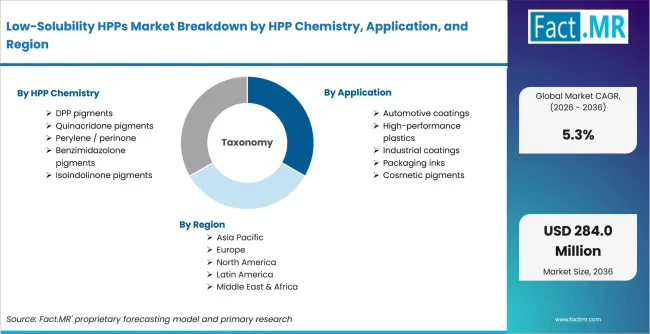
Low Solubility Hpps Market Breakdown By Hpp Chemistry, Application, And Region | Source: Fact.MR
| ATTRIBUTE | DETAILS |
|---|---|
| Quantitative Units | USD million in 2026 to USD million by 2036 at a CAGR |
| Market Definition | Low-solubility HPPs are durable high-performance organic pigments sold for applications where resistance to dissolution or bleeding is specified. Migration and weather performance add further value drivers. Heat and chemical resistance complete the technical scope. |
| HPP Chemistry | DPP pigments; Quinacridone pigments; Perylene / perinone; Benzimidazolone pigments; Isoindolinone pigments |
| Application | Automotive coatings; High-performance plastics; Industrial coatings; Packaging inks; Cosmetic pigments |
| Performance Attribute | Low solubility; Low migration; Weather fastness; Heat fastness; Chemical resistance |
| Color Family | Red / orange; Yellow; Violet / magenta; Blue / green; Specialty shades |
| Buyer Type | Coating manufacturers; Plastics compounders; Ink formulators; Cosmetics manufacturers; Pigment distributors |
| Regions Covered | North America; Europe; Asia Pacific; Latin America; Middle East and Africa |
| Countries Covered | United States; Switzerland; Germany; United Kingdom; Japan, and 30+ countries |
| Key Companies Profiled | Pidilite Industries Limited; DIC; Sudarshan Chemical; artience Co., Ltd.; Trust Chem Co., Ltd. |
| Forecast Period | 2026 to 2036 |
| Approach | Sizing should apply HPP dosage and low-solubility grade penetration to output by application and color family. Adjustments should reflect chemistry and preparation solids. Realized supplier price completes the sizing layer. |
Source: Fact.MR analysis. Updated Jul 17, 2026
How is the market segmented?
-
By HPP Chemistry
- DPP pigments
- Quinacridone pigments
- Perylene / perinone
- Benzimidazolone pigments
- Isoindolinone pigments
-
By Application
- Automotive coatings
- High-performance plastics
- Industrial coatings
- Packaging inks
- Cosmetic pigments
-
By Performance Attribute
- Low solubility
- Low migration
- Weather fastness
- Heat fastness
- Chemical resistance
-
By Color Family
- Red / orange
- Yellow
- Violet / magenta
- Blue / green
- Specialty shades
-
By Buyer Type
- Coating manufacturers
- Plastics compounders
- Ink formulators
- Cosmetics manufacturers
- Pigment distributors
-
By Region
- North America
- United States
- Europe
- Switzerland
- Germany
- United Kingdom
- Asia Pacific
- Japan
Frequently Asked Questions
Which HPP chemistry leads?
What is the largest application?
Which performance attribute ranks first?
What color family is largest?
Which buyer group purchases the most?
How does growth compare across the covered countries?
Which suppliers are named in the market share table?
Who worked on this report


Preview the report firsthand - request a free sample
Free SampleGet the brochure for pricing and purchase details
Download PDF