- Base Value(2025): 3.7 Bn
- Forecast Value (2036): 13.5 Bn
- CAGR (2036): 11.9%
Crowd-Control Technology Market Overview, Growth Outlook, and Forecast by Fact.MR
- In 2025, the global crowd-control technology market was valued at approximately USD 3.7 billion.
- Based on Fact.MR analysis, demand for crowd-control technologies is estimated to grow to around USD 4.2 billion in 2026 and approximately USD 13.5 billion by 2036.
- The market is projected to expand at a CAGR of around 12.5% during the forecast period.
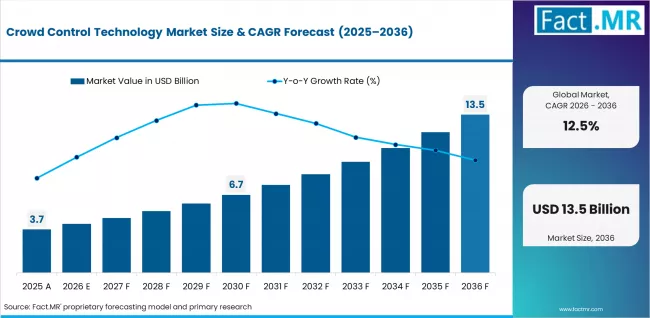
Crowd Control Technology Market Value Analysis | Source: Fact.MR
Summary of the Crowd-Control Technology Market
- Market Snapshot
- In 2025, the global crowd-control technology market was valued at approximately USD 3.7 billion.
- The market is estimated to reach around USD 4.2 billion in 2026 and is projected to attain nearly USD 13.5 billion by 2036.
- The crowd-control technology market is expected to expand at a CAGR of approximately 12.5% during the forecast period.
- The market is anticipated to create an absolute dollar opportunity of approximately USD 9.3 billion between 2026 and 2036.
- In terms of deployment architecture, Cloud-Based Systems dominate with a share of approximately 36.9% in 2026, driven by scalability, centralized monitoring, and strong integration with AI-powered crowd analytics platforms.
- From an end-use industry perspective, Government & Public Safety leads the segment with a share of approximately 23.4% in 2026, driven by increasing investments in surveillance modernization and urban safety infrastructure.
- Demand and Growth Drivers
- The need for technology to manage crowds is increasing as cities have more people living in them and society holds more big public events. There is a growing need for systems capable of monitoring crowds in real time for their safety while also providing tools for managing crowds safely and effectively.
- The trend towards using artificial intelligence (AI), computer vision, and predictive analytics is causing a shift toward the use of intelligent systems to analyze and respond to crowd behaviour in real time.
- There is an increasing emphasis on creating smart cities and digital infrastructures which has led to an increasing number of smart transport systems, surveillance networks and emergency response systems being integrated into one another.
- Product and Segment View
- Increasing demand for Cloud-Based Systems with 36.9% share is driven by their scalability, centralized monitoring capabilities, and strong integration with AI-powered crowd analytics platforms for real-time crowd management.
- Rising adoption of AI & Machine Learning with 21.4% share is supported by its ability to enable predictive crowd behavior analysis, automated alerts, and real-time decision-making in high-density environments.
- Growing demand for Computer Vision with 17.2% share is driven by its capability to detect, track, and analyze crowd movement patterns across public spaces, transport hubs, and large events.
- Increasing adoption of Government & Public Safety applications with 23.4% share is supported by rising investments in surveillance modernization, public safety infrastructure, and emergency response systems.
- Rising demand for Pedestrian Crowd management with 34.8% share is driven by growing urban mobility, smart city expansion, and the need for efficient monitoring of high-footfall public spaces.
- Geography and Competitive Outlook
- The emergence of rapid urbanization, mass public gatherings, and government-led smart city technology and surveillance programs will continue to drive growth in the Crowd-Control Technology market in China and India.
- North America and Europe represent the majority of this market, owing primarily to high levels of spending on AI-driven security solutions, advanced cloud-based infrastructures, and early adopters using intelligent crowd monitoring solutions for transport, events, and public safety.
- With governments and enterprises investing heavily in 5G technologies, artificial intelligence, and smart cities, regions such as Asia-Pacific are experiencing high growth rates due to their increasing use of real-time analysis of crowds and automated crowd management systems.
- The global Crowd-Control Technology market includes key players such as Cisco, Honeywell, Milestone Systems, Irisity, Mefron, and Kustom Signals.
- Analyst Opinion
- Shambhu Nath Jha, Principal Consultant at Fact.MR, says, “The Crowd-Control Technology Market does not include standalone surveillance cameras or basic public address systems that function without intelligent crowd analytics or real-time decision-making capabilities, such as traditional CCTV systems, manual alarm systems, or non-automated barriers. The list excludes general-purpose communication infrastructure together with standard lighting systems and physical security equipment which lack AI-powered crowd monitoring and facial recognition and IoT-based crowd management systems.
Crowd-Control Technology Market — At a Glance
| Metric | Value |
|---|---|
| Market Value 2025 | USD 3.7 Billion |
| Market Value 2026 | USD 4.2 Billion |
| Market Value 2036 | USD 13.5 Billion |
| Absolute Dollar Opportunity | USD 9.3 Billion (2026–2036) |
| CAGR | 12.50% |
| Growth Multiple | 5.3x |
| Key Demand Theme | Rising demand for AI-powered crowd intelligence, real-time monitoring, and smart public safety systems |
| Leading Deployment Model | Cloud-Based Systems |
| Deployment Share | 36.90% |
| Leading End Use Industry | Government & Public Safety |
| End Use Share | 23.40% |
| Leading Technology | Artificial Intelligence (AI) & Machine Learning |
| Technology Share | 21.40% |
| Leading Crowd Type | Pedestrian Crowds |
| Crowd Type Share | 34.80% |
| Leading Connectivity Technology | Wi-Fi |
| Connectivity Share | 31.40% |
| Key Growth Regions | North America, Europe, Asia-Pacific |
| Fastest Growing Countries | China (13.5%), U.K. (13.3%), Germany (12.6%), Japan (12.2%), U.S. (11.9%) |
| Key Companies | Cisco, Honeywell, Genetec, BriefCam, Thales, Cognyte, Milestone Systems, Clearway |
| Deployment Segmentation | Cloud-Based, Hybrid, Edge-Based, On-Premise Systems |
| End Use Segmentation | Government, Transportation, Events, Commercial, Smart Cities, Industrial, Healthcare, Education, Defense |
| Technology Segmentation | AI/ML, Computer Vision, Facial Recognition, IoT, Big Data Analytics, Cloud Computing, Edge Computing, RFID, Biometrics |
| Crowd Type Segmentation | Pedestrian, Vehicular, Mixed, High-Density Events, Emergency & Evacuation |
| Connectivity Segmentation | Wi-Fi, 4G/LTE, 5G, Bluetooth, LPWAN, Satellite Systems |
| Regional Segmentation | North America, Europe, Asia-Pacific, Middle East & Africa, Latin America |
Source: Fact.MR analysis. Updated May 13, 2026
Key Growth Drivers, Constraints, and Opportunities
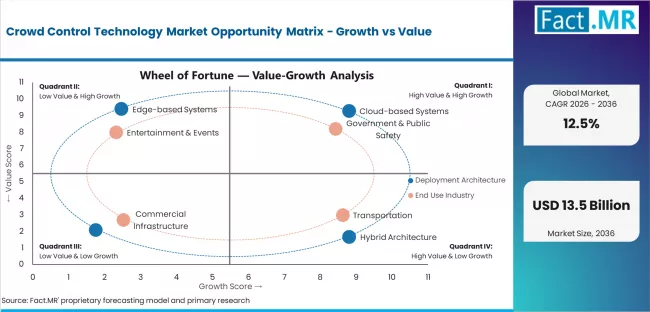
Crowd Control Technology Market Opportunity Matrix Growth Vs Value | Source: Fact.MR
Key Factors Driving Growth
- Increasing number of public events, protest gatherings, and security issues is creating increased demand for intelligent crowd control via AI, computer vision, and real time analytics.
- In the area of public safety and smart city technologies, the growth of smart city investments is propelling the adoption of IoT based crowd monitoring, facial recognition and emergency response platforms throughout urban areas nationwide.
- High bandwidth connectivity (5G, IoT), coupled with the expansion of edge computing infrastructure will allow real time crowd analysis to be deployed at scale and autonomous alerting systems to be rolled out at transportation, stadium, and worship venues.
| Growth Driver | Demand Impact | Time Horizon | Key Impact Area | Fact.MR Insight |
|---|---|---|---|---|
| Increasing incidence of large-scale public events, protests, and security threats | High | Short–Mid Term | Adoption acceleration | Rising security concerns are driving strong demand for AI-based crowd monitoring and real-time threat detection across public venues |
| Growing investments in smart city infrastructure and public safety systems | High | Short–Mid Term | System deployment & scaling | Governments are rapidly adopting IoT-enabled crowd analytics and facial recognition to enhance urban safety management |
| Rising need for real-time emergency response and evacuation management | High | Mid Term | Operational efficiency | Organizations are leveraging AI-powered crowd control systems to enable faster, data-driven decisions during critical incidents |
| Advancements in AI, computer vision, and IoT sensing technologies | High | Mid–Long Term | Technology advancement | Continuous innovation in video analytics and edge computing is enhancing capabilities of intelligent crowd control solutions |
Source: Fact.MR analysis. Updated May 13, 2026
Key Market Constraints
- High costs to implement and integrate AI video analytics, facial recognition and IoT sensor networks could be a barrier to adoption, especially for smaller municipalities and private venues that operate with a limited budget.
- A lack of technical expertise or experience operating intelligent crowd management systems would also negatively impact adoption rates. This is particularly true in developing areas, and traditional security sectors, where there are fewer individuals with the skills needed to develop and operate these systems.
- Worries about data privacy, collecting biometric data and following regulations as well as the risk of using surveillance technologies will also limit deployment, as many organizations are concerned about the legal and ethical implications.
Key Opportunity Areas
- Public venues, transportation terminals, and smart cities are all increasingly using artificial intelligence (AI) video analytics along with the Internet of Things (IoT) sensors, creating a high demand for intelligent crowd monitoring systems and real-time threat detection systems.
- As more and more cloud computing, edge computing, and 5G networks are being rolled out, there is a growing number of opportunities to implement scalable and low-latency crowd control solutions that can be utilized in stadiums, places of worship, and emergency response systems.
- The focus on the development of smart infrastructures and also on the modernization of public safety has increased the requirement for having integrated crowd management solutions that use technology such as facial recognition, biometrics, and predictive analytics, to provide enterprise-level security operations.
Segment-wise Analysis of the Crowd-Control Technology Market
- Platform / Software holds 64.80% share in the component segment, driven by increasing adoption of integrated crowd-control platforms for real-time monitoring, AI analytics, and public safety coordination systems.
- Cloud-Based deployment accounts for 36.90% share in the deployment segment, supported by scalability, centralized surveillance, and strong integration with AI-powered crowd intelligence ecosystems.
- AI & Machine Learning-based systems hold 21.40% share in the technology segment, driven by increasing use of predictive analytics, automated crowd detection, and real-time decision-making systems.
The crowd-control technology market is segmented by deployment model, end-use industry, technology, crowd type, connectivity, and region.
Which Deployment Architecture Segment Dominates the Market?
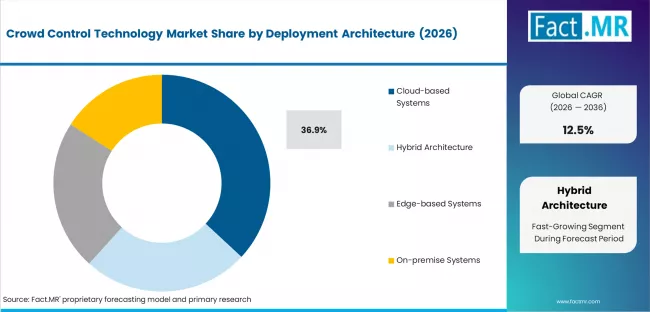
Crowd Control Technology Market Analysis By Deployment Architecture | Source: Fact.MR
The Cloud-Based Systems area will dominate and has 36.9% of the overall market; it supports all aspects of large-scale video analysis via scalable data storage/processing capability, and will continue to allow for easy access to all types of crowd monitoring programs regardless of where they are stored. In addition, since the increased popularity of crowdsourcing has created many opportunities for companies and occasionally has resulted in a loss of profits; there will continue to be a high demand for Cloud-Based Systems that provide affordable solutions to both government and private customers.
Which End Use Industry Segment Dominates the Market?
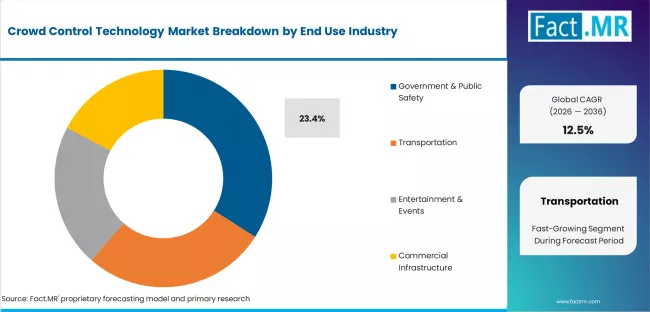
Crowd Control Technology Market Analysis By End Use Industry | Source: Fact.MR
From the forecast aspect, the Government & Public Safety will continue to be a leading segment with an estimated share of 23.4% in the coming years. The reason lies in its power of allowing crowd monitoring in real time for general public events, demonstrations or essential infrastructures, which could rise support on the emergency early detection and removal, and the general deployment for and smart city development.
Which Technology Type Segment Dominates the Market?
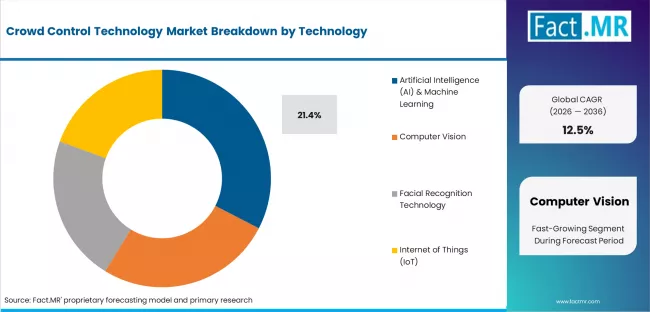
Crowd Control Technology Market Analysis By Technology | Source: Fact.MR
AI & Machine learning Segment is anticipated to maintain the dominance in this field in the coming years with an estimated share of 21.4%. The real-time video analytics, and predictive crowd behavior modeling capabilities, assisting security personnel for intelligent decision-making, and adopted into various applications like facial recognition, IoT-based crowd monitoring, and computer vision is helping this segment to lead among the other applications in this field within the forecast period.
Which Crowd Type Segment Dominates the Market?
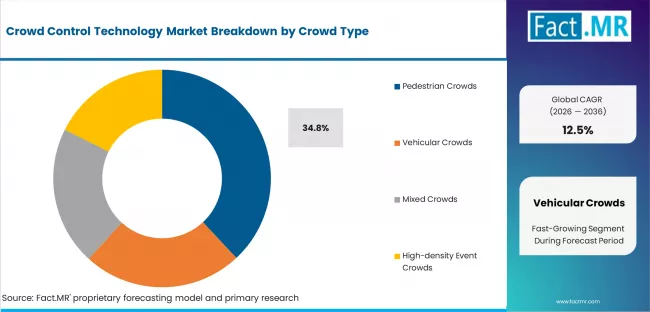
Crowd Control Technology Market Analysis By Crowd Type | Source: Fact.MR
The Pedestrian Crowds category will maintain its top position in this segment of the overall market with a 34.8% projected market share over the next few years. The segments capabilities to provide solutions for high-density foot traffic counts throughout urban transportation stations, arenas/stadiums, shopping areas/centers, as well as at public gatherings to allow for real-time optimization of crowds and/or to provide an efficient means of detecting anomalies will support continued demand from both government and commercial operational entities.
Regional Outlook Across Key Markets
The market analysis covers key global regions, including South Asia and Pacific, Middle East & Africa, North America, Latin America, Western Europe, and Eastern Europe. It is segmented geographically, with specific market dynamics for each region. The full report provides a detailed market attractiveness analysis.
.webp "Top Country Growth Comparison Crowd Control Technology Market Cagr (2026 2036)")
Top Country Growth Comparison Crowd Control Technology Market Cagr (2026 2036) | Source: Fact.MR
CAGR Table
| Country | CAGR (%) |
|---|---|
| U.S. | 11.9% |
| China | 13.5% |
| U.K. | 13.3% |
| Germany | 12.6% |
| Japan | 12.2% |
| India | 13.7% |
| South Korea | 13.1% |
Source: Fact.MR analysis. Updated May 13, 2026
Source: Fact.MR (FMR) analysis, based on proprietary forecasting model and primary research.
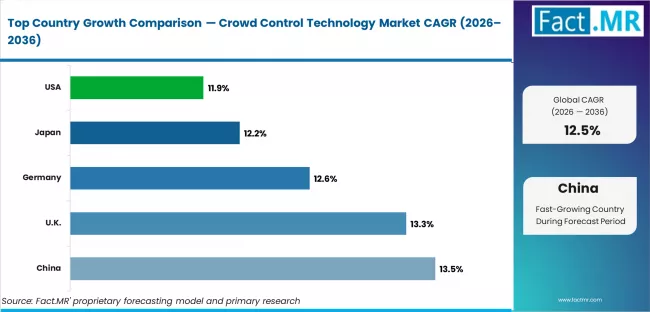
Crowd Control Technology Market Cagr Analysis By Country | Source: Fact.MR
North America – The Smart Security & Public Safety Hub
The North American market is forecasted to experience constant growth due to many continued investments made by the government and private sectors in organizations supporting the realization of smart city projects and the deployment of IoT-enabled crowd monitoring systems in diverse industry sectors.
- U.S.: Demand for crowd-control technology in the U.S. is projected to grow at around 11.9% CAGR, supported by significant investments in surveillance and emergency response infrastructure, rapid adoption of facial recognition and real-time threat detection.
Western Europe – The Smart Security & Public Safety Hub
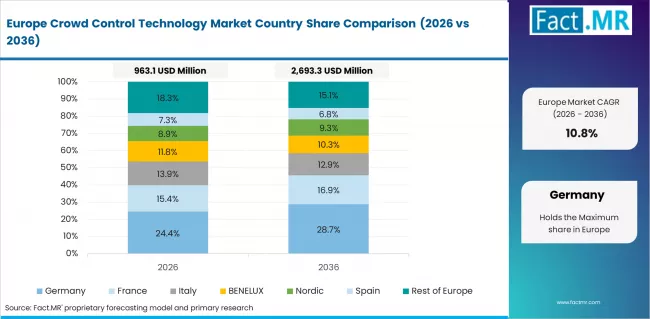
Crowd Control Technology Market Europe Country Market Share Analysis, 2026 & 2036 | Source: Fact.MR
Growth in the Western European Crowd-Control Technology industry can be seen through increased investment in smart city surveillance projects, a growing focus on modernizing public safety and emergency response, and increased adoption of AI-based systems to monitor crowds and recognize faces in the transportation, event, and government sectors.
- Germany: Demand for crowd-control technology in Germany is projected to grow at a 12.6% CAGR through 2036, supported by its strong industrial base, advanced engineering capabilities, and increasing adoption of AI-driven video analytics and IoT-enabled crowd management solutions
East Asia – The High-Growth Smart Security Hub
The crowd-control technology industry has been growing rapidly in East Asia since many smart cities are being developed, AI-based surveillance systems and facial recognition technology projects are continuing to be implemented, and IoT-enabled crowd control solutions and emergency responses are increasing in all industries across all parts of the world.
- China: Demand for crowd-control technology in China is projected to grow at around a 13.5% CAGR through 2036, supported by large-scale investments in public safety infrastructure, strong government initiatives for urban security.
South Asia & Pacific – The Emerging Smart Security & Public Safety Growth Hub
The South Asia and Pacific crowd-control technology market is expanding with countries adopting smart city projects, AI surveillance, and adoption of IoT-enabled crowd surveillance systems for public safety and commercial infrastructure at a brisk pace.
- India: Demand for crowd-control technology in India is projected to grow steadily at around a 13.7% CAGR through 2036, driven by expanding smart city projects, rising public event security needs, and increasing adoption of AI-powered video analytics
Latin America – The Emerging Smart Security & Public Safety Market
Public safety will be a major catalyst on one hand with increased expenditure on modernising the law enforcement machinery, and the increased use of AI-based crowd monitoring, facial recognition and non-lethal acoustic deterrence systems in urban air security and border control will surely boost the Latin America Crowd-Control Technology Market.
- Brazil: Demand for crowd-control technology in Brazil is projected to grow steadily at 13.7% through 2036, supported by growing investments in public safety infrastructure, and digital modernization of law enforcement and event security operations.
Middle East & Africa – The Emerging Smart Security & Infrastructure Expansion Zone
The market in the Middle East and Africa will continue to grow due to the increasing number of smart cities being developed by government and enterprise sectors with an emphasis on modernizing public safety while using AI to monitor crowds.
- KSA: Demand for Crowd-Control Technology in Saudi Arabia is projected to grow steadily at a 13.6% CAGR through 2036, supported by Vision 2030 initiatives, growing investments in smart security and IoT infrastructure, and increasing adoption of advanced crowd analytics and facial recognition systems across transportation hubs, religious sites, and entertainment venues.
Fact.MR’s analysis of the Crowd-Control Technology Market provides a comprehensive regional outlook covering North America, Latin America, Western Europe, East Asia, South Asia & Pacific, and Middle East & Africa. Readers can access country-wise insights, growth trends, public safety modernization patterns, and smart security dynamics shaping both mature and emerging markets, driven by increasing deployment of AI-based video analytics, facial recognition, and IoT-enabled crowd monitoring systems across industries globally.
Competitive Benchmarking and Company Positioning
Leading Companies Shaping the Crowd-Control Technology Market
Crowd Control Technology Market Analysis By Company | Source: Fact.MR
The crowd-control technology market is not a tightly consolidated industry, as it features several key players operating across global markets, offering advanced AI-based video analytics, facial recognition, and IoT-enabled crowd monitoring solutions. Companies such as Cisco, Honeywell, Milestone Systems, Genetec, Cognyte, and Thales Group collectively account for approximately 40-45% of the global market. With strong capabilities in smart security infrastructure, real-time surveillance, and public safety systems, these companies are continuously enhancing their offerings through innovations in AI-driven crowd analytics, edge computing, and integrated emergency response platforms.
Key Players of the Crowd-Control Technology Market
- Cisco
- Honeywell
- Milestone Systems
- Irisity
- Mefron
- Kustom Signals
- Clearway
- Neoma
- FlybyGuys
- Genetec
- Cognyte
- Thales Group
Recent Industry Developments
- Spatial AI and LiDAR enable venues to monitor crowds in real time, improving safety (2025): Spatial Intelligence solutions are designed specifically for environments where understanding crowd flow. Real-time detection helps identify bottlenecks before they escalate. (Spatial AI) [1]
- ECHO 10K Sensor & AI Platform Launched for UAV Surveillance (2026): Sapient Perception has launched ECHO, a purpose-built 10K sensor for unmanned aerial vehicles that supports autonomous applications in defense, security, and emergency response. (Sapient) [2]
- WiredLeap Launches MagicBox, Networks Into Autonomous AI Agent Systems (2026): Bengaluru-based deep-tech startup, has launched MagicBox, an edge-AI device that transforms existing CCTV infrastructure into a network of autonomous AI agents capable of monitoring, analysing. (WiredLeap) [3]
- Milestone Systems Enhances Security with Open Platform Video Management (2025): Milestone Systems, a leading provider of open platform video management software, is helping security teams leverage integrated technology solutions to enhance safety and create seamless experiences. (Milestone Systems) [4]
- Saudi AI-Powered Smart Platform Launched to Enhance Pilgrim Safety and Crowd Management (2025): The platform marks a significant advancement in digital transformation and surveillance integration, aligning with the objectives of Saudi Vision 2030. By combining AI with remote sensing and geographic information systems (GIS), the platform processes high-resolution satellite imagery to deliver comprehensive, real-time insights. (King Abdulaziz City of Sciences and Technology) [5]
Sources and Research References
- [1] “Spatial AI and LiDAR enable venues to monitor crowds in real time, improving safety, guest experience, and privacy while optimizing operations.”, 2025
- [2] “ECHO 10K Sensor & AI Platform Launched for Persistent UAV Surveillance”, 2026
- [3] “WiredLeap Launches MagicBox, Turning Networks Into Autonomous AI Agent Systems”, 2026
- [4] “Milestone Systems Enhances Summer Festival Season Security with Open Platform Video Management”, 2025
- [5] “Saudi AI-Powered Smart Platform Launched to Enhance Pilgrim Safety and Crowd Management”, 2025
Crowd-Control Technology Market Definition
The market include the technologies, hardware and solutions that use the power of AI, computer vision IoT biometrics, and real time analytics to assist with crowd management and crowd control operations at varied venues and places.
Crowd-Control Technology Market Inclusions
The market covers any software, hardware or service that offers crowd monitoring and control systems. These systems can be implemented in the areas of government & public safety, entertainment & events, and transportation.
Crowd-Control Technology Market Exclusions
The market does not consist of standalone monitoring hardware and manual security programs that rely on no intelligent analytics to make real time decisions and also will not include general purpose communication/networking systems; standard lighting infrastructure and/or traditional access control systems that do not utilize ai based methods to track and manage crowds or predict crowd behaviour/activity.
Crowd-Control Technology Market Research Methodology
- Primary Research
- The current trend of the industry in Crowd-Control Technology is identified from input provided by stakeholders throughout the industry value chain. Stakeholders included: AI and Computer Vision Platform Providers, Crowd Analytics Software Developers, Surveillance Equipment Manufacturers, and Public Safety Agencies who are providing solutions for crowd control at transportation systems, events and smart city initiatives.
- Desk Research
- Conducted second hand research on the market, founded on annual reports of primary technology vendors and reports by appropriate media in the security, public safety and smart infrastructure arena.
- Market-Sizing and Forecasting
- Combined revenue generated by AI Based Crowd Analytics Platforms, Facial Recognition Systems, IoT-Powered Crowd Monitoring Solutions, Biometrics Identification Systems, and Real Time Communication Tools, was aggregated together. Total Aggregated Revenue includes both Hardware and Software Sales and all other Services Related to the Technologies Across All Industries Using Intelligent Crowd Control Solutions.
- Data Validation and Update Cycle
- The market data is validated through several checks with industry experts and cross referenced with leading security, surveillance and public safety technology providers. As new developments are born in the realms of AI-based video analytics, facial recognition, IoT-enabled crowd monitoring and real time emergency response system the Market data is constantly revised to incorporate the latest advances in public safety regulations and smart city projects.
Segmentation
Scope of Analysis
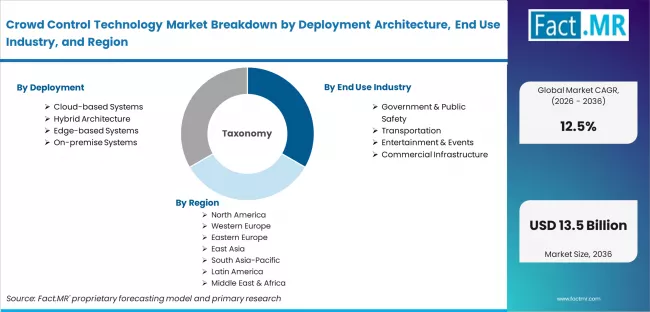
Crowd Control Technology Market Breakdown By Deployment Architecture, End Use Industry, And Region | Source: Fact.MR
| Parameter | Details |
|---|---|
| Quantitative Units | USD 3.7 billion in 2025 to USD 13.5 billion in 2036, at a CAGR of 12.5% |
| Market Definition | The Crowd-Control Technology Market comprises AI-based video analytics, facial recognition systems, IoT-enabled crowd monitoring platforms, biometric solutions, and real-time communication infrastructure designed to monitor, manage, and direct crowds in various environments. |
| Regions Covered | North America, Latin America, Europe, East Asia, South Asia & Pacific, Middle East & Africa |
| Countries Covered | USA, Canada, UK, Germany, China, India, 30 plus countries |
| Key Companies | Cisco, Honeywell, Milestone Systems, Genetec, Cognyte, Thales Group, and others |
| Forecast Period | 2026 to 2036 |
| Approach | Hybrid demand-side and top-down methodology based on smart city investments, public safety modernization trends, growth in AI-based surveillance and facial recognition, increasing demand for real-time crowd analytics, rising investments in 5G and edge infrastructure, and expanding deployment of IoT-enabled crowd monitoring systems across global industries. |
Source: Fact.MR analysis. Updated May 13, 2026
Analysis by Technology Type, by Deployment Architecture, by Crowd Type, by Connectivity Technology, by End Use Industry, and by Region
-
Crowd-Control Technology Market By Technology Type:
- Artificial Intelligence (AI) & Machine Learning
- Predictive Crowd Analytics
- Behavioral Analytics
- Computer Vision
- Object Detection
- Motion Tracking
- Facial Recognition Technology
- Identity Verification
- Watchlist Screening
- Emotion & Behavior Recognition
- Internet of Things (IoT)
- Smart Sensors
- Connected Surveillance Devices
- Big Data Analytics
- Real-time Data Processing
- Predictive Incident Analytics
- Cloud Computing
- Cloud-based Monitoring Platforms
- Remote Surveillance Management
- SaaS Crowd Intelligence Platforms
- Edge Computing
- Edge Video Processing
- Low-latency Analytics
- On-site AI Inference
- RFID & Smart Identification Technologies
- RFID Tracking
- Smart Badging
- Biometrics
- Fingerprint Recognition
- Iris Recognition
- Others
- Artificial Intelligence (AI) & Machine Learning
-
Crowd-Control Technology Market By Deployment Architecture:
- Cloud-based Systems
- Edge-based Systems
- Hybrid Architecture
- On-premise Systems
-
Crowd-Control Technology Market By Crowd Type:
- Pedestrian Crowds
- Vehicular Crowds
- Mixed Crowds
- High-density Event Crowds
- Emergency & Evacuation Crowds
-
Crowd-Control Technology Market By Connectivity Technology:
- Wi-Fi
- 4G/LTE
- 5G
- Bluetooth
- LPWAN
- Satellite-enabled Systems
-
Crowd-Control Technology Market By End Use Industry:
- Government & Public Safety
- Transportation
- Entertainment & Events
- Smart Cities
- Commercial Infrastructure
- Healthcare Facilities
- Educational Institutions
- Industrial & Manufacturing Sites
- Religious & Pilgrimage Sites
- Defense & Military Installations
-
Crowd-Control Technology Market By Region:
- North America
- USA
- Canada
- Mexico
- Latin America
- Brazil
- Chile
- Rest of LATAM
- East Asia
- China
- Japan
- South Korea
- Western Europe
- Germany
- Italy
- France
- U.K.
- Spain
- BENELUX
- Nordic
- Rest of W. Europe
- Eastern Europe
- Russia
- Hungary
- Poland
- Balkan & Baltics
- Rest of E. Europe
- Middle East and Africa
- Kingdom of Saudi Arabia
- United Arab Emirates
- South Africa
- Rest of Middle East and Africa
- North America
Frequently Asked Questions
How large is the demand for Crowd-Control Technology in the global market in 2025?
What will be the market size of Crowd-Control Technology in the global market by 2036?
What is the expected demand growth for Crowd-Control Technology in the global market between 2026 and 2036?
Which deployment architecture segment is expected to dominate the Crowd-Control Technology Market?
How significant is the growth outlook for India in this market?
Which company is identified as a leading player in the Crowd-Control Technology Market?
Who worked on this report


Preview the report firsthand - request a free sample
Free SampleGet the brochure for pricing and purchase details
Download PDF