- Market Value (2025): USD 6.6 Bn
- Estimated Value (2026): USD 7.2 Bn
- Forecast Value (2036): USD 18.6 Bn
- CAGR (2026-2036): 9.9%
What is the Cyber-Resilient Control Platforms Market forecast to be worth by 2036?
USD 7.2 billion in 2026 to USD 18.6 billion by 2036, at a 9.9% CAGR.
- The cyber-resilient control platforms market crossed a valuation of USD 6.6 billion in 2025.
- Demand is forecast to increase from USD 7.2 billion in 2026 to USD 18.6 billion by 2036.
- The cyber-resilient control platforms market is forecast to record a 9.9% CAGR from 2026 to 2036.
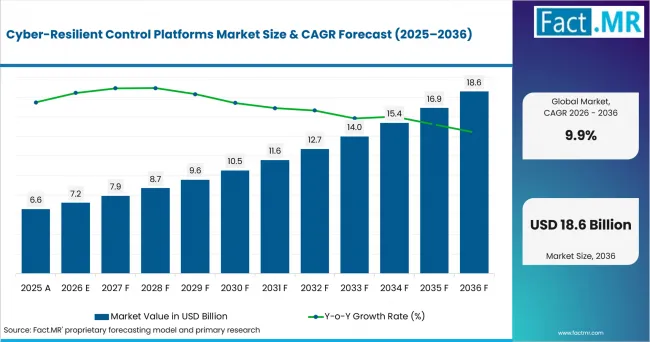
Cyber Resilient Control Platforms Market Value Analysis | Source: Fact.MR
What are the defining numbers behind Cyber-Resilient Control Platforms Market growth?
USD 11.3 billion absolute opportunity by 2036, led by PLC, secure boot, ransomware resilience and energy sites.
- Demand Drivers in the Market
- Control engineers rely on secure controllers as it harmful changes can disrupt plant operations.
- Secure remote access is becoming more important as outside service connect to plant control systems for maintenance and support.
- Safety and cyber teams work together to make sure security changes do not cause any problems during shutdowns and daily plant operations.
- Key Segments Analyzed
- By Control Layer: PLC is expected to hold 31.0% share in 2026 due to its direct role in machine and process logic across brownfield and modern plant sites.
- By Resilience Feature: Secure boot is forecast to account for 38.0% share in 2026 because startup integrity helps block unauthorized firmware and altered controller images.
- By Threat Domain: Ransomware is anticipated to capture 34.0% share in 2026 as teams place more value on segmentation, recovery and protected control states.
- By Industry: Energy is estimated to represent 31.0% share in 2026 because generation, transmission and process facilities depend on steady service.
- Analyst Opinion at Fact.MR
- Shambhu Nath Jha, Principal Consultant at Fact.MR, states, “Platforms are controlling their access without affecting normal operations. For setup and recovery, vendors need to can stand out for security.”
- Strategic Implications
- Control vendors can add identity checks and recovery steps for tools which is already use. Compared with separate security tools, this keeps daily work in one place.
- System integrators firstly check about the older devices which depend on current network connections. Making changes without this check, lowers the risk of disrupting system design or vendor support.
- Security teams check how quickly important controls return to service and remain available. This gives a clearer view of system resilience than looking at the number of security alerts alone.
Japan is forecast at 10.1% CAGR through 2036 as factory OT security receives more policy attention. The USA is forecast at 9.8% amid ransomware risk in key systems. Germany is forecast at 9.5%, France at 9.2% and the UK at 8.0% as teams harden control sites.
How does the Cyber-Resilient Control Platforms Market break down by segment?
PLC leads Control Layer at 31.0%; secure boot leads Resilience Feature leads with 38.0% share in 2026.
Which Control Layer dominates?
PLC holds 31.0% share in 2026.
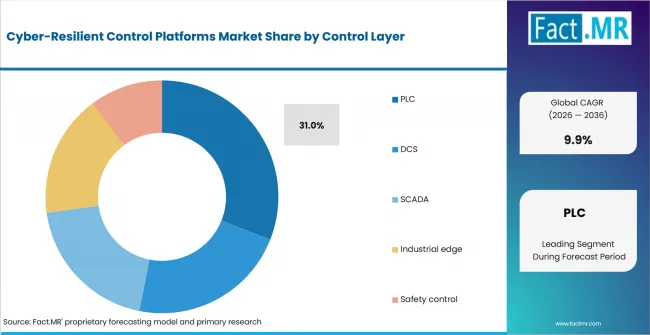
Cyber Resilient Control Platforms Market Analysis By Control Layer | Source: Fact.MR
In comparison, DCS is mainly used in process plants, while SCADA manages account spread across different locations. Plant edge systems handle the connections which is closer to the site and provide secure connections. Safety controls have a separate role because cyber changes must follow their particular requirements.
What leads the Resilience Feature segment?
Secure boot accounts for 38.0% share in 2026.
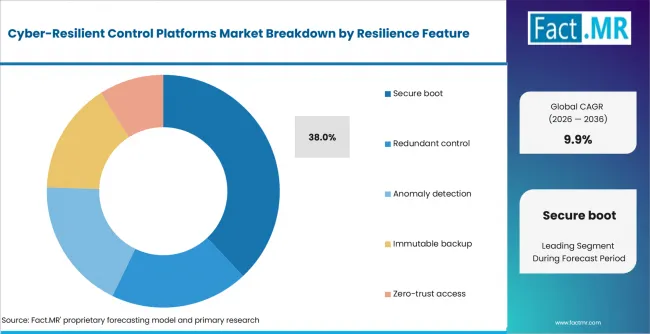
Cyber Resilient Control Platforms Market Analysis By Resilience Feature | Source: Fact.MR
Secure boot is leading the segment because it checks whether software is trusted before the system starts normal operation. In comparison, redundant control helps to control the systems running. Immutable backup keeps settings safe for recovery, whereas remote users can access the zero-trust access limits.
How does Threat Domain shape demand?
Ransomware captures 34.0% share in 2026.
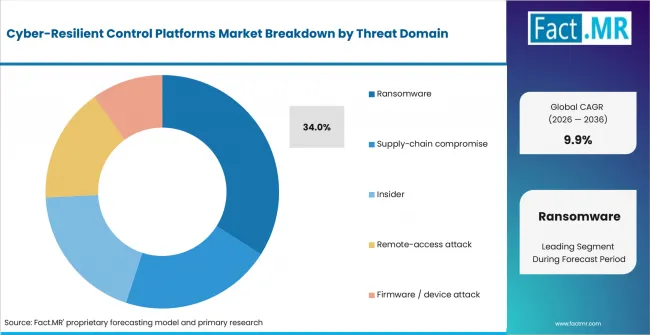
Cyber Resilient Control Platforms Market Analysis By Threat Domain | Source: Fact.MR
Plant outages can directly affect daily operations compare to supply-chain attacks can affect trusted updates. Insider and remote-access attacks create questions over system access. Firmware attacks target the controller system more directly and it result on recovery system. Clear recovery steps help teams bring controls back to safe operation after an attack.
What supports Energy within Industry?
Energy represents 31.0% share in 2026.
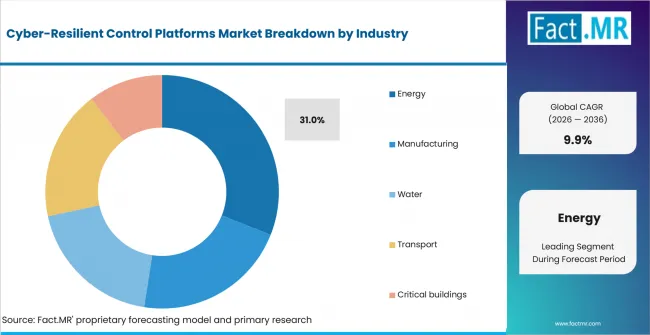
Cyber Resilient Control Platforms Market Analysis By Industry | Source: Fact.MR
Generation and network work depend on steady control, factory follows with broad PLC and DCS estates. Water and critical buildings also use distributed controls where downtime can affect service or safety.
What is accelerating Cyber-Resilient Control Platforms Market adoption, and what is holding it back?
Adoption is driven by ransomware protection and secure operation of controllers. Growth is limited by integration with legacy systems and complex system changes.
Drivers Impact Analysis
| DRIVER | (~) % IMPACT ON CAGR | GEOGRAPHIC RELEVANCE | IMPACT TIMELINE |
|---|---|---|---|
| Ransomware resilience in critical operations | +1.7% | Global | Short term (<= 2 years) |
| Secure controller startup and firmware trust | +1.4% | Global | Medium term (2-4 years) |
| Remote engineering access control | +1.1% | Global | Short term (<= 2 years) |
| OT visibility and anomaly detection | +0.9% | Global | Medium term (2-4 years) |
| Recovery and immutable configuration needs | +0.7% | Global | Long term (>= 4 years) |
Opportunity Impact Analysis
| OPPORTUNITY | (~) % IMPACT ON CAGR | GEOGRAPHIC RELEVANCE | IMPACT TIMELINE |
|---|---|---|---|
| Brownfield resilience overlays | +1.2% | Mature markets | Medium term (2-4 years) |
| Zero-trust access for OT | +1.0% | Global | Short term (<= 2 years) |
| Secure industrial edge control | +0.8% | Global | Medium term (2-4 years) |
| Resilience evidence for regulated operators | +0.6% | Europe, North America | Long term (>= 4 years) |
Restraints Impact Analysis
| RESTRAINT | (~) % IMPACT ON CAGR | GEOGRAPHIC RELEVANCE | IMPACT TIMELINE |
|---|---|---|---|
| Legacy protocol and device constraints | -0.7% | Global | Short term (<= 2 years) |
| Change-control and outage windows | -0.6% | Global | Medium term (2-4 years) |
| Safety and cybersecurity coordination | -0.4% | Process industries | Medium term (2-4 years) |
| Specialist OT security skills | -0.3% | Global | Long term (>= 4 years) |
Which countries are scaling Cyber-Resilient Control Platforms Market fastest?
- The growth rates of these countries differ by 2.1 percentage points across the forecast period.
- Japan is 0.3 percentage point ahead of the USA as factory OT security gets more policy attention.
- The USA is 0.3 percentage point ahead of Germany as ransomware risks in important systems continue to support security spending.
- Germany is 0.3 percentage point ahead of France as plants improve security across older control systems.
- France is 1.2 percentage points ahead of the UK as key infrastructure teams continue to improve system resilience.
Even with similar growth rates, market conditions differ because the age of control systems, regulations, and security risks vary by country. The market covers North America, Latin America, Europe, East Asia, South Asia & Pacific, and the Middle East & Africa.
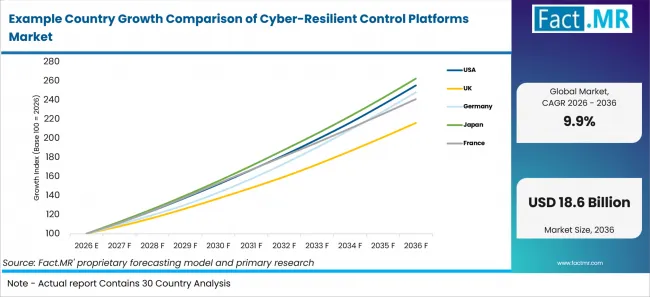
Example Country Growth Comparison Of Cyber Resilient Control Platforms Market | Source: Fact.MR
| Country | CAGR (2026-2036) |
|---|---|
| Japan | 10.1% |
| United States | 9.8% |
| Germany | 9.5% |
| France | 9.2% |
| United Kingdom | 8.0% |
What supports Japan adoption?
Demand for Japan will increase 10.1% CAGR.
Japan is improving industrial cyber security as more factories use automation and they need controllers security. In October 2025, METI finalized its OT Security Guidelines for Semiconductor Device Factories, while during 2025, Japan’s National Police Agency recorded 226 reported ransomware incidents. Demand is rising for secure controller backups and recovery tools.
What supports United States adoption?
9.8% CAGR, led by critical-infrastructure ransomware risk and control-system modernization.
More than 3600 complaints about ransomware were received by the FBI in 2025 . In 2025, U.S. electricity net generation was 4.43 thousand TWh . The U.S. has a large industrial control base with ongoing ransomware exposure in critical operations.
What supports Germany adoption?
Sales for Germany rises 9.5% CAGR.
Germany is increasing cyber-resilience requirements across industrial and energy assets. The BSI reported a 24% rise in newly identified vulnerabilities from July 2024 to June 2025. Demand is increases for secure access and recovery controls which give protection to brownfield plants without changing complete control-system replacement.
How is France developing demand?
9.2% CAGR, driven by critical-infrastructure cyber programs and a large electricity and plant-control footprint.
Cyber risks remain a concern for factories and important services in France. ANSSI handled 3,586 cyber events in 2025, including 1,366 confirmed incidents. Mainland France also generated 547.5 TWh of electricity. Plants need security systems that control access and protect system settings and allow operations to restart safely.
What supports the United Kingdom’s growth?
8.0% CAGR, shaped by production-sector cyber risk and formal resilience work around essential services.
Cyberattacks keep striking factories and utility services across the UK. A survey of utilities or production businesses in 2025/2026 found that 49% had experienced a cyber-breach or attack in the last 12 months. The NCSC also supported 429 cyber incidents between September 2024 and August 2025.
Who leads the Cyber-Resilient Control Platforms Market?
Rockwell Automation uses SecureOT with its control systems to track equipment, find security risks, monitor threats, respond to attacks, and restore operations. Siemens uses SINEC Secure Connect to protect system access and communication. Schneider Electric uses Modicon control systems with IEC 62443 security standards.
Honeywell uses Cyber Insights in Experion systems for security threats monitoring. It also offers network security, incident response and recovery services. Emerson employs security tools and Zero Trust methods to safeguard DeltaV systems. Yokogawa protects CENTUM VP and ProSafe-RS with security tools based on IEC 62443 standards.
Which companies are the key providers?
Key companies include Rockwell Automation; Siemens; Schneider Electric; Honeywell; Emerson; and Yokogawa.
- Rockwell Automation
- Siemens
- Schneider Electric
- Honeywell
- Emerson
- Yokogawa
Bibliography
- Agence nationale de la sécurité des systèmes d’information. (2026, May 19). Cyber threat overview 2025.
- Bundesnetzagentur. (2026, January 5). Bundesnetzagentur publishes 2025 electricity market data.
- Bundesamt für Sicherheit in der Informationstechnik. (2025, November 11). Die Lage der IT-Sicherheit in Deutschland 2025 [The state of IT security in Germany 2025].
- Federal Bureau of Investigation, Internet Crime Complaint Center. (2026). 2025 Internet Crime Report.
- Ministry of Economy, Trade and Industry. (2025, October 24). OT Security Guidelines for Semiconductor Device Factories compiled in Japanese and English versions.
- Ministry of Economy, Trade and Industry. (2026, February 27). Indices of industrial production: Preliminary report for January 2026.
- National Police Agency. (2026, March). Cyber Police Agency Letter 2025 Vol. 15.
- Economic and Social Research Institute, Cabinet Office, Government of Japan. (2025, December 11). Business Outlook Survey (Summary), October–December 2025.
- Office for National Statistics. (2026, February 12). Index of Production, UK: December 2025.
- RTE. (2026, February 25). Bilan électrique 2025 - Principaux résultats.
- U.S. Census Bureau. (2026, April 1). Manufacturing and trade inventories and sales: January 2026.
- U.S. Energy Information Administration. (2026, March 5). U.S. electricity generation in 2025 hit a record, again.
- Department for Science, Innovation and Technology, & Home Office. (2026, April 30). Cyber security breaches survey 2025/2026.
- National Cyber Security Centre. (2025, October 14). NCSC Annual Review 2025 [Incident management section].
- Federal Statistical Office (Destatis). (2026, February 6). Production in December 2025: -1.9% on the previous month.
- Institut national de la statistique et des études économiques. (2026, February 5). In December 2025, manufacturing output fell back sharply (-0.8%).
- Rockwell Automation. (2025, November 12). Rockwell Automation introduces SecureOT solution suite to strengthen industrial cybersecurity resilience.
- Siemens AG. (2025, October 1). New Siemens platform brings Zero Trust security to industrial networks.
- Honeywell. (2025, June 9). Honeywell drives industrial transition from automation to autonomy with new AI-enabled digital suite.
- Schneider Electric. (2025, August 27). Cybersecurity System Certification EcoStruxure Process Expert for ASP 2023 [Product announcement].
- Yokogawa Electric Corporation. (2026, April 8). Yokogawa integrated control and safety system, CENTUM VP and ProSafe-RS, and related software receive cybersecurity certification.
This Report Answers
- The report explains where cyber-resilient control platforms are used across Control Layer and Resilience Feature. It also covers Threat Domain, Industry, and regional deployment across industrial environments.
- Segment analysis identifies the leading subsegments and explains why PLCs, secure boot, ransomware resilience, and energy applications hold prominent positions within the market.
- Country analysis examines the United States, United Kingdom, Germany, Japan, and France. It considers ransomware exposure, OT-security policy, infrastructure scale, brownfield control estates, and resilience programs that influence adoption.
- Competitive analysis reviews Rockwell Automation, Siemens, Schneider Electric, Honeywell, Emerson, and Yokogawa across industrial control security, secure communications, system hardening, asset visibility, threat monitoring, and recovery.
- Application analysis assesses how secure startup, remote-access control, anomaly detection, immutable backup, recovery workflows, and controller trust influence platform selection. It also considers PLC, DCS, SCADA, industrial edge, and safety-control environments.
What does the Cyber-Resilient Control Platforms Market cover?
The market covers control platforms and resilience capabilities that maintain trusted industrial operation during cyber disruption. It includes controller and supervisory environments where secure startup, controlled access, anomaly awareness and recoverable configurations are integrated with operational technology.
The assessment also considers secure information exchange between control and enterprise environments. Relevant adjacent categories include OT-IT data bridges, smart factory platforms and cyber-secure CNC systems. These links provide context only and do not replace the market boundary defined in this report.
What is included in the scope?
The scope includes PLC, DCS, SCADA, industrial edge and safety-control environments with built-in resilience functions. It covers secure boot, redundant control, anomaly detection, immutable backup and zero-trust access.
Included rollouts must serve plant control or resilience. Country coverage includes the USA, UK, Germany, Japan and France.
What is excluded from the scope?
The scope excludes enterprise cyber security without a direct industrial-control role. Standalone products are excluded unless integrated with operational technology.
General cloud protection, consumer protection and conventional business-uptime software remain outside the boundary.
How Was the Analysis Built?
The analysis draws on 120+ sources, 35+ company portfolios, 25+ countries, and more than 20 industry interviews.
- Primary Research: Primary research includes discussions with manufacturers, service providers, technology developers, distributors, end users, and subject-matter experts. These conversations examine purchasing priorities, product adoption, operational challenges, approval requirements, competitive positioning, and the factors that influence wider market acceptance.
- Desk Research: Desk research covers government statistics, regulatory publications, company filings, trade data, technical studies, industry associations, standards, public policy, and other authoritative sources. Every source used in the analysis is documented in the bibliography.
- Market Sizing and Forecasting: Market estimates combine historical performance, demand indicators, pricing and volume trends, segment shares, company participation, country-level growth, adoption patterns, investment activity, and barriers to market expansion.
- Data Validation and Update Cycle: Findings are validated by comparing primary interviews with public data, company activity, regulatory changes, trade patterns, and industry developments. Regular updates review new product launches, capacity changes, partnerships, approvals, and shifts in commercial adoption.
What is the report’s scope and coverage?
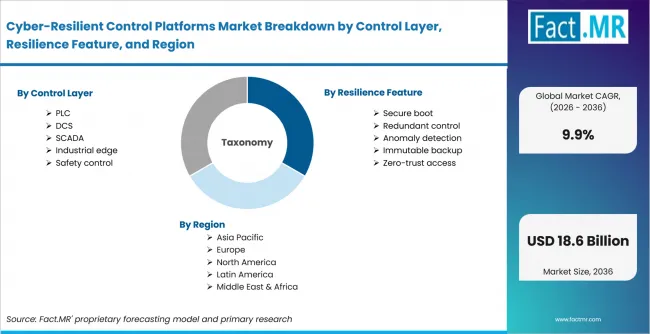
Cyber Resilient Control Platforms Market Breakdown By Control Layer, Resilience Feature, And Region | Source: Fact.MR
| Attribute | Details |
|---|---|
| Quantitative Units | USD billion |
| Market Definition | Industrial control platforms and integrated functions that preserve trusted, recoverable operation during cyber disruption. |
| Control Layer | PLC; DCS; SCADA; Industrial edge; Safety control |
| Resilience Feature | Secure boot; Redundant control; Anomaly detection; Immutable backup; Zero-trust access |
| Threat Domain | Ransomware; Supply-chain compromise; Insider; Remote-access attack; Firmware / device attack |
| Industry | Energy; Manufacturing; Water; Transport; Critical buildings |
| Regions Covered | North America; Latin America; Western Europe; Eastern Europe; East Asia; South Asia & Pacific; Middle East & Africa |
| Countries Covered | United States; United Kingdom; Germany; Japan; France |
| Key Companies Profiled | Rockwell Automation; Siemens; Schneider Electric; Honeywell; Emerson; Yokogawa |
| Forecast Period | 2026 to 2036 |
| Approach | Installed control base, resilience feature attachment, industry criticality, country indicators and provider portfolio review. |
How is the market segmented?
-
By Control Layer:
- PLC
- DCS
- SCADA
- Industrial edge
- Safety control
-
By Resilience Feature:
- Secure boot
- Redundant control
- Anomaly detection
- Immutable backup
- Zero-trust access
-
By Threat Domain:
- Ransomware
- Supply-chain compromise
- Insider
- Remote-access attack
- Firmware / device attack
-
By Sector:
- Energy
- Manufacturing
- Water
- Transport
- Key buildings
-
By Region:
- North America
- Latin America
- Western Europe
- Eastern Europe
- East Asia
- South Asia & Pacific
- Middle East & Africa