Export Controls & Tech Sanctions Compliance Services Market Size, Share, Growth and Forecast (2026 - 2036)
The Export Controls & Tech Sanctions Compliance Services Market is segmented by Service Type, by Regulation Type, by Customer Type, by Delivery Model, by End Use and Region. Forecast for 2026 to 2036.
What is the export controls & tech sanctions compliance services market forecast to be worth by 2036?
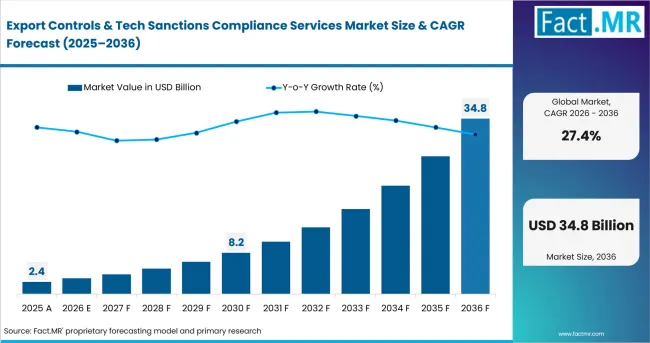
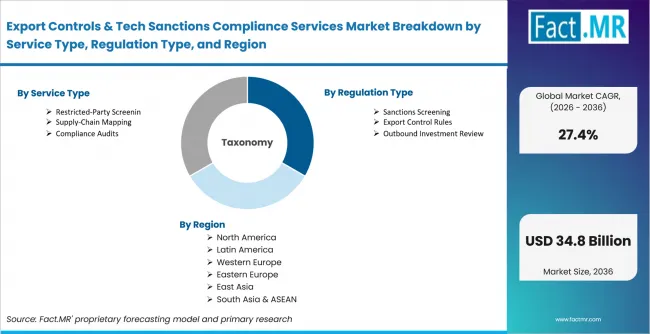
USD 3.10 billion in 2026 to USD 34.80 billion by 2036, at 27.4% CAGR.
- The export controls & tech sanctions compliance services market crossed a valuation of USD 2.43 billion in 2025.
- Demand is estimated to increase from USD 3.10 billion in 2026 to USD 34.80 billion by 2036.
- The market is forecast to record 27.4% CAGR during 2026 to 2036 as semiconductor controls, sanctions screening and outbound-investment rules add recurring compliance work.
What are the defining numbers behind export controls & tech sanctions compliance services growth?
USD 31.70 billion absolute opportunity by 2036, led by Taiwan and South Korea.
- Demand Drivers in the Market
- Semiconductor export controls push suppliers to review product, buyer and end-use details before order acceptance.
- Sanctions list changes make ownership screening a daily compliance task for exporters and banks.
- Outbound-investment rules add diligence work for investors backing chip, quantum and artificial intelligence assets.
- Supply-chain mapping supports evidence when buyers ask suppliers to explain product origin and diversion exposure.
- Key Segments Analyzed
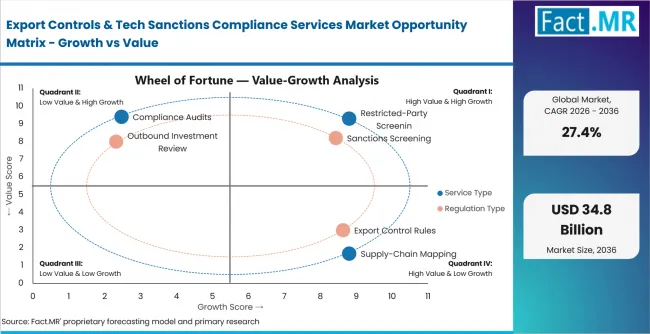
- By Service Type: Restricted-Party Screening is expected to hold 32.0% share in 2026 because every shipment and counterparty review starts with list checks.
- By Regulation Type: Sanctions Screening is projected to capture 29.0% share in 2026 as ownership and beneficial-control checks widen.
- By Customer Type: Semiconductor Firms are likely to account for 30.0% share in 2026 because chip controls apply directly to tools, wafers and know-how.
- By Delivery Model: SaaS Subscriptions are forecast to hold 41.0% share in 2026 because compliance teams need continuous list updates and audit logs.
- By End Use: Semiconductor Supply Chains are expected to hold 35.0% share in 2026 because product controls and diversion risk are concentrated there.
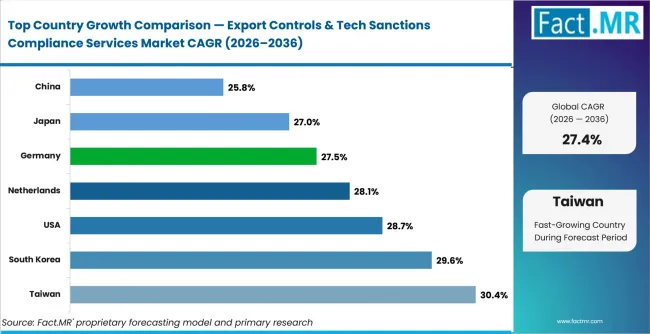
- By Geography: Taiwan is projected to record 30.4% CAGR through 2036 as chip exports require deeper customer and end-use checks.
- Analyst Opinion at Fact.MR
- Shambhu Nath Jha, Senior Analyst at Fact.MR, states, “Export-control compliance is shifting from a legal checkpoint into a live operating layer for technology trade. We see buyers asking whether a supplier can prove who owns the customer, where the item goes and whether the product classification is current. Providers that combine regulatory content with supplier mapping gain earlier access to semiconductor and industrial export programs.”
- Strategic Implications
- Exporters should connect screening, classification and license records before sales teams quote controlled items.
- Semiconductor firms need supplier and customer maps that show ownership, location and end-use exposure.
- Software providers should add regulatory content refresh and audit trails to avoid manual rework.
- Advisory firms need workflow capability because buyers want repeatable controls, not one-time memos.
Screening and supply-chain mapping services form the core of this market. The Bureau of Industry and Security reported in January 2025 that the Disruptive Technology Strike Force had brought 26 criminal cases tied to sanctions, export control violations and restricted technology transfer.
Taiwan is projected to record 30.4% CAGR through 2036 as chip exports require tighter customer checks. South Korea is expected to post 29.6% CAGR because memory and chip equipment flows require end-use review. The United States is forecast to advance at 28.7% CAGR as its rules shape global exporter workflows. The Netherlands is likely to record 28.1% CAGR because semiconductor equipment controls require licensing support. Germany is projected to expand at 27.5% CAGR as EU dual-use controls and industrial exporters sustain advisory demand. Japan is expected to register 27.0% CAGR as chip-equipment suppliers need classification and destination checks. China is forecast to grow at 25.8% CAGR as rare-earth and technology export controls change counterparty review needs.
How does the export controls & tech sanctions compliance services market break down by segment?
Restricted-party screening leads at 32.0%; SaaS subscriptions lead at 41.0%.
Which service type leads?
Restricted-Party Screening holds 32.0% share in 2026.
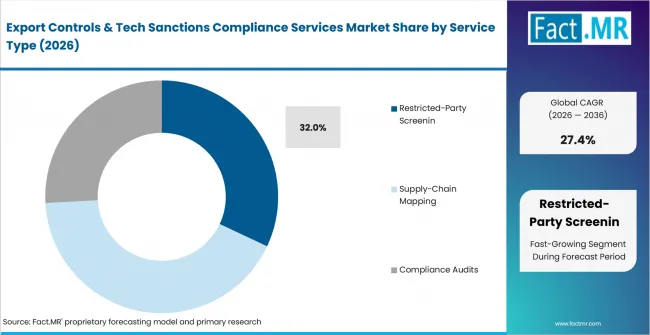
Restricted-Party Screening is expected to hold 32.0% share in 2026 because trade decisions begin with list, ownership and counterparty checks. The service connects directly to denied-party data and enforcement expectations. Buyers also compare it with food safety compliance technologies where record accuracy affects audit outcomes. Screening demand expands because exporters need fast proof before shipment release.
Which regulation type leads?
Sanctions Screening holds 29.0% share in 2026.
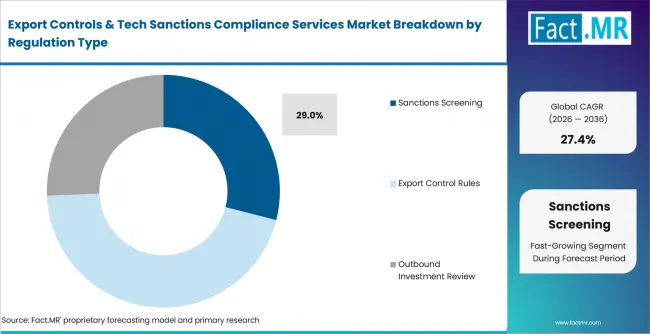
Sanctions Screening leads because sanctions exposure can appear through subsidiaries, beneficial owners and indirect counterparties. Exporters need tools that trace ownership beyond the direct buyer. The service overlaps with supplier management because supplier and customer records both need clean identity data. This segment is expected to stay ahead as sanctions programs change faster than manual spreadsheets can track.
Which customer type leads?
Semiconductor Firms hold 30.0% share in 2026.
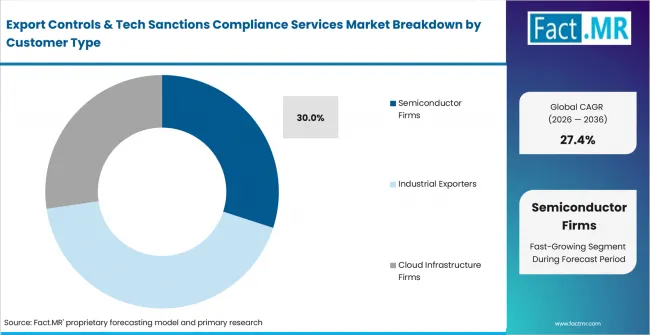
Semiconductor Firms are likely to account for 30.0% share in 2026 because they handle controlled tools, chip designs and equipment parts. Compliance teams need classification support before a sale and end-use review before delivery. Demand is concentrated among equipment makers, foundries, materials suppliers and distributors that serve high-performance computing and memory production.
Which delivery model leads?
SaaS Subscriptions hold 41.0% share in 2026.
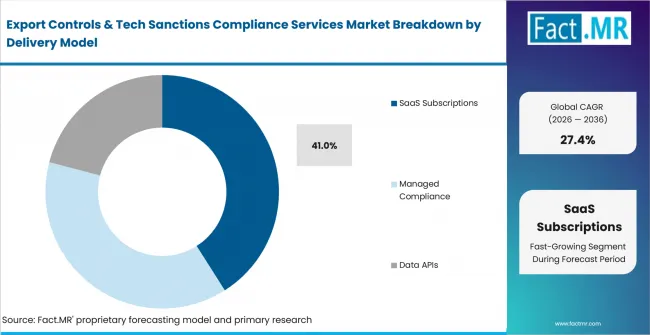
SaaS Subscriptions lead because compliance teams need updated screening content, audit trails and role-based workflows. The model is expected to hold 41.0% share in 2026 as exporters shift repeat checks into shared systems. Comparable workflow buying is visible in supplier quality management applications where buyers use software to standardize evidence across suppliers. Managed services stay important when legal interpretation is required.
Which end use leads?
Semiconductor Supply Chains hold 35.0% share in 2026.
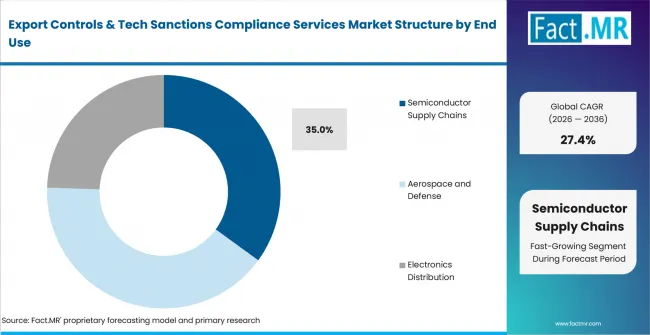
Semiconductor Supply Chains lead because chip tools, design software, materials and components face direct controls in multiple jurisdictions. The segment is expected to hold 35.0% share in 2026 as buyers need evidence on customer identity, item classification and destination. Service demand rises where shipment delay, license denial or enforcement risk can stop production schedules.
What is accelerating export controls compliance demand, and what is holding it back?
Semiconductor rules and outbound-investment review drive it; data quality and legal interpretation restrain it.
The main driver is the expansion of technology controls. The Bureau of Industry and Security added controls across semiconductor manufacturing equipment, software and high-bandwidth memory in late 2024. These rules increased the amount of product classification, license review and customer screening work required before shipment.
Outbound-investment review adds another workflow. The U.S. Department of the Treasury program covers semiconductors and microelectronics, quantum information technologies and artificial intelligence systems. This pushes investors and corporate development teams to document restricted exposure before a transaction. Comparable event-led compliance workflows are visible in the automated recall execution platform category where proof and speed matter during regulatory action.
The main restraint is data quality. Entity ownership changes, name variations and routed shipments can create false positives or missed risk. Providers also need legal interpretation when a rule depends on product performance, end-use or ownership thresholds. Buyers prefer tools that connect data, workflow, and expert review.
Where do the biggest export controls compliance opportunities sit?
Semiconductor licensing, supply-chain mapping and outbound-investment diligence.
- Semiconductor Licensing: Advisors can help exporters classify controlled items and prepare license evidence before shipment planning.
- Supply-Chain Mapping: Platforms can link supplier records, ownership chains and shipment routes. This buyer need is close to supply-chain management BPO where companies externalize complex operational checks.
- Outbound-Investment Diligence: Compliance firms can support investors reviewing chip, quantum and artificial intelligence exposure before deal approval.
Which countries are scaling export controls compliance services fastest?
Taiwan 30.4%, South Korea 29.6%, United States 28.7%, Netherlands 28.1%, Germany 27.5%, Japan 27.0%, China 25.8%.
Based on regional analysis, the export controls & tech sanctions compliance services market is segmented into North America, East Asia, Western Europe, South Asia and Pacific, Latin America, and Middle East and Africa.
.webp)
| Country | CAGR |
|---|---|
| Taiwan | 30.4% |
| South Korea | 29.6% |
| United States | 28.7% |
| Netherlands | 28.1% |
| Germany | 27.5% |
| Japan | 27.0% |
| China | 25.8% |

What is powering Taiwan’s lead?
30.4% CAGR, supported by chip exports and customer-screening pressure.
Taiwan is projected to record 30.4% CAGR through 2036 as semiconductor and information-technology exports require deeper end-use review. The Ministry of Finance reported that Taiwan’s 2025 exports reached USD 640.7 billion. Parts of electronic products and information, communication and audio-video products together made up most export value. Compliance demand favors providers that can connect customer screening with product classification and destination checks.
What supports South Korea’s outlook?
29.6% CAGR, supported by semiconductor exports and memory supply-chain controls.
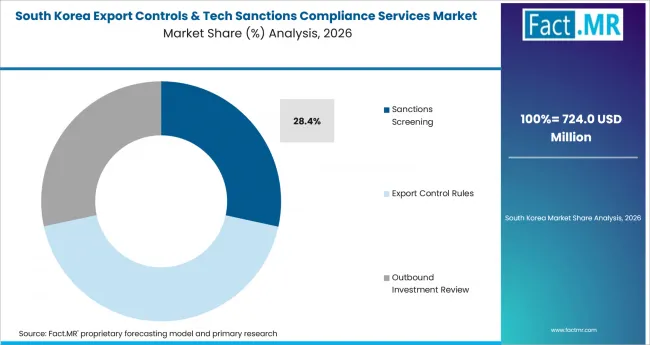
South Korea is expected to post 29.6% CAGR through 2036 as semiconductor exports and equipment imports require faster screening. The Ministry of Trade, Industry and Resources reported semiconductor exports of USD 32.8 billion in March 2026. Memory, equipment and computer flows create repeated classification and customer-review needs. Providers with Korean-language entity data and East Asia license knowledge gain stronger buyer access.
What makes the United States a policy center?
28.7% CAGR, backed by enforcement activity and outbound-investment rules.
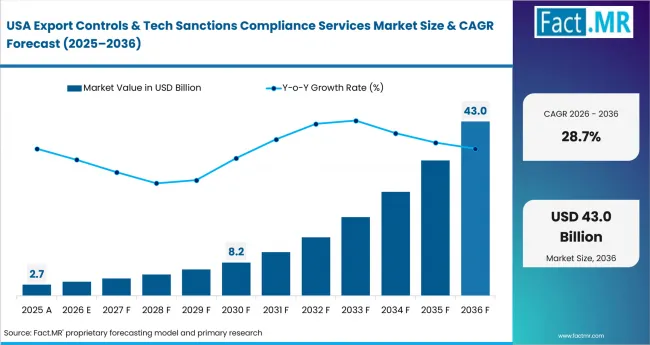
The United States is forecast to advance at 28.7% CAGR through 2036 because its controls shape global compliance workflows. The Bureau of Industry and Security reported 26 Disruptive Technology Strike Force criminal cases tied to sanctions, export-control violations and sensitive technology transfer. U.S. buyers also compare trade compliance tools with related age verification and online safety compliance services where policy enforcement requires auditable identity checks.
Why does the Netherlands matter?
28.1% CAGR, supported by semiconductor equipment licensing and EU alignment.
The Netherlands is likely to record 28.1% CAGR through 2036 because semiconductor equipment exports require careful licensing review. The Dutch government expanded export controls on semiconductor manufacturing equipment in September 2024 and tightened specific measuring and inspection equipment controls in January 2025. Equipment suppliers need classification support, customer checks and license documentation before shipments proceed.
What underpins Germany’s compliance base?
27.5% CAGR, backed by EU dual-use controls and industrial exporter depth.
Germany is projected to expand at 27.5% CAGR through 2036 because industrial exporters face EU dual-use licensing and sanctions review. The Federal Office for Economic Affairs and Export Control acts as Germany’s central export licensing authority. Machinery, electronics and aerospace exporters need practical support that links product classification with customer and destination review. Demand favors advisors that understand German filings and EU control logic.
Why is Japan an important compliance market?
27.0% CAGR, supported by chip-equipment production and conservative export review.
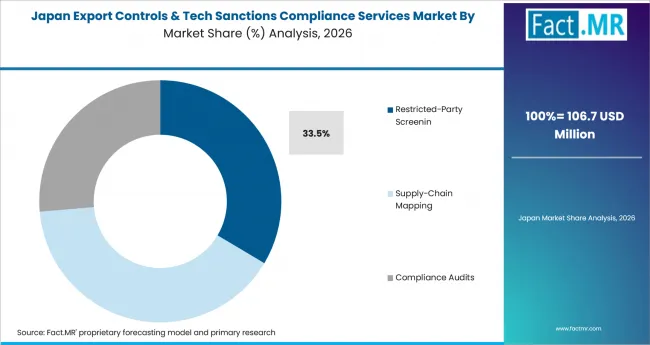
Japan is expected to register 27.0% CAGR through 2036 as semiconductor equipment suppliers manage customer and destination exposure. The Semiconductor Equipment Association of Japan forecast sales of Japanese-made semiconductor manufacturing equipment at JPY 4.91 trillion for fiscal 2025. That equipment base creates repeated needs for classification, license screening and distributor oversight.
How is China reshaping compliance checks?
25.8% CAGR, supported by export controls on critical inputs and counterparty review.
China is forecast to grow at 25.8% CAGR through 2036 as controls on rare earth and technology items increase exporter review needs. The Ministry of Commerce and the General Administration of Customs announced export controls on medium and heavy rare earth related items in April 2025. Global buyers also monitor related compliance programs such as multi-MRL pesticide programs where export eligibility depends on destination-specific rules.
Who leads the export controls & tech sanctions compliance services landscape?
Kharon, Sayari, Altana, Exiger, Descartes, SAP and Thomson Reuters lead through data, workflow and advisory depth.
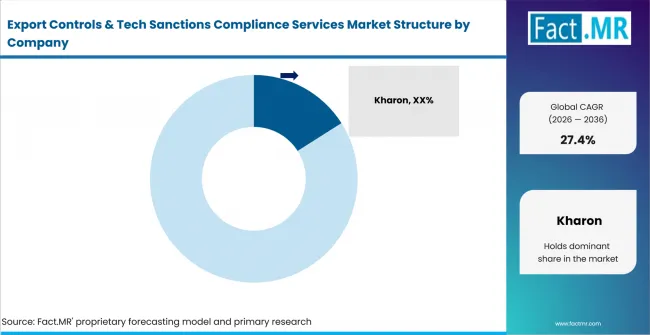
Export controls & tech sanctions compliance services are used by exporters, investors and industrial buyers that need defensible evidence before trade or deal execution. Kharon is recognized for sanctions and ownership intelligence used in counterparty review. Sayari supports supply-chain mapping and risk screening through primary-source corporate data. Altana provides value-chain mapping used by public and private-sector customers.
Capability separates suppliers in this market. Exiger supports government and enterprise users with transshipment detection and supply-chain risk tools. Descartes expanded export-control and license-management capabilities in 2025. Thomson Reuters supplies trade content across more than 220 countries and territories. Comparable compliance workflow pressure appears in cash-and-carry logistics optimization services where route, documentation and rule checks affect operating decisions.
Buyer selection is based on data coverage, update speed, audit records and expert review. Enterprise platforms such as SAP compete when trade controls need to sit inside planning and shipment systems. Advisory practices at Deloitte, EY, PwC and KPMG compete where the buyer needs program design, transaction review and training. Some exporters also link export controls with net-zero-as-a-service work because supplier evidence and reporting discipline increasingly overlap.
Entry is difficult because a usable service needs regulatory content, entity data, screening logic and defensible documentation. Smaller providers can win when they specialize in one country, one control category or one high-risk supply chain. Providers best placed through 2036 combine current regulatory content, map-level supplier visibility and service teams that can explain exceptions in plain language.
Which companies are the key players?
Kharon, Sayari, Altana, Exiger, Descartes, SAP, Thomson Reuters, Deloitte, EY, PwC and KPMG.
- Kharon
- Sayari
- Altana
- Exiger
- Descartes
- SAP
- Thomson Reuters
- Deloitte
- EY
- PwC
- KPMG
Bibliography
- [1] U.S. Department of Commerce, Bureau of Industry and Security. (2025, January 2). Export Enforcement releases 2024 year in review.
- [2] U.S. Department of Commerce, Bureau of Industry and Security. (2024, December 2). Commerce strengthens export controls to restrict China’s capability to produce advanced semiconductors for military applications.
- [3] U.S. Department of the Treasury. (n.d.). Outbound Investment Security Program.
- [4] European Commission. (2025, January 31). Report highlights EU’s approach to export controls of dual-use items.
- [5] Government of the Netherlands. (2024, September 6). The Netherlands expands export control measure for advanced semiconductor manufacturing equipment.
- [6] Government of the Netherlands. (2025, January 15). Klever: Export controls on advanced semiconductor manufacturing equipment to be tightened.
- [7] Ministry of Commerce of the People’s Republic of China, & General Administration of Customs of the People’s Republic of China. (2025, April 4). Announcement No. 18 of 2025 of the Ministry of Commerce and the General Administration of Customs of the People’s Republic of China announcing the decision to implement export control on some medium and heavy rare earth related items.
- [8] Ministry of Trade, Industry and Resources. (2026, April 1). March 2026 exports reach record $86.1 billion, surpassing $80 billion for the first time.
- [9] Ministry of Finance, R.O.C. (Taiwan). (2026, February 23). Annual external trade report in 2025.
- [10] Semiconductor Equipment Association of Japan. (2026, January 15). Market forecast report: Semiconductor and FPD manufacturing equipment: Fiscal years 2025 to 2027.
- [11] Federal Office for Economic Affairs and Export Control. (n.d.). Export control.
- [12] Sayari. (2024, April 9). Sayari launches new supply chain mapping solution to automate risk detection in upstream suppliers.
- [13] Altana. (2024, February 5). United Kingdom Department for Business & Trade contracts with Altana to provide the UK government with the only dynamic, intelligent map of the global supply chain.
- [14] Exiger. (2025, October 28). U.S. Customs and Border Protection selects Exiger’s AI as critical tool for detection of illicit transshipment.
- [15] Descartes Systems Group. (2025, February 6). Descartes showcases global trade intelligence technology innovations.
- [16] Thomson Reuters Tax & Accounting. (2026, April 7). Thomson Reuters delivers validated global trade content for Oracle users.
This Report Addresses
- Strategic intelligence on export controls & tech sanctions compliance services across service type, regulation type and customer type.
- Segment analysis covering Restricted-Party Screening, Sanctions Screening, Semiconductor Firms, SaaS Subscriptions and Semiconductor Supply Chains.
- Regional outlook covering Taiwan, South Korea, United States, Netherlands, Germany, Japan and China.
- Competitive analysis of Kharon, Sayari, Altana, Exiger, Descartes, SAP, Thomson Reuters, Deloitte, EY, PwC and KPMG.
- Service assessment covering screening, supply-chain mapping, export licensing support, classification advisory and compliance audits.
- Regulation assessment covering U.S. semiconductor controls, EU dual-use rules, outbound-investment review and country-specific export controls.
- Primary interviews, provider checks, official source review and regulatory-update validation support the forecast.
What does the export controls & tech sanctions compliance services market cover?
Screening, supply-chain mapping and license-support services for controlled goods, technology, investment and counterparties.
The export controls & tech sanctions compliance services market covers software, managed services and advisory work used to keep controlled products and technology from reaching prohibited buyers. It includes restricted-party screening, ownership checks, product classification, license support and supply-chain mapping. The market differs from general customs services because the service focus is sanctions exposure, end-use evidence and technology-control compliance.
What is included in the scope?
Restricted-party screening, end-use checks, product classification, license preparation and supply-chain visibility.
The scope includes sanctions screening and entity ownership review. It covers export-control classification, license application support and outbound-investment diligence. It includes supply-chain mapping for restricted technology and compliance audit support. It also includes managed compliance programs used by semiconductor, electronics, aerospace and industrial exporters.
What is excluded from the scope?
General freight forwarding, customs brokerage without controls review and legal disputes after enforcement action.
The scope excludes freight forwarding services that do not include export-control review. It excludes ordinary customs brokerage where no sanctions or technology-control assessment is provided. It excludes law-firm litigation services after an enforcement case begins. It also excludes financial-crime screening tools sold outside trade, technology or export workflows.
How was the analysis built?
120+ sources, 60+ company portfolios, 30+ countries, 25+ interviews.
- Primary Research: Primary research includes interviews with trade compliance heads, semiconductor exporters and sanctions-screening buyers. It also includes input from managed-service providers and export-control advisors.
- Desk Research: Desk research reviews official export-control rules, sanctions programs and dual-use regulation sources. It covers company service lines, platform features and recent compliance service launches.
- Market-Sizing and Forecasting: Forecasting uses regulated exporter counts, software pricing and managed-service intensity. Semiconductor rule changes and enforcement activity support the market assessment.
- Data Validation and Update Cycle: Forecasts are validated through provider checks and buyer interviews. Rule updates, licensing activity and company developments help confirm market direction.
What is the report’s scope and coverage?
| Attribute | Details |
|---|---|
| Quantitative Units | USD Billion in 2026 to USD Billion by 2036 at CAGR |
| Market Definition | Screening, supply-chain mapping and licensing services for export controls, technology sanctions and outbound-investment rules |
| Service Type | Restricted-Party Screening, Supply-Chain Mapping, Export Licensing Support, Classification Advisory, Compliance Audits |
| Regulation Type | Sanctions Screening, Export Control Rules, Outbound Investment Review, Dual-Use Classification, Forced Labor Checks |
| Customer Type | Semiconductor Firms, Industrial Exporters, Electronics Distributors, Cloud Infrastructure Firms, Financial Institutions |
| Delivery Model | SaaS Subscriptions, Managed Compliance, Advisory Projects, Data APIs, Training Support |
| End Use | Semiconductor Supply Chains, Aerospace and Defense, AI Infrastructure, Industrial Automation, Electronics Distribution |
| Regions Covered | North America, East Asia, Western Europe, South Asia and Pacific, Latin America, Middle East and Africa |
| Countries Covered | Taiwan, South Korea, United States, Netherlands, Germany, Japan, China |
| Key Companies Profiled | Kharon, Sayari, Altana, Exiger, Descartes, SAP, Thomson Reuters, Deloitte, EY, PwC and KPMG |
| Forecast Period | 2026 to 2036 |
| Approach | Hybrid top-down and bottom-up approach using exporter base, software pricing, service intensity, regulatory updates and provider validation |
How is the market segmented?
-
By Service Type:
- Restricted-Party Screening
- Supply-Chain Mapping
- Export Licensing Support
- Classification Advisory
- Compliance Audits
-
By Regulation Type:
- Sanctions Screening
- Export Control Rules
- Outbound Investment Review
- Dual-Use Classification
- Forced Labor Checks
-
By Customer Type:
- Semiconductor Firms
- Industrial Exporters
- Electronics Distributors
- Cloud Infrastructure Firms
- Financial Institutions
-
By Delivery Model:
- SaaS Subscriptions
- Managed Compliance
- Advisory Projects
- Data APIs
- Training Support
-
By End Use:
- Semiconductor Supply Chains
- Aerospace and Defense
- AI Infrastructure
- Industrial Automation
- Electronics Distribution
-
By Region:
- North America
- United States
- Canada
- Mexico
- Latin America
- Brazil
- Argentina
- Rest of Latin America
- Europe
- Germany
- United Kingdom
- France
- Italy
- Spain
- Netherlands
- Rest of Europe
- Asia Pacific
- China
- India
- Japan
- South Korea
- Taiwan
- ASEAN
- Middle East & Africa
- GCC Countries
- South Africa
- UAE
- Rest of Middle East & Africa
- North America
- Frequently Asked Questions -
How should buyers understand the current position of the Export Controls & Tech Sanctions Compliance Services Market?
The export controls and tech sanctions compliance services market is estimated to be a fast-forming compliance layer for exporters handling controlled technologies.
How is the Export Controls & Tech Sanctions Compliance Services Market expected to develop through the forecast period?
The market is projected to expand as companies need external support for licensing checks and counterparty reviews.
What growth pattern is expected in the Export Controls & Tech Sanctions Compliance Services Market?
The market is forecast to advance above traditional compliance services because technology controls now affect shipments and investments.
Which service category has the clearest early lead in this market?
Restricted-Party Screening leads because exporters must verify buyers and intermediaries before shipments or transactions move forward.
Which country shows the strongest pull for export controls and tech sanctions compliance services?
Taiwan shows the strongest pull because semiconductor exports require deeper customer checks and end-use review.
How does South Korea support demand in this market?
South Korea supports demand because memory chip and equipment flows require tighter screening before international shipment.
Why does the Netherlands matter in export controls and tech sanctions compliance services?
The Netherlands matters because semiconductor equipment controls create recurring needs for licensing and destination checks.
How does Germany fit into the export controls and tech sanctions compliance outlook?
Germany is important because dual-use manufacturing and European Union controls require advisory support.
How does Japan contribute to service demand in this market?
Japan contributes through chip-equipment suppliers that need classification support and destination review before cross-border sales.
How does China affect the compliance services outlook?
China affects the outlook because technology and rare-earth controls change how companies assess supply risk and shipment exposure.
What is supporting demand for export controls and tech sanctions compliance services?
Demand is supported by companies that must screen controlled technology and restricted buyers before shipments proceed.
What limits wider use of export controls and tech sanctions compliance services?
Wider use is constrained by data quality because ownership changes and name variants can create review errors.
Why are semiconductor supply chains important in this market?
Semiconductor supply chains are important because chip tools and technical know-how face controls in multiple jurisdictions.
Table of Content
- Executive Summary
- Global Market Outlook
- Demand to side Trends
- Supply to side Trends
- Technology Roadmap Analysis
- Analysis and Recommendations
- Market Overview
- Market Coverage / Taxonomy
- Market Definition / Scope / Limitations
- Research Methodology
- Chapter Orientation
- Analytical Lens and Working Hypotheses
- Market Structure, Signals, and Trend Drivers
- Benchmarking and Cross-market Comparability
- Market Sizing, Forecasting, and Opportunity Mapping
- Research Design and Evidence Framework
- Desk Research Programme (Secondary Evidence)
- Company Annual and Sustainability Reports
- Peer-reviewed Journals and Academic Literature
- Trade Journals, Industry Magazines, and Analyst Briefs
- Conference Proceedings, Webinars, and Seminar Materials
- Government Statistics Portals and Public Data Releases
- Press Releases and Reputable Media Coverage
- Specialist Newsletters and Curated Briefings
- Sector Databases and Reference Repositories
- Fact.MR Internal Proprietary Databases and Historical Market Datasets
- Subscription Datasets and Paid Sources
- Social Channels, Communities, and Digital Listening Inputs
- Additional Desk Sources
- Expert Input and Fieldwork (Primary Evidence)
- Primary Modes
- Qualitative Interviews and Expert Elicitation
- Quantitative Surveys and Structured Data Capture
- Blended Approach
- Why Primary Evidence is Used
- Field Techniques
- Interviews
- Surveys
- Focus Groups
- Observational and In-context Research
- Social and Community Interactions
- Stakeholder Universe Engaged
- C-suite Leaders
- Board Members
- Presidents and Vice Presidents
- R&D and Innovation Heads
- Technical Specialists
- Domain Subject-matter Experts
- Scientists
- Physicians and Other Healthcare Professionals
- Governance, Ethics, and Data Stewardship
- Research Ethics
- Data Integrity and Handling
- Primary Modes
- Opportunity
- Trends
- Desk Research Programme (Secondary Evidence)
- Scenario Forecast
- Demand in Optimistic Scenario
- Demand in Likely Scenario
- Demand in Conservative Scenario
- Opportunity Map Analysis
- Product Life Cycle Analysis
- Supply Chain Analysis
- Investment Feasibility Matrix
- Value Chain Analysis
- PESTLE and Porter’s Analysis
- Regulatory Landscape
- Regional Parent Market Outlook
- Production and Consumption Statistics
- Import and Export Statistics
- Global Market Analysis 2021 to 2025 and Forecast, 2026 to 2036
- Historical Market Size Value (USD Million) Analysis, 2021 to 2025
- Current and Future Market Size Value (USD Million) Projections, 2026 to 2036
- Y to o to Y Growth Trend Analysis
- Absolute $ Opportunity Analysis
- Global Market Pricing Analysis 2021 to 2025 and Forecast 2026 to 2036
- Global Market Analysis 2021 to 2025 and Forecast 2026 to 2036, By Service Type
- Introduction / Key Findings
- Historical Market Size Value (USD Million) Analysis By Service Type , 2021 to 2025
- Current and Future Market Size Value (USD Million) Analysis and Forecast By Service Type , 2026 to 2036
- Restricted-Party Screenin
- Supply-Chain Mapping
- Compliance Audits
- Restricted-Party Screenin
- Y to o to Y Growth Trend Analysis By Service Type , 2021 to 2025
- Absolute $ Opportunity Analysis By Service Type , 2026 to 2036
- Global Market Analysis 2021 to 2025 and Forecast 2026 to 2036, By Regulation Type
- Introduction / Key Findings
- Historical Market Size Value (USD Million) Analysis By Regulation Type, 2021 to 2025
- Current and Future Market Size Value (USD Million) Analysis and Forecast By Regulation Type, 2026 to 2036
- Sanctions Screening
- Export Control Rules
- Outbound Investment Review
- Sanctions Screening
- Y to o to Y Growth Trend Analysis By Regulation Type, 2021 to 2025
- Absolute $ Opportunity Analysis By Regulation Type, 2026 to 2036
- Global Market Analysis 2021 to 2025 and Forecast 2026 to 2036, By Customer Type
- Introduction / Key Findings
- Historical Market Size Value (USD Million) Analysis By Customer Type, 2021 to 2025
- Current and Future Market Size Value (USD Million) Analysis and Forecast By Customer Type, 2026 to 2036
- Semiconductor Firms
- Industrial Exporters
- Cloud Infrastructure Firms
- Semiconductor Firms
- Y to o to Y Growth Trend Analysis By Customer Type, 2021 to 2025
- Absolute $ Opportunity Analysis By Customer Type, 2026 to 2036
- Global Market Analysis 2021 to 2025 and Forecast 2026 to 2036, By Delivery Model
- Introduction / Key Findings
- Historical Market Size Value (USD Million) Analysis By Delivery Model, 2021 to 2025
- Current and Future Market Size Value (USD Million) Analysis and Forecast By Delivery Model, 2026 to 2036
- SaaS Subscriptions
- Managed Compliance
- Data APIs
- SaaS Subscriptions
- Y to o to Y Growth Trend Analysis By Delivery Model, 2021 to 2025
- Absolute $ Opportunity Analysis By Delivery Model, 2026 to 2036
- Global Market Analysis 2021 to 2025 and Forecast 2026 to 2036, By End Use
- Introduction / Key Findings
- Historical Market Size Value (USD Million) Analysis By End Use, 2021 to 2025
- Current and Future Market Size Value (USD Million) Analysis and Forecast By End Use, 2026 to 2036
- Semiconductor Supply Chains
- Aerospace and Defense
- Electronics Distribution
- Semiconductor Supply Chains
- Y to o to Y Growth Trend Analysis By End Use, 2021 to 2025
- Absolute $ Opportunity Analysis By End Use, 2026 to 2036
- Global Market Analysis 2021 to 2025 and Forecast 2026 to 2036, By Region
- Introduction
- Historical Market Size Value (USD Million) Analysis By Region, 2021 to 2025
- Current Market Size Value (USD Million) Analysis and Forecast By Region, 2026 to 2036
- North America
- Latin America
- Western Europe
- Eastern Europe
- East Asia
- South Asia and Pacific
- Middle East & Africa
- Market Attractiveness Analysis By Region
- North America Market Analysis 2021 to 2025 and Forecast 2026 to 2036, By Country
- Historical Market Size Value (USD Million) Trend Analysis By Market Taxonomy, 2021 to 2025
- Market Size Value (USD Million) Forecast By Market Taxonomy, 2026 to 2036
- By Country
- USA
- Canada
- Mexico
- By Service Type
- By Regulation Type
- By Customer Type
- By Delivery Model
- By End Use
- By Country
- Market Attractiveness Analysis
- By Country
- By Service Type
- By Regulation Type
- By Customer Type
- By Delivery Model
- By End Use
- Key Takeaways
- Latin America Market Analysis 2021 to 2025 and Forecast 2026 to 2036, By Country
- Historical Market Size Value (USD Million) Trend Analysis By Market Taxonomy, 2021 to 2025
- Market Size Value (USD Million) Forecast By Market Taxonomy, 2026 to 2036
- By Country
- Brazil
- Chile
- Rest of Latin America
- By Service Type
- By Regulation Type
- By Customer Type
- By Delivery Model
- By End Use
- By Country
- Market Attractiveness Analysis
- By Country
- By Service Type
- By Regulation Type
- By Customer Type
- By Delivery Model
- By End Use
- Key Takeaways
- Western Europe Market Analysis 2021 to 2025 and Forecast 2026 to 2036, By Country
- Historical Market Size Value (USD Million) Trend Analysis By Market Taxonomy, 2021 to 2025
- Market Size Value (USD Million) Forecast By Market Taxonomy, 2026 to 2036
- By Country
- Germany
- UK
- Italy
- Spain
- France
- Nordic
- BENELUX
- Rest of Western Europe
- By Service Type
- By Regulation Type
- By Customer Type
- By Delivery Model
- By End Use
- By Country
- Market Attractiveness Analysis
- By Country
- By Service Type
- By Regulation Type
- By Customer Type
- By Delivery Model
- By End Use
- Key Takeaways
- Eastern Europe Market Analysis 2021 to 2025 and Forecast 2026 to 2036, By Country
- Historical Market Size Value (USD Million) Trend Analysis By Market Taxonomy, 2021 to 2025
- Market Size Value (USD Million) Forecast By Market Taxonomy, 2026 to 2036
- By Country
- Russia
- Poland
- Hungary
- Balkan & Baltic
- Rest of Eastern Europe
- By Service Type
- By Regulation Type
- By Customer Type
- By Delivery Model
- By End Use
- By Country
- Market Attractiveness Analysis
- By Country
- By Service Type
- By Regulation Type
- By Customer Type
- By Delivery Model
- By End Use
- Key Takeaways
- East Asia Market Analysis 2021 to 2025 and Forecast 2026 to 2036, By Country
- Historical Market Size Value (USD Million) Trend Analysis By Market Taxonomy, 2021 to 2025
- Market Size Value (USD Million) Forecast By Market Taxonomy, 2026 to 2036
- By Country
- China
- Japan
- South Korea
- By Service Type
- By Regulation Type
- By Customer Type
- By Delivery Model
- By End Use
- By Country
- Market Attractiveness Analysis
- By Country
- By Service Type
- By Regulation Type
- By Customer Type
- By Delivery Model
- By End Use
- Key Takeaways
- South Asia and Pacific Market Analysis 2021 to 2025 and Forecast 2026 to 2036, By Country
- Historical Market Size Value (USD Million) Trend Analysis By Market Taxonomy, 2021 to 2025
- Market Size Value (USD Million) Forecast By Market Taxonomy, 2026 to 2036
- By Country
- India
- ASEAN
- Australia & New Zealand
- Rest of South Asia and Pacific
- By Service Type
- By Regulation Type
- By Customer Type
- By Delivery Model
- By End Use
- By Country
- Market Attractiveness Analysis
- By Country
- By Service Type
- By Regulation Type
- By Customer Type
- By Delivery Model
- By End Use
- Key Takeaways
- Middle East & Africa Market Analysis 2021 to 2025 and Forecast 2026 to 2036, By Country
- Historical Market Size Value (USD Million) Trend Analysis By Market Taxonomy, 2021 to 2025
- Market Size Value (USD Million) Forecast By Market Taxonomy, 2026 to 2036
- By Country
- Kingdom of Saudi Arabia
- Other GCC Countries
- Turkiye
- South Africa
- Other African Union
- Rest of Middle East & Africa
- By Service Type
- By Regulation Type
- By Customer Type
- By Delivery Model
- By End Use
- By Country
- Market Attractiveness Analysis
- By Country
- By Service Type
- By Regulation Type
- By Customer Type
- By Delivery Model
- By End Use
- Key Takeaways
- Key Countries Market Analysis
- USA
- Pricing Analysis
- Market Share Analysis, 2025
- By Service Type
- By Regulation Type
- By Customer Type
- By Delivery Model
- By End Use
- Canada
- Pricing Analysis
- Market Share Analysis, 2025
- By Service Type
- By Regulation Type
- By Customer Type
- By Delivery Model
- By End Use
- Mexico
- Pricing Analysis
- Market Share Analysis, 2025
- By Service Type
- By Regulation Type
- By Customer Type
- By Delivery Model
- By End Use
- Brazil
- Pricing Analysis
- Market Share Analysis, 2025
- By Service Type
- By Regulation Type
- By Customer Type
- By Delivery Model
- By End Use
- Chile
- Pricing Analysis
- Market Share Analysis, 2025
- By Service Type
- By Regulation Type
- By Customer Type
- By Delivery Model
- By End Use
- Germany
- Pricing Analysis
- Market Share Analysis, 2025
- By Service Type
- By Regulation Type
- By Customer Type
- By Delivery Model
- By End Use
- UK
- Pricing Analysis
- Market Share Analysis, 2025
- By Service Type
- By Regulation Type
- By Customer Type
- By Delivery Model
- By End Use
- Italy
- Pricing Analysis
- Market Share Analysis, 2025
- By Service Type
- By Regulation Type
- By Customer Type
- By Delivery Model
- By End Use
- Spain
- Pricing Analysis
- Market Share Analysis, 2025
- By Service Type
- By Regulation Type
- By Customer Type
- By Delivery Model
- By End Use
- France
- Pricing Analysis
- Market Share Analysis, 2025
- By Service Type
- By Regulation Type
- By Customer Type
- By Delivery Model
- By End Use
- India
- Pricing Analysis
- Market Share Analysis, 2025
- By Service Type
- By Regulation Type
- By Customer Type
- By Delivery Model
- By End Use
- ASEAN
- Pricing Analysis
- Market Share Analysis, 2025
- By Service Type
- By Regulation Type
- By Customer Type
- By Delivery Model
- By End Use
- Australia & New Zealand
- Pricing Analysis
- Market Share Analysis, 2025
- By Service Type
- By Regulation Type
- By Customer Type
- By Delivery Model
- By End Use
- China
- Pricing Analysis
- Market Share Analysis, 2025
- By Service Type
- By Regulation Type
- By Customer Type
- By Delivery Model
- By End Use
- Japan
- Pricing Analysis
- Market Share Analysis, 2025
- By Service Type
- By Regulation Type
- By Customer Type
- By Delivery Model
- By End Use
- South Korea
- Pricing Analysis
- Market Share Analysis, 2025
- By Service Type
- By Regulation Type
- By Customer Type
- By Delivery Model
- By End Use
- Russia
- Pricing Analysis
- Market Share Analysis, 2025
- By Service Type
- By Regulation Type
- By Customer Type
- By Delivery Model
- By End Use
- Poland
- Pricing Analysis
- Market Share Analysis, 2025
- By Service Type
- By Regulation Type
- By Customer Type
- By Delivery Model
- By End Use
- Hungary
- Pricing Analysis
- Market Share Analysis, 2025
- By Service Type
- By Regulation Type
- By Customer Type
- By Delivery Model
- By End Use
- Kingdom of Saudi Arabia
- Pricing Analysis
- Market Share Analysis, 2025
- By Service Type
- By Regulation Type
- By Customer Type
- By Delivery Model
- By End Use
- Turkiye
- Pricing Analysis
- Market Share Analysis, 2025
- By Service Type
- By Regulation Type
- By Customer Type
- By Delivery Model
- By End Use
- South Africa
- Pricing Analysis
- Market Share Analysis, 2025
- By Service Type
- By Regulation Type
- By Customer Type
- By Delivery Model
- By End Use
- USA
- Market Structure Analysis
- Competition Dashboard
- Competition Benchmarking
- Market Share Analysis of Top Players
- By Regional
- By Service Type
- By Regulation Type
- By Customer Type
- By Delivery Model
- By End Use
- Competition Analysis
- Competition Deep Dive
- Kharon
- Overview
- Product Portfolio
- Profitability by Market Segments (Product/Age /Sales Channel/Region)
- Sales Footprint
- Strategy Overview
- Marketing Strategy
- Product Strategy
- Channel Strategy
- Sayari
- Altana
- Exiger
- Descartes
- SAP
- Thomson Reuters
- Deloitte
- Kharon
- Competition Deep Dive
- Assumptions & Acronyms Used
List Of Table
- Table 1: Global Market Value (USD Million) Forecast by Region, 2021 - 2036
- Table 2: Global Market Value (USD Million) Forecast by Service Type, 2021 - 2036
- Table 3: Global Market Value (USD Million) Forecast by Regulation Type, 2021 - 2036
- Table 4: Global Market Value (USD Million) Forecast by Customer Type, 2021 - 2036
- Table 5: Global Market Value (USD Million) Forecast by Delivery Model, 2021 - 2036
- Table 6: Global Market Value (USD Million) Forecast by End Use, 2021 - 2036
- Table 7: North America Market Value (USD Million) Forecast by Country, 2021 - 2036
- Table 8: North America Market Value (USD Million) Forecast by Service Type, 2021 - 2036
- Table 9: North America Market Value (USD Million) Forecast by Regulation Type, 2021 - 2036
- Table 10: North America Market Value (USD Million) Forecast by Customer Type, 2021 - 2036
- Table 11: North America Market Value (USD Million) Forecast by Delivery Model, 2021 - 2036
- Table 12: North America Market Value (USD Million) Forecast by End Use, 2021 - 2036
- Table 13: Latin America Market Value (USD Million) Forecast by Country, 2021 - 2036
- Table 14: Latin America Market Value (USD Million) Forecast by Service Type, 2021 - 2036
- Table 15: Latin America Market Value (USD Million) Forecast by Regulation Type, 2021 - 2036
- Table 16: Latin America Market Value (USD Million) Forecast by Customer Type, 2021 - 2036
- Table 17: Latin America Market Value (USD Million) Forecast by Delivery Model, 2021 - 2036
- Table 18: Latin America Market Value (USD Million) Forecast by End Use, 2021 - 2036
- Table 19: Western Europe Market Value (USD Million) Forecast by Country, 2021 - 2036
- Table 20: Western Europe Market Value (USD Million) Forecast by Service Type, 2021 - 2036
- Table 21: Western Europe Market Value (USD Million) Forecast by Regulation Type, 2021 - 2036
- Table 22: Western Europe Market Value (USD Million) Forecast by Customer Type, 2021 - 2036
- Table 23: Western Europe Market Value (USD Million) Forecast by Delivery Model, 2021 - 2036
- Table 24: Western Europe Market Value (USD Million) Forecast by End Use, 2021 - 2036
- Table 25: Eastern Europe Market Value (USD Million) Forecast by Country, 2021 - 2036
- Table 26: Eastern Europe Market Value (USD Million) Forecast by Service Type, 2021 - 2036
- Table 27: Eastern Europe Market Value (USD Million) Forecast by Regulation Type, 2021 - 2036
- Table 28: Eastern Europe Market Value (USD Million) Forecast by Customer Type, 2021 - 2036
- Table 29: Eastern Europe Market Value (USD Million) Forecast by Delivery Model, 2021 - 2036
- Table 30: Eastern Europe Market Value (USD Million) Forecast by End Use, 2021 - 2036
- Table 31: East Asia Market Value (USD Million) Forecast by Country, 2021 - 2036
- Table 32: East Asia Market Value (USD Million) Forecast by Service Type, 2021 - 2036
- Table 33: East Asia Market Value (USD Million) Forecast by Regulation Type, 2021 - 2036
- Table 34: East Asia Market Value (USD Million) Forecast by Customer Type, 2021 - 2036
- Table 35: East Asia Market Value (USD Million) Forecast by Delivery Model, 2021 - 2036
- Table 36: East Asia Market Value (USD Million) Forecast by End Use, 2021 - 2036
- Table 37: South Asia and Pacific Market Value (USD Million) Forecast by Country, 2021 - 2036
- Table 38: South Asia and Pacific Market Value (USD Million) Forecast by Service Type, 2021 - 2036
- Table 39: South Asia and Pacific Market Value (USD Million) Forecast by Regulation Type, 2021 - 2036
- Table 40: South Asia and Pacific Market Value (USD Million) Forecast by Customer Type, 2021 - 2036
- Table 41: South Asia and Pacific Market Value (USD Million) Forecast by Delivery Model, 2021 - 2036
- Table 42: South Asia and Pacific Market Value (USD Million) Forecast by End Use, 2021 - 2036
- Table 43: Middle East & Africa Market Value (USD Million) Forecast by Country, 2021 - 2036
- Table 44: Middle East & Africa Market Value (USD Million) Forecast by Service Type, 2021 - 2036
- Table 45: Middle East & Africa Market Value (USD Million) Forecast by Regulation Type, 2021 - 2036
- Table 46: Middle East & Africa Market Value (USD Million) Forecast by Customer Type, 2021 - 2036
- Table 47: Middle East & Africa Market Value (USD Million) Forecast by Delivery Model, 2021 - 2036
- Table 48: Middle East & Africa Market Value (USD Million) Forecast by End Use, 2021 - 2036
List Of Figures
- Figure 1: Global Market Pricing Analysis
- Figure 2: Global Market Value (USD Million) Forecast 2021-2036
- Figure 3: Global Market Value Share and BPS Analysis by Service Type , 2026 - 2036
- Figure 4: Global Market Y-o-Y Growth Comparison by Service Type , 2026 - 2036
- Figure 5: Global Market Attractiveness Analysis by Service Type
- Figure 6: Global Market Value Share and BPS Analysis by Regulation Type, 2026 - 2036
- Figure 7: Global Market Y-o-Y Growth Comparison by Regulation Type, 2026 - 2036
- Figure 8: Global Market Attractiveness Analysis by Regulation Type
- Figure 9: Global Market Value Share and BPS Analysis by Customer Type, 2026 - 2036
- Figure 10: Global Market Y-o-Y Growth Comparison by Customer Type, 2026 - 2036
- Figure 11: Global Market Attractiveness Analysis by Customer Type
- Figure 12: Global Market Value Share and BPS Analysis by Delivery Model, 2026 - 2036
- Figure 13: Global Market Y-o-Y Growth Comparison by Delivery Model, 2026 - 2036
- Figure 14: Global Market Attractiveness Analysis by Delivery Model
- Figure 15: Global Market Value Share and BPS Analysis by End Use, 2026 - 2036
- Figure 16: Global Market Y-o-Y Growth Comparison by End Use, 2026 - 2036
- Figure 17: Global Market Attractiveness Analysis by End Use
- Figure 18: Global Market Value (USD Million) Share and BPS Analysis by Region, 2026 - 2036
- Figure 19: Global Market Y-o-Y Growth Comparison by Region, 2026 - 2036
- Figure 20: Global Market Attractiveness Analysis by Region
- Figure 21: North America Market Incremental Dollar Opportunity, 2026 - 2036
- Figure 22: Latin America Market Incremental Dollar Opportunity, 2026 - 2036
- Figure 23: Western Europe Market Incremental Dollar Opportunity, 2026 - 2036
- Figure 24: Eastern Europe Market Incremental Dollar Opportunity, 2026 - 2036
- Figure 25: East Asia Market Incremental Dollar Opportunity, 2026 - 2036
- Figure 26: South Asia and Pacific Market Incremental Dollar Opportunity, 2026 - 2036
- Figure 27: Middle East & Africa Market Incremental Dollar Opportunity, 2026 - 2036
- Figure 28: North America Market Value Share and BPS Analysis by Country, 2026 - 2036
- Figure 29: North America Market Value Share and BPS Analysis by Service Type , 2026 - 2036
- Figure 30: North America Market Y-o-Y Growth Comparison by Service Type , 2026 - 2036
- Figure 31: North America Market Attractiveness Analysis by Service Type
- Figure 32: North America Market Value Share and BPS Analysis by Regulation Type, 2026 - 2036
- Figure 33: North America Market Y-o-Y Growth Comparison by Regulation Type, 2026 - 2036
- Figure 34: North America Market Attractiveness Analysis by Regulation Type
- Figure 35: North America Market Value Share and BPS Analysis by Customer Type, 2026 - 2036
- Figure 36: North America Market Y-o-Y Growth Comparison by Customer Type, 2026 - 2036
- Figure 37: North America Market Attractiveness Analysis by Customer Type
- Figure 38: North America Market Value Share and BPS Analysis by Delivery Model, 2026 - 2036
- Figure 39: North America Market Y-o-Y Growth Comparison by Delivery Model, 2026 - 2036
- Figure 40: North America Market Attractiveness Analysis by Delivery Model
- Figure 41: North America Market Value Share and BPS Analysis by End Use, 2026 - 2036
- Figure 42: North America Market Y-o-Y Growth Comparison by End Use, 2026 - 2036
- Figure 43: North America Market Attractiveness Analysis by End Use
- Figure 44: Latin America Market Value Share and BPS Analysis by Country, 2026 - 2036
- Figure 45: Latin America Market Value Share and BPS Analysis by Service Type , 2026 - 2036
- Figure 46: Latin America Market Y-o-Y Growth Comparison by Service Type , 2026 - 2036
- Figure 47: Latin America Market Attractiveness Analysis by Service Type
- Figure 48: Latin America Market Value Share and BPS Analysis by Regulation Type, 2026 - 2036
- Figure 49: Latin America Market Y-o-Y Growth Comparison by Regulation Type, 2026 - 2036
- Figure 50: Latin America Market Attractiveness Analysis by Regulation Type
- Figure 51: Latin America Market Value Share and BPS Analysis by Customer Type, 2026 - 2036
- Figure 52: Latin America Market Y-o-Y Growth Comparison by Customer Type, 2026 - 2036
- Figure 53: Latin America Market Attractiveness Analysis by Customer Type
- Figure 54: Latin America Market Value Share and BPS Analysis by Delivery Model, 2026 - 2036
- Figure 55: Latin America Market Y-o-Y Growth Comparison by Delivery Model, 2026 - 2036
- Figure 56: Latin America Market Attractiveness Analysis by Delivery Model
- Figure 57: Latin America Market Value Share and BPS Analysis by End Use, 2026 - 2036
- Figure 58: Latin America Market Y-o-Y Growth Comparison by End Use, 2026 - 2036
- Figure 59: Latin America Market Attractiveness Analysis by End Use
- Figure 60: Western Europe Market Value Share and BPS Analysis by Country, 2026 - 2036
- Figure 61: Western Europe Market Value Share and BPS Analysis by Service Type , 2026 - 2036
- Figure 62: Western Europe Market Y-o-Y Growth Comparison by Service Type , 2026 - 2036
- Figure 63: Western Europe Market Attractiveness Analysis by Service Type
- Figure 64: Western Europe Market Value Share and BPS Analysis by Regulation Type, 2026 - 2036
- Figure 65: Western Europe Market Y-o-Y Growth Comparison by Regulation Type, 2026 - 2036
- Figure 66: Western Europe Market Attractiveness Analysis by Regulation Type
- Figure 67: Western Europe Market Value Share and BPS Analysis by Customer Type, 2026 - 2036
- Figure 68: Western Europe Market Y-o-Y Growth Comparison by Customer Type, 2026 - 2036
- Figure 69: Western Europe Market Attractiveness Analysis by Customer Type
- Figure 70: Western Europe Market Value Share and BPS Analysis by Delivery Model, 2026 - 2036
- Figure 71: Western Europe Market Y-o-Y Growth Comparison by Delivery Model, 2026 - 2036
- Figure 72: Western Europe Market Attractiveness Analysis by Delivery Model
- Figure 73: Western Europe Market Value Share and BPS Analysis by End Use, 2026 - 2036
- Figure 74: Western Europe Market Y-o-Y Growth Comparison by End Use, 2026 - 2036
- Figure 75: Western Europe Market Attractiveness Analysis by End Use
- Figure 76: Eastern Europe Market Value Share and BPS Analysis by Country, 2026 - 2036
- Figure 77: Eastern Europe Market Value Share and BPS Analysis by Service Type , 2026 - 2036
- Figure 78: Eastern Europe Market Y-o-Y Growth Comparison by Service Type , 2026 - 2036
- Figure 79: Eastern Europe Market Attractiveness Analysis by Service Type
- Figure 80: Eastern Europe Market Value Share and BPS Analysis by Regulation Type, 2026 - 2036
- Figure 81: Eastern Europe Market Y-o-Y Growth Comparison by Regulation Type, 2026 - 2036
- Figure 82: Eastern Europe Market Attractiveness Analysis by Regulation Type
- Figure 83: Eastern Europe Market Value Share and BPS Analysis by Customer Type, 2026 - 2036
- Figure 84: Eastern Europe Market Y-o-Y Growth Comparison by Customer Type, 2026 - 2036
- Figure 85: Eastern Europe Market Attractiveness Analysis by Customer Type
- Figure 86: Eastern Europe Market Value Share and BPS Analysis by Delivery Model, 2026 - 2036
- Figure 87: Eastern Europe Market Y-o-Y Growth Comparison by Delivery Model, 2026 - 2036
- Figure 88: Eastern Europe Market Attractiveness Analysis by Delivery Model
- Figure 89: Eastern Europe Market Value Share and BPS Analysis by End Use, 2026 - 2036
- Figure 90: Eastern Europe Market Y-o-Y Growth Comparison by End Use, 2026 - 2036
- Figure 91: Eastern Europe Market Attractiveness Analysis by End Use
- Figure 92: East Asia Market Value Share and BPS Analysis by Country, 2026 - 2036
- Figure 93: East Asia Market Value Share and BPS Analysis by Service Type , 2026 - 2036
- Figure 94: East Asia Market Y-o-Y Growth Comparison by Service Type , 2026 - 2036
- Figure 95: East Asia Market Attractiveness Analysis by Service Type
- Figure 96: East Asia Market Value Share and BPS Analysis by Regulation Type, 2026 - 2036
- Figure 97: East Asia Market Y-o-Y Growth Comparison by Regulation Type, 2026 - 2036
- Figure 98: East Asia Market Attractiveness Analysis by Regulation Type
- Figure 99: East Asia Market Value Share and BPS Analysis by Customer Type, 2026 - 2036
- Figure 100: East Asia Market Y-o-Y Growth Comparison by Customer Type, 2026 - 2036
- Figure 101: East Asia Market Attractiveness Analysis by Customer Type
- Figure 102: East Asia Market Value Share and BPS Analysis by Delivery Model, 2026 - 2036
- Figure 103: East Asia Market Y-o-Y Growth Comparison by Delivery Model, 2026 - 2036
- Figure 104: East Asia Market Attractiveness Analysis by Delivery Model
- Figure 105: East Asia Market Value Share and BPS Analysis by End Use, 2026 - 2036
- Figure 106: East Asia Market Y-o-Y Growth Comparison by End Use, 2026 - 2036
- Figure 107: East Asia Market Attractiveness Analysis by End Use
- Figure 108: South Asia and Pacific Market Value Share and BPS Analysis by Country, 2026 - 2036
- Figure 109: South Asia and Pacific Market Value Share and BPS Analysis by Service Type , 2026 - 2036
- Figure 110: South Asia and Pacific Market Y-o-Y Growth Comparison by Service Type , 2026 - 2036
- Figure 111: South Asia and Pacific Market Attractiveness Analysis by Service Type
- Figure 112: South Asia and Pacific Market Value Share and BPS Analysis by Regulation Type, 2026 - 2036
- Figure 113: South Asia and Pacific Market Y-o-Y Growth Comparison by Regulation Type, 2026 - 2036
- Figure 114: South Asia and Pacific Market Attractiveness Analysis by Regulation Type
- Figure 115: South Asia and Pacific Market Value Share and BPS Analysis by Customer Type, 2026 - 2036
- Figure 116: South Asia and Pacific Market Y-o-Y Growth Comparison by Customer Type, 2026 - 2036
- Figure 117: South Asia and Pacific Market Attractiveness Analysis by Customer Type
- Figure 118: South Asia and Pacific Market Value Share and BPS Analysis by Delivery Model, 2026 - 2036
- Figure 119: South Asia and Pacific Market Y-o-Y Growth Comparison by Delivery Model, 2026 - 2036
- Figure 120: South Asia and Pacific Market Attractiveness Analysis by Delivery Model
- Figure 121: South Asia and Pacific Market Value Share and BPS Analysis by End Use, 2026 - 2036
- Figure 122: South Asia and Pacific Market Y-o-Y Growth Comparison by End Use, 2026 - 2036
- Figure 123: South Asia and Pacific Market Attractiveness Analysis by End Use
- Figure 124: Middle East & Africa Market Value Share and BPS Analysis by Country, 2026 - 2036
- Figure 125: Middle East & Africa Market Value Share and BPS Analysis by Service Type , 2026 - 2036
- Figure 126: Middle East & Africa Market Y-o-Y Growth Comparison by Service Type , 2026 - 2036
- Figure 127: Middle East & Africa Market Attractiveness Analysis by Service Type
- Figure 128: Middle East & Africa Market Value Share and BPS Analysis by Regulation Type, 2026 - 2036
- Figure 129: Middle East & Africa Market Y-o-Y Growth Comparison by Regulation Type, 2026 - 2036
- Figure 130: Middle East & Africa Market Attractiveness Analysis by Regulation Type
- Figure 131: Middle East & Africa Market Value Share and BPS Analysis by Customer Type, 2026 - 2036
- Figure 132: Middle East & Africa Market Y-o-Y Growth Comparison by Customer Type, 2026 - 2036
- Figure 133: Middle East & Africa Market Attractiveness Analysis by Customer Type
- Figure 134: Middle East & Africa Market Value Share and BPS Analysis by Delivery Model, 2026 - 2036
- Figure 135: Middle East & Africa Market Y-o-Y Growth Comparison by Delivery Model, 2026 - 2036
- Figure 136: Middle East & Africa Market Attractiveness Analysis by Delivery Model
- Figure 137: Middle East & Africa Market Value Share and BPS Analysis by End Use, 2026 - 2036
- Figure 138: Middle East & Africa Market Y-o-Y Growth Comparison by End Use, 2026 - 2036
- Figure 139: Middle East & Africa Market Attractiveness Analysis by End Use
- Figure 140: Global Market - Tier Structure Analysis
- Figure 141: Global Market - Company Share Analysis