- Base Value(2025): 207.4 Bn
- Estimated Value(2026): 225.0 Bn
- Forecast Value (2036): 508.7 Bn
- CAGR (2026 - 2036): 8.5%
Smart Factory Market Forecast and Outlook By Fact.MR
In 2025, the smart factory market was valued at USD 207.4 billion. Based on Fact.MR analysis, demand for smart factory solutions is estimated to grow to USD 225.0 billion in 2026 and USD 508.7 billion by 2036. FACT.MR projects a CAGR of 8.5% during the forecast period.
The global smart factory market is expected to generate an absolute dollar opportunity of USD 283.7 billion between 2026 and 2036. This transformational expansion reflects accelerating industrial IoT and AI integration across automotive, electronics, and food manufacturing sectors, driven by labour cost optimisation mandates, near-shoring of production to automation-intensive facilities, and government industrial digitalisation policy programmes. Growth is moderated by high upfront capital investment requirements for integrated smart factory deployments, OT cybersecurity risk management complexity, and integration challenges with legacy brownfield manufacturing infrastructure. The smart factory market is expanding as automotive and electronics manufacturers accelerate industrial automation and AI-enabled quality systems.
Country growth reflects industrial policy investment, manufacturing base maturity, and automation adoption readiness. China leads at 10.2% CAGR driven by state-backed intelligent manufacturing programmes and EV production automation. India follows at 9.8% supported by PLI Scheme-linked manufacturing investment and automotive sector automation. South Korea records 9.1% through semiconductor and EV battery plant automation. Germany grows at 8.6% driven by Industrie 4.0 standards adoption and automotive OEM digitalisation. The United States posts 8.0% supported by CHIPS Act-driven semiconductor fab automation and nearshoring investment. Japan grows at 7.5% through automotive and electronics factory modernisation, while the United Kingdom advances at 6.8% through advanced manufacturing programme investment, with mature factory infrastructure constraining faster adoption.
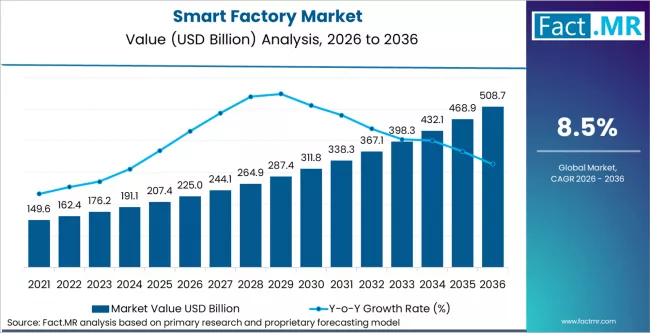
Smart Factory Market Market Value Analysis | Source: Fact.MR
| Metric | Value |
|---|---|
| Estimated Value in 2026 | USD 225.0 billion |
| Forecast Value in 2036 | USD 508.7 billion |
| Forecast CAGR (2026 to 2036) | 8.5% |
Source: Fact.MR analysis. Updated Mar 13, 2026
Market Definition
The smart factory market includes connected manufacturing technologies such as IoT devices, robotics, automation systems, AI process control, and digital twin platforms used to optimise production.
Market Inclusions
Includes global forecasts from 2026 to 2036 by component, end user, and industry vertical across manufacturing sectors such as automotive, electronics, aerospace, energy, food, and healthcare.
Market Exclusions
Excludes standalone industrial robots, general enterprise IT systems not used in manufacturing, and building automation systems outside production environments.
Research Methodology
- Primary Research: Interviews with manufacturing CIOs, plant automation engineers, IoT procurement managers, OEM product leaders, and system integrators.
- Desk Research: Sources include government industrial digitalisation programmes, OEM reports, manufacturing statistics, SEMI data, and automation industry publications.
- Market Sizing and Forecasting: Hybrid model using industrial automation investment data, component shipments, enterprise software contracts, and manufacturing capital expenditure benchmarks.
- Data Validation and Update Cycle: Forecasts validated with OEM revenues, industrial investment surveys, government programmes, and expert interviews.
Summary
- Market Definition
- The smart factory market includes IoT-enabled manufacturing systems integrating automation hardware, AI software, robotics, and digital twin technologies for real-time production optimisation.
- Demand Drivers
- Automotive and EV battery manufacturers are investing in automated smart factories to improve precision and production efficiency.
- Government digital manufacturing initiatives such as Industrie 4.0 and China’s Intelligent Manufacturing Plan are boosting automation investment.
- Rising labour costs are encouraging manufacturers to adopt automation and nearshore production with smart factory infrastructure.
- Key Segments Analyzed
- By Component: Hardware leads with about 70% share in 2026 due to high capital investment in sensors, robotics, PLCs, and edge devices.
- By End User: Discrete Industry holds about 61% share in 2026 driven by automotive and electronics manufacturing automation.
- By Industry Vertical: Automotive leads due to high automation requirements in EV and battery production facilities.
- Analyst Opinion at FACT.MR
- • Shambhu Nath Jha, Principal Consultant at Fact.MR, opines that CXOs will find this report helpful in understanding how AI-driven manufacturing intelligence and digital twin platforms are transforming factory automation and production optimisation.
- Strategic Implications
- Vendors should develop modular smart factory platforms allowing manufacturers to upgrade automation systems gradually.
- Companies should pursue IEC 62443 cybersecurity certification to address industrial OT security risks.
- Automation providers should design specialised solutions for EV battery, semiconductor, and pharmaceutical manufacturing.
- Methodology
- Market sizing used automation capital expenditure data and component shipments validated with OEM revenue disclosures.
- Industrial digitalization programme data and manufacturing productivity benchmarks supported demand analysis.
- Forecasts incorporated nearshoring trends, EV production growth, AI automation adoption, and expert interviews.
Segmental Analysis
Smart Factory Market Analysis by Component
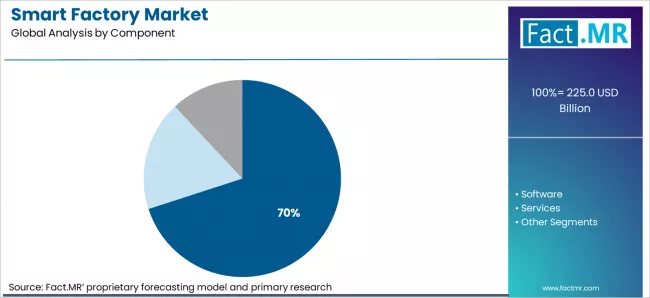
Smart Factory Market Analysis By Component | Source: Fact.MR
Based on FACT.MR analysis, hardware is projected to hold about 70% share in 2026 as sensors, robotics, PLCs, and edge infrastructure are required before software platforms can operate.
- Siemens Xcelerator Hardware Investment: Siemens launched its Sinamics G120X industrial drive platform in October 2024 connected to the MindSphere IoT platform for real-time performance monitoring. [5]
- Fanuc Robot Technology Development: Fanuc introduced the CRX-25iA collaborative robot in January 2025 with enhanced AI-guided assembly features for automotive and electronics manufacturing. [6]
- Industrial IoT Hardware Adoption Trend: The International Federation of Robotics reported global industrial robot installations reached about 590,000 units in 2023, with automotive and electronics accounting for about 65%. [7]
Smart Factory Market Analysis by End User
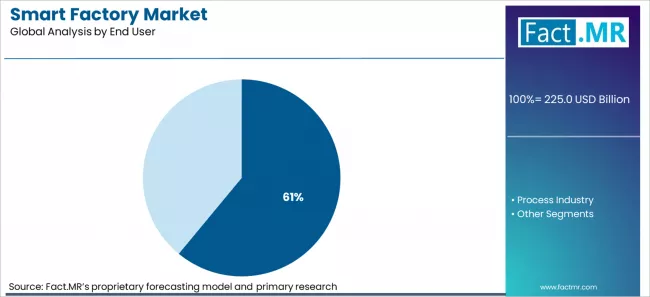
Smart Factory Market Analysis By End User | Source: Fact.MR
Based on FACT.MR analysis, discrete industries are expected to hold about 61% share in 2026 due to high automation demand in automotive and electronics manufacturing.
- Rockwell Automotive End User Investment: Rockwell Automation announced a smart factory partnership with a North American EV manufacturer in November 2024 using Plex MES and FactoryTalk Analytics platforms. [8]
- Schneider Electric Process Industry Technology: Schneider Electric launched EcoStruxure Plant Advisor AI in September 2024 for energy optimisation and predictive maintenance in industrial plants. [9]
- Food and Beverage Smart Factory Trend: Updated FDA Food Safety Modernization Act guidance in August 2024 encourages automated production monitoring systems, increasing sensor and MES adoption in food manufacturing. [10]
Drivers, Restraints, and Opportunities
FACT.MR analysts observe that the smart factory market, has expanded as IoT connectivity costs declined and AI-driven manufacturing software matured. Smart factory adoption is rising through new automated manufacturing facilities and retrofitting of existing plants.
The market is gradually shifting from hardware-led automation investment to software and services growth. AI analytics, digital twins, and MES platforms are generating recurring revenue while hardware competition from Asian manufacturers is increasing.
- Germany Industrie 4.0 Policy Framework: Germany updated its Platform Industrie 4.0 Asset Administration Shell standard in October 2024 to simplify smart factory system integration. The government also approved EUR 4.4 billion under the IPCEI programme supporting semiconductor and electronics manufacturing digitalisation. [2]
- China Intelligent Manufacturing Expansion: China’s MIIT released its 2024-2026 Intelligent Manufacturing Plan targeting 10,000 smart factories and 100 lighthouse factories by 2026. Government subsidies cover up to 30% of automation and industrial IoT equipment investment. [3]
- US CHIPS Act Semiconductor Automation: The US CHIPS and Science Act provides USD 52 billion for semiconductor manufacturing expansion. New fabs from Intel, Samsung, and TSMC must include advanced automation and smart manufacturing systems. [4]
Regional Analysis
The smart factory market is analysed across Asia Pacific, Europe, North America, Latin America, and Middle East and Africa, covering 40+ countries with distinct demand profiles shaped by industrial policy investment, manufacturing sector composition, automation adoption maturity, and OT infrastructure readiness. The full report offers market attractiveness analysis based on government manufacturing digitalization programme timelines, industrial capital expenditure forecasts, and smart factory technology adoption benchmarks.
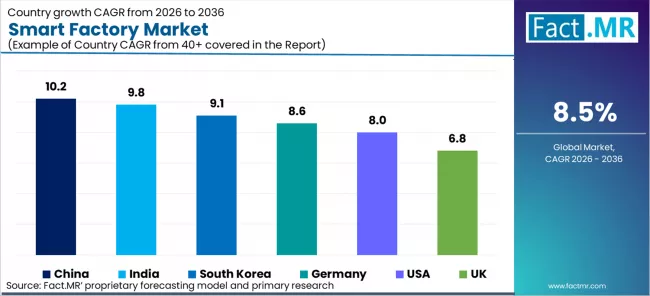
Smart Factory Market Cagr Analysis By Country | Source: Fact.MR
| Country | CAGR (2026-2036) |
|---|---|
| China | 10.2% |
| India | 9.8% |
| South Korea | 9.1% |
| Germany | 8.6% |
| United States | 8.0% |
| United Kingdom | 6.8% |
Source: Fact.MR analysis. Updated Mar 13, 2026
Source: Fact.MR (FACT.MR) analysis, based on proprietary forecasting model and primary research
Asia Pacific Smart Factory Market Analysis
Asia Pacific is the largest investment region for smart factory technology, supported by China’s intelligent manufacturing strategy and expanding EV and semiconductor production. Global automation companies compete with growing domestic automation vendors across the region.
- China: Demand for smart factory solutions in China is projected to grow at 10.2% CAGR through 2036. The MIIT Intelligent Manufacturing Development Plan (2024-2026) targets 10,000 smart factories with provincial subsidies covering up to 30% of IIoT equipment investment. BYD confirmed AI-based quality inspection across 42 EV production lines in Shenzhen with Siemens and Rockwell integration, while CATL’s Gigafactory 4 in Sichuan uses digital twin simulation and automated material handling systems.
- India: India is projected to expand at 9.8% CAGR through 2036. The PLI scheme for Advanced Chemistry Cell batteries with INR 18,100 crore incentives requires automated manufacturing monitoring systems. Tata Motors invested USD 200 million in a smart factory at Pune using Siemens Opcenter MES and ABB robotics, while Mahindra deployed AI quality inspection at its Chakan plant.
- South Korea: Demand for smart factory solutions in South Korea is projected to rise at 9.1% CAGR through 2036. Samsung SDI’s USD 3 billion EV battery investment integrates smart factory systems designed in Korea and replicated globally. The government’s Smart Factory 2.0 programme added KRW 500 billion in subsidies for SME IIoT sensors, MES deployment, and AI analytics adoption.
FACT.MR's analysis of the smart factory market in Asia Pacific consists of country-wise assessment that includes China, Japan, South Korea, India, ASEAN, Australia and New Zealand, and Rest of South Asia and Pacific. Readers can find country CAGR forecasts, industrial digitalization investment data, EV and semiconductor automation benchmarks, and component-level adoption insights.
Europe Smart Factory Market Analysis
Europe is a key region for smart factory standards and automation regulation, shaped by Industrie 4.0 frameworks and EU industrial digitalisation policies. Automation leaders hold strong positions through integrated software and automation solutions.
- Germany: Germany is projected to grow at 8.6% CAGR through 2036. The Investitionszulage programme offers a 12% tax credit for automation equipment purchases with EUR 2 billion funding. BMW reported EUR 1.4 billion digital manufacturing investment including robotic welding and digital twins, while BASF expanded its Smart Manufacturing Centre in Ludwigshafen with Siemens automation systems.
- United Kingdom: Demand for smart factory solutions in the United Kingdom is projected to rise at 6.8% CAGR through 2036. The UK Advanced Manufacturing Plan includes GBP 4.5 billion support with grants for automation investment. Rolls-Royce upgraded its Derby turbine factory with AI vision inspection and Siemens MES, while Jaguar Land Rover deployed Rockwell smart manufacturing platforms across EV production facilities.
FACT.MR's analysis of the smart factory market in Europe consists of country-wise assessment that includes Germany, France, the United Kingdom, Italy, Spain, Nordic countries, BENELUX, and Rest of Western Europe. Readers can find Industrie 4.0 investment data, automation regulation benchmarks, EV manufacturing automation trends, and country-level forecasts by component and industry vertical.
North America Smart Factory Market Analysis
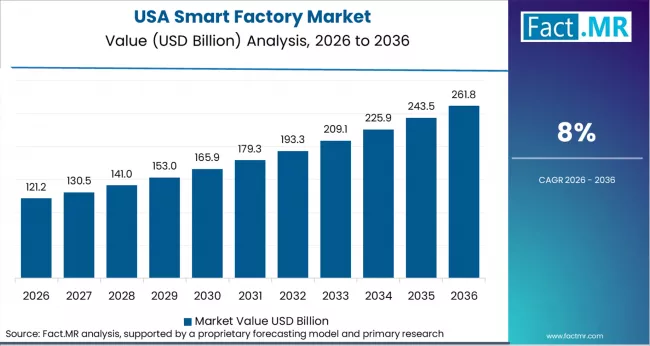
Smart Factory Market Country Value Analysis | Source: Fact.MR
North America leads in high-value smart factory software and AI-driven automation deployments, supported by semiconductor and EV manufacturing investment. Industrial technology companies dominate through advanced manufacturing platforms.
- United States: United States is projected to expand at 8.0% CAGR through 2036. The CHIPS and Science Act awarded USD 8.5 billion to Intel, USD 6.6 billion to TSMC, and USD 6.4 billion to Samsung for semiconductor fabs requiring advanced automation. Honeywell reported 9% growth in process automation revenues, while GE Vernova disclosed 18% growth in digital manufacturing software contracts in 2024.
FACT.MR's analysis of the smart factory market in North America consists of country-wise assessment that includes the United States, Canada, and Mexico. Readers can find CHIPS Act manufacturing investment data, EV battery automation adoption benchmarks, industrial AI platform deployment trends, and country-level forecasts by component and industry vertical.
Competitive Aligners for Market Players
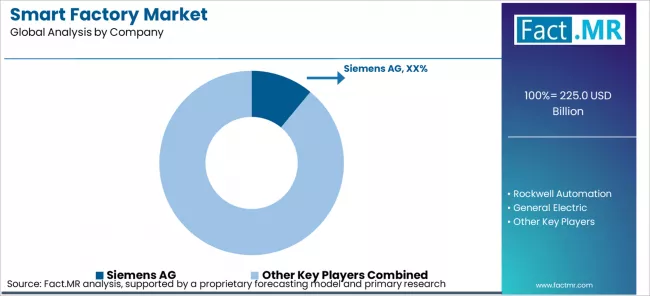
Smart Factory Market Analysis By Company | Source: Fact.MR
The global smart factory market shows moderate concentration at the platform level while remaining fragmented across specific technology components. Major industrial automation companies such as Siemens, ABB, Rockwell Automation, and Schneider Electric hold strong positions in large-scale smart factory deployments because they offer integrated hardware, software, and services. At the same time, specialised vendors including Fanuc, Mitsubishi Electric, and Bosch Rexroth compete in areas like robotics, industrial IoT sensors, and motion control equipment. As the market evolves, competition is gradually shifting away from pure hardware capability toward advanced AI analytics, digital twin simulation, and integrated industrial software ecosystems.
Siemens maintains a structural advantage through its Xcelerator digital platform, which combines automation hardware, engineering software, MES systems, and IoT analytics into one unified environment. This integrated stack makes it difficult for large manufacturers to switch once they standardise on Siemens technologies. ABB benefits from its strong robotics portfolio and global system integration expertise, allowing it to deliver end-to-end automation solutions for complex manufacturing operations. Meanwhile, Rockwell Automation leverages its large North American installed base and the Plex MES cloud platform, generating recurring software subscription revenue.
Large manufacturers typically rely on two or three technology partners across automation domains. While this maintains vendor competition, the deep integration of automation software with production systems creates high switching costs, giving established providers strong pricing power over time.
Key Players
- Siemens AG
- Rockwell Automation
- General Electric
- Schneider Electric
- ABB Ltd.
- Honeywell International Inc.
- Mitsubishi Electric Corporation
- Fanuc Corporation
- Bosch Rexroth AG
- Hitachi Ltd.
Bibliography
- [1] Federal Ministry for Economic Affairs and Climate Action, Germany. (2024). Platform Industrie 4.0 Asset Administration Shell Version 3.0 Release and IPCEI Microelectronics Smart Factory Enablement Funding Update. October 2024.
- [2] Ministry of Industry and Information Technology, People's Republic of China. (2024). 2024-2026 Intelligent Manufacturing Development Action Plan: National Smart Factory Certification Targets, Lighthouse Factory Programme, and Provincial Equipment Subsidy Framework. September 2024.
- [3] U.S. Department of Commerce. (2024). CHIPS and Science Act Facility Grant Awards: Intel, TSMC, Samsung, and Micron Smart Manufacturing Compliance Requirements and Advanced Process Automation Conditions of Funding. November 2024.
- [4] Siemens AG. (2024). Product Launch: Sinamics G120X Industrial Drive Platform for Smart Factory Energy Efficiency Applications with MindSphere IoT Cloud Connectivity. October 2024.
- [5] Fanuc Corporation. (2025). Product Launch Press Release: CRX-25iA Collaborative Robot with AI Force Sensing and Vision-Guided Assembly for Automotive and Electronics Smart Factory Production Cells. January 2025.
- [6] International Federation of Robotics. (2024). World Robotics Report 2024: Global Industrial Robot Installations, Automotive and Electronics Sector Deployment Share, and Smart Factory Hardware Investment Data. September 2024.
- [7] Rockwell Automation Inc. (2024). Press Release: EV Battery Manufacturer Smart Factory Partnership Announcement Plex MES, FactoryTalk Analytics, and Connected Enterprise Architecture Deployment for North American Battery Cell Facility. November 2024.
- [8] Schneider Electric SE. (2024). Product Launch: EcoStruxure Plant Advisor AI Industrial AI Platform for Process Industry Smart Factory Energy Optimisation, Predictive Maintenance, and Autonomous Process Control. September 2024.
- [9] U.S. Food and Drug Administration. (2024). Food Safety Modernization Act Preventive Controls for Human Food Guidance Update: Automated Production Monitoring Systems as Validated Hazard Analysis Compliance Approach. August 2024.
This Report Addresses
- Strategic intelligence on China MIIT Intelligent Manufacturing Development Plan targets, Germany Industrie 4.0 Asset Administration Shell standards, US CHIPS Act smart manufacturing compliance requirements, India PLI Scheme battery manufacturing automation mandates, and South Korea Smart Factory 2.0 Programme investment shaping global smart factory demand through 2036.
- Market forecast from USD 225.0 billion in 2026 to USD 508.7 billion by 2036 at 8.5% CAGR, segmented by component, end-user type, and industry vertical.
- Growth opportunity mapping across China's intelligent manufacturing certification programme, India's EV battery factory automation investment, Germany's digital manufacturing tax incentives, US CHIPS Act semiconductor fab automation, and South Korea's SME smart factory subsidy programme.
- Country CAGR outlook for China 10.2%, India 9.8%, South Korea 9.1%, Germany 8.6%, United States 8.0%, Japan 7.5%, and United Kingdom 6.8%, with industrial policy, manufacturing sector composition, and automation adoption drivers per country.
- Competitive analysis of Siemens AG, Rockwell Automation, ABB Ltd., Schneider Electric, General Electric, Honeywell, Mitsubishi Electric, Fanuc, Bosch Rexroth, and Hitachi covering platform portfolios, software integration strategies, and enterprise client positioning.
- Technology tracking including AI-driven process control and digital twin simulation, IEC 62443 OT cybersecurity certified platforms, collaborative robot deployment for flexible assembly, edge AI for real-time quality inspection, and cloud MES subscription platforms.
- Regulatory analysis covering EU Machinery Regulation automation safety requirements, IEC 62443 industrial cybersecurity standards, Germany Industrie 4.0 AAS interoperability framework, US NIST cybersecurity manufacturing guidance, and China GB/T intelligent manufacturing evaluation standards.
- Report delivered in PDF, Excel datasets, PowerPoint summary, and dashboard formats supported by industrial capital expenditure surveys, OEM segment revenue disclosures, government programme databases, and primary research interviews.
Segmentation
Scope of Report
| Attribute | Details |
|---|---|
| Quantitative Units | USD 225.0 billion (2026) to USD 508.7 billion (2036), at a CAGR of 8.5% |
| Market Definition | Technology solutions enabling automated, data-driven manufacturing including industrial IoT hardware, industrial automation software, robotics, AI-driven process control, and integrated manufacturing execution systems. |
| Component Segmentation | Hardware (70%), Software, Services |
| End User Segmentation | Discrete Industry (61%), Process Industry |
| Industry Vertical Segmentation | Automotive, Aerospace & Defense, Electrical & Electronics, Food & Beverages, Energy & Utilities, Healthcare & Pharmaceuticals, Others |
| Application Coverage | Automated assembly and quality control, predictive maintenance, real-time process monitoring, digital twin simulation, energy management, and supply chain visibility. |
| Regions Covered | Asia Pacific, Europe, North America, Latin America, Middle East and Africa |
| Countries Covered | China, Japan, South Korea, India, Australia and New Zealand, ASEAN, Rest of South Asia and Pacific, Germany, UK, France, Italy, Spain, Nordic, BENELUX, Rest of Western Europe, Russia, Poland, Hungary, USA, Canada, Mexico, Brazil, Chile, Ecuador, Rest of Latin America, Saudi Arabia, GCC, Turkey, South Africa, Rest of MEA |
| Key Companies Profiled | Siemens AG, Rockwell Automation, General Electric, Schneider Electric, ABB Ltd., Honeywell International Inc., Mitsubishi Electric Corporation, Fanuc Corporation, Bosch Rexroth AG, Hitachi Ltd. |
| Forecast Period | 2026 to 2036 |
| Approach | Hybrid top-down and bottom-up model using industrial automation capital expenditure data, component shipment volumes, enterprise software contract values, and primary interviews with manufacturing CIOs and automation procurement leads. |
Source: Fact.MR analysis. Updated Mar 13, 2026
Smart Factory Market by Segments
-
By Component:
- Hardware
- Software
- Services
-
By End User:
- Discrete Industry
- Process Industry
-
By Industry Vertical:
- Automotive
- Aerospace & Defense
- Electrical & Electronics
- Food & Beverages
- Energy & Utilities
- Healthcare & Pharmaceuticals
- Others
-
By Region:
- North America
- United States
- Canada
- Mexico
- Latin America
- Brazil
- Chile
- Ecuador
- Rest of Latin America
- Western Europe
- Germany
- United Kingdom
- France
- Italy
- Spain
- Nordic
- BENELUX
- Rest of Western Europe
- Eastern Europe
- Russia
- Poland
- Hungary
- Balkan and Baltic
- Rest of Eastern Europe
- East Asia
- China
- Japan
- South Korea
- South Asia and Pacific
- India
- ASEAN
- Australia and New Zealand
- Rest of South Asia and Pacific
- Middle East and Africa
- Kingdom of Saudi Arabia
- Other GCC Countries
- Turkey
- South Africa
- Other African Union
- Rest of Middle East and Africa
- North America
Frequently Asked Questions
How large is the smart factory market in 2025?
What will the market size be in 2026?
What is the projected market size by 2036?
What is the expected CAGR for the forecast period 2026 to 2036?
Which component segment holds the leading share?
Which end-user segment commands the largest share?
Which industry vertical leads the market?
Which country is projected to grow the fastest?
What is the primary restraint?
Who worked on this report


Preview the report firsthand - request a free sample
Free SampleGet the brochure for pricing and purchase details
Download PDF