- Market Value (2025): USD 417.8 Mn
- Estimated Value (2026): USD 445.0 Mn
- Forecast Value (2036): USD 1,150 Mn
- CAGR (2026-2036): 10.0%
What is the Cytarabine and Daunorubicin Drugs Market forecast to be worth by 2036?
USD 1.17 billion in 2026 to USD 2.05 billion by 2036 at a 5.8% CAGR.
- In 2025, the cytarabine and daunorubicin drugs market was worth USD 1.11 billion, with generic vials used in hospital induction and consolidation cycles forming most of that base.
- Revenue will advance from USD 1.17 billion in 2026 to USD 2.05 billion by 2036 as more older adults are diagnosed with leukemia and treated with intensive regimens.
- Leukemia chemotherapy drug sales will compound at a Cytarabine and Daunorubicin Drugs Market CAGR between 2026 and 2036, while liposomal combination use and wider cancer care access in middle-income countries add volume.
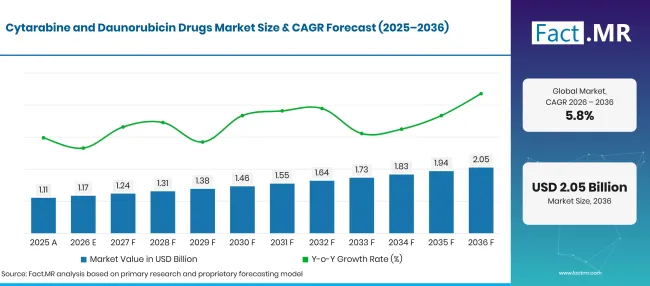
Cytarabine And Daunorubicin Drugs Market Forecast Global | Source: Fact.MR
| Year | Basis | Market Value (USD billion) |
|---|---|---|
| 2025 | Actual | 1.11 |
| 2026 | Estimate | 1.17 |
| 2036 | Forecast | 2.05 |
| CAGR 2026 to 2036 | Forecast period | 5.8% |
Source: Fact.MR analysis. Updated Oct 26, 2026
What are the defining numbers behind Cytarabine and Daunorubicin Drugs Market growth?
Between 2026 and 2036, the market will gain USD 0.9 billion, drawn mainly from leukemia induction in hospital settings.
- Demand Drivers in the Market
- Cancer burden worldwide keeps chemotherapy budgets under pressure to expand. The World Health Organization reported that cancer accounted for nearly 10 million deaths in 2024, close to one in six deaths [1]. Blood cancers form a steady part of that load, and many health systems still rely on older cytotoxic drugs to treat them.
- Childhood leukemia care depends on cytarabine in nearly every protocol. WHO estimated that about 400,000 children and adolescents aged 0 to 19 develop cancer each year, with leukemias among the most common types [2]. Cytarabine appears in induction, intensification and intrathecal phases of pediatric leukemia treatment.
- AML incidence rises with age, and populations are getting older. The U.S. National Cancer Institute estimated 22,720 new acute myeloid leukemia cases in the United States in 2026 [3]. Each fit patient who starts intensive treatment receives several cycles of cytarabine, often after a daunorubicin-based induction.
- Newer targeted agents are often added to chemotherapy instead of replacing it. Clinicians pair FLT3 inhibitors and other targeted drugs with standard induction, which keeps the cytarabine and anthracycline base in use.
- Key Segments Analyzed
- By Product Type: Cytarabine will hold 38.5% share in 2026, since it is dosed in induction, consolidation and high-dose salvage cycles across both myeloid and lymphoid leukemias.
- By Application: Leukemia will account for 52.8% share in 2026, as acute myeloid and acute lymphoblastic leukemia protocols are built around these two agents.
- By Distribution Channel: Hospital Pharmacies will capture 64.2% share in 2026, given that cytotoxic infusions are compounded under sterile conditions inside the treating hospital.
- By End-User: Hospitals will command 58.9% share in 2026 through inpatient induction stays that last several weeks per patient.
- Analyst Opinion at Fact.MR
- Shambhu Nath Jha, Principal Consultant at Fact.MR, states, “Cytarabine and daunorubicin are old molecules, yet most induction protocols for fit AML patients still rely on them. The commercial contest is about reliable sterile supply and hospital tender wins, not about new chemistry. Value growth will come from the liposomal combination in high-risk adults and from more patients reaching treatment in Brazil and Asia.”
- Strategic Implications
- Generic injectable makers should hold buffer stock and qualify second fill-finish sites, because hospital buyers drop suppliers quickly after a missed delivery.
- Hospital pharmacy directors should standardize vial sizes and compounding steps for high-dose cytarabine to cut waste and handling errors.
- Oncology payers should review coverage rules for the liposomal combination so that eligible older patients with secondary AML can reach it.
- Cancer centers in emerging markets should invest in cytotoxic preparation rooms and trained pharmacists before scaling leukemia programs.
Brazil heads the country set at 7.2% CAGR, as public cancer centers enroll more leukemia patients each year. Japan follows at 6.2% where an aged population lifts the number of blood cancer cases. The United Kingdom will grow at 5.8% helped by national cancer registration and NHS treatment pathways. In the United States, a 5.0% rate reflects a mature market with wide generic supply. Germany rounds out the group at 4.1%, with cancer care volumes high but prices held down by tenders.
How does the Cytarabine and Daunorubicin Drugs Market break down by segment?
Cytarabine will lead Product Type at 38.5%; Leukemia will head Application at 52.8%; Hospital Pharmacies will top Distribution Channel at 64.2%; Hospitals will rank first in End-User at 58.9%.
Which Product Type dominates?
Cytarabine generates 38.5% of 2026 revenue.
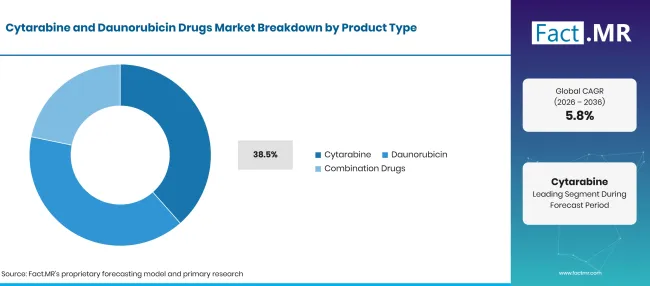
Cytarabine And Daunorubicin Drugs Market Breakdown Product Type | Source: Fact.MR
| Product Type | Share (2026) |
|---|---|
| Cytarabine (Leading segment) | 38.5% |
| Other segments combined | 61.5%* |
| Total | 100.0% |
Source: Fact.MR analysis. Updated Oct 26, 2026
Cytarabine injection is given for seven days in standard induction and again at high doses in consolidation, so each patient uses many vials. Supply is broad across Europe. An EMA list issued in December 2025 named cytarabine marketing authorisation holders including Pfizer, Fresenius Kabi, Hikma, Accord and Sandoz [4]. Most of these vials move through sterile injectable drug plants that also fill other cytotoxics. Hospira’s cytarabine prescribing information, revised in September 2026, lists remission induction in acute non-lymphocytic leukemia and intrathecal use for meningeal leukemia [5]. Daunorubicin is the anthracycline partner in most AML induction courses and is sold as a conventional solution. Combination drugs include Vyxeos, a liposomal fixed ratio of both agents. The European Medicines Agency updated its Vyxeos product information in August 2026, for adults with therapy-related AML or AML with myelodysplasia-related changes [6].
What leads the Application segment?
Leukemia represents 52.8% of 2026 revenue.
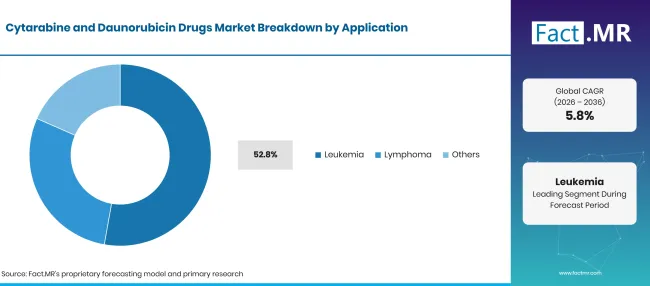
Cytarabine And Daunorubicin Drugs Market Breakdown Application | Source: Fact.MR
| Application | Share (2026) |
|---|---|
| Leukemia (Leading segment) | 52.8% |
| Other segments combined | 47.2%* |
| Total | 100.0% |
Source: Fact.MR analysis. Updated Oct 26, 2026
Acute myeloid leukemia protocols use both drugs at once, and acute lymphoblastic leukemia regimens give cytarabine across several treatment blocks. Each course runs for weeks under inpatient care, which keeps leukemia use well ahead of other indications. Lymphoma treatment uses high-dose cytarabine in salvage and in central nervous system regimens. The National Cancer Institute estimated 79,320 new non-Hodgkin lymphoma cases in the United States in 2026 [7]. Patients with aggressive subtypes often pass through lymphoma treatment lines that include cytarabine before stem cell transplant. Others include blast-phase chronic myeloid leukemia and selected rare cancers.
How does Distribution Channel shape demand?
Hospital Pharmacies take 64.2% of 2026 revenue.
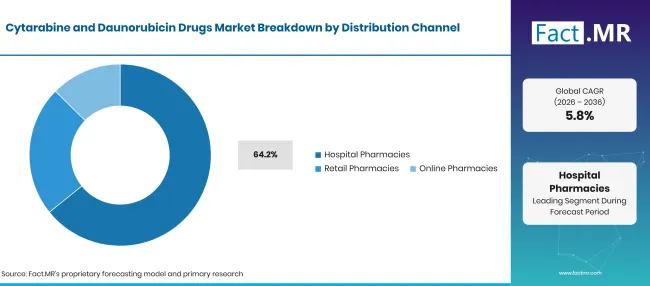
Cytarabine And Daunorubicin Drugs Market Breakdown Distribution Channel | Source: Fact.MR
| Distribution Channel | Share (2026) |
|---|---|
| Hospital Pharmacies (Leading segment) | 64.2% |
| Other segments combined | 35.8%* |
| Total | 100.0% |
Source: Fact.MR analysis. Updated Oct 26, 2026
Cytotoxic drugs must be prepared in biological safety cabinets by trained staff, which ties purchasing to the hospital pharmacy. Group buying contracts and national tenders set prices for whole regions, so a single award can move volume between generic suppliers. Retail pharmacies handle a small share, mostly specialty outlets that dispense to outpatient infusion units. Online pharmacies serve as ordering channels for clinics in some markets, though cold chain and hazardous drug rules limit direct shipping. Supportive drugs from the chemotherapy-induced nausea treatment category often travel through the same hospital orders.
What supports Hospitals within End-User?
Hospitals account for 58.9% of 2026 revenue.
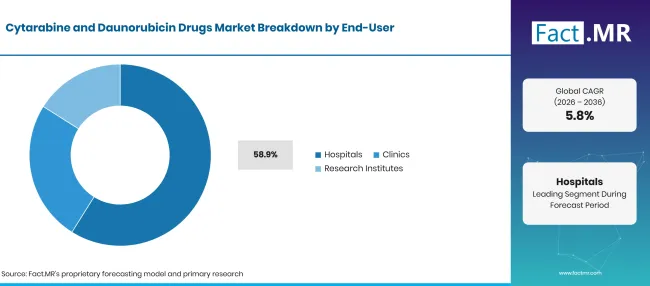
Cytarabine And Daunorubicin Drugs Market Breakdown End User | Source: Fact.MR
| End-User | Share (2026) |
|---|---|
| Hospitals (Leading segment) | 58.9% |
| Other segments combined | 41.1%* |
| Total | 100.0% |
Source: Fact.MR analysis. Updated Oct 26, 2026
Intensive induction leaves patients without working blood counts for several weeks, so they stay on hematology wards with transfusion and infection support. Only hospitals can provide that level of monitoring, which links drug use to bed capacity in leukemia units. Clinics give outpatient consolidation cycles and low-intensity cytarabine to older patients who cannot tolerate full induction. Research institutes buy the drugs for trials that test new agents against or on top of standard chemotherapy, including targeted oncology biologics studied in AML.
What is accelerating Cytarabine and Daunorubicin Drugs Market adoption, and what is holding it back?
Adoption will gain from rising leukemia cases in older people, wider cancer care in middle-income countries and steady use of chemotherapy backbones alongside targeted drugs. Low generic prices, supply disruptions and growing use of non-intensive regimens will hold value growth down.
Drivers Impact Analysis
| DRIVER | (~) % IMPACT ON CAGR | GEOGRAPHIC RELEVANCE | IMPACT TIMELINE |
|---|---|---|---|
| Rising AML incidence in aging populations | +1.4% | North America, Western Europe, East Asia | Long term (>= 4 years) |
| Cytarabine use across pediatric and adult leukemia protocols | +1.1% | Global | Medium term (2-4 years) |
| Targeted agents added on top of standard induction chemotherapy | +0.9% | North America, Western Europe | Medium term (2-4 years) |
| Expansion of public cancer treatment capacity in emerging markets | +0.8% | Latin America, South Asia & Pacific | Long term (>= 4 years) |
| High-dose cytarabine in lymphoma salvage regimens | +0.5% | North America, Western Europe, East Asia | Short term (<= 2 years) |
Source: Fact.MR analysis. Updated Oct 26, 2026
Opportunity Impact Analysis
| OPPORTUNITY | (~) % IMPACT ON CAGR | GEOGRAPHIC RELEVANCE | IMPACT TIMELINE |
|---|---|---|---|
| Liposomal combination use in secondary AML among older adults | +0.9% | North America, Western Europe, East Asia | Medium term (2-4 years) |
| Ready-to-use and prefilled presentations for safer compounding | +0.6% | North America, Western Europe | Short term (<= 2 years) |
| Tender supply contracts in Latin America and Asia | +0.5% | Latin America, South Asia & Pacific | Long term (>= 4 years) |
Source: Fact.MR analysis. Updated Oct 26, 2026
Restraints Impact Analysis
| RESTRAINT | (~) % IMPACT ON CAGR | GEOGRAPHIC RELEVANCE | IMPACT TIMELINE |
|---|---|---|---|
| Price erosion from multiple generic suppliers and tenders | -0.7% | Global | Short term (<= 2 years) |
| Sterile manufacturing failures leading to shortages | -0.5% | North America, Western Europe | Short term (<= 2 years) |
| Shift of unfit older patients to non-intensive regimens | -0.4% | North America, Western Europe | Long term (>= 4 years) |
Source: Fact.MR analysis. Updated Oct 26, 2026
Which countries are scaling the Cytarabine and Daunorubicin Drugs Market through 2036?
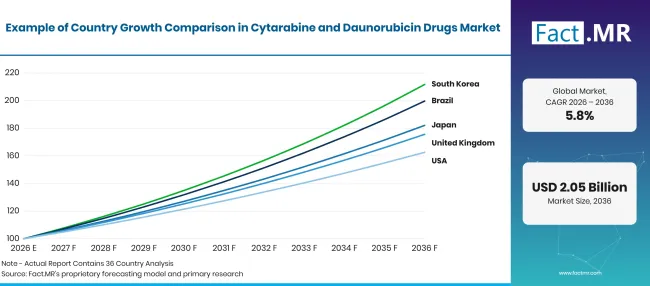
Cytarabine And Daunorubicin Drugs Market Growth Index | Source: Fact.MR
| Country | CAGR (2026 to 2036) |
|---|---|
| Brazil | 7.2% |
| Japan | 6.2% |
| United Kingdom | 5.8% |
| United States | 5.0% |
| Germany | 4.1% |
Source: Fact.MR analysis. Updated Oct 26, 2026
How is Brazil scaling demand?
7.2% CAGR, driven by more leukemia patients entering public cancer treatment.
Leukemia chemotherapy demand in Brazil rests on a large and steady case load. The National Cancer Institute (INCA) estimated 12,220 new leukemia cases for each year of the 2026 to 2028 period, a rate of 5.71 per 100,000 people [8]. Most patients receive induction in SUS-accredited oncology centers, which buy cytarabine and daunorubicin through public procurement.
What supports Japan’s growth?
6.2% CAGR, backed by an aging population with a heavy cancer burden.
Japan’s Ministry of Health, Labour and Welfare reported 378,812 deaths from malignant neoplasms in 2025, or 23.8% of all deaths and the top cause [9]. AML is more common after age 65, so an older population brings more patients to hematology wards. Hospitals there use both conventional induction and the liposomal combination for selected patients.
How is the United Kingdom developing demand?
5.8% CAGR, helped by rising cancer diagnoses within NHS treatment pathways.
NHS England reported 354,820 new cancer diagnoses in England in 2023, about 972 a day and 8,605 more than in 2022 [10]. Haematology units in NHS trusts deliver intensive AML induction with daunorubicin and cytarabine, and national guidance shapes which add-on drugs join that backbone.
What is supporting United States adoption?
5.0% CAGR, reflecting a mature generic market with steady patient numbers.
Acute myeloid leukemia drives most use of these drugs in the United States. The National Cancer Institute estimated 11,500 AML deaths for 2026 and reported an age-adjusted incidence of 4.4 cases per 100,000 people per year [3]. Several generic makers hold FDA labels for each drug, which keeps unit prices low.
How does Germany perform?
4.1% CAGR, as tender-based pricing limits value despite high cancer volumes.
Cancer care in Germany runs at high volume. Destatis reported that about 228,800 people died of cancer in 2025, making it the second most common cause of death after cardiovascular disease [11]. Statutory health insurers and hospital buying groups negotiate generic chemotherapy prices, which keeps revenue growth below case growth.
Who leads the Cytarabine and Daunorubicin Drugs Market?
Supply splits into a branded combination tier and a generic injectables tier. Jazz Pharmaceuticals holds the only liposomal fixed-dose product, Vyxeos, and competes on outcomes in high-risk adult AML. In January 2026, the U.S. Food and Drug Administration completed its review of a Vyxeos supplement that revised pediatric use labeling under a written request [12].
Generic makers compete on sterile capacity, tender pricing and reliable delivery. Pfizer, through Hospira, and Fresenius Kabi hold cytarabine labels in the United States and Europe, while Hikma holds a U.S. daunorubicin label and a European cytarabine authorisation. Accord Healthcare and Sandoz also hold European cytarabine authorisations. Meitheal Pharmaceuticals launched daunorubicin hydrochloride injection in a 20 mg per 4 mL single-dose vial in October 2025 [13]. Sagent Pharmaceuticals supplies cytarabine injection to U.S. hospitals. Supply reliability, ready-to-use formats and access to the liposomal segment will separate stronger suppliers from the rest.
Which companies are the key providers?
Key companies include Jazz Pharmaceuticals plc; Pfizer Inc. (Hospira); Fresenius Kabi; Hikma Pharmaceuticals PLC; Accord Healthcare; Sandoz Group AG; Meitheal Pharmaceuticals; and Sagent Pharmaceuticals.
- Jazz Pharmaceuticals plc
- Pfizer Inc. (Hospira)
- Fresenius Kabi
- Hikma Pharmaceuticals PLC
- Accord Healthcare
- Sandoz Group AG
- Meitheal Pharmaceuticals
- Sagent Pharmaceuticals
Bibliography
- [1] World Health Organization. (2026, July 3). Cancer.
- [2] World Health Organization. (2026, March 10). Cancer in children.
- [3] National Cancer Institute, Surveillance, Epidemiology, and End Results Program. (2026). Cancer Stat Facts: Leukemia, Acute Myeloid Leukemia (AML).
- [4] European Medicines Agency. (2025, December 11). List of nationally authorised medicinal products: Active substance cytarabine (PSUSA/00000911/202503).
- [5] Pfizer (Hospira, Inc.). (2026, September). Cytarabine Injection prescribing information.
- [6] European Medicines Agency. (2026, August 4). Vyxeos liposomal: EPAR.
- [7] National Cancer Institute, Surveillance, Epidemiology, and End Results Program. (2026). Cancer Stat Facts: Non-Hodgkin Lymphoma.
- [8] Instituto Nacional de Câncer (INCA). (2026, February 4). Síntese de resultados e comentários: Estimativa 2026 [Summary of results and comments: 2026 Estimate].
- [9] Ministry of Health, Labour and Welfare, Japan. (2026). Summary of the 2025 annual vital statistics, preliminary].
- [10] NHS England. (2025, October 30). Cancer Registration Statistics, England 2023.
- [11] Statistisches Bundesamt (Destatis). (2026, October 9). Todesursachen 2025: Weniger Verstorbene aufgrund von Herz-Kreislauf-Erkrankungen [Causes of death 2025: Fewer deaths from cardiovascular diseases].
- [12] U.S. Food and Drug Administration. (2026, January 27). Multidisciplinary Review and Evaluation: NDA 209401 S-018, Vyxeos (daunorubicin and cytarabine) liposome.
- [13] Meitheal Pharmaceuticals. (2025, October 2). DAUNOrubicin Hydrochloride Injection Now Available.
This Report Answers
- What hospitals and clinics spend on cytarabine, daunorubicin and their liposomal combination from 2026 to 2036.
- Why cytarabine, leukemia care, hospital pharmacies and hospital wards lead their segments in 2026.
- How cancer burden and treatment capacity differ across Brazil, Japan, the United Kingdom, the United States and Germany.
- Which branded and generic suppliers hold labels for these drugs, and where each one competes.
- Where tender pricing, sterile supply gaps and non-intensive regimens limit value growth.
What does the Cytarabine and Daunorubicin Drugs Market cover?
Cytarabine injection, daunorubicin hydrochloride injection and liposomal daunorubicin-cytarabine are tracked in this assessment. These products serve induction, consolidation and salvage treatment of leukemia and lymphoma.
Revenue is measured at the finished product level for all strengths and pack sizes. Branded and generic products are counted together, across public and private buyers.
What is included in the scope?
Standard-dose and high-dose cytarabine vials, intrathecal presentations and daunorubicin solutions for intravenous use are in scope. Fixed-dose liposomal combinations are counted at their full product value.
Use in non-Hodgkin lymphoma salvage regimens is included, along with blast-phase chronic myeloid leukemia and other labeled uses. Drugs bought by research institutes for trials are also counted.
What is excluded from the scope?
Other anthracyclines such as idarubicin, doxorubicin and mitoxantrone fall outside this market. Targeted AML drugs, hypomethylating agents and venetoclax are excluded, even when given with cytarabine.
Active pharmaceutical ingredient sold between manufacturers is excluded. Stem cell transplant services and cell therapy technologies used after chemotherapy are not counted.
How Was the Analysis Built?
The analysis draws on 120+ sources, 35+ company portfolios, 25+ countries, and more than 20 industry interviews.
- Primary Research: Primary research includes discussions with manufacturers, service providers, technology developers, distributors, end users, and subject-matter experts. These conversations examine purchasing priorities, product adoption, operational challenges, approval requirements, competitive positioning, and the factors that influence wider market acceptance.
- Desk Research: Desk research covers government statistics, regulatory publications, company filings, trade data, technical studies, industry associations, standards, public policy, and other authoritative sources. Every source used in the analysis is documented in the bibliography.
- Market Sizing and Forecasting: Market estimates combine historical performance, demand indicators, pricing and volume trends, segment shares, company participation, country-level growth, adoption patterns, investment activity, and barriers to market expansion.
- Data Validation and Update Cycle: Findings are validated by comparing primary interviews with public data, company activity, regulatory changes, trade patterns, and industry developments. Regular updates review new product launches, capacity changes, partnerships, approvals, and shifts in commercial adoption.
Segmentation
What is the report’s scope and coverage?
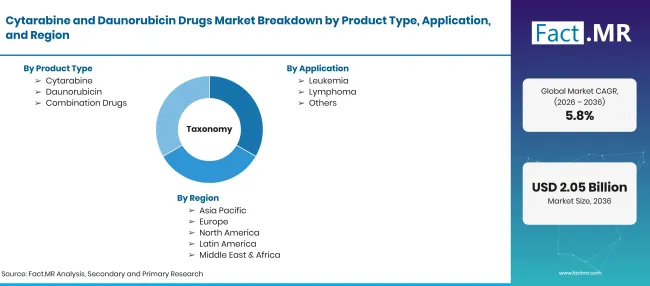
Cytarabine And Daunorubicin Drugs Market Taxonomy | Source: Fact.MR
| Attribute | Details |
|---|---|
| Quantitative Units | USD billion |
| Market Definition | Finished dosage forms of cytarabine, daunorubicin and their fixed-dose combinations used to treat blood cancers. Value is counted at manufacturer selling price across all care settings. |
| Product Type | Cytarabine; Daunorubicin; Combination Drugs |
| Application | Leukemia; Lymphoma; Others |
| Distribution Channel | Hospital Pharmacies; Retail Pharmacies; Online Pharmacies |
| End-User | Hospitals; Clinics; Research Institutes |
| Regions Covered | North America; Latin America; Western Europe; Eastern Europe; East Asia; South Asia & Pacific; Middle East & Africa |
| Countries Covered | Brazil; Japan; United Kingdom; United States; Germany |
| Companies Profiled | Jazz Pharmaceuticals plc; Pfizer Inc. (Hospira); Fresenius Kabi; Hikma Pharmaceuticals PLC; Accord Healthcare; Sandoz Group AG; Meitheal Pharmaceuticals; Sagent Pharmaceuticals |
| Forecast Period | 2026 to 2036 |
| Approach | Hybrid top-down and bottom-up approach using leukemia and lymphoma incidence; share of patients fit for intensive chemotherapy; cycles and vials per course; generic and branded price points by country; and supplier label review. |
Source: Fact.MR analysis. Updated Oct 26, 2026
How is the market segmented?
-
By Product Type
- Cytarabine
- Daunorubicin
- Combination Drugs
-
By Application
- Leukemia
- Lymphoma
- Others
-
By Distribution Channel
- Hospital Pharmacies
- Retail Pharmacies
- Online Pharmacies
-
By End-User
- Hospitals
- Clinics
- Research Institutes
-
By Region
- North America
- Latin America
- Western Europe
- Eastern Europe
- East Asia
- South Asia & Pacific
- Middle East & Africa
Frequently Asked Questions
How big is the cytarabine and daunorubicin drugs market in 2026?
What is the CAGR of the cytarabine and daunorubicin drugs market from 2026 to 2036?
Which product type leads the cytarabine and daunorubicin drugs market?
Which application leads the cytarabine and daunorubicin drugs market?
Which distribution channel leads the cytarabine and daunorubicin drugs market?
Which end-user leads the cytarabine and daunorubicin drugs market?
Which country will grow the most in the cytarabine and daunorubicin drugs market?
Who are the main companies in the cytarabine and daunorubicin drugs market?
Who worked on this report


Preview the report firsthand - request a free sample
Free SampleGet the brochure for pricing and purchase details
Download PDF