- Base Value(2025): 10.8 Bn
- Estimated Value(2026): 11.5 Bn
- Forecast Value (2036): 22.3 Bn
- CAGR (2026 - 2036): 6.8%
Insurance Consulting Services Market Forecast and Outlook Fact.MR
In 2025, the insurance consulting services market was valued at USD 10.8 billion. Based on Fact.MR analysis, demand for insurance consulting services is estimated to grow to USD 11.5 billion in 2026 and USD 22.3 billion by 2036. FACT.MR projects a CAGR of 6.8% during the forecast period.
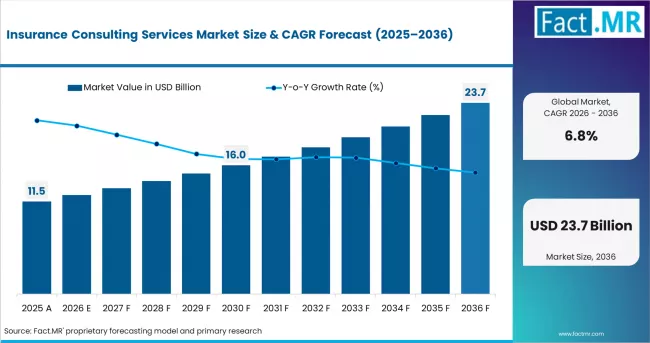
Insurance Consulting Services Market Value Analysis | Source: Fact.MR
Summary Of Insurance Consulting Services Market
- Market Definition
- The market covers risk, compliance, claims, digital, actuarial, and strategy consulting services delivered to insurance companies, brokers, reinsurers, and corporate clients across property & casualty, life & health, and reinsurance segments globally.
- Demand Drivers
- U.S. insurers are scaling digital transformation consulting mandates. Carriers are outsourcing core system modernization and cloud migration to tier-1 advisory firms.
- India’s IRDAI regulatory reforms are expanding compliance consulting demand. Insurers require advisory support on new solvency, product, and distribution frameworks.
- EU Solvency II and IFRS 17 implementation cycles are sustaining actuarial and risk consulting engagements at European insurers and reinsurers through the forecast period.
- Key Segments Analyzed
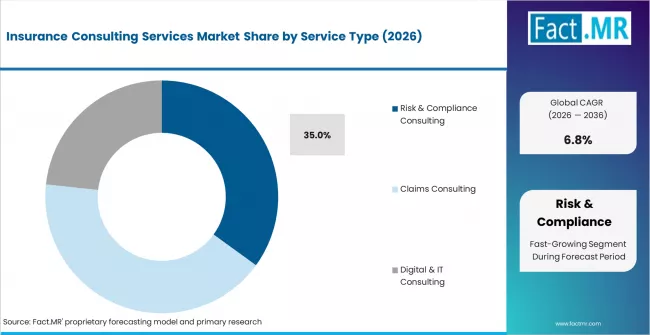
- By Service Type: Risk & Compliance Consulting leads with 35% share in 2026. Driven by regulatory complexity.
- By Insurance Type: Property & Casualty leads with the largest share in 2026. Driven by claims complexity, catastrophe risk modelling demand.
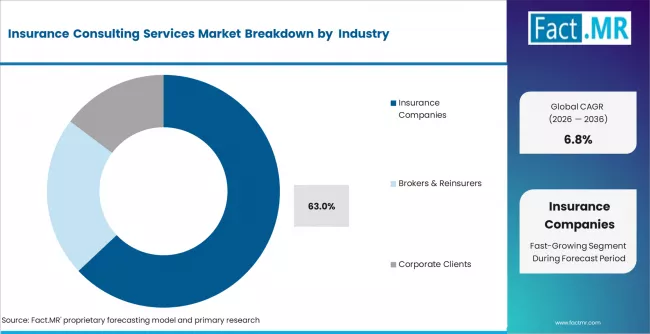
- By End User: Insurance Companies lead with 63% share in 2026. Primary buyers of risk, compliance, digital, and actuarial advisory.
- By Geography: India leads 8.0% CAGR through 2036. Driven by IRDAI-led market formalization.
- Analyst Opinion at FACT.MR
- Shambhu Nath Jha, Principal Consultant at Fact.MR, opines, ‘CXOs will find that insurance consulting is no longer a compliance cost centre but a strategic investment in digital and regulatory capability, and firms that can deliver integrated technology implementation alongside regulatory advisory will capture disproportionate share of the highest-value mandates through 2036.’
- Strategic Implications
- Develop integrated digital and regulatory consulting capability to qualify for outcome-linked mandates at tier-1 insurers replacing conventional advisory retainers with implementation-accountable engagements.
- Build dedicated insurance consulting practices in India and China to capture the highest-CAGR growth markets before global firms establish local delivery scale.
- Invest in IFRS 17, Solvency II, and IRDAI regulatory advisory specialisation to maintain recurring mandate flow from European and Asian insurers facing multi-year compliance implementation cycles.
- Methodology
- Market sizing based on consulting firm insurance practice revenues by service type and geography. Validated with 2024–2025 financial disclosures and insurer procurement data.
- IRDAI reform documents, PRA supervisory statements, BaFin reports, and CBIRC circulars supported demand and country analysis.
- Forecasts incorporate regulatory filing volumes, insurtech investment trends, and digital transformation programme benchmarks from primary research with consulting buyers.
| Metric | Value |
|---|---|
| Estimated Value in 2026 | USD 11.5 billion |
| Forecast Value in 2036 | USD 22.3 billion |
| Forecast CAGR (2026 to 2036) | 6.8% |
Source: Fact.MR analysis. Updated Apr 16, 2026
The market is expected to generate USD 10.8 billion in incremental revenue during the forecast period. Growth is strong and sustained. Demand is driven by regulatory change and digital transformation mandates. Insurance penetration is expanding in Asia Pacific. Growth is moderated by budget constraints and in-house capability build-up. Competition from niche tech advisory firms is increasing.
Insurers are shifting toward outcome-based consulting models. Broad advisory retainers are declining. Procurement is focused on firms with proven insurtech delivery capability. Buyers in the United States and United Kingdom prefer embedded execution teams. This is changing pricing and engagement structures.
India leads with a projected CAGR of 8.0% through 2036. Growth is supported by regulatory reforms and rising insurtech investment. China follows at 7.5%, driven by solvency reforms and digital distribution. The United States records 7.0%, supported by regulatory complexity and transformation demand. The United Kingdom grows at 6.5%, driven by Solvency II transition requirements. Germany records 6.0%, supported by compliance and ESG mandates. Mature markets face fee pressure and internal capability substitution.
Segmental Analysis
Insurance Consulting Services Market Analysis by Service Type
Insurance Consulting Services Market Analysis By Service Type | Source: Fact.MR
Based on FACT.MR, risk and compliance consulting holds 35% share in 2026. It leads due to continuous regulatory change. Insurers require external expertise for capital and compliance frameworks. Internal teams lack specialised capacity for cross-border requirements.
- Deloitte Expansion: Deloitte expanded its insurance regulatory practice in 2024. New teams support Solvency II and IFRS 17 implementation. Focus is on tier-1 carrier compliance programmes. [4]
- EY Development: EY launched an AI-based regulatory platform in 2025. It enables real-time compliance tracking. It integrates with audit and consulting workflows. [5]
- Compliance Demand Trend: International Association of Insurance Supervisors reported 17% growth in advisory demand in 2024. Growth is driven by global solvency and accounting reforms. [6]
Insurance Consulting Services Market Analysis by End User
Insurance Consulting Services Market Analysis By End User | Source: Fact.MR
Based on FACT.MR, insurance companies hold 63% share in 2026. They are the primary buyers of consulting services. Demand spans compliance, actuarial, and digital transformation. Operational complexity drives reliance on external advisors.
- KPMG Investment: KPMG expanded its insurance consulting teams in Asia Pacific in 2024. Focus is on IFRS 17 and digital transformation. Coverage includes Singapore and Tokyo markets.
- Accenture Development: Accenture launched Insurance Cloud Transformation in 2025. It supports core system migration and cloud underwriting. Target clients include tier-1 insurers. [3]
- Broker Demand Trend: British Insurance Brokers’ Association reported 13% growth in consulting demand in 2024. Driven by FCA Consumer Duty compliance needs.
Drivers, Restraints, and Opportunities
Insurance Consulting Services Market Opportunity Matrix Growth Vs Value | Source: Fact.MR
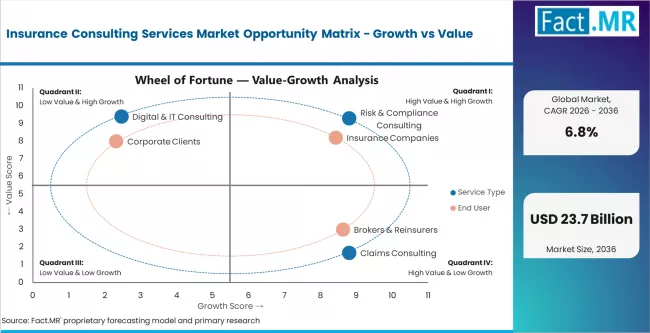
FACT.MR notes growth is linked to regulatory cycles and digital adoption. Compliance demand is structural and recurring. Digital transformation adds discretionary growth. Market expansion is stable across cycles.
Generalist consulting is declining at the top tier. Specialist and integrated services are gaining share. Compliance and implementation are increasingly bundled. Firms with delivery capability command 20–40% fee premiums. Revenue is concentrating among top firms.
- IFRS 17 and Solvency II Compliance: IFRS 17 took effect in 2023. It drives ongoing actuarial and system consulting demand. Solvency II updates in 2024 added new compliance requirements. [1]
- India IRDAI Reform Acceleration: India’s 2024 reform expanded market access. It increased demand for advisory across licensing and compliance. Foreign and domestic insurers are restructuring operations. [2]
- U.S. Digital Transformation Demand: U.S. insurers spent USD 19 billion on technology in 2024. Consulting accounts for 18% of spend. Cloud, AI, and automation are key drivers.
Regional Analysis
The insurance consulting services market is assessed across North America, Europe, Asia Pacific, Latin America, and Middle East and Africa, covering 40+ countries with distinct demand profiles shaped by insurance market maturity, regulatory reform pace, digital transformation investment, and consulting market structure. The full report provides market attractiveness analysis by region and country.
.webp "Top Country Growth Comparison Insurance Consulting Services Market Cagr (2026 2036)")
Top Country Growth Comparison Insurance Consulting Services Market Cagr (2026 2036) | Source: Fact.MR
| Country | CAGR (2026 to 2036) |
|---|---|
| India | 8.0% |
| China | 7.5% |
| United States | 7.0% |
| United Kingdom | 6.5% |
| Germany | 6.0% |
Source: Fact.MR analysis. Updated Apr 16, 2026
Source: Fact.MR (FACT.MR) analysis, based on proprietary forecasting model and primary research
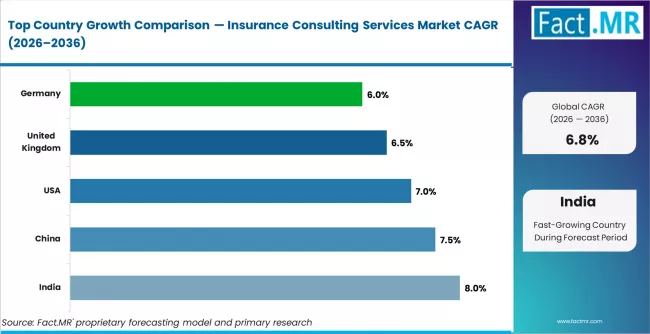
Insurance Consulting Services Market Cagr Analysis By Country | Source: Fact.MR
Asia Pacific Insurance Consulting Services Market Analysis
Asia Pacific is the fastest-growing region. Growth is driven by regulatory reform and insurtech adoption. India and China anchor demand expansion. Deloitte, PwC, and KPMG lead regional consulting supply with strong regulatory and digital advisory capabilities.
- India: Reform-led expansion supports 8.0% CAGR through 2036. IRDAI’s 2024 reforms expanded licensing and foreign ownership. This increased demand for compliance, restructuring, and product advisory. Deloitte strengthened advisory teams to support new entrants. Growth is driven by regulatory transition and market formalisation.
- China: Large-scale compliance modernisation supports 7.5% CAGR through 2036. C-ROSS Phase II reforms increased actuarial and capital modelling demand. PwC expanded advisory capacity in 2025. Demand is concentrated among large domestic insurers. Growth is driven by system-wide regulatory upgrades and digital distribution.
Fact.MR’s analysis covers India, China, Japan, South Korea, ASEAN, and ANZ. It includes reform impacts, insurtech adoption, and consulting demand trends.
North America Insurance Consulting Services Market Analysis
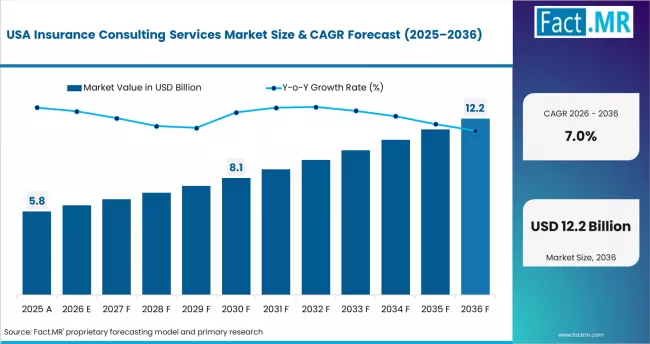
Insurance Consulting Services Market Country Value Analysis | Source: Fact.MR
North America is the largest and most mature market. Growth is driven by enterprise digital transformation and regulatory complexity. Deloitte, Accenture, and McKinsey & Company dominate large-scale engagements across tier-1 insurers.
- United States: Transformation-driven demand supports 7.0% CAGR through 2036. Climate disclosure and risk reporting rules expanded advisory needs in 2024. Accenture launched cloud transformation services in 2025. Insurers are investing in AI underwriting and claims automation. Growth is led by technology transformation and operational efficiency mandates.
Fact.MR’s analysis covers the United States, Canada, and Mexico. It includes regulatory disclosure trends and digital consulting demand.
Europe Insurance Consulting Services Market Analysis
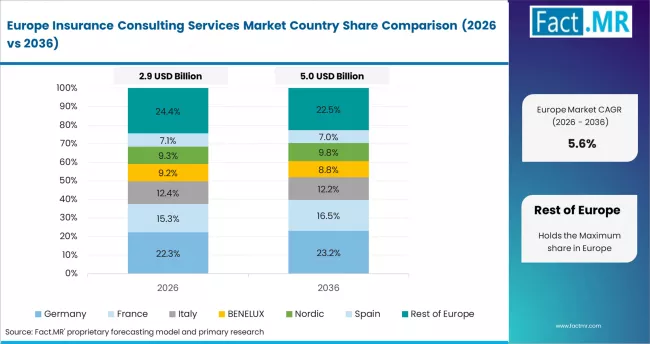
Insurance Consulting Services Market Europe Country Market Share Analysis, 2026 & 2036 | Source: Fact.MR
Europe is a compliance-intensive consulting market. Solvency II, IFRS 17, and ESG mandates define demand. PwC, KPMG, and EY lead through strong actuarial and regulatory advisory practices.
- United Kingdom: Regulatory complexity supports 6.5% CAGR through 2036. PRA reforms and FCA Consumer Duty increase compliance workload. Insurers require continuous actuarial and governance advisory. Growth is driven by supervision intensity and reporting obligations.
- Germany: Governance-led demand supports 6.0% CAGR through 2036. BaFin regulations increased risk management and ORSA requirements. Allianz and Munich Re expanded consulting engagement in 2024. ESG and sustainability reporting are key drivers. Growth is driven by audit, compliance, and internal model governance needs.
Fact.MR’s analysis covers Germany, France, the United Kingdom, Italy, Spain, and Rest of Europe. It includes regulatory, ESG, and advisory demand trends.
Competitive Aligners for Market Players
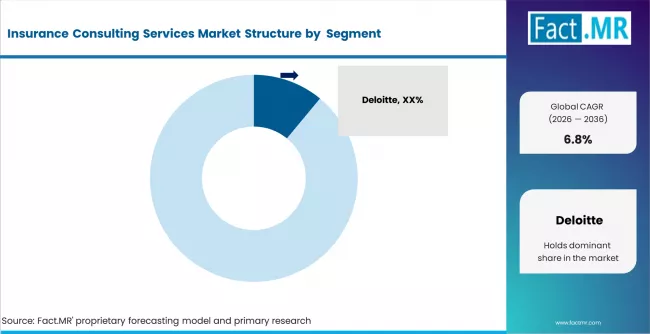
Insurance Consulting Services Market Analysis By Company | Source: Fact.MR
Competitive positioning in the insurance consulting services market is no longer defined by brand scale alone. It is shaped by how effectively firms combine regulatory advisory with execution capability. Mandates are shifting toward integrated delivery. This is concentrating revenue among firms that can embed technology teams within consulting engagements.
Deloitte, PwC, EY, and KPMG retain control of regulatory-heavy programmes. Their strength lies in actuarial depth and multi-jurisdiction compliance capability. However, their positioning is increasingly tied to execution. Pure advisory mandates are declining within this group. Accenture and McKinsey & Company are capturing transformation-led demand. Their advantage is delivery at scale across cloud migration, underwriting automation, and claims platforms. These firms are displacing traditional advisory in programmes linked to measurable outcomes. Their pricing power is supported by implementation ownership rather than strategy input.
Competitive fragmentation is visible below the top tier. Specialist firms are targeting regulatory technology, actuarial modelling, and digital distribution niches. These players compete on speed and technical depth. However, they remain dependent on partnerships for large-scale execution.
Client procurement behavior is reinforcing this structure. Tier-1 insurers are reducing vendor lists. Engagements are awarded based on prior delivery performance, not proposal breadth. Consulting contracts increasingly include execution milestones and performance-linked pricing. The result is a bifurcated market. Firms aligned with delivery-led consulting are scaling share. Those operating on traditional advisory models are being pushed into lower-value, short-cycle engagements with limited pricing leverage.
Key Players
- Deloitte
- PwC
- EY
- KPMG
- Accenture
- McKinsey & Company
- Aon
- Marsh McLennan
Bibliography
- [1] European Insurance and Occupational Pensions Authority. (2024). Solvency II 2024 Review: Updated Capital Requirements, Proportionality Provisions, and Risk Margin Recalibration for European Insurance and Reinsurance Undertakings Under Revised Supervisory Framework. 2024. eiopa.europa.eu
- [2] Insurance Regulatory and Development Authority of India. (2024). Insurance Amendment Act 2024: Composite Licensing Framework, Foreign Direct Investment Ceiling Revision to 100%, and New Capital Adequacy Requirements for Domestic and Foreign-Owned Insurance Carriers in India. 2024. irdai.gov.in
- [3] Accenture. (Early 2025). Practice Launch: Insurance Cloud Transformation Services Offering End-to-End Core System Migration and Cloud-Native Underwriting Platform Implementation for Tier-1 Property, Casualty, and Life Insurance Companies in North America and Europe. January 2025. accenture.com/newsroom
- [4] Deloitte. (2024). Insurance Industry Outlook 2024: U.S. Carrier Technology Transformation Spending of USD 19 Billion with 18% Share in Consulting and Advisory Fees Across Cloud Migration, AI Underwriting, and Claims Automation Programmes at Domestic Property and Casualty Insurers. 2024. deloitte.com/insights
- [5] EY. (Early 2025). Product Launch: AI-Powered Insurance Regulatory Monitoring Platform Enabling Real-Time Multi-Jurisdictional Compliance Tracking for Global Insurer Clients Across North America, Europe, and Asia Pacific Regulatory Frameworks. January 2025. ey.com/newsroom
- [6] International Association of Insurance Supervisors. (2024). Global Insurance Regulatory Advisory Trends 2024: 17% Increase in Cross-Border Regulatory Consulting Engagements at Globally Operating Insurers Driven by Simultaneous IFRS 17, IRDAI, and CBIRC Solvency Reform Implementation Cycles. 2024. iaisweb.org
This Report Addresses
- Strategic intelligence on insurance consulting demand across risk & compliance, digital transformation, actuarial, claims, and strategy advisory segments globally.
- Market forecast from USD 11.5 billion in 2026 to USD 22.3 billion by 2036 at a CAGR of 6.8%.
- Growth opportunity mapping across India IRDAI reform-driven advisory, China C-ROSS solvency consulting, U.S. digital transformation mandates, UK PRA and FCA compliance programmes, and Germany BaFin ESG and ORSA obligations.
- Segment analysis by service type (risk & compliance, claims, digital, actuarial, strategy), insurance type (P&C, life & health, reinsurance), and end user (insurance companies, brokers, corporate clients).
- Regional outlook covering Asia Pacific regulatory reform consulting, North America carrier digital transformation demand, and Europe Solvency II and IFRS 17-driven advisory programmes.
- Competitive landscape of Deloitte, PwC, EY, KPMG, Accenture, McKinsey, Aon, and Marsh McLennan. Focus on regulatory practice depth, insurtech delivery capability, and outcome-linked mandate positioning.
- Regulatory impact analysis covering IFRS 17 implementation cycles, Solvency II review outcomes, IRDAI Insurance Amendment Act implications, CBIRC C-ROSS Phase II updates, and U.S. NAIC climate risk disclosure frameworks.
- Report delivered in PDF, Excel datasets, and presentation formats. Supported by primary interviews, consulting firm revenue disclosures, IRDAI reform documents, PRA and BaFin supervisory publications, and insurer procurement benchmarks.
Insurance Consulting Services Market Definition
The market covers advisory and implementation services for insurers and risk buyers. It includes insurance companies, brokers, reinsurers, and corporates. Services include risk, compliance, claims, digital transformation, actuarial, and strategy consulting.
Insurance Consulting Services Market Inclusions
Includes global and regional forecasts from 2026 to 2036. Covers service type, insurance type, and end user. Includes risk, claims, digital, actuarial, and strategy consulting. Covers property & casualty, life & health, and reinsurance segments. Delivered via direct projects and managed services.
Insurance Consulting Services Market Exclusions
Excludes standalone software licensing revenue. Omits general consulting not specific to insurance. Excludes claims outsourcing and brokerage commissions. Also excludes actuarial staffing not classified as consulting engagements.
Insurance Consulting Services Market Research Methodology
- Primary Research
- Interviews with insurance consulting practice leaders, chief risk officers, chief digital officers, and procurement heads at insurers, reinsurers, and brokers across the United States, United Kingdom, Germany, China, and India.
- Desk Research
- Uses IRDAI regulatory reform disclosures, PRA supervisory statements, BaFin annual reports, CBIRC solvency circulars, and consulting firm revenue disclosures from Deloitte, PwC, EY, and KPMG from 2024–2025.
- Market-Sizing and Forecasting
- Hybrid model integrating top-down consulting revenue estimates from firm financial disclosures with bottom-up engagement volume forecasts by service type and end-user segment across each covered geography.
- Data Validation and Update Cycle
- Validated through consulting firm revenue data, insurer procurement benchmarks, and regulatory filing volumes. Cross-checked with expert interviews. Updated on a rolling annual basis.
Segmentation
Scope of Report
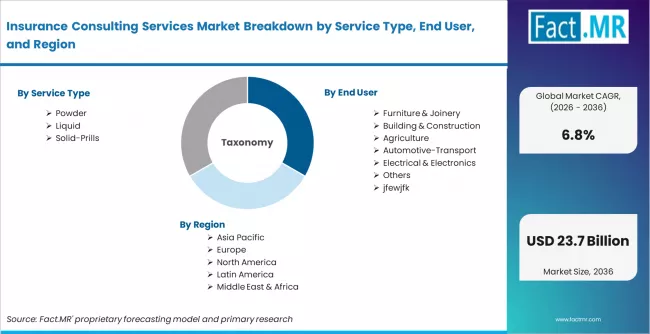
Insurance Consulting Services Market Breakdown By Service Type, End User, And Region | Source: Fact.MR
| Attribute | Details |
|---|---|
| Quantitative Units | USD 11.5 billion (2026) to USD 22.3 billion (2036), at a CAGR of 6.8% |
| Market Definition | Professional advisory and implementation services including risk & compliance, claims, digital & IT, actuarial, and strategy consulting delivered to insurance companies, brokers, reinsurers, and corporate clients across property & casualty, life & health, and reinsurance segments globally. |
| Service Type Segmentation | Risk & Compliance Consulting, Claims Consulting, Digital & IT Consulting, Actuarial Consulting, Strategy & Operations Consulting |
| Insurance Type Segmentation | Property & Casualty, Life & Health, Reinsurance |
| End User Segmentation | Insurance Companies, Brokers & Reinsurers, Corporate Clients |
| Application Coverage | Regulatory compliance advisory, solvency and capital modelling, digital core system transformation, claims analytics, actuarial reporting, ESG and climate risk consulting, and insurtech implementation for carriers and brokers. |
| Regions Covered | North America, Europe, Asia Pacific, Latin America, Middle East and Africa |
| Countries Covered | USA, Canada, Mexico, Germany, UK, France, Italy, Spain, Nordic, BENELUX, China, Japan, South Korea, India, ASEAN, Australia and New Zealand, Brazil, Argentina, Chile, Saudi Arabia, GCC, Turkey, South Africa, Rest of MEA |
| Key Companies Profiled | Deloitte, PwC, EY, KPMG, Accenture, McKinsey & Company, Aon, Marsh McLennan |
| Forecast Period | 2026 to 2036 |
| Approach | Hybrid top-down and bottom-up model using consulting firm insurance practice revenue disclosures, engagement volume estimates by service type and end-user segment, average fee benchmarks by advisory category, and primary interviews with insurance consulting buyers and practice leaders. |
Source: Fact.MR analysis. Updated Apr 16, 2026
Insurance Consulting Services Market by Segments
-
By Service Type:
- Risk & Compliance Consulting
- Claims Consulting
- Digital & IT Consulting
- Actuarial Consulting
- Strategy & Operations Consulting
-
By Insurance Type:
- Property & Casualty
- Life & Health
- Reinsurance
-
By End User:
- Insurance Companies
- Brokers & Reinsurers
- Corporate Clients
-
By Region:
- North America
- United States
- Canada
- Mexico
- Latin America
- Brazil
- Mexico
- Argentina
- Chile
- Rest of Latin America
- Western Europe
- Germany
- United Kingdom
- France
- Italy
- Spain
- Nordic Countries
- BENELUX
- Rest of Western Europe
- Eastern Europe
- Russia
- Poland
- Hungary
- Balkan and Baltic
- Rest of Eastern Europe
- East Asia
- China
- Japan
- South Korea
- South Asia and Pacific
- India
- ASEAN
- Australia and New Zealand
- Rest of South Asia and Pacific
- Middle East and Africa
- Kingdom of Saudi Arabia
- Other GCC Countries
- Turkey
- South Africa
- Rest of Middle East and Africa
- North America
Frequently Asked Questions
How large is the global insurance consulting services market in 2025?
What will the market size be in 2026?
What is the projected market size by 2036?
What is the expected CAGR from 2026 to 2036?
Which service type segment is poised to lead the market?
Which insurance type holds the largest share?
Which end-user segment dominates?
Which country shows the fastest growth?
What is driving demand for insurance consulting services?
What are the major restraints?
Which application is most significant?
Who worked on this report


Preview the report firsthand - request a free sample
Free SampleGet the brochure for pricing and purchase details
Download PDF