- Market Value (2025): USD 0.7 Bn
- Estimated Value (2026): USD 0.9 Bn
- Forecast Value (2036): USD 8.1 Bn
- CAGR (2026-2036): 24.6%
What is the livestream fraud detection market forecast to be worth by 2036?
USD 0.9 billion in 2026 to USD 8.1 billion by 2036, at 24.6% CAGR.
- The livestream fraud detection market crossed a valuation of USD 0.7 billion in 2025.
- Demand is expected to increase from USD 0.9 billion in 2026 to USD 8.1 billion by 2036.
- The market is forecast to record 24.6% CAGR during the forecast period because live commerce creates a narrow window to verify shoppers, coupons and affiliate activity.
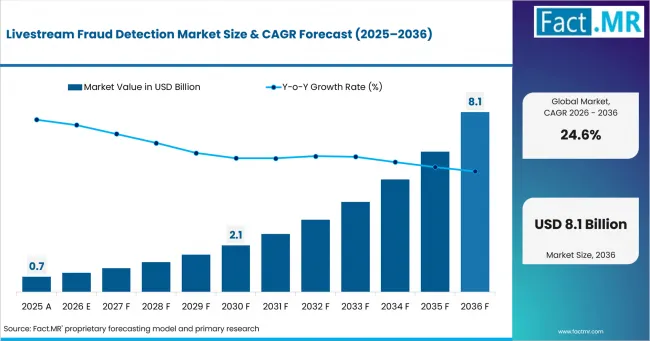
Livestream Fraud Detection Market Market Value Analysis | Source: Fact.MR
What are the defining numbers behind livestream fraud detection growth?
USD 7.2 billion absolute opportunity by 2036, led by China and India.
- Demand Drivers in the Market
- Brands need fake viewer checks before they link creator payment to livestream audience counts.
- Marketplaces need seller-risk screening before sellers receive live selling privileges.
- Retailers need coupon misuse controls because live promotions compress purchase decisions into short sessions.
- Agencies need attribution evidence because affiliate links and creator-led checkout can create payment disputes.
- Key Segments Analyzed
- By Fraud Signal: Fake viewer detection is expected to hold 31.0% share in 2026 because audience quality is the first proof point in a live campaign.
- By User Group: Brands are likely to account for 30.0% share in 2026 as they carry refund exposure and wasted campaign spend.
- By Functional Module: Checkout is projected to hold 28.0% share in 2026 because coupon and refund risk appears at order completion.
- By Deployment: API integrations are forecast to capture 34.0% share in 2026 since fraud signals need to move into chat, tags and carts.
- By Revenue Model: SaaS subscription is expected to hold 46.0% share in 2026 because repeat live events need monthly risk controls.
- By Geography: China is projected to record 28.7% CAGR through 2036 as live commerce and online retail remain closely linked.
- Analyst Opinion at Fact.MR
- Shambhu Nath Jha, Senior Analyst at Fact.MR, states, “Livestream fraud detection is becoming a checkout-control layer instead of a back-office review task. I see brands asking one practical question before they scale creator commerce. Did the live event bring real buyers or paid traffic noise? Vendors that answer this inside the session can reach platform budgets earlier. The advantage belongs to suppliers that connect bot scoring, seller checks and affiliate evidence without slowing live checkout.”
- Strategic Implications
- Brands should link live campaign payment to verified buyer actions instead of gross viewer counts.
- Marketplaces need seller-risk checks before sellers receive livestream privileges.
- Creator agencies should document bot filtering and coupon controls before pitching performance campaigns.
- Fraud vendors need connectors for live chat, checkout and affiliate systems because risk signals appear across the session.
Social media scams now give buyers a clear reason to ask for better proof before livestream checkout. The Federal Trade Commission reported social media scam losses of USD 2.1 billion. Shopping scams were the most reported social media scam type last year.
China is projected to record the fastest country CAGR in this report. India and Indonesia follow because live commerce is tied to creator selling and marketplace onboarding. The United States remains a large buyer because retail e-commerce sales already carry high transaction value.
How does the livestream fraud detection market break down by segment?
Fake viewer detection leads at 31.0%; API integrations lead at 34.0%.
Which fraud signal dominates?
Fake viewer detection holds 31.0% share in 2026.
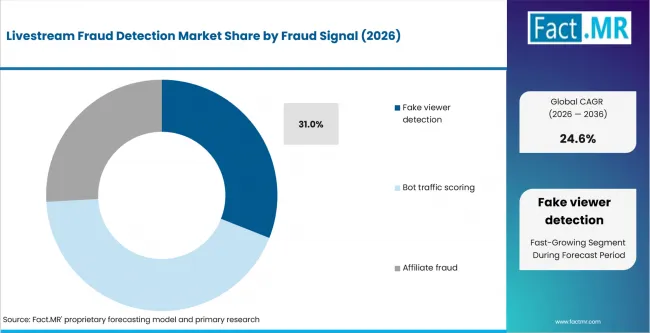
Livestream Fraud Detection Market Analysis By Fraud Signal | Source: Fact.MR
Fake viewer detection leads because inflated attendance can distort creator fees and campaign reporting. Brands fund this area first when they need to separate real buyers from traffic farms. The same signal also helps agencies decide whether a live event deserves repeat spend.
Which user group dominates?
Brands account for 30.0% share in 2026.
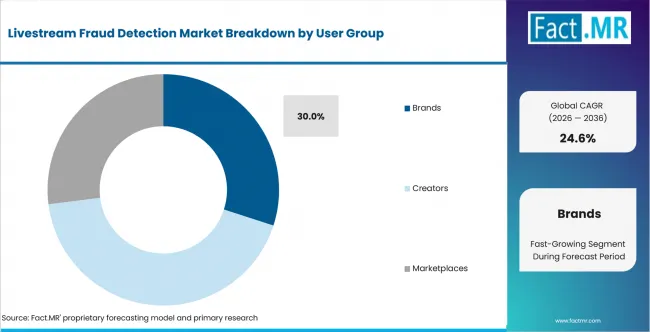
Livestream Fraud Detection Market Analysis By User Group | Source: Fact.MR
Brands lead because they carry refund losses and campaign waste when fake traffic enters live sessions. Their buying logic starts with budget protection and clean attribution. Product teams ask whether the tool can separate real buyers from low-quality traffic before a campaign moves to larger creators.
Which functional module dominates?
Checkout holds 28.0% share in 2026.
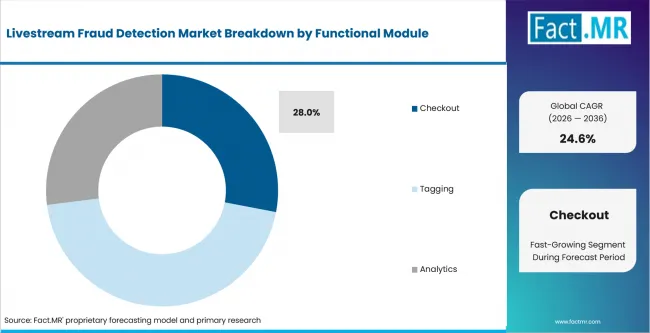
Livestream Fraud Detection Market Analysis By Functional Module | Source: Fact.MR
Checkout leads because livestream transactions often depend on fast cart actions and limited-time discounts. Fraud scoring becomes more useful when it can stop coupon misuse before the order is completed. The signal also needs to pass into payment gateway systems before order approval. Mobile viewing raises the need for controls that work as shoppers move from video to cart through mobile payment tools.
Which deployment model dominates?
API integrations lead with 34.0% share in 2026.
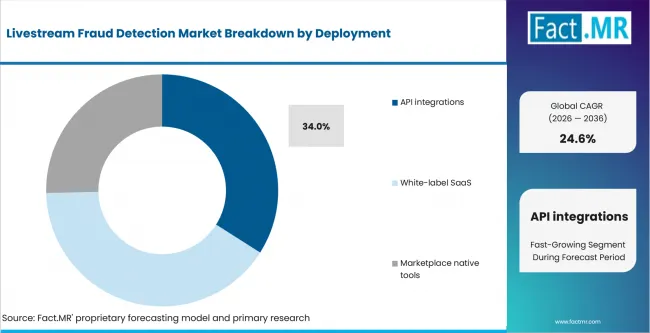
Livestream Fraud Detection Market Analysis By Deployment | Source: Fact.MR
API integrations lead because fraud signals need to move into chat, tagging, checkout and affiliate systems. Buyers prefer this model when one live session touches several tools. The link with real-time payments becomes important where payment confirmation happens immediately. The deployment model also helps marketplaces add session scoring without replacing their existing stack.
Which revenue model dominates?
SaaS subscription holds 46.0% share in 2026.
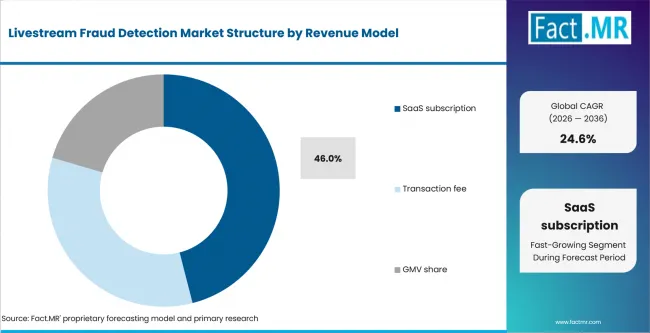
Livestream Fraud Detection Market Analysis By Revenue Model | Source: Fact.MR
SaaS subscription leads because brands and retailers run frequent live events and need month-to-month controls. Vendors can add usage tiers when customer volume or event count rises. Transaction fees remain relevant for smaller sellers that want lower upfront spending.
What is accelerating livestream fraud detection adoption, and what is holding it back?
Creator payout proof and live coupon misuse controls drive it, while false-positive risk and platform data limits restrain it.
Drivers Impact Analysis
| DRIVER | (~) % IMPACT ON CAGR |
GEOGRAPHIC RELEVANCE | IMPACT TIMELINE |
|---|---|---|---|
| Creator payout proof | +5.8% | United States, United Kingdom and Japan | Short term (≤ 2 years) |
| Live coupon misuse | +4.9% | China, India and Indonesia | Short term (≤ 2 years) |
| Seller onboarding risk | +4.5% | China, South Korea and India | Medium term (2–4 years) |
| Affiliate attribution disputes | +3.8% | United States and United Kingdom | Medium term (2–4 years) |
| Marketplace policy enforcement | +3.2% | Global platform buyers | Long term (≥ 4 years) |
Source: Fact.MR analysis. Updated Jul 2, 2026
- Creator payout proof
- Brands are moving creator payment from gross views to verified outcomes. The Federal Bureau of Investigation reported 1,008,597 total internet crime complaints. [2] That scale gives procurement teams a reason to ask for stronger session evidence before approving livestream campaign budgets.
- Live coupon misuse
- Live shopping creates urgency and that urgency can hide repeated coupon use. Fraud tools are likely to gain share when they catch account clusters before checkout. This mechanism connects fraud scoring with financial analytics workflows that already review transaction quality.
- Seller onboarding risk
- Marketplace sellers can scale quickly once they receive live selling access. Platform-level seller checks are becoming part of livestream fraud budgets.
Opportunity Impact Analysis
| OPPORTUNITY | (~) % IMPACT ON CAGR |
GEOGRAPHIC RELEVANCE | IMPACT TIMELINE |
|---|---|---|---|
| Session-level risk scoring | +5.6% | China, United States and India | Short term (≤ 2 years) |
| Creator affiliate audit tools | +4.7% | United States, United Kingdom and Japan | Medium term (2–4 years) |
| Marketplace-native fraud APIs | +4.2% | China, South Korea and Indonesia | Medium term (2–4 years) |
| Refund pattern services | +3.6% | Global retail brands | Medium term (2–4 years) |
| Identity checks for sellers | +3.0% | Regulated commerce platforms | Long term (≥ 4 years) |
Source: Fact.MR analysis. Updated Jul 2, 2026
- Session-level risk scoring
- Vendors can score fraud while the event is still live. This helps buyers stop coupon misuse, fake viewer inflation and suspicious orders before payment settles. The same buyer need connects livestream controls with transaction monitoring because repeated micro-actions matter more than one suspicious order.
- Creator affiliate audit tools
- Creator commerce creates attribution disputes when coupon codes, product tags and affiliate links overlap. YouTube expanded Shopping affiliate access to creators with at least 500 subscribers. [10] More eligible creators create a wider base for audit tools that check whether sales came from verified traffic.
- Identity checks for sellers
- Seller risk checks can expand beyond documents into device, payout and fulfillment signals. That opportunity sits near identity as a service because seller proof becomes part of marketplace trust. Platforms can use these checks before giving live selling privileges.
Restraints Impact Analysis
| RESTRAINT | (~) % IMPACT ON CAGR |
GEOGRAPHIC RELEVANCE | IMPACT TIMELINE |
|---|---|---|---|
| False-positive risk | -3.9% | Global brands and creators | Short term (≤ 2 years) |
| Platform data limits | -3.3% | United States, China and Europe | Medium term (2–4 years) |
| Low budgets at small sellers | -2.7% | India and Indonesia | Medium term (2–4 years) |
| Attribution disputes | -2.2% | Affiliate-heavy channels | Short term (≤ 2 years) |
| Privacy review delays | -1.8% | Europe and Japan | Long term (≥ 4 years) |
Source: Fact.MR analysis. Updated Jul 2, 2026
- False-positive risk
- A fraud tool can harm creator trust if it blocks real buyers during a live drop. Vendors need appeal logs and clear scoring reasons. The restraint is strongest when sellers depend on short promotions and cannot recover lost buyers later.
- Platform data limits
- Third-party tools do not always receive full viewer, chat and checkout signals. Limited access can reduce model accuracy and delay alerts. This creates an advantage for native marketplace tools and approved API partners.
- Low seller budgets
- Small sellers may avoid paid fraud tools when live selling revenue is still inconsistent. Lower-cost bundles can reduce this barrier if vendors price by event count or order volume. Managed review services may suit these sellers before full SaaS adoption.
Which countries are scaling livestream fraud detection fastest?
China 28.7%, India 27.9%, Indonesia 27.2%, South Korea 26.4%, United States 24.8%, United Kingdom 23.9% and Japan 22.8%.
Based on regional analysis, the livestream fraud detection market is segmented into North America, Latin America, Western Europe, East Asia, South Asia and Pacific, and Middle East and Africa.
| Country | CAGR |
|---|---|
| China | 28.7% |
| India | 27.9% |
| Indonesia | 27.2% |
| South Korea | 26.4% |
| United States | 24.8% |
| United Kingdom | 23.9% |
| Japan | 22.8% |
Source: Fact.MR analysis. Updated Jul 2, 2026
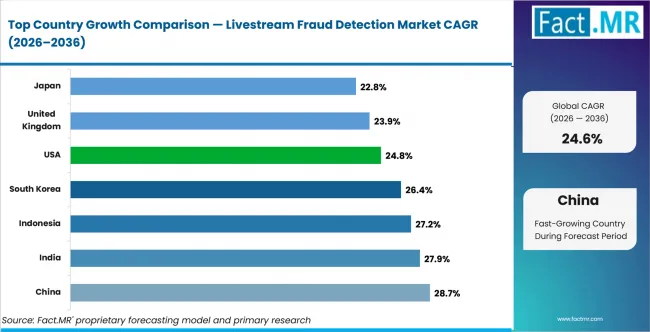
Livestream Fraud Detection Market Cagr Analysis By Country | Source: Fact.MR
What is powering China’s lead?
28.7% CAGR, supported by live commerce depth and online retail scale.
China has the deepest live commerce base among the seven countries. The State Council of the People’s Republic of China reported online retail sales of 15.97 trillion yuan. China is projected to record 28.7% CAGR through 2036 because fraud tools can attach to livestream sellers, coupons and platform checkout. Suppliers with Mandarin support and local API links should gain better access.
Why is India scaling quickly?
27.9% CAGR, driven by open commerce and small-seller onboarding.
Open commerce networks are changing how smaller sellers enter online selling in India. The Press Information Bureau reported that 206,000 merchants had conducted at least one transaction on the Open Network for Digital Commerce. India is expected to expand at 27.9% CAGR through 2036 because new sellers need low-cost fraud checks before live campaigns scale. Buyers are likely to favor tools that price by event or order volume.
How is Indonesia shaping live commerce risk?
27.2% CAGR, backed by social selling and high e-commerce value.
Indonesia uses social channels as a core selling route. The United Nations Statistical Institute for Asia and the Pacific reported e-commerce transaction value of 1,288.93 trillion rupiahs. Indonesia is forecast to grow at 27.2% CAGR through 2036 because non-marketplace selling raises fraud detection needs outside standard platform checks. The main ceiling is small-seller affordability.
What supports South Korea’s outlook?
26.4% CAGR, supported by mobile shopping depth and app-first commerce.
South Korea combines mobile-first commerce with fast platform testing. The Ministry of Data and Statistics reported online shopping transaction value of 24.1280 trillion won. South Korea is expected to advance at 26.4% CAGR through 2036 because mobile shopping and live product demos create dense transaction signals. Vendors need low-latency scoring to fit this buyer pattern.
What defines the United States opportunity?
24.8% CAGR, driven by brand budgets and high e-commerce transaction value.
The United States has large brand budgets and high online retail value. The United States Census Bureau reported seasonally adjusted retail e-commerce sales of USD 326.7 billion. The United States is projected to rise at 24.8% CAGR through 2036 because brands need proof before expanding creator and affiliate spending. The link with deception technology becomes relevant when fake accounts try to imitate real shoppers.
How does the United Kingdom buy these tools?
23.9% CAGR, supported by online retail discipline and privacy review.
The United Kingdom is a practical market for tools tied to online retail and creator compliance. The Office for National Statistics reported that online sales values rose by 12.2% compared with May 2025. The United Kingdom is forecast at 23.9% CAGR through 2036 because retailers already measure online channel quality closely. Buyer preference is expected to center on clear reporting and privacy-safe data use.
Why does Japan remain important?
22.8% CAGR, backed by disciplined e-commerce and accuracy requirements.
Japan has disciplined online retail and a cautious buyer culture. The Ministry of Economy, Trade and Industry reported domestic B-to-C e-commerce value of 26.1 trillion yen. Japan is expected to post 22.8% CAGR through 2036 because live commerce fraud tools must prove accuracy before brands adopt them widely. This makes product transparency a supplier requirement.
Who leads the livestream fraud detection landscape?
Signifyd, Riskified and Sift lead through platform access and checkout control.
Livestream fraud detection services are used by brands, sellers and marketplaces that need reliable evidence before live commerce spending scales. Signifyd provides merchant checkout and app access. Riskified controls seller onboarding and in-app shopping policies.
Buyer selection starts with signal coverage. Vendors that only score checkout fraud may lose when brands need fake viewer checks and affiliate controls. This places livestream risk beside media buying services because campaign spend and traffic quality are judged together. Specialist vendors can win when they explain false positives and give usable evidence to agencies. ClearSale support live selling workflows for brands and retailers.
Which companies are the key players?
Signifyd, Riskified, Sift, Forter, and ClearSale.
- Signifyd
- Riskified
- Sift
- Forter
- ClearSale
Bibliography
- Federal Trade Commission. (2026, April 27). New FTC data show people have lost billions to social media scams.
- Federal Bureau of Investigation. (2026, April 6). Cryptocurrency and AI scams bilk Americans of billions.
- United States Census Bureau. (2026, May 18). Quarterly retail e-commerce sales report.
- State Council of the People’s Republic of China. (2026, January 19). China’s retail sales up 3.7 pct in 2025.
- Press Information Bureau of India. (2026, March 9). Government periodically assesses digital adoption among Micro, Small and Medium Enterprises.
- Ministry of Data and Statistics of South Korea. (2026, June 1). Online shopping in April 2026.
- Office for National Statistics. (2026, June 19). Retail sales, Great Britain: May 2026.
- Ministry of Economy, Trade and Industry of Japan. (2025, August 26). Results of FY2024 e-commerce market survey compiled.
- United Nations Statistical Institute for Asia and the Pacific. (2025, March 31). Measuring the e-commerce value in Indonesia.
This Report Addresses
- Strategic intelligence on livestream fraud detection across fraud signal, user group and deployment model.
- Segment analysis covering fake viewer detection, brands, checkout, API integrations and SaaS subscription.
- Regional outlook covering China, India, Indonesia, South Korea, United States, United Kingdom and Japan.
- Competitive analysis of Signifyd, Riskified, Sift, Forter, ClearSale.
- Service assessment covering bot traffic scoring, refund abuse monitoring, coupon misuse detection and affiliate fraud review.
- Platform assessment covering checkout, tagging, analytics, couponing, demo hosting and affiliate attribution workflows.
- Primary interviews, official source review, provider checks and live commerce platform validation support the forecast.
What does the livestream fraud detection market cover?
Fraud detection software and services for livestream commerce workflows.
The livestream fraud detection market covers software and managed services that identify fake viewers, bot traffic, affiliate fraud, refund abuse and coupon misuse during live commerce activity. It includes tools used by creators, brands, retailers, marketplaces, agencies and social commerce teams. The market differs from general payment fraud because it also evaluates audience quality and live selling behavior. Cross-border campaigns also require links with cross-border e-commerce software when sellers run live promotions across return and payment rules.
What is included in the scope?
Fake viewer detection, bot traffic scoring and checkout-linked fraud review.
The scope includes fake viewer detection and bot traffic scoring. It covers affiliate fraud checks, refund abuse monitoring and coupon misuse detection. It also includes checkout, tagging, analytics, couponing, demo hosting and affiliate attribution modules when they are tied to livestream commerce fraud control.
What is excluded from the scope?
General cybersecurity software and payment processing without livestream fraud scoring.
The scope excludes general cybersecurity software that does not inspect live commerce sessions. It excludes payment processing when no livestream-specific fraud module is attached. It also excludes creator management tools that track commissions without fraud scoring.
How was the analysis built?
100+ sources. 40+ company portfolios. 25+ countries. 20+ interviews.
- Primary Research:
- Primary research includes interviews with commerce platform teams, fraud operations managers and agency buyers. It includes input from retailer online operations teams and social commerce vendors.
- Desk Research:
- Desk research reviews official fraud data, e-commerce indicators and company-owned safety updates. It covers live shopping software portfolios and platform trust disclosures.
- Market-Sizing and Forecasting:
- Forecasting uses a top-down e-commerce risk pool and a bottom-up fraud attach-rate model. Platform integration intensity and live commerce campaign volume support the assessment.
- Data Validation and Update Cycle:
- Forecasts are validated through provider checks and buyer budget logic. Platform safety reports and public e-commerce data help confirm market direction.
Segmentation
What is the report’s scope and coverage?
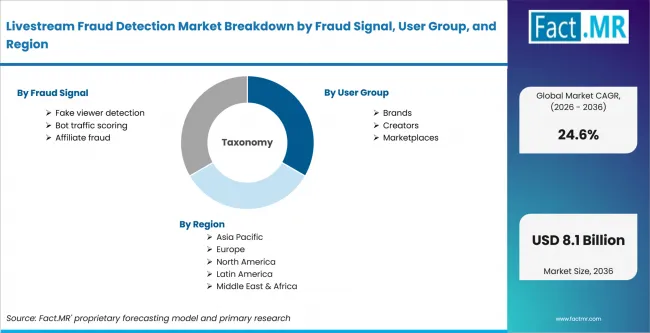
Livestream Fraud Detection Market Breakdown By Fraud Signal, User Group, And Region | Source: Fact.MR
| Attribute | Details |
|---|---|
| Quantitative Units | USD Billion in 2026 to USD Billion by 2036 at CAGR |
| Market Definition | Fraud detection software and services for livestream commerce workflows |
| Fraud Signal | Fake viewer detection, bot traffic scoring, affiliate fraud, refund abuse, coupon misuse detection |
| User Group | Creators, brands, retailers, marketplaces, agencies, social commerce teams |
| Functional Module | Checkout, tagging, analytics, couponing, demo hosting, affiliate attribution |
| Deployment | Shopify apps, marketplace native tools, API integrations, white-label SaaS |
| Revenue Model | SaaS subscription, transaction fee, GMV share, enterprise license, creator tool bundles |
| Regions Covered | North America, Latin America, Western Europe, East Asia, South Asia and Pacific, Middle East and Africa |
| Countries Covered | China, India, Indonesia, South Korea, United States, United Kingdom, Japan |
| Key Companies Profiled | Signifyd, Riskified, Sift, Forter, ClearSale |
| Forecast Period | 2026 to 2036 |
| Approach | Top-down e-commerce risk pool and bottom-up fraud attach-rate model |
Source: Fact.MR analysis. Updated Jul 2, 2026
How is the market segmented?
-
By Fraud Signal:
- Fake viewer detection
- Bot traffic scoring
- Affiliate fraud
- Refund abuse
- Coupon misuse detection
-
By User Group:
- Creators
- Brands
- Retailers
- Marketplaces
- Agencies
- Social commerce teams
-
By Functional Module:
- Checkout
- Tagging
- Analytics
- Couponing
- Demo hosting
- Affiliate attribution
-
By Deployment:
- Shopify apps
- Marketplace native tools
- API integrations
- White-label SaaS
-
By Revenue Model:
- SaaS subscription
- Transaction fee
- GMV share
- Enterprise license
- Creator tool bundles
-
By Region:
- North America
- United States
- Canada
- Mexico
- Latin America
- Brazil
- Argentina
- Rest of Latin America
- Western Europe
- United Kingdom
- Germany
- France
- Italy
- Spain
- Rest of Western Europe
- East Asia
- China
- Japan
- South Korea
- South Asia and Pacific
- India
- Indonesia
- ASEAN
- Australia and New Zealand
- Middle East and Africa
- GCC Countries
- South Africa
- UAE
- Rest of Middle East and Africa
- North America
Frequently Asked Questions
Which fraud signal leads the Livestream Fraud Detection Market?
Which country expands fastest in the Livestream Fraud Detection Market?
How does India perform in the Livestream Fraud Detection Market?
How does Indonesia perform in the Livestream Fraud Detection Market?
How does the United States perform in the Livestream Fraud Detection Market?
What is the primary driver in the Livestream Fraud Detection Market?
What is the main restraint in the Livestream Fraud Detection Market?
Who are the key players in the Livestream Fraud Detection Market?
Why is checkout important in livestream fraud detection?
Who worked on this report


Preview the report firsthand - request a free sample
Free SampleGet the brochure for pricing and purchase details
Download PDF