Dental Impression System Market
Dental Impression System Market Size and Share Forecast Outlook 2025 to 2035
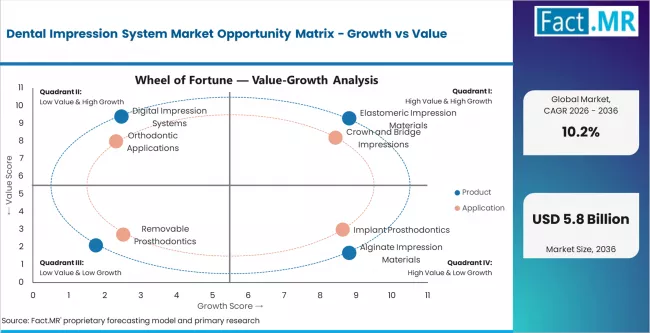
Dental impression system market is projected to grow from USD 2.0 billion in 2025 to USD 5.3 billion by 2035, at a CAGR of 10.2%. Impression Materials will dominate with a 50.2% market share, while restoratives & prosthodontics will lead the application segment with a 49.9% share.
Dental Impression System Market Forecast and Outlook 2025 to 2035
The global dental impression system market is projected to reach USD 5.3 billion by 2035, recording an absolute increase of USD 3.3 billion over the forecast period. The market is valued at USD 2.0 billion in 2025 and is set to rise at a CAGR of 10.2% during the assessment period. Overall, the market is expected to grow by 2.7X between 2025 and 2035.
This expansion is primarily driven by the increasing demand for digital dentistry solutions, including intraoral scanning technologies, which are transforming the way dental professionals capture and process impressions. The rapid integration of specialized impression materials, chairside CAD/CAM systems, and automated dental laboratory workflows is accelerating technology adoption. However, the high initial costs of digital systems and the technical challenges of workflow integration continue to limit adoption in smaller clinics and emerging economies.
Quick Stats for Dental Impression System Market
- Dental Impression System Market Value (2025): USD 2.0 billion
- Dental Impression System Market Forecast Value (2035): USD 5.3 billion
- Dental Impression System Market Forecast CAGR: 10.2%
- Leading Product in Dental Impression System Market: Impression Materials
- Key Growth Regions in Dental Impression System Market: Asia Pacific, North America, and Europe
- Top Players in Dental Impression System Market: Dentsply Sirona, 3Shape A/S, Align Technology, Inc., Henry Schein, Inc., GC Corporation, Kulzer GmbH, Kerr Corporation, Ivoclar Vivadent, Planmeca Oy, COLTENE Group

The market demonstrates consistent upward momentum, with historical data indicating a steady rise from USD 1.7 billion in 2020 to USD 2.0 billion in 2025. This trajectory reflects the global dental industry’s ongoing shift from traditional impression methods to advanced digital workflows, emphasizing precision, efficiency, and patient comfort. Developed regions with established dental infrastructures, particularly in North America and Western Europe, have played a leading role in facilitating this transition.
Between 2025 and 2030, the industry will likely witness a pivotal phase of digital expansion, with general practitioners and multi-specialty clinics increasingly embracing intraoral scanning systems that were once limited to prosthodontic and orthodontic specialists. During this period, material suppliers and device manufacturers will face stronger competition as dental professionals evaluate systems based on accuracy, cost-effectiveness, and return on investment.
Across global regions, adoption trends are expected to diverge significantly. North America and Europe will maintain their leadership positions, supported by favorable reimbursement frameworks, strong R&D ecosystems, and rising patient expectations for customized and high-precision restorations.
Asia Pacific will emerge as the fastest-growing regional market, particularly in China, India, and South Korea, where increasing disposable incomes, expanding private dental chains, and government-led oral healthcare initiatives are boosting adoption rates. Latin America and the Middle East & Africa are gradually gaining prominence, aided by the rise of dental tourism and the growing popularity of cosmetic and restorative dentistry.
An important factor fueling long-term growth is the aging global population, which continues to drive demand for prosthodontic and implant procedures requiring accurate dental impressions. The prevalence of edentulism and tooth loss among elderly patients underscores the need for high-fidelity impression systems that enhance clinical outcomes.
As dental clinics seek to improve productivity and reduce turnaround times, the adoption of chairside digital workflows and cloud-based data management platforms is expected to expand significantly. These trends position the dental impression system market for sustained growth through 2035, as precision, efficiency, and patient experience redefine the next generation of dental care.
Dental Impression System Market Year-over-Year Forecast (2025-2035)
Between 2025 and 2030, the dental impression system market is projected to expand from USD 2.0 billion to USD 3.3 billion, resulting in a value increase of USD 1.3 billion, which represents 39.4% of the total forecast growth for the decade. This phase of development will be shaped by rising demand for digital impression technologies and intraoral scanning systems, product innovation in elastomeric materials and CAD/CAM integration platforms, as well as expanding integration with dental laboratory networks and chairside restoration capabilities. Companies are establishing competitive positions through investment in optical scanning technologies, cloud-based data management systems, and strategic market expansion across restorative dentistry, prosthodontic applications, and orthodontic treatment planning.
From 2030 to 2035, the market is forecast to grow from USD 3.3 billion to USD 5.3 billion, adding another USD 2.0 billion, which constitutes 60.6% of the overall ten-year expansion. This period is expected to be characterized by the expansion of specialized clinical applications, including advanced intraoral scanning capabilities and next-generation impression materials tailored for specific prosthodontic requirements, strategic collaborations between dental equipment manufacturers and material suppliers, and an enhanced focus on workflow efficiency and digital ecosystem integration. The growing emphasis on precision dentistry and patient-centered care will drive demand for comprehensive impression solutions across diverse dental practice environments.
Dental Impression System Market Key Takeaways
| Metric | Value |
|---|---|
| Market Value (2025) | USD 2.0 billion |
| Market Forecast Value (2035) | USD 5.3 billion |
| Forecast CAGR (2025-2035) | 10.2% |
Why is the Dental Impression System Market Growing?
The dental impression system market grows by enabling dental practitioners and prosthodontists to optimize clinical workflows while accessing advanced impression technologies without substantial in-house equipment investment. Dental clinics and prosthodontic practices face mounting pressure to deliver precision restorations and improve patient comfort while managing complex material handling requirements, with specialized impression systems typically providing 40-60% faster procedure completion compared to conventional alternatives, making advanced impression technologies essential for competitive clinical positioning. The dental industry's need for accuracy and application-specific impression capabilities creates demand for comprehensive solutions that can provide superior detail reproduction, maintain consistent dimensional stability, and ensure reliable operation without compromising restoration quality or patient experience.
Government initiatives promoting dental care accessibility and digital health integration drive adoption in private practice, hospital dentistry, and academic dental institutions, where impression quality has a direct impact on treatment outcomes and patient satisfaction. However, system complexity constraints during high-volume clinical operations and the technical requirements for digital impression workflow integration may limit accessibility among smaller practices and developing regions with limited infrastructure for sophisticated dental technology systems.
Segmental Analysis
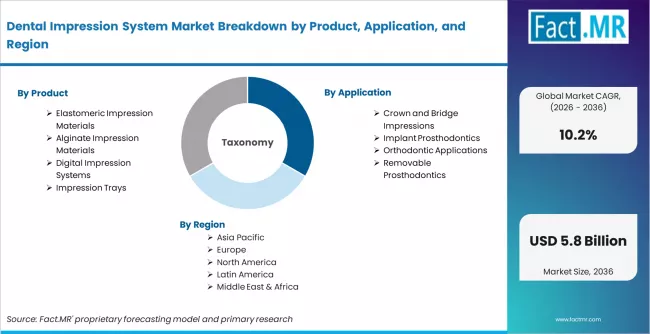
The market is segmented by product, application, end use, and region. By product, the market is divided into impression materials and other products. Based on application, the market is categorized into restorative & prosthodontics and other applications. By end use, the market includes dental clinics and others. Regionally, the market is divided into Asia Pacific, Europe, North America, Latin America, and Middle East & Africa.
By Product, the Impression Materials Segment Accounts for a Dominant Market Share

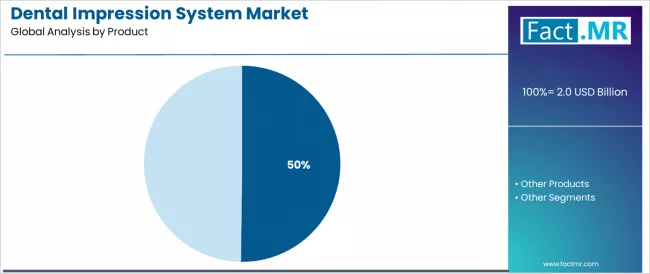
The impression materials segment represents the dominant force in the dental impression system market, capturing approximately 50.2% of total market share in 2025. This established product category encompasses solutions featuring sophisticated elastomeric compounds and alginate formulations, including advanced silicone-based materials and specialized hydrocolloid systems that enable superior impression accuracy and clinical performance across all prosthodontic applications.
The impression materials segment's market leadership stems from its superior material properties, with solutions capable of addressing diverse clinical requirements while maintaining consistent dimensional stability and detail reproduction across all dental practice environments.
The elastomeric silicone subsegment maintains a substantial 28.0% market share within impression materials, serving prosthodontists who require specialized materials with enhanced tear resistance features for complex crown and bridge preparations. These materials offer advanced flow characteristics for detailed impression capture while providing sufficient working time to meet clinical protocol demands.
The alginate subsegment accounts for approximately 12.0% of the market, serving general practice applications requiring cost-effective impression solutions for diagnostic models and preliminary prosthodontic work. The impression trays subsegment represents 6.2% of the market, serving clinical applications requiring specific tray configurations for custom impression procedures.
Key technological advantages driving the impression materials segment include:
- Advanced material technology with integrated dimensional stability that enhances impression accuracy and ensures consistent clinical outcomes
- Established clinical protocols allowing streamlined impression procedures across different case types without extensive technique modifications
- Enhanced handling characteristics enabling diverse application methods while maintaining material integrity and detail reproduction
- Superior clinical acceptance providing optimal impression quality for various restorative and prosthodontic applications
By Application, the Restoratives & Prosthodontics Segment Accounts for the Largest Market Share

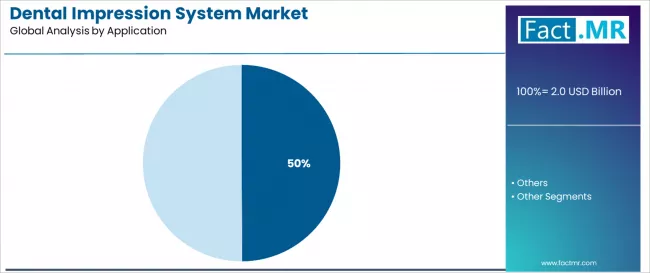
Restoratives & prosthodontics applications dominate the dental impression system market with approximately 49.9% market share in 2025, reflecting the critical role of impression accuracy in supporting specialized treatment requirements and restoration fabrication worldwide.
The restoratives & prosthodontics segment's market leadership is reinforced by increasing demand for fixed prosthodontic treatments, clinical complexity requirements, and rising needs for specialized impression capabilities in restorative dentistry across developed and emerging markets.
The crowns & bridges subsegment represents the largest application category, capturing 27.0% market share through specialized requirements for single-unit and multiple-unit fixed restorations, precise margin capture, and direct fabrication laboratory applications. This subsegment benefits from growing prosthodontic procedure volumes that require specific impression accuracy requirements, material handling protocols, and clinical workflow standards in dental practice markets.
The dentures & implants subsegment accounts for 14.0% market share, serving complete and partial denture fabrication, implant-supported prostheses, and specialized edentulous patient applications across various dental practice sectors. The restorative repairs subsegment represents 8.9% of the market, serving indirect restoration repairs and modification procedures in clinical settings.
Key market dynamics supporting application growth include:
- Restorative dentistry expansion driven by aging populations and prosthodontic demand, requiring specialized impression solutions in emerging dental markets
- Prosthodontic treatment modernization trends require flexible, integrated impression systems for competitive differentiation and clinical outcome improvement
- Integration of digital impression technologies enabling advanced clinical capabilities and laboratory communication systems
- Growing emphasis on precision dentistry driving demand for specialized, validated impression solutions without traditional workflow limitations
By End Use, the Dental Clinics Segment Accounts for the Largest Market Share

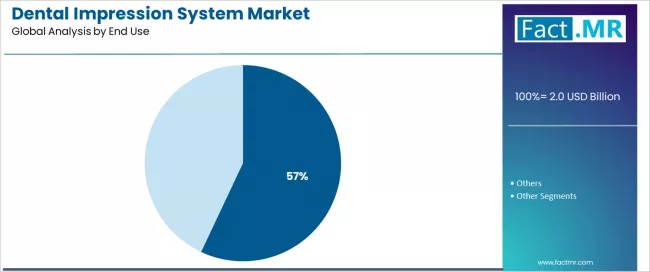
Dental clinics applications dominate the dental impression system market with approximately 57.0% market share in 2025, reflecting the critical role of clinical practice settings in prosthodontic treatment delivery and restoration procedures worldwide. The dental clinics segment's market leadership is reinforced by increasing private practice expansion, clinical equipment modernization, and rising patient volumes for restorative treatments across developed and emerging markets.
The general practice clinics subsegment represents the largest end-use category, capturing 38.0% market share through broad-based restorative dentistry services, routine prosthodontic procedures, and comprehensive dental care delivery applications. This subsegment benefits from growing patient accessibility to dental services that require efficient impression-taking capabilities, versatile material handling, and integrated clinical protocols in general dentistry settings.
The specialist clinics subsegment, focusing on prosthodontics and orthodontics, accounts for 12.0% market share, serving advanced prosthodontic cases, complex restorative procedures, and specialized treatment planning applications. The mobile and field clinics subsegment represents 7.0% of the market, serving outreach dental programs and community health initiatives in underserved areas.
What are the Drivers, Restraints, and Key Trends of the Dental Impression System Market?
The market is driven by three concrete demand factors tied to clinical dentistry outcomes. First, aging population demographics and increasing prosthodontic treatment needs create growing demand for specialized impression systems, with restorative procedure volumes expanding 15-25% annually in major dental markets worldwide, requiring comprehensive impression technology infrastructure. Second, digital dentistry transformation and intraoral scanner adoption drive increased utilization of advanced impression technologies, with many developed countries achieving 30-40% digital impression penetration rates in specialist practices by 2030. Third, technological advancements in impression materials and scanning technologies enable more efficient and accurate clinical solutions that improve treatment quality while reducing chair time and patient discomfort.
Market restraints include high initial investment costs and training requirements for digital impression platforms that can challenge market participants in developing compliant clinical capabilities, particularly in regions where reimbursement frameworks for digital dentistry remain evolving and uncertain. Technical complexity of intraoral scanning systems and specialized software requirements pose another significant challenge, as digital impression workflows demand sophisticated equipment calibration and maintenance protocols, potentially affecting practice adoption rates and operational efficiency. Material handling constraints for conventional impression systems across different clinical environments create additional operational challenges for practitioners, demanding ongoing investment in technique training and quality assurance programs.
Key trends indicate accelerated adoption in Asia-Pacific markets, particularly India and China, where dental care expansion and clinical infrastructure development drive comprehensive impression system adoption. Technology integration trends toward hybrid impression approaches with combined conventional and digital methods, advanced material formulations with enhanced handling characteristics, and integrated laboratory communication solutions enable flexible clinical approaches that optimize efficiency and minimize workflow disruptions. However, the market thesis could face disruption if significant advances in fully automated impression capture or major changes in prosthodontic fabrication technologies reduce reliance on traditional impression system methods.
Analysis of the Dental Impression System Market by Key Country

| Country | CAGR |
|---|---|
| India | 12.0% |
| China | 11.5% |
| USA | 9.8% |
| Brazil | 8.0% |
| Germany | 7.2% |
| UK | 7.0% |
| Japan | 6.5% |
The global dental impression system market is expanding steadily, with India leading at a 12.0% CAGR through 2035, driven by rising dental awareness, private clinic expansion, and affordability improvements. China follows at 11.5%, supported by rapid digital adoption in tier-1 and tier-2 cities and expansion of private dental chains. USA records 9.8%, reflecting large installed base of clinics and high adoption of intraoral scanners.
Brazil grows at 8.0%, demonstrating growing cosmetic dentistry and dental tourism. Germany advances at 7.2%, leveraging strong restorative dentistry demand and insurance coverage. UK posts 7.0%, focusing on robust private clinics and steady move toward chairside digital systems, while Japan grows at 6.5%, emphasizing ageing population demand for prosthodontics.
India Leads Global Market Expansion
India demonstrates the strongest growth potential in the dental impression system market with a CAGR of 12.0% through 2035. The country's leadership position stems from rising dental awareness campaigns, private clinic expansion across tier-2 and tier-3 cities and expanding dental laboratory capacity driving the adoption of advanced impression technologies.
Growth is concentrated in major urban centers, including Mumbai, Delhi, Bangalore, and Chennai, where dental clinics and prosthodontic practices are implementing modern impression systems for enhanced treatment outcomes and patient satisfaction. Distribution channels through dental supply chains and equipment distributors expand deployment across general practice clinics and specialist prosthodontic centers. The country's dental education infrastructure provides foundation for clinical technique training, including comprehensive impression methodology development.
Key market factors:
- Dental care expansion concentrated in urban areas and emerging cities with comprehensive clinic development programs
- Affordability improvements through local material suppliers and equipment distribution networks
- Growing dental laboratory ecosystem, including established fabrication centers with proven prosthodontic capabilities
- Material innovation featuring cost-effective impression compounds, improved alginate formulations, and accessibility-focused technologies
China Emerges as High-Growth Market
In major urban centers including Beijing, Shanghai, Shenzhen, and Guangzhou, the adoption of comprehensive dental impression solutions is accelerating across private dental chains and hospital dental departments, driven by digital technology scaling and government healthcare programs. The market demonstrates strong growth momentum with a CAGR of 11.5% through 2035, linked to comprehensive dental care modernization and increasing focus on precision dentistry solutions.
Chinese dental practices are implementing advanced impression systems and intraoral scanning platforms to enhance clinical efficiency while meeting growing patient demand in expanding urban dental markets. The country's dental manufacturing capabilities create sustained demand for impression materials, while increasing emphasis on quality care drives adoption of advanced clinical systems.
Key development areas:
- Private dental chains and hospital departments leading impression technology adoption with comprehensive digitization programs
- Dental supply channels providing integrated solutions with 85% material quality compliance rates
- Technology partnerships between equipment manufacturers and dental practice groups expanding market reach
- Integration of 3D printing platforms and comprehensive laboratory automation systems
USA Shows Digital Dentistry Innovation Leadership

USA market expansion is driven by diverse clinical demand, including prosthodontic specialization in major metropolitan areas and comprehensive restorative dentistry across multiple regions. The country demonstrates strong growth potential with a CAGR of 9.8% through 2035, supported by established reimbursement frameworks and practice-level technology investment initiatives.
American dental practices face implementation challenges related to workflow integration and equipment costs, requiring strategic adoption approaches and support from technology vendors and training organizations. However, growing patient expectations and clinical efficiency requirements create compelling business cases for impression system modernization, particularly in prosthodontic practices where impression accuracy has a direct impact on treatment success and patient retention.
Market characteristics:
- Prosthodontic and general practice segments showing robust growth with 20% annual increase in digital impression adoption
- Regional expansion trends focused on suburban dental markets in major metropolitan regions
- Future projections indicate the need for advanced training programs and clinical specialist certification systems
- Growing emphasis on chairside CAD/CAM integration and workflow efficiency competitiveness in dental operations
Germany Demonstrates Clinical Excellence
The Germany market leads in advanced dental impression innovation based on integration with prosthodontic workflows and precision material technologies for enhanced clinical quality. The country shows strong potential with a CAGR of 7.2% through 2035, driven by the modernization of existing practice infrastructure and the expansion of advanced dental facilities in major regions, including Bavaria, North Rhine-Westphalia, Baden-Württemberg, and Hesse.
German dental practices are adopting intelligent impression systems for quality improvement and precision enhancement, particularly in regions with advanced prosthodontic requirements and restorative applications demanding comprehensive clinical upgrades. Technology deployment channels through established dental distributors and equipment suppliers expand coverage across general practice facilities and specialist-focused applications.
Leading market segments:
- Prosthodontic practice modernization projects in major urban centers implementing comprehensive impression technology upgrades
- Clinical partnerships with material suppliers, achieving 95% impression accuracy improvement rates
- Strategic collaborations between equipment manufacturers and dental practice networks expanding market presence
- Focus on premium material systems and specialized prosthodontic application requirements
Japan Shows Prosthodontic Treatment Leadership

Japan's dental impression system market demonstrates sophisticated implementation focused on prosthodontic precision and clinical quality optimization, with documented integration of advanced impression materials, achieving 45% improvement in restoration fit accuracy across dental practices and prosthodontic facilities.
The country maintains steady growth momentum with a CAGR of 6.5% through 2035, driven by dental practices' emphasis on clinical excellence and conservative technology adoption methodologies that align with Japanese healthcare standards applied to dental operations. Major regions, including Kanto, Kansai, Chubu, and Kyushu, showcase measured deployment of impression technologies where materials and systems integrate carefully with existing clinical protocols and comprehensive quality management programs.
Key market characteristics:
- Prosthodontic practices and dental hospitals driving advanced impression requirements with emphasis on material quality and clinical precision
- Quality partnerships enabling 97% clinical compliance with comprehensive treatment programs
- Clinical collaboration between Japanese dental groups and international material manufacturers expanding market capabilities
- Emphasis on precision requirements and conservative clinical methodologies
Brazil Emphasizes Cosmetic Dentistry Development
Brazil's dental impression system market demonstrates emerging and growth-focused landscape, characterized by expanding integration of impression systems with existing dental clinic infrastructure across private practices, cosmetic dentistry centers, and dental tourism facilities. Brazil's emphasis on aesthetic dentistry and prosthodontic treatment drives demand for advanced impression solutions that support comprehensive restorative procedures and cosmetic rehabilitation requirements in dental operations.
The market benefits from partnerships between international equipment suppliers and domestic dental distributors, creating service ecosystems that prioritize clinical outcomes and material quality programs. Dental centers in major urban regions showcase developing impression technology implementations where systems achieve efficiency improvements through integrated clinical programs.
UK Shows Private Practice Leadership
UK's dental impression system market demonstrates mature and quality-focused landscape, characterized by balanced integration of conventional and digital impression systems with existing practice infrastructure across private dental clinics, NHS dental services, and specialist prosthodontic centers. UK's emphasis on clinical standards and patient care quality drives demand for reliable impression solutions that support comprehensive restorative procedures and prosthodontic treatment requirements in dental operations.
The market benefits from strong relationships between established equipment manufacturers and domestic dental supply networks, creating comprehensive service ecosystems that prioritize clinical reliability and technique training programs. Dental practices in major regions showcase steady impression technology adoption where systems achieve quality improvements through integrated clinical protocols.
Europe Market Split by Country

The dental impression system market in Europe is projected to grow from USD 0.5 billion in 2025 to USD 1.3 billion by 2035, registering a CAGR of 10.0% over the forecast period. Germany is expected to maintain its leadership position with a 28.0% market share in 2025, maintaining 27.8% by 2035, supported by its extensive dental practice infrastructure, advanced prosthodontic capabilities, and comprehensive clinical networks serving major European markets.
UK follows with a 19.5% share in 2025, projected to reach 19.7% by 2035, driven by comprehensive private dental services in major urban regions implementing advanced impression systems. France holds a 16.0% share in 2025, expected to maintain 15.8% by 2035 through the ongoing development of dental practices and prosthodontic service networks.
Italy commands a 13.5% share, while Spain accounts for 11.0% in 2025. The Rest of Europe region is anticipated to gain momentum, expanding its collective share from 12.0% to 12.2% by 2035, attributed to increasing impression system adoption in Nordic countries and emerging Eastern European dental practices implementing modern clinical programs.
Competitive Landscape of the Dental Impression System Market

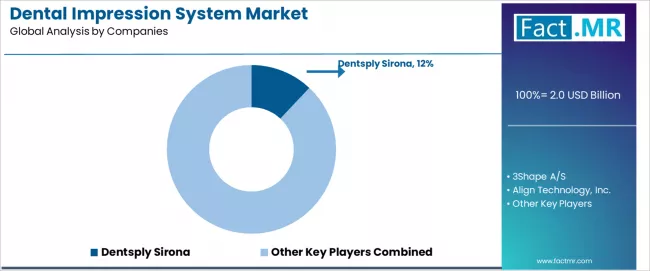
The dental impression system market features approximately 20-30 meaningful players with moderate concentration, where the top three companies control roughly 25-35% of global market share through established product portfolios and extensive dental industry relationships. Competition centers on material quality, clinical accuracy, and technical innovation rather than price competition alone.
Market leaders include Dentsply Sirona, 3Shape A/S, and Align Technology, Inc., which maintain competitive advantages through comprehensive impression system portfolios, advanced material technologies, and deep expertise in the dental and prosthodontic sectors, creating high switching costs for customers. These companies leverage established clinical relationships and ongoing product development partnerships to defend market positions while expanding into adjacent digital dentistry and laboratory automation applications.
Challengers encompass Henry Schein, Inc. and GC Corporation, which compete through specialized material technologies and strong regional presence in key dental markets. Impression specialists, including Kulzer GmbH, Kerr Corporation, and Ivoclar Vivadent, focus on specific material technologies or vertical applications, offering differentiated capabilities in elastomeric materials, alginate formulations, and application-specific solutions.
Regional players and emerging dental technology companies create competitive pressure through innovative material approaches and rapid development capabilities, particularly in high-growth markets including India and China, where local presence provides advantages in cost optimization and clinical training. Market dynamics favor companies that combine advanced material technologies with comprehensive clinical services that address the complete impression workflow from material selection through laboratory communication and quality assurance.
Global Dental Impression System Market - Stakeholder Contribution Framework
Dental impression system solutions represent a critical dental technology that enables dental practitioners, prosthodontists, and dental laboratories to enhance treatment precision and clinical efficiency without substantial in-house material development investment, typically providing 40-60% faster procedure completion compared to conventional alternatives while ensuring exceptional accuracy and patient comfort.
With the market projected to grow from USD 2.0 billion in 2025 to USD 5.3 billion by 2035 at a 10.2% CAGR, these solutions offer compelling advantages - superior accuracy, enhanced efficiency, and clinical reliability capabilities - making them essential for impression materials applications (50.2% market share), restorative & prosthodontics operations (49.9% share), and diverse dental practice applications seeking reliable clinical solutions.
Scaling market penetration and clinical capabilities requires coordinated action across dental policy, regulatory standards, material manufacturers, dental equipment providers, and clinical training institutions.
How Governments Could Spur Local Development and Adoption?
- Dental Technology Programs: Include impression system capabilities in national dental care development initiatives, providing targeted funding for specialized clinical facilities in dental practice regions and supporting local dental companies through innovation grants and development support.
- Tax Policy & R&D Support: Implement accelerated depreciation schedules for dental impression equipment, provide tax incentives for practices investing in advanced digital and material technologies, and establish favorable clinical accounting standards that encourage specialized impression system adoption over conventional approaches.
- Regulatory Framework Development: Create streamlined approval processes for dental impression materials across clinical and laboratory applications, establish clear quality standards and frameworks for specialized impression systems, and develop international harmonization protocols that facilitate cross-border dental technology adoption.
- Skills Development & Training: Fund vocational programs for dental technicians, impression specialists, and prosthodontic professionals. Invest in technology transfer initiatives that bridge dental education with commercial material development and clinical optimization systems.
- Market Access & Competition: Establish procurement policies that favor advanced impression solutions for government dental applications, support dental practice development through clinical modernization programs, and create regulatory environments that encourage innovation in dental impression technologies.
How Industry Bodies Could Support Market Development?
- Clinical Standards & Certification: Define standardized performance metrics for impression systems across prosthodontic, restorative, and general dentistry applications, establish universal material quality and accuracy protocols, and create certification programs for clinical performance that practitioners can rely on.
- Market Education & Best Practices: Lead messaging that demonstrates impression system advantages, emphasizing improved treatment accuracy, enhanced clinical compliance, and superior patient experience compared to outdated material alternatives.
- Technology Integration Standards: Develop interoperability standards for impression systems, laboratory compatibility guidelines, and digital workflow platforms, ensuring seamless integration across different clinical environments and laboratory requirements.
- Professional Development: Run certification programs for dental technicians, impression specialists, and clinical service teams on optimizing material performance, clinical compliance, and prosthodontic excellence in competitive dental markets.
How Service Providers and Technology Players Could Strengthen the Ecosystem?
- Advanced Material Development: Develop next-generation impression materials with enhanced dimensional stability, improved handling characteristics, and application-specific features that enhance clinical reliability while reducing procedural complexity.
- Digital Integration Platforms: Provide comprehensive dental software that integrates impression capture, laboratory communication, treatment planning, and clinical workflow optimization, enabling practices to maximize efficiency and treatment quality effectiveness.
- Service & Support Networks: Offer flexible support programs for dental practices and prosthodontic departments, including clinical training options, material consultation services, and technique optimization pathways that keep impression systems current with clinical demands.
- Research & Development Networks: Build comprehensive R&D capabilities, collaborative material innovation programs, and clinical validation systems that ensure impression technologies maintain high quality standards and consistent performance across diverse dental environments.
How Suppliers Could Navigate the Shift?
- Diversified Material Portfolios: Expand impression system offerings across elastomeric materials applications (28.0% product dominance), restorative & prosthodontics operations (49.9% share), and general practice applications, with particular focus on dental clinics services (57.0% end user dominance) and specialized solutions for prosthodontic requirements.
- Geographic Market Development: Establish operations in high-growth markets like India (12.0% CAGR) and China (11.5% CAGR), while strengthening presence in established markets like USA (9.8% CAGR) and Germany (7.2% CAGR) through regional clinical capabilities and local partnerships.
- Technology-Enabled Services: Implement advanced training systems with real-time clinical support, automated quality optimization, and predictive material performance capabilities that differentiate material offerings and improve customer satisfaction and retention.
- Flexible Service Models: Develop standard, premium, and custom impression solutions that accommodate varying clinical needs, from cost-effective materials to high-precision applications for demanding prosthodontic and regulatory requirements.
How Investors and Financial Enablers Could Unlock Value?
- Clinical Technology Expansion Financing: Provide growth capital for established companies like Dentsply Sirona, 3Shape A/S, and Align Technology, Inc. to expand impression system capacity and development capabilities, particularly in emerging markets with growing dental practice demands.
- Innovation Investment: Back startups developing advanced digital impression systems, next-generation materials, and intelligent clinical technologies that enhance dental industry efficiency and competitive positioning.
- Regional Market Development: Finance market entry and expansion strategies for impression system companies establishing operations in high-growth regions, supporting localization initiatives that reduce material costs while maintaining quality standards.
- Consolidation & Scale Opportunities: Support strategic acquisitions and market consolidation that create economies of scale, improve clinical capabilities, and enhance competitive positioning against fragmented regional providers across multiple geographic markets.
Key Players in the Dental Impression System Market
- Dentsply Sirona
- 3Shape A/S
- Align Technology, Inc.
- Henry Schein, Inc.
- GC Corporation
- Kulzer GmbH (Mitsui Chemicals)
- Kerr Corporation (Envista)
- Ivoclar Vivadent
- Planmeca Oy
- COLTENE Group
Scope of the Report
| Items | Values |
|---|---|
| Quantitative Units | USD 2.0 Billion |
| Product | Impression Materials, Other Products |
| Application | Restorative & Prosthodontics, Other |
| End User | Dental Clinics, Others |
| Regions Covered | Asia Pacific, Europe, North America, Latin America, Middle East & Africa |
| Country Covered | India, China, USA, Germany, Japan, Brazil, UK, and 40+ Covered countries |
| Key Companies Profiled | Dentsply Sirona, 3Shape A/S, Align Technology, Inc., Henry Schein, Inc., GC Corporation, Kulzer GmbH, Kerr Corporation, Ivoclar Vivadent, Planmeca Oy, COLTENE Group |
| Additional Attributes | Dollar sales by product and application categories, regional adoption trends across Asia Pacific, Europe, and North America, competitive landscape with dental equipment manufacturers and material suppliers, clinical facility requirements and specifications, integration with dental laboratory networks and digital workflow platforms, innovations in impression material technology and digital scanning systems, and development of specialized applications with accuracy and clinical optimization capabilities. |
Dental Impression System Market by Segments
-
Product :
- Impression Materials
- Elastomeric Silicone
- Alginate
- Impression Trays
- Others
- Other Products
- Impression Materials
-
Application :
- Restoratives & Prosthodontics
- Crowns & Bridges
- Dentures & Implants
- Restorative Repairs
- Others
- Restoratives & Prosthodontics
-
End User :
- Dental Clinics
- General Practice Clinics
- Specialist Clinics (Prosthodontics/Orthodontics)
- Mobile/Field Clinics
- Others
- Dental Clinics
-
Region :
- Asia Pacific
- China
- Japan
- South Korea
- India
- Australia & New Zealand
- ASEAN
- Rest of Asia Pacific
- Europe
- Germany
- UK
- France
- Italy
- Spain
- Nordic
- BENELUX
- Rest of Europe
- North America
- USA
- Canada
- Mexico
- Latin America
- Brazil
- Chile
- Rest of Latin America
- Middle East & Africa
- Kingdom of Saudi Arabia
- Other GCC Countries
- Turkey
- South Africa
- Other African Union
- Rest of Middle East & Africa
- Asia Pacific
Table of Content
- Executive Summary
- Global Market Outlook
- Demand to side Trends
- Supply to side Trends
- Technology Roadmap Analysis
- Analysis and Recommendations
- Market Overview
- Market Coverage / Taxonomy
- Market Definition / Scope / Limitations
- Market Background
- Market Dynamics
- Drivers
- Restraints
- Opportunity
- Trends
- Scenario Forecast
- Demand in Optimistic Scenario
- Demand in Likely Scenario
- Demand in Conservative Scenario
- Opportunity Map Analysis
- Product Life Cycle Analysis
- Supply Chain Analysis
- Investment Feasibility Matrix
- Value Chain Analysis
- PESTLE and Porter’s Analysis
- Regulatory Landscape
- Regional Parent Market Outlook
- Production and Consumption Statistics
- Import and Export Statistics
- Market Dynamics
- Global Market Analysis 2020 to 2024 and Forecast, 2025 to 2035
- Historical Market Size Value (USD Million) Analysis, 2020 to 2024
- Current and Future Market Size Value (USD Million) Projections, 2025 to 2035
- Y to o to Y Growth Trend Analysis
- Absolute $ Opportunity Analysis
- Global Market Pricing Analysis 2020 to 2024 and Forecast 2025 to 2035
- Global Market Analysis 2020 to 2024 and Forecast 2025 to 2035, By Product
- Introduction / Key Findings
- Historical Market Size Value (USD Million) Analysis By Product, 2020 to 2024
- Current and Future Market Size Value (USD Million) Analysis and Forecast By Product, 2025 to 2035
- Impression Materials
- Other Products
- Y to o to Y Growth Trend Analysis By Product, 2020 to 2024
- Absolute $ Opportunity Analysis By Product, 2025 to 2035
- Global Market Analysis 2020 to 2024 and Forecast 2025 to 2035, By Application
- Introduction / Key Findings
- Historical Market Size Value (USD Million) Analysis By Application, 2020 to 2024
- Current and Future Market Size Value (USD Million) Analysis and Forecast By Application, 2025 to 2035
- Restoratives & Prosthodontics
- Others
- Y to o to Y Growth Trend Analysis By Application, 2020 to 2024
- Absolute $ Opportunity Analysis By Application, 2025 to 2035
- Global Market Analysis 2020 to 2024 and Forecast 2025 to 2035, By End Use
- Introduction / Key Findings
- Historical Market Size Value (USD Million) Analysis By End Use, 2020 to 2024
- Current and Future Market Size Value (USD Million) Analysis and Forecast By End Use, 2025 to 2035
- Dental Clinics
- Others
- Y to o to Y Growth Trend Analysis By End Use, 2020 to 2024
- Absolute $ Opportunity Analysis By End Use, 2025 to 2035
- Global Market Analysis 2020 to 2024 and Forecast 2025 to 2035, By Region
- Introduction
- Historical Market Size Value (USD Million) Analysis By Region, 2020 to 2024
- Current Market Size Value (USD Million) Analysis and Forecast By Region, 2025 to 2035
- North America
- Latin America
- Western Europe
- Eastern Europe
- East Asia
- South Asia and Pacific
- Middle East & Africa
- Market Attractiveness Analysis By Region
- North America Market Analysis 2020 to 2024 and Forecast 2025 to 2035, By Country
- Historical Market Size Value (USD Million) Trend Analysis By Market Taxonomy, 2020 to 2024
- Market Size Value (USD Million) Forecast By Market Taxonomy, 2025 to 2035
- By Country
- USA
- Canada
- Mexico
- By Product
- By Application
- By End Use
- By Country
- Market Attractiveness Analysis
- By Country
- By Product
- By Application
- By End Use
- Key Takeaways
- Latin America Market Analysis 2020 to 2024 and Forecast 2025 to 2035, By Country
- Historical Market Size Value (USD Million) Trend Analysis By Market Taxonomy, 2020 to 2024
- Market Size Value (USD Million) Forecast By Market Taxonomy, 2025 to 2035
- By Country
- Brazil
- Chile
- Rest of Latin America
- By Product
- By Application
- By End Use
- By Country
- Market Attractiveness Analysis
- By Country
- By Product
- By Application
- By End Use
- Key Takeaways
- Western Europe Market Analysis 2020 to 2024 and Forecast 2025 to 2035, By Country
- Historical Market Size Value (USD Million) Trend Analysis By Market Taxonomy, 2020 to 2024
- Market Size Value (USD Million) Forecast By Market Taxonomy, 2025 to 2035
- By Country
- Germany
- UK
- Italy
- Spain
- France
- Nordic
- BENELUX
- Rest of Western Europe
- By Product
- By Application
- By End Use
- By Country
- Market Attractiveness Analysis
- By Country
- By Product
- By Application
- By End Use
- Key Takeaways
- Eastern Europe Market Analysis 2020 to 2024 and Forecast 2025 to 2035, By Country
- Historical Market Size Value (USD Million) Trend Analysis By Market Taxonomy, 2020 to 2024
- Market Size Value (USD Million) Forecast By Market Taxonomy, 2025 to 2035
- By Country
- Russia
- Poland
- Hungary
- Balkan & Baltic
- Rest of Eastern Europe
- By Product
- By Application
- By End Use
- By Country
- Market Attractiveness Analysis
- By Country
- By Product
- By Application
- By End Use
- Key Takeaways
- East Asia Market Analysis 2020 to 2024 and Forecast 2025 to 2035, By Country
- Historical Market Size Value (USD Million) Trend Analysis By Market Taxonomy, 2020 to 2024
- Market Size Value (USD Million) Forecast By Market Taxonomy, 2025 to 2035
- By Country
- China
- Japan
- South Korea
- By Product
- By Application
- By End Use
- By Country
- Market Attractiveness Analysis
- By Country
- By Product
- By Application
- By End Use
- Key Takeaways
- South Asia and Pacific Market Analysis 2020 to 2024 and Forecast 2025 to 2035, By Country
- Historical Market Size Value (USD Million) Trend Analysis By Market Taxonomy, 2020 to 2024
- Market Size Value (USD Million) Forecast By Market Taxonomy, 2025 to 2035
- By Country
- India
- ASEAN
- Australia & New Zealand
- Rest of South Asia and Pacific
- By Product
- By Application
- By End Use
- By Country
- Market Attractiveness Analysis
- By Country
- By Product
- By Application
- By End Use
- Key Takeaways
- Middle East & Africa Market Analysis 2020 to 2024 and Forecast 2025 to 2035, By Country
- Historical Market Size Value (USD Million) Trend Analysis By Market Taxonomy, 2020 to 2024
- Market Size Value (USD Million) Forecast By Market Taxonomy, 2025 to 2035
- By Country
- Kingdom of Saudi Arabia
- Other GCC Countries
- Turkiye
- South Africa
- Other African Union
- Rest of Middle East & Africa
- By Product
- By Application
- By End Use
- By Country
- Market Attractiveness Analysis
- By Country
- By Product
- By Application
- By End Use
- Key Takeaways
- Key Countries Market Analysis
- USA
- Pricing Analysis
- Market Share Analysis, 2024
- By Product
- By Application
- By End Use
- Canada
- Pricing Analysis
- Market Share Analysis, 2024
- By Product
- By Application
- By End Use
- Mexico
- Pricing Analysis
- Market Share Analysis, 2024
- By Product
- By Application
- By End Use
- Brazil
- Pricing Analysis
- Market Share Analysis, 2024
- By Product
- By Application
- By End Use
- Chile
- Pricing Analysis
- Market Share Analysis, 2024
- By Product
- By Application
- By End Use
- Germany
- Pricing Analysis
- Market Share Analysis, 2024
- By Product
- By Application
- By End Use
- UK
- Pricing Analysis
- Market Share Analysis, 2024
- By Product
- By Application
- By End Use
- Italy
- Pricing Analysis
- Market Share Analysis, 2024
- By Product
- By Application
- By End Use
- Spain
- Pricing Analysis
- Market Share Analysis, 2024
- By Product
- By Application
- By End Use
- France
- Pricing Analysis
- Market Share Analysis, 2024
- By Product
- By Application
- By End Use
- India
- Pricing Analysis
- Market Share Analysis, 2024
- By Product
- By Application
- By End Use
- ASEAN
- Pricing Analysis
- Market Share Analysis, 2024
- By Product
- By Application
- By End Use
- Australia & New Zealand
- Pricing Analysis
- Market Share Analysis, 2024
- By Product
- By Application
- By End Use
- China
- Pricing Analysis
- Market Share Analysis, 2024
- By Product
- By Application
- By End Use
- Japan
- Pricing Analysis
- Market Share Analysis, 2024
- By Product
- By Application
- By End Use
- South Korea
- Pricing Analysis
- Market Share Analysis, 2024
- By Product
- By Application
- By End Use
- Russia
- Pricing Analysis
- Market Share Analysis, 2024
- By Product
- By Application
- By End Use
- Poland
- Pricing Analysis
- Market Share Analysis, 2024
- By Product
- By Application
- By End Use
- Hungary
- Pricing Analysis
- Market Share Analysis, 2024
- By Product
- By Application
- By End Use
- Kingdom of Saudi Arabia
- Pricing Analysis
- Market Share Analysis, 2024
- By Product
- By Application
- By End Use
- Turkiye
- Pricing Analysis
- Market Share Analysis, 2024
- By Product
- By Application
- By End Use
- South Africa
- Pricing Analysis
- Market Share Analysis, 2024
- By Product
- By Application
- By End Use
- USA
- Market Structure Analysis
- Competition Dashboard
- Competition Benchmarking
- Market Share Analysis of Top Players
- By Regional
- By Product
- By Application
- By End Use
- Competition Analysis
- Competition Deep Dive
- Dentsply Sirona
- Overview
- Product Portfolio
- Profitability by Market Segments (Product/Age /Sales Channel/Region)
- Sales Footprint
- Strategy Overview
- Marketing Strategy
- Product Strategy
- Channel Strategy
- 3Shape A/S
- Align Technology, Inc.
- Henry Schein, Inc.
- GC Corporation
- Kulzer GmbH (Mitsui Chemicals)
- Kerr Corporation (Envista)
- Ivoclar Vivadent
- Planmeca Oy
- COLTENE Group
- Dentsply Sirona
- Competition Deep Dive
- Assumptions & Acronyms Used
- Research Methodology
List Of Table
- Table 1: Global Market Value (USD Million) Forecast by Region, 2020 to 2035
- Table 2: Global Market Value (USD Million) Forecast by Product, 2020 to 2035
- Table 3: Global Market Value (USD Million) Forecast by Application, 2020 to 2035
- Table 4: Global Market Value (USD Million) Forecast by End Use, 2020 to 2035
- Table 5: North America Market Value (USD Million) Forecast by Country, 2020 to 2035
- Table 6: North America Market Value (USD Million) Forecast by Product, 2020 to 2035
- Table 7: North America Market Value (USD Million) Forecast by Application, 2020 to 2035
- Table 8: North America Market Value (USD Million) Forecast by End Use, 2020 to 2035
- Table 9: Latin America Market Value (USD Million) Forecast by Country, 2020 to 2035
- Table 10: Latin America Market Value (USD Million) Forecast by Product, 2020 to 2035
- Table 11: Latin America Market Value (USD Million) Forecast by Application, 2020 to 2035
- Table 12: Latin America Market Value (USD Million) Forecast by End Use, 2020 to 2035
- Table 13: Western Europe Market Value (USD Million) Forecast by Country, 2020 to 2035
- Table 14: Western Europe Market Value (USD Million) Forecast by Product, 2020 to 2035
- Table 15: Western Europe Market Value (USD Million) Forecast by Application, 2020 to 2035
- Table 16: Western Europe Market Value (USD Million) Forecast by End Use, 2020 to 2035
- Table 17: Eastern Europe Market Value (USD Million) Forecast by Country, 2020 to 2035
- Table 18: Eastern Europe Market Value (USD Million) Forecast by Product, 2020 to 2035
- Table 19: Eastern Europe Market Value (USD Million) Forecast by Application, 2020 to 2035
- Table 20: Eastern Europe Market Value (USD Million) Forecast by End Use, 2020 to 2035
- Table 21: East Asia Market Value (USD Million) Forecast by Country, 2020 to 2035
- Table 22: East Asia Market Value (USD Million) Forecast by Product, 2020 to 2035
- Table 23: East Asia Market Value (USD Million) Forecast by Application, 2020 to 2035
- Table 24: East Asia Market Value (USD Million) Forecast by End Use, 2020 to 2035
- Table 25: South Asia and Pacific Market Value (USD Million) Forecast by Country, 2020 to 2035
- Table 26: South Asia and Pacific Market Value (USD Million) Forecast by Product, 2020 to 2035
- Table 27: South Asia and Pacific Market Value (USD Million) Forecast by Application, 2020 to 2035
- Table 28: South Asia and Pacific Market Value (USD Million) Forecast by End Use, 2020 to 2035
- Table 29: Middle East & Africa Market Value (USD Million) Forecast by Country, 2020 to 2035
- Table 30: Middle East & Africa Market Value (USD Million) Forecast by Product, 2020 to 2035
- Table 31: Middle East & Africa Market Value (USD Million) Forecast by Application, 2020 to 2035
- Table 32: Middle East & Africa Market Value (USD Million) Forecast by End Use, 2020 to 2035
List Of Figures
- Figure 1: Global Market Pricing Analysis
- Figure 2: Global Market Value (USD Million) Forecast 2020 to 2035
- Figure 3: Global Market Value Share and BPS Analysis by Product, 2025 and 2035
- Figure 4: Global Market Y to o to Y Growth Comparison by Product, 2025 to 2035
- Figure 5: Global Market Attractiveness Analysis by Product
- Figure 6: Global Market Value Share and BPS Analysis by Application, 2025 and 2035
- Figure 7: Global Market Y to o to Y Growth Comparison by Application, 2025 to 2035
- Figure 8: Global Market Attractiveness Analysis by Application
- Figure 9: Global Market Value Share and BPS Analysis by End Use, 2025 and 2035
- Figure 10: Global Market Y to o to Y Growth Comparison by End Use, 2025 to 2035
- Figure 11: Global Market Attractiveness Analysis by End Use
- Figure 12: Global Market Value (USD Million) Share and BPS Analysis by Region, 2025 and 2035
- Figure 13: Global Market Y to o to Y Growth Comparison by Region, 2025 to 2035
- Figure 14: Global Market Attractiveness Analysis by Region
- Figure 15: North America Market Incremental Dollar Opportunity, 2025 to 2035
- Figure 16: Latin America Market Incremental Dollar Opportunity, 2025 to 2035
- Figure 17: Western Europe Market Incremental Dollar Opportunity, 2025 to 2035
- Figure 18: Eastern Europe Market Incremental Dollar Opportunity, 2025 to 2035
- Figure 19: East Asia Market Incremental Dollar Opportunity, 2025 to 2035
- Figure 20: South Asia and Pacific Market Incremental Dollar Opportunity, 2025 to 2035
- Figure 21: Middle East & Africa Market Incremental Dollar Opportunity, 2025 to 2035
- Figure 22: North America Market Value Share and BPS Analysis by Country, 2025 and 2035
- Figure 23: North America Market Value Share and BPS Analysis by Product, 2025 and 2035
- Figure 24: North America Market Y to o to Y Growth Comparison by Product, 2025 to 2035
- Figure 25: North America Market Attractiveness Analysis by Product
- Figure 26: North America Market Value Share and BPS Analysis by Application, 2025 and 2035
- Figure 27: North America Market Y to o to Y Growth Comparison by Application, 2025 to 2035
- Figure 28: North America Market Attractiveness Analysis by Application
- Figure 29: North America Market Value Share and BPS Analysis by End Use, 2025 and 2035
- Figure 30: North America Market Y to o to Y Growth Comparison by End Use, 2025 to 2035
- Figure 31: North America Market Attractiveness Analysis by End Use
- Figure 32: Latin America Market Value Share and BPS Analysis by Country, 2025 and 2035
- Figure 33: Latin America Market Value Share and BPS Analysis by Product, 2025 and 2035
- Figure 34: Latin America Market Y to o to Y Growth Comparison by Product, 2025 to 2035
- Figure 35: Latin America Market Attractiveness Analysis by Product
- Figure 36: Latin America Market Value Share and BPS Analysis by Application, 2025 and 2035
- Figure 37: Latin America Market Y to o to Y Growth Comparison by Application, 2025 to 2035
- Figure 38: Latin America Market Attractiveness Analysis by Application
- Figure 39: Latin America Market Value Share and BPS Analysis by End Use, 2025 and 2035
- Figure 40: Latin America Market Y to o to Y Growth Comparison by End Use, 2025 to 2035
- Figure 41: Latin America Market Attractiveness Analysis by End Use
- Figure 42: Western Europe Market Value Share and BPS Analysis by Country, 2025 and 2035
- Figure 43: Western Europe Market Value Share and BPS Analysis by Product, 2025 and 2035
- Figure 44: Western Europe Market Y to o to Y Growth Comparison by Product, 2025 to 2035
- Figure 45: Western Europe Market Attractiveness Analysis by Product
- Figure 46: Western Europe Market Value Share and BPS Analysis by Application, 2025 and 2035
- Figure 47: Western Europe Market Y to o to Y Growth Comparison by Application, 2025 to 2035
- Figure 48: Western Europe Market Attractiveness Analysis by Application
- Figure 49: Western Europe Market Value Share and BPS Analysis by End Use, 2025 and 2035
- Figure 50: Western Europe Market Y to o to Y Growth Comparison by End Use, 2025 to 2035
- Figure 51: Western Europe Market Attractiveness Analysis by End Use
- Figure 52: Eastern Europe Market Value Share and BPS Analysis by Country, 2025 and 2035
- Figure 53: Eastern Europe Market Value Share and BPS Analysis by Product, 2025 and 2035
- Figure 54: Eastern Europe Market Y to o to Y Growth Comparison by Product, 2025 to 2035
- Figure 55: Eastern Europe Market Attractiveness Analysis by Product
- Figure 56: Eastern Europe Market Value Share and BPS Analysis by Application, 2025 and 2035
- Figure 57: Eastern Europe Market Y to o to Y Growth Comparison by Application, 2025 to 2035
- Figure 58: Eastern Europe Market Attractiveness Analysis by Application
- Figure 59: Eastern Europe Market Value Share and BPS Analysis by End Use, 2025 and 2035
- Figure 60: Eastern Europe Market Y to o to Y Growth Comparison by End Use, 2025 to 2035
- Figure 61: Eastern Europe Market Attractiveness Analysis by End Use
- Figure 62: East Asia Market Value Share and BPS Analysis by Country, 2025 and 2035
- Figure 63: East Asia Market Value Share and BPS Analysis by Product, 2025 and 2035
- Figure 64: East Asia Market Y to o to Y Growth Comparison by Product, 2025 to 2035
- Figure 65: East Asia Market Attractiveness Analysis by Product
- Figure 66: East Asia Market Value Share and BPS Analysis by Application, 2025 and 2035
- Figure 67: East Asia Market Y to o to Y Growth Comparison by Application, 2025 to 2035
- Figure 68: East Asia Market Attractiveness Analysis by Application
- Figure 69: East Asia Market Value Share and BPS Analysis by End Use, 2025 and 2035
- Figure 70: East Asia Market Y to o to Y Growth Comparison by End Use, 2025 to 2035
- Figure 71: East Asia Market Attractiveness Analysis by End Use
- Figure 72: South Asia and Pacific Market Value Share and BPS Analysis by Country, 2025 and 2035
- Figure 73: South Asia and Pacific Market Value Share and BPS Analysis by Product, 2025 and 2035
- Figure 74: South Asia and Pacific Market Y to o to Y Growth Comparison by Product, 2025 to 2035
- Figure 75: South Asia and Pacific Market Attractiveness Analysis by Product
- Figure 76: South Asia and Pacific Market Value Share and BPS Analysis by Application, 2025 and 2035
- Figure 77: South Asia and Pacific Market Y to o to Y Growth Comparison by Application, 2025 to 2035
- Figure 78: South Asia and Pacific Market Attractiveness Analysis by Application
- Figure 79: South Asia and Pacific Market Value Share and BPS Analysis by End Use, 2025 and 2035
- Figure 80: South Asia and Pacific Market Y to o to Y Growth Comparison by End Use, 2025 to 2035
- Figure 81: South Asia and Pacific Market Attractiveness Analysis by End Use
- Figure 82: Middle East & Africa Market Value Share and BPS Analysis by Country, 2025 and 2035
- Figure 83: Middle East & Africa Market Value Share and BPS Analysis by Product, 2025 and 2035
- Figure 84: Middle East & Africa Market Y to o to Y Growth Comparison by Product, 2025 to 2035
- Figure 85: Middle East & Africa Market Attractiveness Analysis by Product
- Figure 86: Middle East & Africa Market Value Share and BPS Analysis by Application, 2025 and 2035
- Figure 87: Middle East & Africa Market Y to o to Y Growth Comparison by Application, 2025 to 2035
- Figure 88: Middle East & Africa Market Attractiveness Analysis by Application
- Figure 89: Middle East & Africa Market Value Share and BPS Analysis by End Use, 2025 and 2035
- Figure 90: Middle East & Africa Market Y to o to Y Growth Comparison by End Use, 2025 to 2035
- Figure 91: Middle East & Africa Market Attractiveness Analysis by End Use
- Figure 92: Global Market - Tier Structure Analysis
- Figure 93: Global Market - Company Share Analysis
- FAQs -
How big is the dental impression system market in 2025?
The global dental impression system market is estimated to be valued at USD 2.0 billion in 2025.
What will be the size of dental impression system market in 2035?
The market size for the dental impression system market is projected to reach USD 5.3 billion by 2035.
How much will be the dental impression system market growth between 2025 and 2035?
The dental impression system market is expected to grow at a 10.2% CAGR between 2025 and 2035.
What are the key product types in the dental impression system market?
The key product types in dental impression system market are impression materials and other products.
Which application segment to contribute significant share in the dental impression system market in 2025?
In terms of application, restoratives & prosthodontics segment to command 49.9% share in the dental impression system market in 2025.