- Base Value(2025): 920.0 Mn
- Estimated Value(2026): 973.4 Mn
- Forecast Value (2036): 1710.5 Mn
- CAGR (2026 - 2036): 5.8%
Dental Laser Market Analysis and Forecast by Fact.MR
The dental laser market, valued at USD 920.0 million in 2025, is projected to expand at a 5.8% CAGR to reach USD 1,710.528 million by 2036. Dental lasers are precision light-based instruments used for soft tissue surgery, hard tissue ablation, teeth whitening, and periodontal therapy across clinical settings. Growth reflects the global shift toward minimally invasive dentistry, patient preference for reduced-pain procedures, and the integration of laser systems into digital dental workflows. Demand is being supported by equipment financing programmes and expanded insurance coverage for laser-assisted procedures in developed markets.
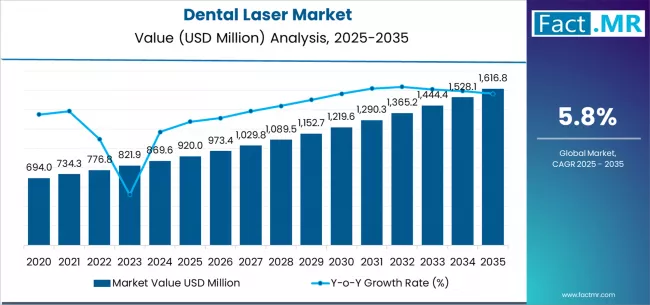
Dental Laser Market Market Value Analysis | Source: Fact.MR
Summary of Dental Laser Market
- Market Snapshot
- The market is valued at USD 920.0 million in 2025.
- Revenue is estimated to reach USD 973.36 million in 2026 and USD 1,710.528 million by 2036.
- A CAGR of 5.8% is forecast for the 2026 to 2036 assessment period.
- Incremental opportunity of USD 737.168 million is projected between 2026 and 2036.
- Diode lasers hold a 44.0% share of the laser type segment.
- The USA (6.2% CAGR) and Mexico (5.8% CAGR) are the fastest-expanding country markets.
- Demand and Growth Drivers
- Patient demand for reduced-pain, anaesthesia-free dental procedures is shifting clinical preference toward laser-assisted treatments over conventional mechanical instrumentation.
- Growth in aesthetic dentistry, including teeth whitening and gum recontouring, is creating new revenue streams for dental practices investing in multi-wavelength laser platforms.
- Dental insurance providers in the USA and Europe are expanding coverage codes for laser-assisted periodontal therapy, reducing out-of-pocket costs and increasing procedure volumes.
- Portable and compact laser systems are enabling adoption in smaller dental practices and mobile dentistry units, extending market penetration beyond large urban clinics.
- Product and Segment View
- Diode lasers command 44.0% of the laser type segment, reflecting their versatility across soft tissue procedures and teeth whitening at a lower price point than erbium or CO2 systems.
- Soft tissue applications account for 49.0% of total demand, driven by gingivectomy, frenectomy, and periodontal pocket decontamination procedures.
- Dental clinics represent 76.0% of end-use demand, reflecting the primary care setting for most laser-assisted dental procedures.
- Key segmentation includes:
- Laser Type: Diode, Er:YAG and Er,Cr:YSGG, CO2 and Others
- Application: Soft Tissue, Hard Tissue, Whitening and Others
- End User: Dental Clinics, Hospitals, Academic
- Technology: Laser Technology, Delivery Systems, Control Systems
- Deployment: Fixed Systems, Portable Systems
- Geography and Competitive Outlook
- North America accounts for the largest regional share, with the USA generating USD 341.941 million in 2025 revenue.
- East Asia contributes steady demand, with Japan (USD 44.064 million) and South Korea (USD 26.417 million) in 2025.
- BIOLASE Inc. leads the competitive field with an estimated 15.0% revenue share.
- Fotona, Dentsply Sirona, and Convergent Dental are principal challengers across global markets.
- Analyst Opinion
- The dental laser market is moving beyond early-adopter clinics into mainstream general dentistry as equipment costs decline and clinical training becomes more accessible. Diode lasers are the primary entry point for first-time adopters due to lower capital costs and multi-procedure versatility. Erbium-based systems retain premium positioning for hard tissue work that requires both cutting and ablation capability. The integration of laser modules into all-in-one digital dentistry platforms, alongside CAD/CAM and intraoral scanning, will accelerate adoption among practices pursuing full digital workflow transformation through 2036.
Key Growth Drivers, Constraints, and Opportunities
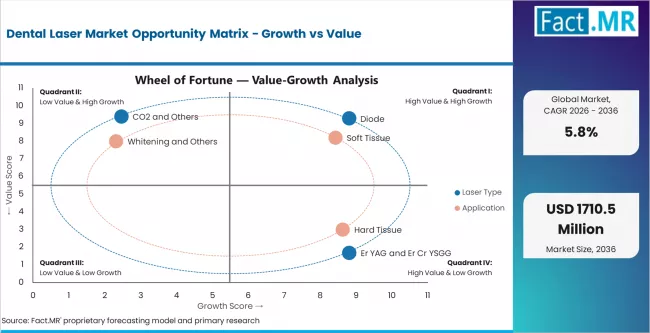
Dental Laser Market Opportunity Matrix Growth Vs Value | Source: Fact.MR
Key Factors Driving Growth
- Global expansion of aesthetic dentistry services, with cosmetic dental procedure volumes growing at 8 to 12% annually in developed markets according to American Academy of Cosmetic Dentistry data, is creating sustained demand for laser whitening and soft tissue recontouring systems.
- Regulatory bodies including the FDA and EU MDR are establishing clearer classification pathways for dental laser devices, reducing time-to-market for new systems and encouraging manufacturer investment in next-generation platforms.
- Dental education institutions are integrating laser training into core curricula, with over 60% of US dental schools now offering dedicated laser dentistry modules according to ADA survey data, building a pipeline of laser-trained practitioners.
Key Market Constraints
- High capital acquisition costs, with multi-wavelength dental laser systems priced between USD 25,000 and USD 100,000, create a significant barrier for solo practitioners and small group practices, limiting market penetration in price-sensitive segments.
- Lack of standardised clinical protocols for laser-assisted procedures across different dental specialties creates inconsistency in treatment outcomes and slows insurer willingness to expand reimbursement codes.
- Competition from ultrasonic and piezoelectric instruments for certain soft tissue and bone surgery applications provides a lower-cost alternative that reduces the incremental value proposition of laser systems for price-conscious practices.
Key Opportunity Areas
- Integration of AI-guided treatment planning with laser delivery systems is enabling automated power and exposure adjustments based on tissue type and treatment goals, improving procedural consistency and reducing operator dependency.
- Growth of dental tourism in Mexico, Turkey, and Thailand is creating demand for modern laser-equipped clinics that can attract international patients seeking aesthetic and restorative treatments at competitive price points.
- Development of dual-wavelength and all-tissue laser platforms that combine soft and hard tissue capability in a single unit is reducing the capital cost barrier for practices that previously needed separate systems for different applications.
Segment-wise Analysis of the Dental Laser Market
- Diode lasers hold 44.0% of the laser type segment, reflecting their cost-effectiveness and versatility across soft tissue procedures.
- Soft tissue applications account for 49.0% of total demand, with hard tissue and whitening applications comprising the balance.
- Dental clinics represent 76.0% of end-use revenue, followed by hospitals and academic institutions.
Which laser type dominates the Dental Laser Market?
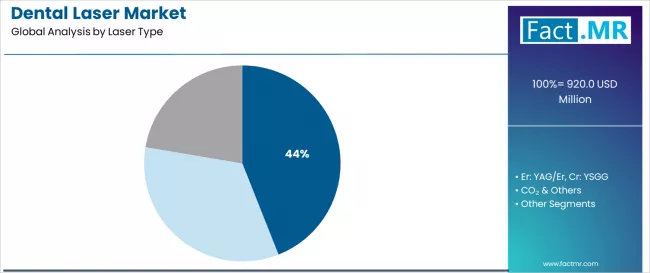
Dental Laser Market Analysis By Laser Type | Source: Fact.MR
Diode lasers control 44.0% of the laser type segment. Their dominance reflects a combination of lower acquisition cost (typically USD 5,000 to USD 25,000), compact form factor, and suitability for the most common soft tissue procedures including gingivectomy, frenectomy, and sulcular debridement. Diode systems operate at 810 to 980 nm wavelengths and require minimal maintenance, making them the preferred entry-level laser for general dental practices.
Er:YAG and Er,Cr:YSGG lasers hold the second-largest share, positioned as premium all-tissue systems capable of both soft and hard tissue applications. These erbium-based systems operate at wavelengths (2,780 to 2,940 nm) that are strongly absorbed by water, enabling precise tooth structure ablation with minimal thermal damage. CO2 lasers and other types serve specialised niches in oral surgery and academic settings.
Which application segment leads demand in the Dental Laser Market?
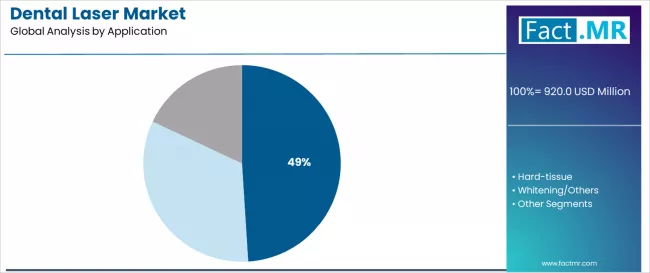
Dental Laser Market Analysis By Application | Source: Fact.MR
Soft tissue applications generate 49.0% of market revenue. Laser-assisted soft tissue procedures offer clinically measurable advantages over scalpel-based techniques, including reduced bleeding, faster healing times, and often the elimination of sutures. These benefits translate into shorter procedure times and improved patient satisfaction scores, which are direct practice-building factors for dental clinics competing for patient retention.
Hard tissue applications represent a growing share, driven by patient demand for drill-free cavity preparation and the clinical advantages of laser-mediated caries removal in paediatric and anxiety-prone patient populations. Whitening applications, while lower in per-procedure revenue, generate high patient volumes and function as an introductory service that exposes patients to laser dentistry capability within a practice.
Which end-user segment captures the largest share in the Dental Laser Market?
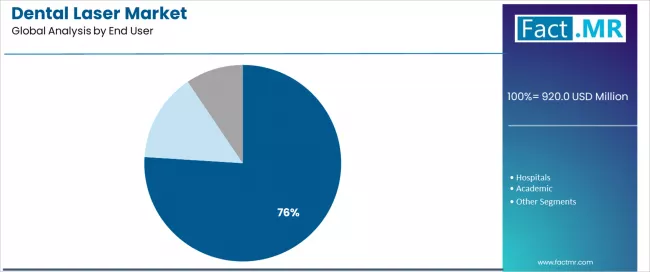
Dental Laser Market Analysis By End User | Source: Fact.MR
Dental clinics account for 76.0% of end-use demand, consistent with the predominance of private practice as the primary delivery setting for dental care globally. Solo and group practices invest in laser systems as a competitive differentiator, with laser-equipped practices typically commanding 15 to 25% higher per-procedure fees for laser-assisted treatments versus conventional approaches.
Hospitals and academic institutions comprise the remaining 24.0%. Hospital dental departments tend to invest in higher-specification erbium and CO2 systems for oral surgery applications, while academic institutions purchase across all laser types for teaching and clinical research purposes.
Which Product Trend is Shaping the Next Phase of Growth in the Dental Laser Market?
The fastest-moving trend in the dental laser space is the convergence of laser instrumentation with digital dentistry platforms. Manufacturers are developing laser modules that integrate directly with CAD/CAM systems, intraoral scanners, and practice management software, creating unified workflows where treatment planning, laser parameter selection, and post-procedure documentation occur within a single digital environment. This integration reduces the friction of adopting laser technology for practices that have already invested in digital workflows, as the laser becomes an extension of existing infrastructure rather than a standalone capital purchase.
A parallel development is the miniaturisation and cost reduction of portable laser systems. Companies such as AMD Lasers and newer entrants are producing handheld diode laser units priced below USD 5,000, making laser capability accessible to mobile dentistry providers, public health clinics, and practitioners in lower-income markets. These portable systems sacrifice some power output and versatility compared to fixed units but deliver adequate performance for the most common soft tissue applications. The combination of platform integration for high-end practices and portable affordability for entry-level adopters is broadening the market's addressable base from both ends of the price spectrum.
Regional Outlook Across Key Markets
.webp "Top Country Growth Comparison Dental Laser Market Cagr (2026 2036)")
Top Country Growth Comparison Dental Laser Market Cagr (2026 2036) | Source: Fact.MR
- North America holds the largest regional revenue share, anchored by the USD 341.941 million USA market in 2025.
- East Asia contributes steady demand, with Japan at USD 44.064 million and South Korea at USD 26.417 million in 2025.
- Europe maintains consistent mid-single-digit growth, led by Germany and France.
- Latin America is an emerging growth corridor, with Mexico matching the global CAGR of 5.8%.
CAGR Table
| Country | CAGR (%) |
|---|---|
| USA | 6.2% |
| Mexico | 5.8% |
| Germany | 5.4% |
| France | 5.3% |
| South Korea | 5.2% |
| United Kingdom | 5.1% |
| Japan | 5.0% |
Source: Fact.MR analysis. Updated Apr 30, 2026
Source: Fact.MR analysis, based on proprietary forecasting model and primary research.
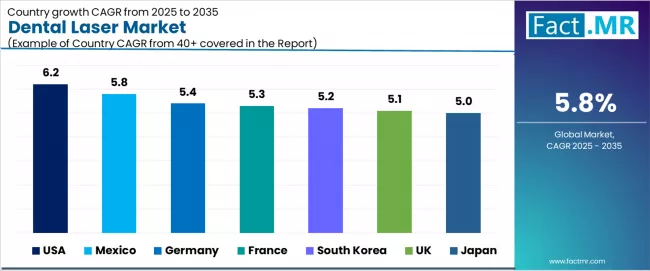
Dental Laser Market Cagr Analysis By Country | Source: Fact.MR
USA:Insurance reimbursement expansion and aesthetic dentistry growth sustain leadership
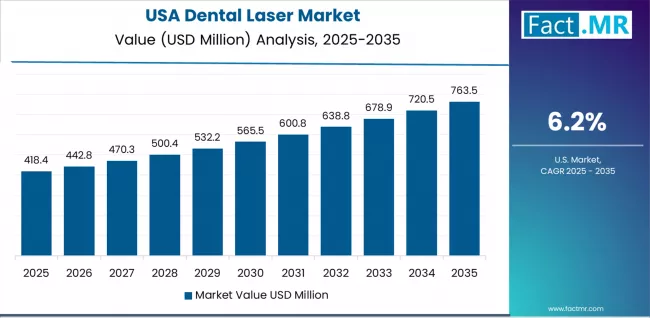
Dental Laser Market Country Value Analysis | Source: Fact.MR
The USA generates USD 341.941 million in 2025, the largest single-country market, growing at a 6.2% CAGR. Growth is driven by the ADA's expanded CDT code set for laser-assisted procedures, which has prompted major dental insurers to broaden coverage for laser periodontal therapy and soft tissue surgery. Aesthetic dentistry demand, particularly teeth whitening and gum recontouring, contributes a significant elective revenue stream outside insurance-based care.
- Over 25% of US dental practices now own at least one laser system, up from approximately 12% in 2018, per ADA Health Policy Institute practice survey data.
Mexico: Dental tourism infrastructure and cross-border patient flows accelerate adoption
Mexico records a 5.8% CAGR, driven by the rapid build-out of modern dental clinics in border cities such as Tijuana, Los Algodones, and Cancun that cater to US and Canadian dental tourists. These clinics invest in visible technology, including laser systems, as a competitive signal to attract international patients willing to travel for cost savings of 40 to 70% on dental procedures.
- Mexico received over 1.5 million dental tourism visits annually by 2024, per Mexican Dental Association estimates, with laser-equipped clinics commanding higher patient volumes.
Germany: Precision engineering heritage and specialist dental practice networks drive adoption
Germany grows at 5.4% CAGR, supported by a dental care system that emphasises specialist referral and advanced treatment modalities. German dental practices, particularly those focused on periodontics and implantology, favour erbium-based laser systems for their hard tissue precision. The country's strong domestic manufacturing base in medical devices creates a supportive ecosystem for laser technology adoption.
- Germany hosts over 70,000 active dental practices, with specialist periodontists and oral surgeons representing the highest laser adoption rates per the German Dental Association ('S BZAK) data.
France: Public health system integration and aesthetic demand support steady growth
France records a 5.3% CAGR, reflecting dual demand from the public healthcare system (which covers therapeutic laser use in periodontal disease) and the private aesthetic dentistry sector. French dental education institutions have integrated laser training into postgraduate curricula, building practitioner confidence in laser-assisted techniques.
- France's Assurance Maladie expanded reimbursement for laser-assisted periodontal debridement in 2024, directly stimulating equipment purchases among general dental practitioners.
South Korea: Technology-forward dental practices and cosmetic focus sustain demand
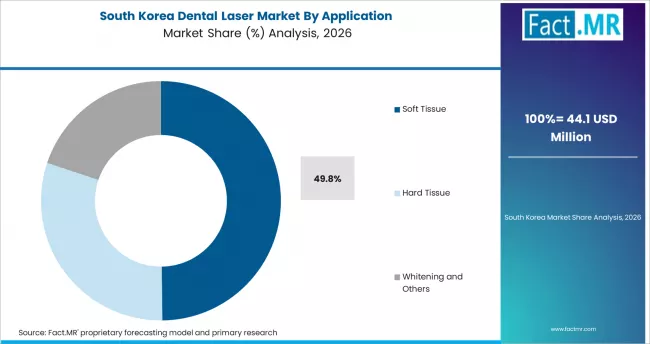
Dental Laser Market South Korea Market Share Analysis By Application | Source: Fact.MR
South Korea generates USD 26.417 million in 2025, growing at 5.2% CAGR. The country's high per-capita spending on dental aesthetics and a dense network of technology-equipped dental clinics in Seoul create strong demand for advanced laser platforms. South Korean dental practices frequently combine laser treatments with digital smile design and ceramic restoration workflows.
- South Korea's dental laser adoption rate exceeds 35% of urban dental practices, per Korean Dental Association survey data, one of the highest penetration rates in Asia Pacific.
Japan: Ageing population care needs and conservative clinical adoption create stable demand
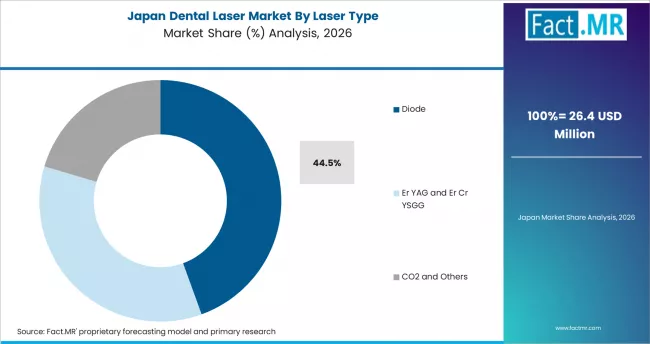
Dental Laser Market Japan Market Share Analysis By Laser Type | Source: Fact.MR
Japan contributes USD 44.064 million in 2025, growing at 5.0% CAGR. Demand is shaped by the country's large elderly population requiring periodontal treatment and the conservative, evidence-driven approach of Japanese dental practitioners who favour well-established laser wavelengths with extensive clinical literature support. The national health insurance system covers laser-assisted procedures under specific therapeutic codes.
- Japan's national health insurance reimbursement for laser periodontal therapy covered over 800,000 procedures in fiscal year 2024, per Japan Dental Association claims data.
Competitive Benchmarking and Company Positioning
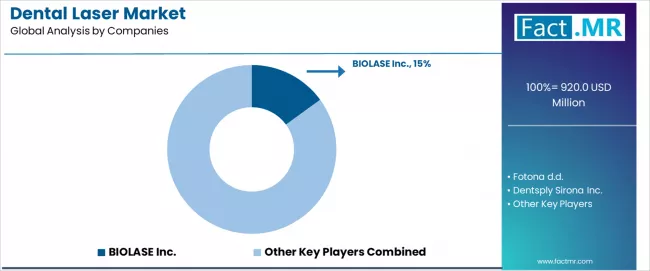
Dental Laser Market Analysis By Company | Source: Fact.MR
Dental Laser Market Analysis By Company
- BIOLASE Inc. holds approximately 15.0% of global revenue, maintaining its position through a broad portfolio of diode and erbium laser platforms and an extensive global distribution network.
- Fotona, Dentsply Sirona, and Convergent Dental collectively hold significant shares, competing on technology differentiation, clinical evidence, and integrated digital workflows.
- Regional specialists including AMD Lasers, LightScalpel, and DenMat Holdings serve niche segments with focused product offerings in specific wavelength and application categories.
The competitive structure is moderately fragmented, with BIOLASE holding the largest single-company share at 15.0% but facing credible competition from multiple well-resourced players. BIOLASE's strength lies in its comprehensive product range spanning the Waterlase (erbium) and Epic (diode) platforms, giving the company coverage across both soft and hard tissue applications. Fotona competes at the premium end with dual-wavelength systems that combine Er:YAG and Nd:YAG capability.
Dentsply Sirona brings the advantage of integrated digital dentistry ecosystems, offering laser capability as part of broader practice workflow solutions that include CAD/CAM, imaging, and practice management software. Convergent Dental's Solea system differentiates on speed and patient comfort for hard tissue applications. The competitive dynamic centres on whether the market evolves toward integrated platform players (favouring Dentsply Sirona) or specialist laser companies (favouring BIOLASE and Fotona).
Key Companies in the Dental Laser Market
The dental laser competitive field includes BIOLASE Inc., Fotona d.d., Dentsply Sirona Inc., Convergent Dental Inc., AMD Lasers LLC, Straumann Group, J. Morita Corporation, LaserSmile, LightScalpel LLC, and DenMat Holdings LLC.
Recent Industry Developments
- BIOLASE Inc.: Waterlase iPlus platform update (2025)
- BIOLASE released a software update for its Waterlase iPlus erbium laser platform, adding AI-assisted power calibration for hard tissue procedures and expanded preset protocols for paediatric dental applications.
- Convergent Dental: Solea all-tissue clearance expansion (2025)
- Convergent Dental received expanded FDA clearance for the Solea 9.3-micron CO2 laser system, covering additional hard tissue indications including Class V cavity preparation and crown lengthening procedures.
- Fotona: TwinLight periodontal protocol clinical data (2025)
- Fotona published multi-centre clinical results for its TwinLight Er:YAG/Nd:YAG combined periodontal treatment protocol, demonstrating statistically improved clinical attachment levels compared to scaling and root planing alone.
- Dentsply Sirona: laser module integration with Primescan (2026)
- Dentsply Sirona announced the development of a laser treatment planning module compatible with its Primescan intraoral scanning platform, enabling unified digital workflows from diagnosis through laser-assisted treatment execution.
Leading Companies Shaping the Dental Laser Market
-
Global Players
- BIOLASE Inc.
- Fotona d.d.
- Dentsply Sirona Inc.
- Convergent Dental Inc.
- J. Morita Corporation
- Straumann Group
-
Regional Players
- AMD Lasers LLC
- LightScalpel, LLC
- DenMat Holdings LLC
-
Emerging / Start-up Players
- LaserSmile
- Ultradent Products Inc.
- CAO Group Inc.
Sources and Research References
- BIOLASE Inc. Annual Report and SEC Filings (2024, 2025)
- U.S. FDA 510(k) clearance database for dental laser devices
- American Dental Association (ADA) Health Policy Institute practice surveys and CDT code registry
- American Academy of Cosmetic Dentistry (AACD) annual procedure volume reports
- Japanese Dental Association claims and reimbursement data (fiscal year 2024)
- Korean Dental Association practice equipment survey data
- Mexican Dental Association dental tourism statistics (2024)
All numerical data in this report is derived from Fact.MR proprietary forecasting models, validated through primary research interviews and cross-referenced with the public-domain sources listed above. No data from syndicated market research publishers has been used.
Key Questions This Report Addresses
- What is the projected size of the dental laser market by 2036?
- Which laser type holds the largest share of the dental laser market?
- What CAGR is forecast for the dental laser market between 2026 and 2036?
- Which application segment generates the most revenue in the dental laser market?
- Which country is expected to grow fastest in the dental laser market?
- Who is the leading company in the global dental laser market?
- What is the incremental opportunity in the dental laser market between 2026 and 2036?
- What share of dental laser demand comes from dental clinics?
- How is portable laser technology affecting market penetration?
- What role does dental insurance reimbursement play in laser adoption?
Dental Laser Market Definition
The dental laser market encompasses the manufacture, distribution, and clinical deployment of laser-based instruments designed for oral healthcare applications. Products in scope include diode, erbium (Er:YAG and Er,Cr:YSGG), and CO2 laser systems configured for soft tissue surgery, hard tissue preparation, teeth whitening, and therapeutic applications in periodontics, endodontics, and oral surgery. The market covers both fixed and portable system formats sold to dental clinics, hospitals, and academic institutions.
Dental Laser Market Inclusions
- All commercially available dental laser systems across diode, erbium, and CO2 wavelength categories for clinical oral healthcare use.
- Revenue from laser hardware, integrated delivery systems, and control system modules sold as complete units or bundled packages.
- Soft tissue, hard tissue, whitening, and therapeutic periodontal applications performed using laser instrumentation.
- Sales through dental clinics, hospital dental departments, and academic dental institutions globally.
Dental Laser Market Exclusions
- Low-level laser therapy (LLLT) devices used exclusively for photobiomodulation without surgical or ablative capability.
- Dental curing lights and LED-based whitening systems that do not use coherent laser light sources.
- Standalone consumables, disposable fibre tips, and replacement parts sold separately from laser systems.
- Research-grade laser equipment used exclusively in laboratory or preclinical dental research settings.
Dental Laser Market Research Methodology
- Primary research with dental practitioners, oral surgeons, and dental equipment distributors across 12 countries.
- Revenue modelling based on unit shipment data from manufacturer filings, dental trade association registries, and import/export databases.
- Pricing analysis using distributor catalogue data, equipment financing programme terms, and institutional procurement records.
- Competitive share estimation through company annual reports, investor presentations, and dental trade show product launch tracking.
- Demand validation through dental association membership surveys, continuing education enrolment data, and insurance reimbursement code adoption rates.
- Forecast calibration against dental practice formation rates, capital equipment replacement cycles, and regulatory clearance timelines for new systems.
Segmentation
Scope of Analysis
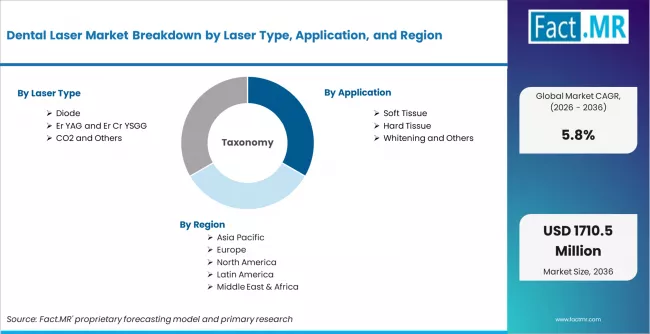
Dental Laser Market Breakdown By Laser Type, Application, And Region | Source: Fact.MR
| Parameter | Details |
|---|---|
| Report Coverage | Global market analysis with country-level forecasts for 7 countries and 40+ additional markets |
| Base Year | 2025 |
| Forecast Period | 2026 to 2036 |
| Market Size (2025) | USD 920.0 Million |
| Units | USD Million |
| Segments Covered | Laser Type (Diode, Er:YAG and Er,Cr:YSGG, CO2 and Others), Application (Soft Tissue, Hard Tissue, Whitening and Others), End User (Dental Clinics, Hospitals, Academic), Technology (Laser Technology, Delivery Systems, Control Systems), Deployment (Fixed Systems, Portable Systems) |
| Regions Covered | North America, Latin America, Europe, East Asia, South Asia and Pacific, Middle East and Africa |
| Countries Profiled | USA, Mexico, Germany, France, South Korea, United Kingdom, Japan |
| Companies Profiled | BIOLASE, Fotona, Dentsply Sirona, Convergent Dental, AMD Lasers, Straumann, J. Morita, LaserSmile, LightScalpel, DenMat Holdings |
| Forecast Methodology | Bottom-up revenue modelling validated through primary research, company filings, and dental trade association data |
Source: Fact.MR analysis. Updated Apr 30, 2026
Market Segmentation Analysis
-
Dental Laser Market Market Segmented by Laser Type:
- Diode
- Standard Diode Laser
- High Power Diode Laser
- Portable Diode Laser
- Er YAG and Er Cr YSGG
- Hard Tissue Ablation Systems
- Mixed Tissue Dental Systems
- Minimally Invasive Laser Units
- CO2 and Others
- Surgical CO2 Lasers
- Compact Dental CO2 Systems
- Multi Wavelength Laser Platforms
- Diode
-
Dental Laser Market Market Segmented by Application:
- Soft Tissue
- Gingivectomy
- Gingivoplasty
- Frenectomy Procedures
- Hard Tissue
- Cavity Preparation
- Enamel Shaping
- Bone Surgery Applications
- Whitening and Others
- Teeth Whitening Systems
- Periodontal Therapy
- Endodontic Support Applications
- Soft Tissue
-
Dental Laser Market Market Segmented by End User:
- Dental Clinics
- Solo Practices
- Multi Chair Clinics
- Specialty Dental Centers
- Hospitals
- Multi Specialty Hospitals
- Dental Departments in Hospitals
- Tertiary Care Hospitals
- Academic
- Dental Colleges
- Research Institutes
- Training Simulation Centers
- Dental Clinics
-
Dental Laser Market Market Segmented by Technology:
- Laser Technology
- Diode Technology
- Semiconductor Based Systems
- Er YAG Technology
- Water Absorption Based Ablation
- Er Cr YSGG Technology
- Hydrokinetic Cutting
- CO2 Technology
- Thermal Ablation Systems
- Delivery Systems
- Fiber Optic Delivery
- Articulated Arm Systems
- Handheld Devices
- Control Systems
- Digital Control Units
- Automated Settings
- Precision Control Software
- Laser Technology
-
Dental Laser Market Market Segmented by Deployment:
- Fixed Systems
- Clinic Installed Systems
- Wall Mounted Units
- Integrated Dental Units
- Portable Systems
- Handheld Devices
- Battery Operated Lasers
- Mobile Dental Units
- Fixed Systems
-
Dental Laser Market Market by Region:
- North America
- USA
- Canada
- Mexico
- Latin America
- Brazil
- Chile
- Rest of Latin America
- Western Europe
- Germany
- UK
- Italy
- Spain
- France
- Nordic
- BENELUX
- Rest of Western Europe
- Eastern Europe
- Russia
- Poland
- Hungary
- Balkan & Baltic
- Rest of Eastern Europe
- East Asia
- China
- Japan
- South Korea
- South Asia and Pacific
- India
- ASEAN
- Australia & New Zealand
- Rest of South Asia and Pacific
- Middle East & Africa
- Kingdom of Saudi Arabia
- Other GCC Countries
- Turkiye
- South Africa
- Other African Union
- Rest of Middle East & Africa
- North America
Frequently Asked Questions
What is the current size of the dental laser market?
What CAGR is expected for the dental laser market?
Which laser type leads the dental laser market?
Which application segment is largest in the dental laser market?
Which country will grow fastest in the dental laser market?
Who is the leading company in the dental laser market?
What is the forecast value of the dental laser market by 2036?
Who worked on this report


Preview the report firsthand - request a free sample
Free SampleGet the brochure for pricing and purchase details
Download PDF