DI Investment Castings Market (2026 - 2036)

DI Investment Castings Market is segmented by Process (Lost Wax Casting, Vacuum Casting, Shell Mold Casting, Other Investment Casting Methods), Application (Turbine & Rotating Components, Suspension & Structural Components, Engine & Transmission Parts, Fluid Handling Components, Powertrain & Energy Components, Specialty & Precision Components), End-Use Industry (Automotive & Transportation, Aerospace & Defense, Energy & Utilities, Oil & Gas Industry, Industrial Equipment & Heavy Machinery, Construction & Infrastructure, Healthcare & Medical Technology), Sales Channel (OEMs, Aftermarket), and Region. Forecast for 2026 to 2036.

Core Findings

    DI Investment Castings Market Size, Market Forecast and Outlook By Fact.MR

    The di investment castings market was valued at USD 7.80 billion in 2025, projected to reach USD 8.21 billion in 2026, and is forecast to expand to USD 13.62 billion by 2036 at a 5.2% CAGR. is experiencing a specification upgrade cycle, where aerospace turbine maintenance, energy infrastructure modernization, and automotive lightweighting programmes are driving demand for precision-cast DI components that replace machined forgings at lower total cost of ownership.

    The absolute dollar expansion between 2026 and 2036 amounts to approximately USD 5.41 billion. Growth reflects replacement demand across aging power generation and petrochemical infrastructure, combined with new component specifications in automotive powertrain and aerospace turbine applications. Lead times for tooling qualification and the limited number of foundries with aerospace-grade investment casting certification act as natural capacity constraints.
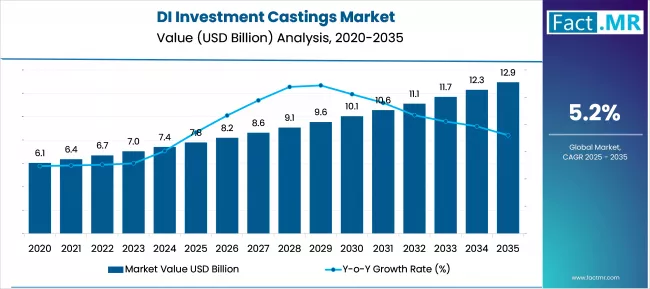
    Di Investment Castings Market Market Value Analysis

    DI Investment Castings Market Key Takeaways

    Metric Details
    Industry Size (2026) USD 8.21 billion
    Industry Value (2036) USD 13.62 billion
    CAGR (2026 to 2036) 5.2%

    Procurement engineers at tier-1 automotive suppliers are qualifying investment-cast ductile iron components as replacements for multi-step machined forgings in suspension and structural applications. The total cost reduction from near-net-shape casting, which eliminates 3 to 5 machining operations per part, justifies the tooling investment for annual volumes exceeding 50,000 units.

    All major regional markets reflect differentiated growth parameters. India sets the pace at 5.9% CAGR. China registers at 5.5% CAGR. Japan registers at 4.7% CAGR. USA registers at 4.4% CAGR. Germany registers at 3.6% CAGR.

    Summary of DI Investment Castings Market

    • DI Investment Castings Market Definition
      • Ductile iron (DI) investment castings are precision-formed metal components produced by pouring molten ductile iron (also called nodular or spheroidal graphite iron) into ceramic shell moulds created from wax patterns. The investment casting process delivers near-net-shape parts with complex geometries, tight dimensional tolerances (typically plus or minus 0.3%), and surface finishes that minimize post-casting machining.
    • Demand Drivers in the Market
      • Aerospace MRO turbine component demand: The International Air Transport Association (IATA) projects global air passenger traffic to reach 4.7 billion by 2026.
      • Energy infrastructure modernization: The U.S.
      • Automotive lightweighting via near-net-shape: European automotive CO2 emission targets (95 g/km fleet average) compel OEMs to evaluate every component for mass reduction opportunity.
    • Key Segments Analyzed in the Fact.MR Report
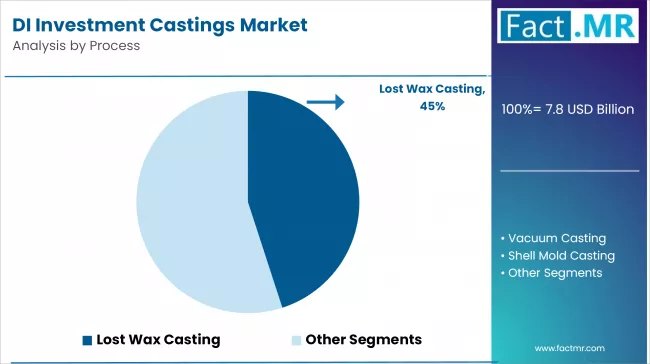
      • Lost Wax Casting process: 45.0% share in 2026.
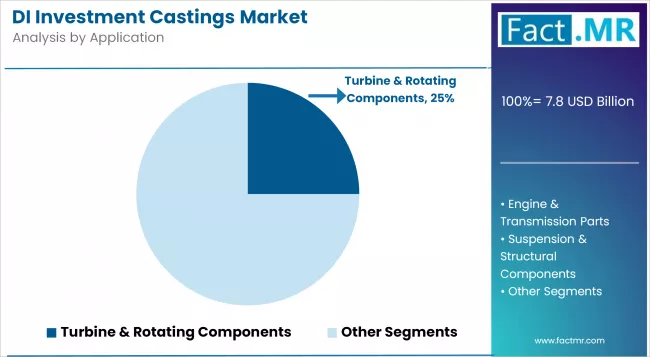
      • Turbine & Rotating Components application: 25.0% share in 2026.
      • India: 5.9% compound growth through 2036.
    • Analyst Opinion at Fact.MR
      • The market is expanding into automotive and industrial applications where ductile iron's combination of tensile strength (400 to 700 MPa), fatigue resistance, and machinability competes directly with steel forgings and aluminum castings. Automotive OEMs evaluating DI investment castings for suspension knuckles and brake caliper brackets find that the near-net-shape process eliminates 60% to 70% of machining steps compared to forged equivalents. This manufacturing efficiency, combined with ductile iron's lower raw material cost versus steel, creates a compelling total cost case for medium-to-high volume production runs..
    • Strategic Implications / Executive Takeaways
      • Procurement teams must establish multi-year supply agreements with qualified producers to secure allocation ahead of anticipated demand increases.
      • Product development resources should prioritize formulations that meet tightening regulatory specifications in key import markets.
      • Regional expansion strategies must account for divergent growth rates and regulatory environments across major consuming nations.

    What are the key trends driving growth in the DI Investment Castings market?

    Trends in the DI investment castings market encompass the adoption of additive manufacturing that can be applied in rapid prototyping and complex designs and a growing adoption of digital twins and simulation software to create optimal quality castings. Sustainability is making its way to the forefront and foundries are shifting to energy saving processes and recycling.

    Aerospace, defense, and medical technology are increasing in the rate of demand in the customized solutions. Besides that, the levels of collaboration between foundries and OEMs are increasing to accelerate the process of innovation, which ensures the provision of complex cast elements in the most cost-effective way on time.

    What factors hinder the growth of the DI Investment Castings market?

    Despite its growth, the DI investment castings market is constrained by aspects such as high startup costs and the requirement to have the skilled labor to operate the specialized casting processes. The environmental factors of pollution and waste management of foundry also have their issues to be considered, and they are to be placed squarely elastic to the regulations.

    The fluctuating cost of raw materials and delays in the supply chain can affect productivity and profitability of manufacture. Besides this, manufacturing processes are competing with other substitutes like precision forging or 3D printing, and this may limit its uptake in some of its uses and the market development in general.

    What are the key regional trends driving the DI Investment Castings Market growth?

    North America

    North America is on top with aerospace, defense and automotive great demand. The sophisticated foundry technologies, sustainability and high R&D investment enhance growth of the market. The further penetration of renewable energy, medical use contributes to the further growth in the region.

    East Asia

    East Asia is undergoing a boom because of the strong automotive manufacturing, industrialization, and infrastructural developments. The large scale manufacturing bases are dominated by China and Japan and competitiveness in the world markets is promoted by technological advancement and low cost production.

    Western Europe

    Western Europe enjoys the advantage of high standards of engineering, high standards of quality as well as sustainability measures. Precision castings are required in aerospace, energy and automotive industries. Very high existence of world foundries and lightweight material innovation contribute to the development of the market.

    Country-wise Outlook
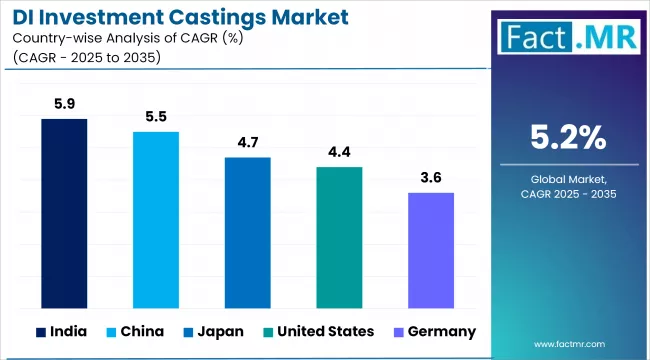
    Di Investment Castings Market Cagr Analysis By Country

    Precision Manufacturing and Automotive Demand Drive the United States’ DI Investment Castings Market

    The U.S. DI investment casting market is growing as a result of increased demand on components with high precision, lightweight, and durability by the automotive, aerospace and defense industries. Manufacturers are engaging in automation, simulation, and additive technologies to become more precise and cost-effective. High efficiency and sustainability in the regulatory focus favor advanced casting adoption as well.
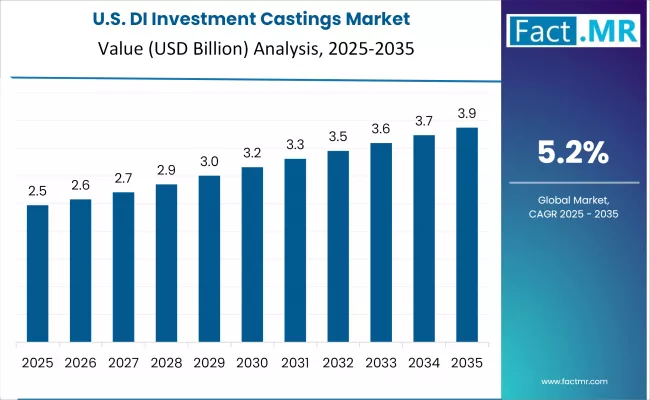
    Di Investment Castings Market Country Value Analysis

    The U.S. foundries, which have matured manufacturing base and high innovation capability, is in good position to satisfy the emerging needs of complex parts in various high-performance applications.

    Industrial Expansion and Infrastructure Growth Propel China’s DI Investment Castings Market”

    The DI investment castings market is experiencing a fast growth in the country of China due to its bulk industrial sector, development of infrastructure and the energy and transport industry. Local foundries are increasing capacities to provide complicated castings used in machinery, automobile, and oil and gas equipment.

    Innovation to develop modern manufacturing along with quality enhancement is another government program enhancing the market. Due to the growth in exports, the current increase in domestic demand, China is becoming one of the most developing centers of production of ductile iron investment casting.

    Engineering Expertise and Automotive Strength Elevate Germany’s DI Investment Castings Market

    The DI investment castings market in Germany enjoys good engineering skills and automotive and industrial machine-driven demand. Investment casting is the top selection of highly precise, efficient, and material-performing parts like engine parts and turbines. German foundries are incorporating the use of digital simulation, automation and sustainability to stay competitive. Germany maintains a lead in the use of ductile iron investment castings throughout Europe with a focus on the innovation and strict adherence to the standards of quality.

    Category-Wise Market Outlook

    Lost Wax Casting Gains Momentum with Precision and Complexity
    Di Investment Castings Market Analysis By Process

    The rapidly-growing sub-segment within the process type is Lost Wax Casting since it permits the production of highly intricate, near-net-shape components with an excellent surface finish and tight tolerances. Critical components, including turbine blades and engine components, are also being increasingly listed in the list of industries that are using this technique in making the parts. Loss Wax Casting is the process of choice in precision-driven work due to the capability to reduce machining demands and produce complex designs at scale.

    Turbine & Rotating Components Accelerate with Energy and Aerospace Demand
    Di Investment Castings Market Analysis By Application

    Turbine & Rotating Components are experiencing the strong growth in applications where global energy efficiency demands and aerospace propulsion are on the increase. The castings of DI investment offer structural reliability, heat resistance and durability needed in turbines blades, rotors and impellers. These parts are essential to gas turbines, jet engines, and renewable energy systems, where accuracy and mechanical performance have a direct effect on efficiency. They are on the increase with industries seeking greater operational stability and performance.

    Aerospace & Defense Lead with Precision and Performance Needs

    In the end-use segment, the subsegment with the rapid growth is the Aerospace & Defense segment because of the requirement of lightweight, high-strength and complex components. Castings produced by DI investment provide the dimensional accuracy and structural integrity required in critical components in aircraft, defense and propulsion systems. Rigorous safety regulations and the desire to achieve fuel efficiency is pushing to adopt. Also, growing defense expenditure and the growth of commercial aerospace provide sustained demand in this industry on accuracy engineered ductile iron castings.

    Competitive Analysis
    Di Investment Castings Market Analysis By Company

    Competitive Outlook: DI Investment Castings Market

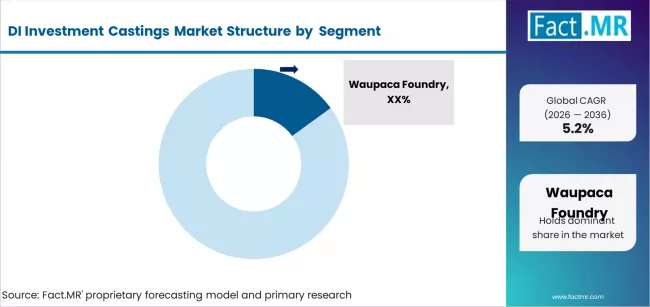
    The key players in the aggressive participation in the DI Investment Castings Market include Aero Metals, Waupaca Foundry, Grede Holdings LLC, Metal Technologies, Inc., and Georg Fischer who shape the aggressive engagement in the castings market. These firms are investing in new technology of casting, automation and precision engineering to satisfy the increasing demand of lightweight, durable and complex components. Their emphasis on incorporating simulation software, additive manufacturing of wax patterns, and sustainable foundry practices have placed them in the lead in providing very essential parts to automotive, aerospace, energy and industrial markets. These companies are leading in quality and cost effectiveness by integrating high volume capacity and innovation in the industry.

    Meanwhile, niche and specialized players such as Ironcastings SPA, FA Foundry, MES, Inc., Dotson Iron Castings, MacLean Power Systems, Zollern GmbH & Co. KG and others are gaining market niches with custom castings, small-batch precision parts and industry-specific experience. They make use of material innovations, shorter delivery times and close collaboration with OEMs as part of their competitiveness strategies. These companies reinforce the variety of markets and spur localized development by serving markets where ductile iron investment castings are needed: in the defense, medical equipment, and power systems sectors.

    Key players in the DI Investment Castings market are Aero Metals, Waupaca Foundry, Grede Holdings LLC, Metal Technologies, Inc., Georg Fischer, Ironcastings SPA, FA Foundry, MES, Inc., Dotson Iron Castings, MacLean Power Systems, Zollern GmbH & Co. KG.

    Recent Development:

    • In September 2025, A featured report in Modern Casting highlighted that foundries are increasingly investing in automation and 3D printing within the stainless-steel investment casting segment to improve lead times and quality, potentially posing competitive pressure to ductile-iron competitors.
    • In April 2025, North American foundries have been rapidly adopting CAD-driven mold design and additive manufacturing to meet rising demand for ultra-precise, small-batch castings—particularly impacting sectors like aerospace and energy.

    Fact.MR has provided detailed information about the price points of key manufacturers of DI Investment Castings market positioned across regions, sales growth, production capacity, and speculative technological expansion, in the recently published report.

    Bibliography

    • National Aerospace and Defense Contractors Accreditation Program (Nadcap). (2024). Investment casting accreditation requirements. Performance Review Institute.
    • Georg Fischer Ltd. (2024). Annual report 2024: Casting solutions division. GF.
    • International Air Transport Association (IATA). (2024). Air passenger traffic forecast: 2024 to 2028. IATA.
    • U.S. Department of Energy. (2024). Grid Resilience and Innovation Partnerships (GRIP) programme: Allocation report. DOE.
    • ASTM International. (2024). ASTM A536: Standard specification for ductile iron castings. ASTM.
    • Vestas Wind Systems A/S. (2024). Supplier quality requirements: Investment cast drivetrain components. Vestas.

    This bibliography is provided for reader reference. The full Fact.MR report contains the complete reference list with primary research documentation.

    This Report Addresses

    • Market sizing and quantitative forecast metrics detailing the precise expenditure dedicated to di investment castings across major industrial sectors through 2036.
    • Segmentation analysis mapping the adoption patterns of specific process categories and evaluating the technical and economic factors driving segment share distribution.
    • Regional deployment intelligence comparing growth trajectories across Asia Pacific, North America, Europe, Latin America, and Middle East and Africa.
    • Regulatory compliance assessment analyzing how evolving standards and policies affect product specifications and market access in key consuming regions.
    • Competitive posture evaluation tracking the positioning of leading producers and the structural factors determining competitive advantage.
    • Capital investment strategic guidance defining the procurement and capacity planning considerations for industry participants.
    • Supply chain risk analysis identifying the specific feedstock, logistics, and regulatory variables that constrain market expansion.
    • Custom data delivery formats encompassing interactive dashboards, raw Excel datasets, and PDF narrative reports.

    DI Investment Castings Market Definition

    Ductile iron (DI) investment castings are precision-formed metal components produced by pouring molten ductile iron (also called nodular or spheroidal graphite iron) into ceramic shell moulds created from wax patterns. The investment casting process delivers near-net-shape parts with complex geometries, tight dimensional tolerances (typically plus or minus 0.3%), and surface finishes that minimize post-casting machining. Applications span turbine components, automotive suspension parts, fluid handling systems, and industrial machinery.

    DI Investment Castings Market Inclusions

    Market scope covers global and regional revenue for DI investment castings across lost wax casting, vacuum casting, shell mould casting, and other investment casting methods. Application segments include turbine and rotating components, suspension and structural components, engine and transmission parts, fluid handling components, powertrain and energy components, and specialty and precision components. End-use industries span automotive and transportation, aerospace and defence, energy and utilities, oil and gas, industrial equipment, construction, and healthcare. The forecast period is 2026 to 2036.

    DI Investment Castings Market Exclusions

    The scope excludes sand-cast and centrifugal-cast ductile iron products. Grey iron investment castings and steel investment castings are excluded unless combined in a multi-material assembly with DI components. Raw ductile iron ingot and pig iron sales are outside the boundary.

    DI Investment Castings Market Research Methodology

    • Primary Research: Analysts engaged with procurement specialists, process engineers, and supply chain directors across producing and consuming regions to map the specific decision criteria triggering purchasing and specification changes.
    • Desk Research: Data collection aggregated regulatory filings, trade body publications, standards body documentation, and company disclosures relevant to the product category.
    • Market-Sizing and Forecasting: Baseline values derive from a bottom-up aggregation of production volumes and trade flows, applying region-specific demand curves to project adoption velocity through 2036.
    • Data Validation and Update Cycle: Projections are tested against publicly reported industry expenditure guidance and cross-referenced with primary interview data to ensure internal consistency.

    Scope of the Report

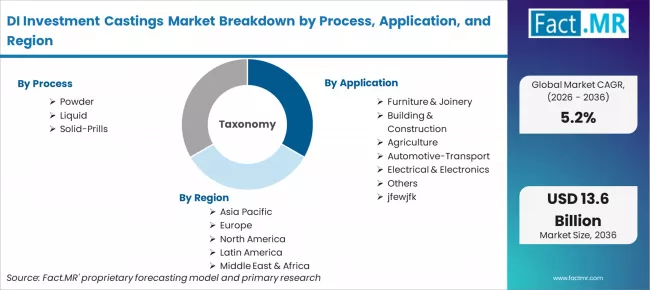
    Di Investment Castings Market Breakdown By Process, Application, And Region

    Metric Value
    Quantitative Units USD 8.21 billion to USD 13.62 billion, at a CAGR of 5.2%
    Market Definition Ductile iron (DI) investment castings are precision-formed metal components produced by pouring molten ductile iron (also called nodular or spheroidal graphite iron) into ceramic shell moulds created from wax patterns. The investment casting process delivers near-net-shape parts with complex geometries, tight dimensional tolerances (typically plus or minus 0.3%), and surface finishes that minimize post-casting machining.
    Process Segmentation Lost Wax Casting, Vacuum Casting, Shell Mold Casting, Other Investment Casting Methods
    Application Segmentation Turbine & Rotating Components, Suspension & Structural Components, Engine & Transmission Parts, Fluid Handling Components, Powertrain & Energy Components, Specialty & Precision Components
    End-Use Industry Segmentation Automotive & Transportation, Aerospace & Defense, Energy & Utilities, Oil & Gas Industry, Industrial Equipment & Heavy Machinery, Construction & Infrastructure, Healthcare & Medical Technology
    Sales Channel Segmentation OEMs, Aftermarket
    Regions Covered North America, Latin America, Europe, East Asia, South Asia, Oceania, Middle East & Africa
    Countries Covered India, China, Japan, USA, Germany, and 40 plus countries
    Key Companies Profiled Waupaca Foundry, Georg Fischer, Grede Holdings LLC, Metal Technologies, Inc., Zollern GmbH & Co. KG, Dotson Iron Castings, MacLean Power Systems, Ironcastings S.p.A., Aero Metals, FA Foundry, MES, Inc.
    Forecast Period 2026 to 2036
    Approach Hybrid top-down and bottom-up methodology reconciling production, trade, and consumption data with primary research validation.

    Segmentation of DI Investment Castings Market Research

    • By Process :

      • Lost Wax Casting
      • Vacuum Casting
      • Shell Mold Casting
      • Other Investment Casting Methods
    • By Application :

      • Engine & Transmission Parts
      • Suspension & Structural Components
      • Turbine & Rotating Components
      • Fluid Handling Components
      • Powertrain & Energy Components
      • Specialty & Precision Components
    • By End-Use Industry :

      • Automotive & Transportation
      • Aerospace & Defense
      • Energy & Utilities
      • Oil & Gas Industry
      • Industrial Equipment & Heavy Machinery
      • Construction & Infrastructure
      • Healthcare & Medical Technology
    • By Sales Channel :

      • OEMs (Original Equipment Manufacturers)
      • Aftermarket
    • By Region :

      • North America
      • Latin America
      • Western Europe
      • Eastern Europe
      • East Asia
      • South Asia & Pacific
      • Middle East & Africa

    Table of Content

    1. Executive Summary
      • Global Market Outlook
      • Demand to side Trends
      • Supply to side Trends
      • Technology Roadmap Analysis
      • Analysis and Recommendations
    2. Market Overview
      • Market Coverage / Taxonomy
      • Market Definition / Scope / Limitations
    3. Research Methodology
      • Chapter Orientation
      • Analytical Lens and Working Hypotheses
        • Market Structure, Signals, and Trend Drivers
        • Benchmarking and Cross-market Comparability
        • Market Sizing, Forecasting, and Opportunity Mapping
      • Research Design and Evidence Framework
        • Desk Research Programme (Secondary Evidence)
          • Company Annual and Sustainability Reports
          • Peer-reviewed Journals and Academic Literature
          • Corporate Websites, Product Literature, and Technical Notes
          • Earnings Decks and Investor Briefings
          • Statutory Filings and Regulatory Disclosures
          • Technical White Papers and Standards Notes
          • Trade Journals, Industry Magazines, and Analyst Briefs
          • Conference Proceedings, Webinars, and Seminar Materials
          • Government Statistics Portals and Public Data Releases
          • Press Releases and Reputable Media Coverage
          • Specialist Newsletters and Curated Briefings
          • Sector Databases and Reference Repositories
          • Fact.MR Internal Proprietary Databases and Historical Market Datasets
          • Subscription Datasets and Paid Sources
          • Social Channels, Communities, and Digital Listening Inputs
          • Additional Desk Sources
        • Expert Input and Fieldwork (Primary Evidence)
          • Primary Modes
            • Qualitative Interviews and Expert Elicitation
            • Quantitative Surveys and Structured Data Capture
            • Blended Approach
          • Why Primary Evidence is Used
          • Field Techniques
            • Interviews
            • Surveys
            • Focus Groups
            • Observational and In-context Research
            • Social and Community Interactions
          • Stakeholder Universe Engaged
            • C-suite Leaders
            • Board Members
            • Presidents and Vice Presidents
            • R&D and Innovation Heads
            • Technical Specialists
            • Domain Subject-matter Experts
            • Scientists
            • Physicians and Other Healthcare Professionals
          • Governance, Ethics, and Data Stewardship
            • Research Ethics
            • Data Integrity and Handling
        • Tooling, Models, and Reference Databases
      • Data Engineering and Model Build
        • Data Acquisition and Ingestion
        • Cleaning, Normalisation, and Verification
        • Synthesis, Triangulation, and Analysis
      • Quality Assurance and Audit Trail
    4. Market Background
      • Market Dynamics
        • Drivers
        • Restraints
        • Opportunity
        • Trends
      • Scenario Forecast
        • Demand in Optimistic Scenario
        • Demand in Likely Scenario
        • Demand in Conservative Scenario
      • Opportunity Map Analysis
      • Product Life Cycle Analysis
      • Supply Chain Analysis
      • Investment Feasibility Matrix
      • Value Chain Analysis
      • PESTLE and Porter’s Analysis
      • Regulatory Landscape
      • Regional Parent Market Outlook
      • Production and Consumption Statistics
      • Import and Export Statistics
    5. Global Market Analysis 2021 to 2025 and Forecast, 2026 to 2036
      • Historical Market Size Value (USD Million) Analysis, 2021 to 2025
      • Current and Future Market Size Value (USD Million) Projections, 2026 to 2036
        • Y to o to Y Growth Trend Analysis
        • Absolute $ Opportunity Analysis
    6. Global Market Pricing Analysis 2021 to 2025 and Forecast 2026 to 2036
    7. Global Market Analysis 2021 to 2025 and Forecast 2026 to 2036, By Process
      • Introduction / Key Findings
      • Historical Market Size Value (USD Million) Analysis By Process, 2021 to 2025
      • Current and Future Market Size Value (USD Million) Analysis and Forecast By Process, 2026 to 2036
        • Lost Wax Casting
        • Vacuum Casting
        • Shell Mold Casting
        • Other Investment Casting Methods
      • Y to o to Y Growth Trend Analysis By Process, 2021 to 2025
      • Absolute $ Opportunity Analysis By Process, 2026 to 2036
    8. Global Market Analysis 2021 to 2025 and Forecast 2026 to 2036, By Application
      • Introduction / Key Findings
      • Historical Market Size Value (USD Million) Analysis By Application, 2021 to 2025
      • Current and Future Market Size Value (USD Million) Analysis and Forecast By Application, 2026 to 2036
        • Turbine & Rotating Components
        • Suspension & Structural Components
        • Engine & Transmission Parts
        • Fluid Handling Components
        • Powertrain & Energy Components
        • Specialty & Precision Components
      • Y to o to Y Growth Trend Analysis By Application, 2021 to 2025
      • Absolute $ Opportunity Analysis By Application, 2026 to 2036
    9. Global Market Analysis 2021 to 2025 and Forecast 2026 to 2036, By End-Use Industry
      • Introduction / Key Findings
      • Historical Market Size Value (USD Million) Analysis By End-Use Industry, 2021 to 2025
      • Current and Future Market Size Value (USD Million) Analysis and Forecast By End-Use Industry, 2026 to 2036
        • Automotive & Transportation
        • Aerospace & Defense
        • Energy & Utilities
        • Oil & Gas Industry
        • Industrial Equipment & Heavy Machinery
        • Construction & Infrastructure
        • Healthcare & Medical Technology
      • Y to o to Y Growth Trend Analysis By End-Use Industry, 2021 to 2025
      • Absolute $ Opportunity Analysis By End-Use Industry, 2026 to 2036
    10. Global Market Analysis 2021 to 2025 and Forecast 2026 to 2036, By Sales Channel
      • Introduction / Key Findings
      • Historical Market Size Value (USD Million) Analysis By Sales Channel, 2021 to 2025
      • Current and Future Market Size Value (USD Million) Analysis and Forecast By Sales Channel, 2026 to 2036
        • OEMs
        • Aftermarket
      • Y to o to Y Growth Trend Analysis By Sales Channel, 2021 to 2025
      • Absolute $ Opportunity Analysis By Sales Channel, 2026 to 2036
    11. Global Market Analysis 2021 to 2025 and Forecast 2026 to 2036, By Region
      • Introduction
      • Historical Market Size Value (USD Million) Analysis By Region, 2021 to 2025
      • Current Market Size Value (USD Million) Analysis and Forecast By Region, 2026 to 2036
        • North America
        • Latin America
        • Western Europe
        • Eastern Europe
        • East Asia
        • South Asia and Pacific
        • Middle East & Africa
      • Market Attractiveness Analysis By Region
    12. North America Market Analysis 2021 to 2025 and Forecast 2026 to 2036, By Country
      • Historical Market Size Value (USD Million) Trend Analysis By Market Taxonomy, 2021 to 2025
      • Market Size Value (USD Million) Forecast By Market Taxonomy, 2026 to 2036
        • By Country
          • USA
          • Canada
          • Mexico
        • By Process
        • By Application
        • By End-Use Industry
        • By Sales Channel
      • Market Attractiveness Analysis
        • By Country
        • By Process
        • By Application
        • By End-Use Industry
        • By Sales Channel
      • Key Takeaways
    13. Latin America Market Analysis 2021 to 2025 and Forecast 2026 to 2036, By Country
      • Historical Market Size Value (USD Million) Trend Analysis By Market Taxonomy, 2021 to 2025
      • Market Size Value (USD Million) Forecast By Market Taxonomy, 2026 to 2036
        • By Country
          • Brazil
          • Chile
          • Rest of Latin America
        • By Process
        • By Application
        • By End-Use Industry
        • By Sales Channel
      • Market Attractiveness Analysis
        • By Country
        • By Process
        • By Application
        • By End-Use Industry
        • By Sales Channel
      • Key Takeaways
    14. Western Europe Market Analysis 2021 to 2025 and Forecast 2026 to 2036, By Country
      • Historical Market Size Value (USD Million) Trend Analysis By Market Taxonomy, 2021 to 2025
      • Market Size Value (USD Million) Forecast By Market Taxonomy, 2026 to 2036
        • By Country
          • Germany
          • UK
          • Italy
          • Spain
          • France
          • Nordic
          • BENELUX
          • Rest of Western Europe
        • By Process
        • By Application
        • By End-Use Industry
        • By Sales Channel
      • Market Attractiveness Analysis
        • By Country
        • By Process
        • By Application
        • By End-Use Industry
        • By Sales Channel
      • Key Takeaways
    15. Eastern Europe Market Analysis 2021 to 2025 and Forecast 2026 to 2036, By Country
      • Historical Market Size Value (USD Million) Trend Analysis By Market Taxonomy, 2021 to 2025
      • Market Size Value (USD Million) Forecast By Market Taxonomy, 2026 to 2036
        • By Country
          • Russia
          • Poland
          • Hungary
          • Balkan & Baltic
          • Rest of Eastern Europe
        • By Process
        • By Application
        • By End-Use Industry
        • By Sales Channel
      • Market Attractiveness Analysis
        • By Country
        • By Process
        • By Application
        • By End-Use Industry
        • By Sales Channel
      • Key Takeaways
    16. East Asia Market Analysis 2021 to 2025 and Forecast 2026 to 2036, By Country
      • Historical Market Size Value (USD Million) Trend Analysis By Market Taxonomy, 2021 to 2025
      • Market Size Value (USD Million) Forecast By Market Taxonomy, 2026 to 2036
        • By Country
          • China
          • Japan
          • South Korea
        • By Process
        • By Application
        • By End-Use Industry
        • By Sales Channel
      • Market Attractiveness Analysis
        • By Country
        • By Process
        • By Application
        • By End-Use Industry
        • By Sales Channel
      • Key Takeaways
    17. South Asia and Pacific Market Analysis 2021 to 2025 and Forecast 2026 to 2036, By Country
      • Historical Market Size Value (USD Million) Trend Analysis By Market Taxonomy, 2021 to 2025
      • Market Size Value (USD Million) Forecast By Market Taxonomy, 2026 to 2036
        • By Country
          • India
          • ASEAN
          • Australia & New Zealand
          • Rest of South Asia and Pacific
        • By Process
        • By Application
        • By End-Use Industry
        • By Sales Channel
      • Market Attractiveness Analysis
        • By Country
        • By Process
        • By Application
        • By End-Use Industry
        • By Sales Channel
      • Key Takeaways
    18. Middle East & Africa Market Analysis 2021 to 2025 and Forecast 2026 to 2036, By Country
      • Historical Market Size Value (USD Million) Trend Analysis By Market Taxonomy, 2021 to 2025
      • Market Size Value (USD Million) Forecast By Market Taxonomy, 2026 to 2036
        • By Country
          • Kingdom of Saudi Arabia
          • Other GCC Countries
          • Turkiye
          • South Africa
          • Other African Union
          • Rest of Middle East & Africa
        • By Process
        • By Application
        • By End-Use Industry
        • By Sales Channel
      • Market Attractiveness Analysis
        • By Country
        • By Process
        • By Application
        • By End-Use Industry
        • By Sales Channel
      • Key Takeaways
    19. Key Countries Market Analysis
      • USA
        • Pricing Analysis
        • Market Share Analysis, 2025
          • By Process
          • By Application
          • By End-Use Industry
          • By Sales Channel
      • Canada
        • Pricing Analysis
        • Market Share Analysis, 2025
          • By Process
          • By Application
          • By End-Use Industry
          • By Sales Channel
      • Mexico
        • Pricing Analysis
        • Market Share Analysis, 2025
          • By Process
          • By Application
          • By End-Use Industry
          • By Sales Channel
      • Brazil
        • Pricing Analysis
        • Market Share Analysis, 2025
          • By Process
          • By Application
          • By End-Use Industry
          • By Sales Channel
      • Chile
        • Pricing Analysis
        • Market Share Analysis, 2025
          • By Process
          • By Application
          • By End-Use Industry
          • By Sales Channel
      • Germany
        • Pricing Analysis
        • Market Share Analysis, 2025
          • By Process
          • By Application
          • By End-Use Industry
          • By Sales Channel
      • UK
        • Pricing Analysis
        • Market Share Analysis, 2025
          • By Process
          • By Application
          • By End-Use Industry
          • By Sales Channel
      • Italy
        • Pricing Analysis
        • Market Share Analysis, 2025
          • By Process
          • By Application
          • By End-Use Industry
          • By Sales Channel
      • Spain
        • Pricing Analysis
        • Market Share Analysis, 2025
          • By Process
          • By Application
          • By End-Use Industry
          • By Sales Channel
      • France
        • Pricing Analysis
        • Market Share Analysis, 2025
          • By Process
          • By Application
          • By End-Use Industry
          • By Sales Channel
      • India
        • Pricing Analysis
        • Market Share Analysis, 2025
          • By Process
          • By Application
          • By End-Use Industry
          • By Sales Channel
      • ASEAN
        • Pricing Analysis
        • Market Share Analysis, 2025
          • By Process
          • By Application
          • By End-Use Industry
          • By Sales Channel
      • Australia & New Zealand
        • Pricing Analysis
        • Market Share Analysis, 2025
          • By Process
          • By Application
          • By End-Use Industry
          • By Sales Channel
      • China
        • Pricing Analysis
        • Market Share Analysis, 2025
          • By Process
          • By Application
          • By End-Use Industry
          • By Sales Channel
      • Japan
        • Pricing Analysis
        • Market Share Analysis, 2025
          • By Process
          • By Application
          • By End-Use Industry
          • By Sales Channel
      • South Korea
        • Pricing Analysis
        • Market Share Analysis, 2025
          • By Process
          • By Application
          • By End-Use Industry
          • By Sales Channel
      • Russia
        • Pricing Analysis
        • Market Share Analysis, 2025
          • By Process
          • By Application
          • By End-Use Industry
          • By Sales Channel
      • Poland
        • Pricing Analysis
        • Market Share Analysis, 2025
          • By Process
          • By Application
          • By End-Use Industry
          • By Sales Channel
      • Hungary
        • Pricing Analysis
        • Market Share Analysis, 2025
          • By Process
          • By Application
          • By End-Use Industry
          • By Sales Channel
      • Kingdom of Saudi Arabia
        • Pricing Analysis
        • Market Share Analysis, 2025
          • By Process
          • By Application
          • By End-Use Industry
          • By Sales Channel
      • Turkiye
        • Pricing Analysis
        • Market Share Analysis, 2025
          • By Process
          • By Application
          • By End-Use Industry
          • By Sales Channel
      • South Africa
        • Pricing Analysis
        • Market Share Analysis, 2025
          • By Process
          • By Application
          • By End-Use Industry
          • By Sales Channel
    20. Market Structure Analysis
      • Competition Dashboard
      • Competition Benchmarking
      • Market Share Analysis of Top Players
        • By Regional
        • By Process
        • By Application
        • By End-Use Industry
        • By Sales Channel
    21. Competition Analysis
      • Competition Deep Dive
        • Waupaca Foundry
          • Overview
          • Product Portfolio
          • Profitability by Market Segments (Product/Age /Sales Channel/Region)
          • Sales Footprint
          • Strategy Overview
            • Marketing Strategy
            • Product Strategy
            • Channel Strategy
        • Georg Fischer
        • Grede Holdings LLC
        • Metal Technologies, Inc.
        • Zollern GmbH & Co. KG
        • Dotson Iron Castings
        • MacLean Power Systems
        • Ironcastings S.p.A.
        • Aero Metals
        • FA Foundry
        • MES, Inc.
    22. Assumptions & Acronyms Used

    List Of Table

    • Table 1: Global Market Value (USD Million) Forecast by Region, 2021 to 2036
    • Table 2: Global Market Value (USD Million) Forecast by Process, 2021 to 2036
    • Table 3: Global Market Value (USD Million) Forecast by Application, 2021 to 2036
    • Table 4: Global Market Value (USD Million) Forecast by End-Use Industry, 2021 to 2036
    • Table 5: Global Market Value (USD Million) Forecast by Sales Channel, 2021 to 2036
    • Table 6: North America Market Value (USD Million) Forecast by Country, 2021 to 2036
    • Table 7: North America Market Value (USD Million) Forecast by Process, 2021 to 2036
    • Table 8: North America Market Value (USD Million) Forecast by Application, 2021 to 2036
    • Table 9: North America Market Value (USD Million) Forecast by End-Use Industry, 2021 to 2036
    • Table 10: North America Market Value (USD Million) Forecast by Sales Channel, 2021 to 2036
    • Table 11: Latin America Market Value (USD Million) Forecast by Country, 2021 to 2036
    • Table 12: Latin America Market Value (USD Million) Forecast by Process, 2021 to 2036
    • Table 13: Latin America Market Value (USD Million) Forecast by Application, 2021 to 2036
    • Table 14: Latin America Market Value (USD Million) Forecast by End-Use Industry, 2021 to 2036
    • Table 15: Latin America Market Value (USD Million) Forecast by Sales Channel, 2021 to 2036
    • Table 16: Western Europe Market Value (USD Million) Forecast by Country, 2021 to 2036
    • Table 17: Western Europe Market Value (USD Million) Forecast by Process, 2021 to 2036
    • Table 18: Western Europe Market Value (USD Million) Forecast by Application, 2021 to 2036
    • Table 19: Western Europe Market Value (USD Million) Forecast by End-Use Industry, 2021 to 2036
    • Table 20: Western Europe Market Value (USD Million) Forecast by Sales Channel, 2021 to 2036
    • Table 21: Eastern Europe Market Value (USD Million) Forecast by Country, 2021 to 2036
    • Table 22: Eastern Europe Market Value (USD Million) Forecast by Process, 2021 to 2036
    • Table 23: Eastern Europe Market Value (USD Million) Forecast by Application, 2021 to 2036
    • Table 24: Eastern Europe Market Value (USD Million) Forecast by End-Use Industry, 2021 to 2036
    • Table 25: Eastern Europe Market Value (USD Million) Forecast by Sales Channel, 2021 to 2036
    • Table 26: East Asia Market Value (USD Million) Forecast by Country, 2021 to 2036
    • Table 27: East Asia Market Value (USD Million) Forecast by Process, 2021 to 2036
    • Table 28: East Asia Market Value (USD Million) Forecast by Application, 2021 to 2036
    • Table 29: East Asia Market Value (USD Million) Forecast by End-Use Industry, 2021 to 2036
    • Table 30: East Asia Market Value (USD Million) Forecast by Sales Channel, 2021 to 2036
    • Table 31: South Asia and Pacific Market Value (USD Million) Forecast by Country, 2021 to 2036
    • Table 32: South Asia and Pacific Market Value (USD Million) Forecast by Process, 2021 to 2036
    • Table 33: South Asia and Pacific Market Value (USD Million) Forecast by Application, 2021 to 2036
    • Table 34: South Asia and Pacific Market Value (USD Million) Forecast by End-Use Industry, 2021 to 2036
    • Table 35: South Asia and Pacific Market Value (USD Million) Forecast by Sales Channel, 2021 to 2036
    • Table 36: Middle East & Africa Market Value (USD Million) Forecast by Country, 2021 to 2036
    • Table 37: Middle East & Africa Market Value (USD Million) Forecast by Process, 2021 to 2036
    • Table 38: Middle East & Africa Market Value (USD Million) Forecast by Application, 2021 to 2036
    • Table 39: Middle East & Africa Market Value (USD Million) Forecast by End-Use Industry, 2021 to 2036
    • Table 40: Middle East & Africa Market Value (USD Million) Forecast by Sales Channel, 2021 to 2036

    List Of Figures

    • Figure 1: Global Market Pricing Analysis
    • Figure 2: Global Market Value (USD Million) Forecast 2021 to 2036
    • Figure 3: Global Market Value Share and BPS Analysis by Process, 2026 and 2036
    • Figure 4: Global Market Y-o-Y Growth Comparison by Process, 2026 to 2036
    • Figure 5: Global Market Attractiveness Analysis by Process
    • Figure 6: Global Market Value Share and BPS Analysis by Application, 2026 and 2036
    • Figure 7: Global Market Y-o-Y Growth Comparison by Application, 2026 to 2036
    • Figure 8: Global Market Attractiveness Analysis by Application
    • Figure 9: Global Market Value Share and BPS Analysis by End-Use Industry, 2026 and 2036
    • Figure 10: Global Market Y-o-Y Growth Comparison by End-Use Industry, 2026 to 2036
    • Figure 11: Global Market Attractiveness Analysis by End-Use Industry
    • Figure 12: Global Market Value Share and BPS Analysis by Sales Channel, 2026 and 2036
    • Figure 13: Global Market Y-o-Y Growth Comparison by Sales Channel, 2026 to 2036
    • Figure 14: Global Market Attractiveness Analysis by Sales Channel
    • Figure 15: Global Market Value (USD Million) Share and BPS Analysis by Region, 2026 and 2036
    • Figure 16: Global Market Y-o-Y Growth Comparison by Region, 2026 to 2036
    • Figure 17: Global Market Attractiveness Analysis by Region
    • Figure 18: North America Market Incremental Dollar Opportunity, 2026 to 2036
    • Figure 19: Latin America Market Incremental Dollar Opportunity, 2026 to 2036
    • Figure 20: Western Europe Market Incremental Dollar Opportunity, 2026 to 2036
    • Figure 21: Eastern Europe Market Incremental Dollar Opportunity, 2026 to 2036
    • Figure 22: East Asia Market Incremental Dollar Opportunity, 2026 to 2036
    • Figure 23: South Asia and Pacific Market Incremental Dollar Opportunity, 2026 to 2036
    • Figure 24: Middle East & Africa Market Incremental Dollar Opportunity, 2026 to 2036
    • Figure 25: North America Market Value Share and BPS Analysis by Country, 2026 and 2036
    • Figure 26: North America Market Value Share and BPS Analysis by Process, 2026 and 2036
    • Figure 27: North America Market Y-o-Y Growth Comparison by Process, 2026 to 2036
    • Figure 28: North America Market Attractiveness Analysis by Process
    • Figure 29: North America Market Value Share and BPS Analysis by Application, 2026 and 2036
    • Figure 30: North America Market Y-o-Y Growth Comparison by Application, 2026 to 2036
    • Figure 31: North America Market Attractiveness Analysis by Application
    • Figure 32: North America Market Value Share and BPS Analysis by End-Use Industry, 2026 and 2036
    • Figure 33: North America Market Y-o-Y Growth Comparison by End-Use Industry, 2026 to 2036
    • Figure 34: North America Market Attractiveness Analysis by End-Use Industry
    • Figure 35: North America Market Value Share and BPS Analysis by Sales Channel, 2026 and 2036
    • Figure 36: North America Market Y-o-Y Growth Comparison by Sales Channel, 2026 to 2036
    • Figure 37: North America Market Attractiveness Analysis by Sales Channel
    • Figure 38: Latin America Market Value Share and BPS Analysis by Country, 2026 and 2036
    • Figure 39: Latin America Market Value Share and BPS Analysis by Process, 2026 and 2036
    • Figure 40: Latin America Market Y-o-Y Growth Comparison by Process, 2026 to 2036
    • Figure 41: Latin America Market Attractiveness Analysis by Process
    • Figure 42: Latin America Market Value Share and BPS Analysis by Application, 2026 and 2036
    • Figure 43: Latin America Market Y-o-Y Growth Comparison by Application, 2026 to 2036
    • Figure 44: Latin America Market Attractiveness Analysis by Application
    • Figure 45: Latin America Market Value Share and BPS Analysis by End-Use Industry, 2026 and 2036
    • Figure 46: Latin America Market Y-o-Y Growth Comparison by End-Use Industry, 2026 to 2036
    • Figure 47: Latin America Market Attractiveness Analysis by End-Use Industry
    • Figure 48: Latin America Market Value Share and BPS Analysis by Sales Channel, 2026 and 2036
    • Figure 49: Latin America Market Y-o-Y Growth Comparison by Sales Channel, 2026 to 2036
    • Figure 50: Latin America Market Attractiveness Analysis by Sales Channel
    • Figure 51: Western Europe Market Value Share and BPS Analysis by Country, 2026 and 2036
    • Figure 52: Western Europe Market Value Share and BPS Analysis by Process, 2026 and 2036
    • Figure 53: Western Europe Market Y-o-Y Growth Comparison by Process, 2026 to 2036
    • Figure 54: Western Europe Market Attractiveness Analysis by Process
    • Figure 55: Western Europe Market Value Share and BPS Analysis by Application, 2026 and 2036
    • Figure 56: Western Europe Market Y-o-Y Growth Comparison by Application, 2026 to 2036
    • Figure 57: Western Europe Market Attractiveness Analysis by Application
    • Figure 58: Western Europe Market Value Share and BPS Analysis by End-Use Industry, 2026 and 2036
    • Figure 59: Western Europe Market Y-o-Y Growth Comparison by End-Use Industry, 2026 to 2036
    • Figure 60: Western Europe Market Attractiveness Analysis by End-Use Industry
    • Figure 61: Western Europe Market Value Share and BPS Analysis by Sales Channel, 2026 and 2036
    • Figure 62: Western Europe Market Y-o-Y Growth Comparison by Sales Channel, 2026 to 2036
    • Figure 63: Western Europe Market Attractiveness Analysis by Sales Channel
    • Figure 64: Eastern Europe Market Value Share and BPS Analysis by Country, 2026 and 2036
    • Figure 65: Eastern Europe Market Value Share and BPS Analysis by Process, 2026 and 2036
    • Figure 66: Eastern Europe Market Y-o-Y Growth Comparison by Process, 2026 to 2036
    • Figure 67: Eastern Europe Market Attractiveness Analysis by Process
    • Figure 68: Eastern Europe Market Value Share and BPS Analysis by Application, 2026 and 2036
    • Figure 69: Eastern Europe Market Y-o-Y Growth Comparison by Application, 2026 to 2036
    • Figure 70: Eastern Europe Market Attractiveness Analysis by Application
    • Figure 71: Eastern Europe Market Value Share and BPS Analysis by End-Use Industry, 2026 and 2036
    • Figure 72: Eastern Europe Market Y-o-Y Growth Comparison by End-Use Industry, 2026 to 2036
    • Figure 73: Eastern Europe Market Attractiveness Analysis by End-Use Industry
    • Figure 74: Eastern Europe Market Value Share and BPS Analysis by Sales Channel, 2026 and 2036
    • Figure 75: Eastern Europe Market Y-o-Y Growth Comparison by Sales Channel, 2026 to 2036
    • Figure 76: Eastern Europe Market Attractiveness Analysis by Sales Channel
    • Figure 77: East Asia Market Value Share and BPS Analysis by Country, 2026 and 2036
    • Figure 78: East Asia Market Value Share and BPS Analysis by Process, 2026 and 2036
    • Figure 79: East Asia Market Y-o-Y Growth Comparison by Process, 2026 to 2036
    • Figure 80: East Asia Market Attractiveness Analysis by Process
    • Figure 81: East Asia Market Value Share and BPS Analysis by Application, 2026 and 2036
    • Figure 82: East Asia Market Y-o-Y Growth Comparison by Application, 2026 to 2036
    • Figure 83: East Asia Market Attractiveness Analysis by Application
    • Figure 84: East Asia Market Value Share and BPS Analysis by End-Use Industry, 2026 and 2036
    • Figure 85: East Asia Market Y-o-Y Growth Comparison by End-Use Industry, 2026 to 2036
    • Figure 86: East Asia Market Attractiveness Analysis by End-Use Industry
    • Figure 87: East Asia Market Value Share and BPS Analysis by Sales Channel, 2026 and 2036
    • Figure 88: East Asia Market Y-o-Y Growth Comparison by Sales Channel, 2026 to 2036
    • Figure 89: East Asia Market Attractiveness Analysis by Sales Channel
    • Figure 90: South Asia and Pacific Market Value Share and BPS Analysis by Country, 2026 and 2036
    • Figure 91: South Asia and Pacific Market Value Share and BPS Analysis by Process, 2026 and 2036
    • Figure 92: South Asia and Pacific Market Y-o-Y Growth Comparison by Process, 2026 to 2036
    • Figure 93: South Asia and Pacific Market Attractiveness Analysis by Process
    • Figure 94: South Asia and Pacific Market Value Share and BPS Analysis by Application, 2026 and 2036
    • Figure 95: South Asia and Pacific Market Y-o-Y Growth Comparison by Application, 2026 to 2036
    • Figure 96: South Asia and Pacific Market Attractiveness Analysis by Application
    • Figure 97: South Asia and Pacific Market Value Share and BPS Analysis by End-Use Industry, 2026 and 2036
    • Figure 98: South Asia and Pacific Market Y-o-Y Growth Comparison by End-Use Industry, 2026 to 2036
    • Figure 99: South Asia and Pacific Market Attractiveness Analysis by End-Use Industry
    • Figure 100: South Asia and Pacific Market Value Share and BPS Analysis by Sales Channel, 2026 and 2036
    • Figure 101: South Asia and Pacific Market Y-o-Y Growth Comparison by Sales Channel, 2026 to 2036
    • Figure 102: South Asia and Pacific Market Attractiveness Analysis by Sales Channel
    • Figure 103: Middle East & Africa Market Value Share and BPS Analysis by Country, 2026 and 2036
    • Figure 104: Middle East & Africa Market Value Share and BPS Analysis by Process, 2026 and 2036
    • Figure 105: Middle East & Africa Market Y-o-Y Growth Comparison by Process, 2026 to 2036
    • Figure 106: Middle East & Africa Market Attractiveness Analysis by Process
    • Figure 107: Middle East & Africa Market Value Share and BPS Analysis by Application, 2026 and 2036
    • Figure 108: Middle East & Africa Market Y-o-Y Growth Comparison by Application, 2026 to 2036
    • Figure 109: Middle East & Africa Market Attractiveness Analysis by Application
    • Figure 110: Middle East & Africa Market Value Share and BPS Analysis by End-Use Industry, 2026 and 2036
    • Figure 111: Middle East & Africa Market Y-o-Y Growth Comparison by End-Use Industry, 2026 to 2036
    • Figure 112: Middle East & Africa Market Attractiveness Analysis by End-Use Industry
    • Figure 113: Middle East & Africa Market Value Share and BPS Analysis by Sales Channel, 2026 and 2036
    • Figure 114: Middle East & Africa Market Y-o-Y Growth Comparison by Sales Channel, 2026 to 2036
    • Figure 115: Middle East & Africa Market Attractiveness Analysis by Sales Channel
    • Figure 116: Global Market - Tier Structure Analysis
    • Figure 117: Global Market - Company Share Analysis

    - Frequently Asked Questions -

    How large is the demand for DI Investment Castings in the global market in 2026?

    Demand for DI Investment Castings in the global market is estimated to be valued at USD 8.21 billion in 2026.

    What will be the market size of DI Investment Castings in the global market by 2036?

    Market size for DI Investment Castings is projected to reach USD 13.62 billion by 2036.

    What is the expected demand growth for DI Investment Castings in the global market between 2026 and 2036?

    Demand for DI Investment Castings is expected to grow at a CAGR of 5.2% between 2026 and 2036.

    Which Process is poised to lead global sales by 2026?

    Lost Wax Casting accounts for 45.0% share in 2026.

    How is the Application segment structured in this report?

    Turbine & Rotating Components holds a 25.0% share in 2026 within the Application segment.

    What is the growth outlook for India in this report?

    India is projected to grow at a CAGR of 5.9% during 2026 to 2036.

    What is DI Investment Castings and what is it mainly used for?

    Ductile iron (DI) investment castings are precision-formed metal components produced by pouring molten ductile iron (also called nodular or spheroidal graphite iron) into ceramic shell moulds created from wax patterns. The investment casting process delivers near-net-shape parts with complex geometries, tight dimensional tolerances (typically plus or minus 0.3%), and surface finishes that minimize post-casting machining.

    How does Fact.MR build and validate the DI Investment Castings forecast?

    Forecasting models apply a hybrid top-down and bottom-up methodology starting with production and trade data, and cross-validate projections against primary research findings and quarterly industry data releases.

    DI Investment Castings Market