- Base Value(2025): 4.80 Mn
- Estimated Value(2026): 5.22 Mn
- Forecast Value (2036): 12.14 Mn
- CAGR (2026 - 2036): 8.8%
Dipropylene Glycol N-Propyl Ether Market Size, Market Forecast and Outlook By Fact.MR
The dipropylene glycol n-propyl ether market was valued at USD 4.80 million in 2025, projected to reach USD 5.22 million in 2026, and is forecast to expand to USD 12.14 million by 2036 at a 8.8% CAGR. Coatings formulators seeking low-toxicity coalescing aids for waterborne architectural paints and industrial coatings are driving procurement of DPnP ether as a replacement for traditional glycol ether solvents facing tightening VOC and reproductive toxicity restrictions. The compound's slow evaporation rate, excellent film formation assistance, and low odor profile make it a specification-grade coalescent for latex paint systems where open time and leveling performance are critical quality parameters.
An absolute dollar opportunity of USD 6.92 million between 2026 and 2036 positions this as a high-growth specialty solvent market where regulatory substitution dynamics, coating formulation transitions, and waterborne technology adoption rates determine volume trajectories. Production costs are anchored to propylene oxide and n-propanol feedstock pricing, with manufacturing concentrated among a limited number of glycol ether producers operating continuous etherification processes. The restricted supplier base creates pricing power for incumbent manufacturers while raising entry barriers for new capacity.
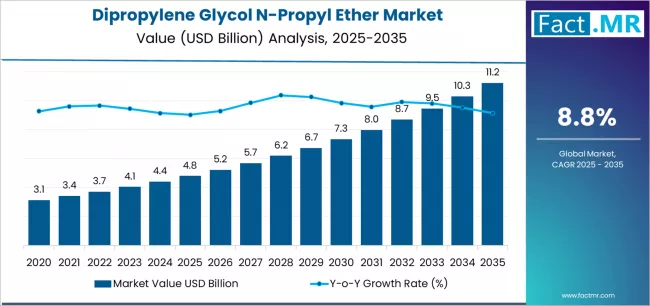
Dipropylene Glycol N Propyl Ether Market Market Value Analysis | Source: Fact.MR
Dipropylene Glycol N-Propyl Ether Market Key Takeaways
| Metric | Details |
|---|---|
| Industry Size (2026) | USD 5.22 million |
| Industry Value (2036) | USD 12.14 million |
| CAGR (2026 to 2036) | 8.8% |
Source: Fact.MR analysis. Updated Mar 26, 2026
Source: Fact.MR, 2026
All major dipropylene glycol n-propyl ether markets reflect accelerated adoption trajectories. India sets the pace with an 11.0% CAGR, followed by China at 10.0% as waterborne coatings adoption accelerates across construction and industrial maintenance sectors. USA advances at an 8.0% rate supported by EPA VOC rule compliance driving coalescent substitution. Japan tracks at 7.5% and Brazil at 7.0%. Germany registers a 6.5% pace driven by EU Decopaint Directive compliance. UK expands at 6.0% as architectural coatings reformulation timelines accelerate.
Summary of Dipropylene Glycol N-Propyl Ether Market
- Market Overview
- The market is valued at USD 4.80 million in 2025 and is projected to reach USD 12.14 million by 2036.
- The industry is expected to grow at a 8.8% CAGR from 2026 to 2036, creating an incremental opportunity of USD 6.92 million.
- The market operates as a high-growth specialty glycol ether category where VOC regulatory compliance timelines, waterborne coatings transitions, and coalescent substitution dynamics define adoption velocity.
- Demand and Growth Drivers
- Demand is accelerating as architectural paint manufacturers replace restricted glycol ether coalescents with DPnP ether to comply with tightening VOC emission rules and reproductive toxicity regulations.
- Industrial coatings formulators are expanding procurement for waterborne metal protection and automotive refinish systems where slow evaporation and film leveling performance are specification requirements.
- Detergent and cleaning product manufacturers are adopting DPnP ether as a coupling solvent in concentrated liquid formulations requiring low-odor, low-toxicity glycol ether alternatives.
- Among key countries, India leads at 11.0% CAGR, followed by China at 10.0%, the USA at 8.0%, Japan at 7.5%, Brazil at 7.0%, Germany at 6.5%, and the UK at 6.0%.
- Product and Segment View
- Dipropylene glycol n-propyl ether (DPnP) is a propylene oxide-based glycol ether solvent characterized by slow evaporation, low odor, and excellent coalescing properties for waterborne coating and adhesive formulations.
- Solvents dominates the Application segment with 38.7% share in 2026, as coalescing aid and coupling solvent applications in waterborne paints and cleaners constitute the primary procurement channel.
- Coatings and latex paints applications collectively represent a major demand segment as architectural and industrial waterborne formulations require effective film-forming assistance at compliant VOC levels.
- Scope includes all commercial grades of DPnP ether sold for solvent, coatings, detergent, and chemical intermediate applications. It excludes other glycol ether variants and propylene glycol sold without etherification.
- Geography and Competitive Outlook
- India and China are the fastest-growing markets, with accelerating waterborne coatings adoption in construction and industrial sectors driving DPnP ether coalescent procurement at double-digit growth rates.
- The USA and Germany represent regulation-driven Western markets where EPA VOC rules and EU Decopaint Directive compliance timelines sustain coalescent substitution demand.
- Competition is shaped by propylene oxide integration, etherification process scale, and coatings formulation technical support, with key players including Eastman Chemical Company, Monument Chemical, India Glycols Limited, ADEKA Corporation, LyondellBasell Industries, The Dow Chemical Company.
Why is the Dipropylene Glycol N-Propyl Ether Market Growing?
Market expansion is being supported by the increasing global emphasis on specialty chemical formulations and the corresponding shift toward high-performance chemical intermediates that can provide superior solvency characteristics while meeting user requirements for premium formulation performance and cost-effective processing solutions. Modern industrial users are increasingly focused on incorporating chemical systems that can enhance formulation reliability while satisfying demands for consistent, precisely controlled chemical properties and optimized processing efficiency practices. Dipropylene glycol n-propyl ether's proven ability to deliver chemical performance excellence, formulation compatibility benefits, and diverse application possibilities makes it an essential component for specialty-focused manufacturers and quality-focused chemical professionals.
The growing emphasis on formulation optimization and chemical processing reliability is driving demand for high-performance glycol ether systems that can support distinctive formulation outcomes and comprehensive chemical management across manufacturing processes, coating applications, and premium industrial installations. User preference for chemical solutions that combine functional excellence with processing optimization is creating opportunities for innovative implementations in both traditional and emerging specialty chemical applications. The rising influence of advanced processing technologies and automated quality systems is also contributing to increased adoption of premium glycol ether solutions that can provide authentic processing benefits and reliable performance monitoring characteristics.
Segmental Analysis
The market is segmented by application and region. Based on application, the market is categorized into solvents, chemical intermediates, coatings, detergents, latex paints, and other applications. Regionally, the market is divided into North America, Europe, Asia Pacific, Latin America, Middle East & Africa, and other regions.
By Application, the Solvents Segment Accounts for 38.7% Market Share
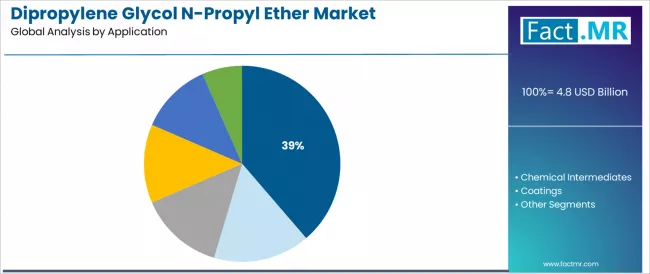
Dipropylene Glycol N Propyl Ether Market Analysis By Application | Source: Fact.MR
The solvents segment is projected to account for 38.7% of the dipropylene glycol n-propyl ether market in 2026, reaffirming its position as the leading application category. Industrial users and chemical professionals increasingly utilize solvents applications for their superior dissolution characteristics, established performance standards, and essential functionality in diverse chemical processing applications across multiple industrial sectors. Solvent applications' proven performance characteristics and established cost-effectiveness directly address user requirements for reliable chemical processing and optimal formulation precision in manufacturing and specialty chemical applications.
This application segment forms the foundation of modern chemical processing performance patterns, as it represents the application category with the greatest processing versatility and established compatibility across multiple industrial chemical systems. Industrial investments in advanced chemical technology and performance optimization continue to strengthen adoption among formulation-focused users. With manufacturers prioritizing processing consistency and chemical reliability, solvent systems align with both efficiency objectives and performance requirements, making them the central component of comprehensive chemical processing strategies.
What are the Drivers, Restraints, and Key Trends of the Dipropylene Glycol N-Propyl Ether Market?
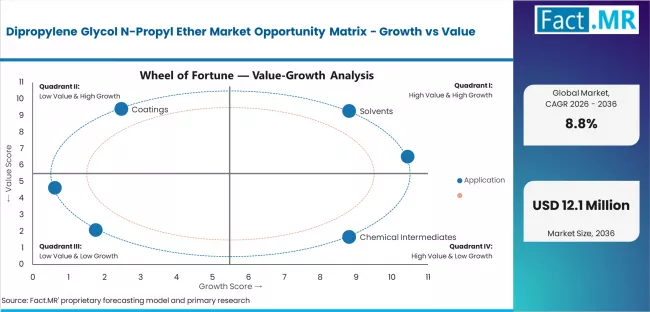
Dipropylene Glycol N Propyl Ether Market Opportunity Matrix Growth Vs Value | Source: Fact.MR
The dipropylene glycol n-propyl ether market is advancing rapidly due to increasing specialty chemical adoption and growing need for high-performance solvent solutions that emphasize superior chemical compatibility across manufacturing segments and formulation applications. However, the market faces challenges, including competition from alternative chemical intermediates, handling complexity considerations, and raw material cost factors affecting adoption rates. Innovation in chemical synthesis enhancement and advanced purification materials continues to influence market development and expansion patterns.
Expansion of Advanced Formulation and Specialty Chemical Applications
The growing adoption of dipropylene glycol n-propyl ether with specialized chemical properties and advanced formulation integration is enabling users to develop chemical strategies that provide distinctive processing benefits while commanding automated operation and enhanced real-time performance analysis characteristics.
Specialty formulation applications provide superior processing consistency while allowing more sophisticated optimization features across various chemical categories. Users are increasingly recognizing the processing advantages of specialized chemical positioning for comprehensive formulation outcomes and technology-integrated manufacturing management.
Integration of Quality Control and Processing Enhancement Systems
Modern dipropylene glycol n-propyl ether manufacturers are incorporating advanced quality sensors, real-time chemical monitoring capabilities, and automated processing systems to enhance formulation precision, improve product reliability effectiveness, and meet industrial demands for premium chemical solutions.
These systems improve processing effectiveness while enabling new applications, including continuous quality monitoring programs and automated production protocols. Advanced quality integration also allows users to support proactive processing positioning and performance assurance beyond traditional chemical operation requirements.
Analysis of the Dipropylene Glycol N-Propyl Ether Market by Key Country
.webp "Top Country Growth Comparison Dipropylene Glycol N Propyl Ether Market Cagr (2026 2036)")
Top Country Growth Comparison Dipropylene Glycol N Propyl Ether Market Cagr (2026 2036) | Source: Fact.MR
| Country | CAGR (2026-2036) |
|---|---|
| China | 10.0% |
| India | 11.0% |
| Germany | 6.5% |
| Brazil | 7.0% |
| USA | 8.0% |
| UK | 6.0% |
| Japan | 7.5% |
Source: Fact.MR analysis. Updated Mar 26, 2026
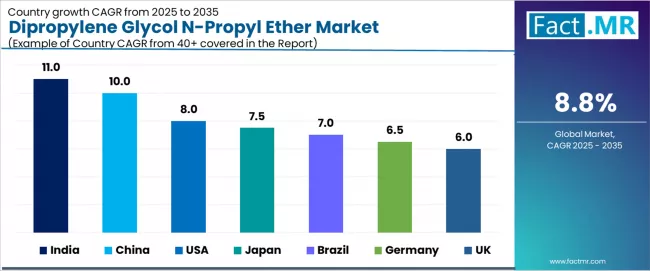
Dipropylene Glycol N Propyl Ether Market Cagr Analysis By Country | Source: Fact.MR
The dipropylene glycol n-propyl ether market is experiencing robust growth globally, with India leading at an 11.0% CAGR through 2036, driven by the expanding chemical manufacturing sector, growing specialty chemical requirements, and increasing adoption of advanced formulation systems. China follows at 10.0%, supported by rising industrialization, expanding chemical processing industry, and growing acceptance of specialty chemical technologies.
The USA shows growth at 8.0%, emphasizing advanced chemical processing standards and comprehensive specialty chemical development. Japan records 7.5%, focusing on chemical manufacturing precision and processing efficiency growth. Brazil demonstrates 7.0% growth, prioritizing chemical industry modernization and processing optimization.
The report covers an in-depth analysis of 40+ countries; seven top-performing countries are highlighted below.
India Leads Global Market Growth with Chemical Industry Expansion
Revenue from dipropylene glycol n-propyl ether consumption and sales in India is projected to exhibit exceptional growth with a CAGR of 11.0% through 2036, driven by the country's rapidly expanding chemical manufacturing sector, favorable government policies toward chemical industry modernization, and initiatives promoting specialty chemical technologies across major industrial regions.
India's position as a growing chemical processing hub and increasing focus on formulation optimization systems are creating substantial demand for high-quality glycol ethers in both domestic and export markets. Major chemical companies and specialty distributors are establishing comprehensive processing capabilities to serve growing demand and emerging specialty chemical opportunities.
- Expanding chemical culture and growing specialty consciousness are driving demand for dipropylene glycol n-propyl ether across chemical facilities, processing plants, and comprehensive formulation systems throughout Indian industrial markets.
- Strong chemical infrastructure and technology adoption initiatives are supporting the rapid adoption of premium glycol ethers among specialty-focused manufacturers seeking to meet evolving industrial standards and efficiency requirements.
China Demonstrates Strong Market Potential with Industrial Chemical Focus
Revenue from dipropylene glycol n-propyl ether products in China is expanding at a CAGR of 10.0%, supported by rising chemical industrialization investment, growing specialty consciousness, and expanding chemical distributor capabilities.
The country's developing chemical infrastructure and increasing investment in specialty technologies are driving demand for glycol ethers across both traditional and modern chemical applications. International chemical companies and domestic distributors are establishing comprehensive operational networks to address growing market demand for specialty chemicals and efficient formulation solutions.
- Rising chemical development and expanding manufacturing capabilities are creating opportunities for dipropylene glycol n-propyl ether adoption across process industries, modern chemical projects, and distributor companies throughout major Chinese industrial regions.
- Growing specialty awareness initiatives and chemical technology advancement are driving the adoption of specialized glycol ether products and services among industrial users seeking to enhance their processing efficiency and meet increasing specialty demand.
USA Maintains Market Leadership with Technology Excellence
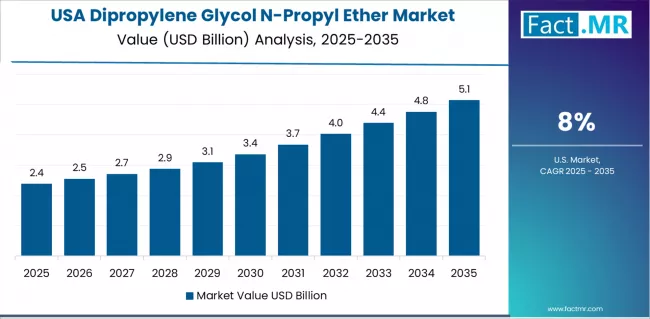
Dipropylene Glycol N Propyl Ether Market Country Value Analysis | Source: Fact.MR
Revenue from dipropylene glycol n-propyl ether products in the USA is projected to grow at a CAGR of 8.0% through 2036, supported by the country's mature chemical standards, established specialty chemical regulations, and leadership in advanced processing technology.
America's sophisticated chemical standards and strong support for advanced specialty systems are creating steady demand for both traditional and innovative glycol ether varieties. Leading chemical manufacturers and specialty distributors are establishing comprehensive operational strategies to serve both domestic markets and growing export opportunities.
- Advanced chemical technology capabilities and established specialty-focused markets are driving demand for premium dipropylene glycol n-propyl ether across manufacturing facilities, processing plants, and comprehensive chemical companies seeking superior performance profiles and processing innovation.
- Strong chemical excellence culture and regulatory leadership are supporting the adoption of innovative glycol ether technology among users prioritizing processing reliability and chemical precision in specialty applications.
Japan Strengthens Position with Precision Chemical Growth
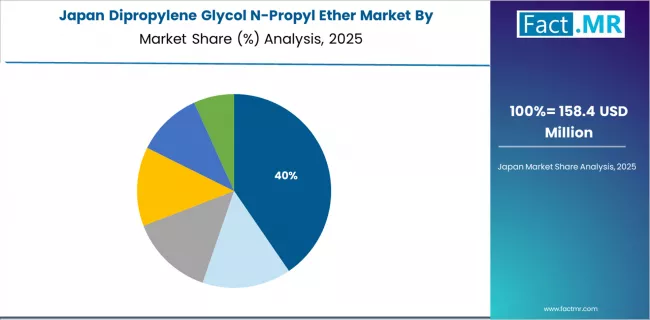
Dipropylene Glycol N Propyl Ether Market Japan Market Share Analysis By Application | Source: Fact.MR
Revenue from dipropylene glycol n-propyl ether products in Japan is projected to grow at a CAGR of 7.5% through 2036, driven by the country's emphasis on precision manufacturing, chemical processing excellence, and advanced technology integration requiring efficient specialty chemical solutions.
Japanese industrial users and chemical-focused facilities consistently seek specialty-focused equipment that enhances processing efficiency and supports precision excellence for both traditional and modern chemical applications. The country's position as an Asian chemical leader continues to drive innovation in specialized formulation applications and manufacturing precision standards.
- Advanced precision manufacturing technology capabilities and growing chemical applications are driving demand for industrial dipropylene glycol n-propyl ether across manufacturing consumers, chemical providers, and efficiency-focused distributors seeking superior processing and distinctive performance profiles.
- Strong focus on precision excellence and chemical processing systems is supporting the adoption of specialty glycol ether varieties among users and distributors seeking authentic Japanese precision-focused products in regional markets with established manufacturing expertise.
Brazil Anchors Growth with Chemical Industry Development
Revenue from dipropylene glycol n-propyl ether products in Brazil is projected to grow at a CAGR of 7.0% through 2036, supported by the country's emphasis on chemical industry advancement, specialty chemical optimization, and advanced processing system integration requiring efficient formulation solutions.
Brazilian chemical users and specialty-focused facilities prioritize performance reliability and processing precision, making specialized glycol ethers essential components for both traditional and modern chemical applications. The country's comprehensive chemical industry leadership and advancing specialty patterns support continued market expansion.
- Advanced chemical industry capabilities and growing precision chemical management are driving demand for dipropylene glycol n-propyl ether across specialty applications, modern chemical formats, and technology-integrated processing programs serving domestic markets with increasing operational requirements.
- Strong focus on processing optimization and performance excellence is encouraging users and distributors to adopt chemical solutions that support efficiency objectives and meet Brazilian quality standards for specialty chemical applications.
Germany Maintains Steady Growth with Chemical Engineering Focus
Revenue from dipropylene glycol n-propyl ether products in Germany is projected to grow at a CAGR of 6.5% through 2036, supported by established chemical standards, mature specialty markets, and emphasis on processing reliability across manufacturing and chemical sectors.
German industrial users and chemical professionals prioritize quality performance and processing consistency, creating steady demand for premium glycol ether solutions. The country's comprehensive market maturity and established chemical practices support continued development in specialized applications.
- Established chemical markets and mature specialty industry are driving demand for quality dipropylene glycol n-propyl ether across manufacturing operations, processing facilities, and professional chemical companies throughout German industrial regions.
- Strong emphasis on quality standards and processing reliability is supporting the adoption of premium glycol ether varieties among users seeking proven performance and established chemical credentials in specialty applications.
UK Demonstrates Precision-Focused Growth
Revenue from dipropylene glycol n-propyl ether products in the UK is projected to grow at a CAGR of 6.0% through 2036, supported by the country's emphasis on chemical precision, processing excellence, and advanced technology integration requiring efficient specialty solutions.
Industrial users in the UK and chemical-focused facilities prioritize technical performance and processing precision, making specialized glycol ethers essential components for both traditional and modern chemical applications. The country's comprehensive chemical leadership and advancing precision patterns support continued market expansion.
- Advanced precision chemical technology capabilities and growing technical specialty applications are driving demand for dipropylene glycol n-propyl ether across specialty chemical applications, modern precision formats, and technology-integrated processing programs serving domestic markets with increasing quality requirements.
- Strong focus on technical precision and processing excellence is encouraging users and distributors to adopt glycol ether solutions that support chemical objectives and meet British precision standards for specialty applications.
Europe Market Split by Country
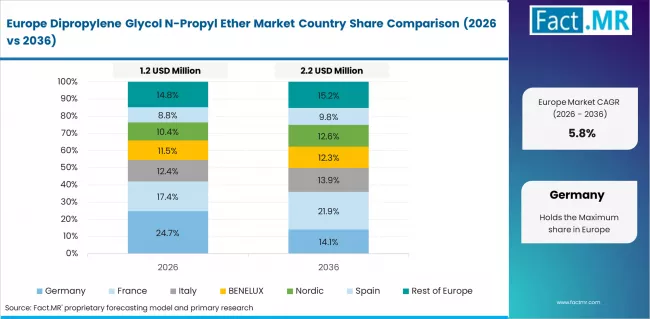
Dipropylene Glycol N Propyl Ether Market Europe Country Market Share Analysis, 2026 & 2036 | Source: Fact.MR
The Europe dipropylene glycol n-propyl ether market is projected to grow from USD 1.2 million in 2026 to USD 2.8 million by 2036, recording a CAGR of 8.8% over the forecast period. Germany leads the region with a 41.7% share in 2026, moderating slightly to 41.2% by 2036, supported by its strong chemical engineering traditions and demand for premium, precision-manufactured glycol ether solutions. The UK follows with 23.3% in 2026, easing to 22.9% by 2036, driven by a mature specialty chemical market and emphasis on processing reliability and quality performance.
France accounts for 15.0% in 2026, rising to 15.4% by 2036, reflecting steady adoption of specialty chemical technologies and formulation optimization. Italy holds 8.3% in 2026, expanding to 8.8% by 2036 as chemical manufacturing modernization and specialty processing applications grow.
Spain contributes 6.7% in 2026, growing to 7.2% by 2036, supported by expanding chemical development and specialty awareness modernization. The Nordic countries rise from 3.3% in 2026 to 3.5% by 2036 on the back of strong chemical consciousness and advanced processing methodologies. BENELUX remains at 1.7% share across both 2026 and 2036, reflecting mature, specialty-focused chemical markets.
Competitive Landscape of the Dipropylene Glycol N-Propyl Ether Market
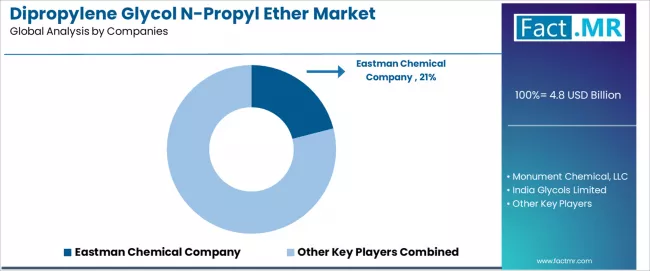
Dipropylene Glycol N Propyl Ether Market Analysis By Company | Source: Fact.MR
The dipropylene glycol n-propyl ether market is characterized by competition among established chemical manufacturers, specialized glycol ether companies, and integrated specialty chemical providers. Companies are investing in advanced production technologies, specialized chemical engineering, product innovation capabilities, and comprehensive distribution networks to deliver consistent, high-quality, and reliable glycol ether systems. Innovation in chemical synthesis optimization, purification technology advancement, and specialty-focused product development is central to strengthening market position and customer satisfaction.
Eastman Chemical Company leads the market with a strong focus on chemical technology innovation and comprehensive specialty chemical solutions, offering industrial and processing systems with emphasis on performance excellence and chemical heritage. Monument Chemical provides integrated specialty chemicals with a focus on industrial market applications and precision processing networks. India Glycols delivers comprehensive glycol technology solutions with a focus on chemical positioning and processing efficiency. ADEKA CORPORATION specializes in comprehensive chemical systems with an emphasis on specialty applications. Jiangsu Yida Chemical focuses on comprehensive chemical manufacturing with advanced design and premium positioning capabilities.
Global Dipropylene Glycol N-Propyl Ether Market - Stakeholder Contribution Framework
The success of dipropylene glycol n-propyl ether in meeting specialty chemical demands, manufacturing efficiency requirements, and processing integration will not only enhance chemical performance outcomes but also strengthen global specialty chemical manufacturing capabilities. It will consolidate emerging regions' positions as hubs for efficient chemical production and align advanced economies with comprehensive specialty systems. This calls for a concerted effort by all stakeholders -- governments, industry bodies, manufacturers, distributors, and investors. Each can be a crucial enabler in preparing the market for its next phase of growth.
How Governments Could Spur Local Production and Adoption?
- Targeted Incentives: Introduce specialty chemical modernization subsidies for companies adopting advanced glycol ether production technologies in manufacturing and chemical regions, and production-linked incentives for facilities producing chemicals for domestic consumption and export markets.
- Trade Agreements: Accelerate export growth through bilateral and multilateral agreements that classify dipropylene glycol n-propyl ether under "specialty chemical products," easing cross-border regulatory approvals and chemical safety certifications.
- Facilitate Innovation: Establish Centers of Excellence for chemical technology innovation and glycol ether engineering. Fund R&D into efficient production systems, chemical optimization, and industrial-standard integration for manufacturing and processing applications.
How Industry Bodies Could Support Market Development?
- Foster Connectivity: Constitute a global chemical technology consortium linking glycol ether manufacturers, specialty chemical suppliers, users, and policymakers to align production targets with chemical efficiency and specialty commitments.
- Promote Exports: Work with export councils to brand dipropylene glycol n-propyl ether as premium, engineering-focused specialty solutions. Facilitate trade fairs to connect chemical technology innovators with global buyers in manufacturing, processing, and industrial sectors.
- Upskilling Programs: Develop curricula on advanced glycol ether manufacturing, chemical technology, specialty chemical processes, and efficiency optimization to prepare manufacturers and operators for premium chemical market opportunities.
How Distributors and Specialty Chemical Players Could Strengthen the Ecosystem?
- Drive Integration: Bundle dipropylene glycol n-propyl ether with specialty-focused marketing and efficiency messaging systems. Position specialized chemicals as part of holistic "chemical processing optimization solutions."
- Forge Partnerships: Collaborate with glycol ether manufacturers and technology providers for joint R&D on specialty applications, efficiency enhancement initiatives, and global quality assurance for premium markets.
How Manufacturers Could Navigate the Shift?
- Capture Premium Markets: Leverage government incentives and rising specialty demand to offer dipropylene glycol n-propyl ether into growth markets where general chemical solutions face performance and reliability challenges.
- Invest in Technology: Partner with technology providers to advance efficient chemical workflows, industrial-grade quality, and advanced manufacturing practices.
- Build Capabilities: Train technical staff and specialty specialists to demonstrate glycol ethers' processing advantages, repositioning chemical relationships toward long-term specialty partnerships.
Key Players in the Dipropylene Glycol N-Propyl Ether Market
- Eastman Chemical Company
- Monument Chemical, LLC
- India Glycols Limited
- ADEKA Corporation
- Jiangsu Yida Chemical Co., Ltd.
- LyondellBasell Industries Holdings B.V.
- Midland Chemicals Ltd.
- Global Bio-Chem Technology Group Company Limited
- Manali Petrochemicals Limited
- Jiangsu Dynamic Chemical Co., Ltd.
- The Dow Chemical Company
Bibliography
- United States Environmental Protection Agency. (2024, September). National Volatile Organic Compound Emission Standards: Architectural Coatings Rule Amendments. U.S. EPA.
- European Commission. (2024). Directive 2004/42/CE (Decopaint Directive): Consolidated Text on VOC Limits for Decorative Paints. Official Journal of the European Union.
- Eastman Chemical Company. (2024). Eastman Annual Report 2024: Additives and Functional Products Division. Eastman Chemical, Kingsport.
- European Chemicals Agency. (2024). REACH Registration Dossier: Dipropylene Glycol N-Propyl Ether. ECHA, Helsinki.
- India Glycols Limited. (2024). India Glycols Annual Report 2023-24: Glycol Ethers and Specialty Chemicals Division. India Glycols, Noida.
- The Dow Chemical Company. (2024). Dow Coatings Materials Product Guide 2024: Coalescents and Film Formation Aids. Dow Inc., Midland.
This bibliography is provided for reader reference. The full Fact.MR report contains the complete reference list with primary research documentation.
This Report Addresses
- Market sizing and quantitative forecast metrics detailing the precise specialty solvent expenditure dedicated to dipropylene glycol n-propyl ether across coatings, detergent, and chemical sectors through 2036.
- Segmentation analysis mapping application-specific consumption patterns and evaluating the coalescent substitution dynamics driving procurement from restricted glycol ethers to DPnP alternatives.
- Regional deployment intelligence comparing the waterborne coatings transition rates in Asia against the VOC regulation-driven reformulation timelines prevalent in North American and European paint markets.
- Regulatory compliance assessment analyzing how EPA architectural coatings VOC rules and EU Decopaint Directive limits create specification-level pull for low-VOC coalescent solvents.
- Competitive posture evaluation tracking propylene oxide integration, etherification capacity, and coatings formulation technical support that define market positioning among leading glycol ether producers.
- Capital project strategic guidance defining the etherification and purification capacity required to service accelerating DPnP ether demand from waterborne coatings transitions.
- Supply chain vulnerability analysis identifying propylene oxide feedstock pricing volatility and concentrated supplier base risks affecting procurement reliability.
- Custom data delivery formats encompassing interactive dashboards, raw Excel datasets, and comprehensive PDF narrative reports.
Dipropylene Glycol N-Propyl Ether Market Definition
Dipropylene glycol n-propyl ether (DPnP) is a propylene oxide-derived glycol ether solvent produced through the catalytic etherification of dipropylene glycol with n-propanol. The compound exhibits a slow evaporation rate, low vapor pressure, minimal odor, and favorable toxicological profile compared to ethylene oxide-based glycol ethers. Its primary function is as a coalescing aid in waterborne latex paints, where it temporarily softens polymer particles to enable continuous film formation before evaporating from the cured coating. Secondary applications include use as a coupling solvent in concentrated cleaning formulations and as a reaction medium for chemical synthesis.
Dipropylene Glycol N-Propyl Ether Market Inclusions
Market scope includes all commercial grades of dipropylene glycol n-propyl ether sold for solvent, coatings coalescent, detergent coupling, and chemical intermediate applications. Coverage spans global and regional market sizes, the forecast period from 2026 to 2036, and application-level breakdowns. VOC regulatory impact assessments and coalescent substitution trend analysis are incorporated.
Dipropylene Glycol N-Propyl Ether Market Exclusions
The scope excludes other glycol ether variants such as dipropylene glycol methyl ether (DPM) and dipropylene glycol butyl ether (DPnB). Propylene glycol and dipropylene glycol sold without n-propyl etherification fall outside the market boundary. Pharmaceutical-grade glycol ethers produced under GMP conditions are omitted.
Dipropylene Glycol N-Propyl Ether Market Research Methodology
- Primary Research: Analysts engaged with coatings formulation chemists, glycol ether procurement managers, and detergent product developers to map coalescent specification requirements and substitution timelines.
- Desk Research: Data collection aggregated EPA VOC rule amendment texts, EU Decopaint Directive compliance guidance, and glycol ether production capacity disclosures from chemical producer annual reports.
- Market-Sizing and Forecasting: Baseline values derive from a bottom-up aggregation of DPnP ether shipment volumes from major glycol ether producers, applying waterborne coatings adoption curves to project coalescent demand.
- Data Validation and Update Cycle: Projections are cross-validated against published specialty solvent revenue from leading chemical companies and quarterly architectural coatings production indices.
Segmentation
Scope of the Report
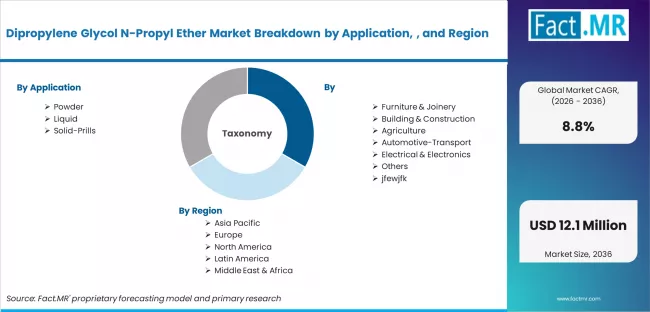
Dipropylene Glycol N Propyl Ether Market Breakdown By Application, , And Region | Source: Fact.MR
| Metric | Value |
|---|---|
| Quantitative Units | USD 5.22 million to USD 12.14 million, at a CAGR of 8.8% |
| Market Definition | DPnP ether is a propylene oxide-based glycol ether solvent used as a coalescing aid in waterborne coatings, a coupling solvent in detergent formulations, and a reaction medium for chemical synthesis. |
| Application Segmentation | Solvents, Chemical Intermediates, Coatings, Detergents, Latex Paints, Other Applications |
| Regions Covered | North America, Latin America, Europe, East Asia, South Asia, Oceania, Middle East & Africa |
| Countries Covered | India, China, USA, Japan, Brazil, Germany, UK, and 40 plus countries |
| Key Companies Profiled | Eastman Chemical Company, Monument Chemical, India Glycols Limited, ADEKA Corporation, LyondellBasell Industries, Dow Chemical Company, Jiangsu Yida Chemical, Midland Chemicals, Manali Petrochemicals, Jiangsu Dynamic Chemical |
| Forecast Period | 2026 to 2036 |
| Approach | Forecasting models apply a bottom-up methodology starting with glycol ether production volumes, projecting DPnP ether demand based on waterborne coatings adoption rates and VOC regulatory compliance timelines. |
Source: Fact.MR analysis. Updated Mar 26, 2026
Dipropylene Glycol N-Propyl Ether Market by Segments
-
Application:
- Solvents
- Chemical Intermediates
- Coatings
- Detergents
- Latex Paints
- Other Applications
-
Region:
- North America
- United States
- Canada
- Mexico
- Europe
- Germany
- United Kingdom
- France
- Italy
- Spain
- Nordic Countries
- BENELUX
- Rest of Europe
- Asia Pacific
- China
- India
- Japan
- South Korea
- Australia
- Rest of Asia Pacific
- Latin America
- Brazil
- Argentina
- Rest of Latin America
- Middle East & Africa
- Kingdom of Saudi Arabia
- United Arab Emirates
- South Africa
- Rest of Middle East & Africa
- Other Regions
- Oceania
- Central Asia
- Other Markets
- North America
Frequently Asked Questions
How large is the demand for dipropylene glycol n-propyl ether in the global market in 2026?
What will be the market size of dipropylene glycol n-propyl ether in the global market by 2036?
What is the expected demand growth for dipropylene glycol n-propyl ether between 2026 and 2036?
Which Application segment is poised to lead global sales by 2026?
What is driving demand in India?
What is the growth outlook for Japan in this report?
What does Fact.MR use as the basis for its DPnP ether forecast?
Who worked on this report


Preview the report firsthand - request a free sample
Free SampleGet the brochure for pricing and purchase details
Download PDF