- Market Value (2025): USD 16.9 Bn
- Estimated Value (2026): USD 17.9 Bn
- Forecast Value (2036): USD 30.7 Bn
- CAGR (2026-2036): 5.6%
What is the Diesel Vehicle Exhaust Gas Aftertreatment System Market forecast to be worth by 2036?
USD 17.9 billion in 2026 to USD 30.7 billion by 2036, at a 5.6% CAGR.
- According to Fact.MR analysis, the diesel vehicle exhaust gas aftertreatment system market reached USD 16.9 billion in 2025.
- Sales are projected to reach from USD 17.9 billion in 2026 to USD 30.7 billion by 2036 as new commercial vehicles continue to use integrated exhaust systems.
- The market is forecast to record a 5.6% CAGR between 2026 and 2036 across original equipment and replacement applications.
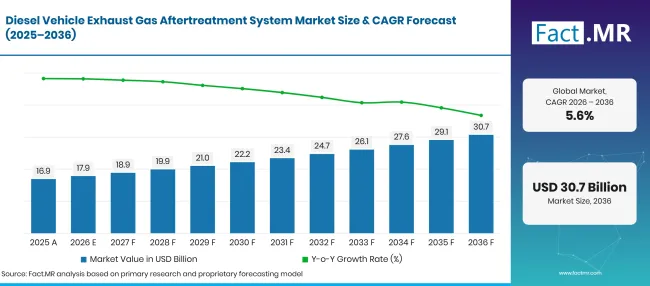
Diesel Vehicle Exhaust Gas Aftertreatment System Market Forecast Global | Source: Fact.MR
| Year | Basis | Market Value (USD billion) |
|---|---|---|
| 2025 | Actual | 16.9 |
| 2026 | Estimate | 17.9 |
| 2036 | Forecast | 30.7 |
| CAGR 2026 to 2036 | Forecast period | 5.6% |
Source: Fact.MR analysis. Updated Oct 26, 2026
What are the defining numbers behind Diesel Vehicle Exhaust Gas Aftertreatment System Market growth?
USD 12.8 billion in additional market value by 2036, with SCR and heavy commercial vehicles central to the outlook.
- Demand Drivers in the Market
- Truck manufacturers need exhaust systems that control nitrogen oxides during low-load operation as well as regular highway driving.
- European commercial fleets remain closely tied to diesel power. The European Automobile Manufacturers’ Association reported that diesel represented 92.1% of new EU truck registrations in the first half of 2026 [2]. This keeps exhaust treatment central to current truck production.
- Service workshops need replacement filters, sensors and dosing components that fit the vehicle’s installed exhaust layout. Fleet operators weigh the cost of downtime alongside parts availability when planning repairs.
- Key Segments Analyzed
- By Technology: Selective Catalytic Reduction (SCR) holds 42.3% share in 2026, reflecting its role in diesel nitrogen oxide control.
- By Vehicle Type: Heavy Commercial Vehicles account for 44.6% share in 2026 sales because long operating hours make exhaust durability central to fleet operations.
- By Sales Channel: Original Equipment Manufacturer (OEM) leads with 71.2% share in 2026 as systems are integrated during vehicle assembly.
- Analyst Opinion at Fact.MR
- Shambhu Nath Jha, Principal Consultant at Fact.MR, states, “The difficult part of exhaust treatment is maintaining performance when exhaust temperatures fall. For diesel truck programs, suppliers must show how temperature control and service access work together within the available space.”
- Strategic Implications
- Engine manufacturers should assess catalyst heating and low-temperature conversion early in their diesel platform design to avoid late packaging changes.
- Component producers should maintain consistent filter quality and documented durability performance because service life affects fleet operating costs.
- Fleet maintenance teams should track the compatibility of sensors and replacement units with each engine calibration before ordering parts.
- Distributors should build stock plans around commonly serviced vehicle platforms and clearly identify compatible replacement assemblies.
Germany is projected to expand at 6.7% CAGR through 2036 on the strength of its commercial vehicle fleet and repair base. Brazil follows at 6.1% as heavy-duty emissions compliance remains part of vehicle manufacturing. The United States is forecast at 5.5% amid engine certification and fleet service needs. The United Kingdom is estimated at 4.9% with continued freight operations, while Japan is projected at 4.4% as domestic manufacturers refine established diesel platforms.
How does the Diesel Vehicle Exhaust Gas Aftertreatment System Market break down by segment?
SCR represents 42.3% of technology sales; heavy commercial vehicles account for 44.6%; OEMs contribute 71.2% in 2026.
Which Technology dominates?
Selective Catalytic Reduction (SCR) accounts for 42.3% of 2026 market value.
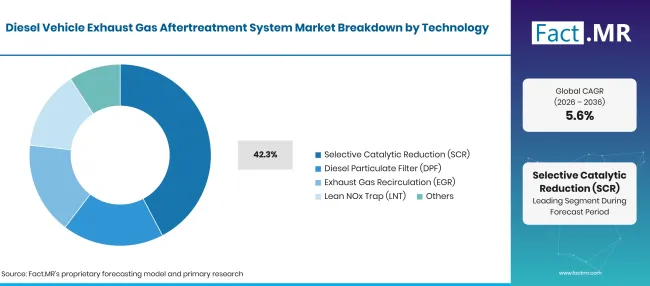
Diesel Vehicle Exhaust Gas Aftertreatment System Market Breakdown Technology | Source: Fact.MR
| Technology | Share (2026) |
|---|---|
| Selective Catalytic Reduction (SCR) (Leading segment) | 42.3% |
| Other technologies combined | 57.7% |
| Total | 100.0% |
Source: Fact.MR analysis. Updated Oct 26, 2026
Selective Catalytic Reduction (SCR) treats nitrogen oxides by introducing a diesel exhaust fluid solution before the catalyst. Diesel Particulate Filters (DPF) address soot and need cleaning strategies suited to the route and load. Exhaust Gas Recirculation (EGR) changes combustion conditions before the gases reach the tailpipe equipment. Lean NOx Traps (LNT) serve applications where packaging and engine operation support that design.
What leads the Vehicle Type segment?
Heavy Commercial Vehicles hold 44.6% share in 2026.
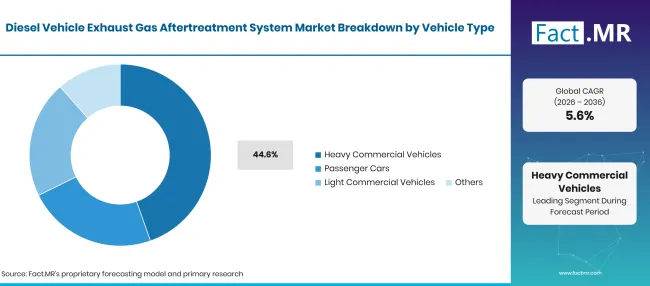
Diesel Vehicle Exhaust Gas Aftertreatment System Market Breakdown Vehicle Type | Source: Fact.MR
| Vehicle Type | Share (2026) |
|---|---|
| Heavy Commercial Vehicles (Leading segment) | 44.6% |
| Other vehicle types combined | 55.4% |
| Total | 100.0% |
Source: Fact.MR analysis. Updated Oct 26, 2026
Heavy trucks spend long periods under load, making emissions performance and service life important in system selection. Light commercial vehicles use smaller packages suited to delivery schedules and urban routes.
How does Sales Channel shape demand?
Original Equipment Manufacturer (OEM) sales represent 71.2% of the market in 2026.
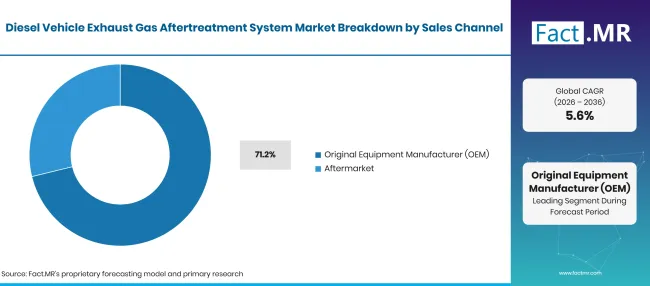
Diesel Vehicle Exhaust Gas Aftertreatment System Market Breakdown Sales Channel | Source: Fact.MR
| Sales Channel | Share (2026) |
|---|---|
| Original Equipment Manufacturer (OEM) (Leading segment) | 71.2% |
| Aftermarket | 28.8% |
| Total | 100.0% |
Source: Fact.MR analysis. Updated Oct 26, 2026
OEM sales account for integrated exhaust systems fitted at the factory, where component dimensions and control software need to match the engine from the beginning. The U.S. EPA’s July 2026 proposed amendments to SCR-related provisions highlight the role of system diagnostics and compliance planning in diesel engine development [3].
What is accelerating Diesel Vehicle Exhaust Gas Aftertreatment System Market adoption, and what is holding it back?
Heavy-duty diesel production and emissions-control requirements support sales; system cost and service complexity create barriers.
Drivers Impact Analysis
| DRIVER | (~) % IMPACT ON CAGR | GEOGRAPHIC RELEVANCE | IMPACT TIMELINE |
|---|---|---|---|
| Diesel-heavy commercial vehicle production | +1.0% | Europe, Americas, Asia | Short term (<= 2 years) |
| Tighter low-temperature emissions control | +0.8% | United States, Europe | Medium term (2–4 years) |
| Fleet maintenance and replacement cycles | +0.7% | Global | Medium term (2–4 years) |
| OEM integration of exhaust controls | +0.5% | Global | Long term (>= 4 years) |
| Durability and diagnostic requirements | +0.4% | United States, Europe | Long term (>= 4 years) |
Source: Fact.MR analysis. Updated Oct 26, 2026
Opportunity Impact Analysis
| OPPORTUNITY | (~) % IMPACT ON CAGR | GEOGRAPHIC RELEVANCE | IMPACT TIMELINE |
|---|---|---|---|
| Improved cold-start conversion | +0.8% | North America | Medium term (2–4 years) |
| Accessible filter service designs | +0.6% | Global | Medium term (2–4 years) |
| Platform-specific replacement kits | +0.4% | Europe, Americas | Short term (<= 2 years) |
Source: Fact.MR analysis. Updated Oct 26, 2026
Restraints Impact Analysis
| RESTRAINT | (~) % IMPACT ON CAGR | GEOGRAPHIC RELEVANCE | IMPACT TIMELINE |
|---|---|---|---|
| High integration and validation expense | -0.6% | Global | Medium term (2–4 years) |
| Maintenance and downtime exposure | -0.5% | Global | Short term (<= 2 years) |
| Growth of alternative powertrains | -0.4% | Europe, Japan | Long term (>= 4 years) |
Source: Fact.MR analysis. Updated Oct 26, 2026
Which countries are scaling the Diesel Vehicle Exhaust Gas Aftertreatment System Market through 2036?
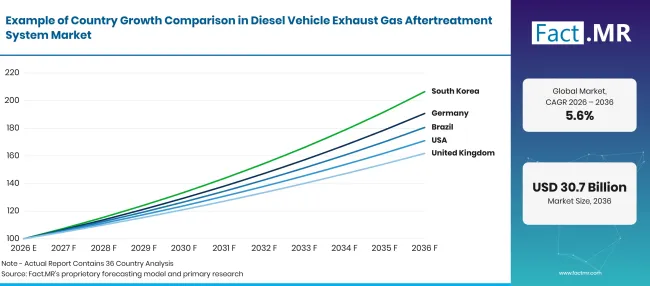
Diesel Vehicle Exhaust Gas Aftertreatment System Market Growth Index | Source: Fact.MR
| Country | CAGR (2026 to 2036) |
|---|---|
| Germany | 6.7% |
| Brazil | 6.1% |
| United States | 5.5% |
| United Kingdom | 4.9% |
| Japan | 4.4% |
Source: Fact.MR analysis. Updated Oct 26, 2026
What supports Germany’s adoption?
6.7% CAGR, connected to commercial vehicle production and fleet upkeep.
German truck manufacturers select SCR catalysts and particulate filters at the engine-development stage because emissions controls must suit different driving loads. local production programs are expected to support systems that fit vehicle platforms and remain accessible during servicing. The Federal Statistical Office reported in March 2025 that Germany exported approximately 3.4 million new passenger cars during 2024 [7].
How is Brazil developing demand?
6.1% CAGR, associated with heavy vehicle compliance and service needs.
Local manufacturers and service companies have an opening to supply SCR units suited to Brazilian vehicle models. Trucks working long distances need dependable sensors and fluid dosing, so repair teams pay attention to the exact engine configuration. Brazil’s Ministry of the Environment published its road-vehicle emissions inventory in September 2026, covering the 2024 inventory year and PROCONVE categories [4].
What shapes United States demand?
5.5% CAGR, tied to 2027 engine programs and diagnostics.
In the United States, heavy-duty engine makers are preparing diesel treatment hardware for revised certification and real-world operating conditions. low-temperature nitrogen oxide conversion is expected to receive close attention as companies refine their next engine platforms.
How does the United Kingdom perform?
4.9% CAGR, linked to freight distance and replacement purchases.
British freight operators place considerable weight on repair time because diesel trucks often run against scheduled deliveries. replacement particulate filters and dosing-system parts are expected to benefit from workshops that offer quick vehicle-specific identification. The Department for Transport reported in May 2026 that Great Britain-registered heavy goods vehicles travelled 19.0 billion vehicle kilometres on UK roads in 2025 [5].
What influences Japan’s market development?
4.4% CAGR, shaped by compact packaging and long service lives.
Japanese commercial vehicle manufacturers work with compact engine bays and carefully arranged exhaust routes. According to Fact.MR analysis, packaging needs are expected to influence the position of SCR units and particulate filters in future truck models. The Ministry of Land, Infrastructure, Transport and Tourism released its Motor Vehicles in Figures 2026 publication with separate categories for trucks and buses [6].
Who leads the Diesel Vehicle Exhaust Gas Aftertreatment System Market?
Competition spans complete exhaust assemblies, catalyst materials and electronic control equipment. Robert Bosch GmbH and Denso Corporation supply engine and emissions-related components, while Tenneco and FORVIA are associated with exhaust system engineering.
Cummins supplies integrated engine and aftertreatment architectures for heavy commercial vehicles. Johnson Matthey participates through emissions-control catalyst technology. Exhaust suppliers compete on the ability to meet the engine maker’s packaging and operating requirements. Cummins explained in September 2026 that its Twin Module design uses two assemblies and a single DEF doser [1]. Such layouts underline the value of designing the exhaust path alongside the engine and truck frame.
Which companies are the key providers?
Key companies include Robert Bosch GmbH; Tenneco Inc.; FORVIA SE; Cummins Inc.; Eberspächer Group; Marelli Holdings Co., Ltd.; Denso Corporation; and Johnson Matthey.
- Robert Bosch GmbH
- Tenneco Inc.
- FORVIA SE
- Cummins Inc.
- Eberspächer Group
- Marelli Holdings Co., Ltd.
- Denso Corporation
- Johnson Matthey
Bibliography
- [1] Cummins Inc. (2026, September 23). Twin Module: Cummins’ 2027 diesel aftertreatment system.
- [2] European Automobile Manufacturers’ Association. (2026, July 29). New commercial vehicle registrations: Vans +1.9%, trucks +9.8%, buses +22.7% in H1 2026.
- [3] U.S. Environmental Protection Agency. (2026, July 14). Proposed rule: Amendments and nonconformance penalties for model year 2027 and later heavy-duty highway engines and amendments to inducement provisions for SCR-equipped diesel engines.
- [4] Ministério do Meio Ambiente e Mudança do Clima. (2026, September 24). Resultados do Inventário Nacional de Emissões Atmosféricas por Veículos Automotores Rodoviários 2025 (Ano-Base 2024) [Data set].
- [5] Department for Transport. (2026, May 27). Road freight statistics: 2025.
- [6] Ministry of Land, Infrastructure, Transport and Tourism. (2026). 数字でみる自動車2026 [Motor vehicles in figures 2026].
- [7] Statistisches Bundesamt (Destatis). (2025, March 20). 3,4 Millionen neue Autos im Jahr 2024 aus Deutschland exportiert.
This Report Answers
- The 2026 market value, the 2036 forecast and the expected pace of sales growth.
- Why heavy commercial vehicles remain central to diesel exhaust equipment spending.
- How SCR, DPF, EGR and LNT differ in their roles and operating needs.
- How OEM purchasing differs from replacement-part activity.
- Which local conditions shape diesel aftertreatment activity in five national markets.
What does the Diesel Vehicle Exhaust Gas Aftertreatment System Market cover?
The market covers systems that treat diesel exhaust from on-road vehicles after combustion. Revenue includes relevant exhaust treatment assemblies and components sold for original vehicle installation or for replacement during service. Its boundary follows diesel vehicles and the equipment needed to control their regulated tailpipe pollutants.
What is included in the scope?
SCR catalysts and dosing hardware are covered alongside diesel particulate filters and related treatment equipment.
EGR and LNT systems are represented within the technology structure. Systems fitted to heavy commercial vehicles and light commercial vehicles form part of the vehicle coverage, together with passenger cars and other road vehicles.
What is excluded from the scope?
Battery-electric vehicles without diesel engines are outside the market. Standalone non-road generator exhaust systems and treatment equipment dedicated to marine vessels are excluded.
Fuel, general vehicle repair work and unrelated engine components are not counted as aftertreatment system revenue.
How Was the Analysis Built?
The analysis draws on 120+ sources, 35+ company portfolios, 25+ countries, and more than 20 industry interviews.
- Primary Research: Primary research includes discussions with manufacturers, service providers, technology developers, distributors, end users, and subject-matter experts. These conversations examine purchasing priorities, product adoption, operational challenges, approval requirements, competitive positioning, and the factors that influence wider market acceptance.
- Desk Research: Desk research covers government statistics, regulatory publications, company filings, trade data, technical studies, industry associations, standards, public policy, and other authoritative sources. Every source used in the analysis is documented in the bibliography.
- Market Sizing and Forecasting: Market estimates combine historical performance, demand indicators, pricing and volume trends, segment shares, company participation, country-level growth, adoption patterns, investment activity, and barriers to market expansion.
- Data Validation and Update Cycle: Findings are validated by comparing primary interviews with public data, company activity, regulatory changes, trade patterns, and industry developments. Regular updates review new product launches, capacity changes, partnerships, approvals, and shifts in commercial adoption.
Segmentation
What is the report’s scope and coverage?
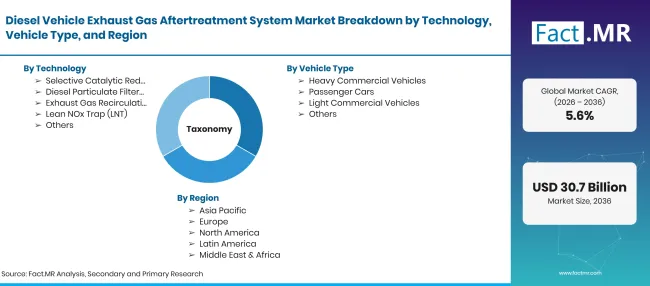
Diesel Vehicle Exhaust Gas Aftertreatment System Market Taxonomy | Source: Fact.MR
| Attribute | Details |
|---|---|
| Quantitative Units | USD billion |
| Market Definition | Exhaust aftertreatment hardware and associated control components installed on road-going diesel vehicles to treat particulate matter and nitrogen oxides. |
| Technology | Selective Catalytic Reduction (SCR); Diesel Particulate Filter (DPF); Exhaust Gas Recirculation (EGR); Lean NOx Trap (LNT); Others |
| Vehicle Type | Heavy Commercial Vehicles; Passenger Cars; Light Commercial Vehicles; Others |
| Sales Channel | Original Equipment Manufacturer (OEM); Aftermarket |
| Regions Covered | North America; Latin America; Western Europe; Eastern Europe; East Asia; South Asia & Pacific; Middle East & Africa |
| Countries Covered | Germany; Brazil; United States; United Kingdom; Japan |
| Forecast Period | 2026 to 2036 |
| Companies Profiled | Robert Bosch GmbH; Tenneco Inc.; FORVIA SE; Cummins Inc.; Eberspächer Group; Marelli Holdings Co., Ltd.; Denso Corporation; and Johnson Matthey. |
| Approach | Review of vehicle production, emissions requirements, parts applications, supplier systems and service conditions. |
Source: Fact.MR analysis. Updated Oct 26, 2026
How is the market segmented?
-
By Technology
- Selective Catalytic Reduction (SCR)
- Diesel Particulate Filter (DPF)
- Exhaust Gas Recirculation (EGR)
- Lean NOx Trap (LNT)
- Others
-
By Vehicle Type
- Heavy Commercial Vehicles
- Passenger Cars
- Light Commercial Vehicles
- Others
-
By Sales Channel
- Original Equipment Manufacturer (OEM)
- Aftermarket
-
By Region
- North America
- Latin America
- Western Europe
- Eastern Europe
- East Asia
- South Asia & Pacific
- Middle East & Africa
Frequently Asked Questions
How big is the Diesel Vehicle Exhaust Gas Aftertreatment System Market in 2026?
What is the CAGR of the Diesel Vehicle Exhaust Gas Aftertreatment System Market from 2026 to 2036?
Which technology leads the Diesel Vehicle Exhaust Gas Aftertreatment System Market?
Which vehicle type leads the Diesel Vehicle Exhaust Gas Aftertreatment System Market?
Who are the leading companies in the Diesel Vehicle Exhaust Gas Aftertreatment System Market?
Who worked on this report


Preview the report firsthand - request a free sample
Free SampleGet the brochure for pricing and purchase details
Download PDF