- Market Value (2025): USD 16.5 Bn
- Estimated Value (2026): USD 18.5 Bn
- Forecast Value (2036): USD 57.5 Bn
- CAGR (2026-2036): 12.0%
What is the Driving Support System ECU Market forecast to be worth by 2036?
USD 18.46 billion in 2026 to USD 57.54 billion by 2036, at a 12.0% CAGR.
- As per Fact.MR analysis, the Driving_Support_System_ECU_Market market was valued at USD 16.5 billion in 2025.
- Industry revenue is forecast to rise from USD 18.5 billion in 2026 to USD 57.5 billion by 2036.
- The 12.0% forecast CAGR reflects broader use of assisted-driving functions, with safety validation and semiconductor qualification shaping the pace of installation.
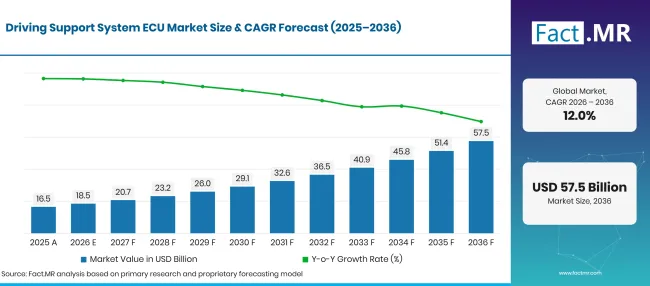
Driving Support System Ecu Market Forecast Global | Source: Fact.MR
| Year | Basis | Market Value (USD billion) |
|---|---|---|
| 2025 | Historical estimate | 16.5 |
| 2026 | Base-year estimate | 18.5 |
| 2036 | Forecast | 57.5 |
| CAGR 2026–2036 | Forecast growth | 12.0% |
Source: Fact.MR analysis. Updated Oct 27, 2026
What are the defining numbers behind Driving Support System ECU Market growth?
The market is expected to add USD 39.08 billion between 2026 and 2036.
Passenger cars account for the larger vehicle-volume opportunity, while original equipment programs remain the principal route to market. Adaptive cruise control offers a clear example of the ECU's commercial role: it joins radar or camera inputs to verified longitudinal control. Rules governing emergency braking and evolving consumer-assessment protocols also raise the engineering workload behind each platform. [1] [3]
- Demand Drivers in the Market
- Safety programs now evaluate whether automatic emergency braking reliably detects vehicles and pedestrians under more demanding test conditions. That raises demand for stable sensing-to-control interfaces, not merely another sensor fitted to the bumper. [3]
- Multi-function controllers can support lane centering, adaptive cruise control and emergency braking from common hardware. Consolidation is attractive where manufacturers can document isolation between safety-critical functions.
- New Euro NCAP 2026 assessment protocols place more scrutiny on real-world usability and assisted-driving behavior. Suppliers that can validate driver interaction alongside control logic improve their prospects in future vehicle programs. [1]
- Model-refresh cycles increasingly involve software changes and new sensors. ECU teams must maintain processor headroom and toolchains so a controller can be reused without repeating the entire integration exercise.
- Commercial-vehicle fleets are gradually widening their use of active safety packages, particularly where vehicle downtime, accident exposure and insurer requirements justify higher electronics content.
- Key Segments Analyzed
- By Vehicle Type: Passenger Cars represents 62.4% of the 2026 market. Passenger-car platforms combine large production runs with repeated feature upgrades.
- By Application: Adaptive Cruise Control represents 26.8% of the 2026 market. Adaptive cruise control has the highest individual application allocation.
- By Sales Channel: OEM represents 85.3% of the 2026 market. Design-in, calibration and warranty obligations favor the factory channel.
- Analyst Opinion at Fact.MR
- Shambhu Nath Jha, Sr. Consultant at Fact.MR says, “ECU sourcing decisions increasingly depend on repeatable safety performance and the cost of integrating each new vehicle platform. A processor with a larger specification offers limited value unless the manufacturer can demonstrate predictable software behavior across sensors, weather conditions and model variants. A supplier capable of carrying certification evidence from one vehicle platform to the next should have a stronger position than one competing chiefly on board price.”
- Strategic Implications
- ECU suppliers should maintain a traceable safety case for braking and steering outputs before proposing a consolidated compute platform.
- Automakers should evaluate the processor reserve required for sensor upgrades, rather than selecting controllers solely against today's feature set.
- Tier-one suppliers can reduce qualification delays by aligning silicon, embedded software and electromagnetic compatibility tests early in a program. Coordination with the automotive electronic manufacturing services market is important when board-production quality affects safety-critical controller yields.
- Replacement providers need access to verified calibration procedures; unsupported retrofits into safety-critical paths pose material warranty and liability risks.
How does the Driving Support System ECU Market break down by segment?
Three purchasing dimensions explain most of the revenue split: the vehicle receiving the controller, the assistance function to which revenue is assigned and the commercial channel.
Why do passenger cars dominate ECU installations?
Passenger Cars accounts for 62.4% of the Vehicle Type segment in 2026.
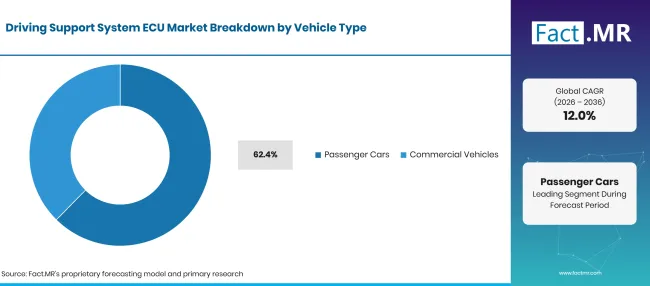
Driving Support System Ecu Market Breakdown Vehicle Type | Source: Fact.MR
| Vehicle Type | Share (2026) |
|---|---|
| Passenger Cars | 62.4% |
| Commercial Vehicles | 37.6% |
Source: Fact.MR analysis. Updated Oct 27, 2026
Passenger cars command 62.4% of 2026 revenue because assisted-driving packages have moved down from premium nameplates to higher-volume configurations. The benefit is not uniform across every vehicle: some low-cost models still combine functions in smaller controllers. Commercial-vehicle systems face a different procurement test. Fleet operators value robust braking assistance and consistent maintenance, but long duty cycles and model-specific electrical architectures can delay controller redesigns. The wider automotive radar sensor market is relevant here because radar capability affects ECU inputs while remaining a separate hardware category. [2]
Why does adaptive cruise control lead the application mix?
Adaptive Cruise Control accounts for 26.8% of the Application segment in 2026.
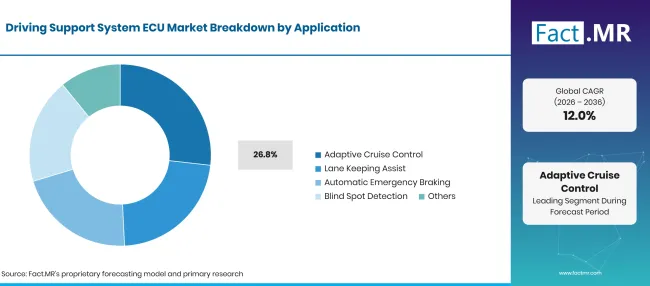
Driving Support System Ecu Market Breakdown Application | Source: Fact.MR
| Application | Share (2026) |
|---|---|
| Adaptive Cruise Control | 26.8% |
| Lane Keeping Assist | 24.4% |
| Automatic Emergency Braking | 23.7% |
| Blind Spot Detection | 17.3% |
| Others | 7.8% |
Source: Fact.MR analysis. Updated Oct 27, 2026
Adaptive cruise control represents 26.8% of 2026 ECU demand within the application split. It requires repeated distance and speed calculations and continuous coordination with vehicle controls. Lane keeping makes steering accuracy and camera alignment particularly important. Automatic emergency braking places greater weight on decision latency and robust operation in borderline situations. The growth of driver monitoring and in-cabin sensing also affects how assisted-driving functions hand control back to a human driver. These functions often share physical electronics, so application shares represent the principal assigned use rather than a separate controller for every feature. [3]
What keeps the OEM channel ahead of aftermarket sales?
OEM accounts for 85.3% of the Sales Channel segment in 2026.
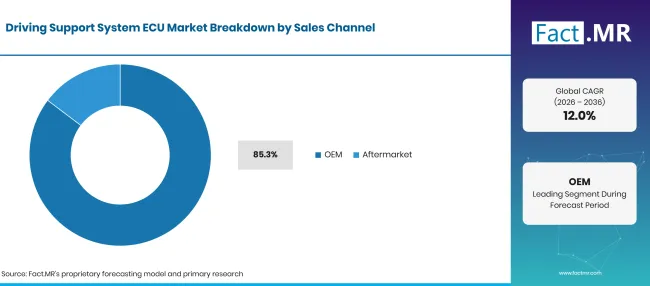
Driving Support System Ecu Market Breakdown Sales Channel | Source: Fact.MR
| Sales Channel | Share (2026) |
|---|---|
| OEM | 85.3% |
| Aftermarket | 14.7% |
Source: Fact.MR analysis. Updated Oct 27, 2026
The OEM channel accounts for 85.3% in 2026. A steering or braking ECU normally needs to be matched with a vehicle's sensors, cybersecurity provisions and diagnostic environment before type approval. Adding the controller later can be costly or technically impractical. Aftermarket revenue is concentrated in replacement, specialist integration and service-related demand. Controller software also depends on the vehicle's automotive operating-system architecture, which makes the initial design choice difficult to reverse. [4]
What is accelerating Driving Support System ECU Market adoption, and what is holding it back?
Engineering adoption has strong upside, but the forecast remains sensitive to validation capacity and supply-chain readiness. The figures below describe approximate sensitivity to individual market conditions, not summed contributions to the headline growth rate.
Drivers Impact Analysis
| DRIVER | (~) % IMPACT ON CAGR | GEOGRAPHIC RELEVANCE | IMPACT TIMELINE |
|---|---|---|---|
| Broader AEB inclusion in new vehicle programs | +1.2% | North America, Europe | 2026–2032 |
| Common compute architecture across model trims | +0.9% | Europe, East Asia | 2027–2035 |
| Assisted-driving feature uptake in passenger cars | +1.4% | Global OEMs | 2026–2036 |
| Fleet safety specification updates | +0.6% | USA, Brazil, Europe | 2028–2036 |
| Longer software support for ECU families | +0.7% | Japan, Germany, USA | 2027–2036 |
Source: Fact.MR analysis. Updated Oct 27, 2026
Opportunity Impact Analysis
| OPPORTUNITY | (~) % IMPACT ON CAGR | GEOGRAPHIC RELEVANCE | IMPACT TIMELINE |
|---|---|---|---|
| Scalable zonal controller integration | +1.1% | Germany, Japan, USA | 2028–2036 |
| Better validation of adverse-weather sensing | +0.8% | Europe, North America | 2027–2034 |
| Calibration services for multi-sensor ECUs | +0.5% | Global service hubs | 2026–2033 |
| Local supply qualification for new platforms | +0.6% | Brazil, Asia | 2027–2035 |
Source: Fact.MR analysis. Updated Oct 27, 2026
Restraints Impact Analysis
| RESTRAINT | (~) % IMPACT ON CAGR | GEOGRAPHIC RELEVANCE | IMPACT TIMELINE |
|---|---|---|---|
| Lengthy functional-safety sign-off | -0.9% | Global OEMs | 2026–2030 |
| Automotive-grade chip qualification delays | -0.7% | Japan, Germany, USA | 2026–2031 |
| Repair complexity and sensor recalibration cost | -0.5% | North America, Europe | 2027–2036 |
| Fragmented software stacks across models | -0.8% | Global | 2026–2036 |
Source: Fact.MR analysis. Updated Oct 27, 2026
Which countries are scaling the Driving Support System ECU Market through 2036?
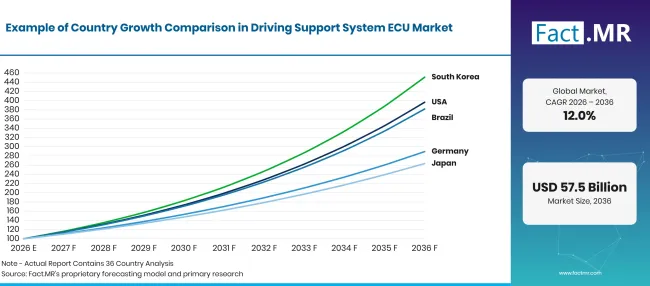
Driving Support System Ecu Market Growth Index | Source: Fact.MR
| Country | CAGR (2026–2036) |
|---|---|
| Germany | 11.21% |
| Brazil | 14.34% |
| United States | 14.77% |
| United Kingdom | 9.62% |
| Japan | 10.17% |
Source: Fact.MR analysis. Updated Oct 27, 2026
How is German vehicle engineering reshaping ECU demand?
11.21% CAGR through 2036. Safety validation and tightly integrated vehicle platforms define the buying cycle.
German manufacturers are tying assisted-driving controls to long vehicle-platform development programs. Euro NCAP's revised assessment framework places weight on usability and driver-assistance behavior, creating additional validation work for automakers selling across Europe. [1] The EU's phased general-safety requirements reinforce the commercial importance of robust braking and control functions. [2] Germany's 11.21% projected CAGR is supported by complex vehicle electronics programs, though lengthy release cycles tend to postpone revenue until platforms enter series production.
Why could Brazil post faster ECU growth from a smaller base?
14.34% CAGR through 2036. A wider fitment of safety functions creates room for ECU content gains.
Brazil's growth opportunity centers on moving assisted-driving features beyond relatively expensive passenger vehicles. Suppliers must adapt to platform economics, import content and a dealership repair environment that is less uniform than in mature premium segments. The 14.34% CAGR outlook reflects widening access to adaptive cruise and emergency-braking packages rather than a sudden shift to self-driving vehicles. Controllers designed for efficient calibration and reuse across trim levels are better matched to local programs.
What is giving the United States the strongest outlook in the comparison?
14.77% CAGR through 2036. Broader emergency-braking requirements and large vehicle volumes support investment.
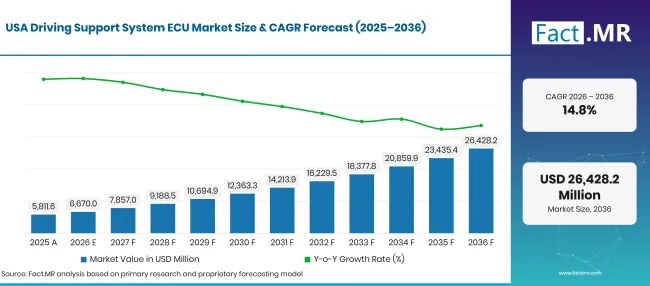
Driving Support System Ecu Market Forecast Usa | Source: Fact.MR
The US market is projected to grow at 14.77% as manufacturers expand active safety functions across passenger cars and light trucks. NHTSA's 2024 automatic emergency-braking rule established a firmer regulatory direction, although the compliance timetable and technical challenges affect individual launch plans. [3] Automakers also need to manage more sensors per vehicle without creating unacceptable service costs. ECU suppliers that provide documented diagnostic paths and consistent response times should benefit from this combination of scale and regulatory pressure.
How is the UK market being shaped by vehicle imports and service needs?
9.62% CAGR through 2036. A mixed vehicle fleet keeps attention on standards compatibility.
The United Kingdom's 9.62% growth forecast reflects a vehicle mix supplied by many international manufacturers. Demand is therefore closely connected to European platform decisions rather than exclusively domestic ECU engineering. Retailers and repair networks must handle calibrations after windscreen replacement and collision repairs, while OEMs keep safety software consistent across right-hand-drive variants. Controllers that are easy to diagnose and support can reduce downstream costs even when UK-specific production volumes are limited.
What explains Japan’s disciplined ECU expansion?
10.17% CAGR through 2036. Strong vehicle-electronics integration favors tested, reusable systems.
Japanese automakers tend to roll out assisted-driving changes through carefully validated platforms. The market's 10.17% CAGR outlook reflects wider function availability alongside conservative release management for braking and steering control. Semiconductor qualification, redundancy and supplier continuity matter to manufacturers seeking a stable service life. This environment creates demand for controllers that can incorporate next-generation sensors without disrupting existing manufacturing and diagnostic processes.
Who shapes the Driving Support System ECU Market?
Bosch, Continental, Denso, ZF and Aptiv operate across the controller, sensing and systems-integration layers. Mobileye, Magna, Valeo and Hyundai Mobis also participate in driving-assistance programs with different combinations of software, perception and vehicle electronics. The relevant competitive question is which responsibilities a supplier can validate and maintain across an entire vehicle architecture, not how many chips appear on its product sheet.
An ECU contract can tie up software maintenance, electronic manufacturing and test engineering for several model years. Automakers increasingly examine continuity of component supply alongside functional safety and cyber-resilience. Board assembly and qualification are important, but assembly capacity alone is insufficient for control-system design ownership. Competition therefore turns on approved platforms, release quality and long-term service capability.
Which companies are the key providers?
- Robert Bosch GmbH
- Continental AG
- DENSO Corporation
- ZF Friedrichshafen AG
- Aptiv PLC
- Magna International Inc.
- Mobileye Global Inc.
- Valeo SA
- Hyundai Mobis Co., Ltd.
What is the report’s scope and coverage?
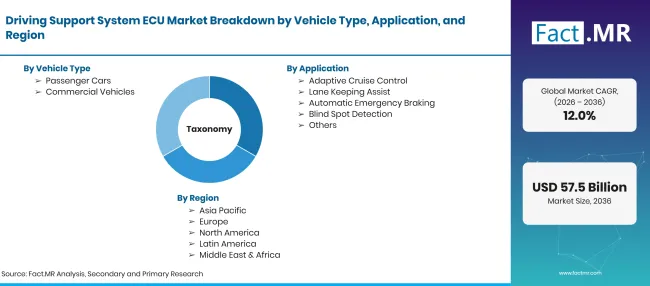
Driving Support System Ecu Market Taxonomy | Source: Fact.MR
| Attribute | Details |
|---|---|
| Study title | Driving Support System ECU Market |
| Base year | 2026 |
| Historical reference | 2025 |
| Forecast period | 2026–2036 |
| Base market value | USD 18.46 billion |
| Forecast market value | USD 57.54 billion |
| Forecast CAGR | 12.0% |
| Segment dimensions | Vehicle Type, Application, Sales Channel |
| Country analysis | Germany, Brazil, United States, United Kingdom, Japan |
| Regional coverage | North America, Latin America, Western Europe, Eastern Europe, East Asia, South Asia & Pacific, Middle East & Africa |
Source: Fact.MR analysis. Updated Oct 27, 2026
How is the market segmented?
-
By Vehicle Type
- Passenger Cars
- Commercial Vehicles
-
By Application
- Adaptive Cruise Control
- Lane Keeping Assist
- Automatic Emergency Braking
- Blind Spot Detection
- Others
-
By Sales Channel
- OEM
- Aftermarket
-
By Region
- North America
- Latin America
- Western Europe
- Eastern Europe
- East Asia
- South Asia & Pacific
- Middle East & Africa
Bibliography
- [1] Euro NCAP. (2025, November 26). Euro NCAP announces 2026 protocol changes to tackle modern driving risks.
- [2] European Commission. (2026, July 8). Safer cars, safer roads: New rules take effect.
- [3] National Highway Traffic Safety Administration. (2024, April 29). NHTSA finalizes rule on automatic emergency braking.
- [4] United Nations Economic Commission for Europe. (2024, October 4). New UN regulation paves way for deployment of driving assistance systems.
This Report Answers
- How large are global driving support ECU sales in 2025, 2026 and 2036?
- What is the 2026–2036 market CAGR?
- Which driving-assistance applications generate the largest 2026 allocations?
- How do passenger-car and commercial-vehicle ECU budgets differ?
- Which countries have faster forecast growth, and why?
- Which regulatory, validation and service costs shape supplier selection?
What does the Driving Support System ECU Market cover?
The study values the vehicle-mounted electronic control units principally assigned to driving-assistance functions. It examines the design-in channel, the balance of passenger and commercial vehicles, and applications including adaptive cruise control, lane keeping, emergency braking and blind spot support. Revenue and growth expectations relate to ECU systems and associated qualifying content, not the value of autonomous vehicles as a whole.
What is included in the scope?
Original equipment ECU revenue, relevant replacement-controller sales, passenger and commercial vehicles, listed assistance applications, supplier ecosystems, and the five-country forecast comparison. The regional view covers global programs regardless of where the vehicle is finally sold.
What is excluded from the scope?
Standalone cameras, radar and lidar sold separately; infotainment processors; general powertrain controllers; fully autonomous driving service revenue; and sales of complete vehicles. Those adjacent categories inform demand but are not added to the ECU market value.
How Was the Analysis Built?
The analysis draws on 120+ sources, 35+ company portfolios, 25+ countries, and more than 20 industry interviews.
- Primary Research: Primary research includes discussions with manufacturers, service providers, technology developers, distributors, end users, and subject-matter experts. These conversations examine purchasing priorities, product adoption, operational challenges, approval requirements, competitive positioning, and the factors that influence wider market acceptance.
- Desk Research: Desk research covers government statistics, regulatory publications, company filings, trade data, technical studies, industry associations, standards, public policy, and other authoritative sources. Every source used in the analysis is documented in the bibliography.
- Market Sizing and Forecasting: Market estimates combine historical performance, demand indicators, pricing and volume trends, segment shares, company participation, country-level growth, adoption patterns, investment activity, and barriers to market expansion.
- Data Validation and Update Cycle: Findings are validated by comparing primary interviews with public data, company activity, regulatory changes, trade patterns, and industry developments. Regular updates review new product launches, capacity changes, partnerships, approvals, and shifts in commercial adoption.
Frequently Asked Questions
How big is the driving support system ECU market in 2026?
What value is forecast for 2036?
What is the CAGR for 2026–2036?
Which vehicle type has the largest share?
Which application leads?
What share is sold through OEMs?
Who worked on this report


Preview the report firsthand - request a free sample
Free SampleGet the brochure for pricing and purchase details
Download PDF