- Market Value (2025): USD 38.5 Bn
- Estimated Value (2026): USD 40.6 Bn
- Forecast Value (2036): USD 69.9 Bn
- CAGR (2026-2036): 5.6%
What is the VVT and Start-Stop Systems Market forecast to be worth by 2036?
USD 40.6 billion in 2026 to USD 69.9 billion by 2036 at a 5.6% CAGR.
- In 2025, the VVT and start-stop systems market was worth USD 38.5 billion, with factory-fitted units on new engines accounting for most of that revenue.
- By 2036 the market will reach USD 69.9 billion, up from USD 40.6 billion in 2026, as hybrid engines and fleet efficiency rules keep both technologies on new engine programs.
- A 5.6% CAGR will hold from 2026 to 2036, since mild-hybrid and full-hybrid engines need faster cam phasers and stronger restart hardware than older engines.
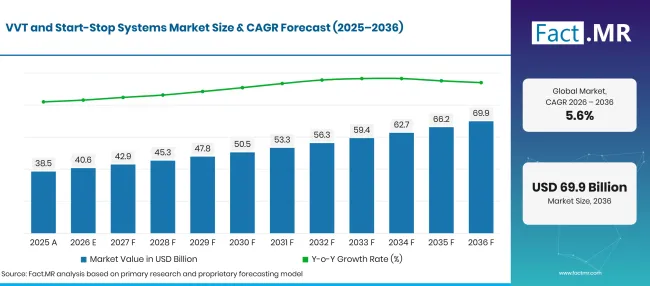
Vvt And Start Stop Systems Market Forecast Global | Source: Fact.MR
| Year | Basis | Market Value (USD billion) |
|---|---|---|
| 2025 | Actual | 38.5 |
| 2026 | Estimate | 40.6 |
| 2036 | Forecast | 69.9 |
| CAGR 2026 to 2036 | Forecast period | 5.6% |
Source: Fact.MR analysis. Updated Oct 26, 2026
What are the defining numbers behind VVT and Start-Stop Systems Market growth?
Between 2026 and 2036, the market will gain USD 29.3 billion in new value, led by hybrid and commercial vehicle engine programs.
- Demand Drivers in the Market
- Hybrid engines are the main pull on valve timing and restart hardware. Eurostat counted 3.62 million new non-plug-in hybrid cars registered in the EU in 2025, up 13.4%, with plug-in hybrids at 1.03 million [1]. Every one of these engines shuts down and restarts many times per trip, so cam phasers and starters face heavier duty cycles.
- Supplier contracts confirm that combustion engine work continues. In February 2025, BorgWarner said it would supply variable cam timing for a major East Asian automaker’s latest hybrid and gasoline engines, with production from the first quarter of 2026 [2].
- European policy now leaves room for efficient engines after 2035. The European Commission’s automotive package of December 2025 sets a 90% tailpipe emission reduction target for new cars from 2035, with the remaining 10% to be offset through EU-made low-carbon steel, e-fuels or biofuels [3]. Plug-in hybrids and range extenders built under this target will still carry valve timing control.
- Trucks, buses and delivery vans spend long periods idling in traffic and at depots. Fleet operators fit start-stop and cylinder deactivation to save diesel on these idle-heavy routes, and engine makers add variable valve actuation to manage exhaust temperatures for after-treatment.
- Older cars and vans keep the replacement channel active. Starters, phaser solenoids and timing actuators wear out after many restart cycles, and independent workshops replace them once warranties expire.
- Key Segments Analyzed
- By Technology: Start-Stop Systems will hold 42.5% share in 2026, given that the hardware cuts idle fuel use in city traffic without a high-voltage system.
- By Vehicle Type: Commercial Vehicles will account for 54.8% share in 2026, as trucks and buses carry more valve actuation and restart content per engine.
- By Fuel Type: Gasoline will capture 58.9% share in 2026, since most hybrid engines are built around a gasoline cycle.
- By End-User: OEMs will command 59.3% share in 2026 through fitment contracts signed during engine development.
- Analyst Opinion at Fact.MR
- Shambhu Nath Jha, Principal Consultant at Fact.MR, states, “Carmakers now judge cam phasers and start-stop hardware on how well they cope with frequent hybrid restarts, not only on unit price. Commercial vehicle engines carry the heaviest content, because fleet owners pay for every liter saved at idle. Suppliers that design for 48V and hybrid duty cycles will win the engine programs that launch through 2036.”
- Strategic Implications
- Valve timing suppliers should qualify electric and torsional-assist cam phasers for hybrid engines, given that these engines restart far more often than conventional ones.
- Truck and bus engine makers should pair cylinder deactivation with start-stop to lower idle fuel burn and keep after-treatment warm on urban routes.
- Aftermarket distributors should stock phaser solenoids and heavy-duty starters for vehicles leaving warranty, since replacement cycles follow restart counts.
- Component makers exposed to tariffs should spread precision machining for phasers and starters across more than one country to protect margins.
At 6.8%, the United States heads the group, where hybrids are gaining share of light-duty sales and stop/start already appears on most gasoline vehicles. Germany follows at 6.4%, with hybrid registrations growing under EU emission rules. Japan records 6.0% as automakers keep refreshing hybrid engines. Brazil expands at 4.9%, helped by new federal efficiency ceilings. Last comes the United Kingdom at 4.3%, as zero emission cars take a larger slice of new registrations.
How does the VVT and Start-Stop Systems Market break down by segment?
Start-Stop Systems will lead Technology at 42.5%; Commercial Vehicles will head Vehicle Type at 54.8%; Gasoline will top Fuel Type at 58.9%; OEMs will hold first place in End-User at 59.3%.
Where does Technology demand concentrate?
Start-Stop Systems take 42.5% of 2026 revenue.
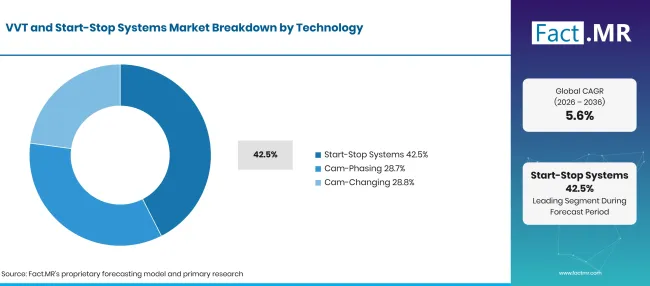
Vvt And Start Stop Systems Market Breakdown Technology | Source: Fact.MR
| Technology | Share (2026) |
|---|---|
| Start-Stop Systems (Leading segment) | 42.5% |
| Other segments combined | 57.5%* |
| Total | 100.0% |
Source: Fact.MR analysis. Updated Oct 26, 2026
Automakers can add engine shutdown at idle with an upgraded starter, a stronger battery and control software, so no engine redesign is needed. That low entry cost lets them fit the feature on entry models as well as premium ones. Cam-phasing units, often driven by an engine electronic control system, follow in volume. In the United States, gasoline engines with stop/start accounted for 57.6% of model year 2024 vehicle production, according to the EPA [4]. Cam-changing systems serve a narrower set of performance and diesel engines, where switching cam profiles improves low-speed torque.
What leads the Vehicle Type segment?
Commercial Vehicles represent 54.8% of 2026 sales.
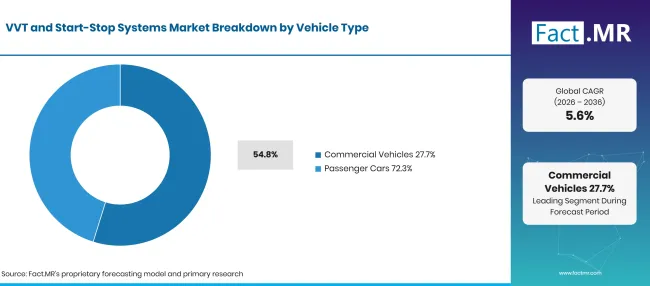
Vvt And Start Stop Systems Market Breakdown Vehicle Type | Source: Fact.MR
| Vehicle Type | Share (2026) |
|---|---|
| Commercial Vehicles (Leading segment) | 54.8% |
| Other segments combined | 45.2%* |
| Total | 100.0% |
Source: Fact.MR analysis. Updated Oct 26, 2026
Heavy trucks and city buses run engines for long hours, often at idle, so each saved liter adds up quickly for fleet owners. A single heavy-duty engine can carry variable valve actuation and cylinder deactivation alongside a heavy-duty starter and its own control module. That content lifts revenue per vehicle well above a car. Passenger cars supply far greater unit volume, but content per vehicle is lower. Carmakers fit start-stop and cam phasers across most new models, and the automotive engine valve base in cars keeps cam-phasing demand broad.
How does Fuel Type shape demand?
Gasoline accounts for 58.9% of 2026 demand.
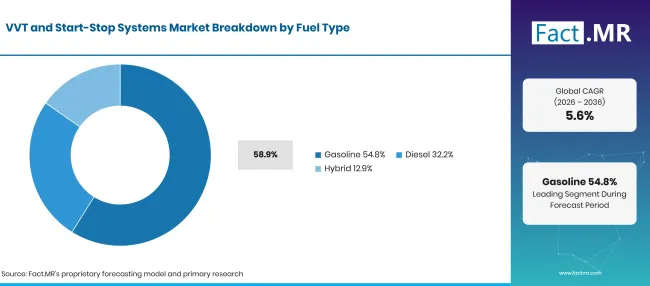
Vvt And Start Stop Systems Market Breakdown Fuel Type | Source: Fact.MR
| Fuel Type | Share (2026) |
|---|---|
| Gasoline (Leading segment) | 58.9% |
| Other segments combined | 41.1%* |
| Total | 100.0% |
Source: Fact.MR analysis. Updated Oct 26, 2026
Most full and mild hybrid engines run on a gasoline cycle, and they rely on wide cam phasing to switch between efficient and high-power modes. Turbocharged gasoline engines, often paired with an automotive turbocharger, need variable timing to limit turbo lag. Pure petrol volumes are shrinking in Europe, where Eurostat recorded 2.98 million new petrol cars in 2025, down 18.4% [1]. Diesel stays central to trucks and buses. Hybrid-specific hardware adds content per engine, since starter-generators and electric phasers cost more than conventional parts.
What supports OEMs within End-User?
OEMs take 59.3% of 2026 revenue.
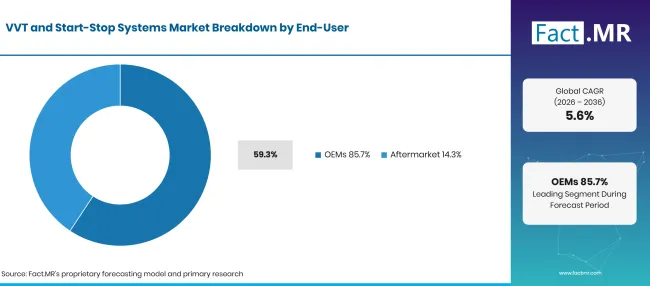
Vvt And Start Stop Systems Market Breakdown End User | Source: Fact.MR
| End-User | Share (2026) |
|---|---|
| OEMs (Leading segment) | 59.3% |
| Other segments combined | 40.7%* |
| Total | 100.0% |
Source: Fact.MR analysis. Updated Oct 26, 2026
Automakers lock in valve timing and restart hardware while an engine is still on the test bench, and contracts often run for the whole life of an engine family. Tier 1 suppliers work with engine teams on calibration, so changing supplier mid-program is rare. The aftermarket serves vehicles that have left warranty. Workshops replace phaser solenoids, timing actuators and heavy-duty starters, and the alternator and starter motor channel gives distributors a ready route to these buyers.
What is accelerating VVT and Start-Stop Systems Market adoption, and what is holding it back?
Hybrid engine programs, idle-heavy truck fleets and fuel efficiency rules keep valve timing and restart hardware in demand. Expansion is limited by the shift of some buyers to battery-electric cars, which carry neither technology, and by tariffs on precision components.
Drivers Impact Analysis
| DRIVER | (~) % IMPACT ON CAGR | GEOGRAPHIC RELEVANCE | IMPACT TIMELINE |
|---|---|---|---|
| Hybrid engines fitted with fast cam phasers and restart hardware | +1.5% | Global | Short term (<= 2 years) |
| Fuel economy and CO2 rules that keep efficient combustion engines in production | +1.2% | North America, Western Europe, Latin America | Medium term (2-4 years) |
| Idle reduction in trucks, buses and delivery fleets | +0.9% | North America, Western Europe, East Asia | Medium term (2-4 years) |
| Replacement of worn starters and phaser parts in older fleets | +0.6% | North America, Western Europe | Long term (>= 4 years) |
Source: Fact.MR analysis. Updated Oct 26, 2026
Opportunity Impact Analysis
| OPPORTUNITY | (~) % IMPACT ON CAGR | GEOGRAPHIC RELEVANCE | IMPACT TIMELINE |
|---|---|---|---|
| 48V belt starter-generators combined with advanced cam phasing | +0.9% | Global | Medium term (2-4 years) |
| Cylinder deactivation and variable valve actuation for heavy-duty diesel engines | +0.7% | North America, Western Europe | Medium term (2-4 years) |
| Electric cam phasers for hybrid-dedicated engines | +0.5% | East Asia | Long term (>= 4 years) |
Source: Fact.MR analysis. Updated Oct 26, 2026
Restraints Impact Analysis
| RESTRAINT | (~) % IMPACT ON CAGR | GEOGRAPHIC RELEVANCE | IMPACT TIMELINE |
|---|---|---|---|
| Growth of battery-electric cars that need no valve timing or engine restart | -0.8% | Western Europe, East Asia | Medium term (2-4 years) |
| Starter and battery wear concerns from frequent restarts | -0.4% | Global | Short term (<= 2 years) |
| Tariffs and trade disruption raising component costs | -0.3% | North America | Short term (<= 2 years) |
Source: Fact.MR analysis. Updated Oct 26, 2026
Which countries are scaling the VVT and Start-Stop Systems Market through 2036?
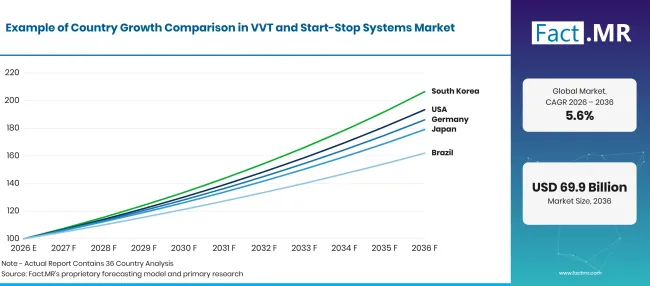
Vvt And Start Stop Systems Market Growth Index | Source: Fact.MR
| Country | CAGR (2026 to 2036) |
|---|---|
| United States | 6.8% |
| Germany | 6.4% |
| Japan | 6.0% |
| Brazil | 4.9% |
| United Kingdom | 4.3% |
Source: Fact.MR analysis. Updated Oct 26, 2026
What supports United States adoption?
6.8% CAGR, driven by rising hybrid sales and near-standard stop/start on gasoline vehicles.
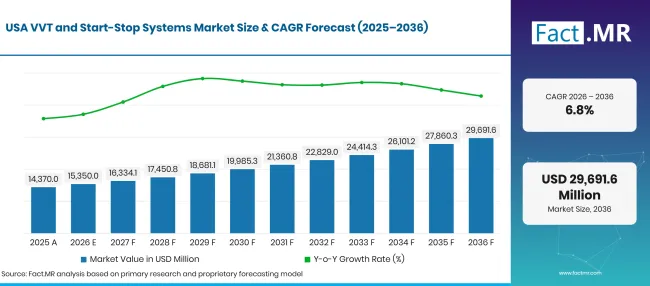
Vvt And Start Stop Systems Market Forecast Usa | Source: Fact.MR
The U.S. Energy Information Administration reported that hybrids reached a record 16% of light-duty vehicle sales between the second quarter of 2025 and the second quarter of 2026 [5]. EPA data show mild hybrids at 5.3% and strong hybrids at 9.5% of model year 2024 production [4]. Pickup and SUV engines also carry cylinder deactivation and wide cam phasing to meet federal fuel economy rules.
How is Germany developing demand?
6.4% CAGR, backed by hybrid registrations that keep growing under EU rules.
The Kraftfahrt-Bundesamt reported 1,127,509 new hybrid vehicles in 2025, up 19.0% and equal to 39.5% of registrations [6]. Plug-in hybrids accounted for 311,398 of them. New petrol registrations fell 21.6% to a 27.2% share [6]. That shift moves valve timing content from plain petrol engines into hybrid engines that need faster phasers and stronger restart parts.
What is supporting Japan’s adoption?
6.0% CAGR, helped by hybrid engines that keep combustion hardware in demand.
The International Energy Agency reported that electric cars accounted for less than 3% of sales in Japan in 2025 [7]. With so few battery-electric cars, domestic automakers keep investing in new hybrid engines. Local suppliers such as Aisin, Denso and Astemo build cam phasers, control solenoids and starters close to these engine plants.
How is Brazil scaling demand?
4.9% CAGR, as federal efficiency ceilings push automakers toward cleaner engines.
Decree 12,435 of April 2025 regulates Brazil’s Mover program and requires light vehicle makers to meet a new energy consumption ceiling by October 1, 2027 [8]. Electric car sales in Brazil reached 9% of new car sales in 2025, according to the IEA [7]. Most of the fleet still runs on flex-fuel engines, which gain from cam phasing when switching between ethanol and gasoline.
How does the United Kingdom perform?
4.3% CAGR, tempered by a rising zero emission share of new cars.
The Department for Transport reported that new petrol car registrations fell 19% to 610,000 in 2025 [9]. Zero emission cars accounted for 23% of new car registrations, compared with 19% in 2024 [9]. Hybrids and mild hybrids still fill much of the remaining market, so start-stop and cam phasing continue on most combustion models.
Who leads the VVT and Start-Stop Systems Market?
Three groups shape supply. Valve timing specialists such as BorgWarner, Schaeffler and Aisin compete on phaser response speed and durability under hybrid restart cycles.
BorgWarner won a torsional-assist variable cam timing award for a Japanese automaker’s next-generation hybrid engine in May 2026, with production from 2028 [10]. In August 2026, it added cam torque actuated programs for a European premium V6 family and a high-volume Chinese 1.5-liter turbo gasoline engine [11]. Japanese system makers Denso, Astemo and Mitsubishi Electric pair valve timing controls or starters with engine electronics. Electrification suppliers such as Valeo sell 48V hardware; in June 2026, Valeo launched a 48V two-speed eAxle that adds electric rear drive to Dacia mild-hybrid models [12]. Eaton serves heavy-duty engines with valve actuation and cylinder deactivation. Winning hybrid engine programs early, and supporting them across their full production life, will separate the stronger suppliers.
Which companies are the key providers?
Key companies include BorgWarner Inc.; Schaeffler AG; AISIN Corporation; DENSO Corporation; Astemo, Ltd.; Mitsubishi Electric Corporation; Valeo SE; and Eaton Corporation plc.
- BorgWarner Inc.
- Schaeffler AG
- AISIN Corporation
- DENSO Corporation
- Astemo, Ltd.
- Mitsubishi Electric Corporation
- Valeo SE
- Eaton Corporation plc
Bibliography
- [1] Eurostat. (2026, July 31). New battery-only electric cars up 30% in 2025.
- [2] BorgWarner. (2025, February 6). BorgWarner Supplies Variable Cam Timing Technology for Major East Asian OEM’s Hybrid and Gasoline Engines.
- [3] European Commission, TRIMIS. (2025, December 24). Automotive package.
- [4] U.S. Environmental Protection Agency. (2026, February). The 2025 EPA Automotive Trends Report: Greenhouse Gas Emissions, Fuel Economy, and Technology since 1975.
- [5] U.S. Energy Information Administration. (2026, July 27). Hybrid sales rise while battery electric sales remain lower after tax credit expiration.
- [6] Kraftfahrt-Bundesamt. (2026, January 6). Fahrzeugzulassungen im Dezember 2025: Jahresbilanz [Vehicle registrations in December 2025: Annual review].
- [7] International Energy Agency. (2026, May 20). Global EV Outlook 2026: Trends in electric cars.
- [8] Presidência da República, Brazil. (2025, April 15). Decreto nº 12.435, de 15 de abril de 2025 [Decree No. 12,435 of April 15, 2025].
- [9] Department for Transport. (2026, April 29). Vehicle licensing statistics, United Kingdom: 2025.
- [10] BorgWarner. (2026, May 6). BorgWarner Wins Two Conquest Awards in Asia for Combustion and Hybrid Powertrain Programs.
- [11] BorgWarner. (2026, August 5). BorgWarner Secures New Variable Cam Timing Program Awards in Europe and China.
- [12] Valeo. (2026, June 17). Valeo Accelerates the Energy Transition with First 48V 2-Speed eAxle for Dacia Duster, Bigster & Striker.
This Report Answers
- How revenue splits by technology, vehicle type, fuel type and end-user from 2026 to 2036.
- Why start-stop systems, commercial vehicles, gasoline engines and OEM fitment hold the top position in each segment.
- What separates growth in the United States, Germany, Japan, Brazil and the United Kingdom.
- Which suppliers win hybrid engine programs, and on what basis.
- Where 48V hardware, electric phasers and heavy-duty valve actuation will open new revenue.
What does the VVT and Start-Stop Systems Market cover?
This market brings together two families of engine efficiency hardware. The first varies valve timing through cam-phasing or cam-changing; the second stops the engine at idle and restarts it on demand.
Revenue is tracked for passenger cars and commercial vehicles with gasoline, diesel and hybrid engines. Sales are measured at the point of sale to the automaker or to the aftermarket buyer.
What is included in the scope?
Complete start-stop, cam-phasing and cam-changing systems are counted. Their phasers, solenoids and actuators are included, as are enhanced starters and control modules. Batteries count only when sold as part of a start-stop system.
Belt starter-generators used in 48V mild-hybrid systems are included when they perform the engine restart function. Replacement units sold through workshops and parts distributors are also counted.
What is excluded from the scope?
Fixed-timing valvetrains, standard starters and batteries in vehicles without start-stop are left out. Turbochargers, fuel injection and lubricants are also outside the market.
Battery-electric powertrains are excluded, as are traction motors and battery packs in hybrid electric vehicles; only the engine-side valve timing and restart hardware in those vehicles is counted.
How Was the Analysis Built?
The analysis draws on 120+ sources, 35+ company portfolios, 25+ countries, and more than 20 industry interviews.
- Primary Research: Primary research includes discussions with manufacturers, service providers, technology developers, distributors, end users, and subject-matter experts. These conversations examine purchasing priorities, product adoption, operational challenges, approval requirements, competitive positioning, and the factors that influence wider market acceptance.
- Desk Research: Desk research covers government statistics, regulatory publications, company filings, trade data, technical studies, industry associations, standards, public policy, and other authoritative sources. Every source used in the analysis is documented in the bibliography.
- Market Sizing and Forecasting: Market estimates combine historical performance, demand indicators, pricing and volume trends, segment shares, company participation, country-level growth, adoption patterns, investment activity, and barriers to market expansion.
- Data Validation and Update Cycle: Findings are validated by comparing primary interviews with public data, company activity, regulatory changes, trade patterns, and industry developments. Regular updates review new product launches, capacity changes, partnerships, approvals, and shifts in commercial adoption.
Segmentation
What is the report’s scope and coverage?
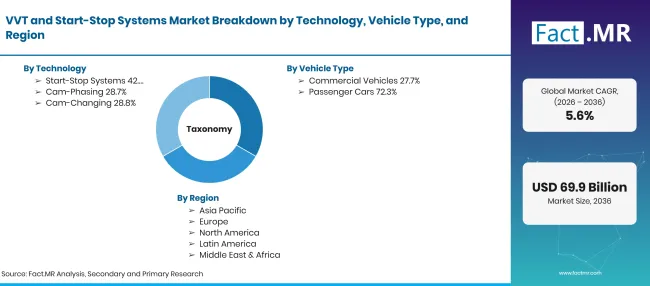
Vvt And Start Stop Systems Market Taxonomy | Source: Fact.MR
| Attribute | Details |
|---|---|
| Quantitative Units | USD billion in 2026 to USD billion by 2036 at CAGR |
| Market Definition | Engine technologies that vary valve timing or automatically stop and restart the engine at idle, including start-stop, cam-phasing and cam-changing systems. Revenue covers sales to vehicle makers and the aftermarket for passenger cars and commercial vehicles. |
| Technology | Start-Stop Systems; Cam-Phasing; Cam-Changing |
| Vehicle Type | Commercial Vehicles; Passenger Cars |
| Fuel Type | Gasoline; Diesel; Hybrid |
| End-User | OEMs; Aftermarket |
| Regions Covered | North America; Latin America; Western Europe; Eastern Europe; East Asia; South Asia & Pacific; Middle East & Africa |
| Countries Covered | United States; Germany; Japan; Brazil; United Kingdom |
| Companies Profiled | BorgWarner Inc.; Schaeffler AG; AISIN Corporation; DENSO Corporation; Astemo, Ltd.; Mitsubishi Electric Corporation; Valeo SE; Eaton Corporation plc |
| Forecast Period | 2026 to 2036 |
| Approach | Top-down and bottom-up estimate using vehicle and engine production; content value per engine by technology; OEM and aftermarket channel split; fuel and vehicle mix by country; and supplier program review. |
Source: Fact.MR analysis. Updated Oct 26, 2026
How is the market segmented?
-
By Technology
- Start-Stop Systems
- Cam-Phasing
- Cam-Changing
-
By Vehicle Type
- Commercial Vehicles
- Passenger Cars
-
By Fuel Type
- Gasoline
- Diesel
- Hybrid
-
By End-User
- OEMs
- Aftermarket
-
By Region
- North America
- Latin America
- Western Europe
- Eastern Europe
- East Asia
- South Asia & Pacific
- Middle East & Africa
Frequently Asked Questions
How big is the VVT and start-stop systems market in 2026?
What is the CAGR of the VVT and start-stop systems market from 2026 to 2036?
Which technology leads the VVT and start-stop systems market?
Which vehicle type leads the VVT and start-stop systems market?
Which fuel type leads the VVT and start-stop systems market?
Which end-user leads the VVT and start-stop systems market?
Which country will grow the most in the VVT and start-stop systems market?
Who are the main companies in the VVT and start-stop systems market?
Who worked on this report


Preview the report firsthand - request a free sample
Free SampleGet the brochure for pricing and purchase details
Download PDF